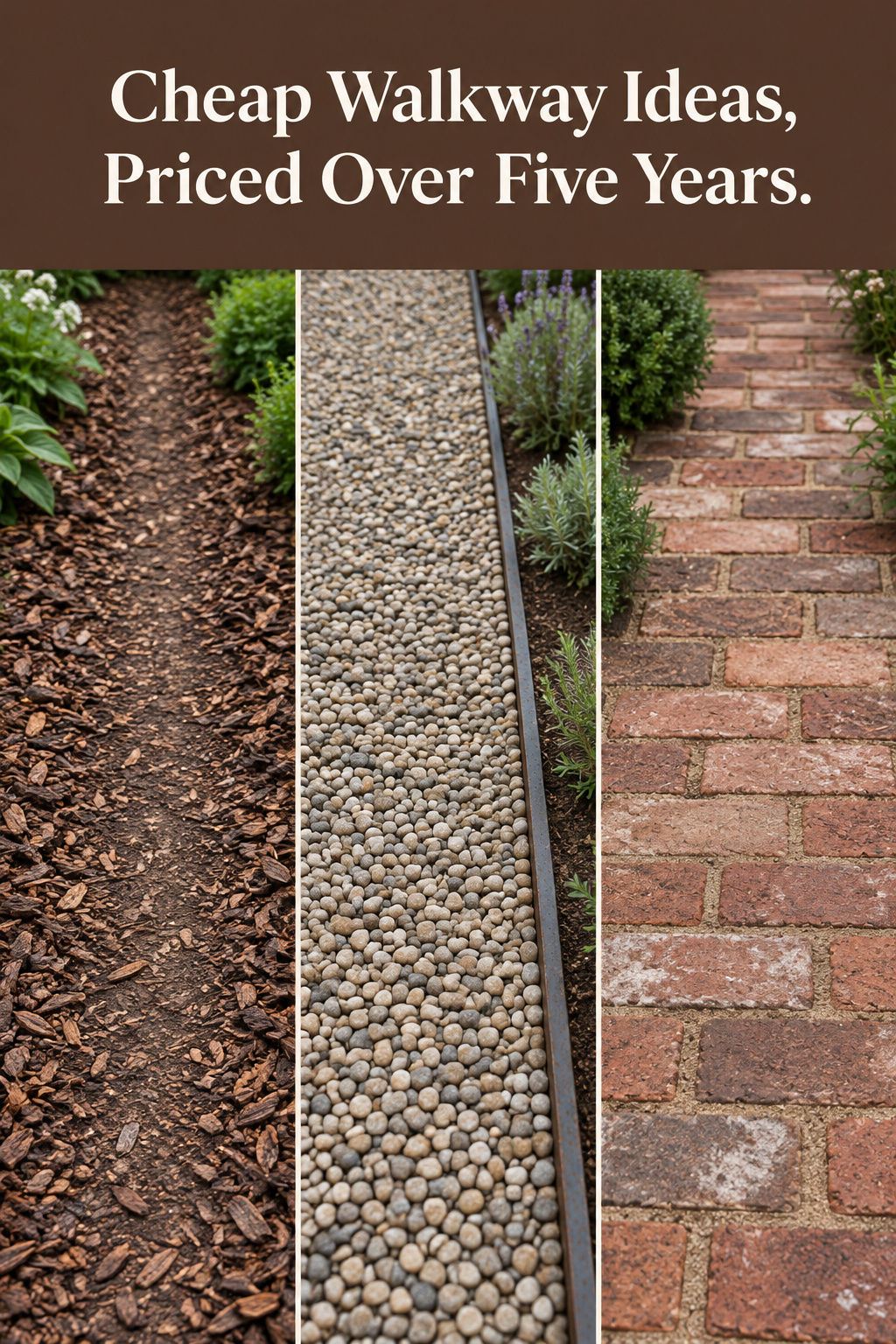
You’ve done the sum already. Thirty feet of path, three feet wide, three inches of bark. That’s 13 bags at about $4.88 each, so $63 and a Saturday. Most lists of cheap walkway ideas say bark wins.
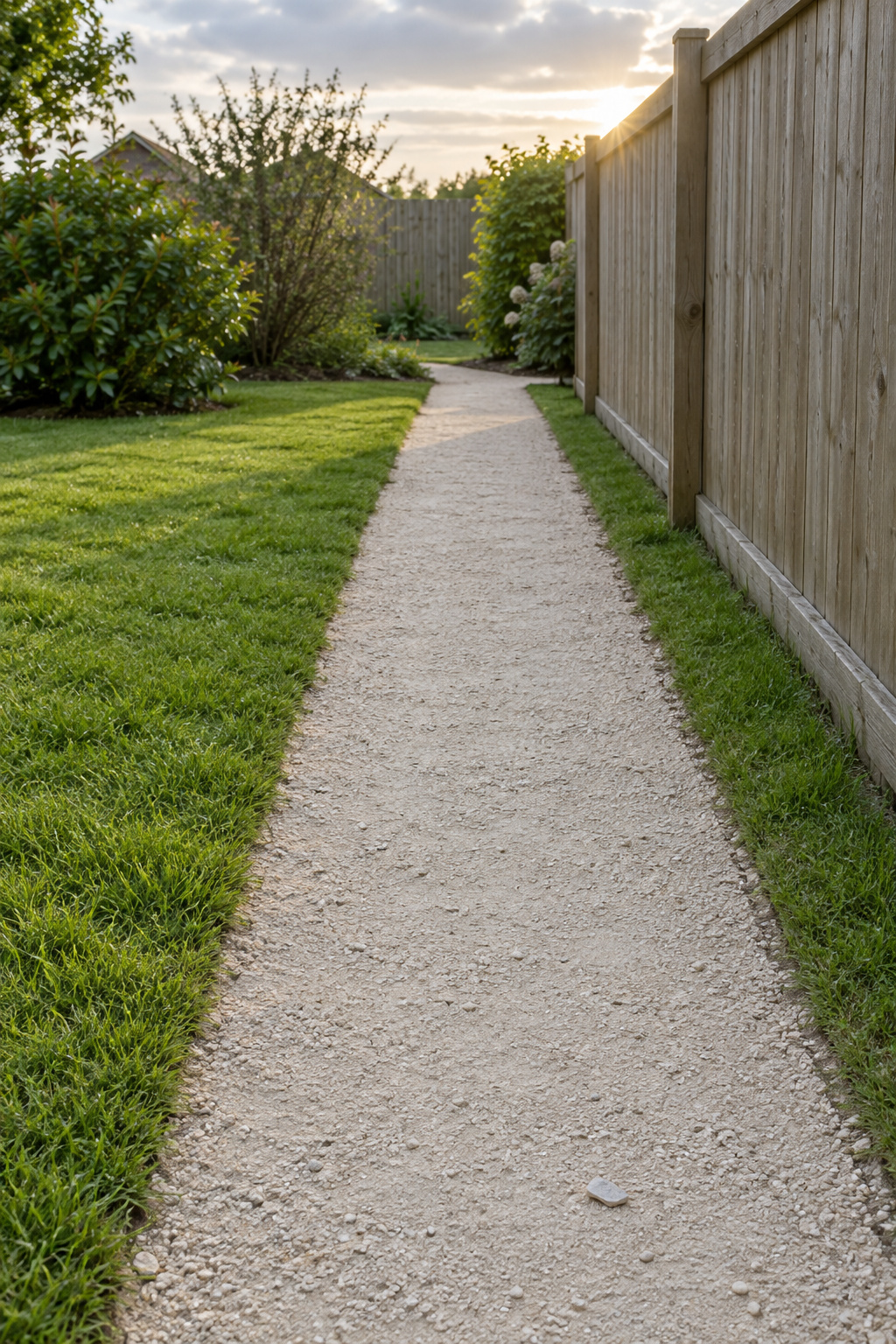
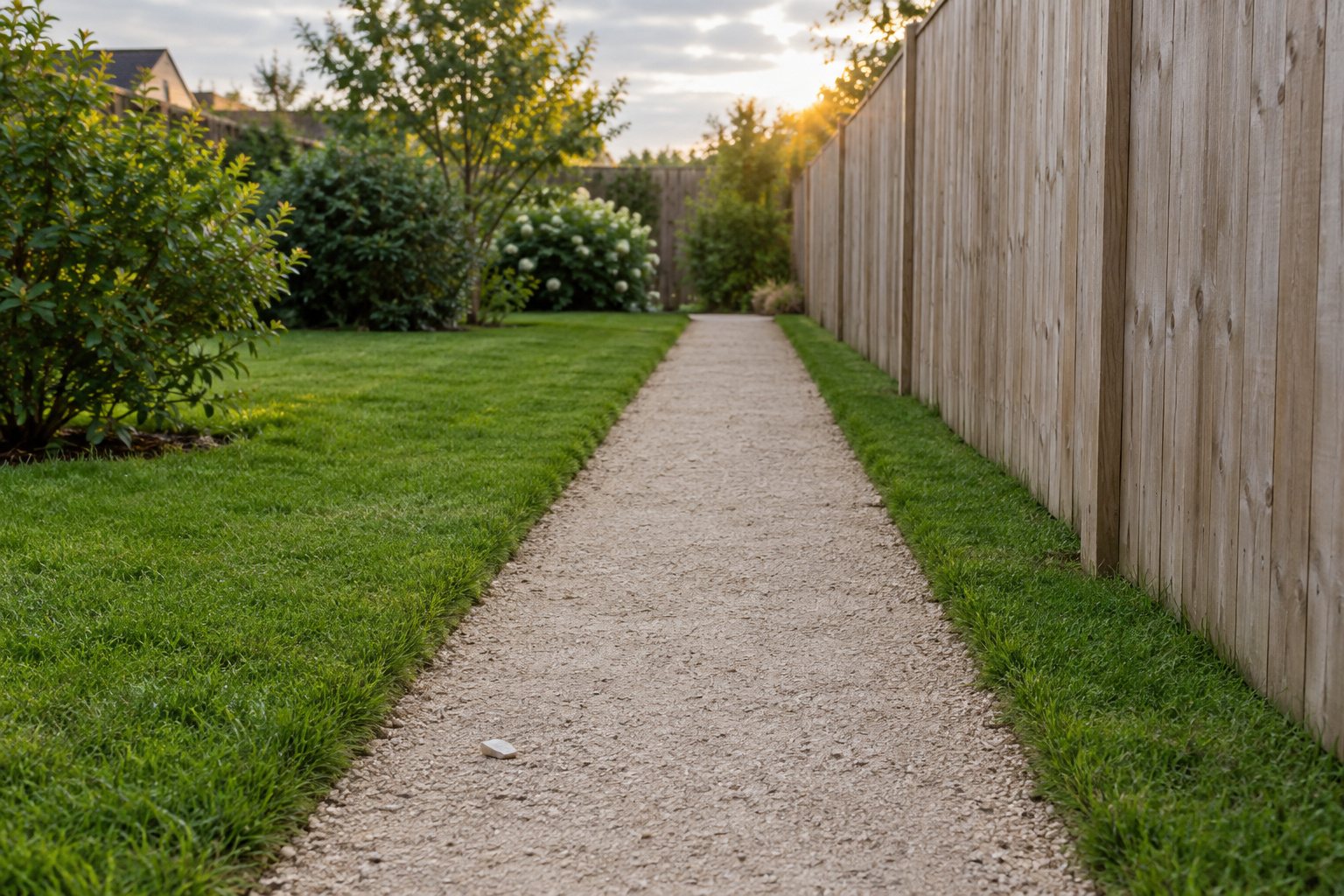
Then the bark wanders into the lawn, so you add plastic edging down both sides: $135, twice what the bark cost. Next spring the path has thinned and you buy more. By year five your $63 path has cost $283. Those lists price the surface and leave out the edging, the base and the top-ups, which on a narrow path are most of the money.
TL;DR
- On a 3 ft path, concrete stepping stones cost about $5.66 a foot and never need topping up, which makes them cheaper than edged bark ($6.51 a foot) from day one.
- Steel edging is about three quarters of what a pea gravel path costs to lay ($16.00 of $20.79 a foot), and even on the same plastic edging as bark, loose gravel only catches up at the start of year seven.
- For a route that takes a barrow every day, compacted decomposed granite is cheapest for five years ($680 for 30 ft), and new pavers ($692) pull ahead from year seven.
Cheap walkway ideas for a 3-foot path, priced per foot
I’m fixing up a 1970s ranch house outside Knoxville one room at a time, so I price everything for day one and for year five. Here is that for a path 3 ft wide, with the base, edging and top-ups each surface needs, and the extra 10% I always buy built into the bark, loose stone, stepping stones, pavers and brick. These are materials only (poured concrete is a contractor’s installed price), and prices move a lot by region and store, so treat them as mid-range planning numbers.
| Surface | Day one, per foot | Year five, per foot | Suits |
|---|---|---|---|
| Mown grass | $0.00 | $0.00 | Weekly walk |
| Concrete stepping stones | $5.66 | $5.66 | Weekly walk |
| Bark or wood chip, plastic edging | $6.51 | $9.44 | Weekly walk |
| Crushed stone, steel edging | $20.36 | $21.16 | Weekly walk |
| Compacted decomposed granite, steel edging | $20.58 | $21.50 | Weekly walk; daily wheels on a deeper base |
| Pea gravel, steel edging | $20.79 | $21.84 | Weekly walk |
| New concrete pavers | $23.07 | $23.07 | Weekly walk or daily wheels |
| Poured concrete, for comparison | $24.00 | $24.00 | Weekly walk or daily wheels |
| Salvaged brick, bought used | $26.45 | $26.45 | Weekly walk or daily wheels |
By year five the stones are still at $5.66 and the bark has climbed past $9. The other decision is how often the path gets walked and whether wheels use it, so start from garden path ideas sorted by how often they’re walked before buying a single bag.
Bark, wood chip and mown grass: cheapest on day one, first to need a top-up
Bark is the surface everyone reaches for. Lay it 3 inches deep. Thinner than 2 inches and it grows weeds instead of stopping them, and 4 is the ceiling. Bagged at the middle of the price range, 3 inches of bark is $2.01 a foot including the extra 10%. The plastic edging that keeps it on the path is $4.50 a foot, the biggest line on the bill.
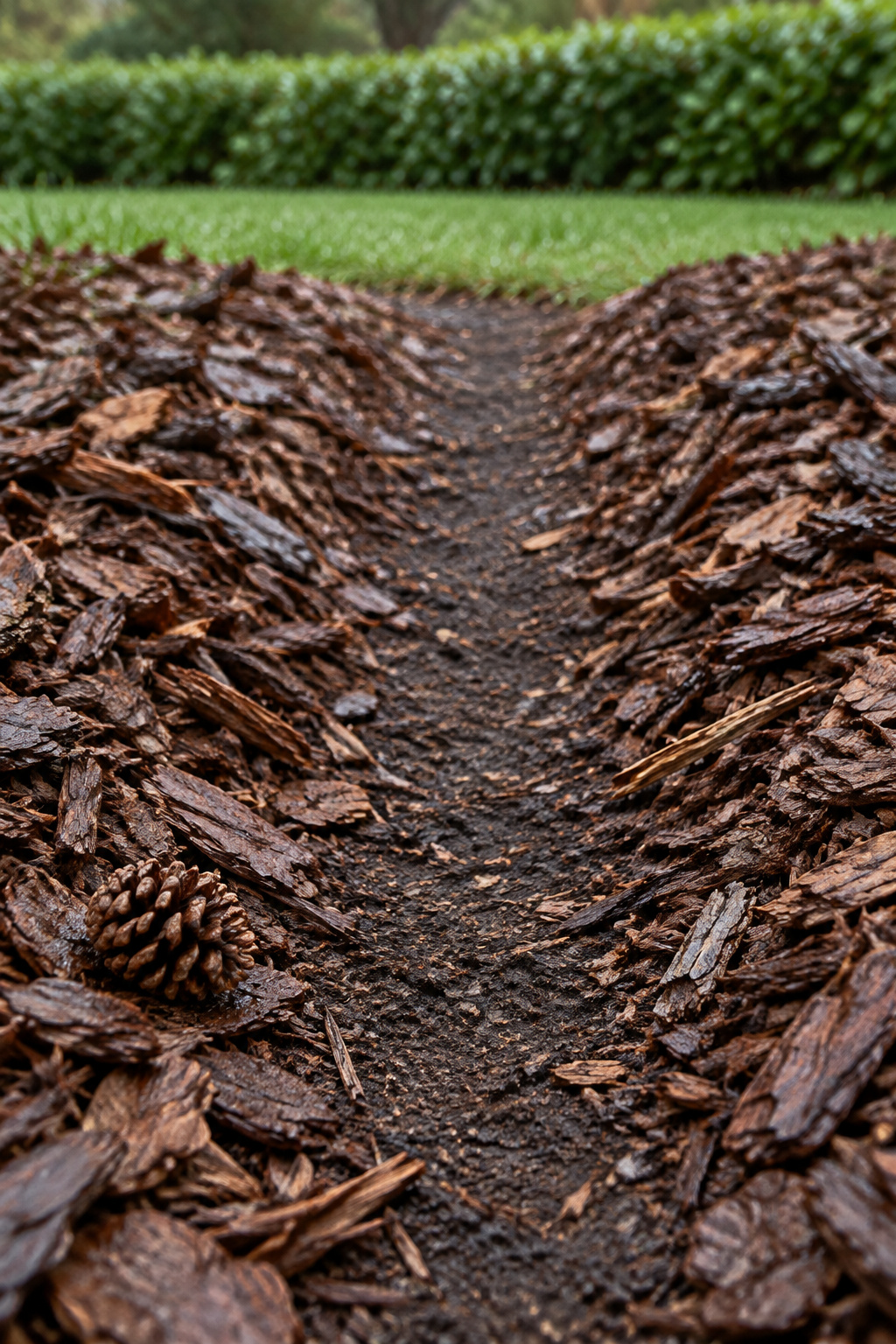
Then the path starts eating itself. Hardwood mulch loses roughly a third to a half of its depth each year, so I price a top-up every year at 40% of the depth: 1.2 inches, about $0.73 a foot. Four of those by year five takes the row from $6.51 to $9.44, or $195 to $283 for 30 feet.
Not everyone agrees it’s yearly: Virginia Cooperative Extension says it may need replenishing annually, UC ANR every few years. If yours goes two years between top-ups, bark is $7.97 a foot at year five instead of $9.44, and stays cheap for longer.
The mistake: skipping the edging to hold the bill at $2.01 a foot, next to lawn. The bark ends up in the grass. Where a bed or fence already holds it in, go without. Where it borders lawn, buy the edge.
Mown grass costs nothing in material and suits a weekly walk through a meadow or orchard. The mowing isn’t in that zero, and it won’t take daily wheels.
Pea gravel, crushed stone and decomposed granite: what the base and edging add
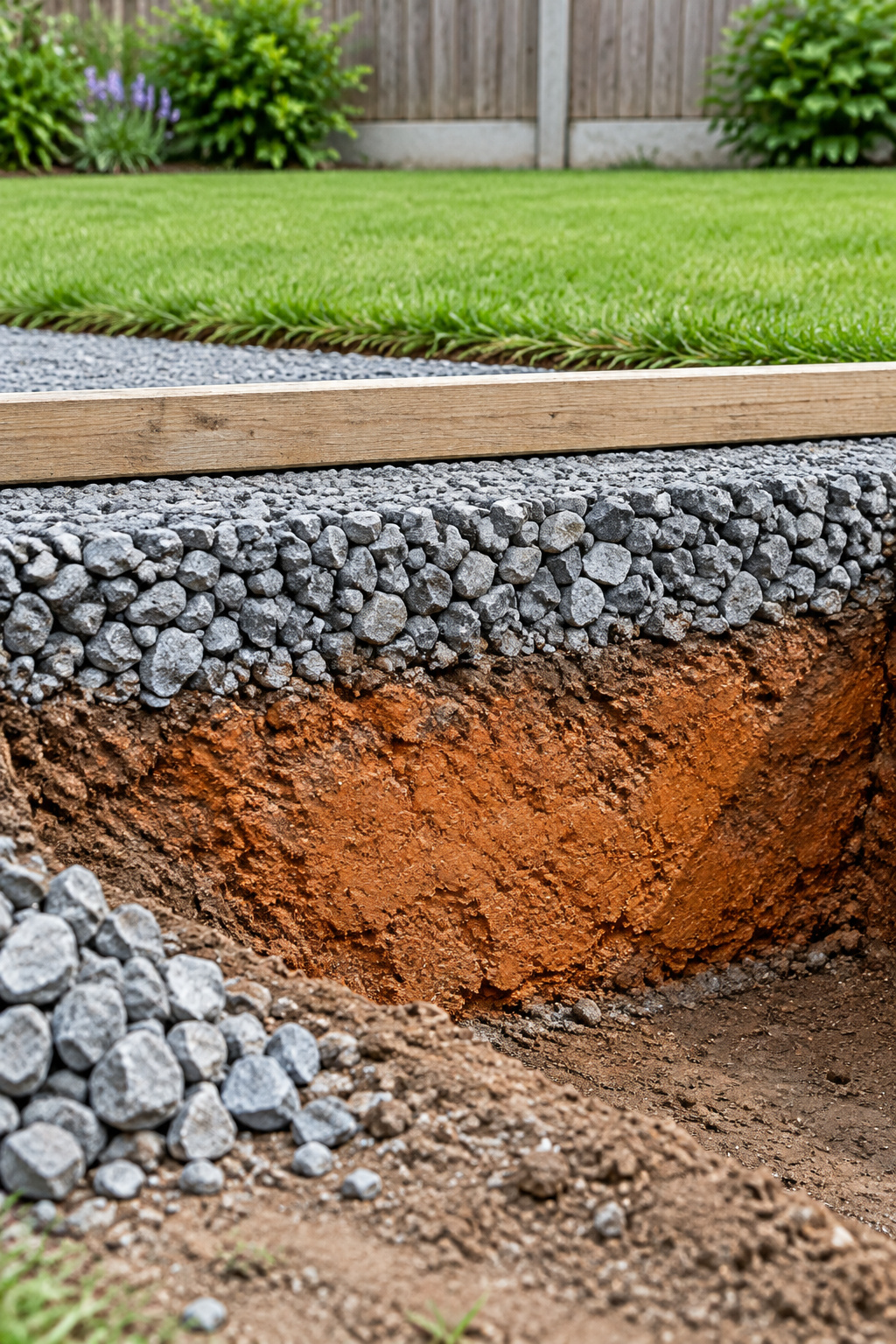
A foot of pea gravel path, line by line: $1.78 for 2 inches of surface stone, $2.03 for 3 inches of crushed-stone base, $0.98 for woven fabric and $16.00 for steel edging down both sides. That’s $20.79, and the stone you’ll see is under 10% of it. A 3 ft path holds little stone but needs as much edging as a wide one. Crushed stone ($20.36) and decomposed granite ($20.58) land in the same place.
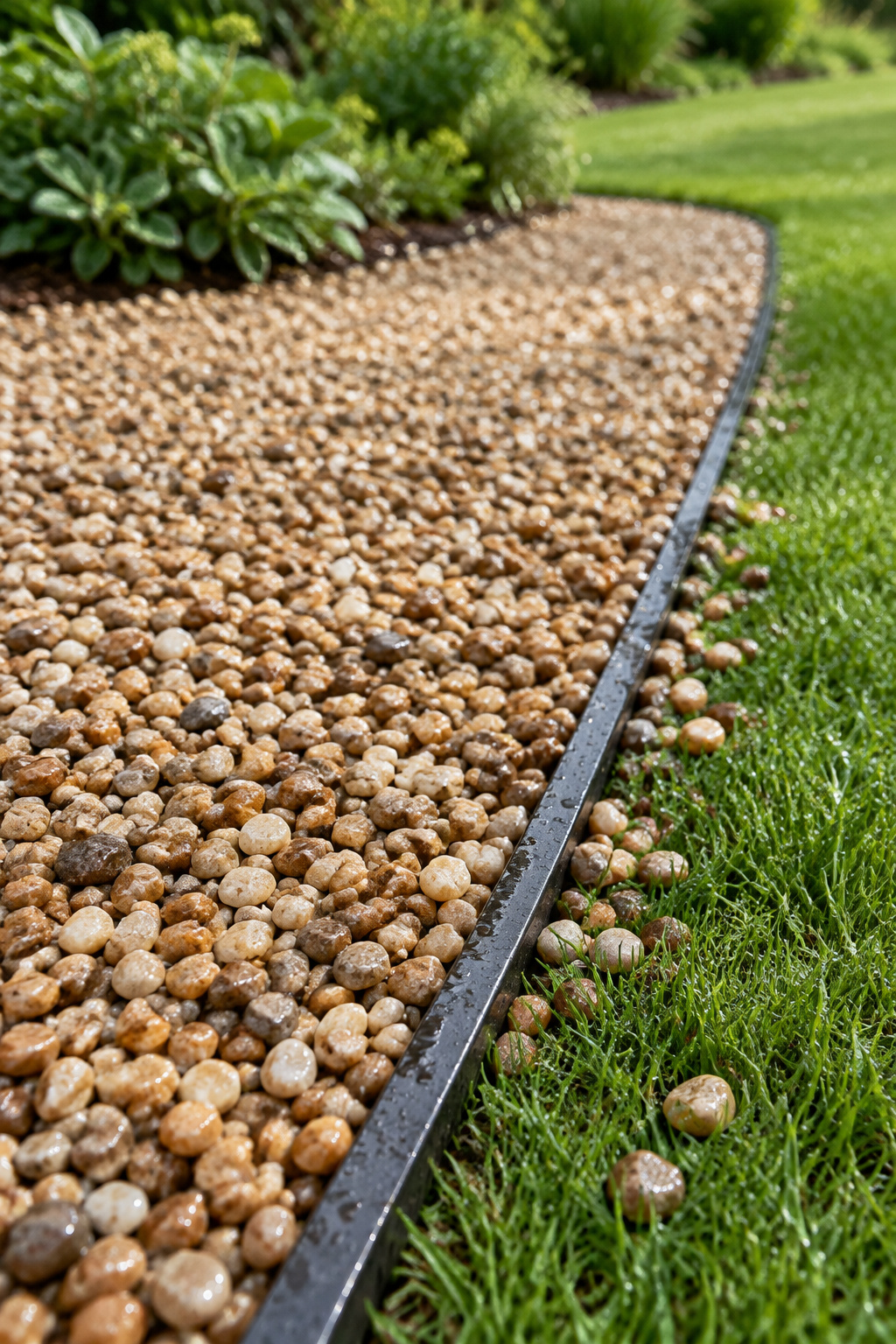
One price trap: the $28 a ton you’ll see quoted for pea gravel is the rate for orders of 24 tons or more. A 30 ft path uses about 2 tons, which buys at about $45 a ton.
Top-ups are cheap: about $0.53 a foot for 0.65 inches of pea gravel every second year, roughly a dollar over five years.
Put pea gravel on the same plastic edging as bark and it’s $9.29 a foot on day one and $10.34 at year five, against bark’s $9.44. Gravel adds about $0.27 a year and bark adds $0.73, so the gap closes slowly and the two meet at the start of year seven. Put the gravel on steel and it never catches bark inside ten years.
Loose gravel is the wrong surface for a route that takes a barrow or stroller every day: the wheels sink and drag. Compacted decomposed granite is the exception, because it packs nearly solid. Which stone, how deep and how to install the edging live in our gravel patio articles.
Concrete stepping stones and salvaged brick: the hard surfaces that stop costing you
Concrete stepping stones
A 16 inch square concrete step stone runs $5.47 to $12.81 depending on the finish and the store. At about $7.72 each, with a stone about every couple of feet and a small pad of crushed stone under each, the path is $4.95 a foot in stones plus $0.70 in bedding: $5.66 a foot, $170 for 30 feet. It needs no edging, no base across the full width and no top-ups, so day one and year five are the same number.
That’s why stones beat edged bark from the start. They only need to be set well once, and setting stepping stones so they stay level is the part worth taking slowly. What grows or sits between the stones is a separate cost, and wheels can’t use them, so the $5.66 prices a walking route only.
Salvaged brick and reclaimed pavers
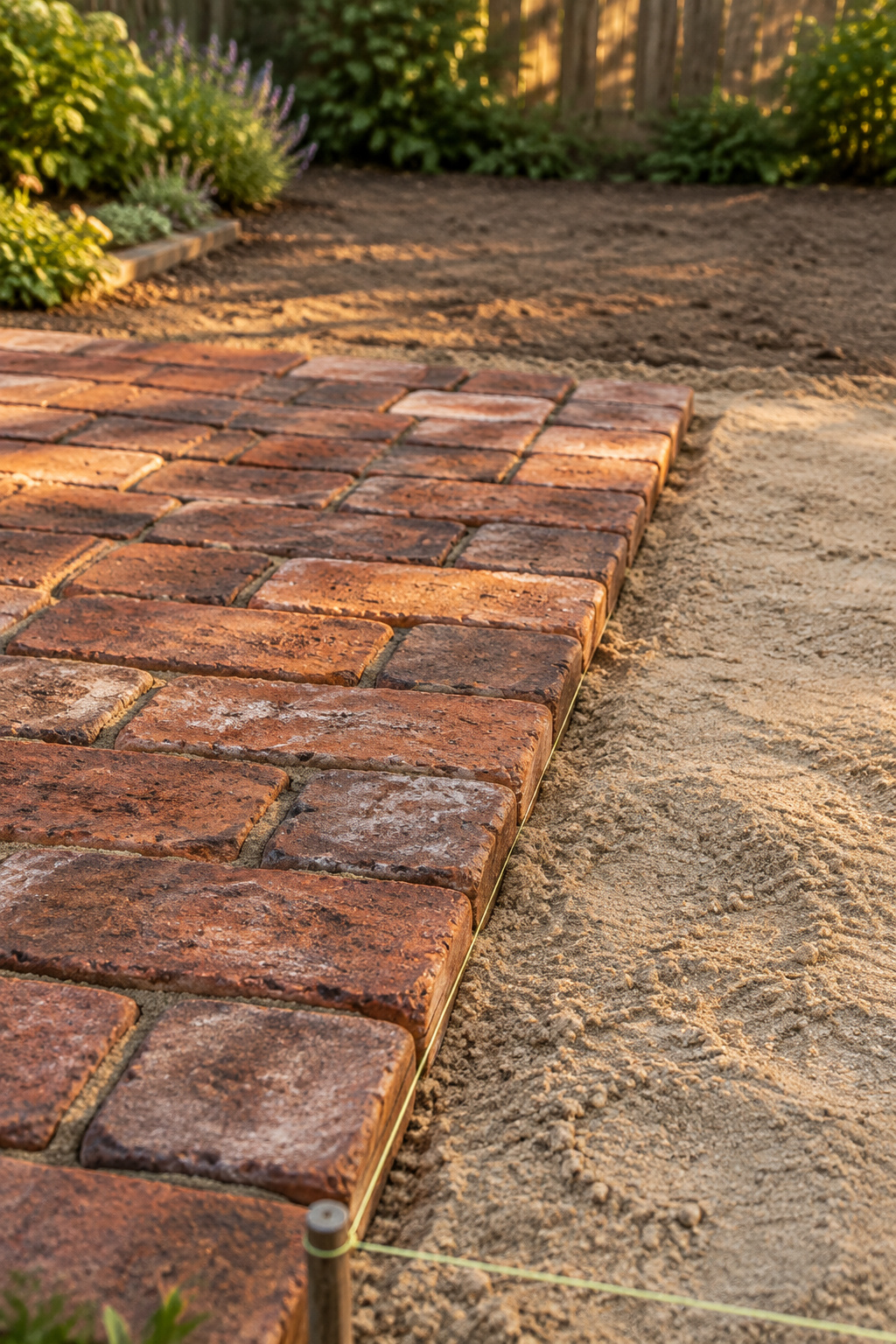
New 4×8 concrete pavers start around $0.78 each. Laid on a compacted base with bedding sand and edge restraint, they come to $23.07 a foot: $15.18 for the pavers, $2.71 for the base, $0.68 for sand and $4.50 for the edge.
Used brick sells for $1.25 to $10 a square foot. Bought at the middle of that, a brick path is $26.45 a foot, more than new pavers. It only wins when it’s nearly free: at $1.25 a square foot the path comes to about $12 a foot. And it has to be paving-grade brick, or the savings break with it.
Once laid, none of these three has a top-up line inside five years. On a weekly walk, though, only the stepping stones come in under edged bark in that time.
The five-year totals for a 30-foot path: weekly walk against daily wheels
Both crossovers sit at year seven: loose gravel meets plastic-edged bark there on a weekly walk, and pavers overtake decomposed granite there on a wheeled route.
| Route | Surface (30 ft) | Day one | Year 3 | Year 5 |
|---|---|---|---|---|
| Weekly walk | Concrete stepping stones | $170 | $170 | $170 |
| Weekly walk | Bark, plastic edging | $195 | $239 | $283 |
| Weekly walk | Crushed stone, steel edging | $611 | $623 | $635 |
| Weekly walk | Decomposed granite, steel edging | $617 | $631 | $645 |
| Weekly walk | Pea gravel, steel edging | $624 | $639 | $655 |
| Weekly walk | New concrete pavers | $692 | $692 | $692 |
| Weekly walk | Poured concrete | $720 | $720 | $720 |
| Weekly walk | Salvaged brick, bought used | $793 | $793 | $793 |
| Daily wheels | Compacted decomposed granite, deeper base | $638 | $659 | $680 |
For a weekly walk, my pick is concrete stepping stones wherever bark would need edging. If a bed or fence already holds the path in, bark with no edging is $2.01 a foot on day one and $4.94 by year five, cheaper than stones until year six. Edging is the assumption that swings this whole table, so price it first.
On a daily wheeled route only the firm surfaces are priced, and pavers, poured concrete and brick cost the same as on the weekly rows. Compacted decomposed granite is cheapest for five years, but it keeps taking about $0.36 a foot a year in top-ups, while pavers sit still at $0.39 a foot more. If the path will still be there after year six, lay pavers. The brick row only holds if the brick is sound, so start with checking salvaged brick before you lay it.
Bulk or bags, the extra 10%, and what to skip
Bulk or bags: where the break-even sits
For a 30 ft bark path, bags win. Thirteen bags cost about $63. Bulk is about $41, but with delivery at $70 to $140 it lands around $146, so bulk only wins if you haul it yourself. On LawnStarter’s prices, delivered bulk mulch beats bags at about 5 cubic yards; Mulch Mound puts that line nearer 2. Either way, a 30 ft path is under 1.
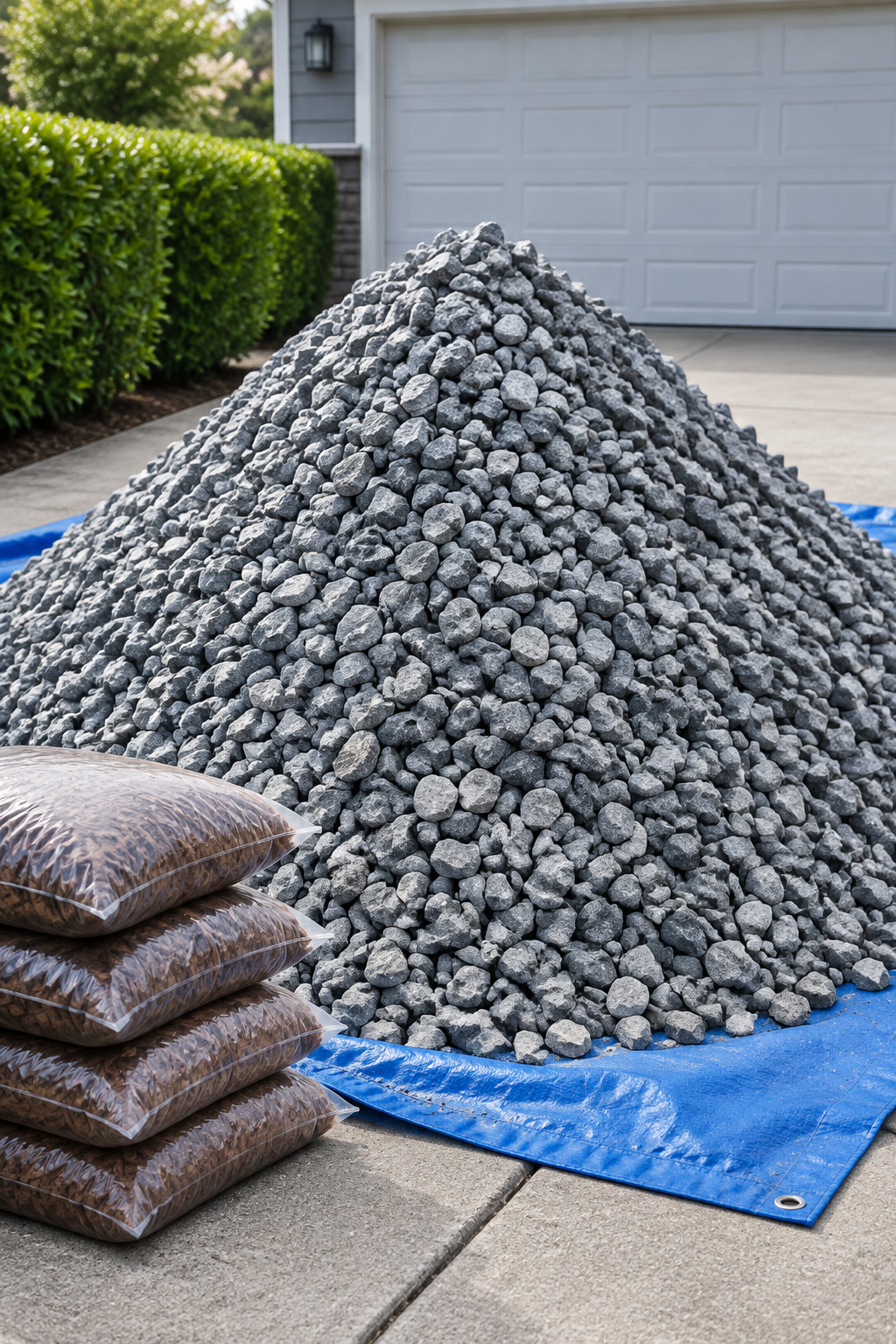
Stone is the opposite. The pea gravel layer for the same path is 33 half-cubic-foot bags at $5.97, or $197. Bulk with delivery is about $53. Bags cost about 3.7 times as much.
I never skip the extra 10% on materials. I keep a box of spare screws, shims and a level behind the seat of my pickup. It started after a job where I drove forty minutes for one screw. On the bark path, the 10% is about one more bag, roughly $5. Plan for the trip you don’t want to make. Buy the extra bag.
What to skip
Skip the fabric under bark, since mulch at the right depth doesn’t need it, but keep it under gravel: without fabric and a proper base, weeds can take over within about a year. Skip shallow edging on gravel too, because a 2 inch edge lets stone creep under it. Use 4 inch. And don’t chase the cheapest bag; the spread between bag prices is small next to bags against bulk stone.
Price the route at five years, put edging and base on the bill before the surface, and add the 10%. If you want the cheapest version you can undo, lay bagged bark with no edging where something already holds it in: about $63 for 30 feet, and if you change your mind, you rake it into the beds.
FAQ
Is it cheaper to hire a landscaper or lay a garden path yourself?
Doing it yourself is cheaper. Patio figures are the nearest benchmark: doing the labor yourself saves $4 to $18 a square foot, which is $12 to $54 a foot on a 3 ft path. Hiring a pro adds labor, while the base, edging and top-ups cost the same either way.
How do I work out how much material a garden path needs?
Multiply length by width by depth in feet to get cubic feet, then divide by 27 for cubic yards. A 30 ft path, 3 ft wide and 3 inches deep, is 22.5 cubic feet. Add 10% and it’s 24.75, so buy 13 two-cubic-foot bags. For stone, a cubic yard is 54 half-cubic-foot bags.
Where can I find free wood chips for a garden path?
Ask your city, utility companies or local arborists, who often give chips away. ChipDrop delivers a tree crew’s load for free when a truck is full nearby, but you can’t pick the day and it may include logs. Let fresh chips age 3 to 12 months before they touch planted edges.