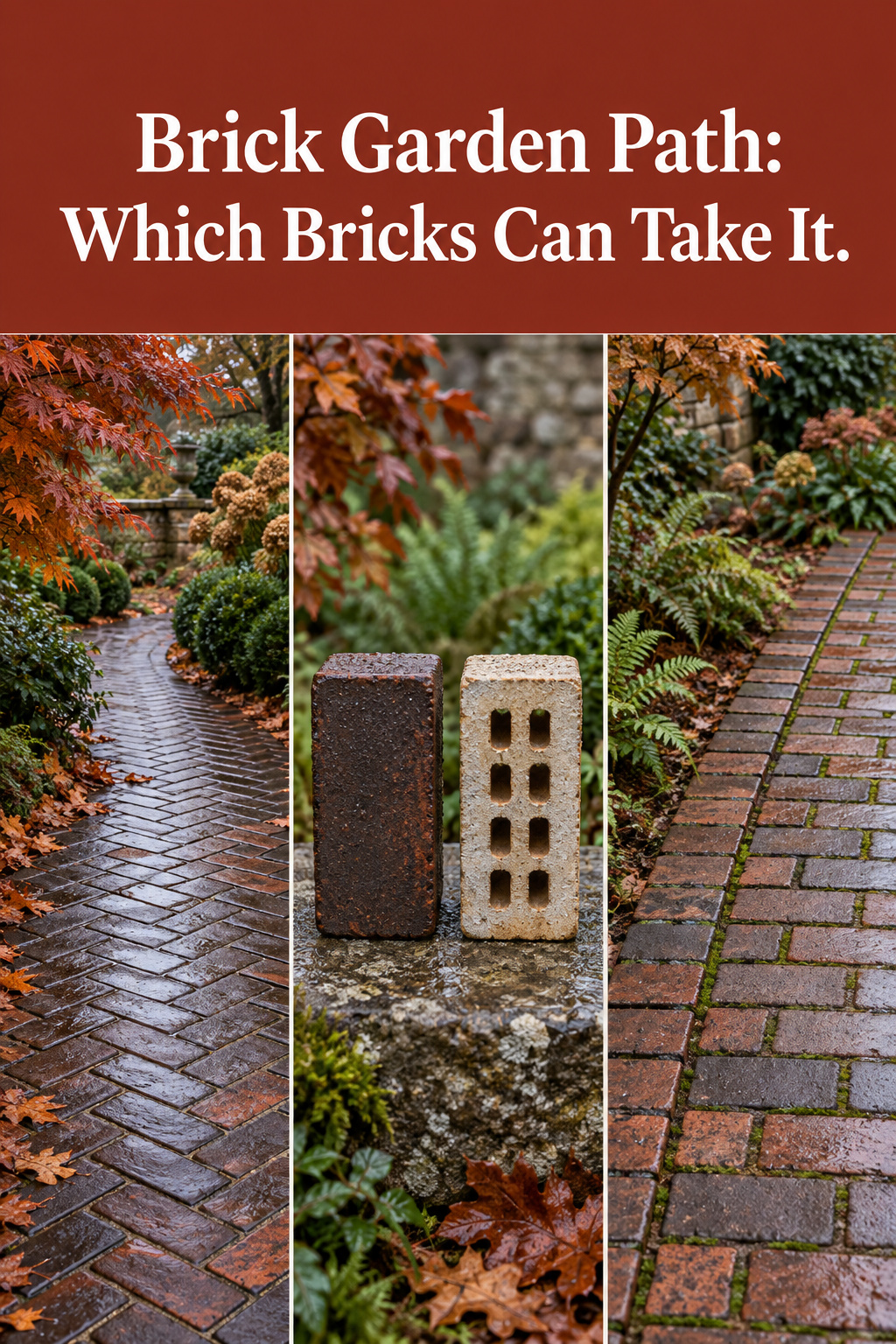
A brick made for a wall and a brick made for a path can look exactly alike, and only one of them was made to be frozen wet and walked on. That is the trouble with a brick garden path built from salvage. The pile behind the garage is warm red, soft at the corners, and free. Laid flat where winters freeze, it may still be a path after a few winters, or a bed of orange flakes.
You can’t tell which by looking, but you can shorten the odds before you dig.
TL;DR
- Paving brick is graded under ASTM C902, and its Class SX is the one made to be frozen while saturated; wall brick is graded SW, MW or NW, and the facing-brick standard says it does not cover paving.
- Check salvaged brick four ways before laying it: where it came from, a clear ring, a face that doesn’t shed grit, and a 24-hour soak on five bricks judged against about 8% absorption, not the 20% salvage guides print.
- Lay it sand-set: at least 4 inches of compacted crushed-stone base, about an inch of concrete sand, narrow joints, and a rigid edge such as a soldier course set in concrete.
Paving Brick and Wall Brick Look Alike and Are Not the Same Thing
Paving brick is usually solid and was made to lie flat under feet and weather. Wall brick was made to stand up, and laying one on its back asks it to do a job it was never graded for.
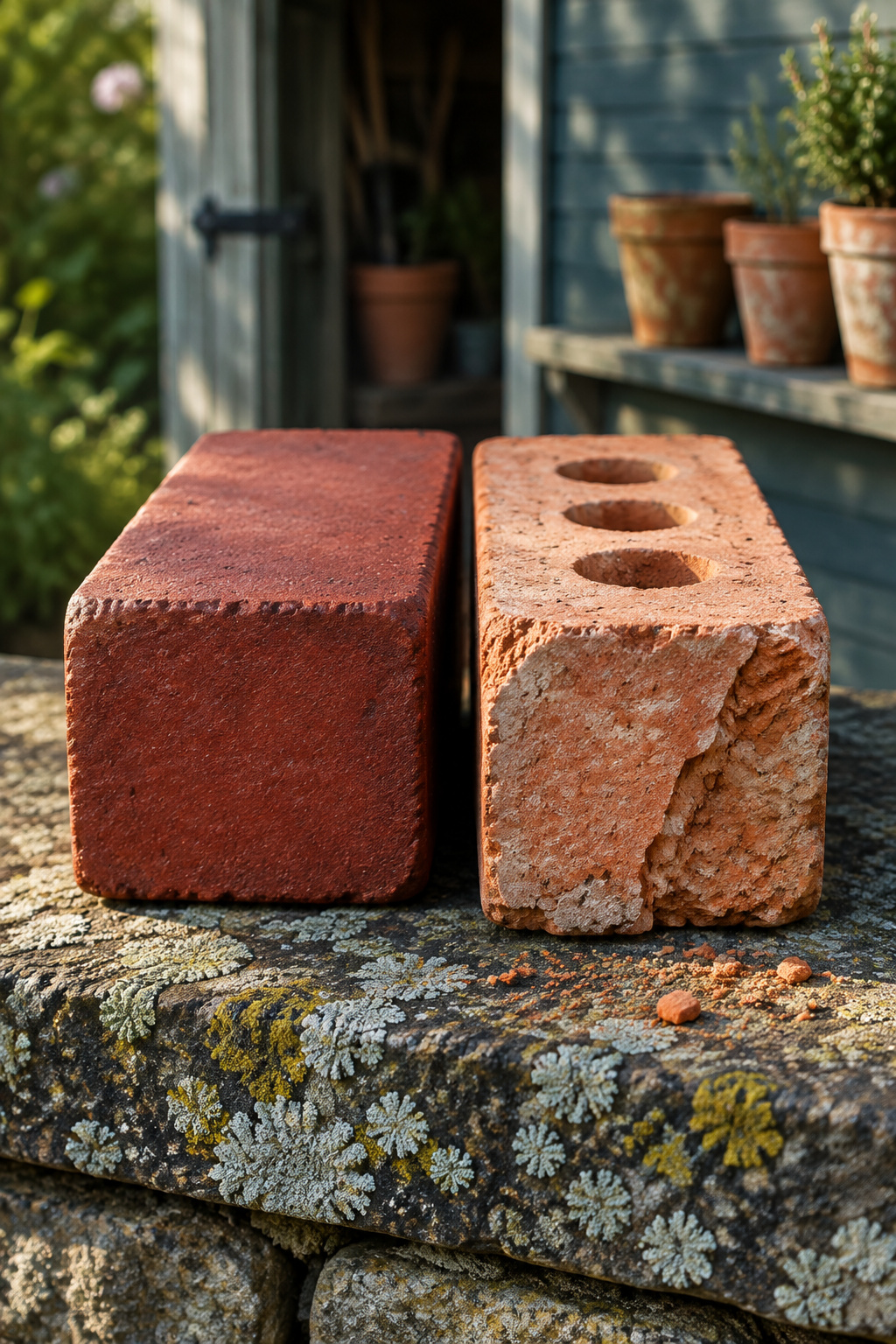
ASTM C902 covers paving brick for foot traffic and light vehicles such as home driveways. Under the standard’s paving class, SX, a brick needs a compressive strength of about 8,000 psi, a 24-hour cold-water absorption of no more than 8.0% on average, and a saturation coefficient no higher than 0.78. Facing brick falls under ASTM C216, whose own scope says it is not intended for paving brick and points back to C902.
The best wall grade still falls short. Grade SW facing brick may absorb up to 17.0% in a five-hour boil at a saturation coefficient of 0.78. In a cold soak that works out to roughly 13%: 17.0 × 0.78 ≈ 13.3, against 8.0% for a paver.
| Standard | Made for | Weather grade | Fit for a flat garden path |
|---|---|---|---|
| ASTM C902 | Paving brick, foot and light vehicle traffic | SX: may be frozen while saturated | Yes, the safe choice wherever it freezes |
| ASTM C902 | Paving brick | MX outdoors without frost, NX indoors | Only where winters never freeze (MX) |
| ASTM C216 | Facing brick for walls | SW or MW | Not a paving rating |
| ASTM C62 | Building brick for walls | SW, MW or NW | Not a paving rating |
Some SW wall brick may last when laid flat. Even the paving standard admits some brick can’t survive a few severe winters and that a service record is the best sign of durability. Where winters freeze hard, brick made for paving is the only safe bet.
Four Checks Before You Lay a Salvaged Brick, and What Each One Tells You
I keep a coffee can of paint chips in my workshop. I started it after a client insisted a pink was original and the layers proved it was from the 1950s. Old isn’t the same as original, and it isn’t the same as paving either. Check before you call a brick either one.
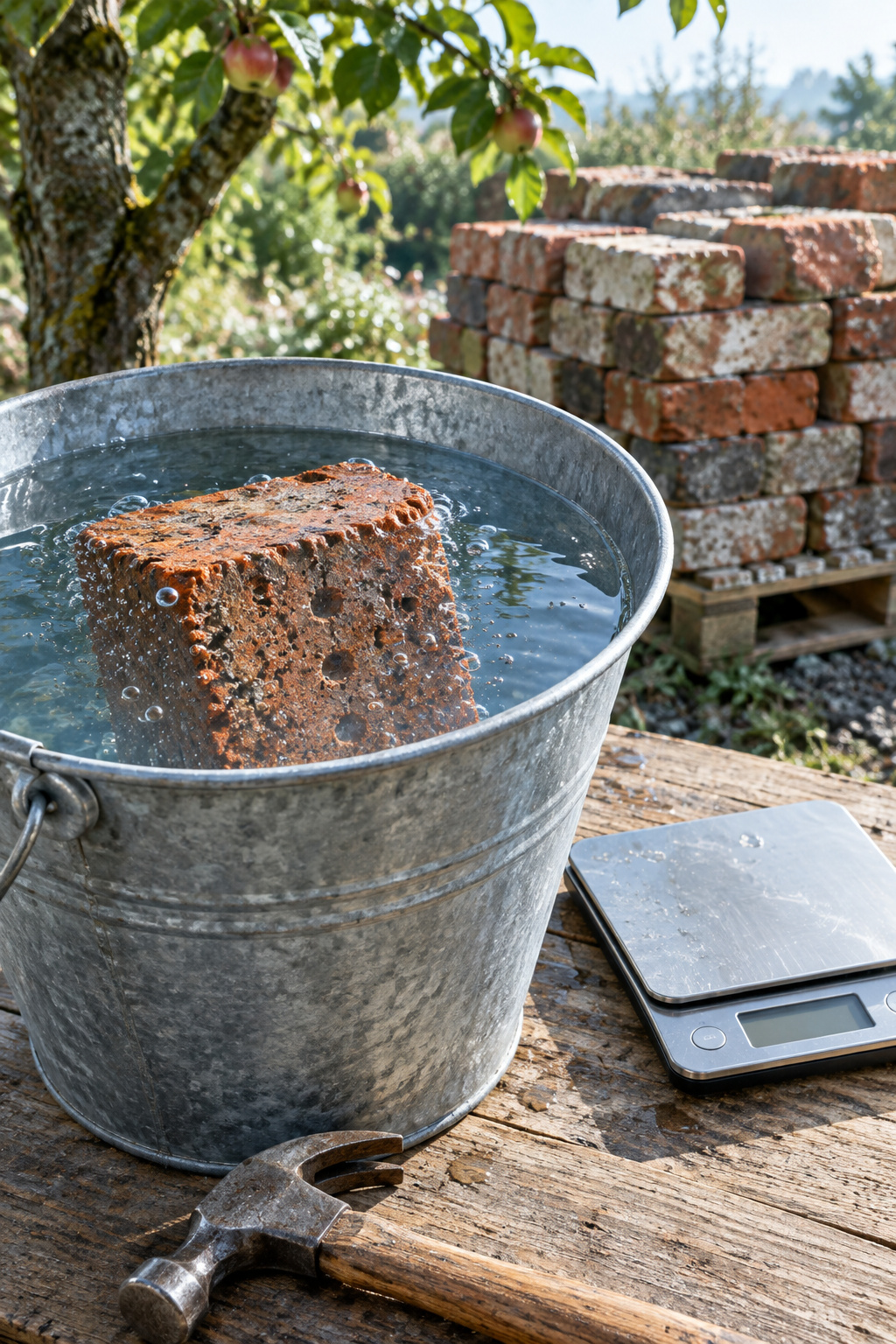
Run them in this order.
- Read where it came from. Brick from an exposed outside wall has already survived winters; inside-wall brick, often salmon pink, is the classic failure. Pass over brick from cellars, fireplaces or salted roadside foundations. A maker’s stamp is a lead to look up, never proof of paving grade.
- Listen to it. Tap two bricks together. A clear ring suggests a dense, sound body; a dull thud suggests a crack inside or a soft, under-fired brick.
- Scratch and rub. A face that sheds grit under a key, or peels when two bricks are rubbed together, is likely too soft for the ground.
- Soak five. Weigh a dry brick, soak it in cold water for 24 hours, wipe and weigh again. A brick going from 4.00 lb to 4.32 lb has absorbed 8.0%, right at the paving cap. Average five, as the standard does.
Popular salvage guides call 20% a pass. Class SX allows 8.0% on average and 11.0% for any single brick, so a brick that soaks to 15% passes one test and fails the other. Under about 8% is encouraging; 20% says nothing about frost.
None of this certifies a brick; the UK’s Brick Development Association says age is no proof of frost resistance. The checks give you odds. Salvage is only a bargain if it passes, so if half the pile fails, see how brick compares on cost before buying more.
Brick Garden Path Patterns Matched to the Path’s Shape
Pattern decides how many bricks you cut and how well the field holds together. The Brick Industry Association ranks herringbone strongest because it spreads sideways forces instead of letting rows creep; lay running bond with its long joints across the direction of travel.
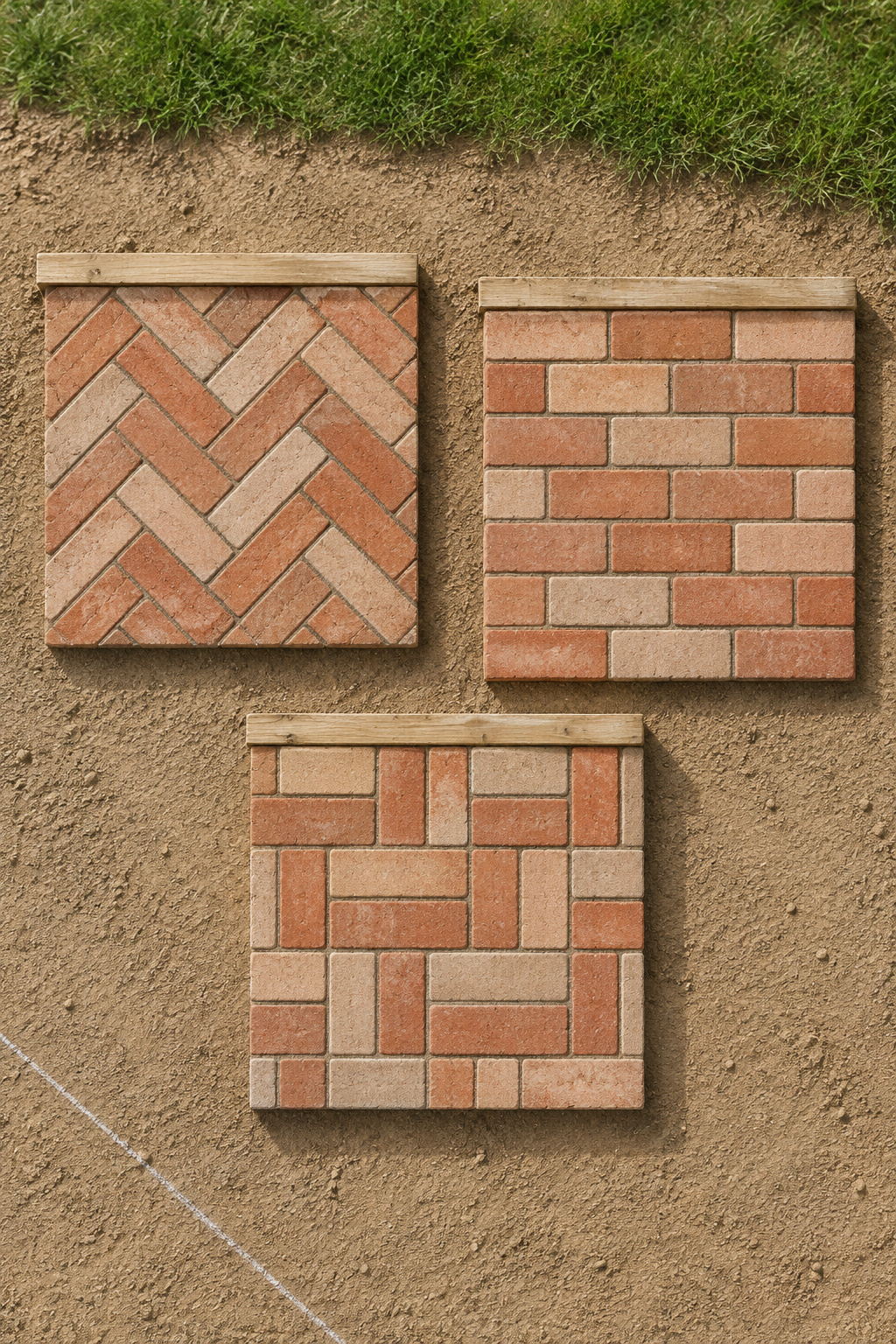
| Pattern | Best for | Cutting | Under traffic |
|---|---|---|---|
| Running bond | Straight runs and gentle curves | Only at the start and the end | Among the smoothest under a barrow |
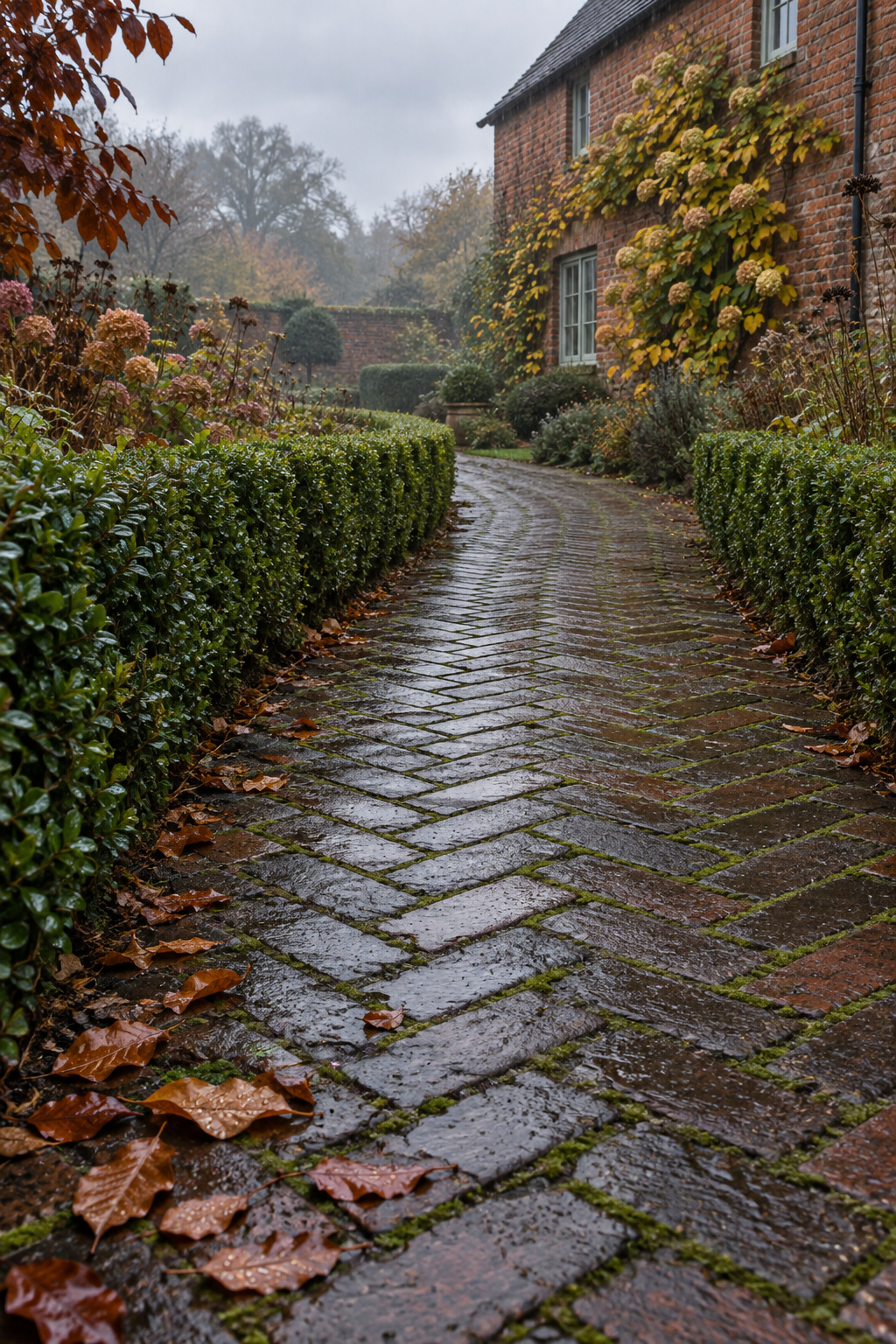
| Herringbone, 45 degrees | Straight runs and curves, a sense of movement | Every other edge brick at least | Strongest |
| Herringbone, 90 degrees | Straight runs, a stair-step look | Cuts at the edges | Strong; smoother under wheels than 45 degrees |
| Basketweave | Straight, light-traffic runs | Beginner friendly laid straight; many cuts laid diagonally | Weaker, joints run straight both ways |
Herringbone at 45 degrees turns a curve well; it just costs cuts. Running bond is the simplest: as Roger Cook of This Old House puts it, however long the walk, you only have the beginning cuts and the end cuts.
Basketweave needs bricks exactly twice as long as they are wide. Cook warns two widths of a standard brick can come up almost 3/4 inch short of one length, and even a true 4 by 8 misses once you add a joint: 2 × 4 + 1/8 = 8 1/8 inches against 8. Measure it twice, and if the bricks fail, lay running bond.
Edge cuts should be at least 2 inches and match on both sides, so settle sizing the path’s width before choosing, then dry-lay one row.
A Sand-Set Brick Path Beats Mortar in a Garden, Built in This Order
A sand-set path is flexible on purpose: each brick is held by friction in sand-filled joints, so when the ground shifts the bricks settle instead of cracking.
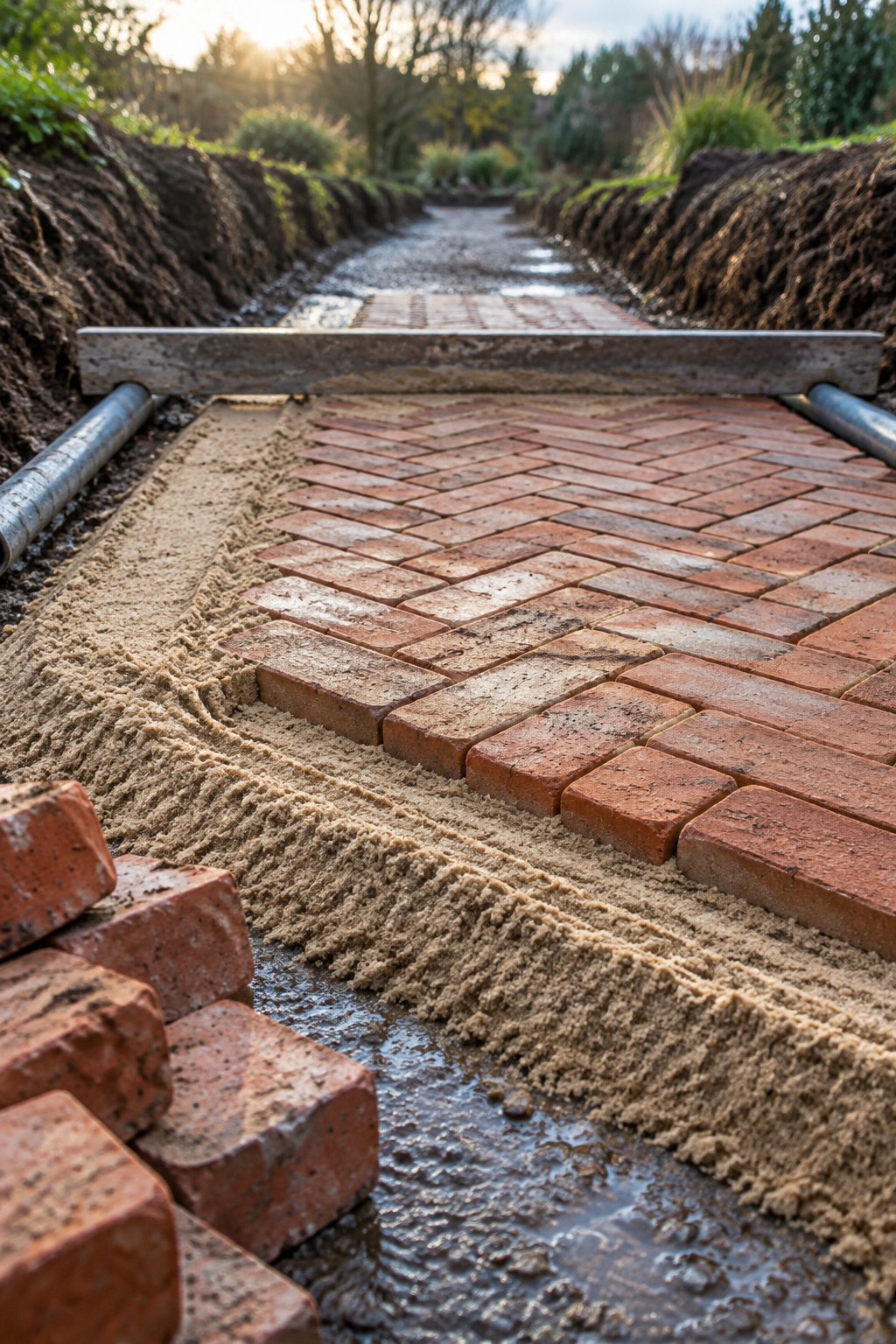
- Dig out and compact the soil. For 4 inches of base, an inch of sand and a 2 1/4 inch paver, that is 4 + 1 + 2 1/4 = 7 1/4 inches below finished surface.
- Compact dense-graded crushed stone, 3/4 inch to fines, in thin lifts to at least 4 inches. Frost-prone or clay ground may need more. Give the surface a fall of 1/4 inch per foot.
- Screed about an inch of sharp concrete sand. Mason sand and stone dust are too round to hold.
- Fix the edge along one side and lay out from it, with joints of 1/16 to 3/16 inch, bricks 1/8 inch proud of final grade for settling.
- Fit the last edge once the field is down, which saves cutting.
- Sweep sand into the joints, compact, and repeat until they stay full.
Gravel paths have their own base rules, covered with gravel patios.
Sand-Set or Mortar
Mortared brick needs a concrete slab underneath or the joints and bricks may crack. Sand-set brick goes on gravel, usually costs less to install, and can be lifted, rebedded and relaid in the same pattern by whoever has the garden next. A mortared path has to be broken out. That reversibility settles it for me. Save mortar for steps, where the edges must be bonded.
Soldier-Course Edging
Sand-set brick only holds if the edges can’t move. A soldier course, bricks on end side by side, set in concrete is the rigid option that also looks like part of the path. It should present a flat vertical face and reach below the sand bed. Skip timber, which the Brick Industry Association warns may not hold over the long term.
Repair an Old Brick Path Before You Relay It
If you already have an old brick path, let’s see what it’s made of before anyone orders a dumpster. Sunken or wavy bricks point to the base, bedding or drainage. Lost joint sand and weeds point to open joints. A flaking face points to the brick itself, and relaying won’t cure it. Brick that has come through many freezing winters with sound faces is proven stock.
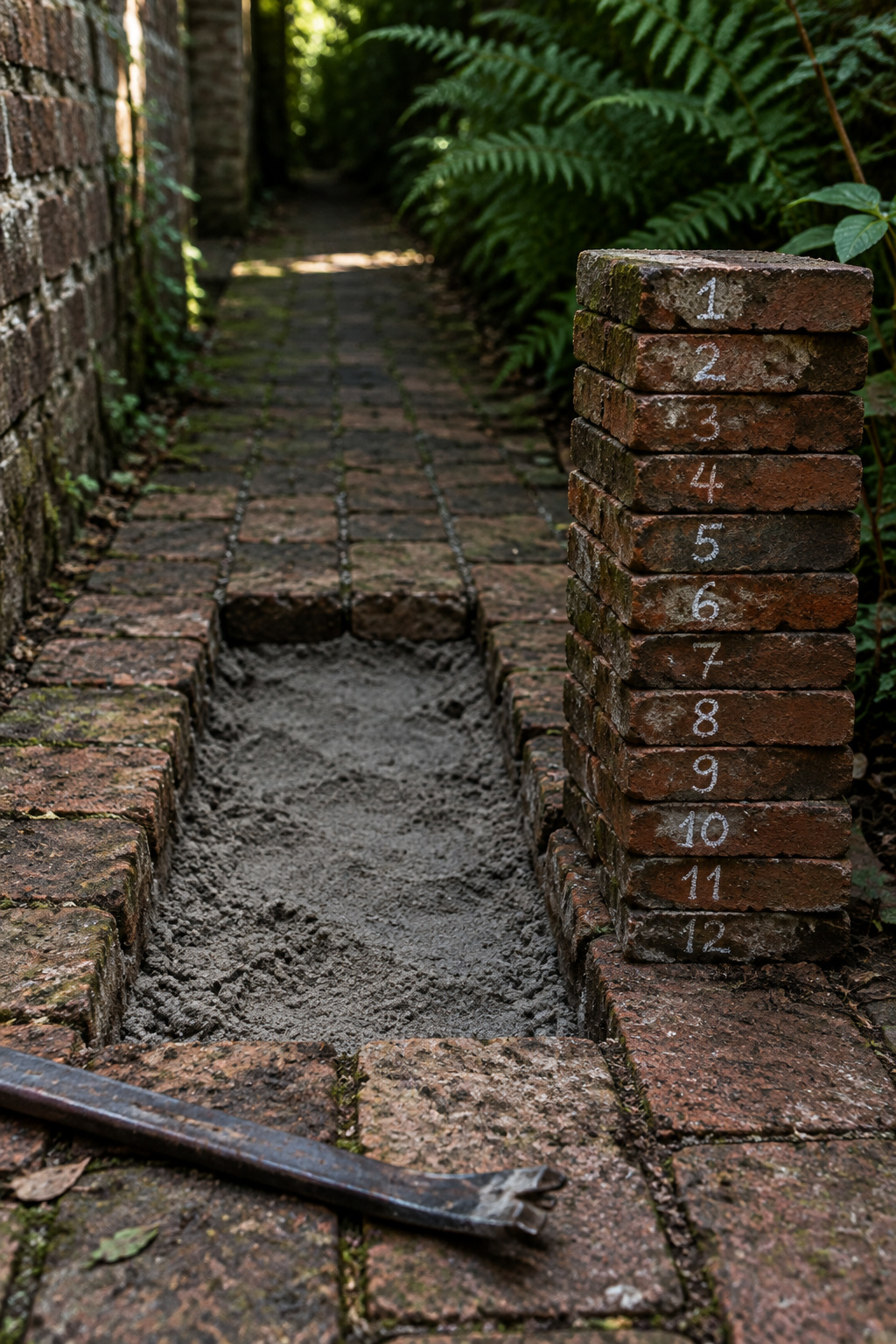
For a sunken patch, pry out the bricks, numbering the cut ones in crayon so each goes back in its spot, as Roger Cook does. Dig out soggy clay, fill low spots with ground limestone and tamp, add an inch of sand, reset with a rubber mallet, and sweep sand into the joints again after the first heavy rain. Settling tends to worsen each year, so repair early.
Masonry contractors say a sealer won’t save spalled bricks; cut them out and replace them with matching brick, the hard part with old stock. If the old path was mortared, don’t repoint soft brick with hard modern cement mortar, which pushes the stress into the brick.
A full relay makes sense when the base has failed along the whole run. I once told a client to keep a crumbling plaster wall and spent three weekends patching it before admitting new drywall would have been the honest choice.
New Brick Should Look New, and the Path You Can Build This Season
When the pile fails, buy new paving brick. A real paver’s data sheet states its C902 class; ask for SX before you look at color.
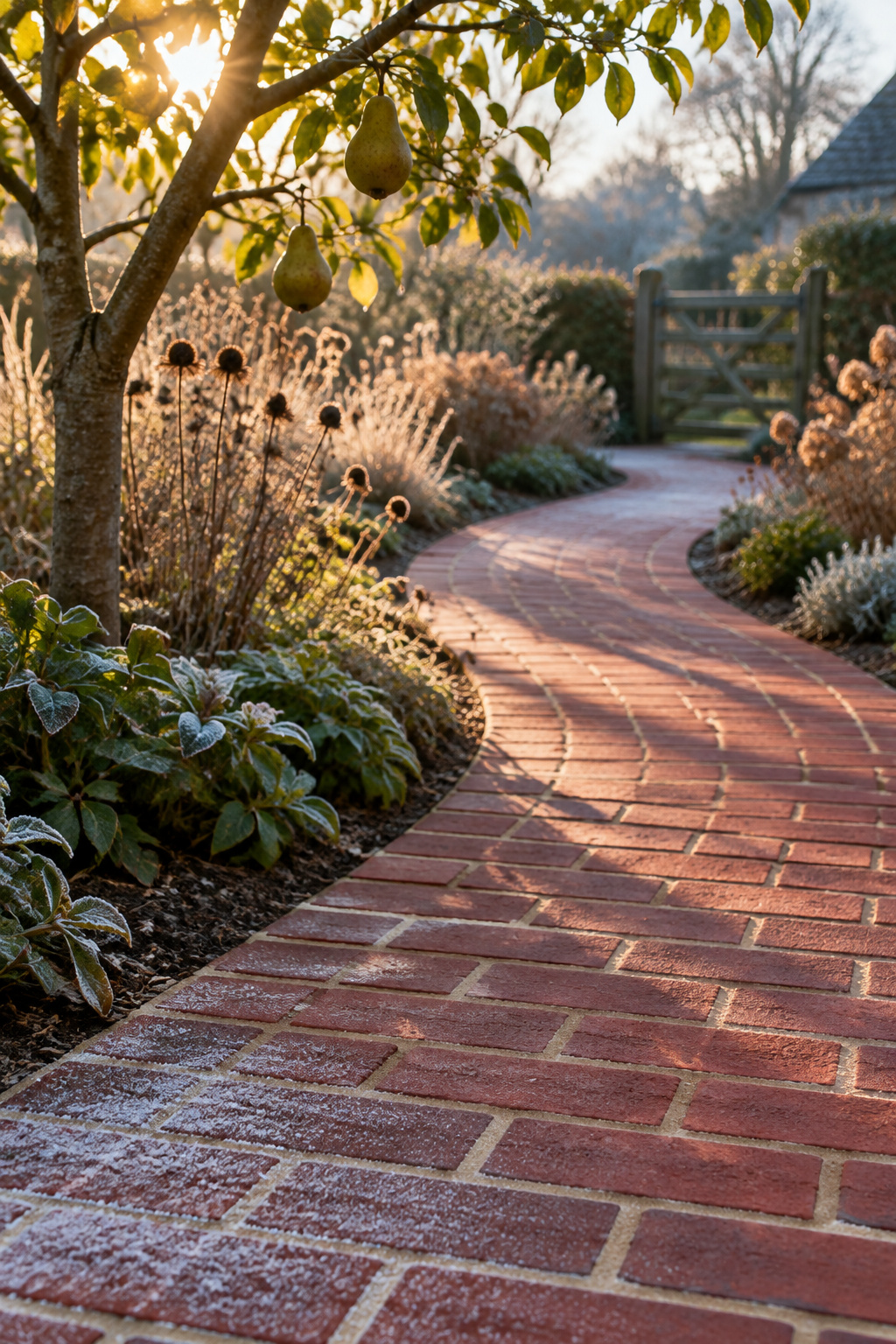
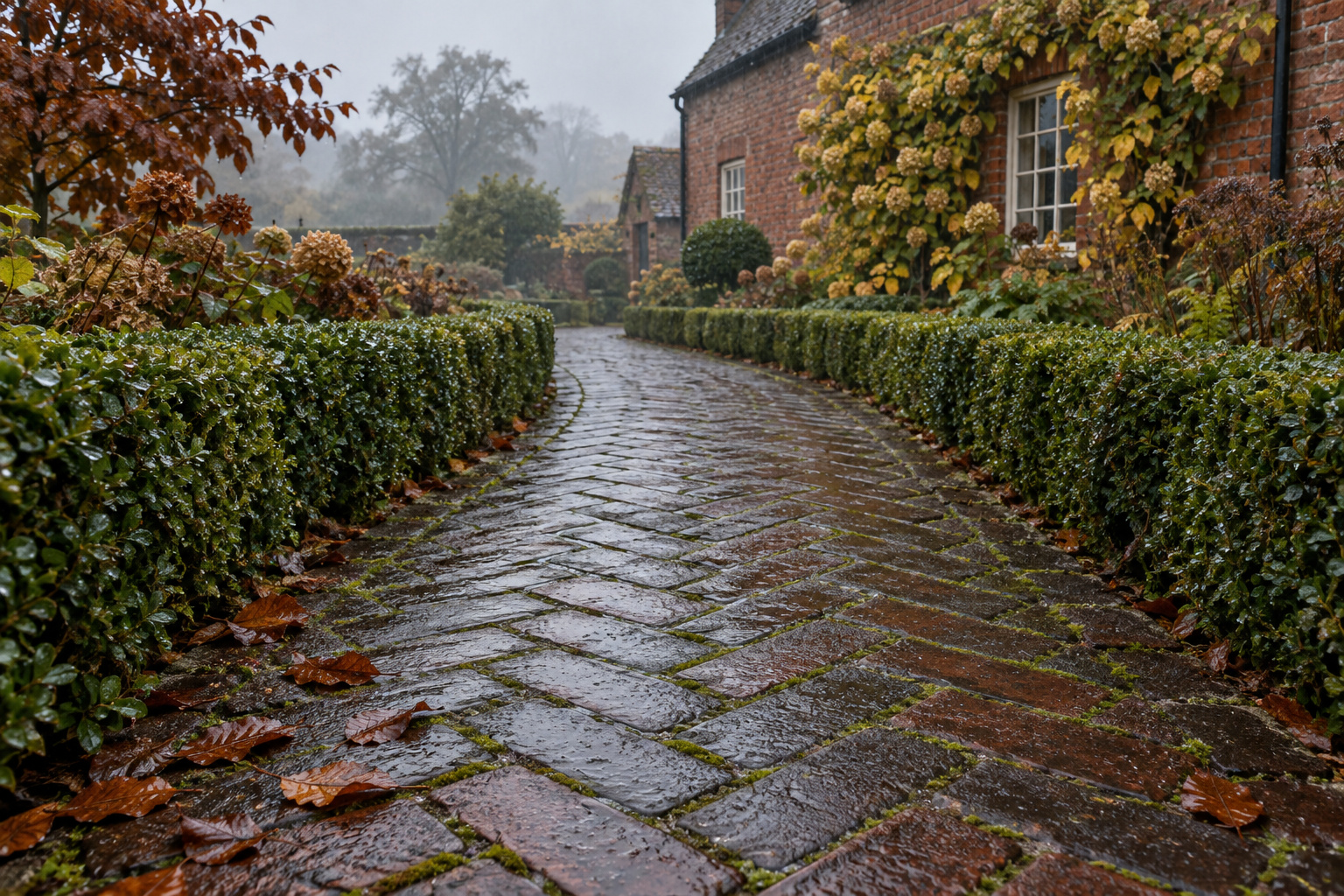
New work should be honest about being new. I live in an 1898 brick house in Bucks County, and I would still rather walk a crisp new herringbone than wall brick doing an impression of age until it flakes. For irregular size, color and texture, the paving standard has an application class, PA. Rubbing fake wear into new brick is a costume. The one salvaged route the UK brick trade endorses with confidence is reclaimed pavers that were laid outdoors before.
Test five bricks, choose the pattern, build the base. If brick doesn’t suit your route, compare other garden walkway materials first.
The popular guides still say under 20% absorption is fine, and the paving standard still says 8.0%. They ask different things: whether a brick is decent building material, and whether it can lie frozen and wet underfoot. I’d test to the 8%. The 20% camp isn’t going anywhere, and your own winters will settle which of us was right about your yard.
FAQ
How long does a brick garden path last?
No trade body publishes a lifespan for a garden path, and the brick is only one layer of it. The paving standard admits some brick can’t survive a few severe winters, while sound paving brick on a well-compacted base with a rigid edge stays put. A path lasts as long as its weakest layer.
How do you clean moss and algae off a brick path?
Scrape off thick growth, brush in a moss killer in dry weather, and keep brushing regularly. On old brick use low water pressure and a stiff nylon brush, and keep the jet out of the joints. Sources disagree on whether moss harms brick, but it makes it slippery. Fixing shade, damp and fall stops it returning.
Is a brick path slippery when wet?
Brick usually has adequate slip resistance, and a rough-textured brick grips better than a smooth one. Most slips come from standing water or a film of moss and algae rather than the brick itself. Give the path a fall so water runs off, keep growth brushed back, and consider chamfered pavers, which shed water.