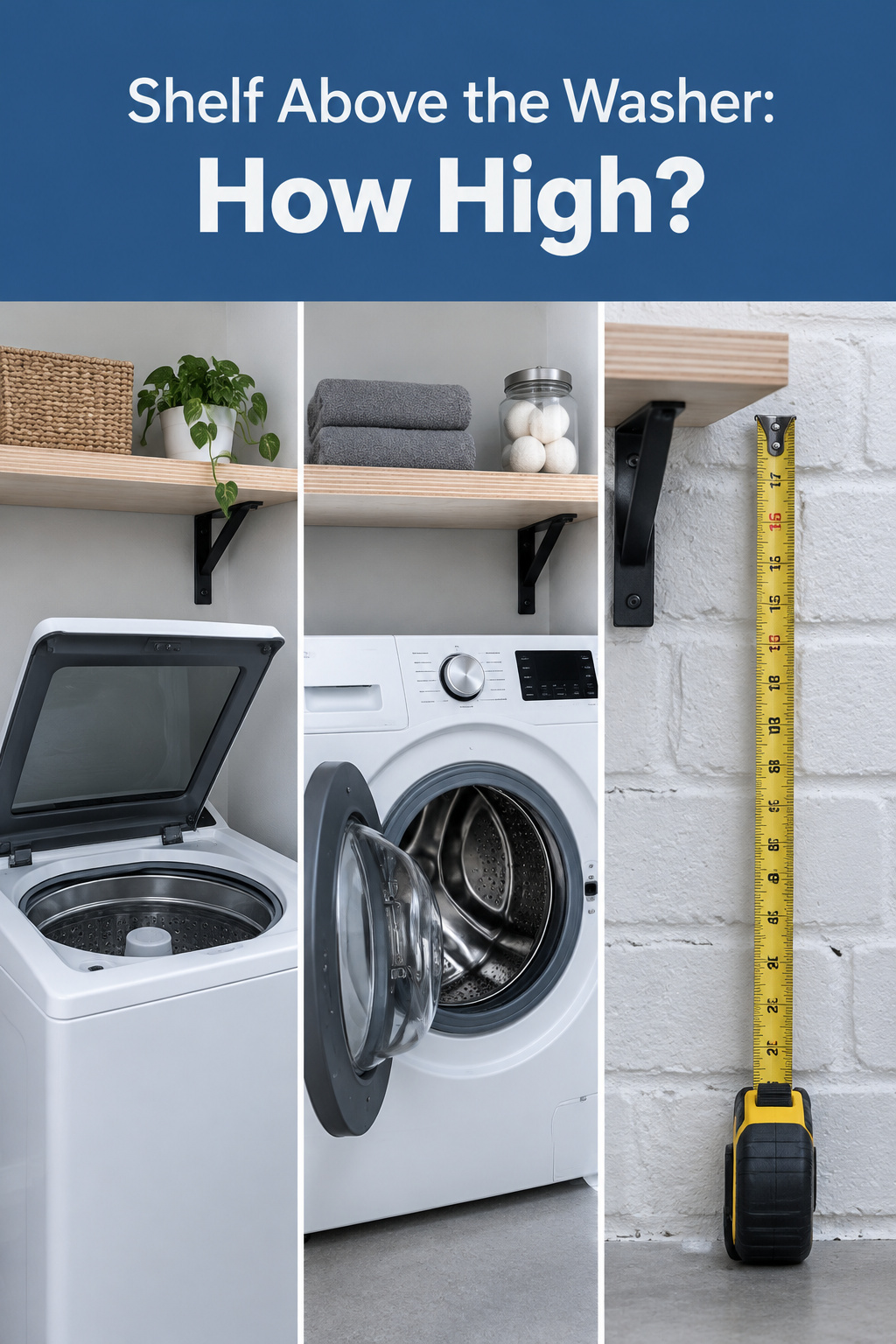
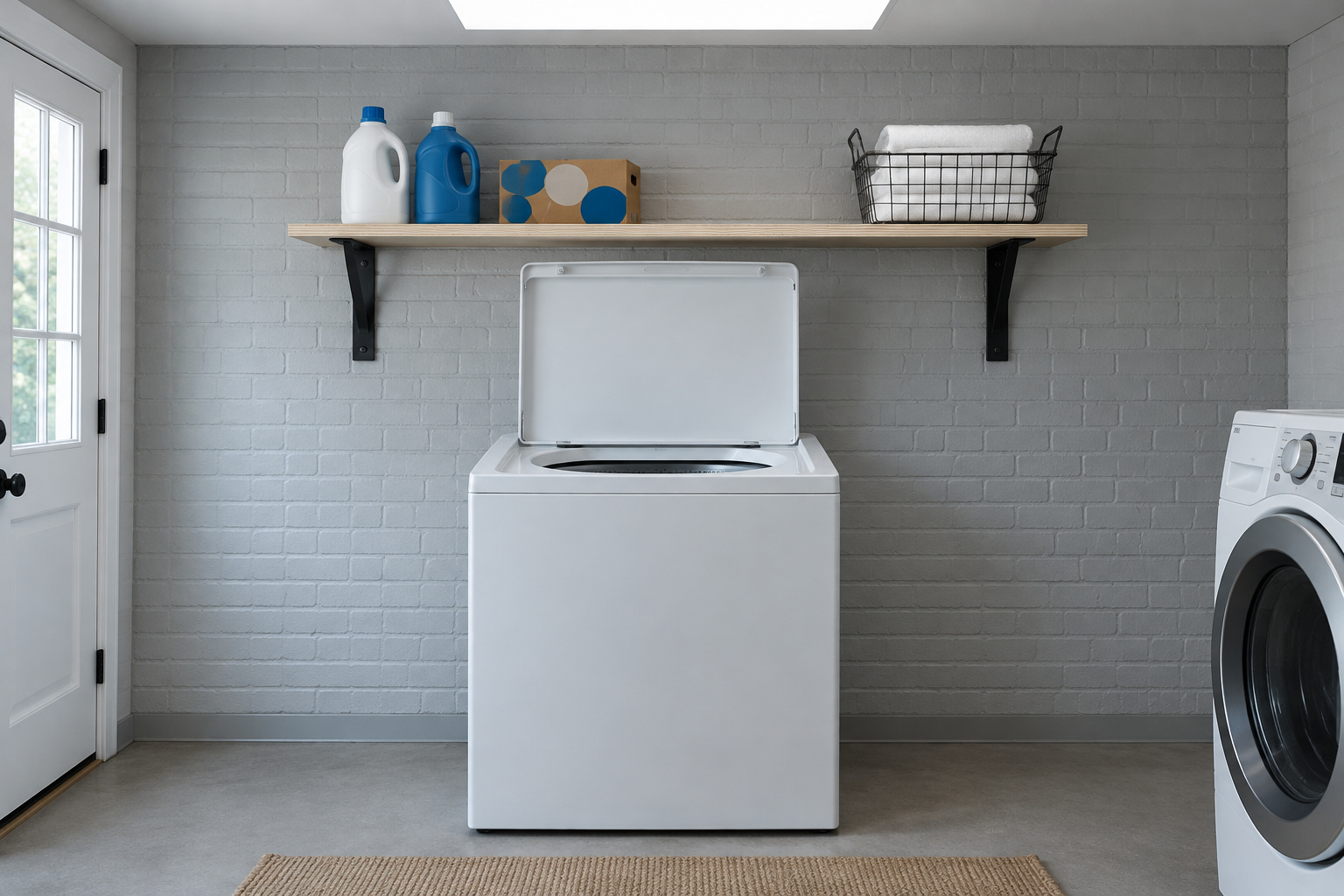

The 18-inch rule is right about your washer lid, and right for the wrong reason. Ask anyone how high to hang shelves above washer and dryer pairs and you get the same number, 18 inches above the machine, copied so often it no longer seems to need a source. I went looking for the measurement behind it and found none. I found manufacturers’ spec sheets that print the number that does matter, and a front-load door that makes the question mostly irrelevant.
TL;DR
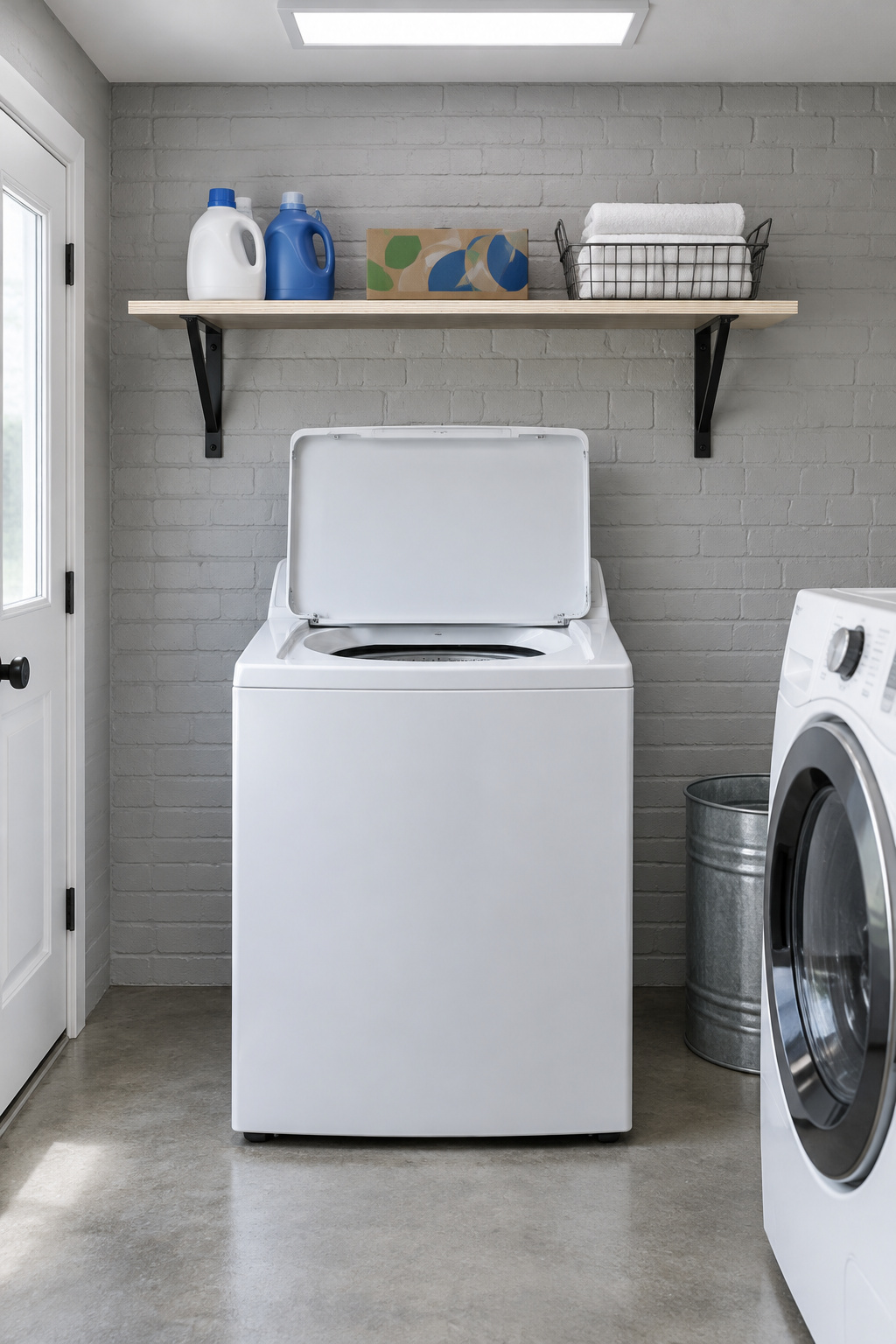
- Top-loader: hang the shelf’s bottom edge about 2 inches above the open-lid height printed on your spec sheet, measured from the floor. On a Whirlpool WTW5057LW-family washer that is roughly 58 3/8 inches off the floor.
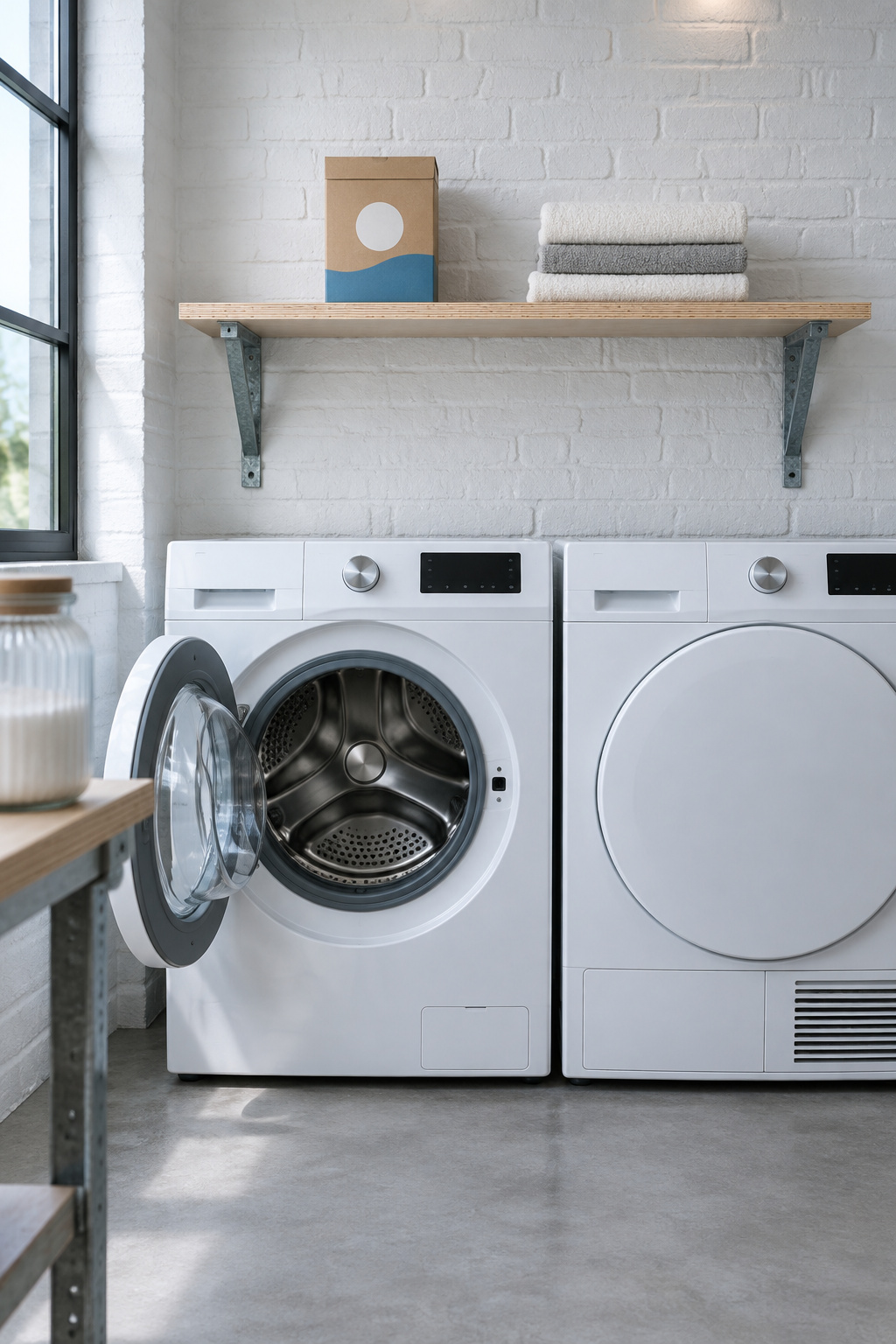
- Front-loader: the door swings sideways, so GE asks for only 1 inch above the cabinet, and comfortable reach sets the shelf, not the machine.
- Over a top-loader, plan one working shelf, not two: a second shelf usually lands above the 70-inch ceiling of NIOSH’s lifting model, so keep it for light things or leave it off.
Shelves Above Washer and Dryer: The Height by Machine Type, Before the Proof
A shelf is only as good as the reach and the clearance beneath it, and the wall is the least interesting part of laundry room open shelving. What decides the height is what moves below the shelf. A top-load lid swings up and back, while a front-load door swings out to the side.
By machine type, the short version:
| Machine type | What moves | Bottom-edge height rule |
|---|---|---|
| Top-load washer | Lid rises about 8–14 in above the closed top | Printed lid-open height + about 2 in, from the floor |
| Front-load washer | Door swings sideways | At least 1 in above the cabinet (GE); set by reach in practice |
| Dryer beside a top-loader | No lid | A continuous shelf follows the washer; a separate shelf can sit lower |
The 18-Inch Rule Tested Against Manufacturer Lid-Open Heights
Where does 18 inches come from? Houzz calls 18 inches above a countertop the standard for upper cabinets, and the figure has plausibly migrated from kitchen counters to machine tops. Nobody I read says so outright, and none of them measured a washer lid. So I set the rule against the three spec sheets I could find that print the height with the lid open.
Top-loaders: how far the lid really rises
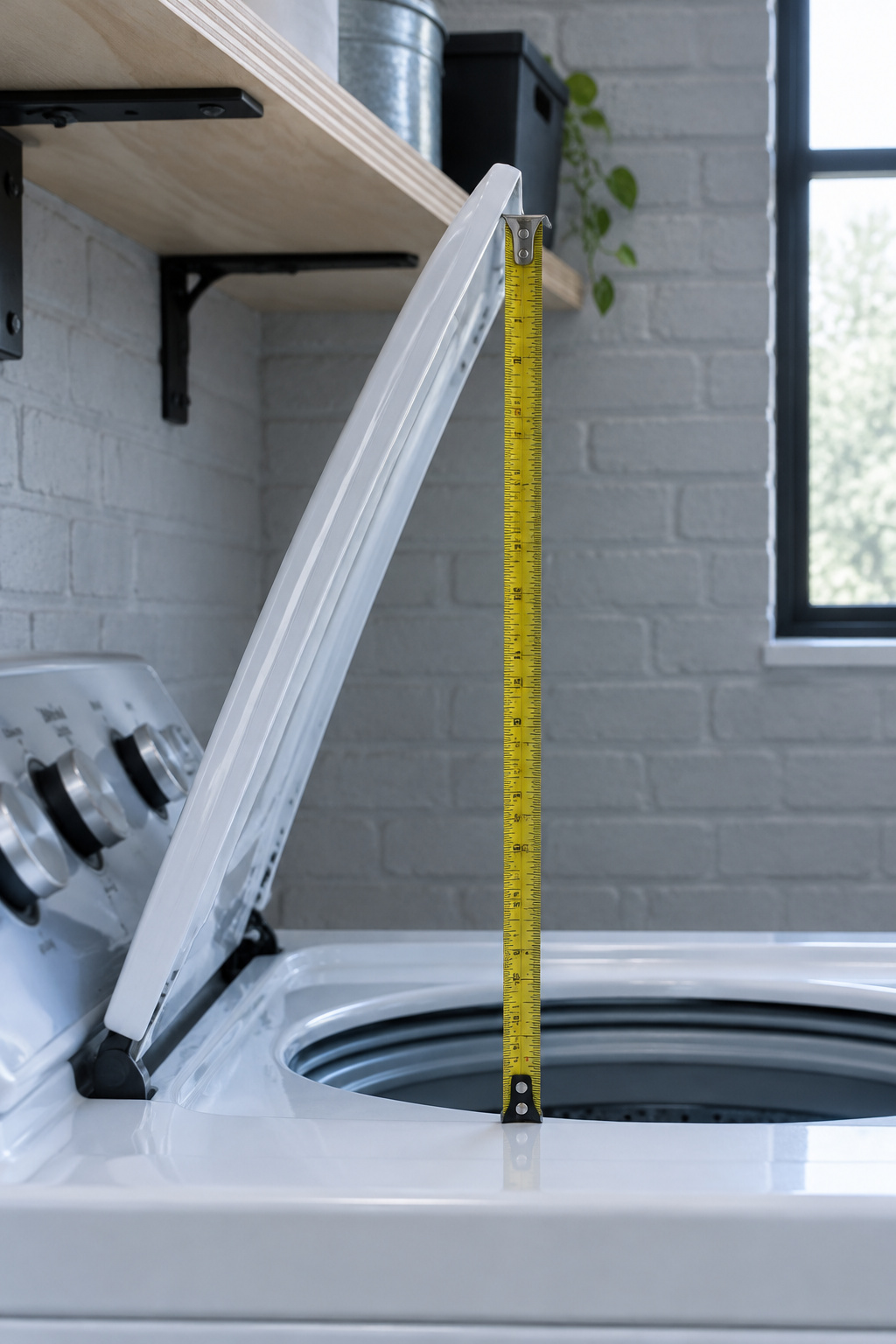
Whirlpool’s dimension guide for the WTW5057LW family prints the closed height as 41 1/2 to 42 1/4 inches and the lid-open height as 55 3/4 to 56 3/8 inches. LG’s sheet for the WT7005CW lists 44 1/2 inches closed and about 57 inches open. Maytag’s technical manual for the MVWP586GW gives 43 to 44 inches closed and 52 inches open.
Working it out, lid rise = open height minus closed height. Whirlpool 55 3/4 − 41 1/2 ≈ 14 1/4 in; LG ≈ 12.7 in; Maytag 52 − 44 = 8 in to 52 − 43 = 9 in. Margin under an 18-inch bottom edge: Whirlpool 18 − 14 1/4 = 3 3/4 in; LG about 5 in; Maytag 9–10 in.
The verdict, then: an 18-inch shelf clears all three lids by roughly 4 to 10 inches, and by about 3 3/4 inches on the Whirlpool, which leaves room for a hand on the lid’s edge and not much more. A second measurement disagrees, because manufacturers ask for more than 18 inches overhead at installation. Whirlpool’s top-load guide calls for 20 inches, Samsung’s WA50R5200AW sheet lists 21 inches on top, and a GE top-load installation sheet asks for 24. Those are closet and alcove install minimums, probably with servicing room folded in, though the sheets don’t explain them. They are not lid measurements, and I would not merge the two. The rule clears the lid; it does not meet the install clearance.
Front-loaders: where the door swing stops
For a front-loader the 18-inch rule answers a question nobody asked. The door swings out sideways, and GE’s installation instructions list a 1-inch minimum above the washer cabinet. If your front-load washer stands about 39 3/4 inches tall, as GE’s comparable model does, the machine would let a shelf start near 40 3/4 inches (my arithmetic: 39 3/4 + 1 = 40 3/4 in). Cabinet sizes and stacking are a separate subject, covered in the stackable washer and dryer guide.
Measure Your Own Machine in Four Steps Before You Mark the Wall
The mistake I most want to prevent is quiet and arithmetic: measuring the machine with the lid shut. Take Whirlpool’s closed top of 42 1/4 inches, add a generous-sounding 12, and you mark 54 1/4 inches, about 2 inches below where that lid stops (my arithmetic: 42 1/4 + 12 = 54 1/4 in; 56 3/8 − 54 1/4 = 2 1/8 in). The shelf ends up level, handsome and in the way.
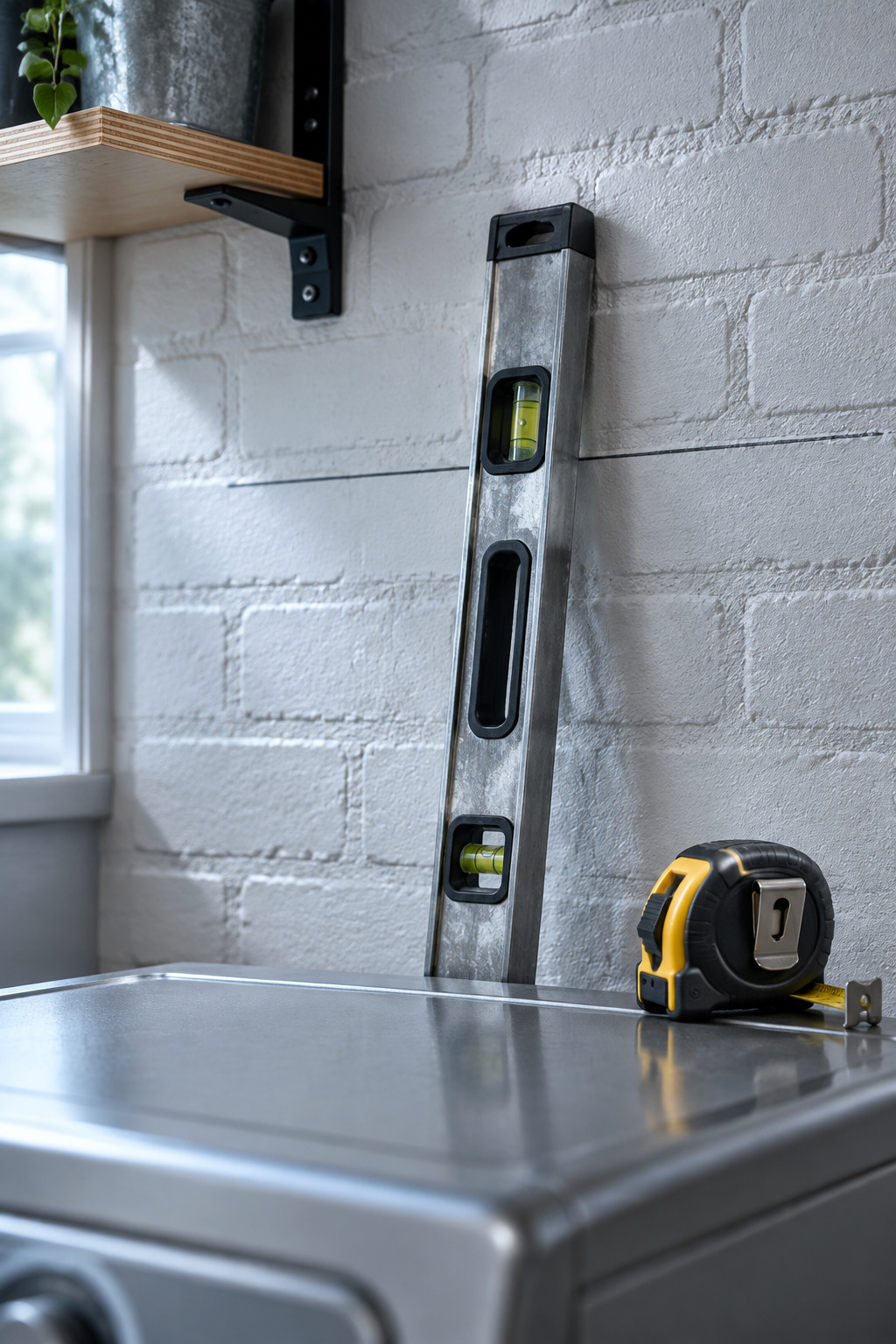
- Level the machine, then open the lid fully and measure from the floor to its highest point. Whirlpool prints heights as ranges because the feet adjust. Compare the tape reading with the “height with lid open” line on your spec sheet. Whirlpool, LG and Maytag all print one.
- Add a hand margin. I use about 2 inches over the open lid, which is my practice and not a standard.
- Mark from the taller machine. When one shelf runs across both machines, the top-loader’s lid sets the height. A dryer has no lid, so a separate shelf over it can sit lower.
- Mark the bottom edge on the wall, then find the studs before anything is drilled.
How Deep and How Far Apart: Shelf Depth and Spacing Above Machines
Depth decides what you can get down without a ladder. Over a top-loader you lean across a 27-inch-deep cabinet before your hand reaches the board, and NIOSH’s lifting model gives no credit to a lift once the hands are more than 25 inches out from the ankles. The arithmetic below is mine, and it rests on one assumption: that you stand with your ankles about 6 inches back from the machine’s front.
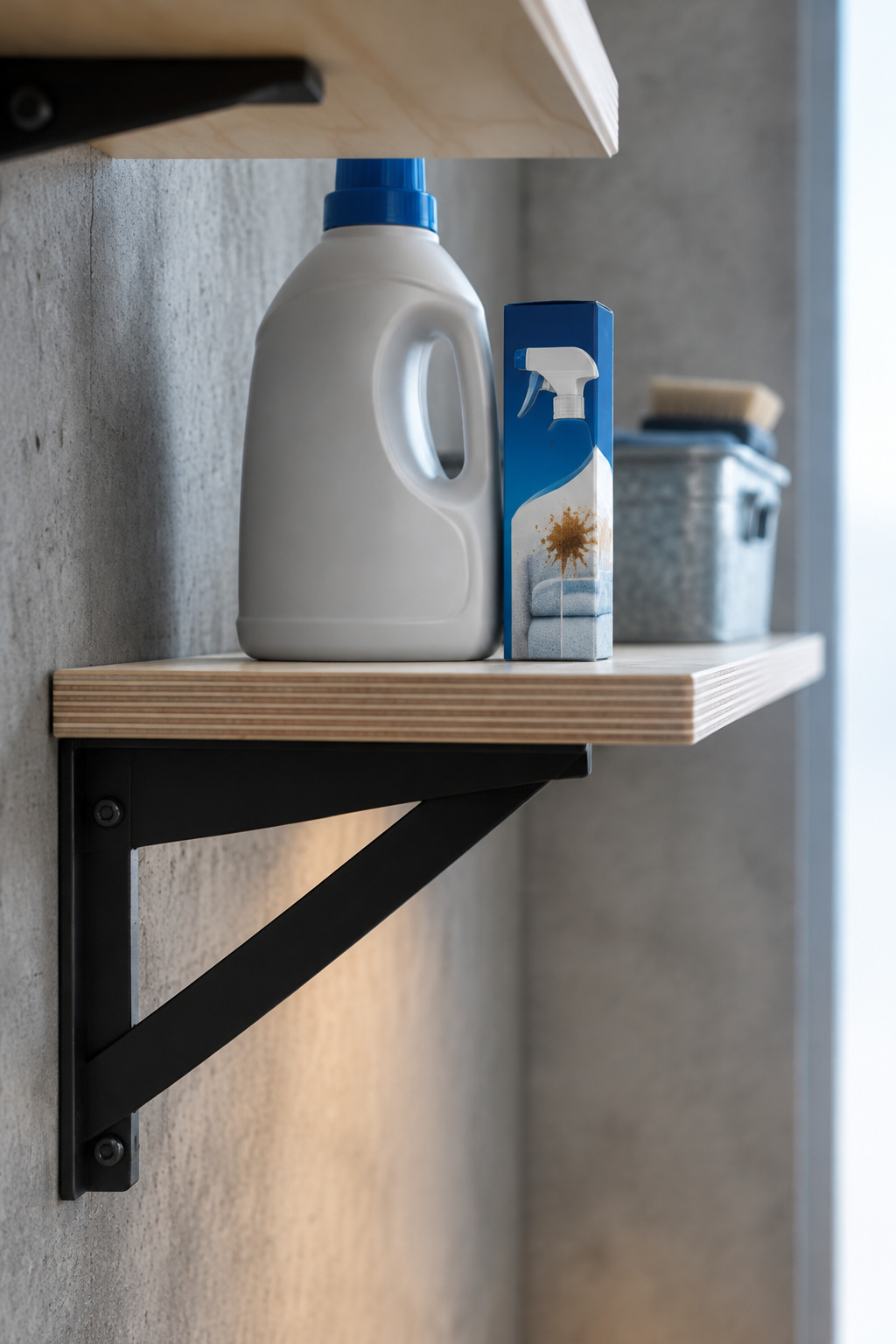
My own sum: front edge of a 12 in shelf over a 27 in machine = (27 − 12) + 6 = 21 in out, inside the limit; the back of the same shelf = 27 + 6 = 33 in out, well past it.
That is the argument for shallow shelving. The commonly cited working depth is 10 to 12 inches, and the 12-inch ceiling has an independent anchor in Houzz’s figure for standard laundry upper cabinets. Spacing is weaker ground. The usual 14 to 16 inches between shelves has only secondary support, and no source says whether the figure means board-to-board pitch or clear gap. With a 3/4-inch board the difference is 3/4 inch, so measure your tallest bottle and treat the numbers as a starting point.
| Shelf depth | Spacing | Suits |
|---|---|---|
| 8–10 in | 14–16 in | Tight closets |
| 10 in | 14–16 in | Most detergent containers |
| 12 in | 14–16 in | Baskets and larger stacks |
| 10–12 in | 10–12 in | A low accessories shelf |
The Reach Limit: How High a Person Can Safely Lift Down a Full Jug
Wall space will happily accept a second and a third shelf, but your shoulders are less accommodating. NIOSH’s Revised Lifting Equation is an occupational tool for two-handed lifts, and I am borrowing it as a yardstick, not a household rule. It puts the best lifting height at about 30 inches, the knuckle height of a 66-inch worker, and treats 70 inches as the upper limit. Above that, the model gives the lift no credit at all.
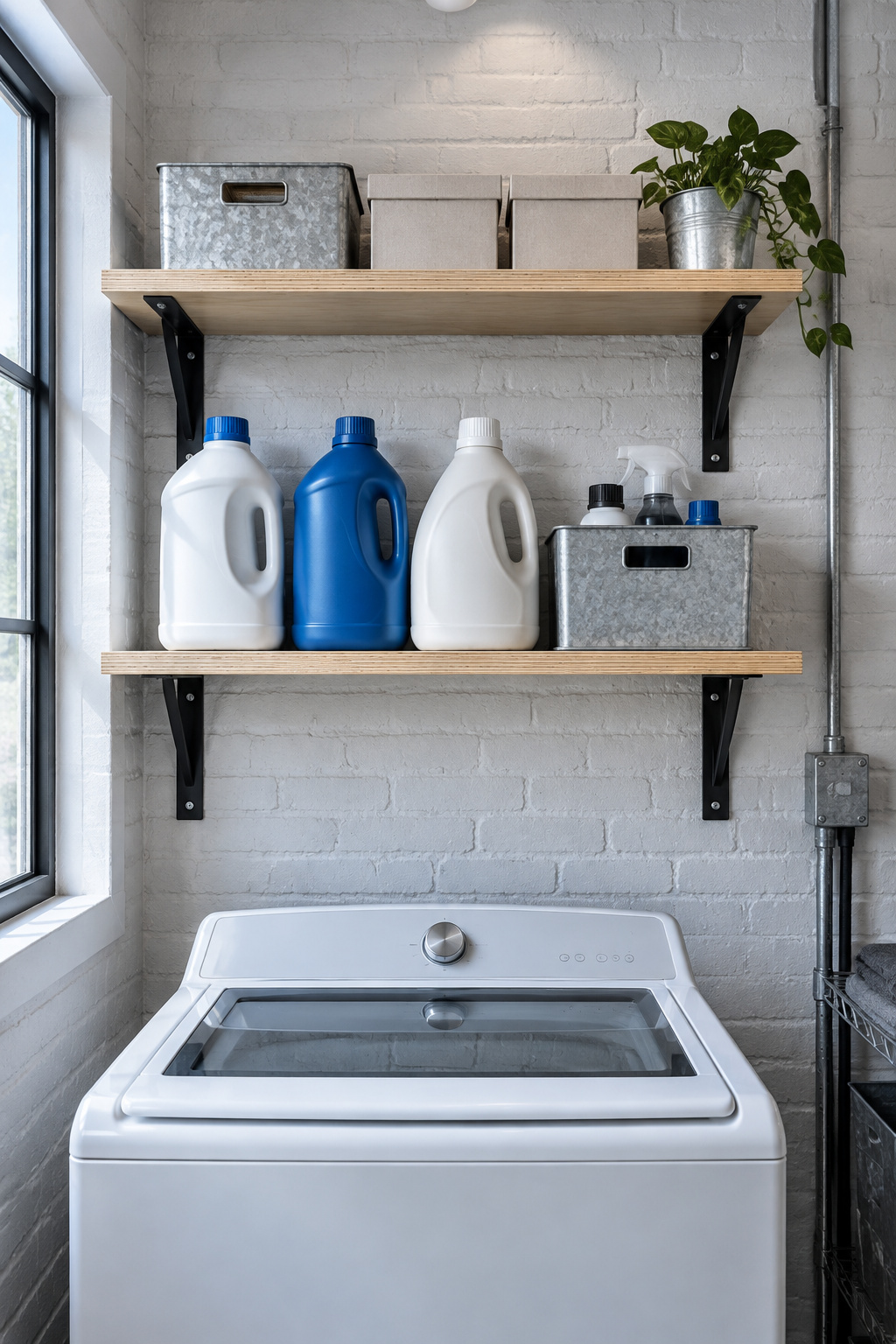
Now put the Whirlpool shelf into that model. I assume a 3/4-inch board and hands about 5 inches above the shelf surface when they grip a jug.
By my estimate, shelf surface = 58 3/8 + 3/4 ≈ 59 1/8 in; hands ≈ 64 in, inside the 70 in limit. A second shelf 15 in higher puts the hands near 79 in, outside it. Over a 40 3/4 in front-load shelf, the first two shelves keep the hands near 46 1/2 and 61 1/2 in; a third reaches about 76 1/2 in.
So the lid pushes the first shelf up, and the reach limit closes the door on the second. Over a top-loader, plan one working shelf, not two. The ADA’s forward-reach range of 15 to 48 inches, dropping to 44 when you reach over something deeper than 20 inches, puts any shelf over a washer outside accessible reach by design, so anyone who needs that range should store beside the machine.
Handling discipline: two hands, no overhead pours
My years in a university special-collections library taught me handling discipline, and it scales down to a laundry shelf. Lift a full jug down with two hands, since that is the only lift NIOSH’s equation describes. Set it on the machine top and pour there, never from overhead. Keep the heaviest things on the lowest shelf and the lightest on top. Once the height is fixed, the next question is how much a shelf can carry, and the guide to heavy-duty laundry room shelves that hold a full row of jugs works through it.
One Shelf, Two Shelves or a Rod Below: Your First Measurement
The old rule was one number for every machine. What holds instead is short enough to pin above the washer:
- Top-load: bottom edge = printed lid-open height from the floor + about 2 inches.
- Front-load: at least 1 inch above the taller cabinet, then set by reach.
- A continuous shelf takes its height from the taller machine’s lid.
- One working shelf over a top-loader; anything above it holds only light things.
When a hanging rod changes the number
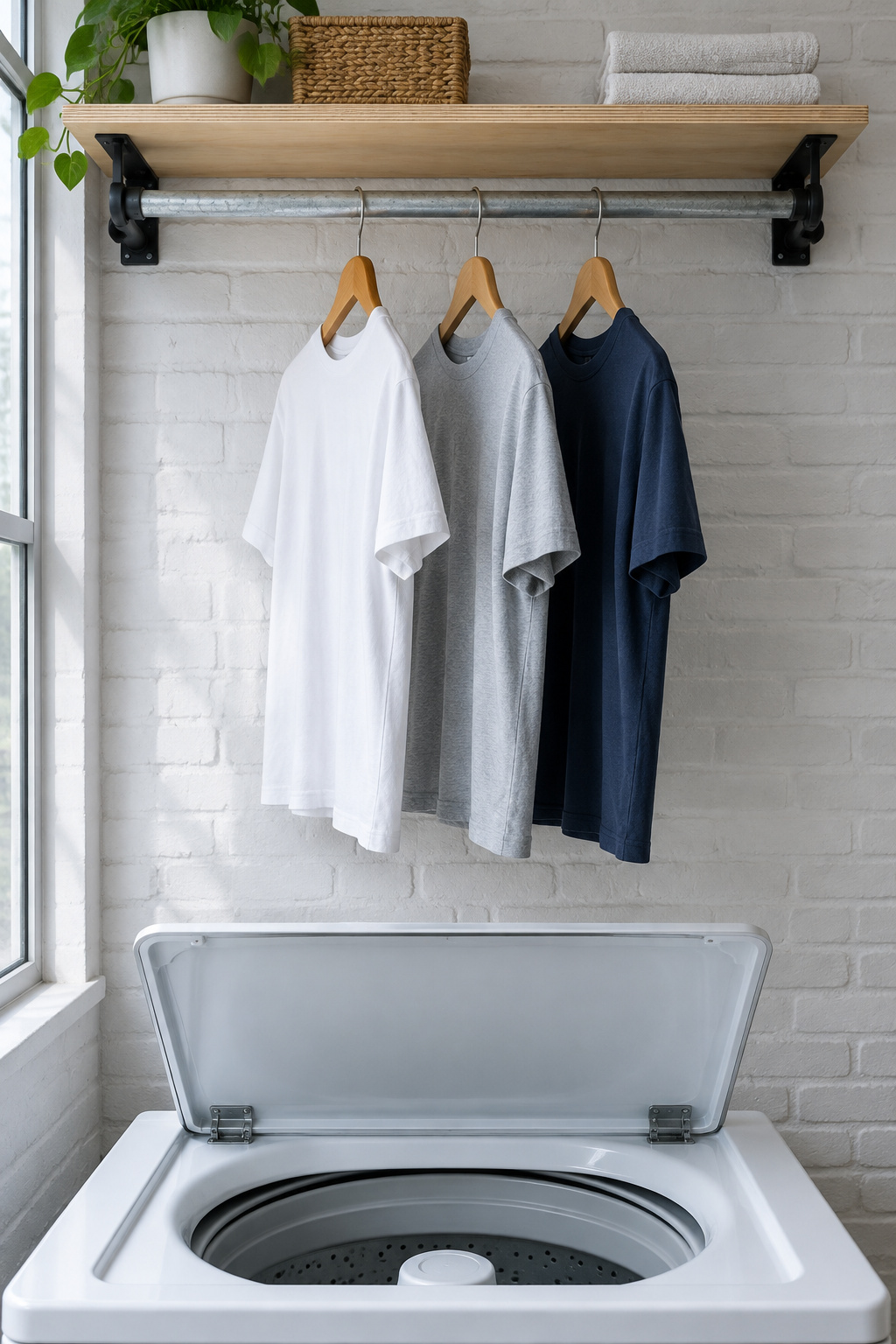
A rod beneath the shelf shares the same air as the lid. Whatever hangs from it has to clear the open lid too, so a rod below a shelf eats the clearance you just measured. At the recommended height the Whirlpool’s gap between open lid and shelf is only 2 inches, which leaves no room for a rod without raising everything. If you want one, the guide to a laundry room shelf with a hanging rod beneath it works out where it can go.
So open the lid, measure from the floor to its highest point, and check that number against the “height with lid open” line on your spec sheet.
FAQ
Can I put a shelf over a washer and dryer if the dryer vent or water supply box is in the way?
Usually yes, since hookups sit low. Samsung’s WA52DG5500AW diagram puts the hot and cold connections about 13 to 15 inches off the floor, well below a shelf set above the open lid. Dryer duct heights vary and have no standard, so measure where the duct leaves the wall and fix brackets to studs beside it.
Should an over-machine shelf run the full width of both machines or just one?
Either works, and the choice sets the height. Houzz notes side-by-side pairs typically fit within 60 inches, so a full-width shelf is roughly a 60-inch run that must clear the taller machine’s lid. A split shelf can sit lower over the dryer or a front-loader, neither of which needs lid clearance.
Does the shelf need to line up with the machines or with the wall studs?
The studs. According to The Spruce, studs run 16 or 24 inches on center and shelf standards should be screwed into them, and the American Wood Council’s framing guide uses the same 16-inch module. Center the shelf on the machines by eye, then place every bracket where it meets a stud.