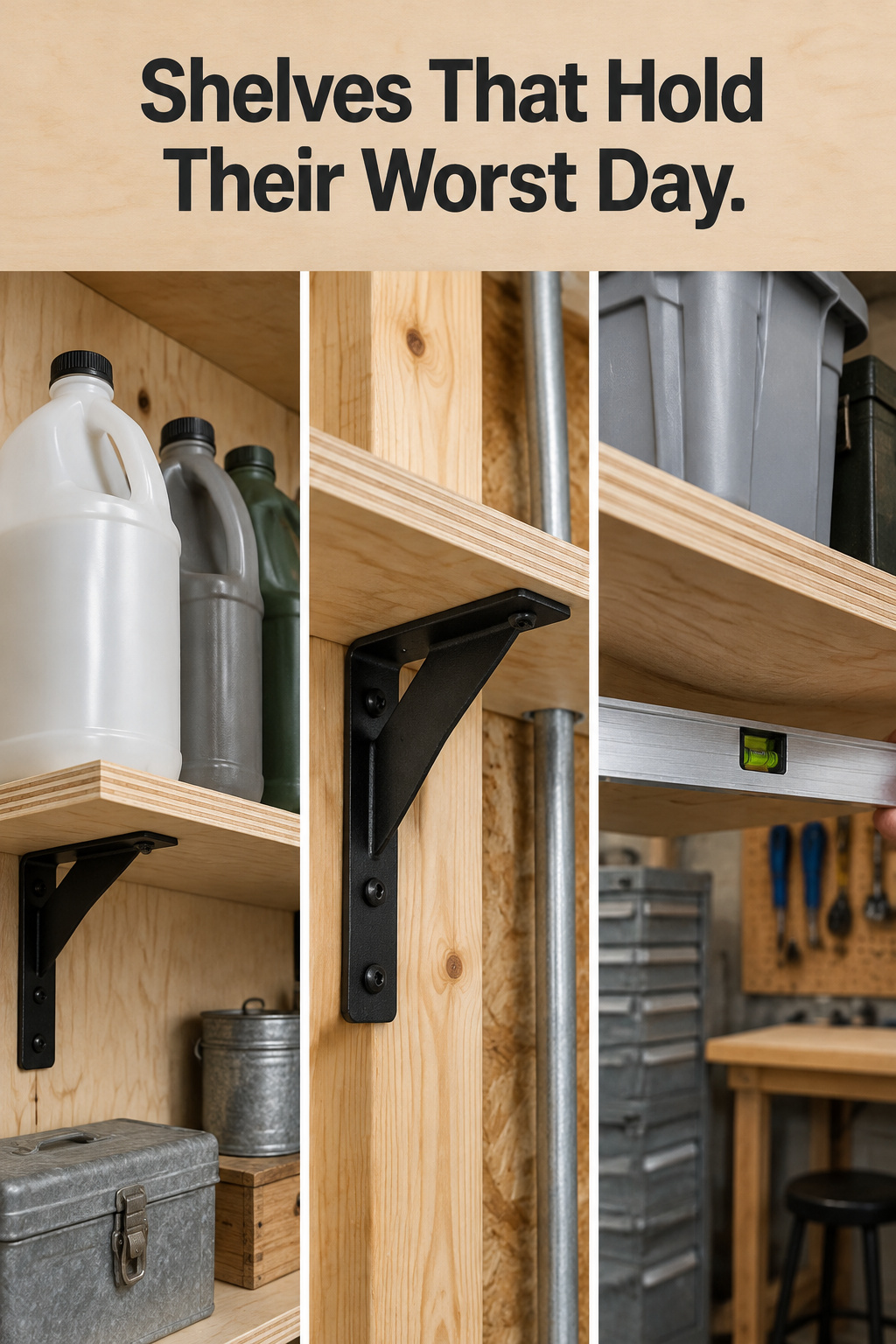
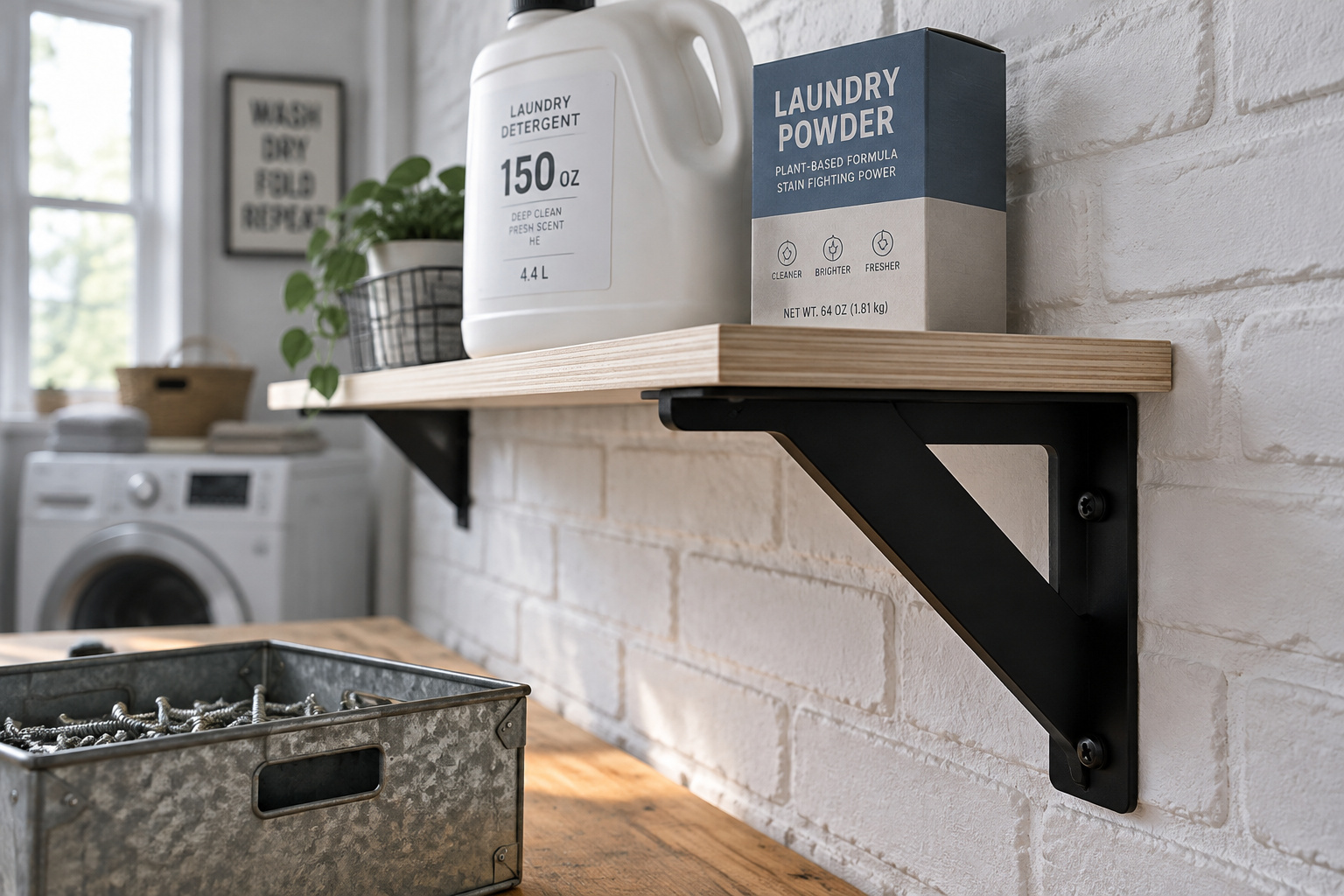
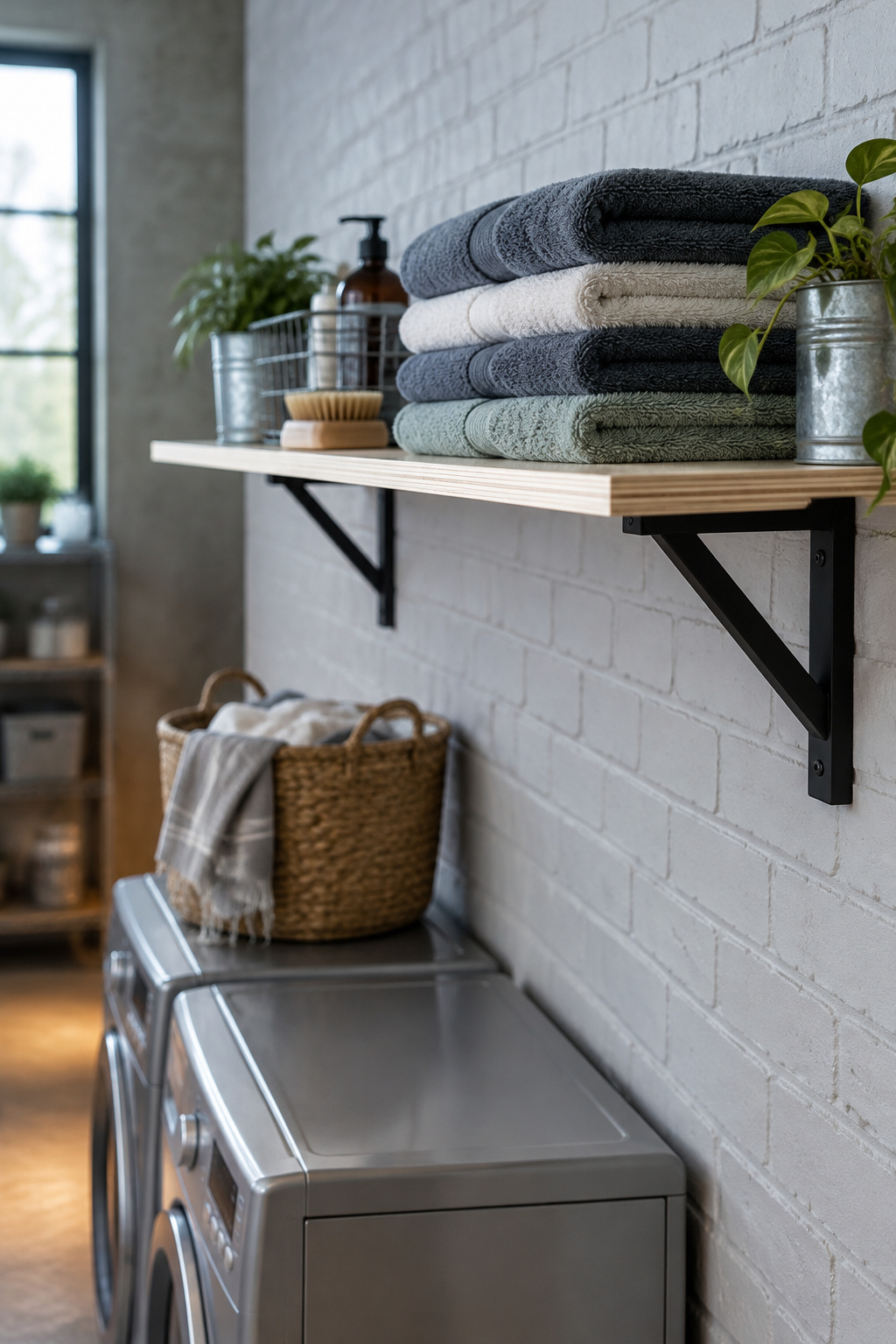
Before you buy a single bracket, do a sum. Two 150-ounce jugs of liquid detergent, two 92-ounce jugs, a box of powder and a tub of stain remover come to about 50 pounds on a 3-foot board, and a board lined with nothing but the big jugs reaches about 62. Heavy duty laundry room shelves are less a product than the result of that arithmetic, done first. Library shelving is specified against a stated load per foot, and a shelf of detergent deserves the same courtesy; guess instead, and the board bows by spring or meets the floor.
TL;DR
- A full 3-foot laundry shelf weighs about 50 lb, and a row of six 150-oz jugs pushes it to about 62 lb, slightly over the 40–60 lb figure usually quoted.
- Fix brackets into studs. The number on an anchor pack is usually an ultimate, and makers work at a quarter of it, so a toggle that pulls out at 238 lb is good for about 60.
- Use bracket arms two-thirds of the shelf depth, 16 in apart into studs, and keep 3/4 in plywood to about 32 in between supports or add a cleat.
What a Full Laundry Shelf Weighs, Item by Item
One large jug of liquid detergent, without its carton, weighs ten and a half pounds, give or take. I found no printed net weight for the bottle, which is the first small scandal of this subject. The jug gives volume and the maker’s safety data sheet gives specific gravity, 1.04 to 1.09, so multiply them (by my arithmetic, volume × 0.0652 lb per fluid ounce of water × gravity) and treat each result as “about”. A listing’s 10.97 lb shipping weight includes packaging.
| Item | What the pack prints | Weight, about | How it was reached |
|---|---|---|---|
| Liquid detergent, large jug | 150 fl oz | 10.2–10.7 lb | my arithmetic: 150 × 0.0652 × 1.04–1.09 |
| Liquid detergent, mid-size jug | 92 fl oz | 6.2–6.5 lb | my arithmetic: 92 × 0.0652 × 1.04–1.09 |
| Powder detergent box | 143 oz net | 8.94 lb | 143 ÷ 16 |
| Stain-remover tub | 7.22 lb | 7.22 lb | printed |
| Typical shelf: 2 large, 2 mid, powder, tub | — | about 50 lb (49.0–50.6) | my arithmetic: sum of the rows above |
| Six large jugs in one row | — | about 62 lb | my arithmetic: 6 × 10.37 |
So the 40–60 lb figure that circulates for a loaded laundry shelf holds for the typical case and runs low for the worst, and as a ceiling it should read “about 50, over 60 when it is all big jugs”. The six-jug row assumes the narrow 5.65 in side faces out. Turn the 9.1 in side forward and three fit, at about 31 lb. A basket of towels is extra, and unweighed here.
Here is the sum: 50 lb over 3 ft is 16.7 lb per linear foot, and the six-jug row 20.7. Paperbacks weigh about 6 lb per foot and small hardcovers about 20, so a full detergent shelf is loaded like a shelf of textbooks. That number drives every other decision about open shelving in a laundry room.
Stud, Anchor or Both: What Actually Holds a Heavy Laundry Shelf to the Wall
The most expensive misreading in a hardware aisle is the large number on an anchor pack. The engineering here comes from fastener makers and the USDA’s Wood Handbook, while the habit of totalling a shelf before trusting any fixing is mine, learned in library work.
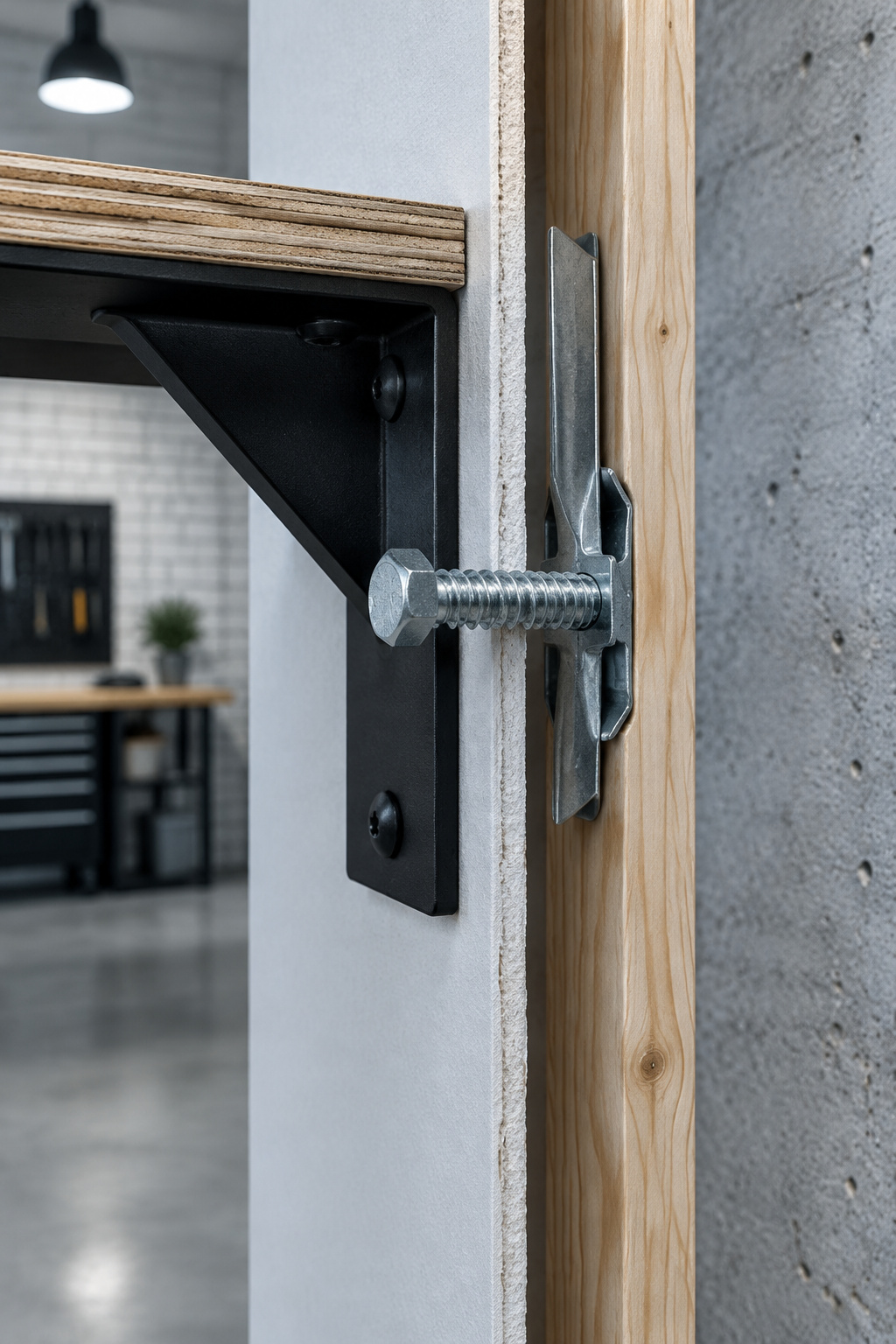
Fixing into studs
The Wood Handbook’s withdrawal equation gives a 5/16 in lag screw in a light softwood stud about 921 lb per inch of thread on my own estimate, assuming a specific gravity of 0.42. That is the point of failure, so apply the anchor makers’ quarter rule: about 230 lb per inch, room to spare for any laundry shelf. Measure the studs, though, because 16 in on center is only a convention born of 4×8 sheets.
Drywall anchors: what they are rated for and where that rating stops
Toggler’s heavy-duty SNAPTOGGLE pulls out of 1/2 in drywall at 238 lb and of 5/8 in drywall at 356 lb. Those are ultimate test loads, and Toggler’s own sheet says to work at a quarter of them; DeWalt, independently, asks for a safety factor of at least 4 (5 in hollow masonry). Holding strength also falls as the load sits farther from the wall.
| Fixing | Printed (ultimate) | Working load (÷ 4) |
|---|---|---|
| 5/16 in lag into softwood stud | about 921 lb per inch of thread | about 230 lb per inch |
| SNAPTOGGLE BA, 1/2 in drywall | 238 lb | about 60 lb |
| SNAPTOGGLE BA, 5/8 in drywall | 356 lb | about 89 lb |
| SNAPTOGGLE BB, 1/2 in drywall | 265 lb | about 66 lb |
What does a fixing bear? My own working, with simplified statics: the 62 lb shelf on two brackets puts 31 lb on each, and if the bracket’s screws sit 8 in apart with the load centered 6 in out, the top screw is pulled at about 23 lb (31 × 6 ÷ 8). A toggle carries that comfortably, while a plain plastic plug, good for perhaps 10 to 25 lb, does not. Any hollow-wall anchor’s capacity depends on the anchor, so read the pack and divide by four. Wire shelving is rated per foot and depends on its clips, and the guide to upgrading wire shelving covers it.
Shelf Brackets for a Laundry Room: Rating, Arm Length and Spacing
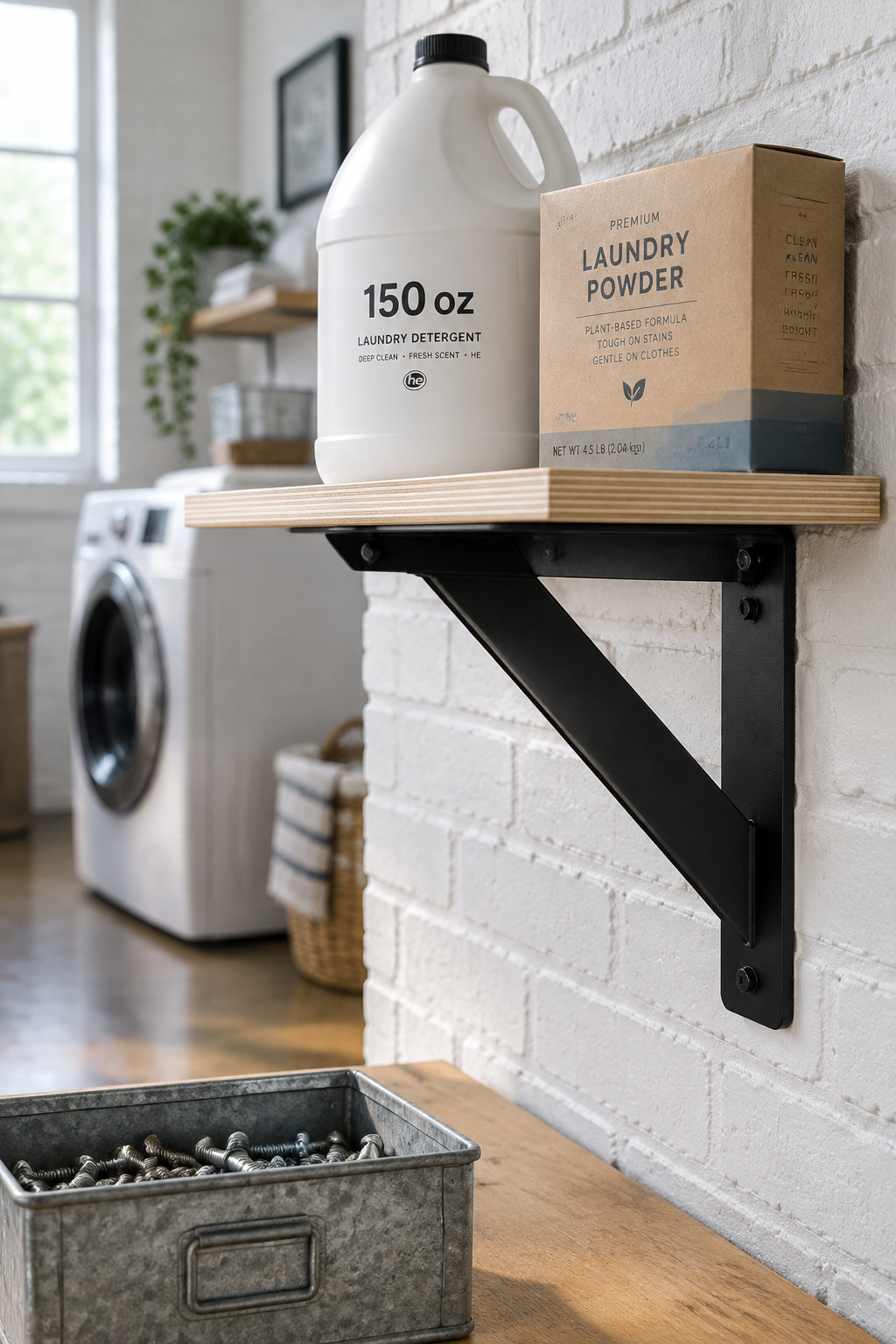
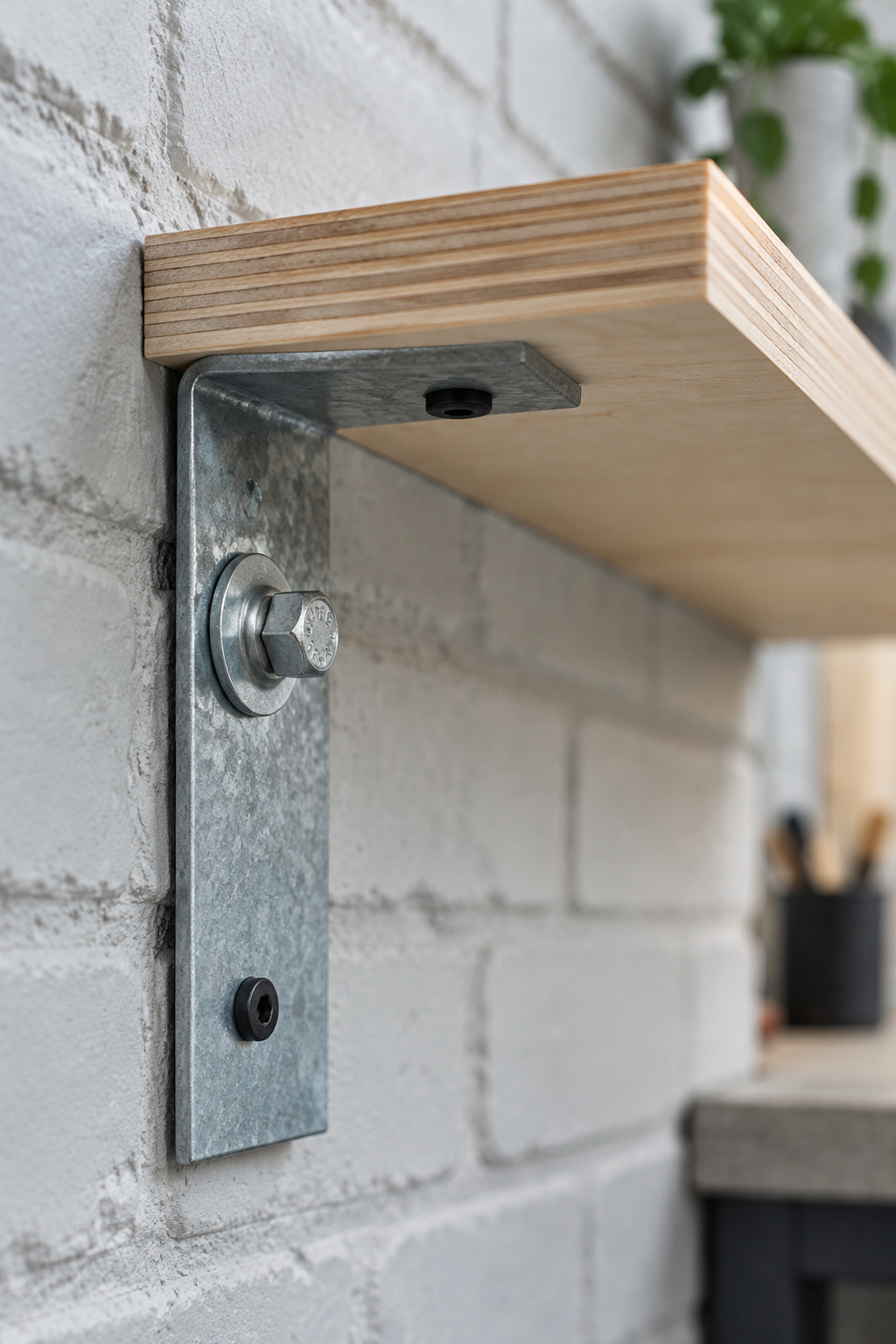
What, exactly, is a bracket’s rating a rating of? I found no standard test method defining one, and packs differ on whether the figure is per bracket or per pair, so if the small print is silent, assume per pair. The bracket tells you more than its label: thin stamped decorative brackets are not made for jugs, whereas thick steel, welded joints and a triangular gusset are. Arm length and spacing do the rest:
- Arm at least two-thirds of the shelf depth. A 12 in shelf wants an 8 in arm; a 15 in shelf, 10 in.
- Brackets at 16 in on center, into studs. Where the studs actually are beats any calculated spacing.
- End overhang of about 6 to 9 in. A 48 in board on brackets 32 in apart overhangs 8 in at each end and passes; a 36 in board on brackets 16 in apart overhangs 10 in and does not.
- Capacity comes from connections, not length. A longer board carries more only if it reaches more studs.
If you would rather the hardware disappear, a floating shelf built to carry its load is the next step, and it faces the same test: set its rating against your own sum before a single jug goes up.
Why Laundry Shelves Sag in the Middle: Span, Thickness and One Honest Threshold
My grandfather left me 2,400 books, which I cataloged over one winter, and a collection that size is a load problem before it is anything else. Working it out, at an assumed 10 to 12 books per foot (my assumption, not a measurement), 2,400 books need 200 to 240 ft of shelf, and at the weighed 20 to 32 lb per foot of small to large hardcovers that is somewhere between 4,000 and 7,680 lb. Two to nearly four tons of reading would bow its boards, if they bowed at all, in one place: the middle of the span, where an evenly loaded shelf sags most. Detergent obeys the same physics, with more sloshing.
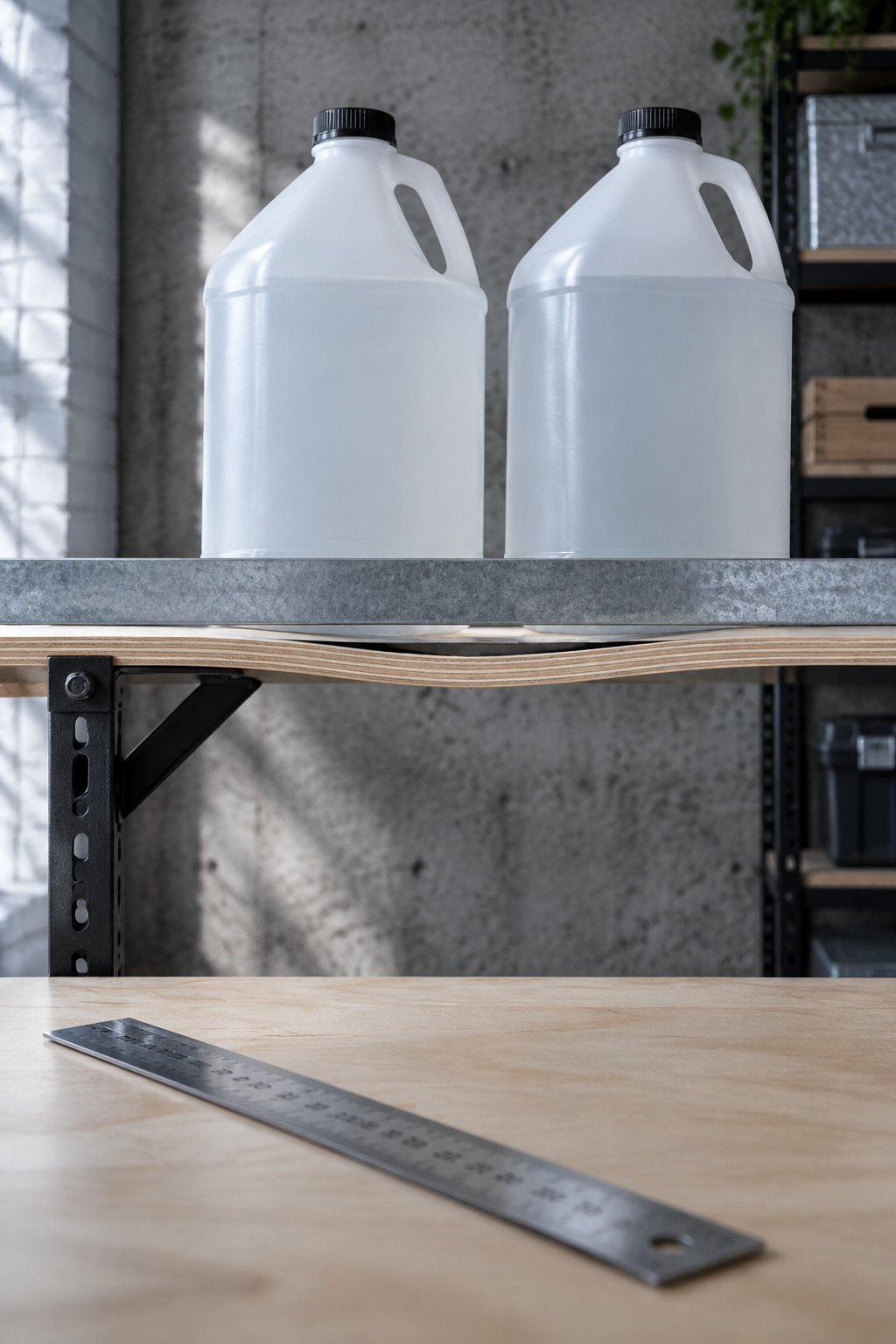
Board thickness against span
Sag grows with load per foot and with the fourth power of the span, so a little extra length costs a great deal. WoodBin measured a 12 in deep, 3/4 in pine plywood shelf with free ends:
| Span | 20 lb/ft | 30 lb/ft | 40 lb/ft |
|---|---|---|---|
| 30 in | 0.03 in | 0.05 in | 0.07 in |
| 36 in | 0.07 in | 0.10 in | 0.14 in |
| 42 in | 0.13 in | 0.18 in | 0.24 in |
At 36 in and 30 lb per foot the board sags about 0.10 in, which is exactly span ÷ 360, and the visibility rule woodworkers quote, 1/32 in per foot, gives 0.094 in on the same board, so the two thresholds are one criterion. That rule appears in Fine Woodworking (Jeff Miller) and on WoodBin, which credits only “published references”, and I could not trace it further back. A looser reading exists: Jon Eakes, as quoted second-hand on a forum, puts noticeable sag at span ÷ 240 to span ÷ 180, or 0.15 to 0.20 in over 36 in.
Time matters too: Miller warns that sag can grow by half or more under a load left in place, so design for 0.02 in per foot, about 0.06 in on a 3 ft shelf. As a practical ceiling, 3/4 in plywood spans about 32 in without visible sag, 42 in with one 1-1/2 in cleat and 48 in with two.
Plan for the Worst Day: Margin, Loading Order and Vibration Creep
Size the shelf for its fullest, not its average. Take the six-jug row and add a towel basket, assumed at 10 lb because nobody here weighed one: 72 lb on a 36 in board, or 24 lb per foot.
My own working, by the standard beam formula with plywood stiffness assumed at 1.2 million psi: that board sags about 0.086 in. That passes the 0.094 in visibility line but fails the 0.06 in creep target, marginal, so add a rear cleat or a third bracket. Each bracket now carries 36 lb, and its top screw is pulled at about 27 lb, still under half a toggle’s 60 lb working load.
Two corrections to the folklore. By my estimate, a single heavy jug at mid-span bends the board only 1.6 times as much as the same weight spread evenly (384 ÷ 240), not the fourfold figure that circulates. A rigid center support cuts sag to a fraction, in my own working about 1/38 in theory for an evenly loaded shelf continuous over it, far better than the one-eighth often given, provided the support does not move. My loading rules, which are practice rather than standard:
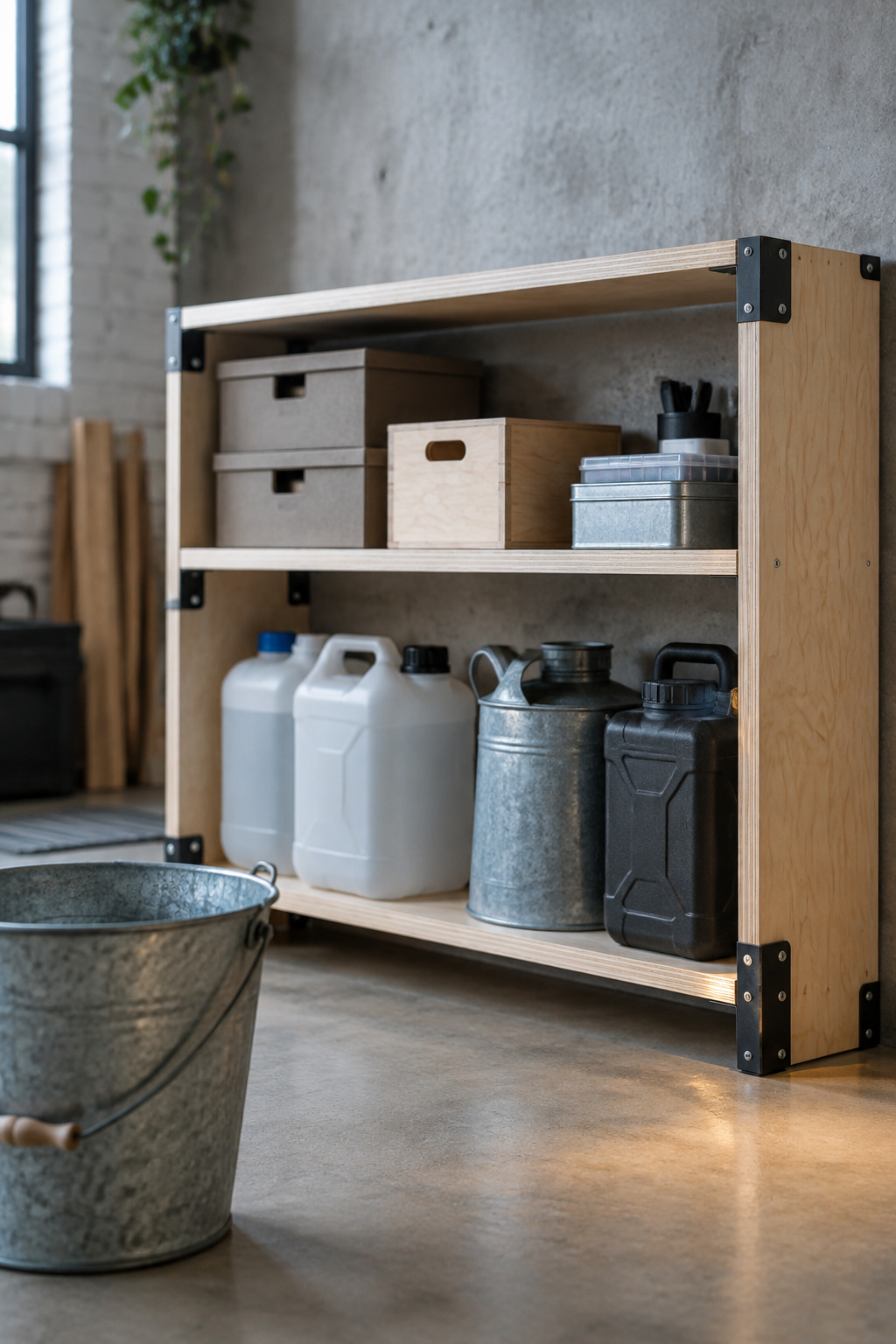
- Put the heaviest jugs on the lowest shelf and close to a bracket, never alone at mid-span.
- On a wall the machines share, expect jugs to creep toward the edge.
- Check sag with a straightedge after a season loaded, not on the day you hang it.
Pipe or Plank: The Few Load Principles Worth Keeping
Five things to carry into a hardware shop:
- Your own sum, written down, for the fullest shelf you can imagine.
- A stud map, so the brackets land in wood rather than on an anchor’s ultimate.
- Gusseted brackets whose arms reach two-thirds of the way across the board.
- A span you can defend: about 32 in of 3/4 in plywood, or a cleat.
- A straightedge, to check again after a season loaded.
Avoid decorative brackets under jugs, a top screw in bare drywall, and a long span justified by how the empty board looked. None of this cares whether the support is steel or iron pipe, since the board still spans and the fixings still pull. Where the hardware becomes the look, pipe and flange shelving built for heavy loads covers sizing fittings, flanges and pipe, and that is where this arithmetic hands over.
FAQ
How do I fix a laundry shelf that is already sagging without taking it down?
Shorten the span or stiffen the board. Unload the shelf, shim it straight, then add a rigid center bracket or a 1 to 2 in cleat along the front or back edge; one cleat lets 3/4 in plywood span about 42 in instead of 32. Check the result with a straightedge not by eye.
What should I use to hang a heavy shelf on a plaster or concrete block wall?
On plaster, find the studs and screw into them with screws at least 2 in long, drilling slowly, because toggles between studs can make plaster bulge. In hollow concrete block, a 3/16 in Tapcon pulls out at 340 lb in medium-weight block, so work it at about 85 lb.
Are steel brackets always stronger than wood for a heavy shelf?
No, it depends on the design. I found no source comparing the two directly, and a thin stamped steel bracket can be weaker than a deep solid-wood one. Strength comes from thick material, welded joints, a gusset, an arm two-thirds of the depth and fixings into studs.