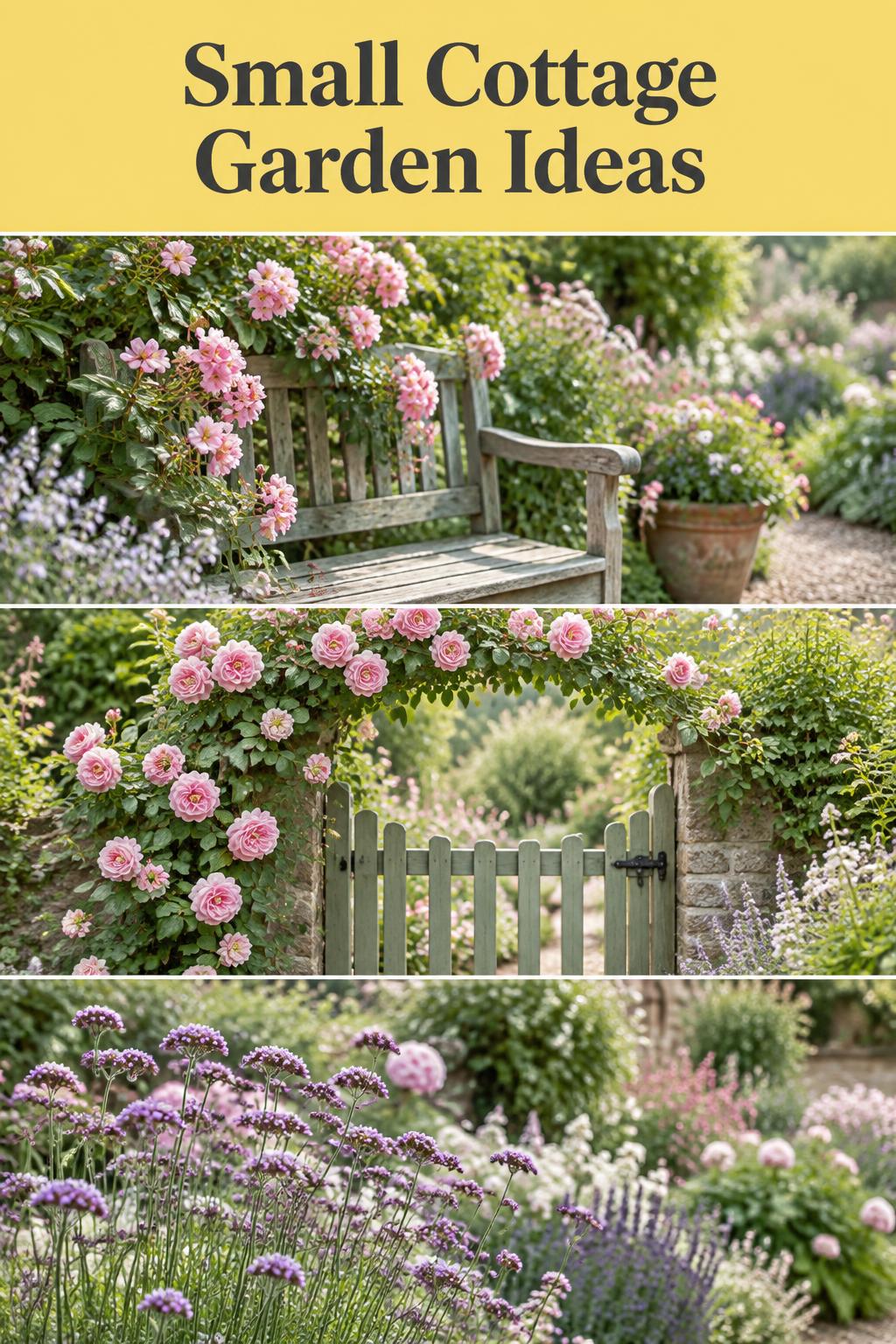
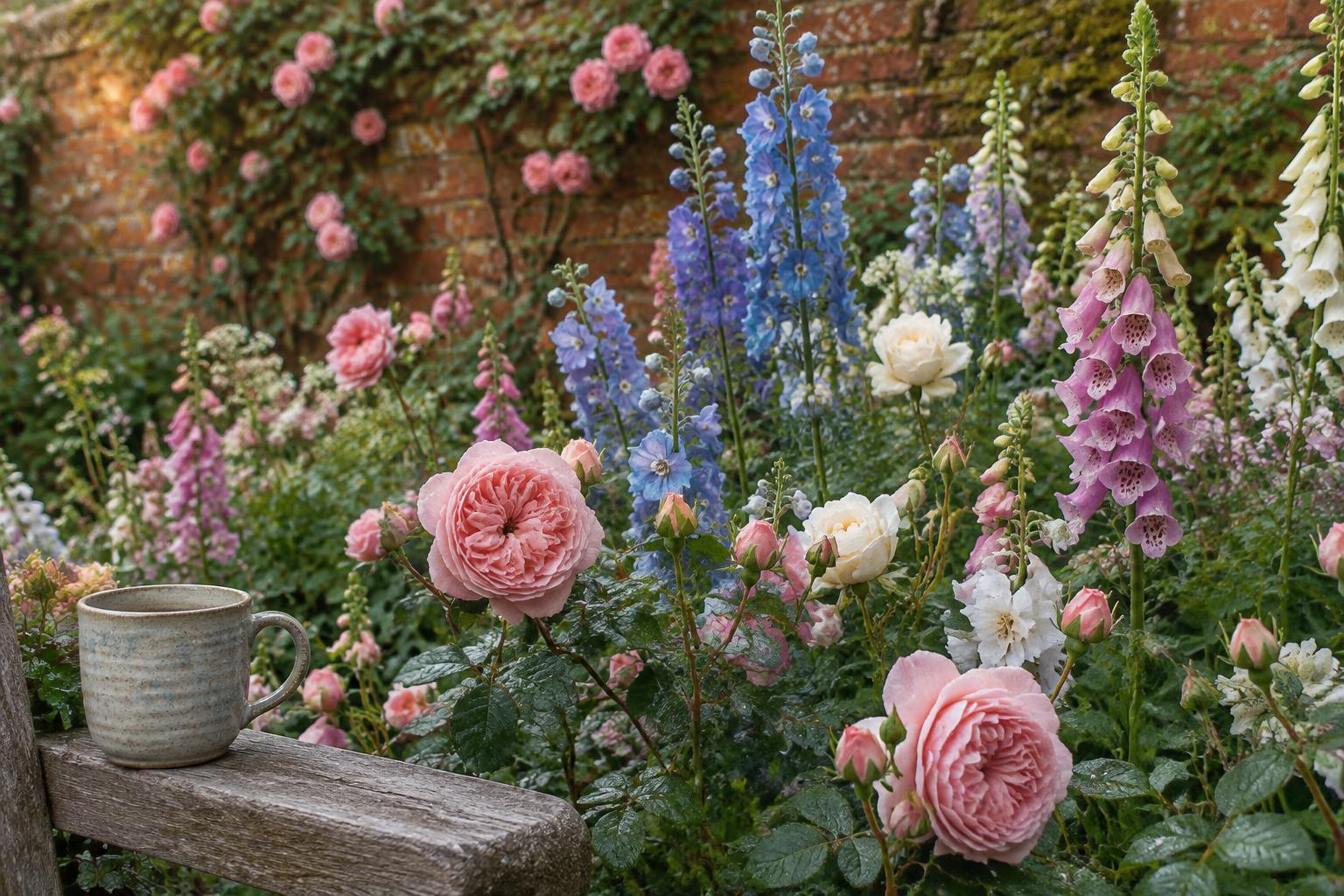
You’re on a bench no wider than a kitchen chair, coffee going cold on the arm, and the garden is right there with you. A purple head of verbena sways within reach. The rose on the fence behind you has dropped a petal on your sleeve. The soil still smells of last night’s rain, and a bee is working the flowers close enough that you can hear it. That’s the feeling all those small cottage garden ideas you’ve pinned are chasing: sitting inside the planting instead of looking at it from across a lawn. The arches and gates look lovely alone, and none tells you where to start. In a tiny backyard, start at the seat. Where you sit decides where the path runs, where the height goes and what grows within reach, and the old rule about planting in threes turns out to be a habit you’re free to break.
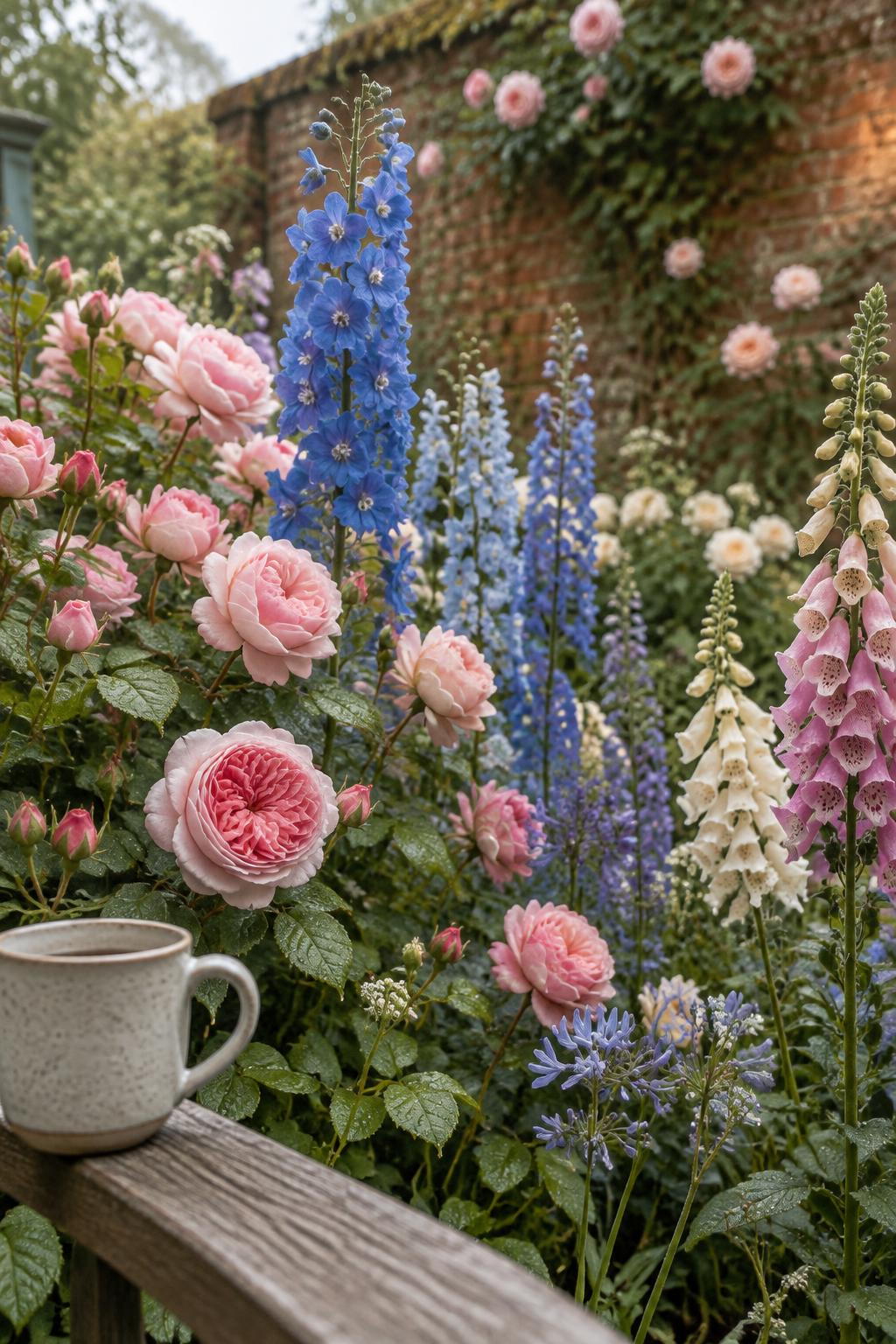
TL;DR
- Pick the seat first, ideally one you can see from the house, since a seat in view draws you outside, then run one short path from it to the door.
- Put the height on walls and fences with a climbing rose tied as close to horizontal as you can get it, and set see-through Verbena bonariensis at the front so the bed stays open from the seat.
- Grow fewer kinds and repeat them. Groups of three or five are a design habit, and a few years in, plants without a strong shape blend into one mass anyway.
Small Cottage Garden Ideas Begin at the Seat You’ll Use
A client of mine once built a full outdoor kitchen and then mostly used the grill. Since then I ask people what they actually cook outside, and I size the space for real use.
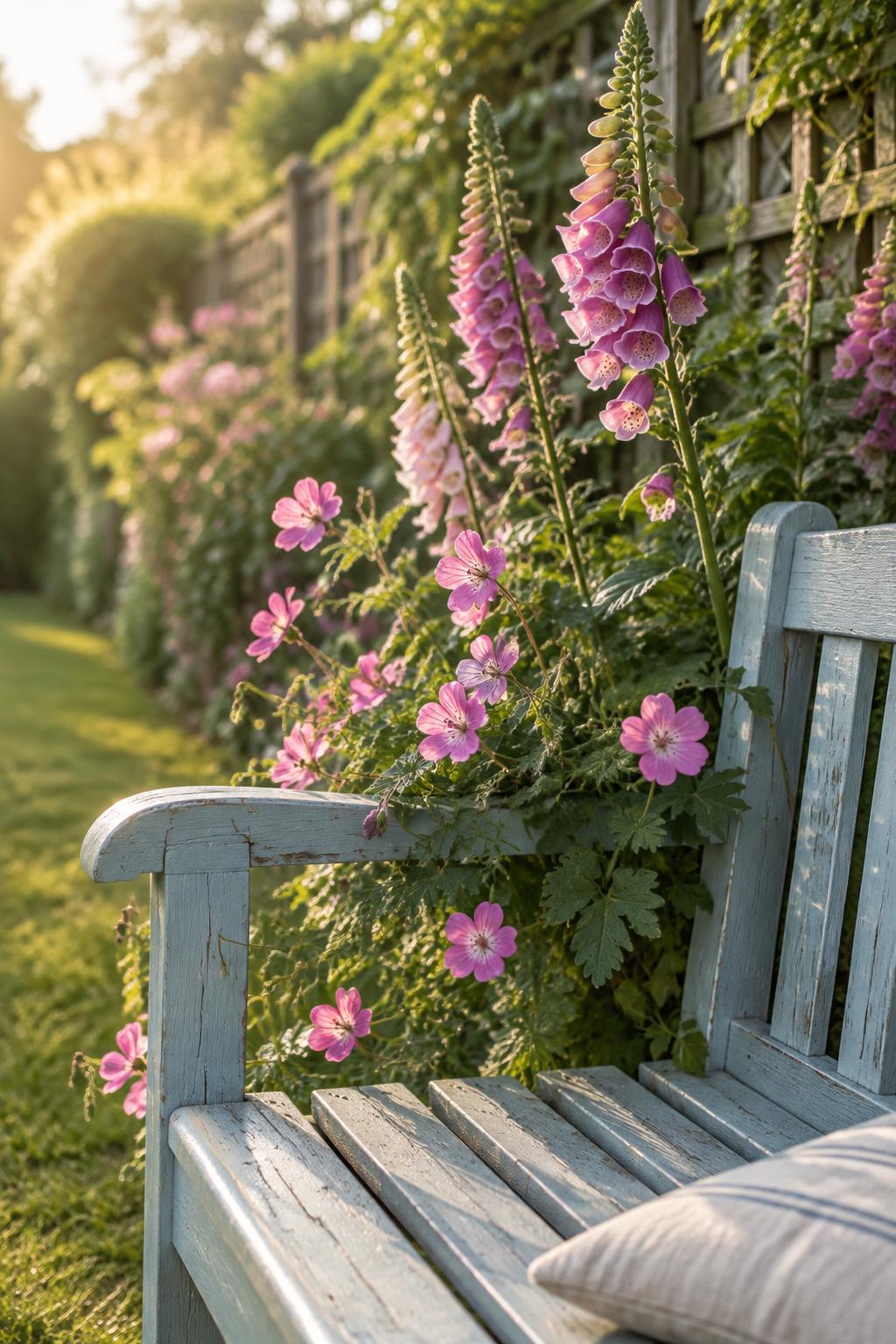
A small cottage garden is the same lesson at a smaller scale. Before you choose a rose or an arch, decide what the yard is for on an ordinary day. Coffee before work? A plate on your knee on a warm evening? Somewhere to sit while the kids dig? Each answer puts the seat in a different place, and the seat is where you’ll judge every plant you buy. Stand there at six o’clock, or whenever you’d really be out, and watch where the sun lands and where the shade falls.
Then check the view from indoors. The RHS, Britain’s gardening charity, makes the point that a seat you can see from the house draws you out into the garden, and that the view from wherever you look out most, the kitchen sink or the living room, deserves priority. In a small yard a border is seen from two places, the window and the seat, so plan it from both. The wider order of planning a cottage garden starts with the ground; in a yard this size, the planting choices start here.
If you can, build the seat in. Built-in seating beats chairs on a small patio. A bench built against a wall or into the edge of the bed stays put, so the planting can grow right up to it and brush your legs. Chairs get dragged around, and the bed retreats from wherever they last landed.
One Short Path From the Seat to the Door
How do you get from the back door to that seat with a mug in one hand? In a small yard the path is only a few steps, and it’s part of the planting: the stretch where flowers lean in and you walk through them.
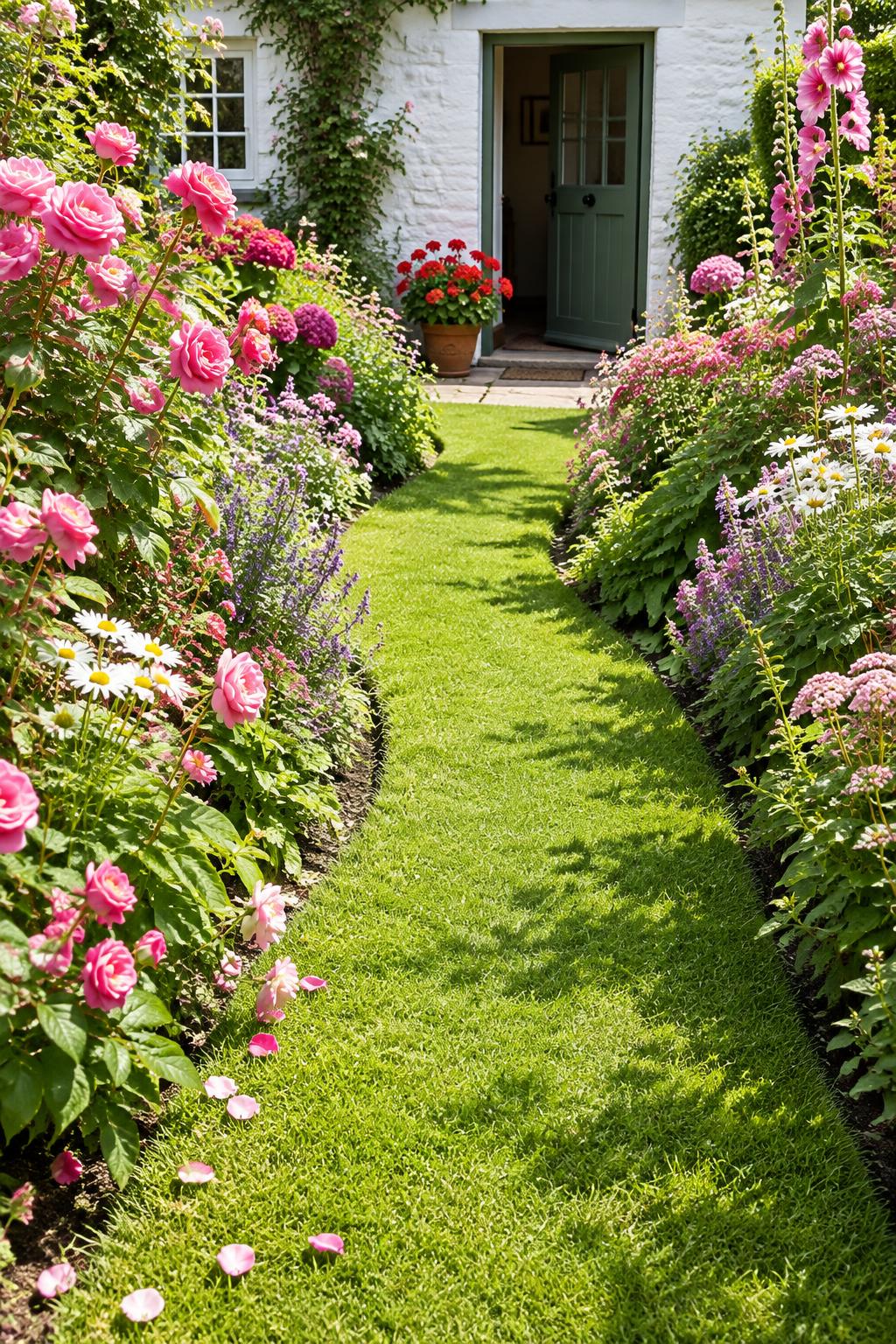
Run it where you actually walk, on the wet morning as well as the dry evening, not where it looks tidy on a sketch. A straight line looks formal and a curve feels natural. Pick whichever matches the way your household moves. One path is plenty.
Give the path an ending. A single plant can carry a spot on its own if it’s placed on purpose, next to a gate or door or at the end of a path, and then it looks deliberate rather than random. At the other end of the scale, low spreading plants such as erigeron and thyme do well in the poor, well-drained cracks along a path, and some are tough enough to take being walked on. Path widths and materials have their own guide in the garden path article; here the path only has to know where it’s going.
Go Up, Not Out: Let the Fence, Wall and Gate Carry the Height
Floor space is the one thing a small yard can’t give you, so the cottage look has to climb. The RHS describes small-space planting as thinking in every direction: up, along, around and through. Roses, wisteria and honeysuckle up the walls and fences use space a bed can’t reach.
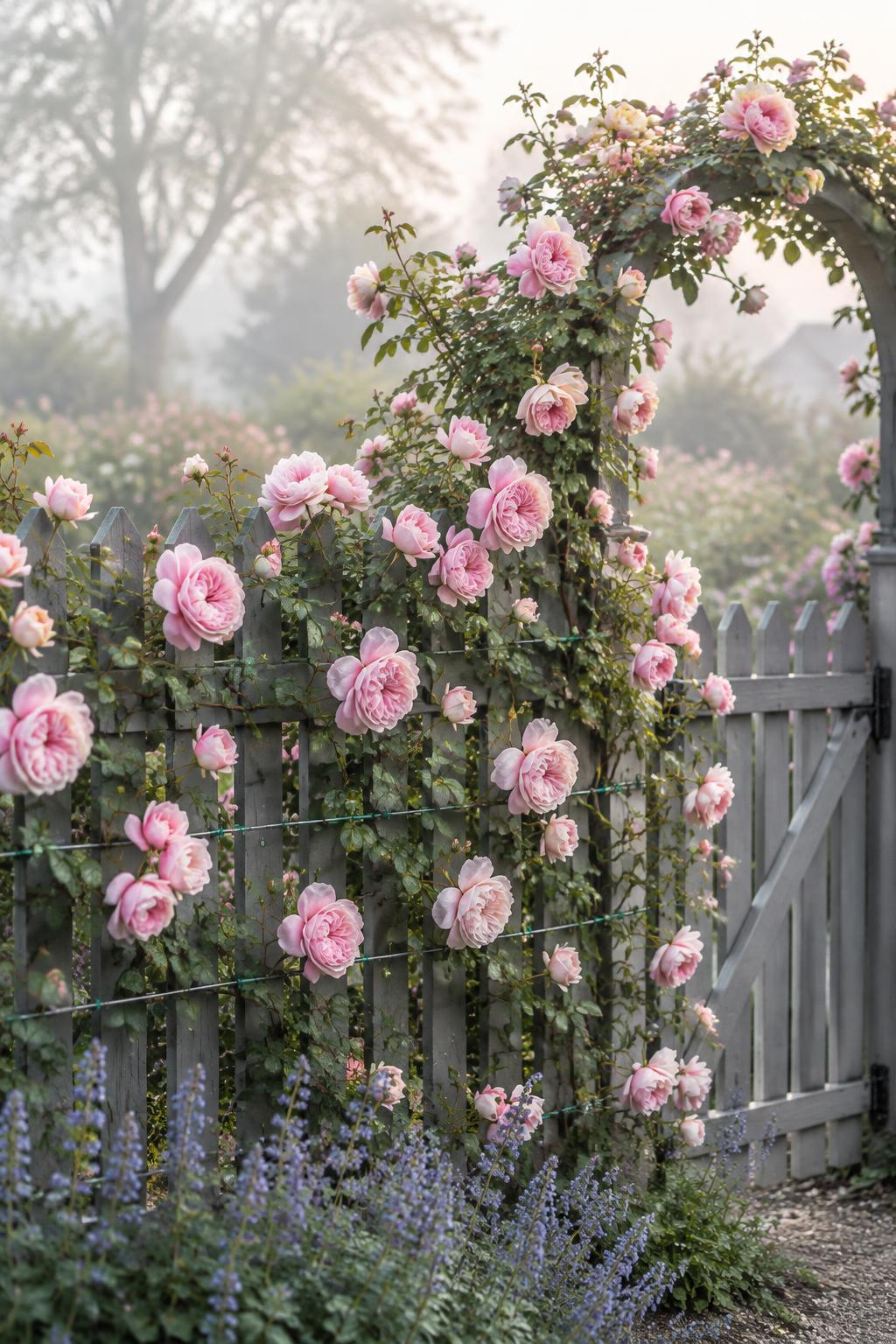
Climbers do a second job in a small garden. If your yard is boxed in by mismatched fencing and a neighbor’s wall, cloaking that patchwork in evergreen climbers pulls it together and makes the garden feel larger. Anything tall leads your eye up toward the sky and away from how little ground there is.
A climbing rose on the fence or arch
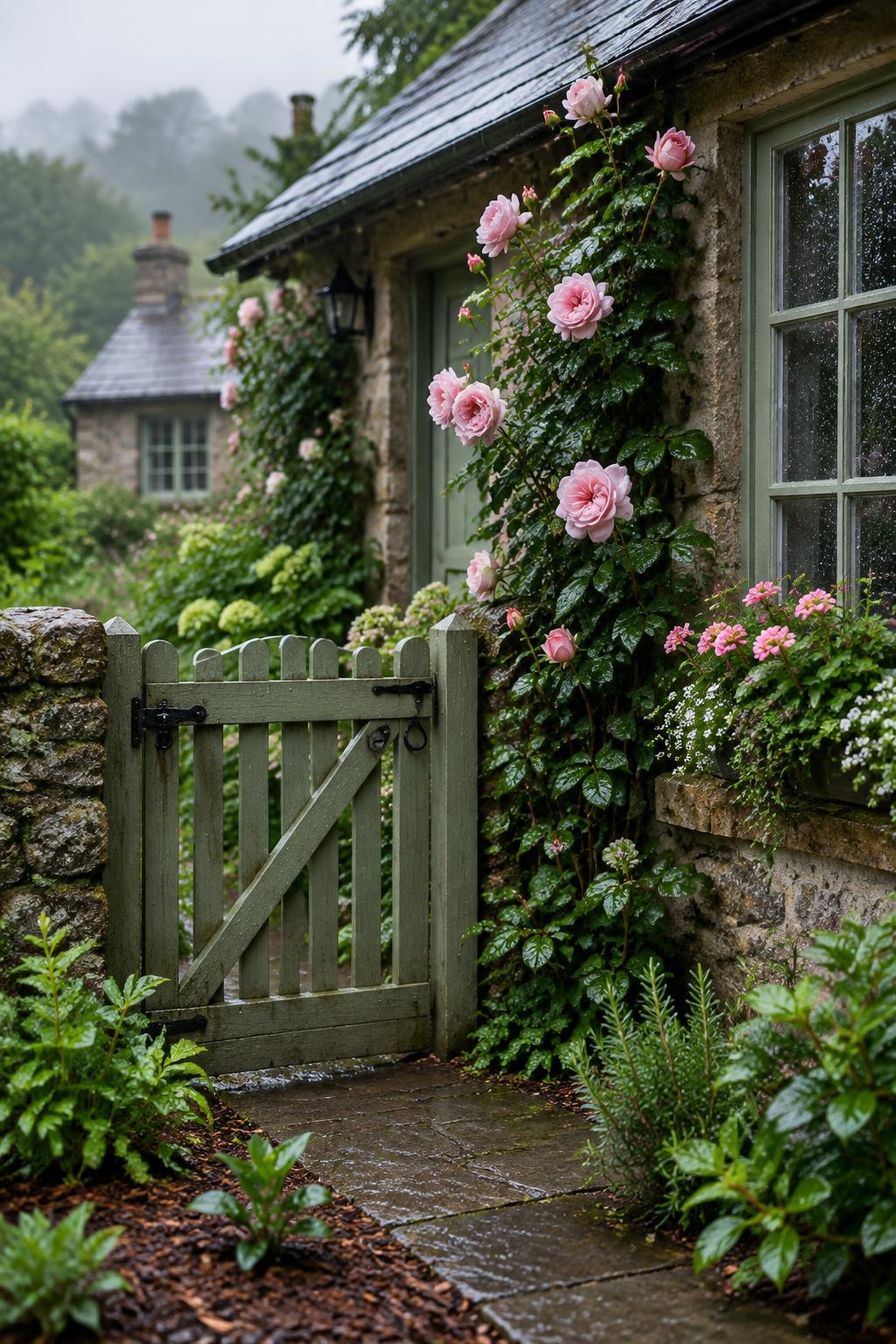
The classic cottage move is a climbing rose, and it suits a small yard because it covers walls, fences and arches rather than the bed. Many repeat-flower from early summer into autumn, and many are scented. A climber isn’t self-clinging, so it needs wires or a trellis. Tie the stems as close to horizontal as you can, and the rose sends up lots of flowering side shoots instead of all its bloom sitting at the top.
The soil at the foot of a wall is usually in a rain shadow, so a rose planted tight against it often dries out in summer, which likely cuts late flowering and encourages fungal disease. Water it regularly through the dry months. Give it fertile soil in sun or light shade. Vines for a pergola are a separate question with their own article in the pergola guide.
See-Through Tall Plants at the Front, and Fewer Kinds Repeated
The habit most of us were taught is tall plants at the back, short at the front. In a big border seen from across a lawn, that works. From a bench a few feet away, it builds a wall of foliage right where you want to look. A few tall, airy plants near the front, with shorter ones between, let your eye travel through the bed.
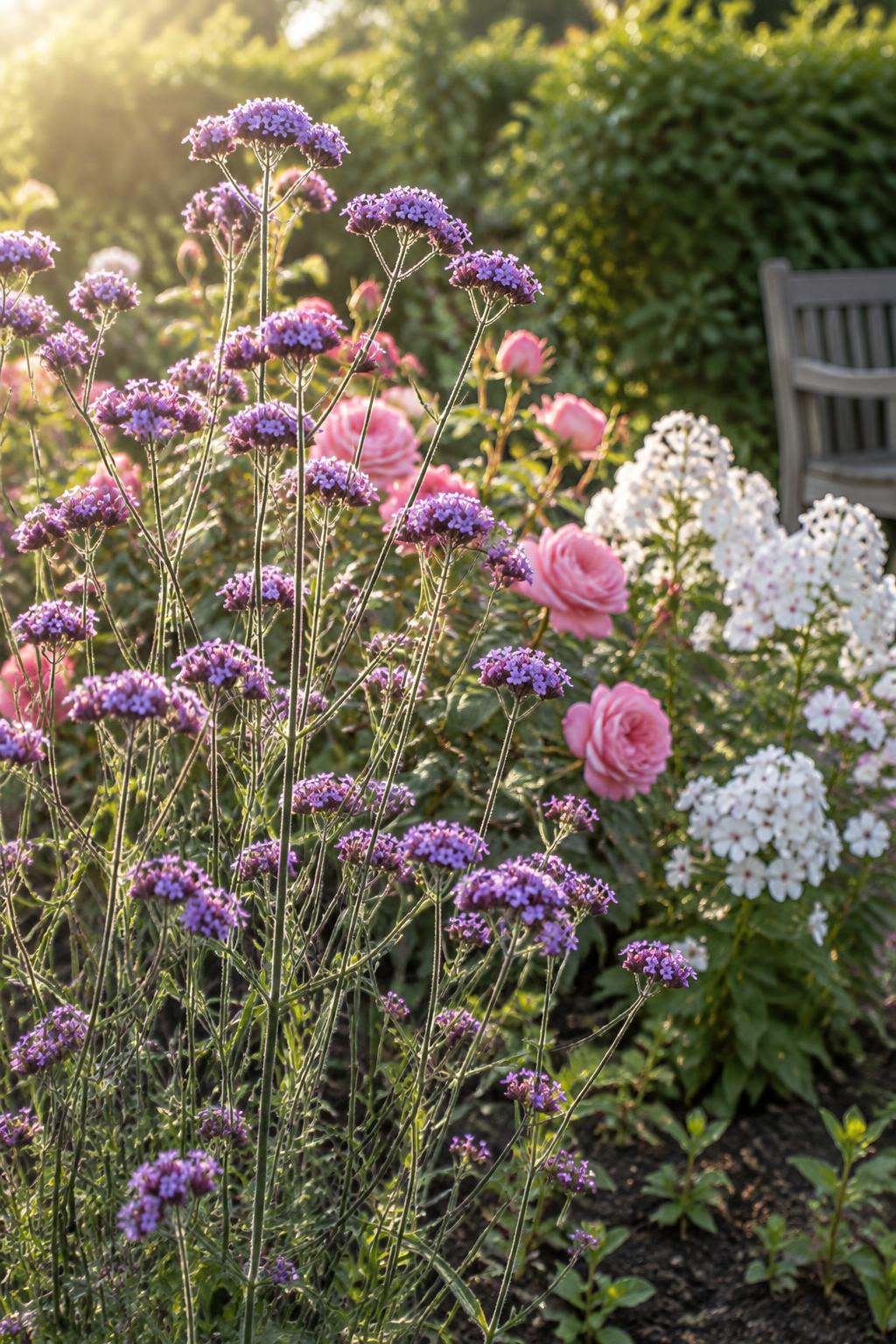
Verbena bonariensis is the plant for this. Beth Chatto Gardens describes its sparsely leaved, wiry stems as an airy, almost see-through effect, perfect at the front of a border. It does want a warm, sheltered spot in full sun and free-draining soil, and in strong wind the tall stems can snap, so keep it out of the gap where gusts come through.
The other half of a calm small bed is a short plant list. The RHS shows a mini cottage garden built from the same plants a large cottage garden would have, only with fewer varieties. Limit the palette and repeat it, and the bed gets a rhythm you can feel from the seat. A short list repeated holds together even better with one color family running through it.
The Odd-Numbers Rule, Tested: How Many of Each a Small Bed Needs
Plant in threes and fives. The reasoning behind it is about looks, not growth: an odd number can be set out as an irregular cluster, which looks more natural than a row or a block, and at least three gives the group some weight.
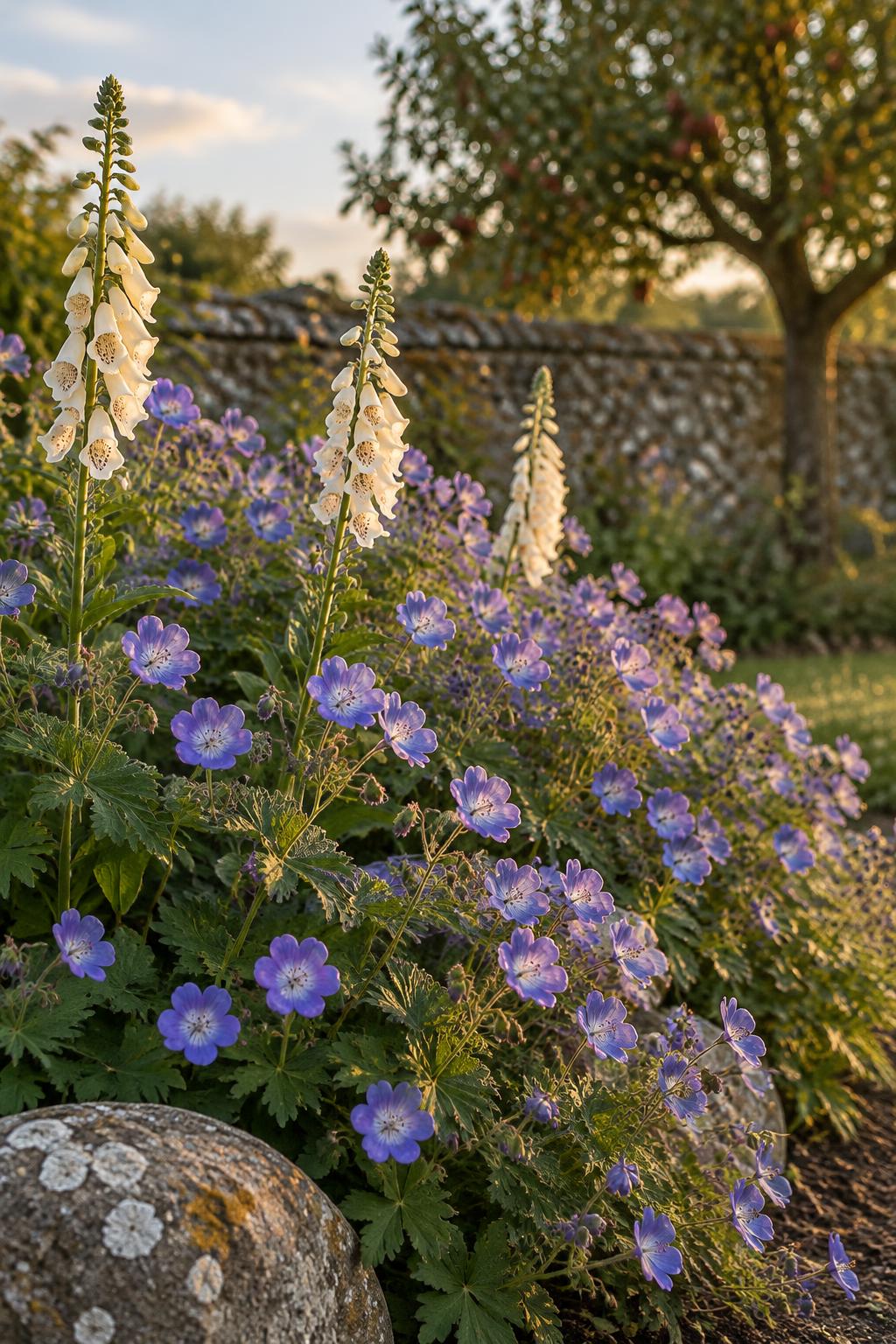
Even the advice that teaches it says to break it when space or budget won’t stretch to three. Unless the plant has a strong, distinct shape, an agave say, in a few years you won’t be able to tell how many you put in; they blend into one mass. So plant four, six or eight. Designer Richard Miers is blunter about the idea that odd numbers copy nature: “Plants don’t grow like that.” He says he can do a group of one or four, depending on the space. A matched pair flanking a gateway is even numbers doing exactly what you want.
So the verdict is a decent habit, and one you can drop in a small bed. In a tiny plot, counting to three or five leaves little groups that never merge. From the seat, repetition counts for more: the same plant showing up again across the bed so it reads as one drift rather than a sampler. And a small bed is a cheap place to try filling a bed from seed for the fillers that knit that drift together.
Six Small Cottage Garden Ideas, Each Planned From the Seat Out
These looks all start from the seat, and each asks something different of a small yard.
| Look | Where it starts from the seat | What it asks of a small yard |
|---|---|---|
| Rose-framed corner seat | A bench in the corner, with a climbing rose on the fence behind it | A sunny or lightly shaded fence with wires, and regular water at the dry foot of the wall |
| See-through front screen | Verbena bonariensis at the front of the bed facing the seat | Full sun, free-draining soil and shelter from strong wind |
| Gate arch | The view from the seat ends at the gate, with a rose over a simple arch and a matched pair either side | A gateway worth framing and room for a simple arch |
| One-path doorstep | A single path from the seat to the door, ending on one plant by the step | Low, tough plants in the cracks and one deliberate specimen |
| Window-view border | A border placed where both the kitchen window and the seat look out | The bed sited where you look out most, with eyesores screened by planting |
| Single-drift bed | One plant repeated through the bed in front of the seat | Fewer kinds, and enough of each to merge into a drift |
Pick one or two and let them lead. In a small garden, two looks done well beat six squeezed in.
Take a chair out to the spot you have in mind, at the hour you’d really use it, and sit there long enough to see where the sun and shade go. That one decision is the start of your plan, and every rose and verbena after it has somewhere to grow toward.
FAQ
Should a small cottage garden have a lawn?
It doesn’t need one. The cottage look comes from the planting, and a lawn is one of the most work-heavy features a garden has. If you keep grass, give it a simple, usable shape and skip narrow slivers between beds, which are fiddly to mow. If you replace it, choose permeable gravel or decking over solid paving.
How do you stop a small cottage garden looking messy?
Give the loose planting a tidy frame and a short plant list. A crisp edge along the bed makes the crowding look intended, and a neatly clipped low hedge does the same job. Grow fewer kinds and repeat them, so the eye reads a pattern. Then keep watch, cutting back or removing whatever starts swamping its neighbors.
What is the best time of year to start a small cottage garden?
Spring or autumn, while the ground is moist. Autumn can give plants a head start in cooler weather, but on heavy clay or a wet garden, spring is usually the safer choice for perennials. Prepare the bed in late summer or over winter, then keep new plants well watered through their first year.