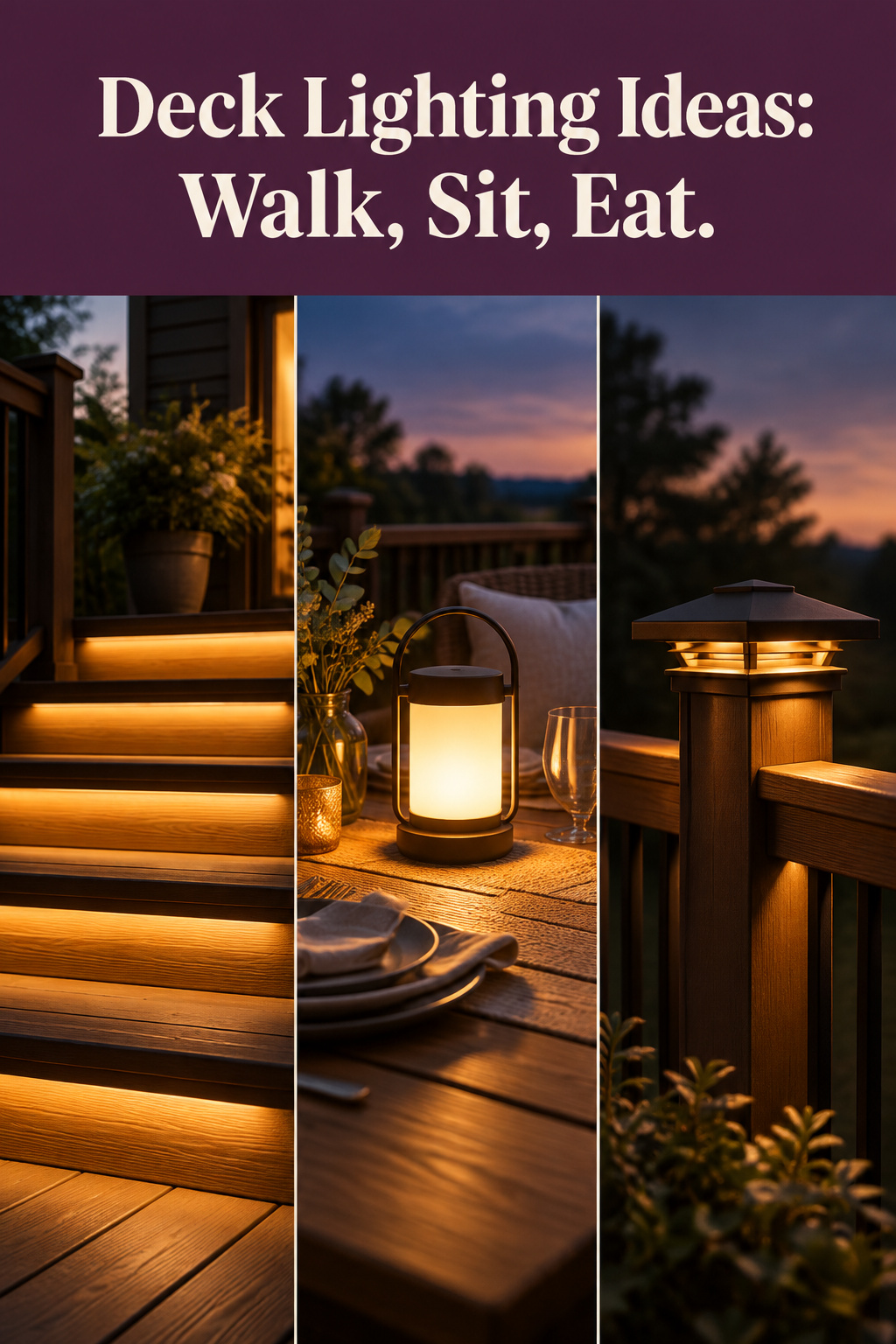
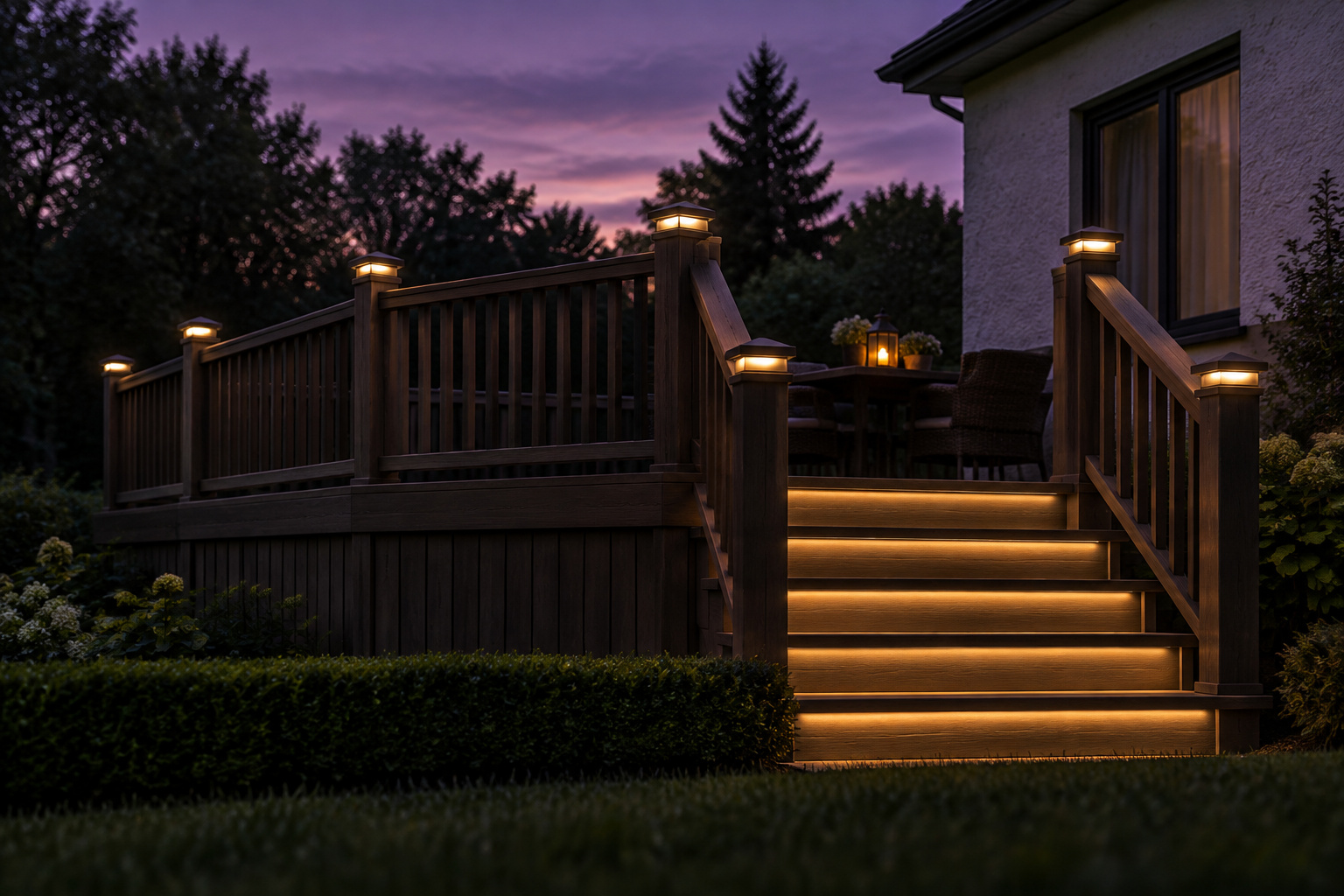

“We never really go out there once it’s dark.”
I hear that about decks more often than about any room indoors. The person saying it is usually standing at the back door. Behind them, one bright fixture on the house wall is switched on.
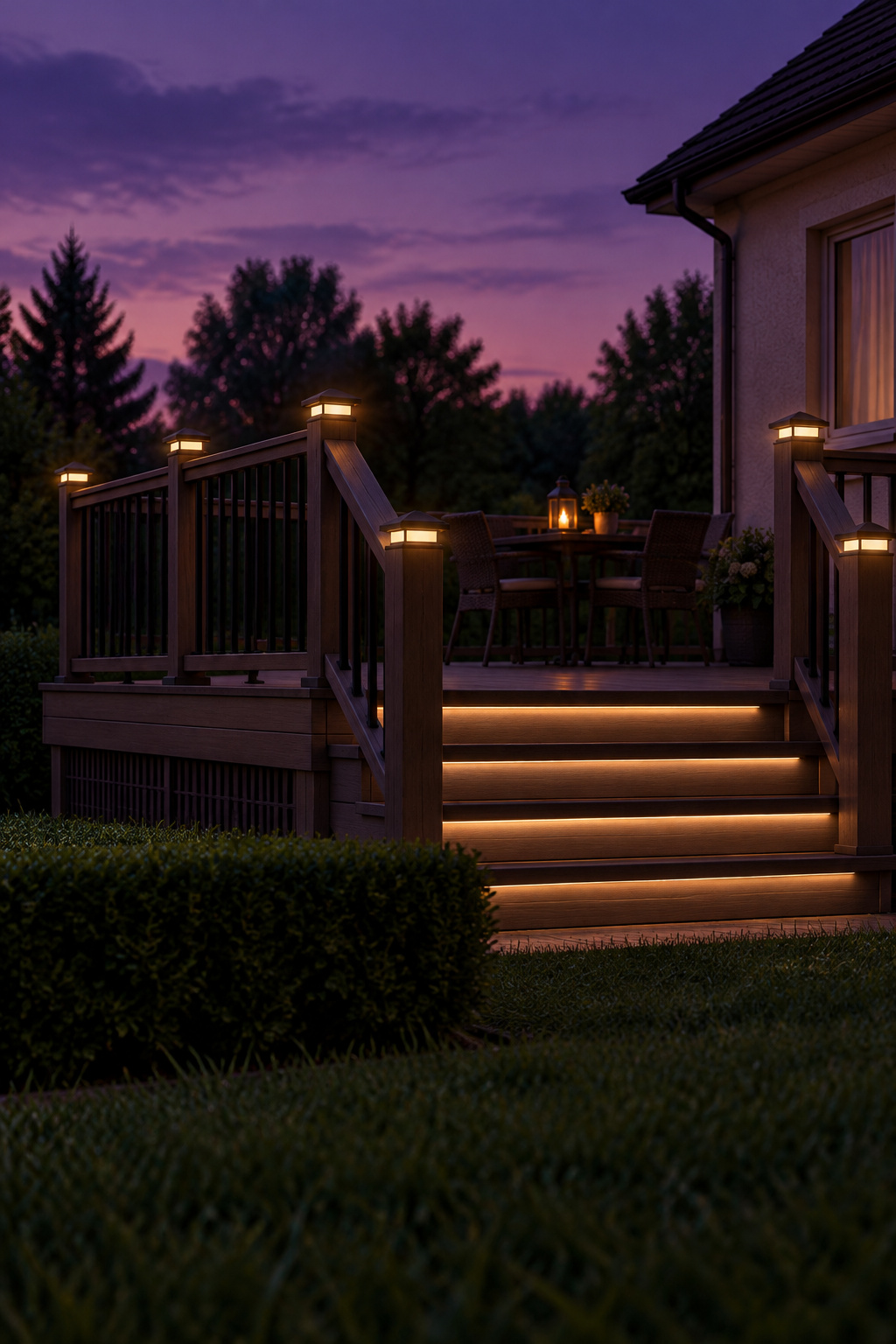
That fixture lights the boards flat, puts glare in your eyes on the steps, and still leaves the bottom tread in shadow. The deck lighting ideas that change an evening are smaller and dimmer: one light for walking, one for sitting, one for eating, each at its own height. String lights are a subject of their own, so I leave them aside here.
TL;DR
- Light the stairs first: one riser light per tread, or every other step, with the top and bottom steps always lit, and start with the dimmest fixture you can find.
- Keep every light warm (under 3600K), low and shielded so no bulb shows from a seat; a cordless IP54 lantern from $59.95 handles the table.
- Choose power by the sun: solar needs 6 to 8 hours of direct sun a day, so shaded posts and stairs lit every night belong on low voltage.
Deck lighting ideas for the walk: step and riser lights at ankle height
Stairs at dusk should feel ordinary. Your feet should know where the next edge is without your eyes working for it. When a riser edge melts into shadow, you slow down and reach for the rail.
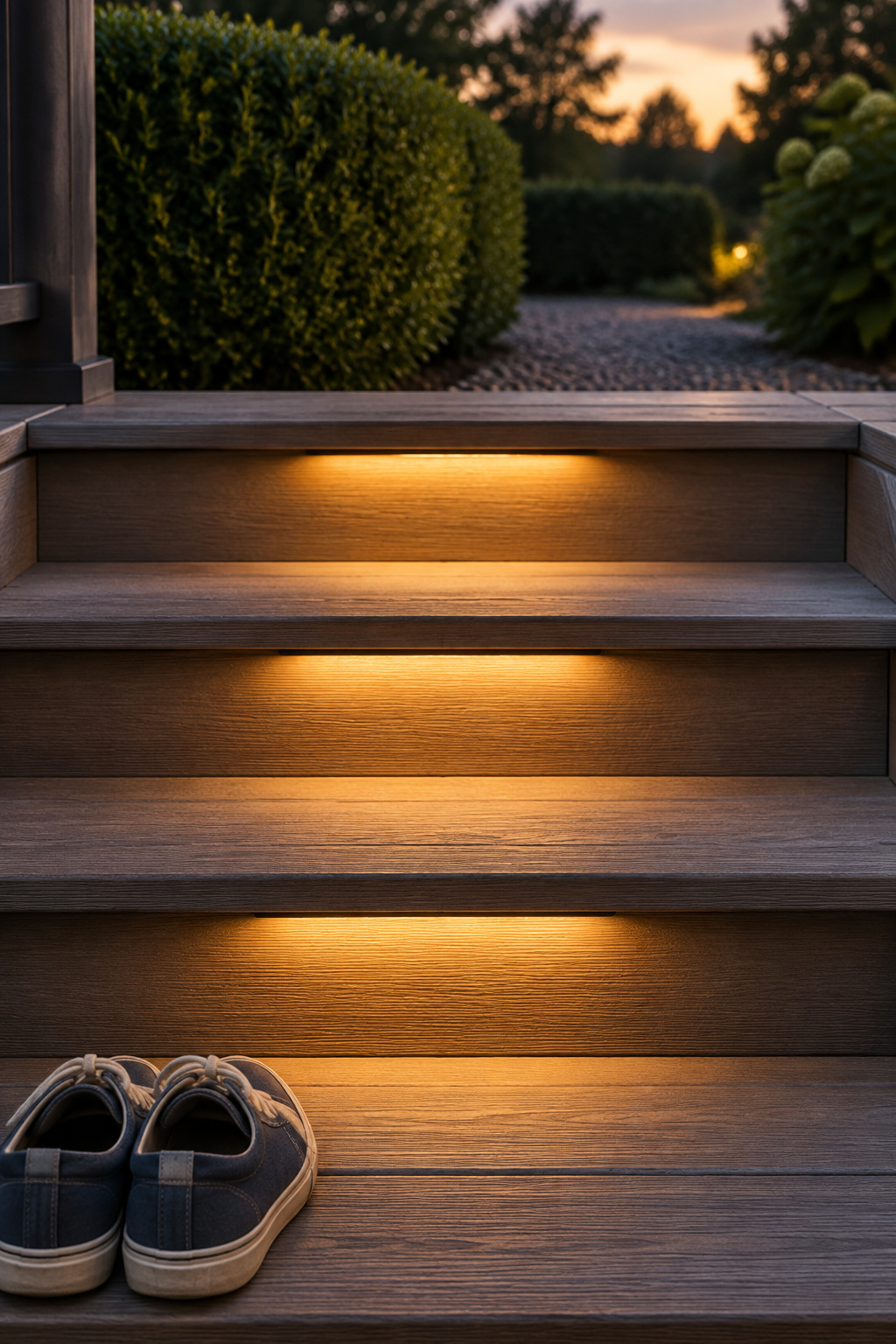
So take something away before you add anything: switch off the light aimed at the stairs from the house wall while you test. People assume brighter is safer. I see it differently, and here’s why: past a fairly low level, more light doesn’t help you see. Glenn Heinmiller, a lighting designer with DarkSky Massachusetts, puts it plainly: “More light is not better.”
A riser light sits in the vertical board under each tread, its housing just below the tread’s nosing, facing down so it lights the step and not your eyes. On output, sources disagree: trade guides put a step fixture at 50 to 150 lumens, dark-sky guidance at 12 to 100. Along a run of decking, one trade guide says 6 to 8 ft apart and deck-lighting guides say 3 to 6 ft. On stairs the practical rule is simpler: one light per tread, or every other step, with the top and bottom steps always lit, because seeing the first step is critical to avoiding falls, as the Illuminating Engineering Society puts it.
I take my shoes off at a client’s door before anyone asks, and where there is to put them tells me a lot about how a household comes and goes. A deck stair tells you the same thing after dark. The lights should follow the routes your furniture leaves open, so settle the walkways your deck lights should follow before you drill. Whether your stairs need a light by code is a local question for your building department.
- Go out at dusk, not full dark, and walk from the back door to the yard.
- Mark each change of level with a strip of tape: the top step, the bottom step, any drop between decks.
- For each mark, choose a riser light under the tread or a light on the post at the top or bottom of the stair.
- Fit one fixture, the dimmest you are considering, and walk the route again.
- Place the rest, powering each up as you go so a loose connection is easy to find.
Steps first, seats second.
Post cap and rail lights: mark the edge without flooding the deck
An edge light has one job, which is to show where the boards end. There are three common ways to do it. Deck post cap lights sit on top of the railing posts and cast a soft glow down around the perimeter. An under-rail strip tucks beneath the top rail; TimberTech’s comes tilted 15 degrees so it faces the deck rather than the yard. Deck railing lights mounted on a post face work best at the top or bottom of a stair.
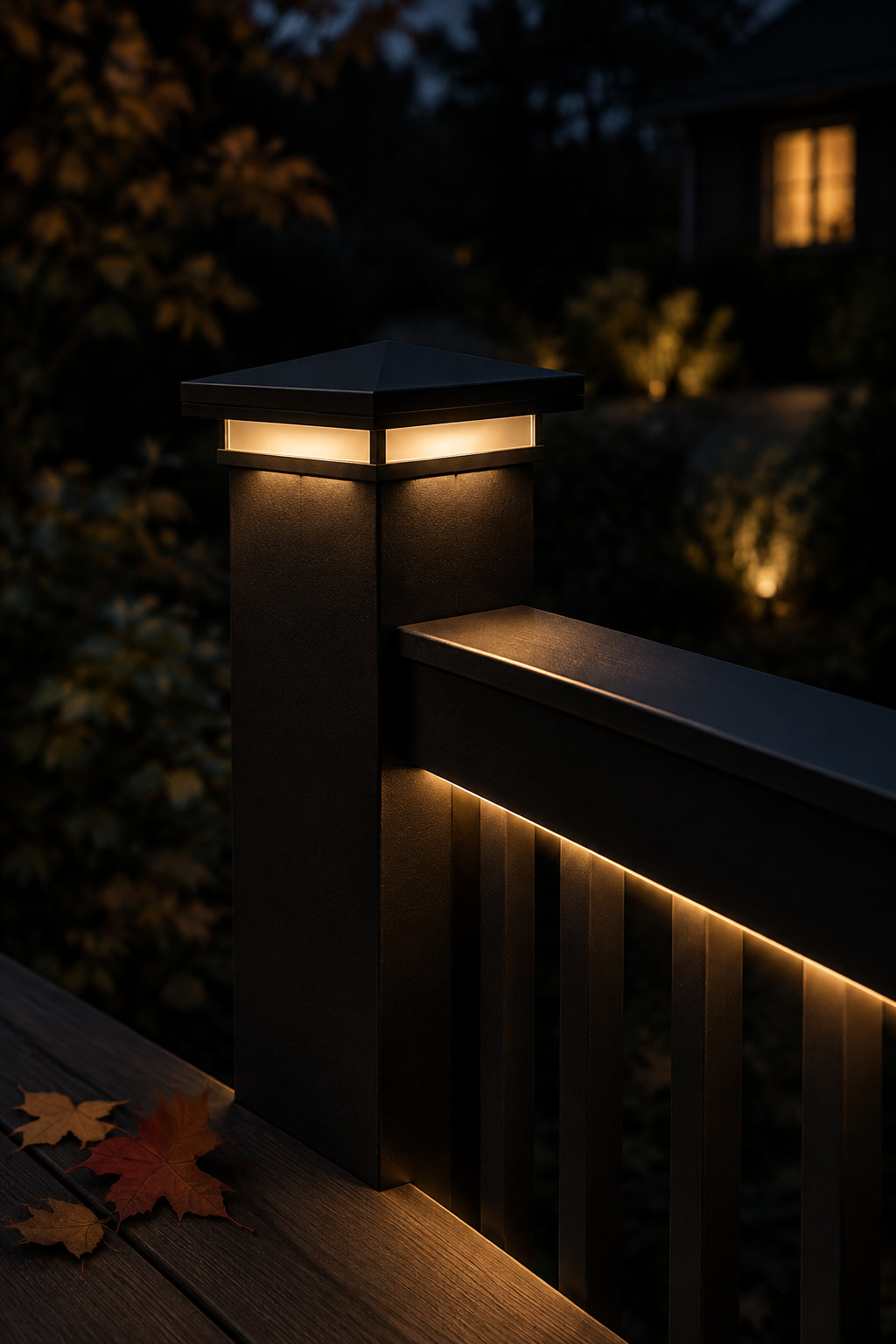
Pick one. A rail carrying all three starts to look like a landing strip, and the eye never rests on the dark beyond it. My own preference is post caps on a deck that is already built, because they go on later without touching the railing; under-rail strips are easiest to fit as the railing goes up. Railing height and the gaps between balusters are building-department questions, not lighting ones.
What to remove here is any bare bulb you can see from a seat. Check every cap for a diffuser and a downward aim, and pass on exposed globes.
Sit in your usual chair and count how many bulbs you can see.
Sitting and eating at dusk: lanterns, floor lamps and table lamps at seat height
Most rooms are too bright in the evening, and decks are no different. Dim lamps at different heights beat one fixture on the house wall, and I’ll argue that with anyone. Here the light that matters sits at the level of your hands.
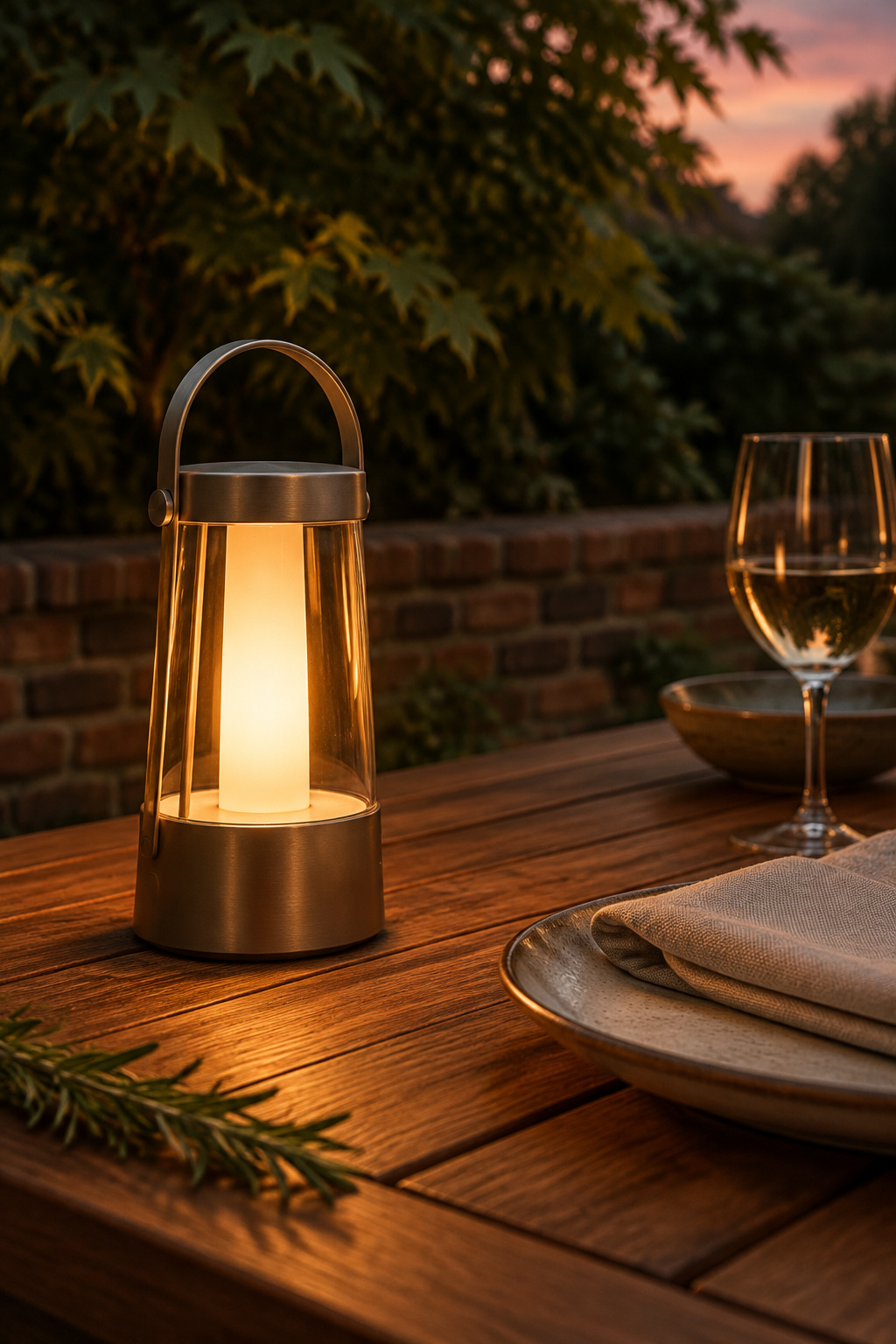
Sitting: lanterns and floor lamps below eye level
A chair should feel held at dusk, with the light low and to one side. The rule borrowed from indoor lamps is that the bottom of the shade sits at about seated eye level, so the bulb stays hidden. On an upright dining chair, an adult’s eyes sit roughly 44 to 52 in above the floor. A lounge chair puts them lower.
My bike bag holds a tape measure, a notebook and a pair of clean socks for other people’s floors, and this is exactly the question the tape is for. Sit down, have someone measure from the boards to your eyes, and keep the lit part of any lantern below that. A portable lantern on the boards beside the chair does it well. The Tala Rugged Muse 2.0 is rated IP65 and runs up to 30 hours at a quarter brightness, dimming toward a candle-warm 1800K.
Eating: table lamps that stay on the table
The table wants its own small pool of light. Keep the lantern short enough to see across: a centerpiece at 12 in or under stays below the sightline. Thomler’s cordless lantern is about that height, rated IP54, warm at 3000K, and runs up to 20 hours per charge for $59.95.
A client once gave me a large scented candle as a thank-you. It is in my hall closet, still unlit. Scent at a table argues with the food, so I would rather put a rechargeable lantern there and let the meal smell like the meal.
Lamps on the table, not lights on the house.
Solar, low-voltage or plug-in: choose by where the sun falls
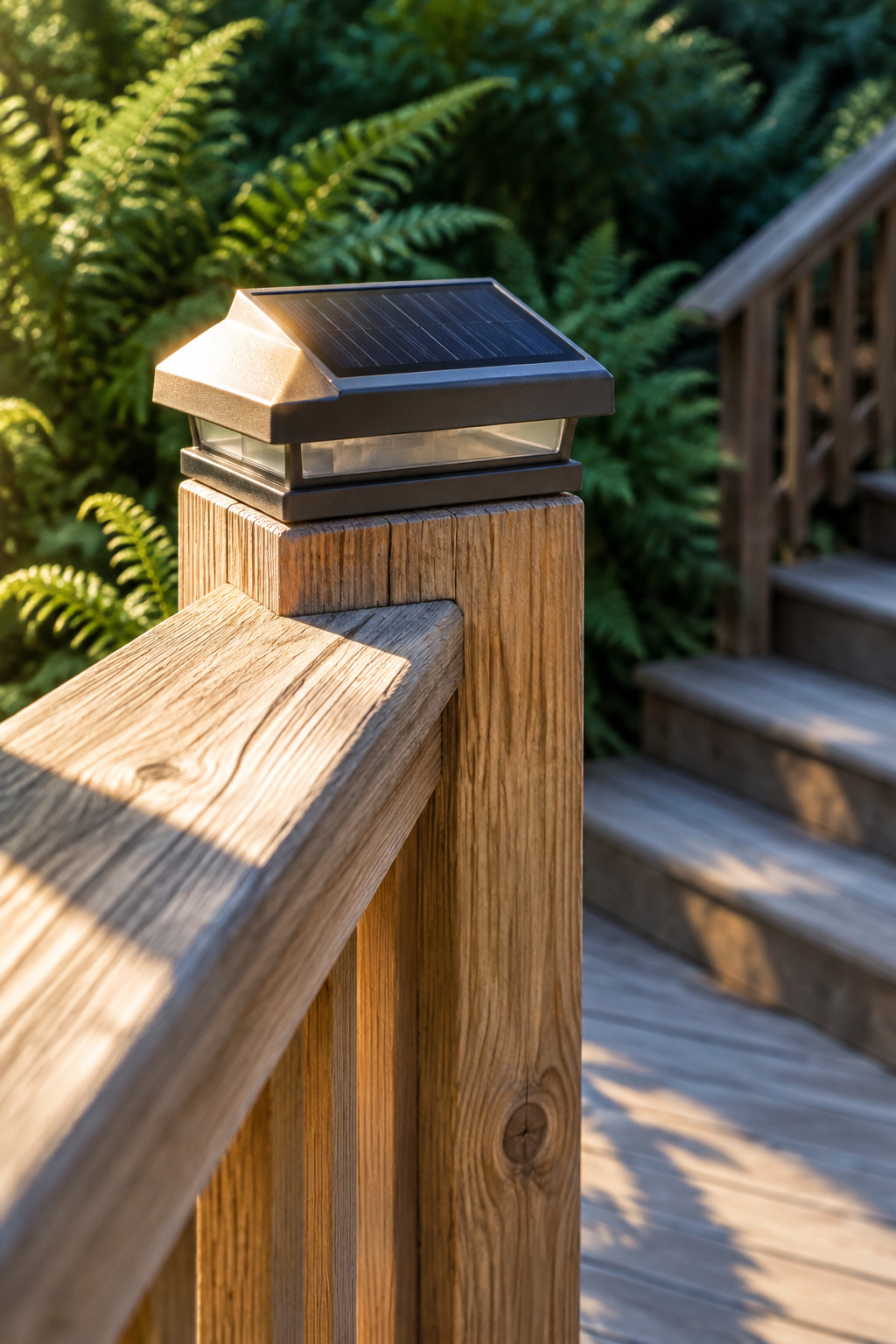
The sun decides this more than any catalog does. Solar deck lights need at least 6 to 8 hours of direct sun a day, and each cap switches on and off by its own sensor, so a shaded post can fade while its neighbor stays lit. Low voltage runs every light from one transformer plugged into a GFCI-protected outdoor outlet, on one timer. Prices below are “as low as” listings from deck retailers and makers, checked 22 November 2026.
| Power | In shade | Install effort | Price | Best job |
|---|---|---|---|---|
| Solar | Weak charging, shorter nights | No wiring | Post caps from $31.99 to $127.99 | A few decorative posts in open sun |
| Low voltage | Unaffected | Transformer, cable under the framing, timer | Post caps from $29.99 to $105.99; step lights mostly $15 to $67 | Stairs and level changes lit every night |
| Plug-in or battery | Unaffected; charge it indoors | USB charging or a cord to an outdoor outlet | Lanterns from $59.95 to $269 | The chair and the table |
Solar batteries may need replacing every 1 to 3 years. A deck with mixed sun can mix the two. This advice rests on retailer and maker pages, not an independent test. Utah Deck Supply puts the stair argument better than I can: “If a post must be visible every night, do not leave it on a battery that may be empty.” Solar on shaded stair posts is the one choice I’d gently talk someone out of.
The room under a raised deck gets no sun at all, so solar is the wrong tool there; lighting the room under a deck starts with where light is needed even by day.
Warm, low and shielded: the three tests, then timers and dimmers
A deck at night should feel like the day settling. DarkSky International and the Illuminating Engineering Society set out principles for responsible outdoor lighting; on a deck the ones that matter are to shield and aim light down, keep it low, control it with timers and keep it warm-colored.
Warm, in numbers, means LEDs under that 3600K line; above it, light turns cooler and draws more insects. Most of the lanterns worth buying sit between 2700K and 3000K. Low means starting with the dimmest fixture and adding only if you need to. Shielded means you see what the light lands on, not the light.
Before buying anything new, take these out or turn them down:
- bare bulbs visible from any seat
- fixtures aimed outward instead of down
- cool-white bulbs in any outdoor fitting
- lights that burn all night with no timer
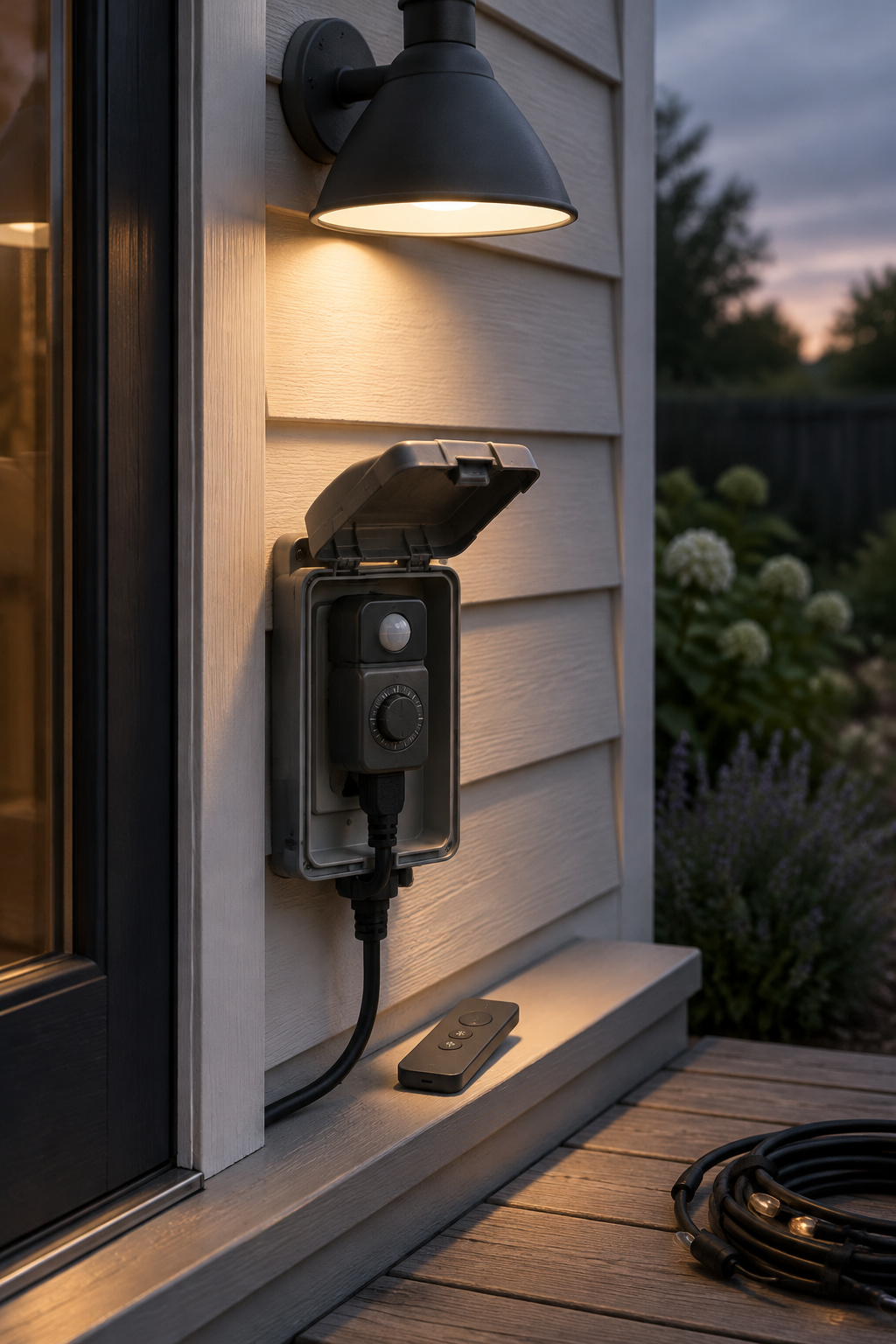
Then add control. A photocell timer of the kind sold with low-voltage deck kits switches on at dusk and runs to dawn or for a set number of hours, such as 2, 4 or 8; keep any remote dimmer somewhere dry.
Look at the bulbs you already own and find the color temperature printed on each one.
Putting the three layers together on one dusk walk-through
I notice a refrigerator’s hum before I notice a wall color, and I usually mention it first. A deck at dusk has its own version of that hum: the glaring fixture you stopped seeing after a week but still feel every evening.
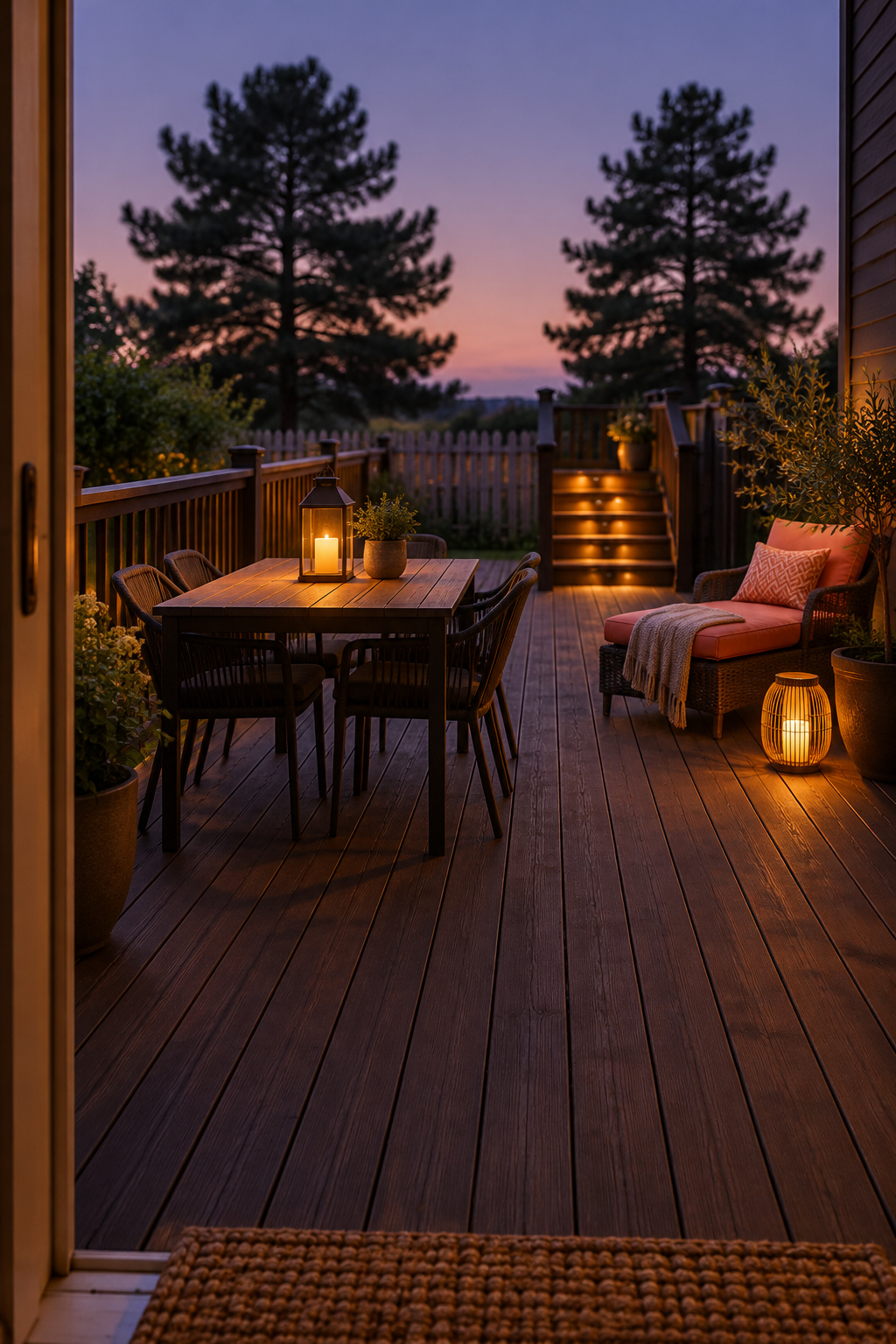
So walk it again, as a guest would, with the wall light off. The top step is lit, and each tread carries a soft line of light at your ankles. One kind of edge light shows where the boards stop, and no bulb shows from the chair. A lantern sits low beside you. At the table, a short lantern makes a pool just wide enough for plates. Walking, sitting and eating each have their own light at their own height, and the whole deck is dimmer than it was.
The yard beyond the deck is its own job, covered in the garden path lighting article. For deck decor ideas beyond lighting, from rugs to color, start with the boards.
I would rather see four small lights doing their own jobs than one big light doing all of them badly. Go out at dusk with a roll of tape and a notebook, mark the stairs, the edge, your chair and the table, and buy the stair light first.
FAQ
Do solar deck lights work in winter?
Yes, but for fewer hours. Short days, a low sun, shade from the house or rail, and snow on the cap all cut charging. No independent test measures winter run time, so check your own: after a few cloudy days, leave the caps on overnight and note when each dims. On some models, a blinking cap means it is undercharged.
Do warm deck lights attract fewer bugs?
Fewer, not none. Insects respond most to short, bluish wavelengths, so warm-white LEDs draw fewer than cool white, and yellow or amber light fewer again. None of the studies were done on decks, though. Shielding lights downward, using fewer and putting them on a timer helps too.
Can you add lighting to a deck that is already built?
Yes. Post cap lights and riser lights can be added to an existing deck, while under-rail strips are easiest to fit as the railing goes up. Solar caps and cordless lanterns need no wiring at all. For low voltage, cable runs loosely stapled under the framing, and the household connection may be a job for a licensed electrician.