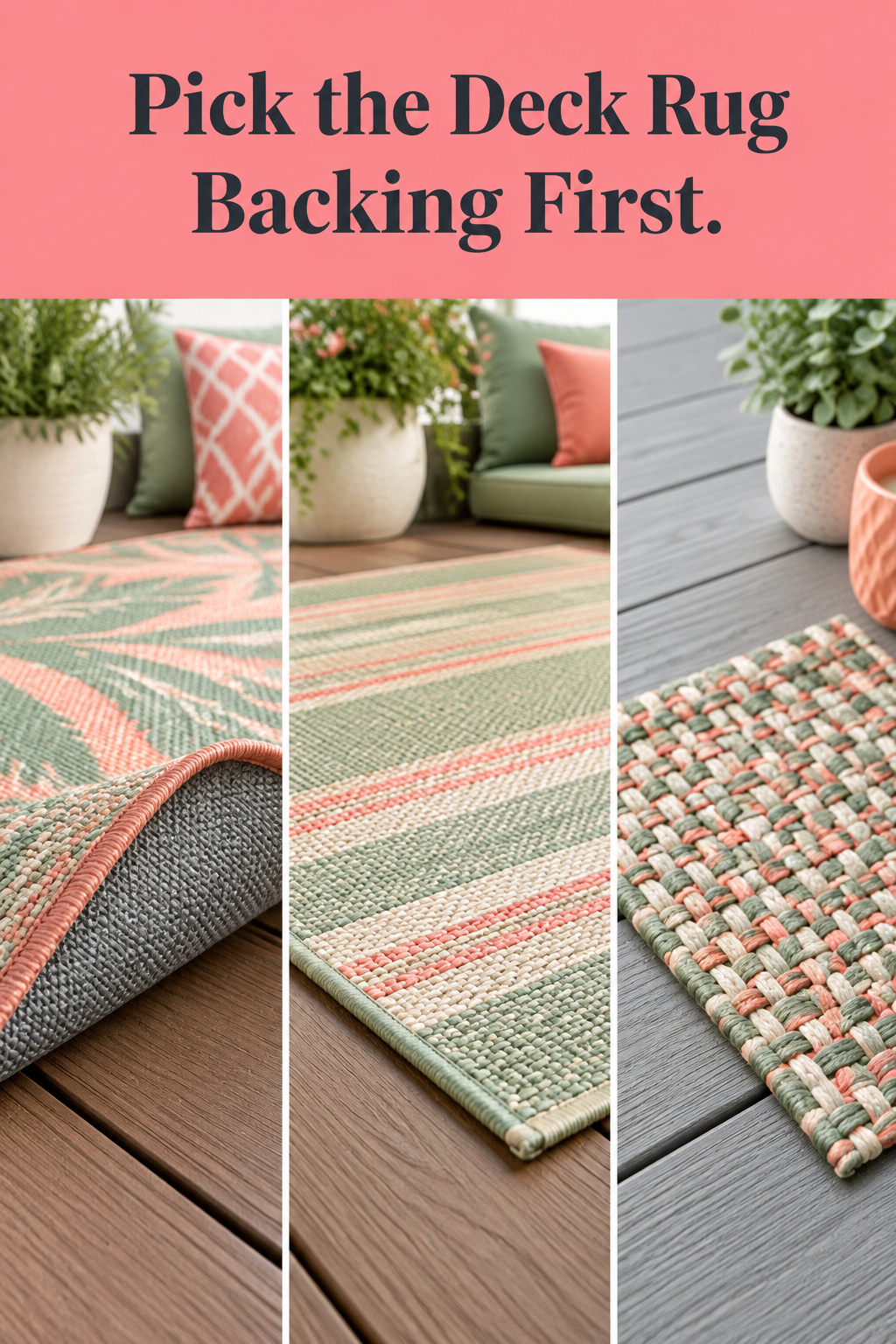
A deck rug in the hand is heavier than it looks. It comes rolled tight, with the pattern facing in. I turn it over before I unroll it. In a showroom I do the same with a drawer, pulling it all the way out to see how it was made. The back is where a rug tells you what it will do to your boards.
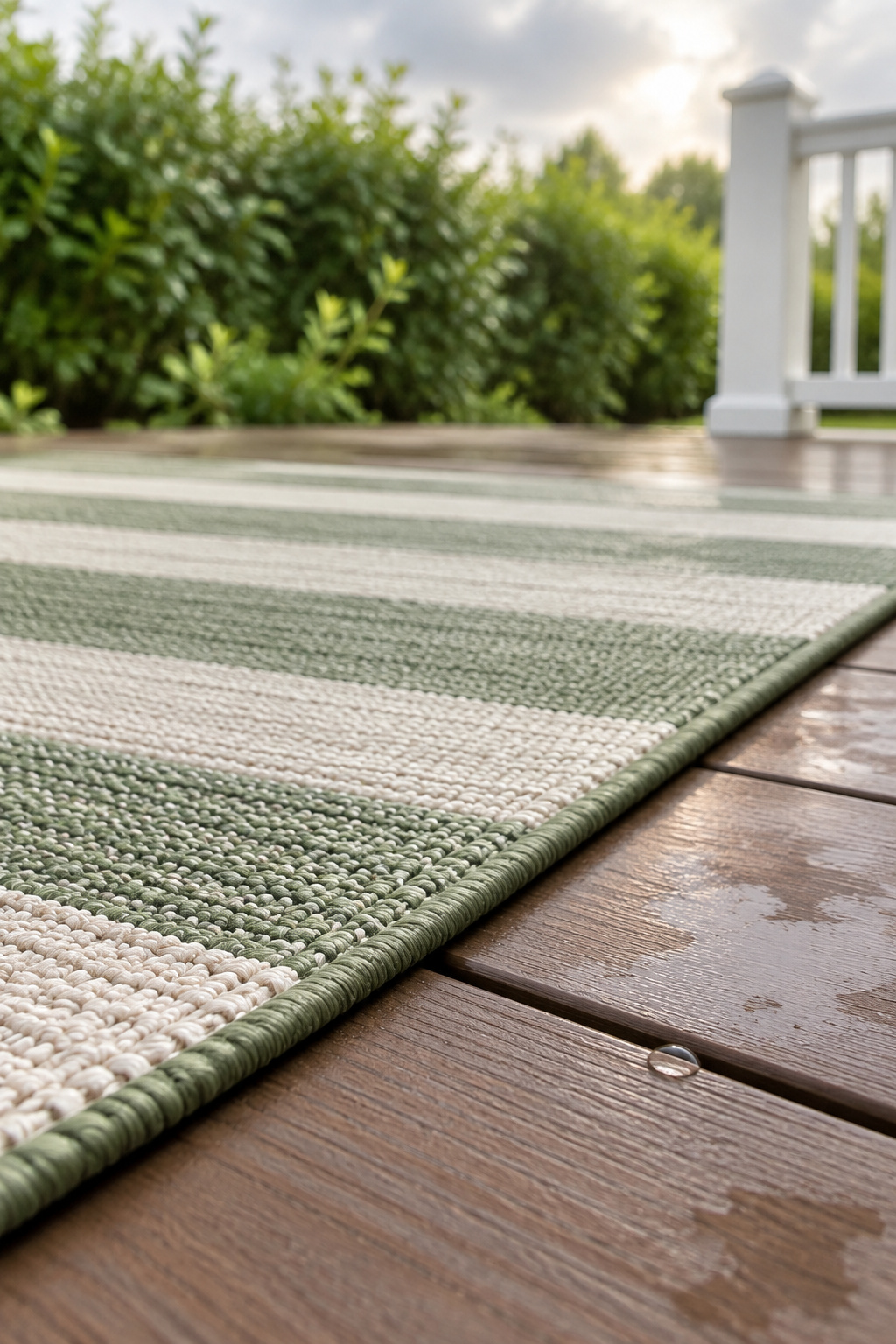
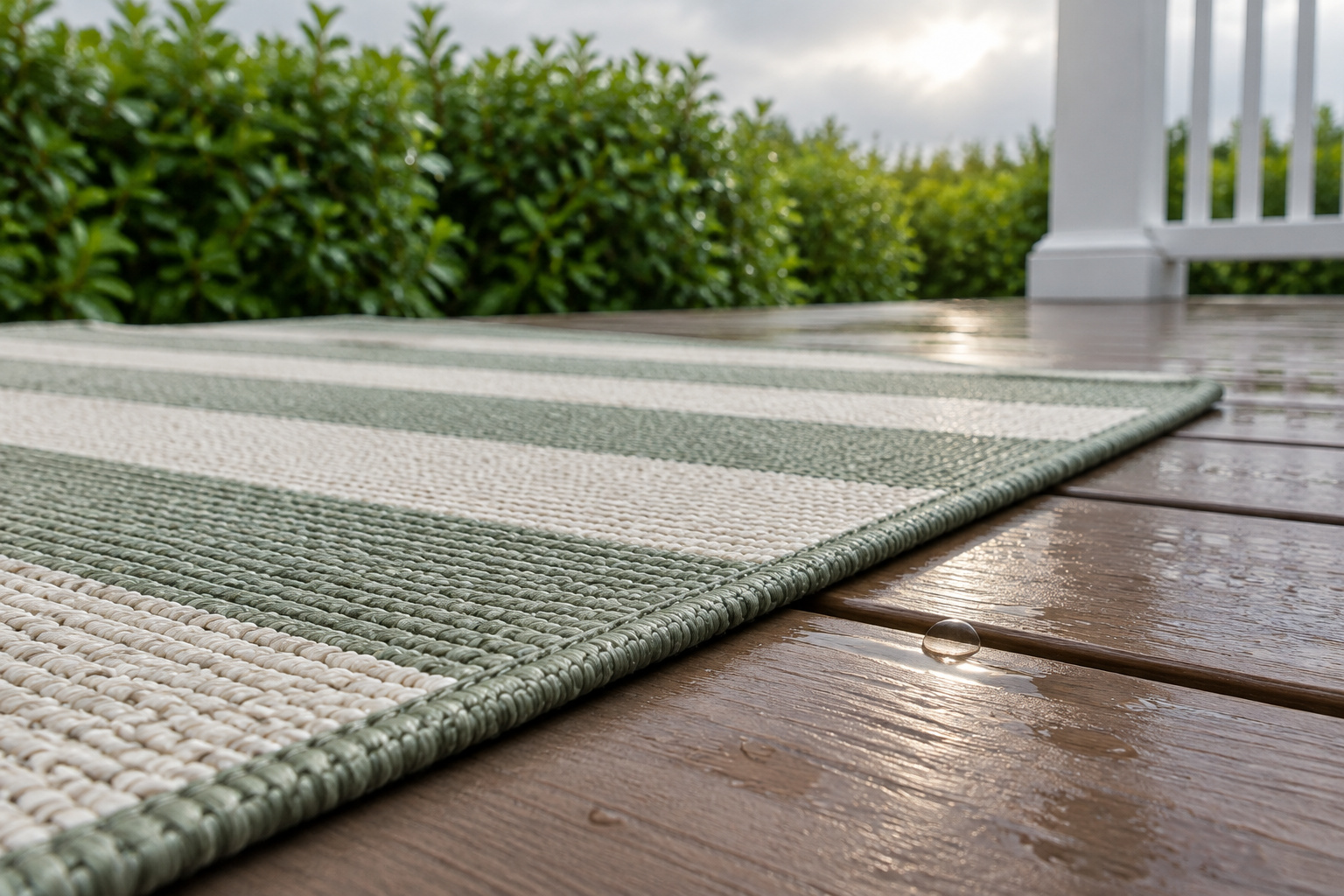
Choosing an outdoor rug for deck boards goes in a fixed order. First the backing, checked against your decking maker’s page. Then fiber and weave, then size. The pattern comes last, the reverse of how the shelves are arranged.
TL;DR
- Skip rubber, vinyl and latex backings: Trex, TimberTech, Fiberon and Deckorators all warn they can mark or discolor composite boards, and an unbacked woven rug is the one no maker tells you to avoid.
- Fiber is where the makers split: Fiberon says polypropylene or colorfast woven rugs only, while Trex points to jute, sisal or bamboo, so your own board maker’s page decides.
- Size the rug to the seating group with at least the front legs of every seat on it, leave about a foot of bare boards around it, and lift it so the boards underneath can dry.
Will an outdoor rug ruin your deck? Both myths skip the backing
Two opposite beliefs travel together. One says any rug will rot or stain a deck. The other says a rug is fine anywhere, as long as it has a grippy rubber back.
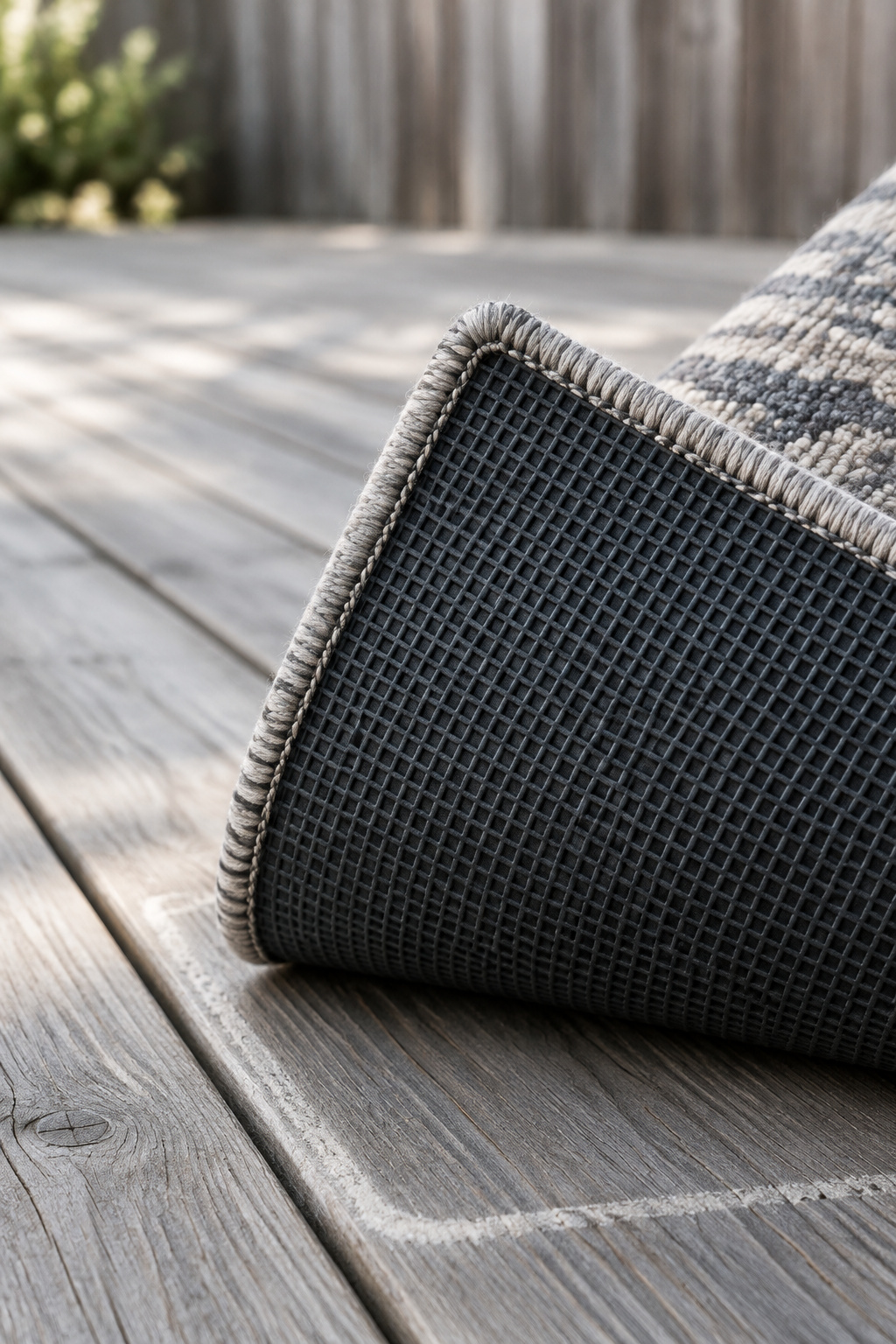
The second belief has a sales department behind it. Rubber pads such as LSI Flooring’s StayPut are sold for composite decking with the promise that they won’t stain, scratch or discolor. The people promising it sell pads, and the board makers themselves warn about rubber.
The first belief has no champion, only a common fear. The real risk is narrower. Water and dirt collect under anything left lying on boards, and Consumer Reports found that any outdoor rug, natural or synthetic, keeps the deck beneath it damp longer than the boards around it.
Both beliefs miss the same thing: a deck rug is a question about its back and about drying.
I read furniture catalogs from the back, where the dimensions and materials are, because the front pages are there to sell. Scroll past the room photos to the line about backing, then open your decking maker’s care page and compare.
The backing decides: what each type does to wood and composite boards
On fiber the composite makers disagree with each other. On backing they come close to one voice.
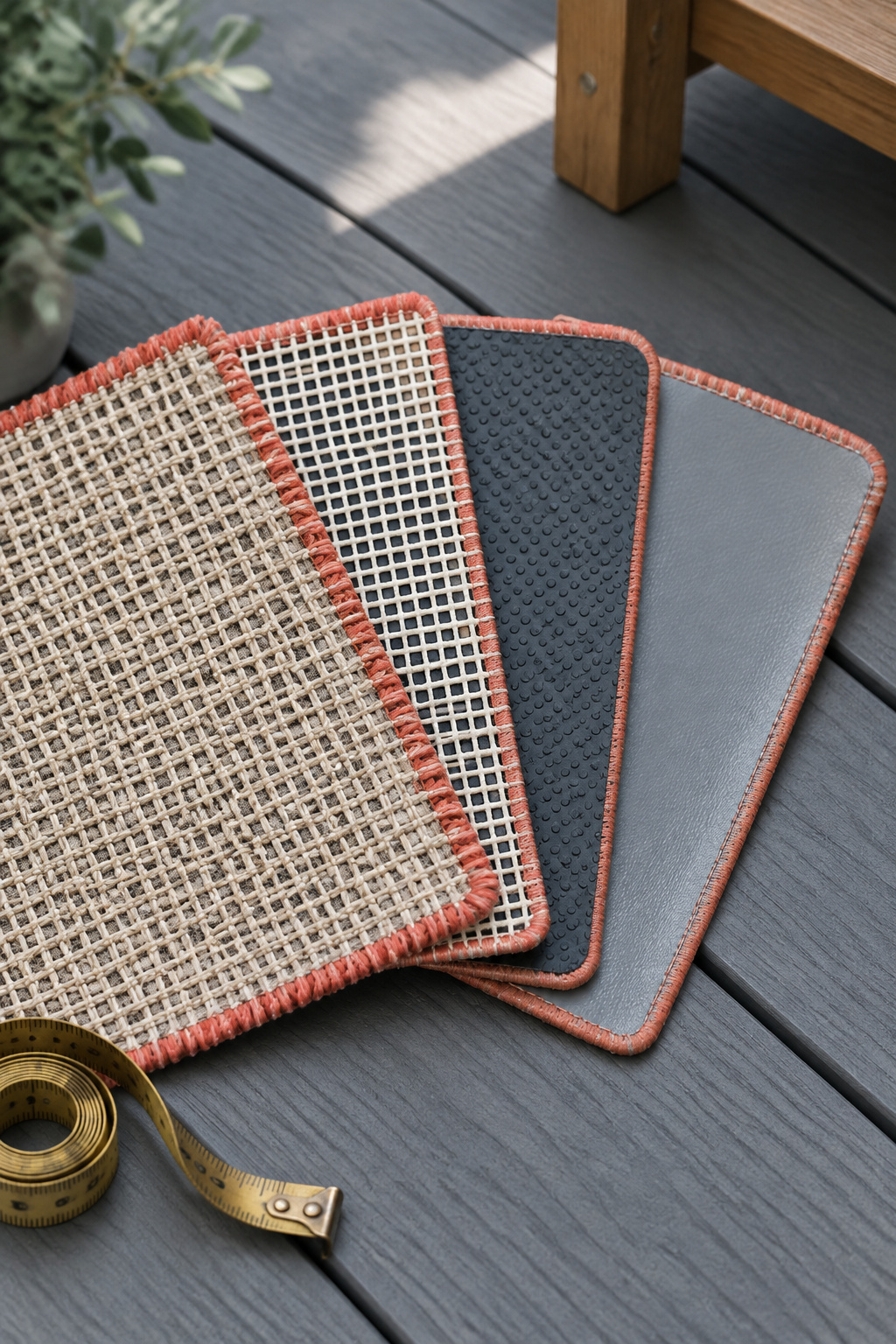
| Backing | What it does on the boards | What makers say |
|---|---|---|
| None (unbacked woven) | Water passes through the weave, though some can sit where the rug touches the boards | Recommended by Fiberon, Wolf and DeckRite; Deckorators notes it can still trap water |
| Rubber or latex | Plasticizers and additives can migrate into the surface, leaving marks, residue or a lighter patch | Warned against by Trex, TimberTech, Fiberon and Deckorators |
| Vinyl | Can mark capped composite and react with PVC boards | Named by Fiberon, Deckorators, Endeck, Zuri, and Trex for its early Escapes line |
| Open-weave mesh pad | Lets air through under the rug | Sellers call it safe; Zuri warns about flexible plastic pads; no maker approves a named pad |
Buy the unbacked woven rug. It is the only row no maker tells you to avoid, and it is the one you can pick up and hose off.
What wood decking asks of a rug
Stain and finish makers say nothing about rugs on their care pages, so the advice for wood comes from how wood fails. Mold and mildew thrive in damp, dark conditions, and a rug makes exactly that patch. The plasticizer warnings are written for composite and PVC, so on wood my worry is moisture before chemistry. The answer is the same: an unbacked or open-weave rug light enough to lift. On a freshly stained deck, wait until the finish has fully cured before laying anything down, because a rug holds moisture against a new finish.
What composite makers say about rugs
Trex’s care page for its Transcend, Enhance and Select boards tells owners to use caution with rubber-backed mats, because they may discolor or lighten the surface. Fiberon is blunter. Any mat with a rubber, vinyl or latex backing could mark the deck, and although the marks can usually be removed, it recommends avoiding those materials.
The makers write about backings and mats, not about loose pads. To the boards, a rubber pad under a rug and a rubber back on a rug are the same material lying in the same place, so I treat them alike. Wording also changes between product lines and years, so read the current page for the boards you actually have.
Fiber and weave: what sun, rain and a hose do to polypropylene, polyester and acrylic
Rugs should be washable, or they are decoration. If a deck rug cannot be hosed clean and dried properly, it is a picture lying on the floor.
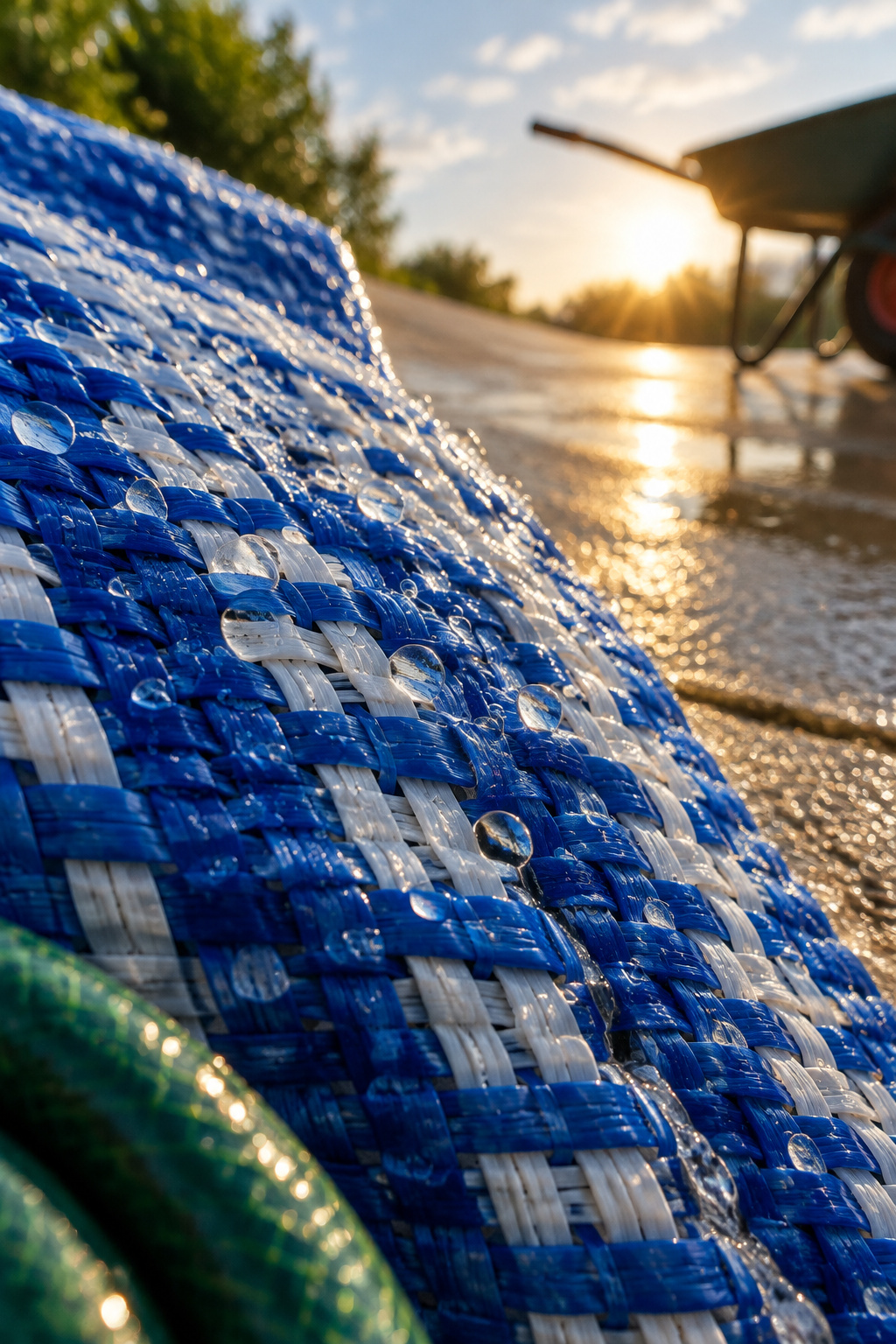
Polypropylene, often sold as olefin, is the workhorse. It sheds water, resists mildew and is the most stain-resistant of the outdoor fibers. Its weakness is sun: over several seasons in full light it gives way sooner than solution-dyed acrylic, which holds its color longest in direct sun. Recycled PET polyester is soft, easy to clean and mildew resistant, and it is happiest with some shade. Acrylic dries quickly but has poor resilience underfoot.
Clean polypropylene with a garden hose and light pressure, never with cleaners containing chlorine, acids or solvents, and let it dry all the way through before it goes back down. Read “washable” with suspicion: the word has no standard behind it, and many washable rugs larger than about 4 by 6 feet will not fit a home machine anyway.
For a deck I would buy a flat weave without a back. Water runs through it and air moves under it, and I trust that more than a thick pile, but that is reasoning, not a drying test.
Rug sellers advise keeping jute and sisal off open decks, because rain and sun make them stain, shrink and mold. Not every decking maker agrees about natural fibers.
Size an outdoor rug for deck seating, not for the whole deck
The rug has one job on a deck: to hold a seating group together. Measure the group, not the boards.
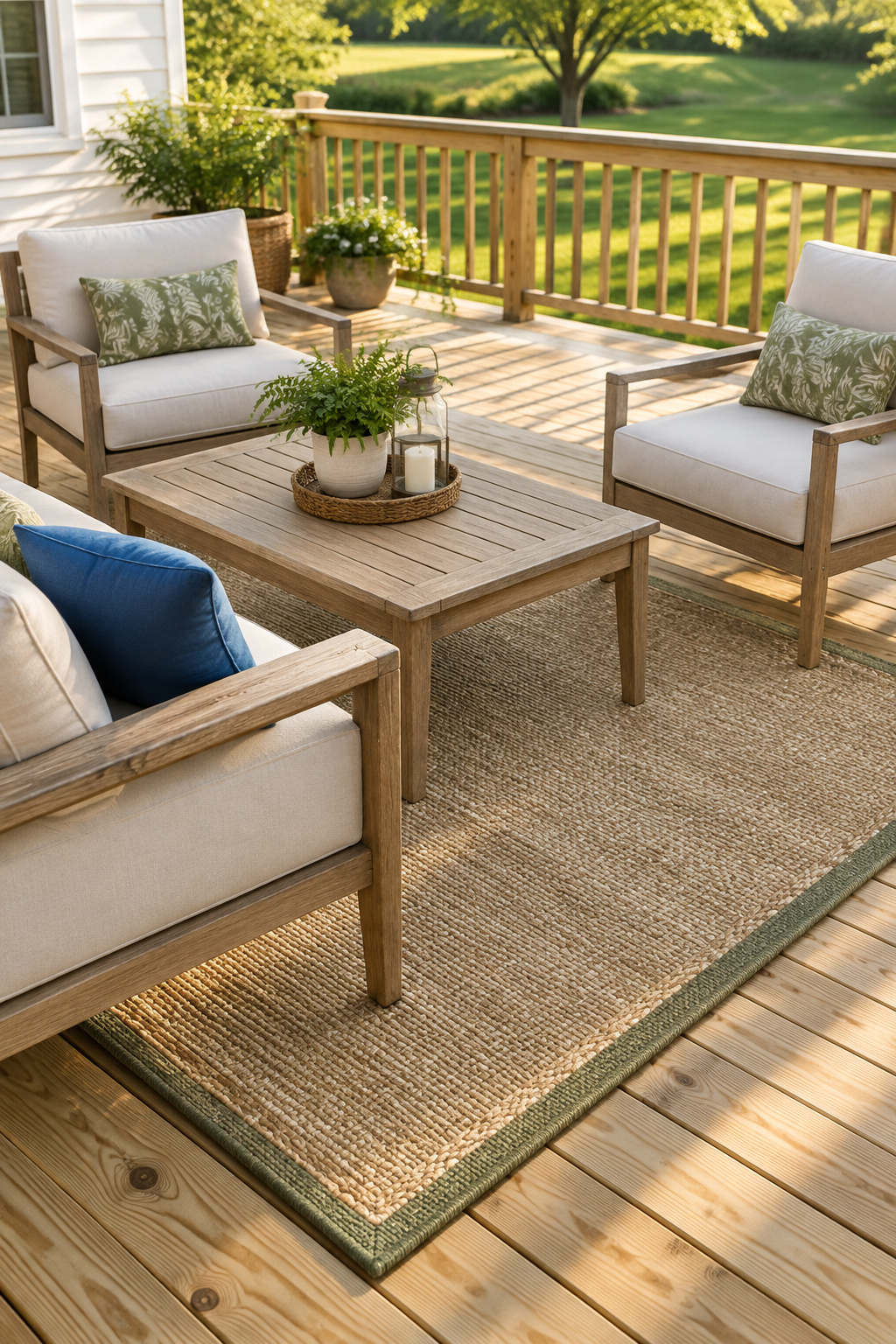
Rug retailers agree on one rule: at least the front legs of every chair and sofa in the group rest on the rug. Mark where those legs land at the outer edges, then buy the rug that reaches the marks.
Around it, leave bare boards. How much is argued over, and about a foot is a fair middle. On a raised deck, keep every corner well inside the edge so nothing hangs over a step. A rug sized to the whole deck covers the one surface you most need to watch. That’s furniture for a photograph. Enough is a good word here: one rug, under one group, with boards showing on every side.
I drink my second coffee from a thermos on the back step in most weather, and from there what I notice is the boards, where the water sits and how fast it leaves. The table, the plants and the lights are separate choices, and they belong with decorating the rest of the deck.
Washable or decoration: lifting, drying and storing the rug each season
The first thing I changed in our house outside Duluth was where wet boots go. If you leave the wet to chance, the floor decides for you. Rain gets under a deck rug whatever you do, so plan how it leaves.
Through the wet months, roll the rug back regularly, sweep, and wash any dirt off the boards with mild soap and water. After heavy rain, lift a corner and look. If the boards are still wet, leave the rug up until they dry, and never lay a damp rug back on damp boards. Drying a rug under a roof is a different question, and it belongs with screened porch furniture.
For the sums, what a deck rug costs in a budget makeover sets a rug against the rest of the spend. My own view is simpler. Buy the better hinge: one good rug stored every winter over a new one every year.
Winter storage
Bring the rug in before the first hard freeze. Frost, snow and constant moisture damage the fibers, and freeze-thaw cycles can lock water under the rug against the boards. Where I live that date comes early, and I would rather bring the rug in a week too soon than chip it out of the ice.
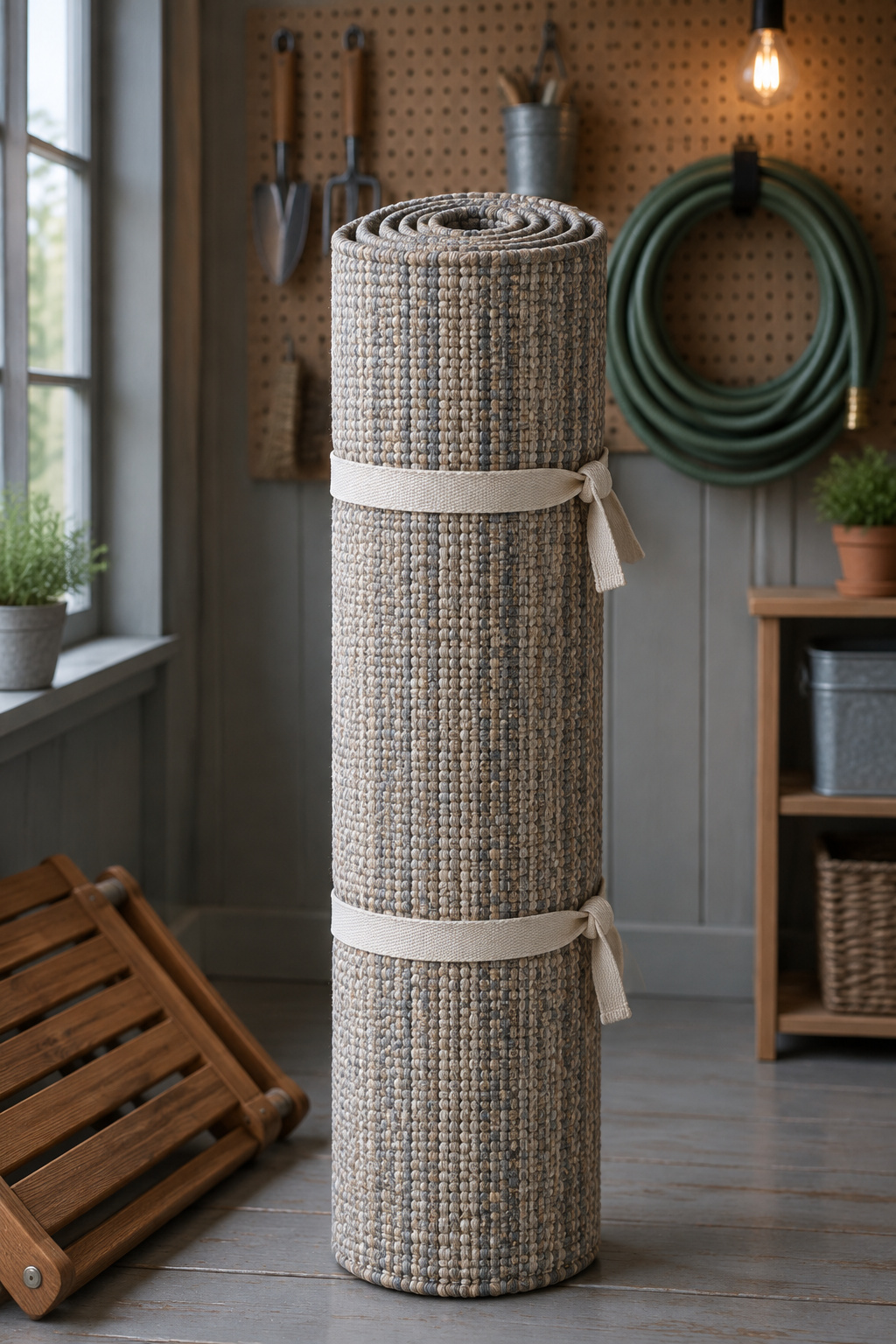
Wash it, let it dry completely, then roll it with the top side out and store it somewhere dry and ventilated. Never fold it, and never put it away damp. If you have room to lay it flat, do, because a rug rolled for months can keep its creases and crushed fibers.
Pattern last: three rules to carry to the store
Take these with you, in this order:
- Check your decking maker’s current care page for your board line before you buy.
- Choose an unbacked woven rug, and skip rubber, vinyl and latex backings and rubber pads.
- Size it to the seating group, front legs on, with bare boards on every side.
Only then turn it over and look at the front. Pattern and color should start from the boards; rug and cushion colors for gray or cedar decks works from there.
That leaves fiber, and I cannot give you one answer because the makers do not have one. Fiberon tells owners to use polypropylene or colorfast woven rugs only. Trex’s FAQ points the other way, toward jute, sisal or bamboo, and cautions that polypropylene or rubber-backed rugs can draw colorant out of its boards. The rug sellers side with Fiberon. For myself I would choose a polypropylene flat weave I can hose clean. On Trex boards I would still do what Trex says. The people who made the boards know them better than I do, and their page outranks mine.
FAQ
What is the difference between an outdoor rug and an indoor-outdoor rug?
Mostly the label, because no standard defines either term. Rugs sold as indoor-outdoor are usually polypropylene or PET polyester, UV-stabilized, mildew resistant and quick to dry, so they work on a deck as well as in a hallway. On boards, the fiber and the backing matter more than the tag, so read the back first.
How do you stop an outdoor rug from blowing around on a deck?
Let the furniture hold it: with the front legs of every seat on the rug, the group pins it down. If you want a pad, check your decking maker first, since most warn against rubber. An open-weave mesh pad 1/8 to 1/4 inch thick, cut an inch inside the rug’s edge, is the gentler choice.
Why does a deck have a pale rectangle where the rug was?
The boards in the sun weathered and faded while the covered boards did not, so the patch under the rug stays darker than the deck around it. Move the rug now and then so the boards weather evenly. On new composite, wait at least three months before laying a rug, so the surface settles into its color first.