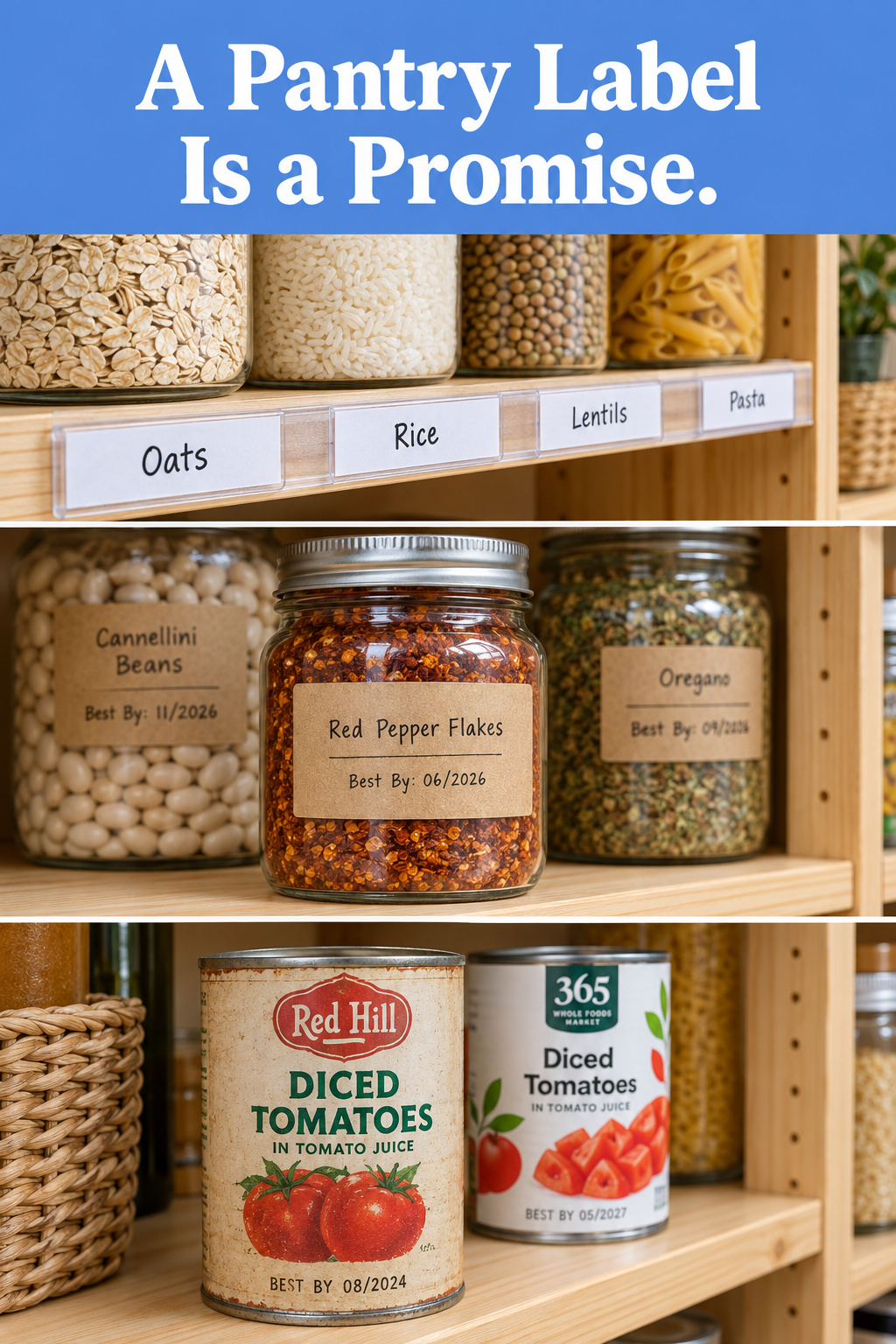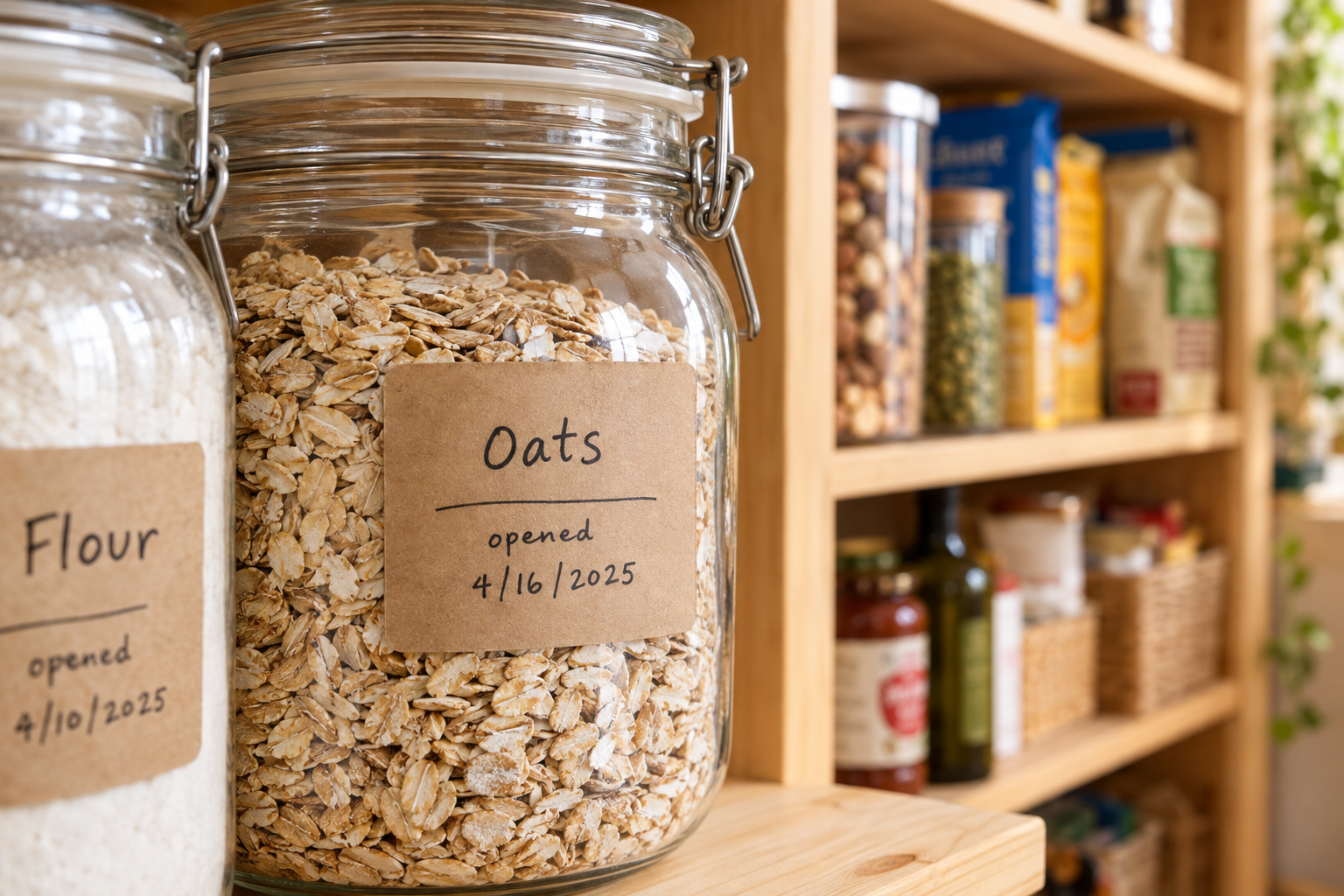
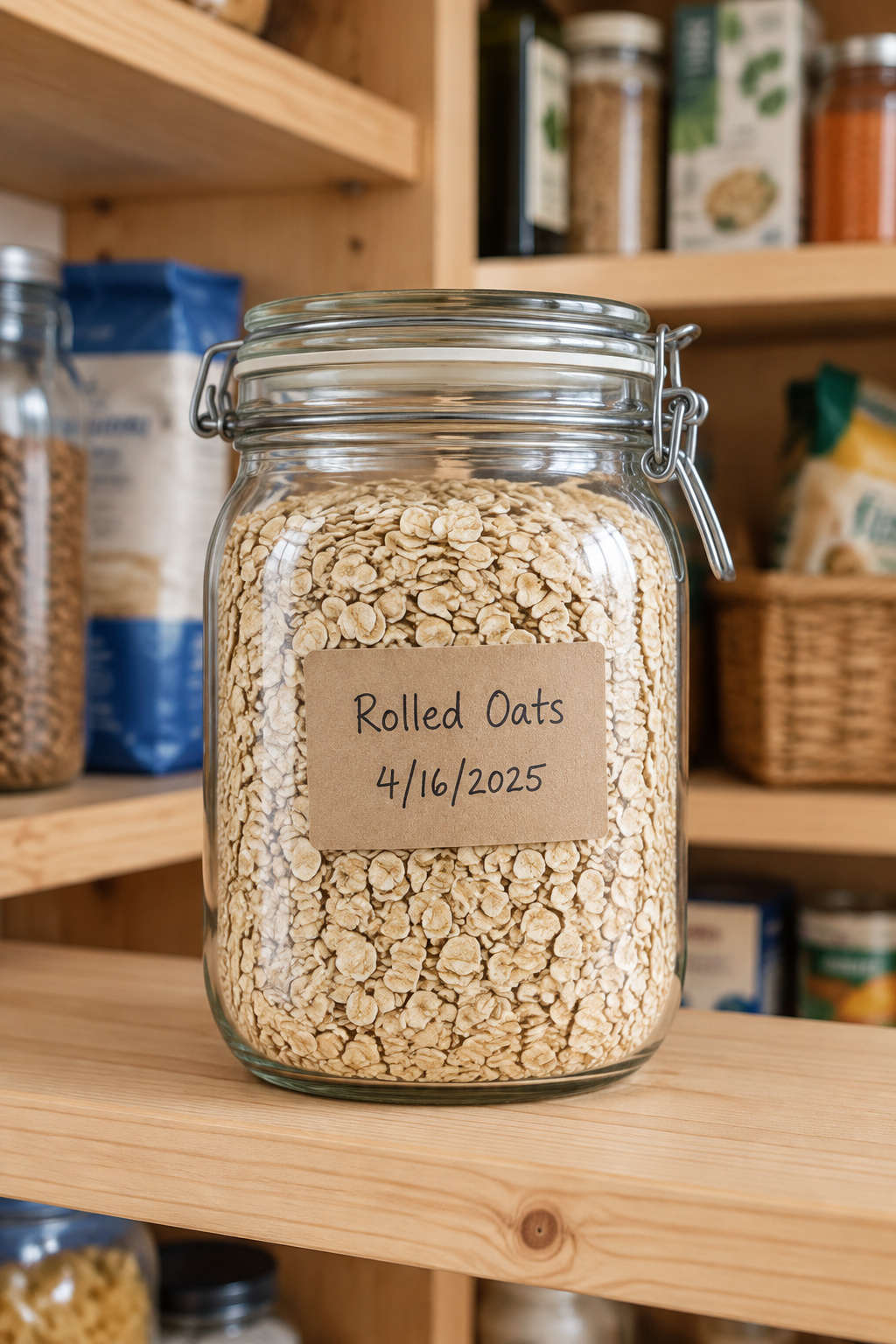
Take the jar of rolled oats at the back of the second shelf: clear glass, a gasketed lid, and a strip of kraft paper reading OATS in careful capitals and nothing else. It is a handsome object and a mute one. It cannot tell you when those oats came into the house, when their bag was opened, or whether they are next in line or already past it. Most pantry label ideas stop exactly where that jar stops, at the name. A label can answer “what is this?” and still leave out the question that decides whether food gets eaten: “how long has this been here, and when should it leave?”
TL;DR
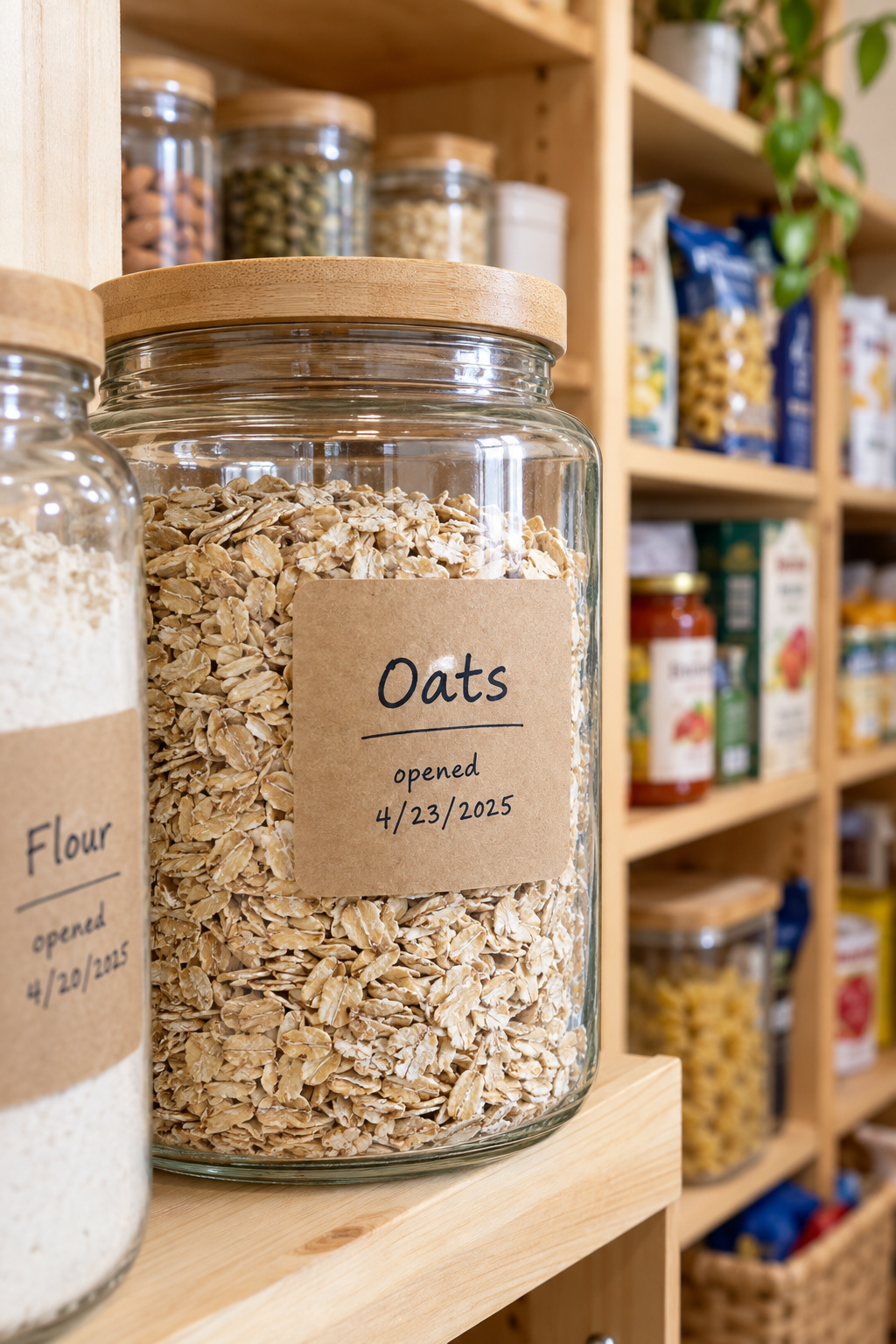
- Write four fields on each container, not just the name: name, date bought, date opened and a use-by in your own words. Decanting loses the printed date, and only infant formula must carry one by federal law (USDA FSIS).
- Size the lettering for the distance you read it from. A borrowed signage rule of 1 inch per 15 feet puts a shelf label read from 3 feet at about 0.2 inch, while a container at arm’s length reads at an x-height near 1.2 mm.
- Labels cut waste only when they drive rotation, with new stock going behind old. The waste reductions measured in household studies came from a use-it-up habit rather than from labels alone.
What a label records
Every library keeps an accession record, a line noting the day each item entered the collection, and I still think of that faint penciled date as the most honest sentence in any catalog: before a book has a shelf mark, it has a date of arrival. A pantry label is the domestic version of the accession line, the household’s only written memory of when a food arrived and when it ought to go.
The USDA’s Food Safety and Inspection Service (FSIS) distinguishes “open dating,” a calendar date written for the consumer about how long a product stays at its best, from “closed dating,” a manufacturer’s code shoppers are not meant to read. A home label re-creates open dating for everything the store never dated, including every staple you pour out of its bag.
A pretty label and a working one are different things. A study of household refrigerators by Davenport et al., published in Resources, Conservation and Recycling, found that items carrying a bare date with no explanatory phrase had markedly lower odds of being fully used than items with no date label at all. So a date with no explanation predicts more waste than no date at all, which is why keeping a pantry organized has to mean keeping it legible in time as well as in space.
Pantry label ideas: shelf labels vs. container labels
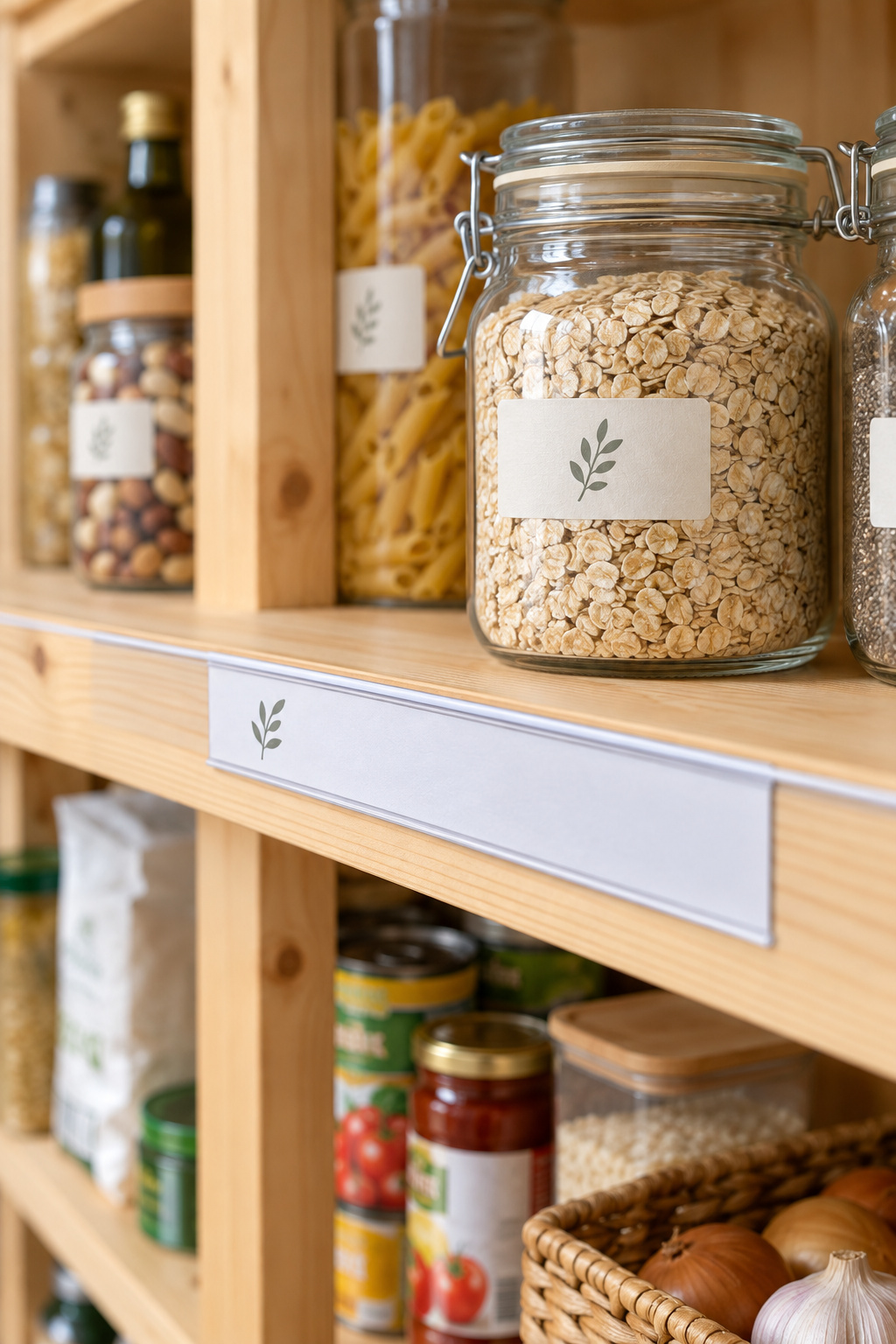
Before writing a single word, decide where the label lives. The organizer Linda Samuels, owner of Oh So Organized!, puts that choice first (shelves, containers or both) because it fixes what every later label can tell you. Libraries answer it with both a bay-end guide and a spine label, for different readers, and the two kinds of pantry label divide their work the same way:
| Shelf-edge label | Container label | |
|---|---|---|
| What it describes | The zone: “rice,” “canned beans” | The object and its dates |
| Survives a container swap | Yes; the zone outlives the jar | No; it leaves with the jar |
| Travels with the food | No | Yes, to the counter or a bag |
| Handling and washing | Rarely touched, never washed | Picked up, wiped, sometimes washed |
| Who reads it | Whoever restocks | Whoever cooks |
The practical case for shelf labels is restocking. Label only the containers and the category vanishes the moment a jar goes in the sink, so any zone refilled loose (grains, snacks) needs its name on the shelf. The dated label belongs on whichever container earns the shelf; choosing that vessel is a separate question. My verdict: label the shelf for the zone and the container for the dates, and never ask one label to do both jobs.
What to write on a label: name, bought, opened, use-by
Follow one bag of flour. It arrives dated by its manufacturer, if at all; it is opened on a Sunday for bread; it is poured into a canister, and the printed date goes out with the recycling. From then on, the canister’s label is the only record.
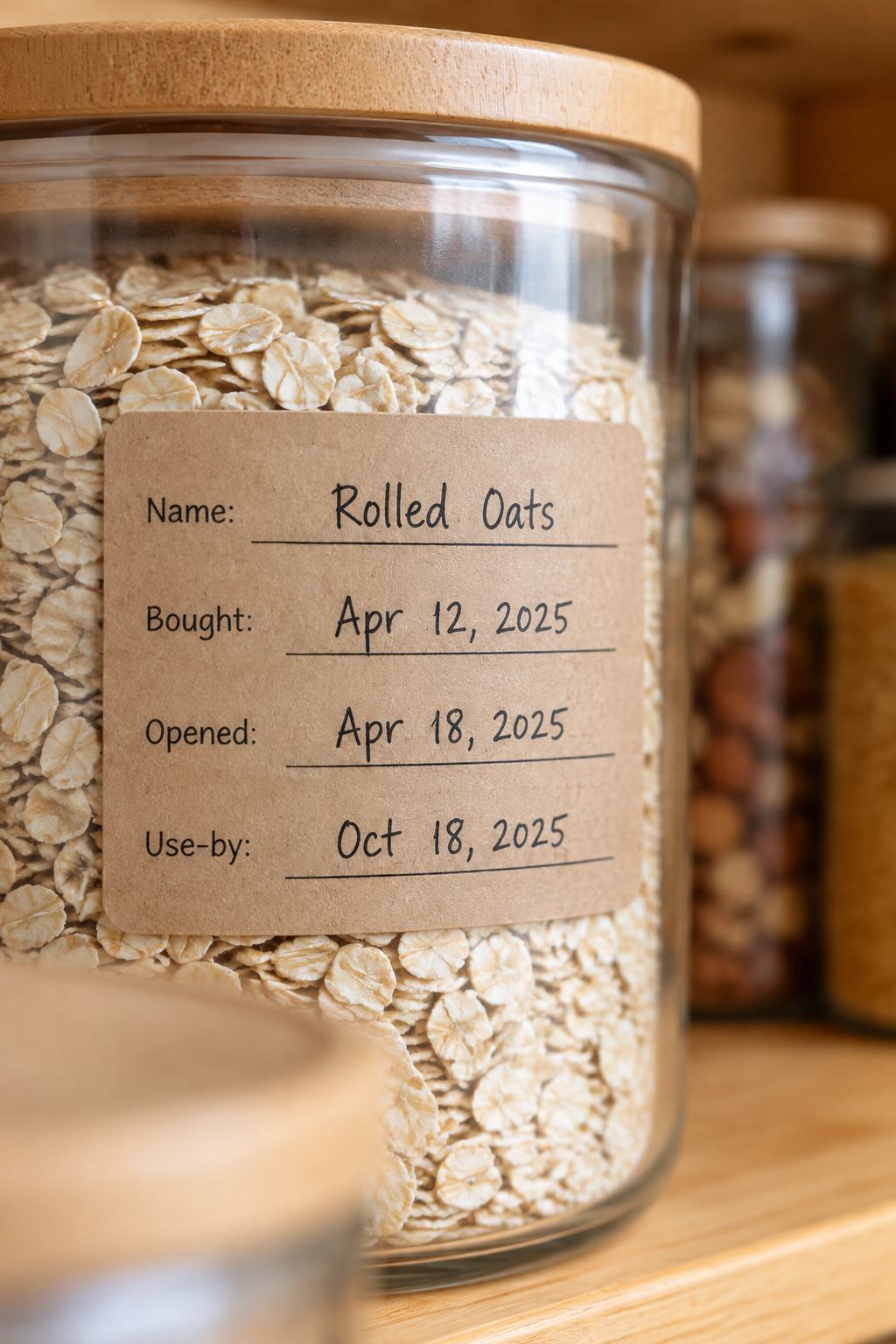
The four fields worth writing
These are the fields in the order the food lives them:
- The name, specific enough to separate two lookalikes. “Flour” is not enough when bread flour and whole wheat sit side by side.
- The date bought. Except for infant formula, federal regulation does not require product dating (FSIS), so your label supplies what the package may never have carried.
- The date opened. Printed dates assume an unopened package. Once opened, shelf life depends on storage rather than the printed date, and only a home label records it.
- A use-by in your own words, the field that turns the other three into an action. Given the Davenport finding, write “use by” beside the date, never the date alone.
What to leave off
Leave off the brand, which means nothing once the food is decanted; recipes, which belong on a card and crowd the fields that matter; and weights or counts, which go wrong the moment the container is topped up. A catalog card that tried to summarize the plot would be a worse card.
Making a label legible from across the kitchen
How far away do you stand when you read your pantry? No legibility standard exists for pantry labels, so the numbers below are borrowed from other fields. The comfortable-reading figure comes from the signage industry: roughly 1 inch of letter height per 15 feet of viewing distance, a fixed visual angle of about 19 arcminutes. Scaled down to pantry distances:
| Reading situation | Distance | Letter height | Basis |
|---|---|---|---|
| Container held at arm’s length | 40 cm | About 1.2 mm x-height | Borrowed accessibility rule (WHO near-vision thresholds) |
| Container read a little farther off | 1 m | About 3 mm x-height | Same rule, multiplied by distance in meters |
| Open pantry door | 3 ft | About 0.2 in (~3/16 in) | 3 ÷ 15 = 0.2 in, from the borrowed signage ratio |
| Standing back in a galley | 6 ft | About 0.4 in (~3/8 in) | 6 ÷ 15 = 0.4 in |
| Across an open-plan kitchen | 10 ft | About 0.67 in (~2/3 in) | 10 ÷ 15 = 0.67 in |
Every signage row uses the same working: height (in) = distance (ft) ÷ 15. A typical printed label font, with a cap height of roughly 1/4 to 3/8 inch, therefore covers a shelf label read from about 5 or 6 feet, and begins to strain past 8 to 10 feet.
Up close, size stops being the problem sooner than expected: in a study by Pelli, Majaj and Chahine, all 49 observers read five-letter words at near-maximum speed at x-heights of 1.2 mm and 1.4 mm. A study of drug labels by Sansgiry et al. in Packaging Technology and Science found that x-height, not nominal point size, predicts legibility, because typefaces vary widely in how tall their lowercase letters stand. Judge a font by its lowercase letters, not the number on the label maker’s dial. Handwriting has no measured figure; the qualitative rules are dark ink on a pale ground, letters formed rather than dashed off, and the label facing front. A label turned toward the wall is as useless as a spine turned backward on a shelf, and I would object to both.
What ‘Best By,’ ‘Sell By,’ and ‘Use By’ mean
This is where the flour’s story can go wrong. The bag carried a phrase, the canister carries your paraphrase, and a wrong paraphrase misleads the whole record. FSIS notes that no single phrase is required in the United States, which is why a home label should restate the meaning rather than copy the words.
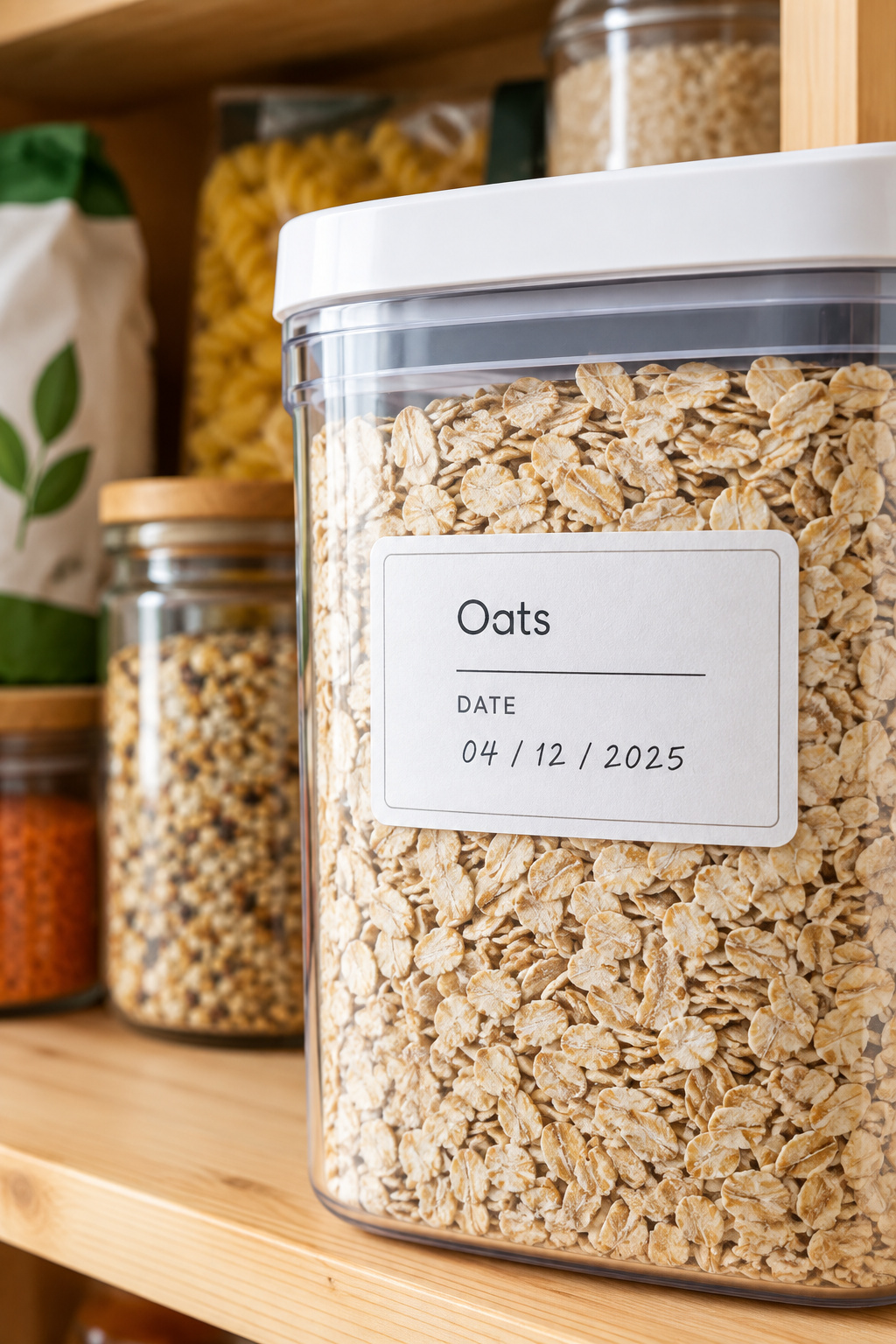
Reading a date like the USDA does
FSIS defines the three common phrases this way:
| Phrase | What FSIS says it signals | Is it a safety date? |
|---|---|---|
| Best if Used By/Before | When the product will be at its best flavor or quality | No, and it is not a purchase date either |
| Sell-By | How long the store should display the product, for inventory | No; it is not meant to guide your own use |
| Use-By | The last date recommended for use at peak quality | No, except on infant formula |
Infant formula is the exception because it is the one product federal law requires to be dated. Where FSIS-regulated manufacturers do date a product, the date must sit right beside a phrase explaining it. Borrow that rule: a date never appears without its phrase. On a canister, “Opened 3/14 · Use by 6/14” is a sentence; “3/14” alone is the bare date that the Davenport study found predicted more waste.
Turning labels into a FIFO system that runs itself
A dated label is only a record until the shelf acts on it. First in, first out is the circulation desk translated into jars: new stock goes to the back, and the older, nearer-dated container stays at the front where a hand reaches first. Rotation depends on comparing two dates at a glance, which is why the bought and opened fields had to be there.
In two five-week randomized field studies in Canada and the United States, Cooper et al. gave households a weekly routine for using up at-risk food, and self-reported food waste fell 33% in Canada and 46% in the United States against baseline. Those numbers measure a use-it-up habit rather than labels, though a label makes the habit possible, because you cannot use the oldest thing first if nothing says which is oldest. The Davenport study adds a curious counterpoint: households that cleaned their refrigerators more often were less likely to fully use a given item, plausibly because tidying without rotation only moves food around.
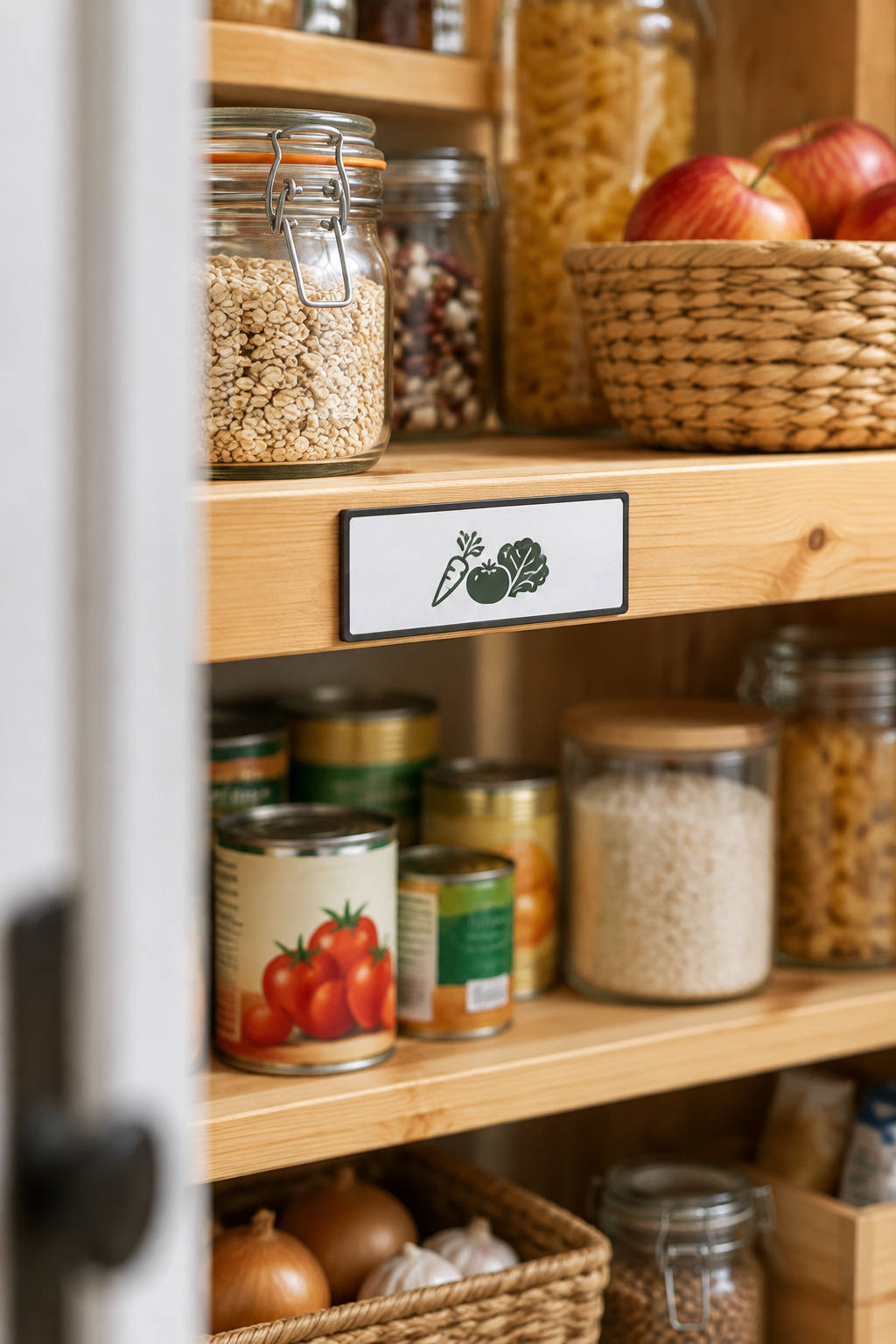
So the system has three motions: label on arrival, place behind older stock, and pull from the front. For young cooks in the house, a picture label a child can read carries the same logic to a lower shelf. Before your next grocery run, label the three containers nearest your pantry’s front with bought, opened and use-by dates, and place whatever new stock arrives behind them.
FAQ
Do pantry labels need to be waterproof?
Only container labels need to be waterproof, because containers get handled, wiped and sometimes washed. Label makers market polyester and vinyl labels for exactly that moisture and handling, though durability figures come from vendors rather than independent tests. Shelf-edge labels are never washed, so paper or kraft works there; the trade-off is replacement, not legibility.
What material works best for pantry labels: vinyl, chalkboard, or paper?
The best material depends on how often the label’s information changes. Vinyl or polyester suits containers that are picked up and wiped. Chalkboard labels suit the fields that change with every refill, the opened and use-by dates. Kraft paper is the cheapest, fastest choice for shelf edges and dry containers that are rarely handled.
How often should pantry labels be replaced?
Replace or update the date fields every time a container is refilled or a new package is opened. On chalkboard or dry-erase that is an edit; on paper it means a fresh label. Shelf-edge labels naming a fixed zone, such as pasta or canned beans, rarely need replacing, because they describe the zone rather than a date.