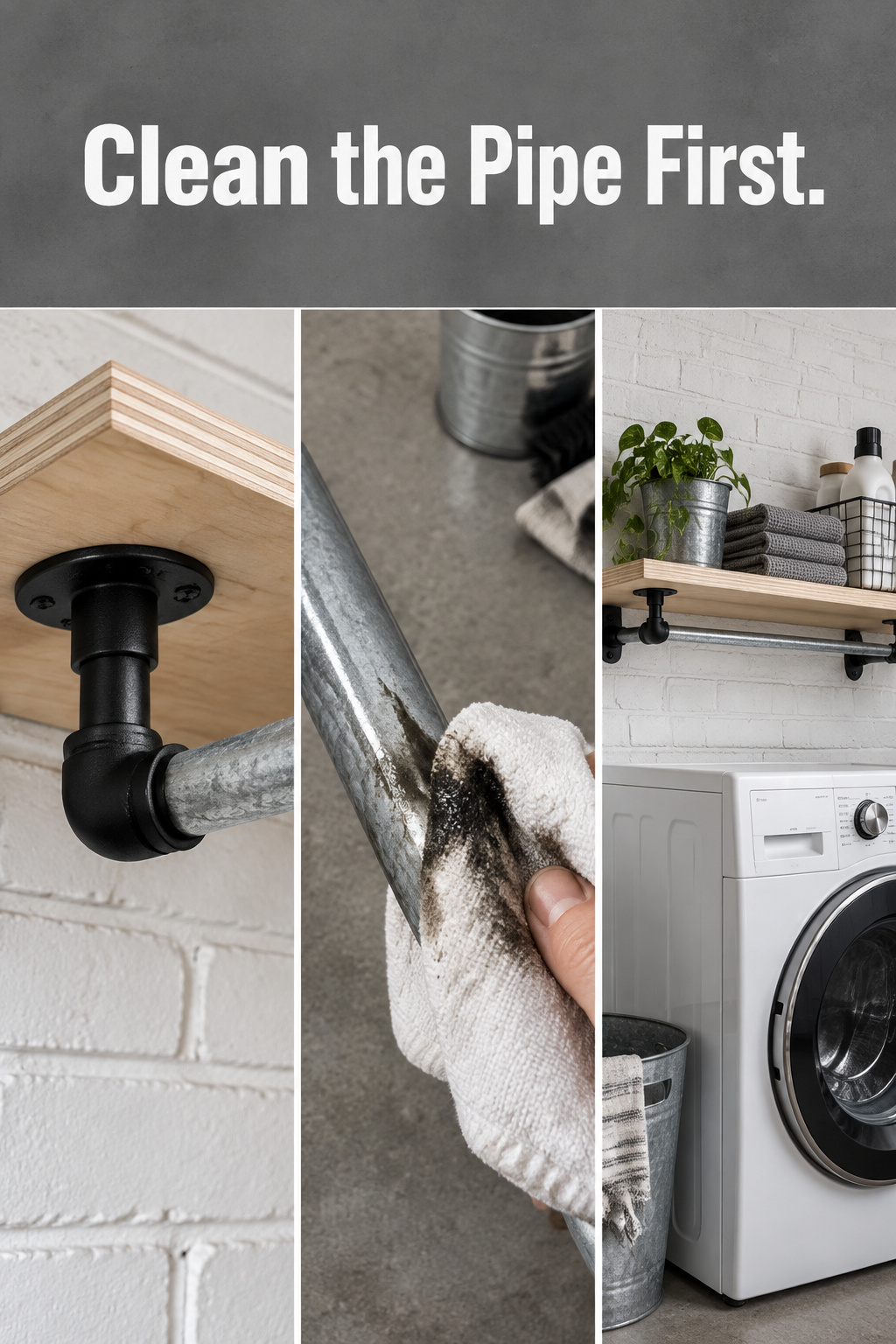
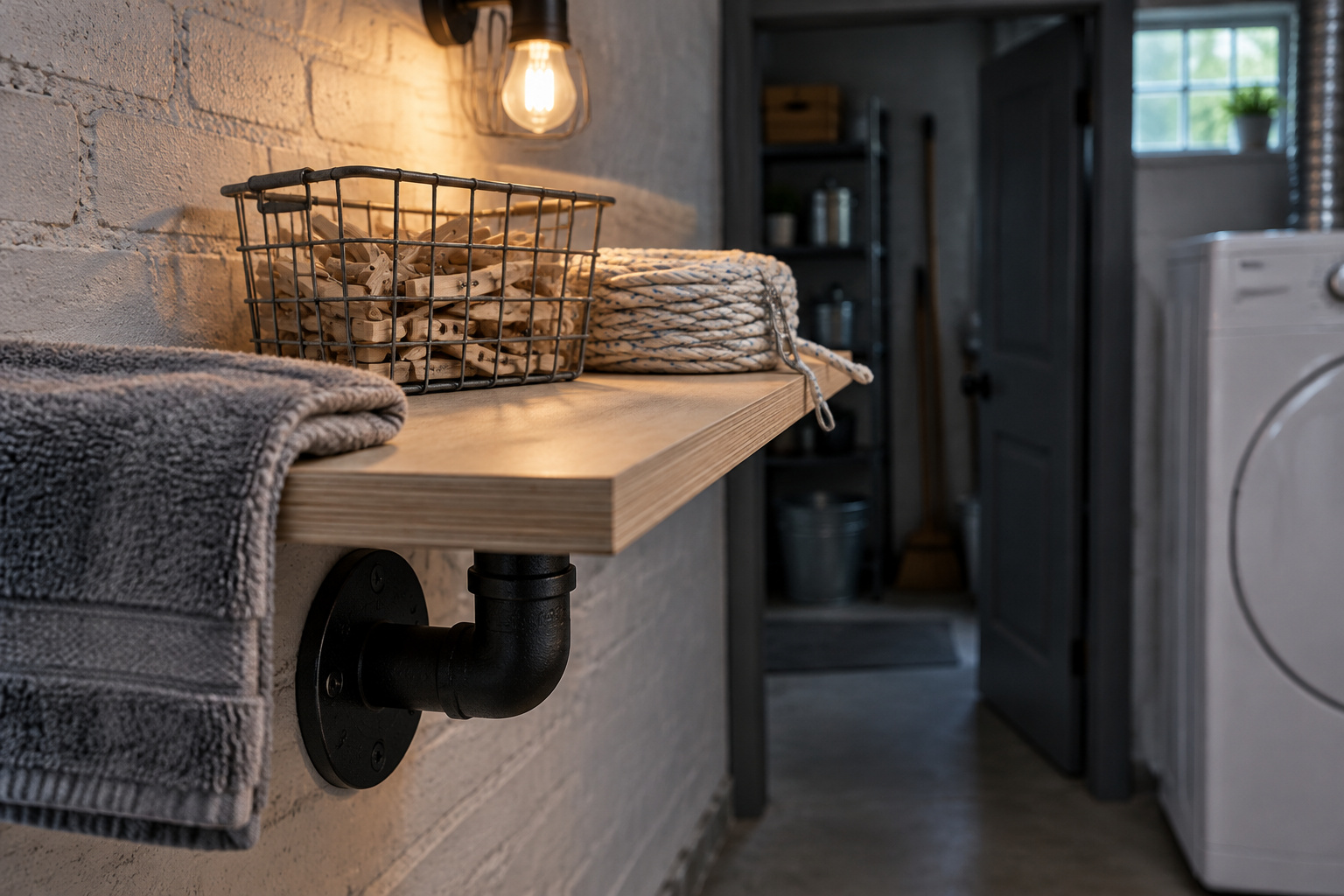
What is that dark, sometimes greasy film on a new pipe fitting, and why should it worry anyone who folds white towels? Every pipe in an industrial pipe shelving laundry room photo was made to carry steam, water, gas or air. ASTM A53, the standard both black and galvanized pipe are made to, says so in its scope. That working past is the appeal, and the problem. Pipe leaves the mill dressed for a warehouse, not a linen cupboard, and the shelf that looks right on every blog can mark the first towel that leans on it. The fix is an order of work, and it starts before the wrench comes out.
TL;DR
- New black pipe arrives with a temporary factory film (oil, grease or lacquer, depending on the mill) that comes off on hands and can mark what touches it. Degrease with fresh solvent and clean rags, dry, then seal before assembly.
- A two-bracket, 3 ft shelf in 3/4 in black pipe came to about $44 to $65 in parts at Home Depot and Lowe’s list prices at the time of writing. The spread depends mostly on whether you buy flanges singly or in an 8-pack.
- Pipe sold as 3/4 in measures 1.050 in across, so drill 1-1/8 in holes for it. Set flanges on studs where you can and plan anchors for the screws that miss.
Black Pipe or Galvanized: The Look You Want and What a Damp Room Does to Each
Galvanized pipe carried household water from around the turn of the twentieth century until copper displaced it in the 1960s. To an eye that dates houses it says “old supply line”, and black says “boiler room”. Pick the history you want on your wall, then pick for the room.
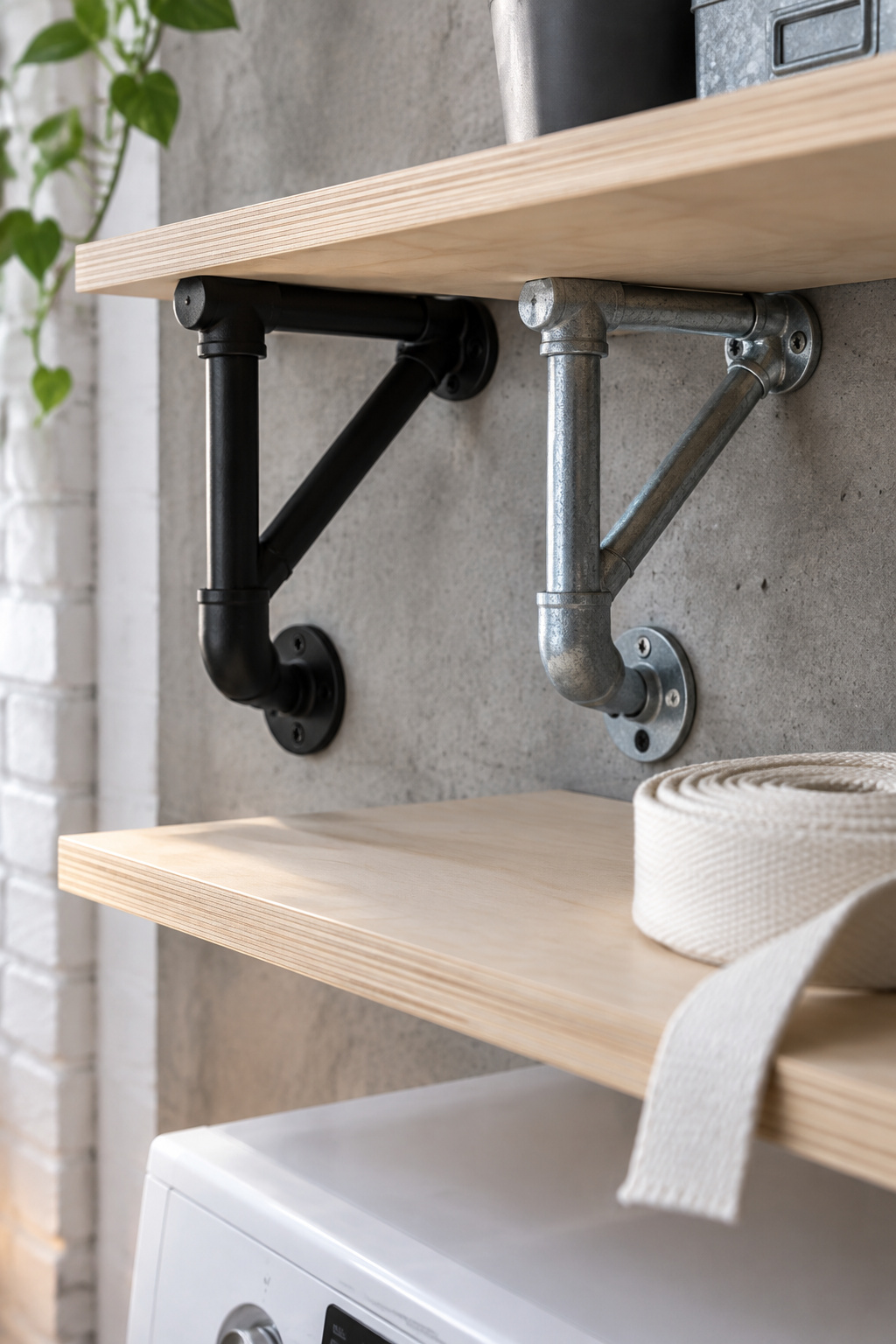
Black pipe is bare steel under a thin mill coating that, one manufacturer says plainly, limits rust in transit and storage, not in service. Galvanized carries zinc, which the American Galvanizers Association says weathers to a matte grey patina through wet-dry cycles, then corrodes at about a thirtieth of the rate of bare steel. Trapped moisture is its weakness: water held against zinc without airflow grows a white, powdery “wet storage stain”. Light staining does not shorten the coating’s life, and a stiff nylon brush, never wire, takes it off.
The evidence gets thin here, and I would rather say so. I found no test of galvanized pipe shelving in a steamy laundry room. My reasoning is only that a board lying flat on a galvanized flange makes the still, damp joint the association describes. Leave air around the fittings and expect the odd white bloom.
| Finish | In a damp room | Film or residue | Cost |
|---|---|---|---|
| Black steel, as bought | Rusts once the mill film is gone, unless sealed | Temporary factory film that comes off on hands | Lowest on most parts |
| Galvanized | Patina protects; trapped moisture gives white stain | Zinc coating; I did not research a film | About 20 to 22% more on flanges and 12 in nipples |
| Black, cleaned and sealed or painted | As good as the sealer and its upkeep | Film removed; sealer replaces it | Black pipe plus sealer |
The price gap is smaller than old supplier charts claim. By my arithmetic, a galvanized 3/4 in flange at $10.65 against black at $8.71 is 10.65 / 8.71 = 1.22, about 22% more; a 12 in nipple 4-pack at $23.90 against $19.97 is about 20% more. If you would rather show no hardware at all, hidden-bracket floating shelves are the quieter answer.
What an Industrial Pipe Shelving Laundry Room Build Costs: Pipe, Fittings and Flanges
Start with the label, which lies politely. Pipe is sold by nominal size, so 3/4 in pipe measures 1.050 in across the outside. Buy every fitting by its label, not a tape measure.
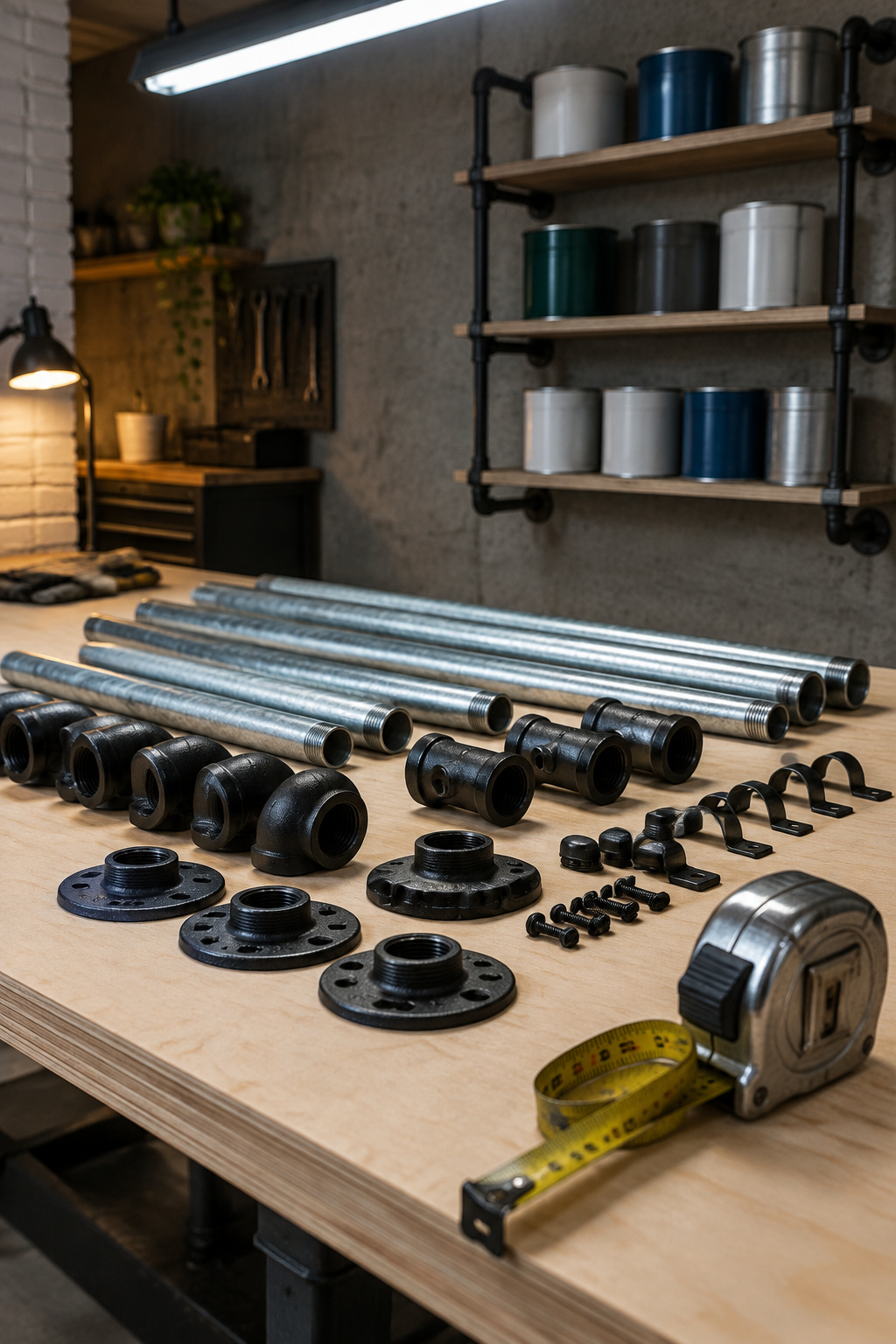
A common bracket is two flanges, one elbow and two short nipples, so a 3 ft shelf on two brackets needs four flanges, two elbows, four nipples and a board. Prices below are Home Depot list prices at the time of writing unless Lowe’s is named, and vary by store.
| Part | Qty | Unit price | Line |
|---|---|---|---|
| 3/4 in black floor flange, single (Southland) | 4 | $8.71 | $34.84 |
| or 3/4 in black flange, 8-pack (Pipe Decor) | 1 pack | $13.99 | $13.99 |
| 3/4 in 90-degree elbow (Lowe’s, ReliaBilt) | 2 | $3.88 | $7.76 |
| 3/4 x 6 in black nipple (STZ), standing in for short nipples | 4 | $3.29 | $13.16 |
| Half a 1 x 10 x 6 ft pine common board | 0.5 | $18.77 | $9.39 |
Here is the sum: with the 8-pack, $13.99 + $7.76 + $13.16 + $9.39 = $44.30; with single flanges, $34.84 + $7.76 + $13.16 + $9.39 = $65.15. That puts a 3 ft run at $44.30 to $65.15, before screws, anchors, sealer and thread tape. The 6 in nipple stands in for the unpriced shorter ones, and buying flanges by the pack is the biggest saving.
Clean the Pipe First: Stripping the Factory Film Before It Reaches Your Laundry
The film is not one substance. One American mill dips its pipe in a 12 to 16% soluble-oil bath for about a month of indoor rust protection, and Australian galvanizers describe a hard bitumen lacquer. One flange seller says its parts arrive “lightly coated with industrial grease” and should be cleaned and sealed. Call it factory film and treat it as packing material, because it was never meant to reach your home.
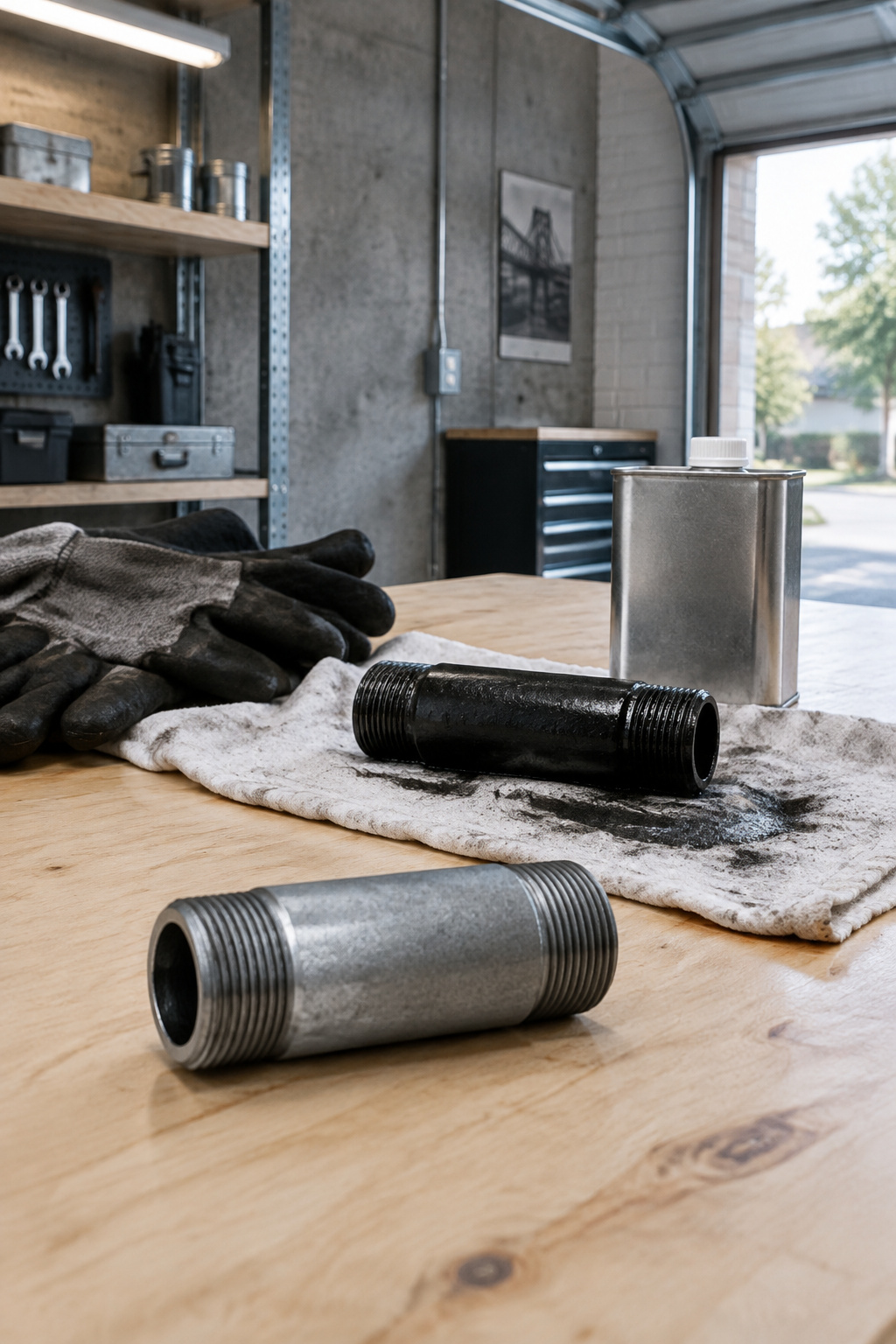
Degreasing: what to use and what not to
The advice conflicts, and no one ranks it. One pipe seller recommends mineral spirits, yet the same seller elsewhere recommends warm soapy water, dried at once because raw steel flash-rusts. An engineering blog strips lacquer with acetone and 0000 steel wool. A shelf blog reaches for window cleaner and forbids abrasion. The only named standard, SSPC-SP1 solvent cleaning, asks that all visible oil and grease come off. A coatings consultant adds what people skip: a dirty rag only moves the oil around.
My practice is mineral spirits on clean, lint-free rags, a fresh rag once one picks up film. The safety data sheet rates it a flammable liquid that can cause dizziness and may be fatal if swallowed and drawn into the airways. Work outdoors or with windows open, away from flames, in nitrile gloves.
I learned which solvent goes where the hard way. At nineteen I stripped an oak chest with the wrong one, and what it took off I could not put back. A solvent that cuts pipe film is no friend to a finished board, so each fitting is cleaned before it goes anywhere near the wood, never after.
- Degrease each fitting until a fresh rag stays clean, and scrub the threads with a stiff brass brush.
- Let the iron dry somewhere ventilated, 30 to 45 minutes by one seller’s count, and never seal damp pipe.
- Seal it, then let the finish cure before you thread anything together.
Sealing: a finish that survives steam and lint
One seller wants two or three light coats of oil-based polyurethane spray, then 24 to 48 hours of cure, since threading soft coating strips it. A shelf blog prefers a thin coat of paste wax, buffed matte and renewed every 12 months. I could find no laundry-room test behind either.
I use paste wax, my preference rather than a finding: it buffs matte, and by my reversibility rule a wax is the easier finish to undo. Keep any finish thin: the Canadian Conservation Institute notes that too much oil on iron attracts dust and dirt, which here means lint.
Board Prep and Flange Anchoring: Where the Shelf Meets the Wall
Preparing the board
Which wood should sit on iron? Not oak, ideally. The USDA Forest Products Laboratory describes iron stain as a blue-black mark that forms when water lets wood’s tannin-like extractives meet steel, with oak, redwood, cypress and cedar especially prone. Dry indoor wood does not stain, but a water-repelling finish can still let it appear later if moisture reaches the iron.
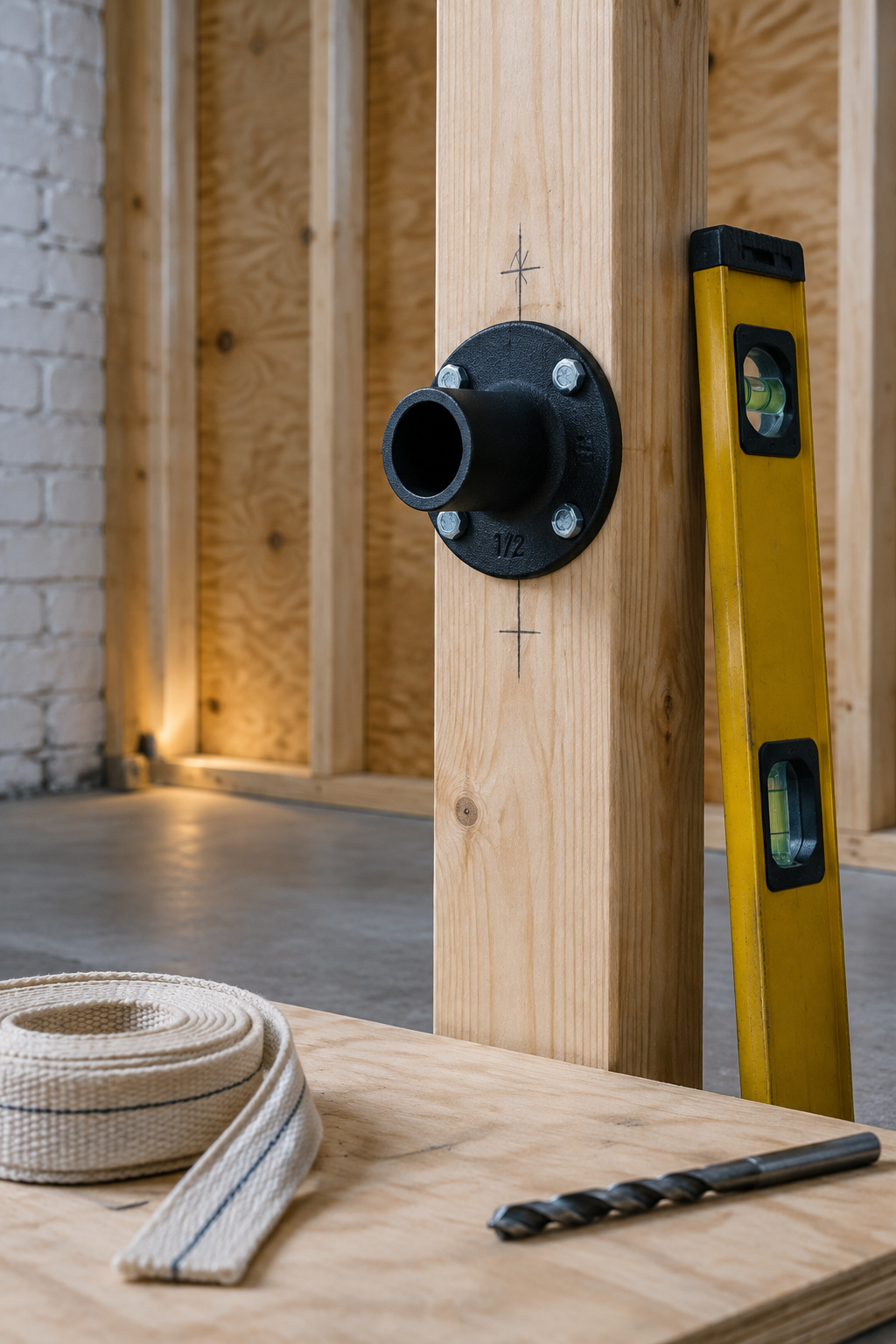
For stain-grade softwood going under an oil-based stain, General Finishes says sand to 120 then 150 grit and stop. How each wood behaves in humidity is its own subject, covered in the guide to wood laundry room ideas. If the pipe runs through the board, drill 1-1/8 in. Working it out, 1.125 in less the pipe’s 1.050 in leaves 0.075 in of clearance, while a 1 in bit is smaller than the pipe. Or sit the board on the top flanges and screw up from below, using screws short enough not to break the surface.
Anchoring the flanges
Depending on the maker, a 3/4 in flange runs roughly 3 to 3.4 in across, with four holes about 0.28 in wide. One hardware guide suggests that a flange centered on a stud usually gets only two screws into wood, since a stud is 1.5 in wide, leaving the other two for hollow-wall anchors. A seller advises lag screws into studs, wedge anchors into masonry, and pre-drilled pilots. What any of that holds is a matter of sums, worked in the load and fixing arithmetic.
Assembling It in the Right Order, Fitting by Fitting
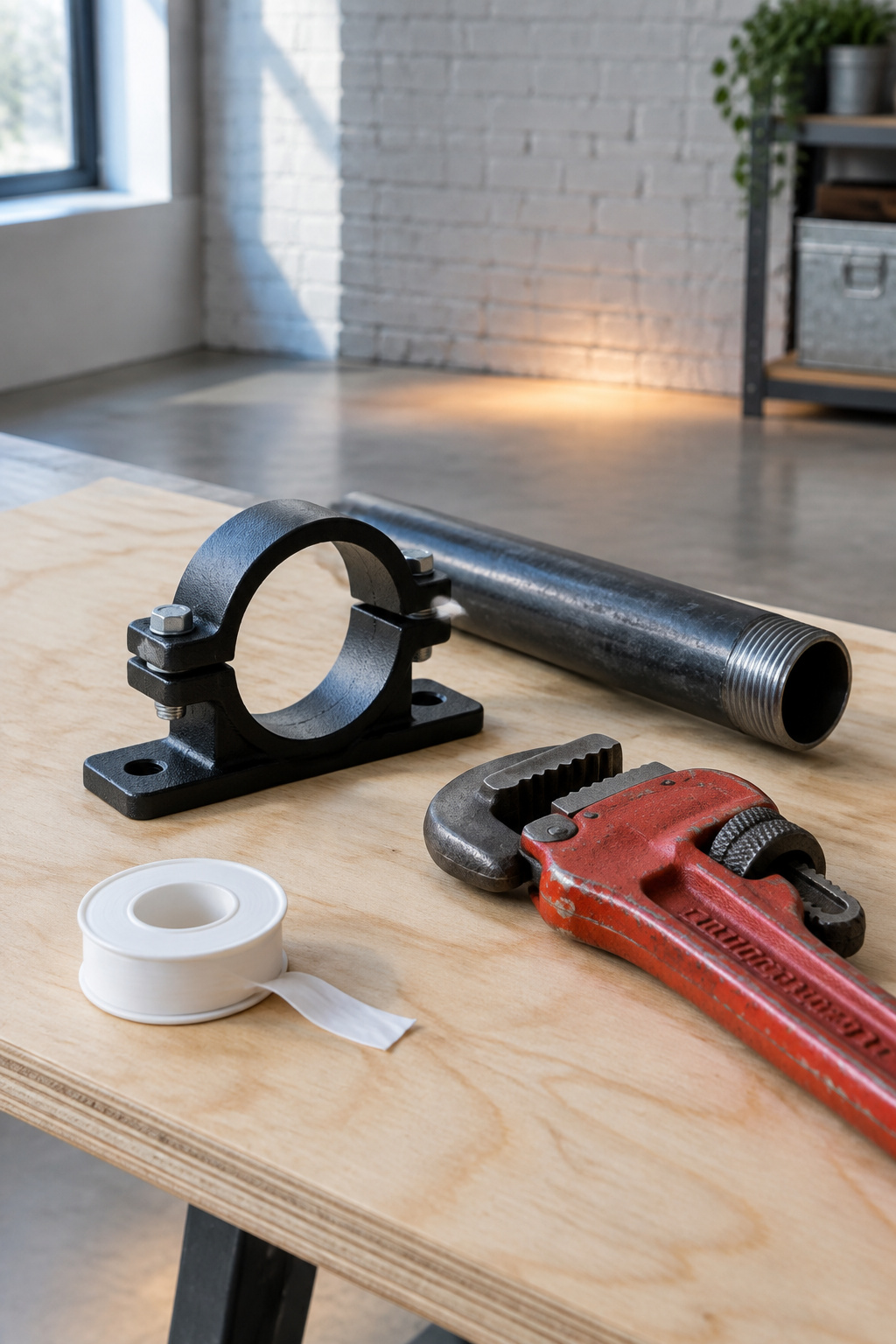
Builders report two mistakes: a shelf that sloped forward because its elbow sat lower than its flange, fixed with an unthreaded flange on the elbow as a spacer, and 6 in nipples that fell short at the wall flange, where readers suggested 7 to 8 in.
- Before buying, measure the whole assembled height and depth on paper, fitting by fitting.
- Dry-fit each bracket by hand on the floor.
- Wrap two or three turns of PTFE tape clockwise around the male threads.
- Thread hand-tight, then a quarter to half turn with a pipe wrench, adjusting until the support flanges sit in one plane.
- Mount bottom-up, one flange at a time: mark through the holes, check level, drill pilots and drive the screws.
- Set the board last and check level again before loading it.
The Laundry Room You Wanted: A Pipe Shelf That Stays Clean
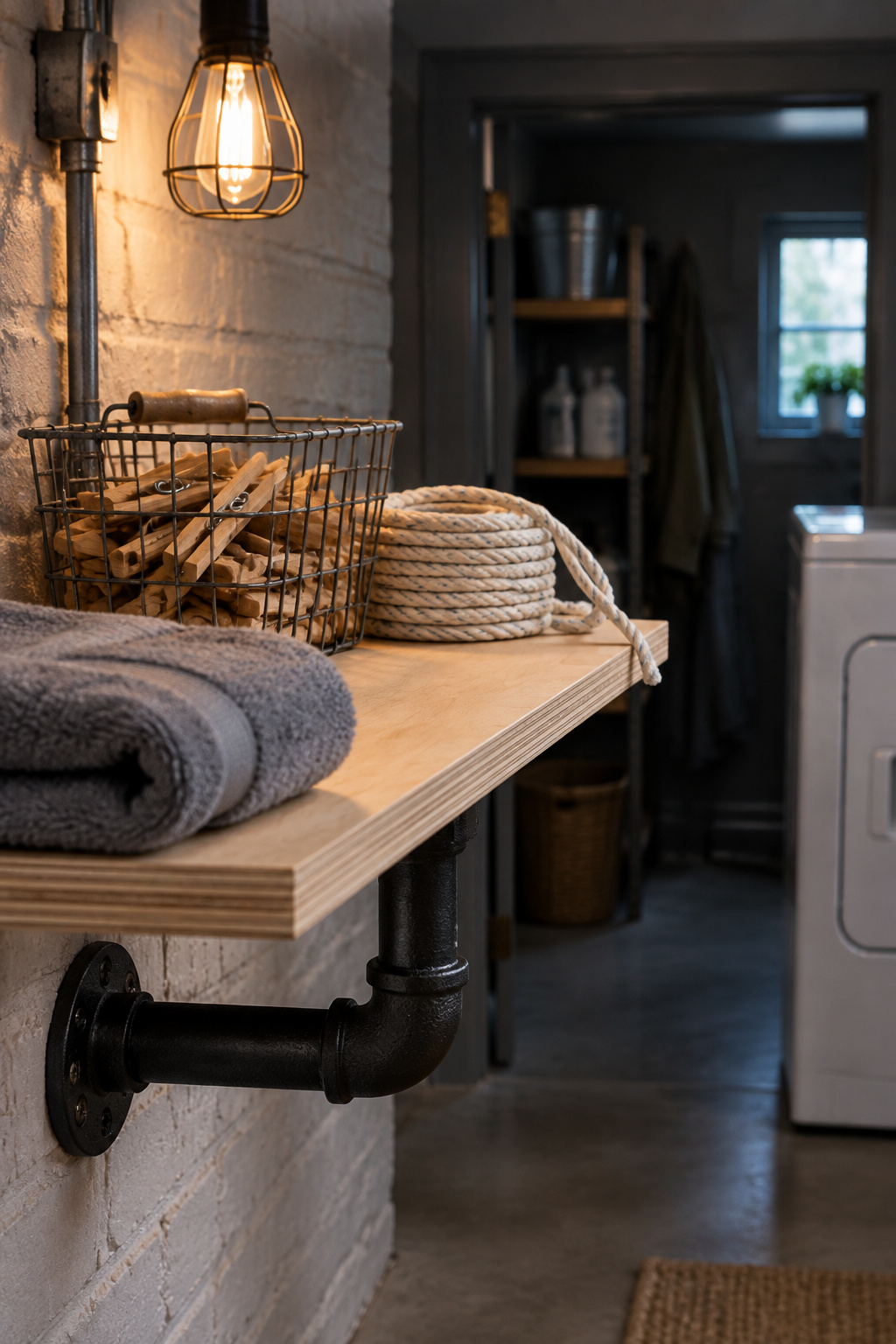
Six months on, the shelf should look as it did the day it went up: charcoal pipe with a dull wax sheen and no grey ring where a fitting meets the board, and towels as white coming off as going on.
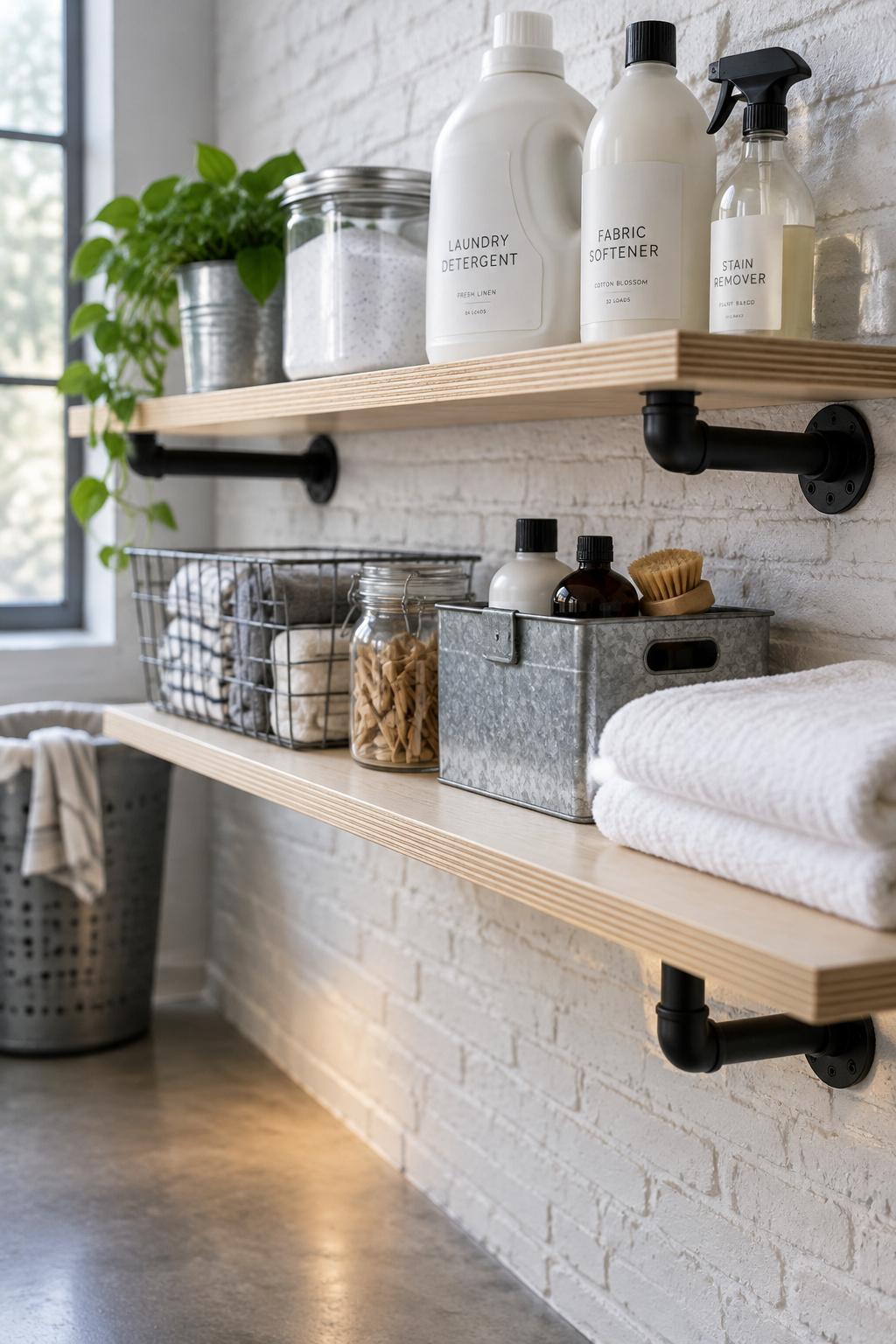
Start with one flange and one nipple. Degrease them, then wipe a white rag across the result; a clean rag proves the method. If pipe turns out not to suit your room, every style of laundry room open shelving is laid out side by side.
One boundary, honestly drawn. I restore and finish old things, and I am not a plumber. The pipe sizes, standards, flange dimensions and prices here are cited from mills, standards and retailers. The cleaning order, the sealing and the board are my trade.
FAQ
Can you use PVC or copper pipe instead of black iron for a shelf?
PVC is a poor choice for a loaded shelf. It loses stiffness as it warms, keeping about 70% at 140 F, and thermoplastics creep under constant load even at room temperature. Nothing I read rates PVC pipe as a shelf bracket, and I found no source on copper pipe shelving, so I will not guess at it.
Do you need to thread the pipe yourself, or can the hardware store do it?
Usually neither. Design around stock nipples, such as a 3/4 x 6 in at $3.29 or a 3/4 x 12 in at $6.24, and nothing needs threading. For custom lengths, ask the store, since some still cut and thread pipe bought there and some have stopped. Online sellers ship pre-cut pipe, with heavy shipping.
How do you get rust spots off a pipe shelf without damaging the finish?
Use the Canadian Conservation Institute’s method: rub the spot gently with 000 or 0000 steel wool and a few drops of light oil, then wipe with mineral spirits on a lint-free cloth. Avoid acid rust strippers. In a laundry room I would finish with wax or clear coat rather than oil, so the repair does not bring a film back.