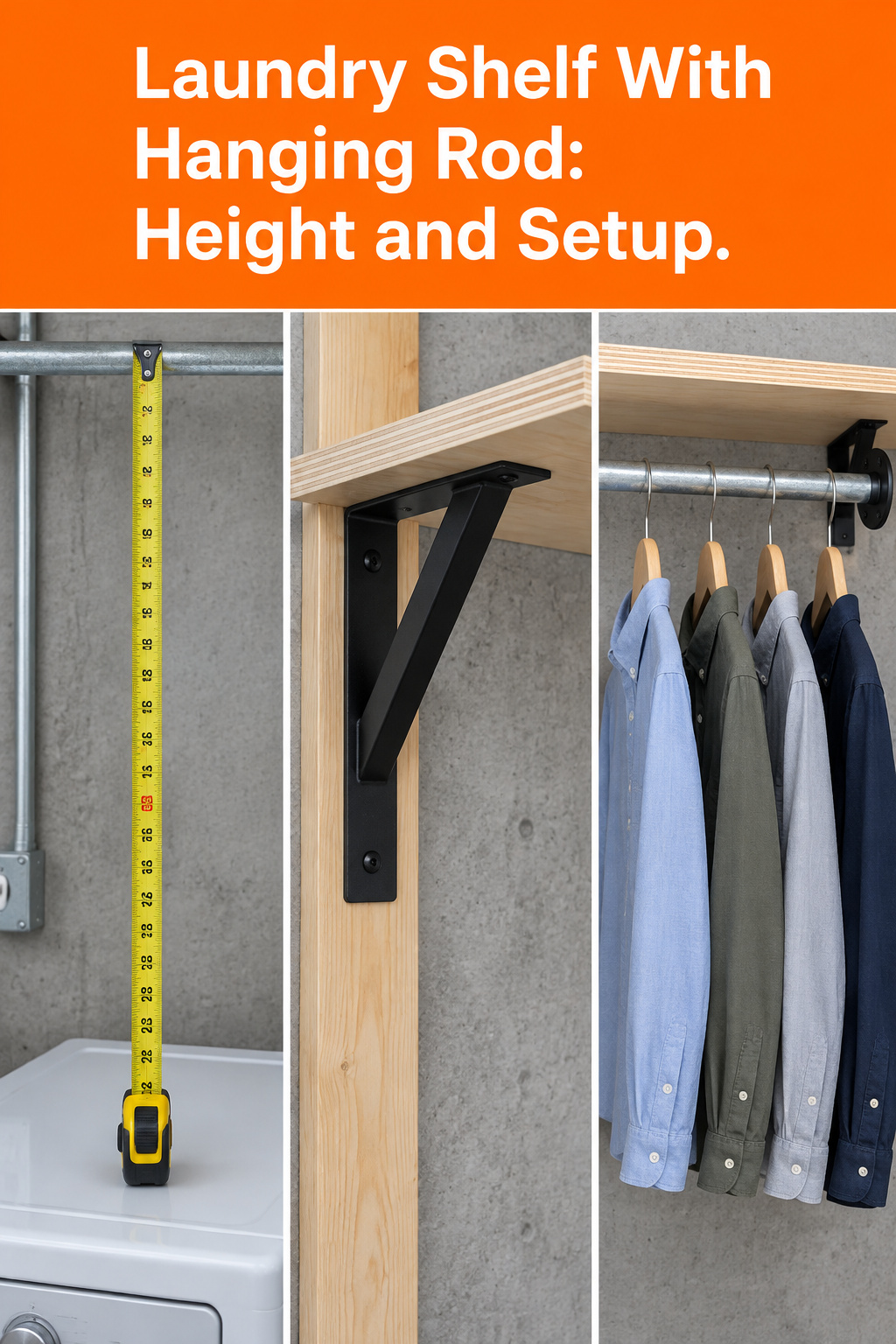
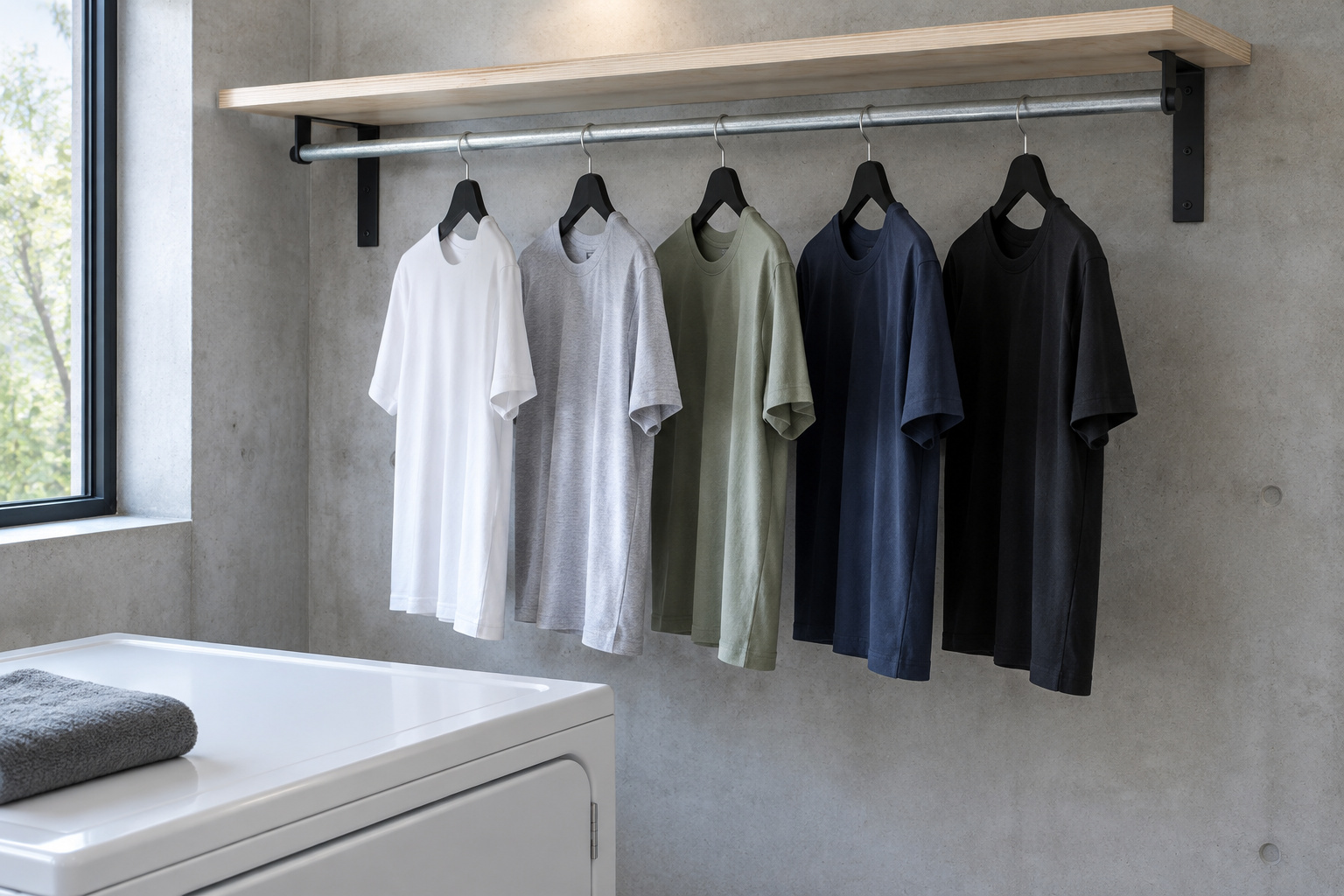
Forty inches. That is about the hanging space an ordinary shirt needs below the rod, and most plans for a laundry room shelf with hanging rod leave the number out. Copy a closet height above your machines and the shirt you meant to save from ironing ends with its hem folded across the dryer top.
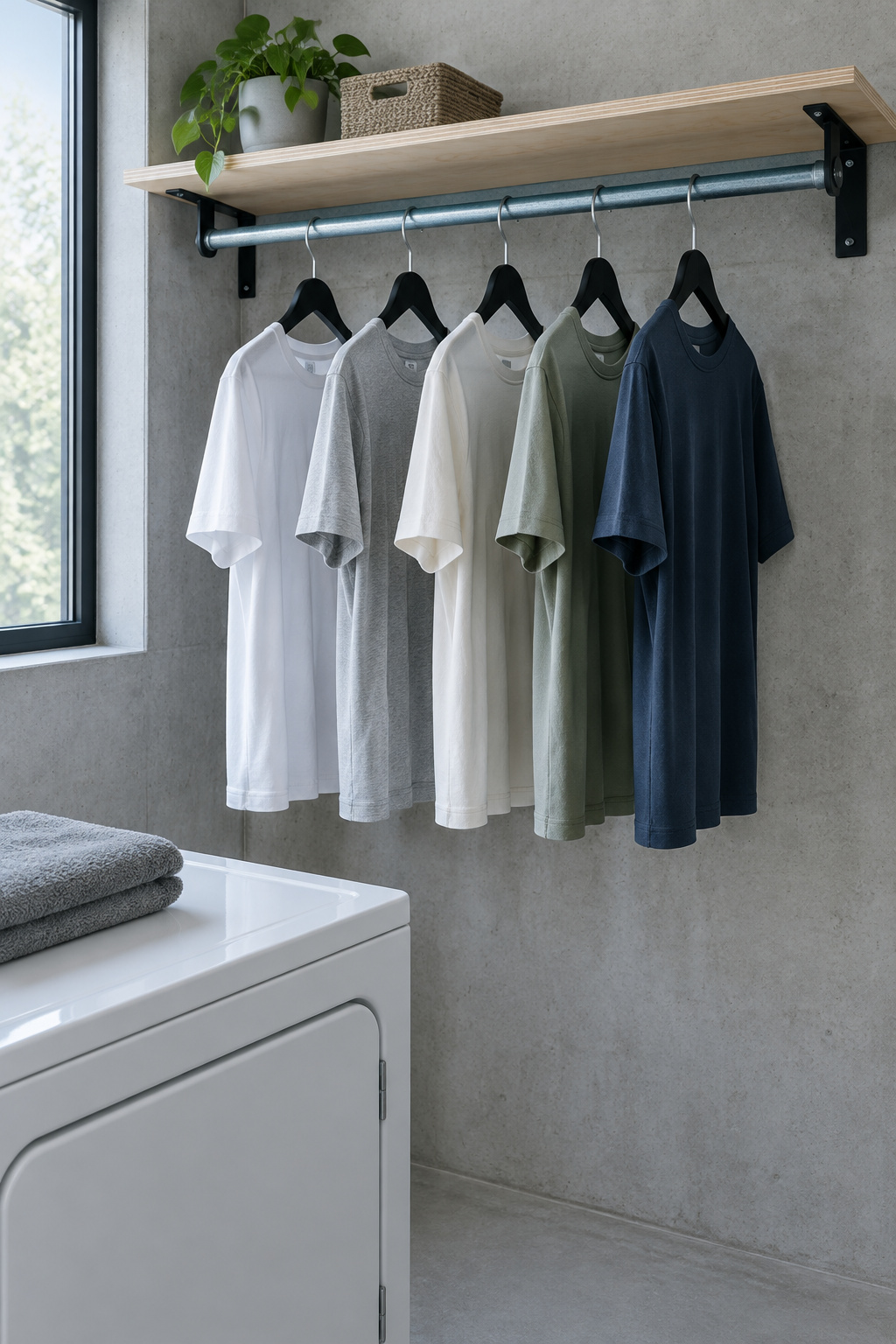
TL;DR
- Height: a front-load top of about 39 3/4 in, a 3 in gap and a 36–40 in shirt drop put the rod near 82 in. The often-quoted 76 in suits only garments that hang about 33 in or less.
- Load: fifteen spin-damp cotton shirts weigh roughly 8.7 lb, well inside a regular-duty rod’s 20 lb per foot rating, so the wall fixing is the limit.
- Placement: hangers about 3 in apart, and the rod over the dryer end or the sink end, never across a top-loader’s lid.
The shirt from the dryer: where it hangs and where it drips
The drum stops. The shirt comes out warm, smelling of clean cotton, the collar soft with heat. It goes either onto a hanger, where its creases fall out, or onto the chair and then the ironing pile. The small tick of a hanger hook on a steel rod is, in every laundry I have planned, the sound of ironing not happening.
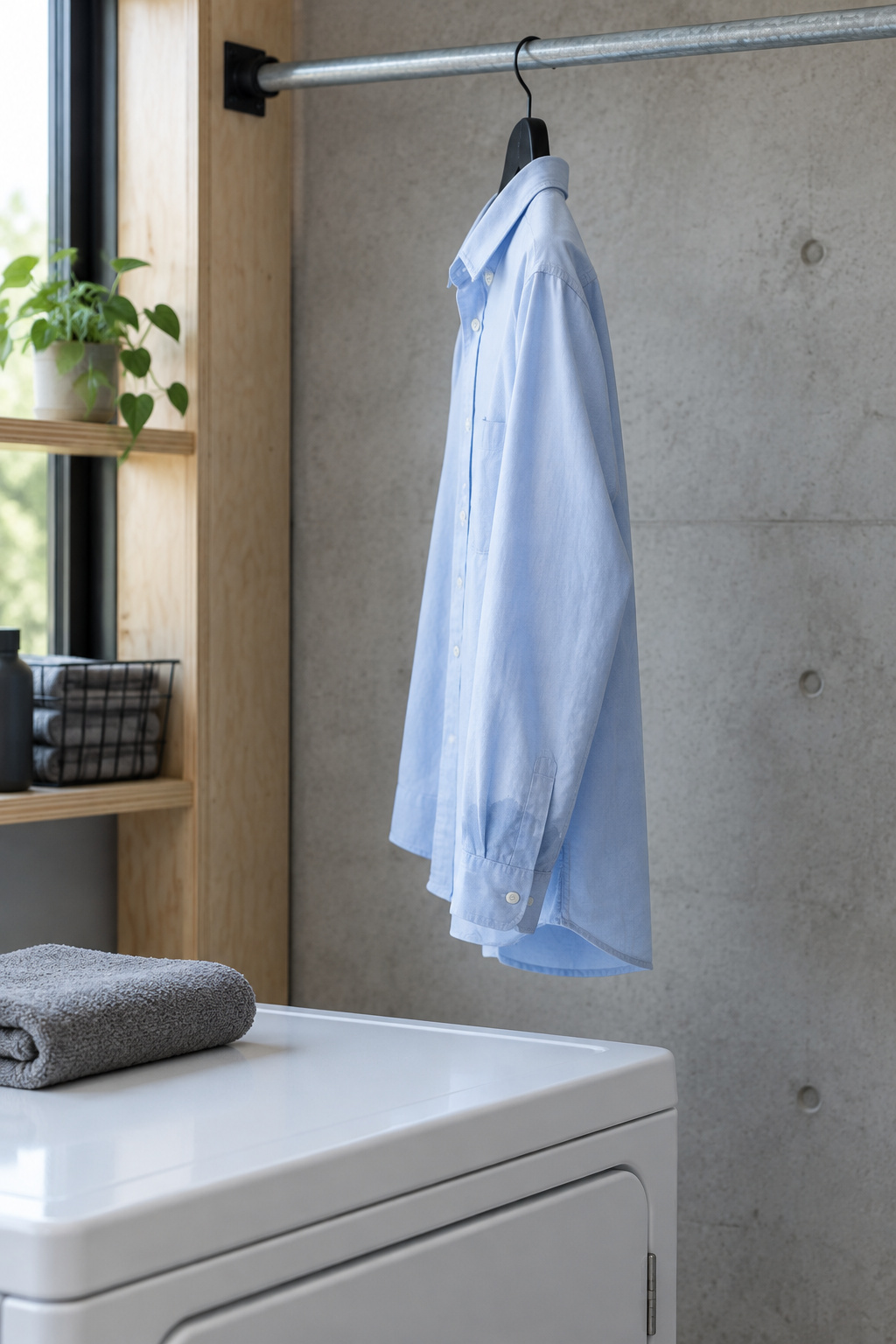
The drip people worry about is mostly imagined. After a spin, cotton still holds roughly half its dry weight in water, about 46 to 48 percent in Asko’s data for a Chalmers University thesis, and the dryer removes it. A shirt that finished in the drum barely drips; the drip belongs to whatever you pull out early.
Guessing goes wrong in familiar ways, a rod too low, so the hem rests on the machine; a rod too long, so it sags; or a rod in the wrong place, hanging cotton where a lid needs to open.
Rod height for a laundry room shelf with a hanging rod: the one number to set first
Published heights for a rod over the washer and dryer run from 60 to 84 in, and few name a garment. Use arithmetic: machine top, plus a gap, plus the garment’s drop.
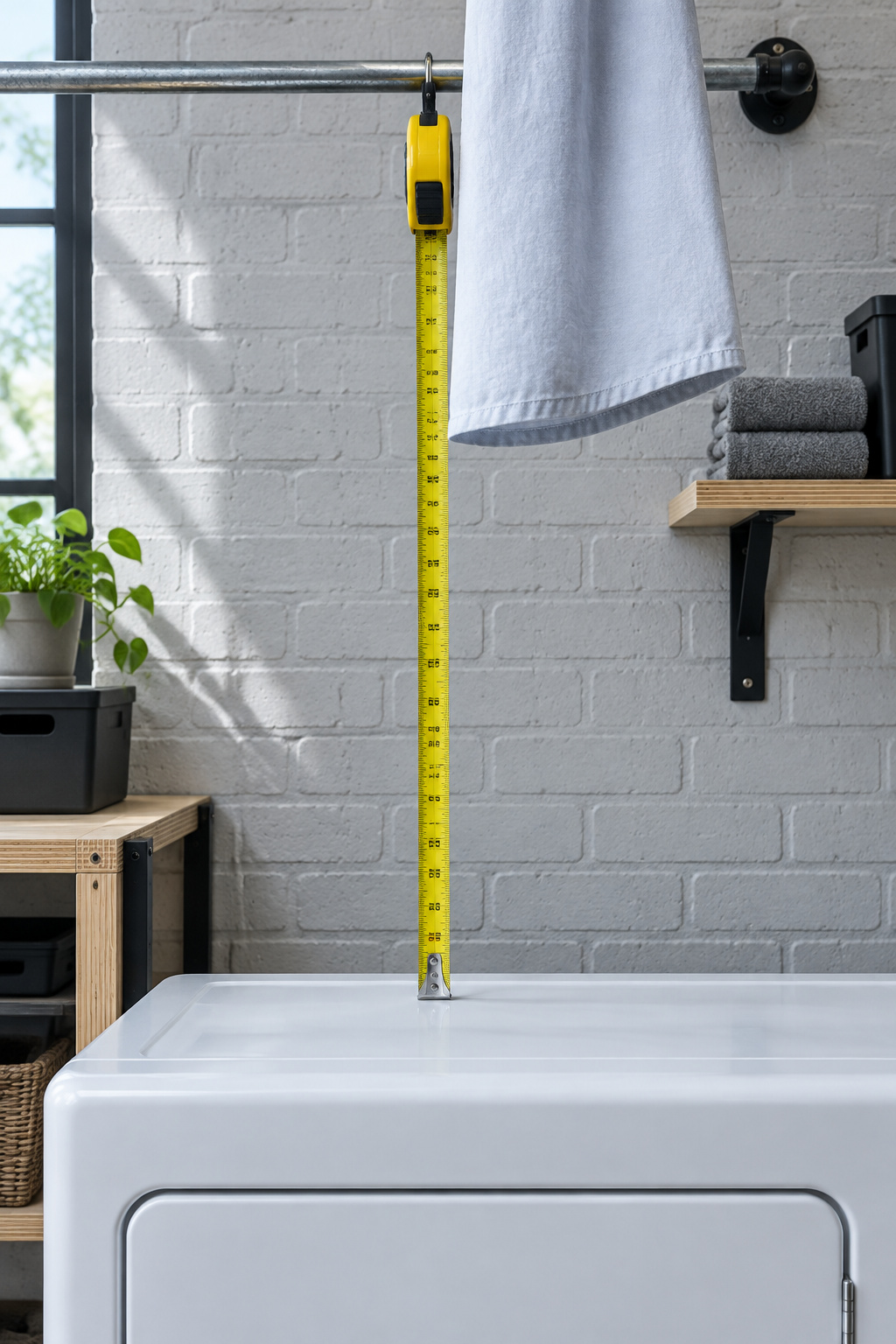
The Samsung and GE spec sheets put front-loaders at 39 to 39 3/4 in. HomeGuide gives shirts 36 to 40 in of hanging space. I add a 3 in gap so a swinging hem never brushes the top, a margin that is my choice, not a published rule.
By my arithmetic, 39 3/4 + 3 + 40 = 82 3/4 in. Set the rod at about 82 in. John Louis Home, which sells shelf-and-rod units, lands at 82–84 in so hanging garments do not touch the machine tops.
Common heights above a 39 3/4 in top compare like this:
| Rod height | Source | Hem of a 36–40 in shirt |
|---|---|---|
| About 82 in | Derived; John Louis Home 82–84 in | 42–46 in, clear |
| 76 in | Houzz, architect Steven Randel | 36–40 in, level with or below the top |
| 66–70 in | Closet single-rod convention; laundry blogs | 26–34 in, resting on the machine |
Randel’s note says only that the space above the machines can hold a drying rod “at about 76 inches,” and names no garment. That height suits anything that hangs about 33 in or less (my arithmetic: 76 − 39 3/4 − 3 = 33 1/4) and does not suit a full shirt.
Angi asks for at least 2 in between the rod and the shelf underside so hangers lift off, which puts the shelf at 84 in or higher (my arithmetic: 82 + 2). That high, it becomes light, rarely used storage: spare hangers, a season’s linens. The guide to how high the shelf above the machines should sit covers the shelf itself.
Shirts, trousers and longer garments
One rod serves shirts and folded trousers, since HomeGuide groups them. Long garments cannot share it: a dress or long coat needs 60 to 70 in of drop, and on an 8 ft wall the sum does not fit (here is the sum: 39 3/4 + 3 + 60 = 102 3/4 in, against 96 in). Give them their own rod at 66 to 70 in beside the machines, with nothing beneath.
Load and brackets: what a rod of damp shirts really weighs
How heavy is a rod of damp laundry? Lighter than the worry. By Speed Queen’s figures a thin cotton shirt weighs about 1.4 to 1.6 times its dry weight after a spin.
Working it out, a 180 g cotton tee at 1.46 is about 263 g; fifteen come to about 8.7 lb, or 2.9 lb per foot on a 3 ft rod.
A regular-duty closet rod is rated at 20 lb per linear foot. In Hardware Decor’s center-load test a 6 ft steel rod of 1 5/16 in held 170 lb against 75 lb for aluminum, and the steel sprang back after sagging. Buy steel.
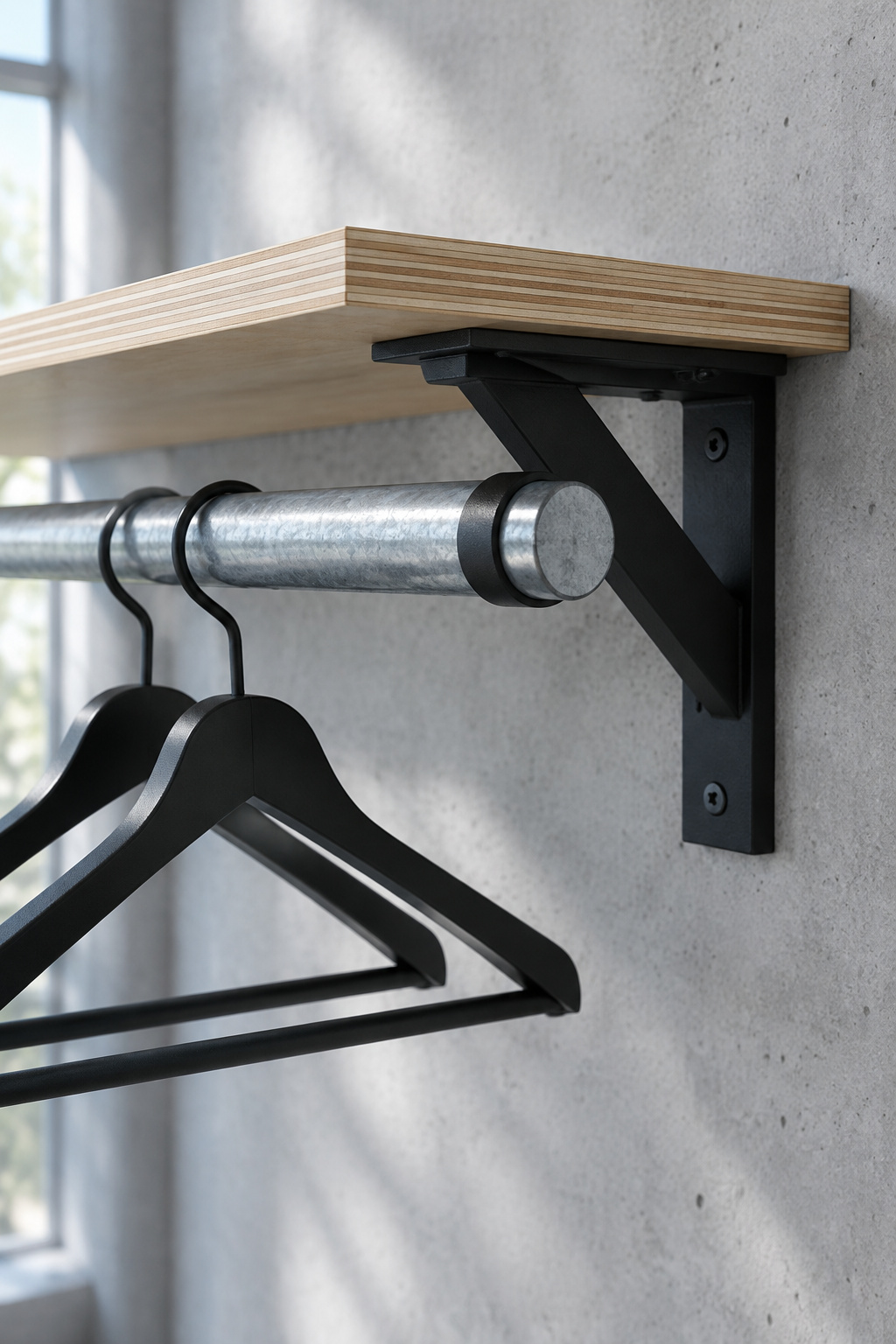
More important is Hardware Decor’s conclusion that a rod is far more likely to fail at the wall mount than in the rod. Knape & Vogt, whose rods are tested to ANSI/BHMA A156.9, asks for brackets screwed into studs. Because a rod hung from a shelf adds to the shelf’s load, the brackets that carry the shelf above must allow for both. The hardware comes three ways:
- Wall flanges or cups, a pair, for a rod on its own.
- Combined shelf-and-rod brackets, one fixing for both.
- A center support, for long spans.
How long is long has two answers. Knape & Vogt says 5 ft or more, while Hardware Decor says 6 ft for a 1 5/16 in round rod and 5 ft for a 1 1/16 in one. By Houzz’s measure side-by-side machines take about 60 in, so a full-width rod sits on the line. Swedes call the right amount lagom: enough, no more. Here that means a 36 to 48 in rod over the dryer end, which needs no support.
Hanger spacing and where the drip lands relative to machine and sink
The usual mistake is filling the rod end to end. Nigel Bearman of Daily Poppins advises a couple of inches between hangers for airflow. No lab has tested that, but it is sound practice.
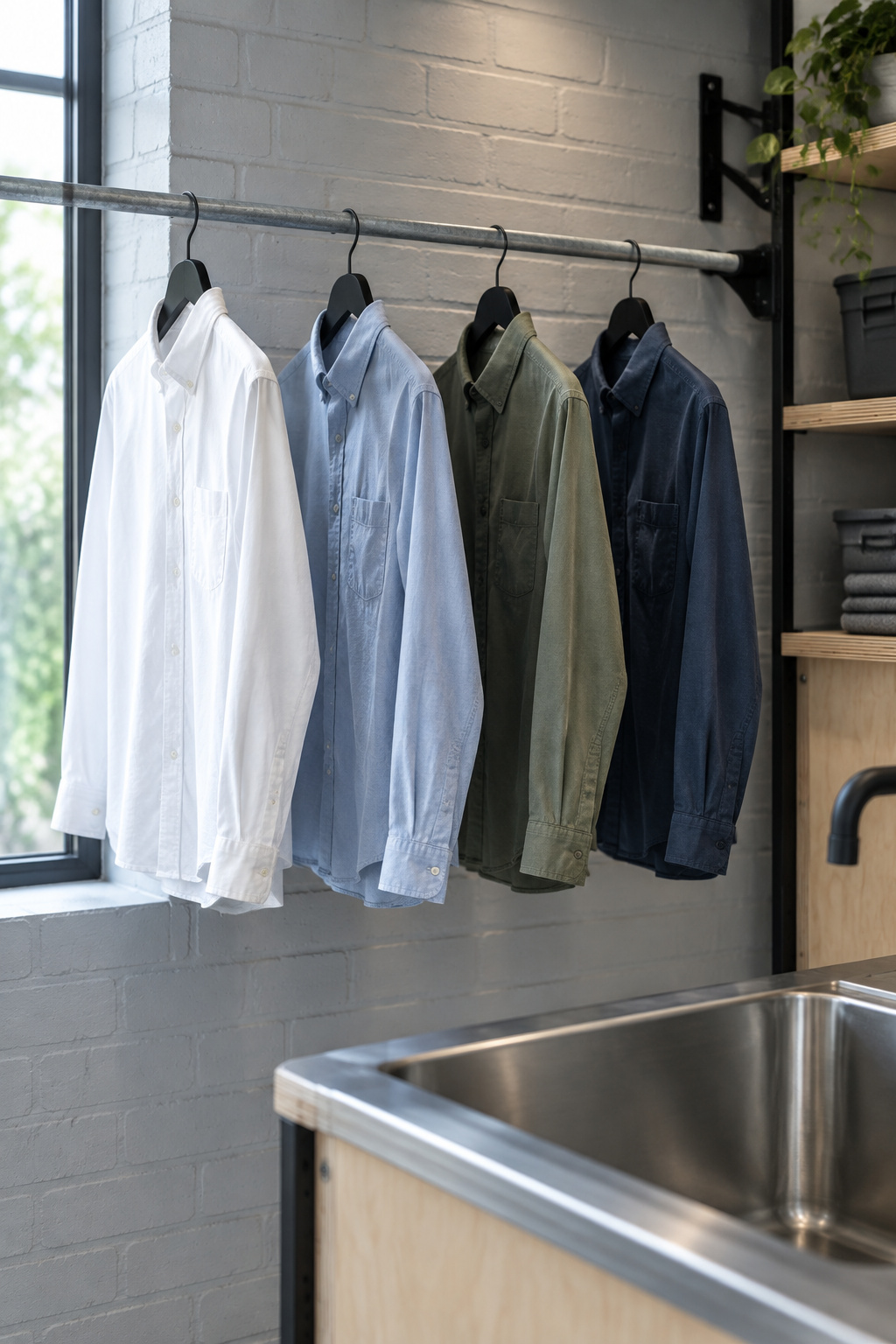
By my estimate, 2 in of air plus about 1 in of shirt and hanger makes a 3 in pitch, so a 36 in rod holds about 12 damp shirts.
If a shirt is still damp next morning, space wider or move more air. Bearman puts indoor drying at about 24 hours before mold or mustiness becomes likely, and the EPA advises humidity below 60 percent with the dryer vented outdoors.
One verdict: where the rod goes
Over the dryer end, never across a top-loader. This is my reasoning, not a published rule. On an 82 in rod a shirt’s hem ends around 42 in from the floor, inside the arc a top-load lid swings through. An enamel dryer top shrugs off a drip, and an open washer tub is what needs to stay dry.
Keep the rod about 12 in off the wall, Lily Ann Cabinets’ figure. If a sink sits beside the machines, run the outer end over it and hang early pulls there so drips go down the drain.
The short version: set it once and leave it
Four numbers settle the wall: a rod at about 82 in, steel in studs and well inside 20 lb per foot, hangers 3 in apart, and the dryer or the sink end. Long garments get their own 66 to 70 in rod.
Storage that needs discipline is failed design, and a rod one step from the dryer is easier than the chair back. Drying racks and airers are a different tool, covered in our drying rack ideas guide. The laundry shelving survey places the rod among the wall’s other choices.
Take a pencil and a level, pick the end, dryer or sink, and mark the rod line there.
FAQ
How much weight can a laundry room clothes rod hold?
A regular-duty closet rod is rated at 20 lb per linear foot, and a 1 5/16 in steel rod held 170 lb in Hardware Decor’s center-load test. Fifteen damp cotton shirts weigh about 8.7 lb, so the rod is rarely the limit; the wall fixing is, which is why the brackets belong in studs.
Should a laundry hanging rod be mounted above or below the shelf?
Below. A combined shelf-and-rod bracket carries both in one fixing. Leave at least 2 in between the top of the rod and the shelf underside, as Angi advises, so hangers lift off, and keep the rod about 12 in out from the wall.
Will hanging damp clothes over the dryer cause mold or damage?
Not if they dry within a day. Nigel Bearman of Daily Poppins puts indoor drying at about 24 hours before mold or musty smells become likely, and the EPA advises indoor humidity below 60 percent and a dryer vented outdoors. An enamel dryer top tolerates drips; keep them out of an open washer tub.