
I lift the hat out of its box and set it on the bench. It looks like a woven drum tied shut with string. There is not a feather in sight. The listing showed a full sunburst, and I’m holding something closer to a basket lid that lost an argument.
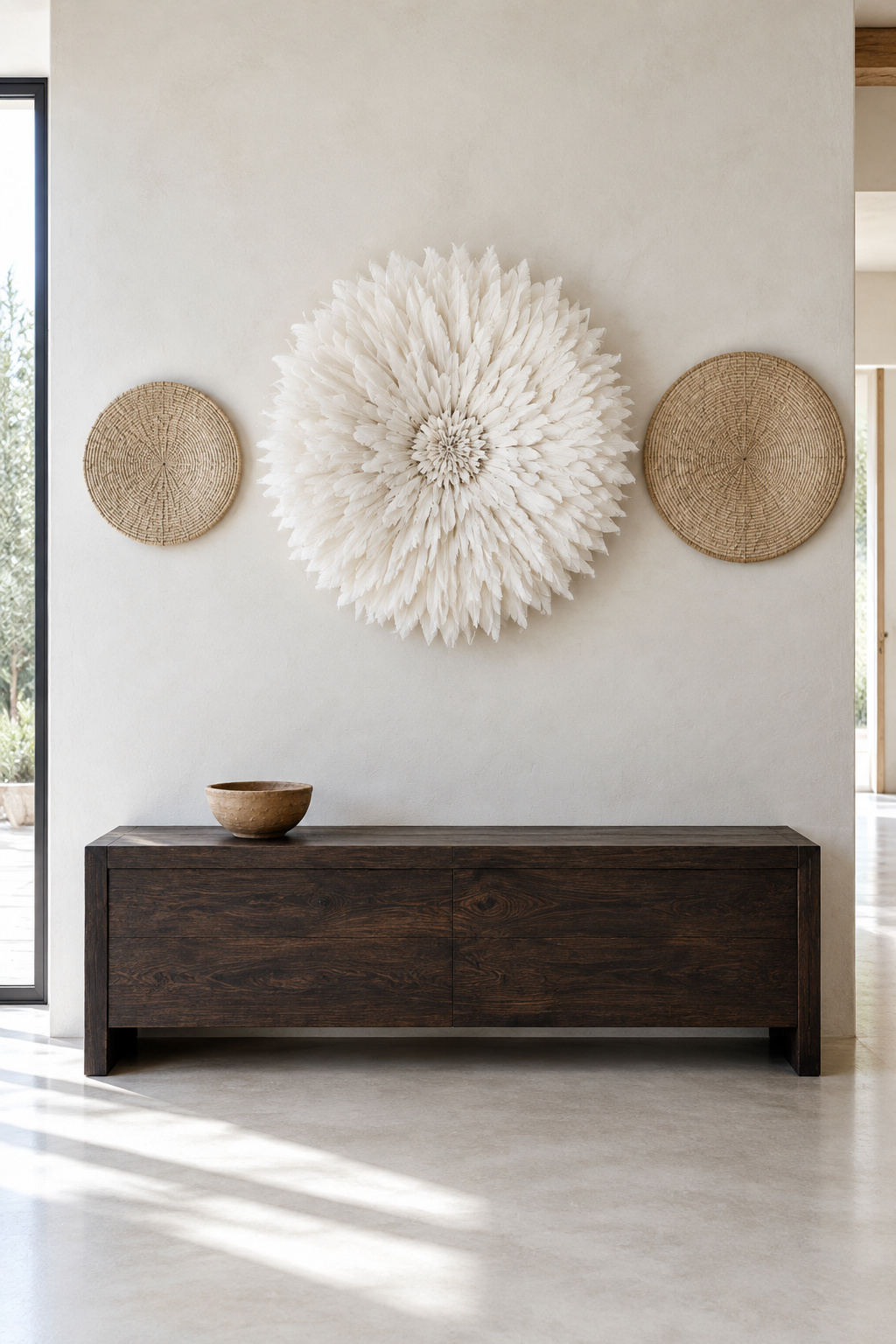
That gap is where juju hat wall decor goes wrong. A juju hat is a light thing that fails in heavy ways. Open and fluff it before it goes near the wall, size the group to the wall instead of the listing, then hang each piece on two points so it can’t turn or droop. Call it a first build. I plan an afternoon and expect it to run long, because the boring step is waiting for feathers to settle, and nobody films that part.
TL;DR
- Untie the strings without cutting them, push the center until it pops, then reshape the feathers by hand; a hair dryer on cool is all the heat you need, and no water.
- Seller sizes cluster around 16 in, 20–24 in, 27.6 in and 30–32 in across, so measure the opened hat before you pick its spot.
- Hang each piece on two points but take the load from one hanger’s rating, because a second hanger steadies a piece without adding capacity.
What You Are Unpacking: A Bamileke Juju Hat in the Box
The hat began as ceremonial regalia. Museum records describe feathered headdresses from the Bamileke kingdoms of the Cameroon Grassfields, worn by kings, titled men, palace dancers and members of the Kuosi elephant society at ceremonies, festivals and funerals. The Textile Museum at George Washington University titles its example “Tyn or Juju Hat”, so if you meet that name, it’s the same object.
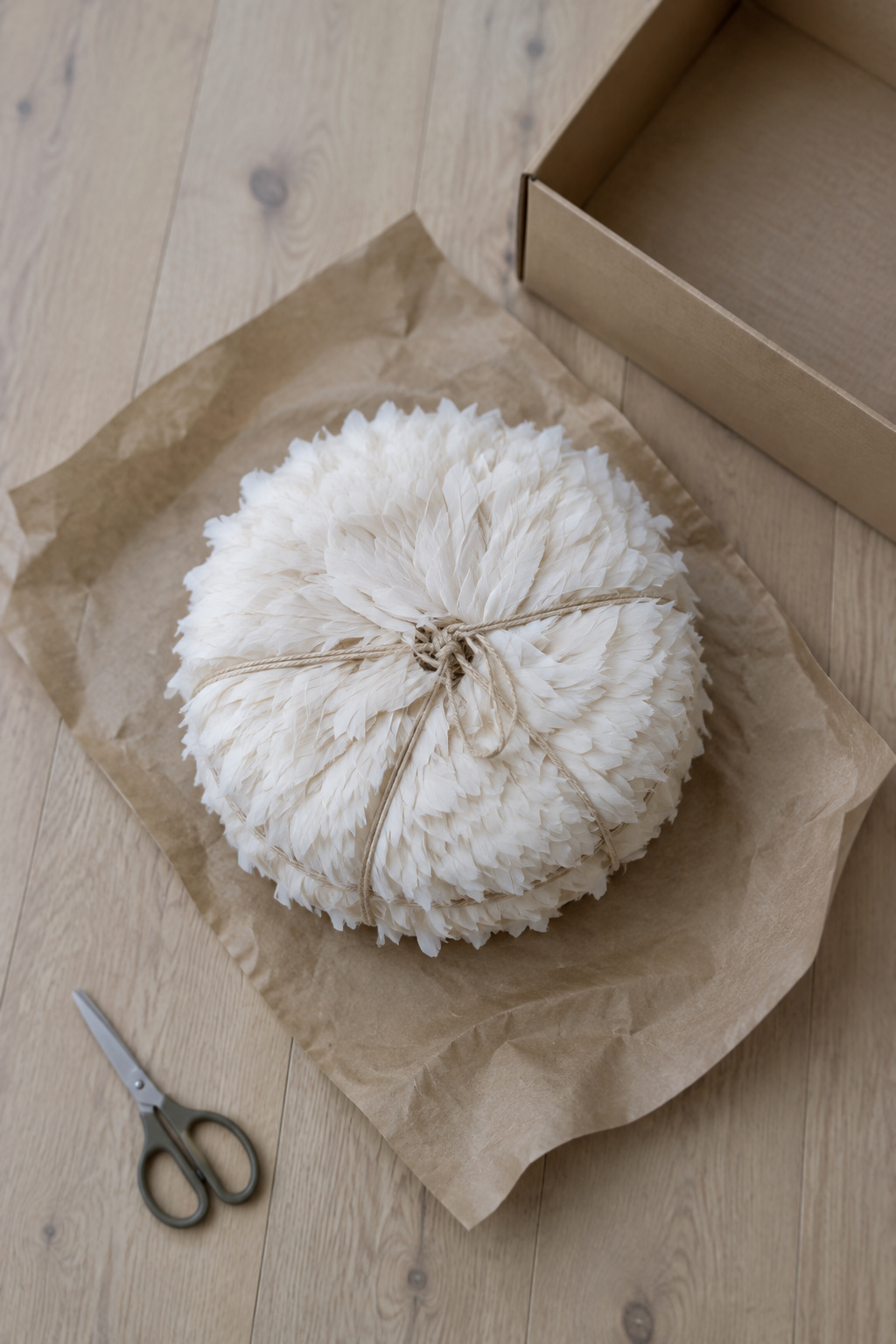
What arrives in your box is a modern descendant, mostly natural or dyed chicken feathers stitched to a woven raffia support. It looks flat by design. The original turns inside out so the rigid woven cap closes over the feathers and protects them in storage or travel. Sellers ship them the same way, folded inward and tied with string.
So the box version is a hat in its travel case. You can’t hang it yet, and you can’t size a wall for it either. For the rest of the room around pieces like this, see Afrohemian decor; here the job is one hat, open and up.
Open and Fluff a Folded Juju Hat Before It Goes Near the Wall
Everything after this depends on the hat’s true diameter, and you won’t know it until the hat is open. Work over a clean sheet so you can see any feather that drops.
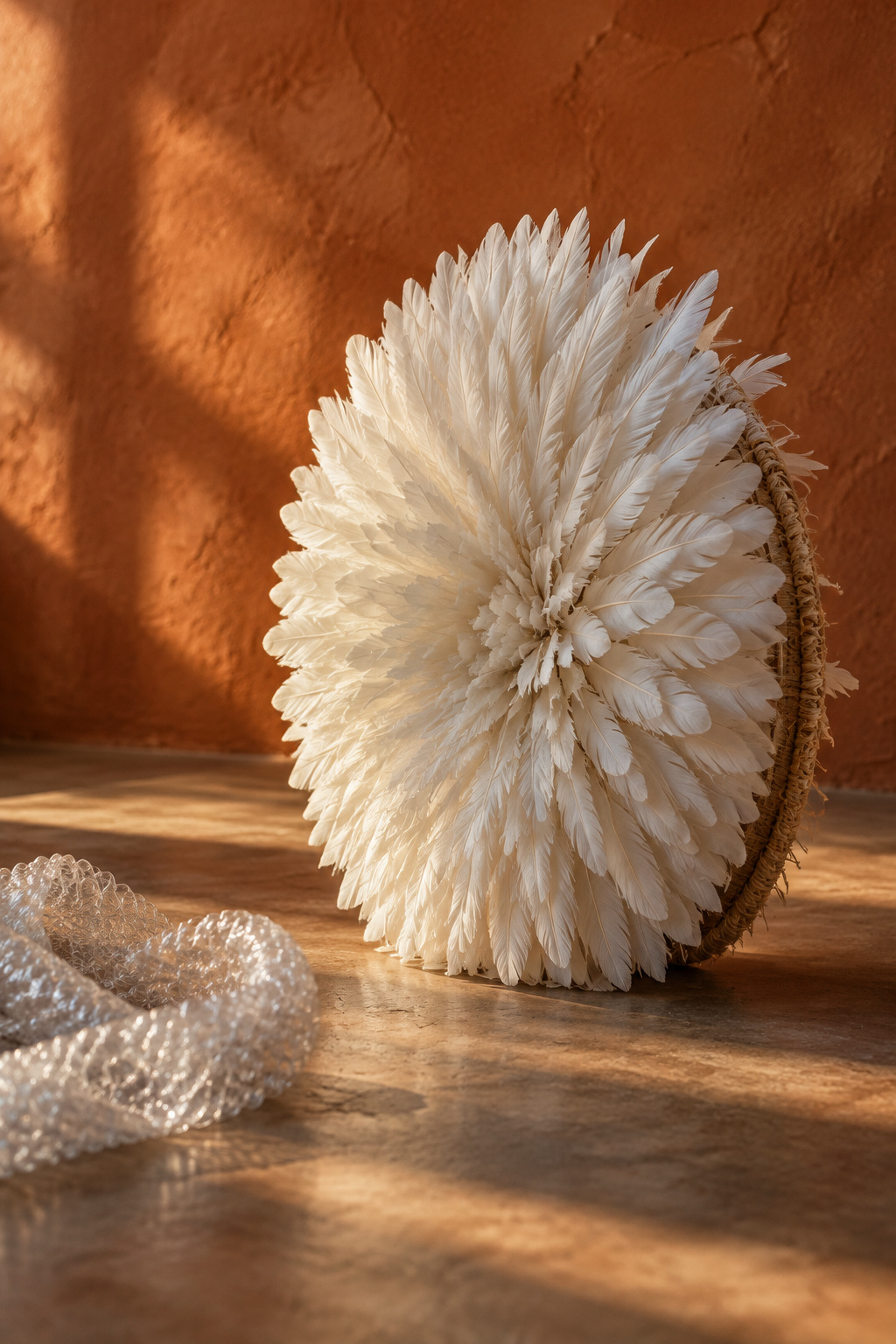
- Untie the outer strings. Don’t cut them: they hold the structure, and once the hat is open they fold away behind it.
- Hold the raffia ring with both hands and push the center inward with your thumbs until it pops. Some hats have a tab or pull-string at the back; a large one may need a knee.
- Check the center. The hat is fully open when it sits even and the feathers lean neither way.
- Press the feathers outward gently, not all the way down, and arrange them by hand. Finger-comb the inner ones.
- Leave it. One seller says the feathers need to breathe after being wrapped, and nobody puts a clock on it. I give mine overnight and stop fussing.
- For an outer patch that stays crushed, use a hair dryer on cool.
Sellers disagree on water, one shop page saying mist and blow-dry while others say water damages feathers. I keep water off. A flat feather you can fluff again tomorrow; a wet one you can’t undo.
The mistake at this step is getting it half open, with the center still sunk, and pressing the feathers flat to make it look finished. Now the ring droops and the feathers are bent. Take your hands off, push the center until it properly pops, and let the feathers come back on their own before you touch them again.
Size the Group to the Wall: Juju Hat Sizes and How Many Fit
Now measure, feather tip to feather tip, because the feathers reach past the raffia ring. I keep a pencil behind my ear for this and still lose one a week. Buy the extra box.
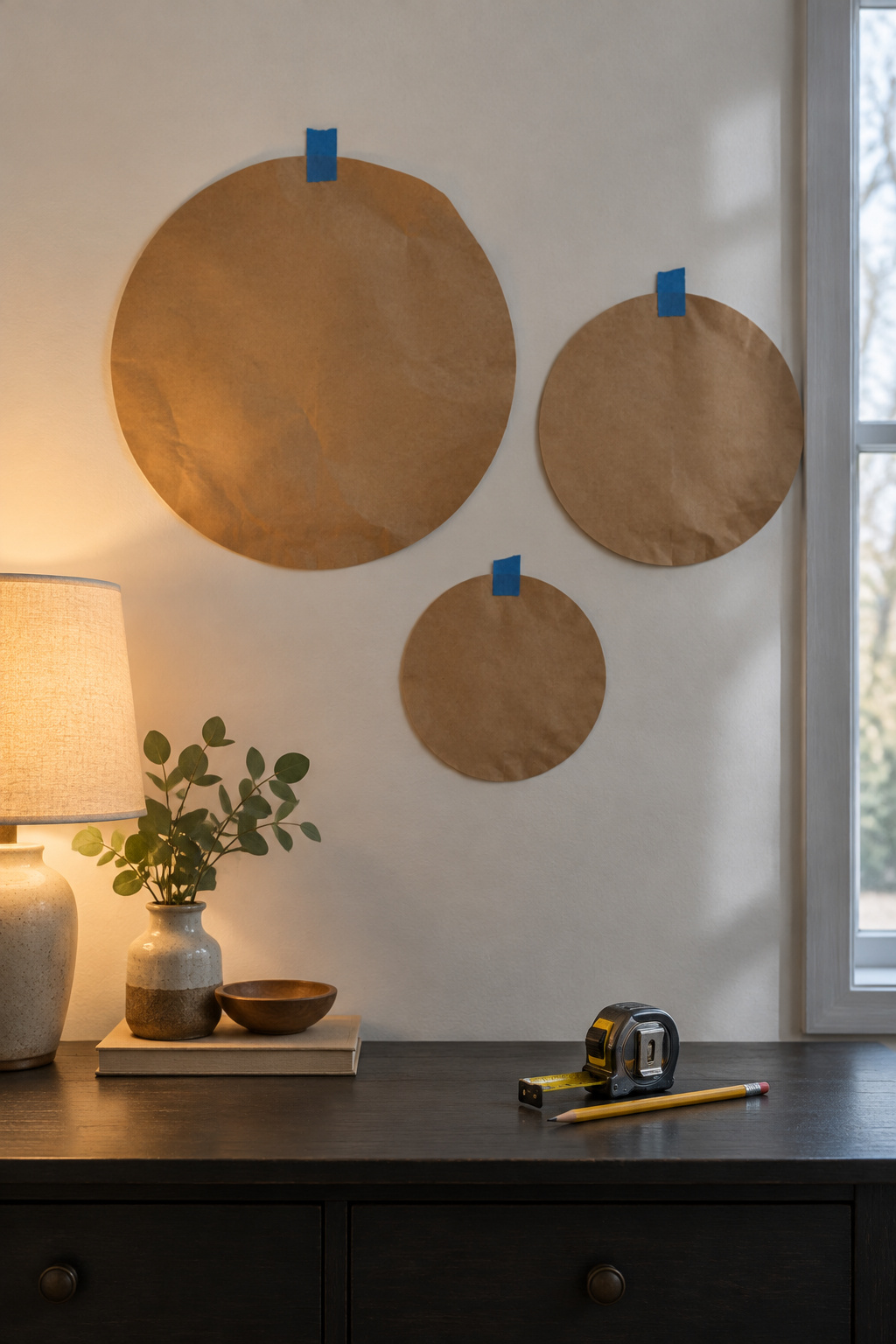
Listed sizes are rounded, and sellers note each hat varies by hand. They fall into rough groups:
| Size group | Listed diameter | Where it suits |
|---|---|---|
| Small | about 16 in (40 cm) | pairs and clusters |
| Standard | 20–24 in | over a console |
| Mid | about 27.6 in (70 cm) | anchor of a small group |
| Large | 30–32 in (77–81 cm) | over a mantel or bed |
Museum hats run from about 15 in to about 35 in across, so there is no “real” size. The listing is a starting guess; your tape is the answer.
No rule says how many hats fit a wall. One flat-basket seller suggests a 24 in piece over a 40 in console, which is 60 percent of the furniture’s width, and I use that as a sense check rather than a law. A large hat on a wall barely wider than it looks jammed in. A wide, empty wall can take a mixed group.
Some walls want one strong piece instead of a group. If yours does, read African art for the living room before buying a third hat. Spacing and hanging height are a living room gallery wall question, and I’ll leave them there.
Juju Hat Wall Decor That Stays Flat: Two Points, Not One
Sellers hang a hat by the thread loop tied to its raffia ring, on one nail or small screw. That works. I add a second point anyway: the loop goes on the top nail, and a small pin sits at the bottom edge of the ring so the hat can’t turn on its loop or tip forward. For a flat basket, two nails through the weave near the top do the same job. Picture Hang Solutions says pieces hang straighter and more secure over time on two hangers, and that’s the whole reason.
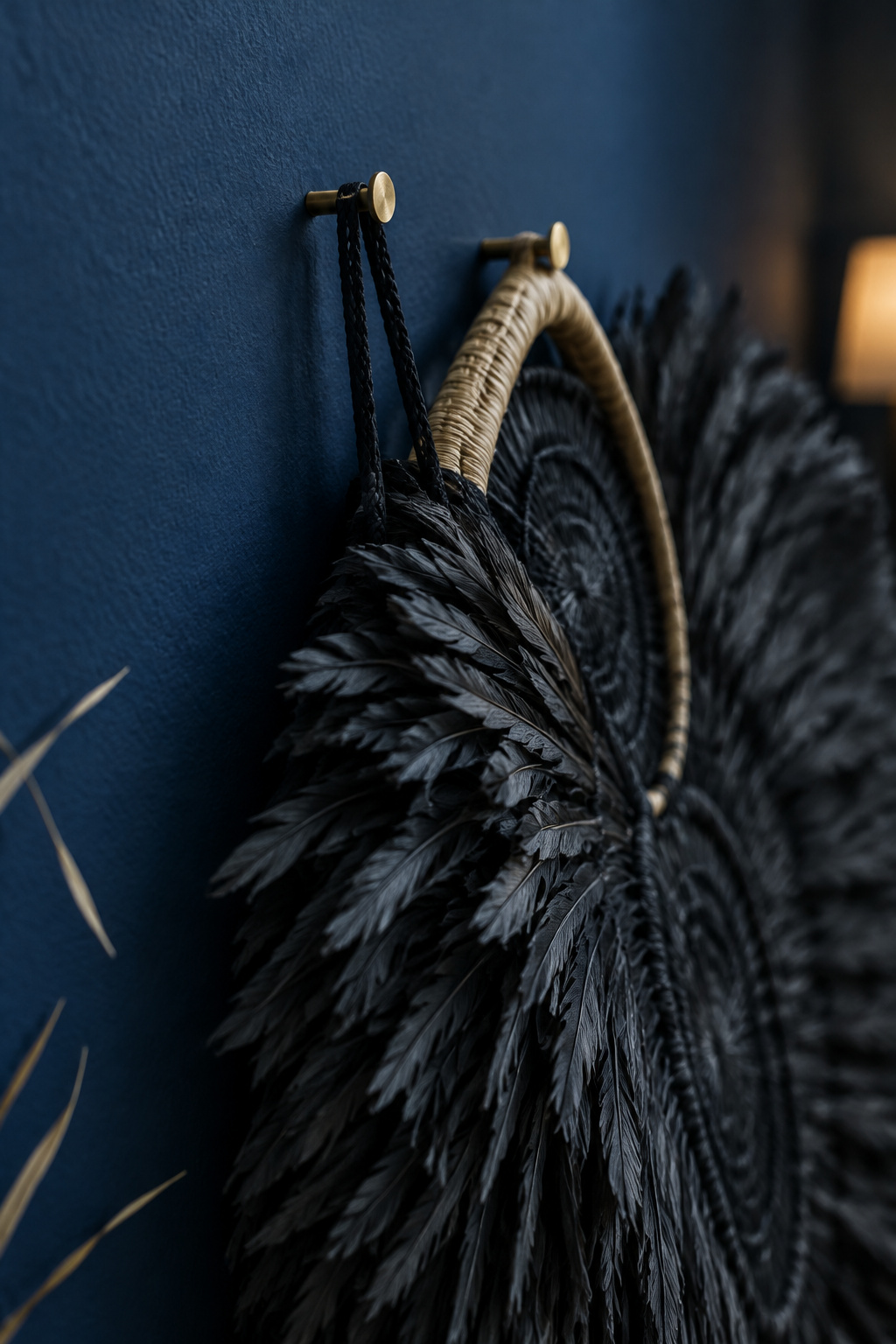
A second hanger doesn’t double the load. The 3M Claw FAQ says plainly that weight held on two hangers is not cumulative, so go by one hanger’s rating. Nobody publishes juju hat weights, so weigh the opened hat on a kitchen scale. For scale, a 16 in flat basket weighs about 0.5 lb.
Before any fixing, I knock along the wall with my knuckles. Hollow is drywall; a dull, solid note may be a stud. Plain drywall is fine for something this light.
| Fixing | Rated to hold | Use for | What goes wrong |
|---|---|---|---|
| Picture hook and nail | 30 lb or 50 lb | hats and baskets | overhammering weakens the grip in drywall |
| Monkey Hook, gold | 35 lb in 1/2 in drywall | hats | tip stops hard: you’ve hit a stud, move over |
| Command medium hook | 3 lb | a weighed basket | the basket outweighs it: read the scale first |
| Command jumbo hook | 7.5 lb | a weighed hat | the hat outweighs it: read the scale first |
Drive picture-hook nails at 45 degrees, as the hook is designed. No laser level? A strip of painter’s tape and the bubble level you already own will mark two level points.
Fixing Sag and Droop
Check your level before you trust it. I flip mine end for end on the same line; if the bubble moves, the level is the liar. Once it reads true, believe it. A crooked shelf is usually a crooked wall, not a crooked shelf, and a round hat under a sloping ceiling line will look tilted while sitting dead level. Walls lie. Hang to the bubble.
Check the hat before blaming the nail. An uneven center is a sign it never fully popped, so take it down and push again. If the ring feels loose, tighten the thread holding the outer raffia sticks a little. Go easy: too tight and the hat stands off the wall instead of sitting flat.
Hats and Baskets Together: Lay the Group Out on the Floor First
The flat baskets that pair best with juju hats are Binga baskets, also called Tonga baskets, woven by Tonga women in the Binga district of Zimbabwe from ilala palm. They began as winnowing trays for grain, which is why they’re flat. Hats bring soft, radiating texture; baskets bring flat pattern. These are wall pieces only. For baskets that hold things instead, that’s a different job.
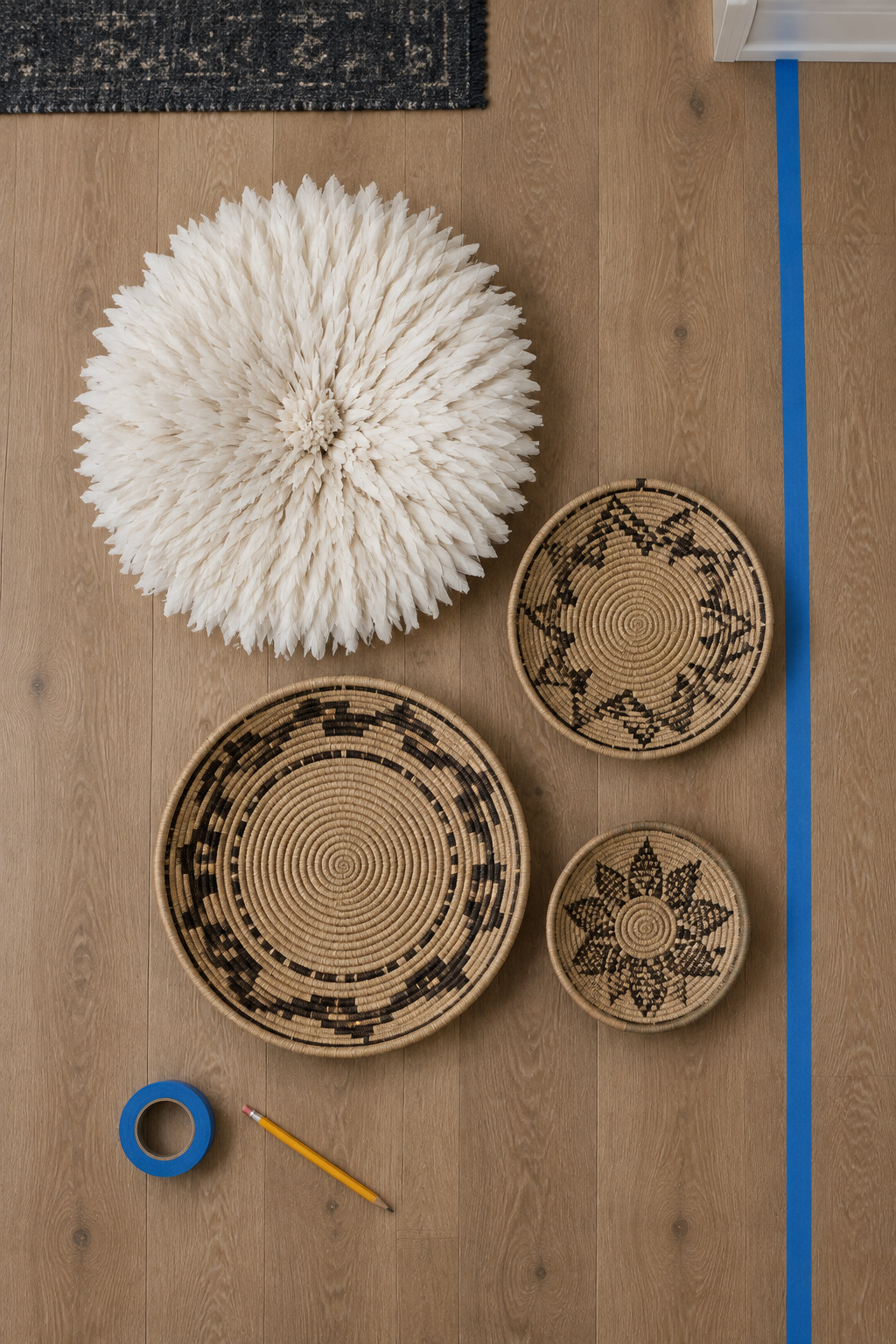
I put every project together once with no glue and walk away for the length of a coffee. A wall group gets the same dry fit, on the floor.
- Lay the pieces face up in front of the wall, largest first, and group the smaller ones around it.
- Shuffle until it looks right, then look again. Photograph it.
- Turn each piece over, lay a strip of painter’s tape across the back and mark both hanging points on it.
- Press the tape to the wall, level it, and mark the nail spots through it.
- Peel the tape, check the marks twice, and drive the nails.
- Hang the largest piece, step back, then hang the rest in your photographed order.
The coffee break is the step people skip, and it’s the one that saves a row of extra holes.
Keeping It Up: Shedding, Dust, Heat and Sun
Shedding: Why Feathers Drop and What to Do About It
Nobody publishes how much a hat sheds, but the construction shows where it comes from. In museum examples the feathers are tied to raffia splits on a cap, or their quills are pushed into a crocheted or basketry cap and tied or sewn with thread. My read is that the ties fail before the feathers do. Rough handling hurts too, since crushed or crowded feathers bend and break.
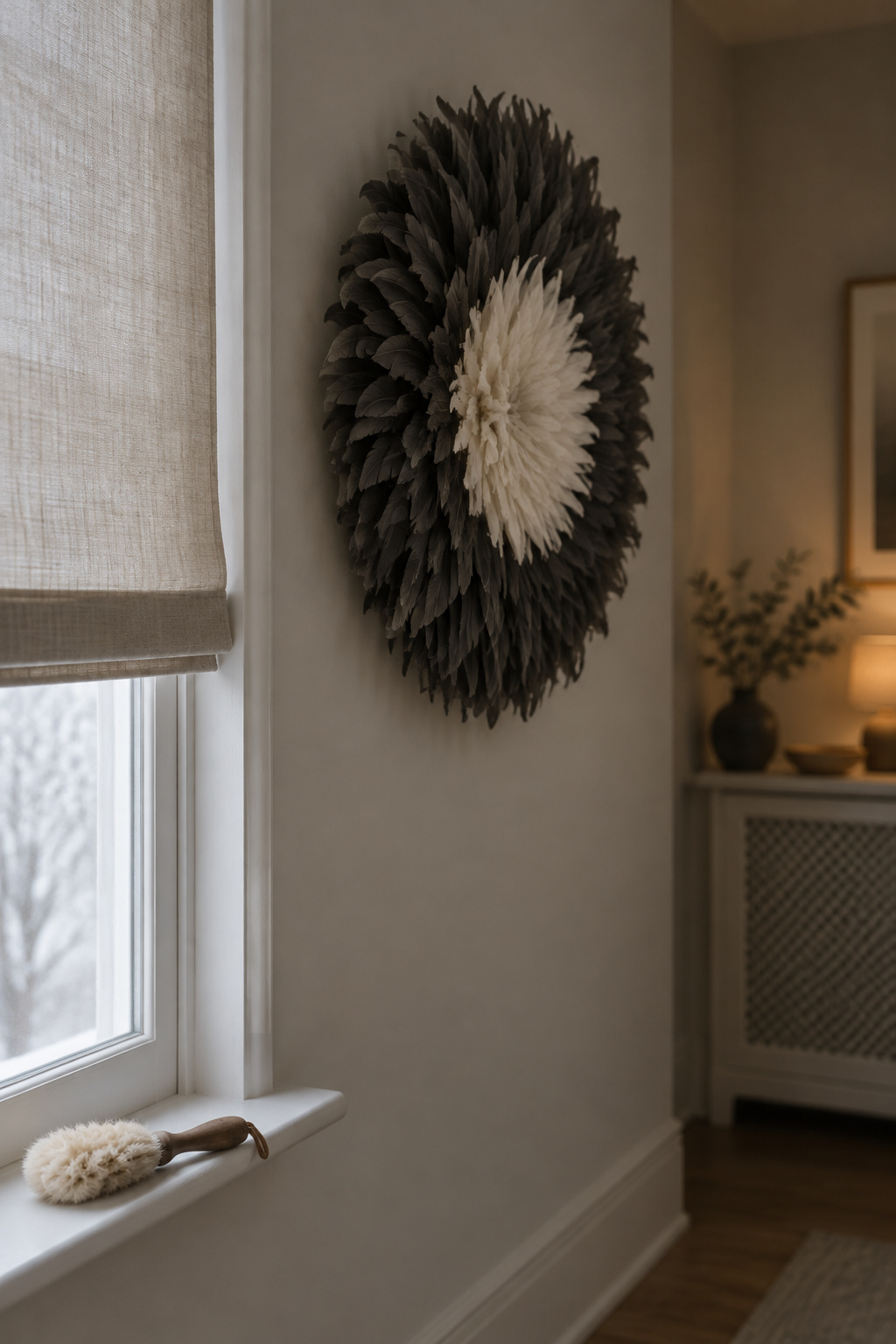
Before hanging, take the hat outside and give it a light shake to clear loose feathers and dust. Finger-comb it and pull any quill already hanging free. Quality varies by seller, and one buyer review mentions visible plastic ties and thin feathering, so inspect the back on day one. Once it’s up, handle it by the ring only.
Dust, Heat and Sun
Juju hats collect less dust than you’d expect. Dust now and then with a feather duster, soft brush or the dryer on cool, never a damp cloth. Keep dyed hats out of direct sun so the color doesn’t fade, and away from direct heat, so not over a radiator. For moths, put cedar behind the hat or use an anti-moth spray every three to four months, and inspect it twice a year, spring and fall.
The cheapest reversible version is one basket on two picture-hook nails, two holes a dab of filler hides if you change your mind. Live with that first. When the hats go up, they’ll sit flat, steady and full, the way the photo promised. In the first month, glance at the floor under the wall for feathers, press each center to check it hasn’t sunk, and look behind each hat for moths.
FAQ
Can you hang a juju hat in a bathroom or kitchen?
Not a steamy one. The Canadian Conservation Institute warns that mold can grow on feathers once humidity reaches 65 percent or more, and big humidity swings cause trouble too. Sellers say to keep hats away from persistent moisture and direct heat. Kitchen steam also makes things dusty faster, so a living room wall is the safer spot.
Are juju hats a problem if you have a feather allergy?
They can be, and your allergist should make that call. The American College of Allergy, Asthma and Immunology says feathers can become embedded in household dust and trouble people allergic to them, and dust mites are the most common cause of dust allergy. Sellers say hats are fumigated for shipping, so air a new one in a ventilated room.
Is it disrespectful to hang a juju hat as decor?
No museum, scholar or Bamileke source settles that question. The records do say what the hat was: ceremonial regalia for kings, titled men, dancers and Kuosi members, and dancers still wear them at festivals. Learn that history, skip the “brings luck” sales lore, and buy from a seller who can tell you who made it.