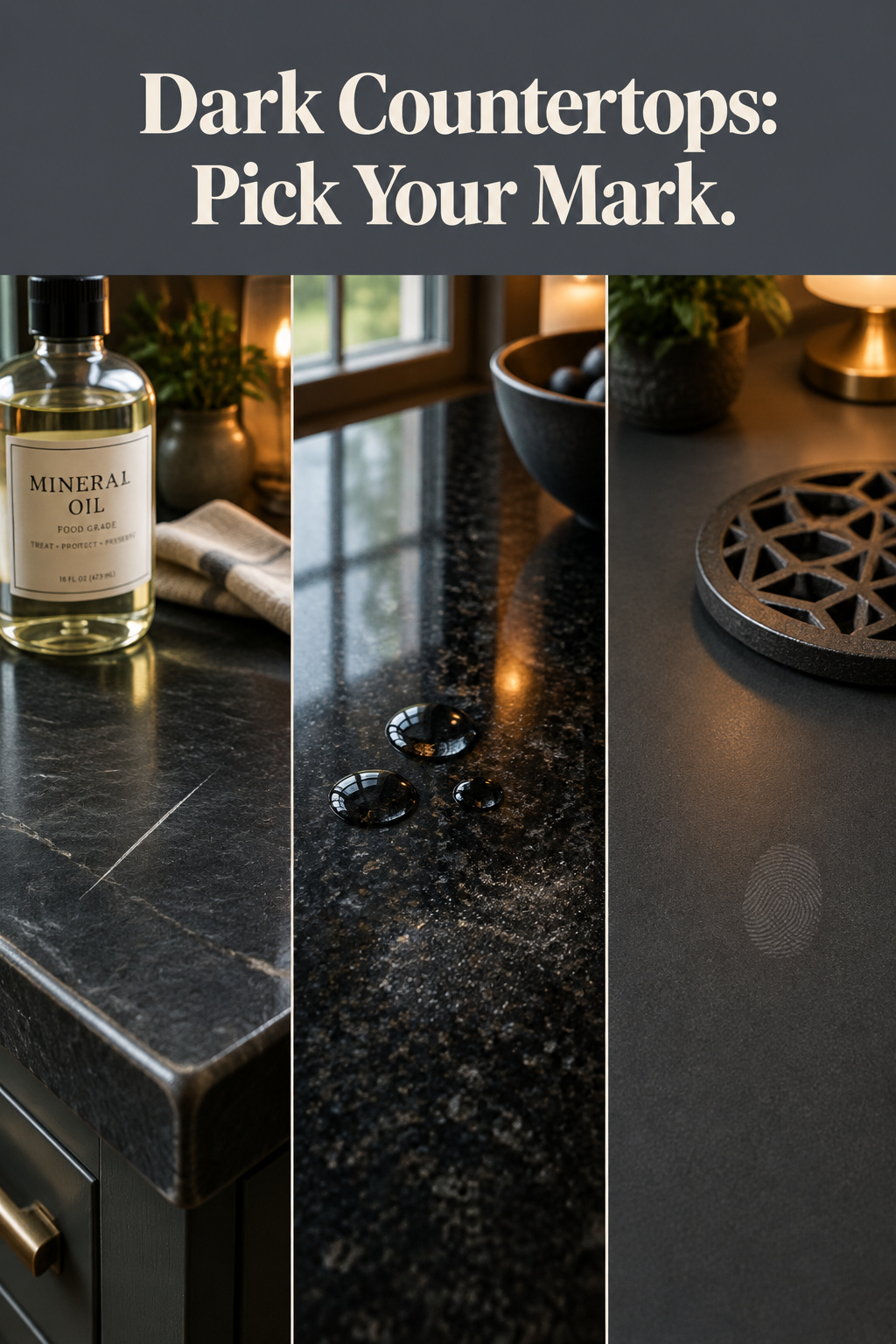
“Go black on the counters. Black hides everything.” I hear that line a lot when people talk about dark kitchen countertops. It’s half right.
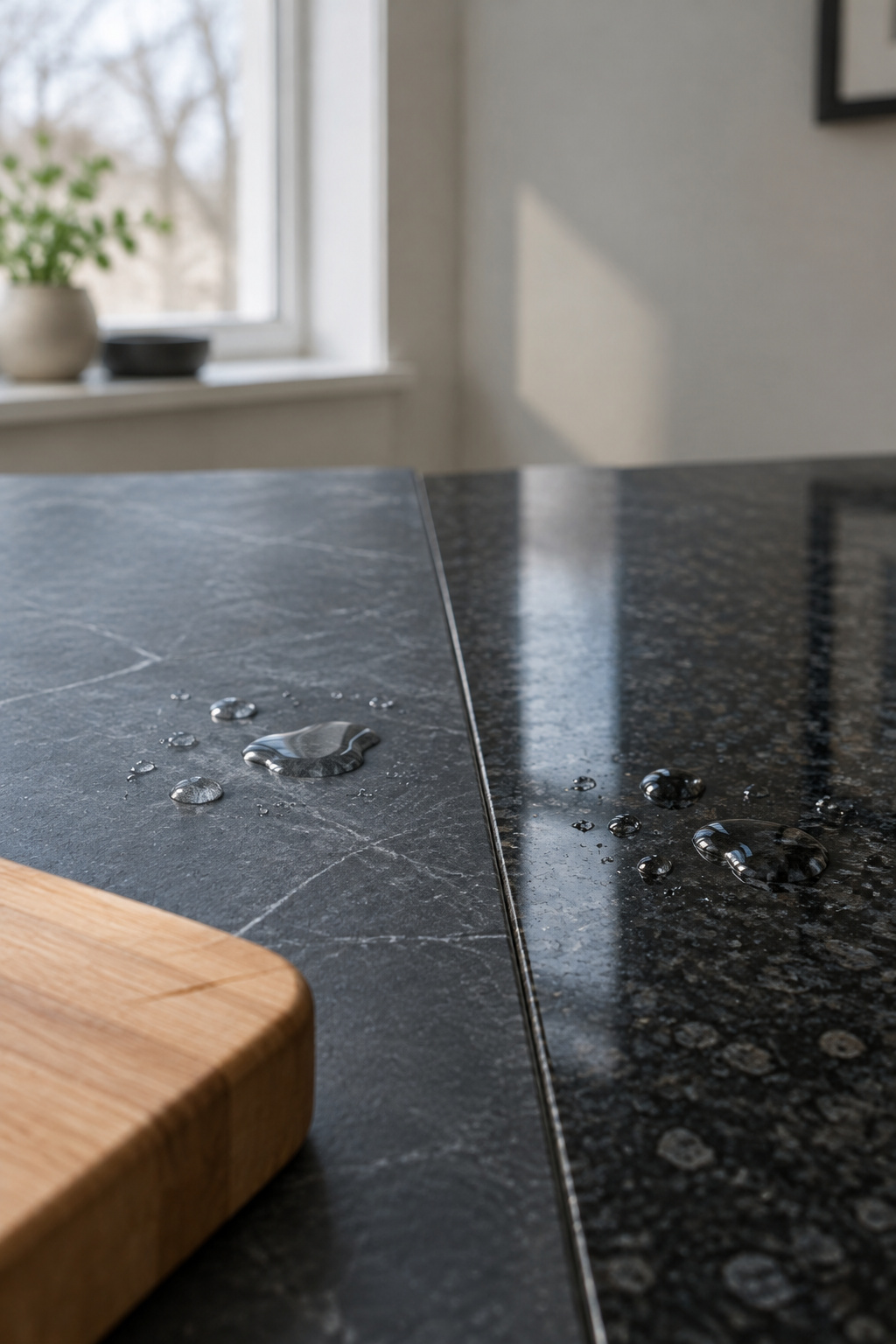
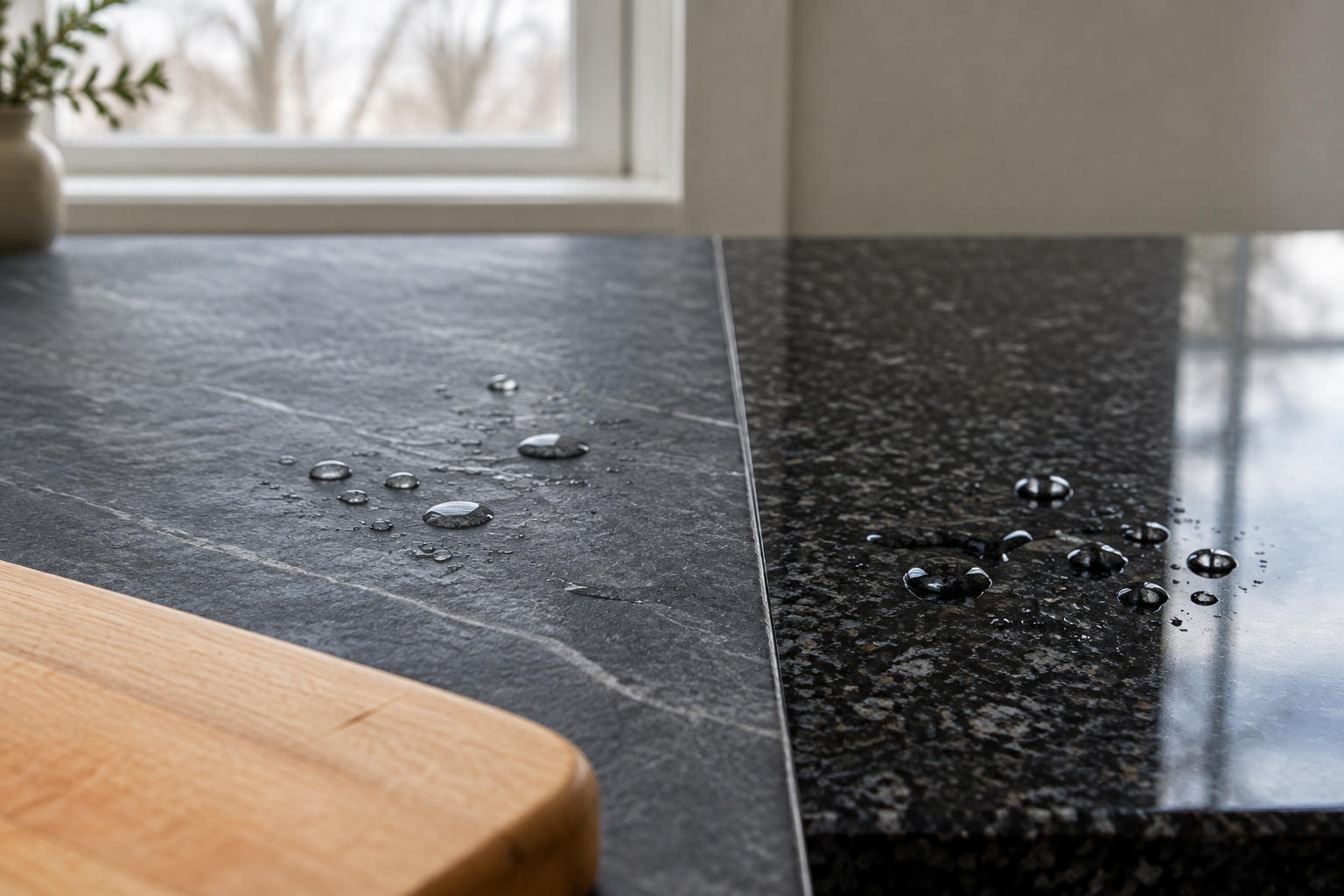
A dark counter can hide crumbs and food stains better than light stone. Then it shows the things white swallows: dried tap water, a film of dust, the print of every hand that leaned on it. Every dark surface shows something. So the real choice is which mark you’ll least mind seeing, given how you actually clean, and not which slab stays darkest in a photo.
TL;DR
- Every dark counter shows a mark: soapstone scratches and needs oil to stay black, black granite shows water spots and prints, dark quartz shows prints and limescale, and dark laminate flags water spots in gloss.
- Pick by your cleaning routine: a daily wiper suits polished or leathered black granite or dark quartz, a monthly oiler suits soapstone, and a household that does neither suits a veined quartz or matte solid surface.
- Fixr’s January 2026 ranges run from $15 to $60 a square foot for laminate up to $50 to $200 and more for quartz, and quotes for the same stone vary three to five times between price guides.
Dark Kitchen Countertops, Sorted by the Mark They Show
In my Saturday class nobody touches a saw for the first hour. Everyone measures the same board until we all get the same number. I’d like to run counter pricing that way, because the guides don’t agree with each other at all. One puts soapstone at $20 to $70 a square foot, another at $100 to $180.
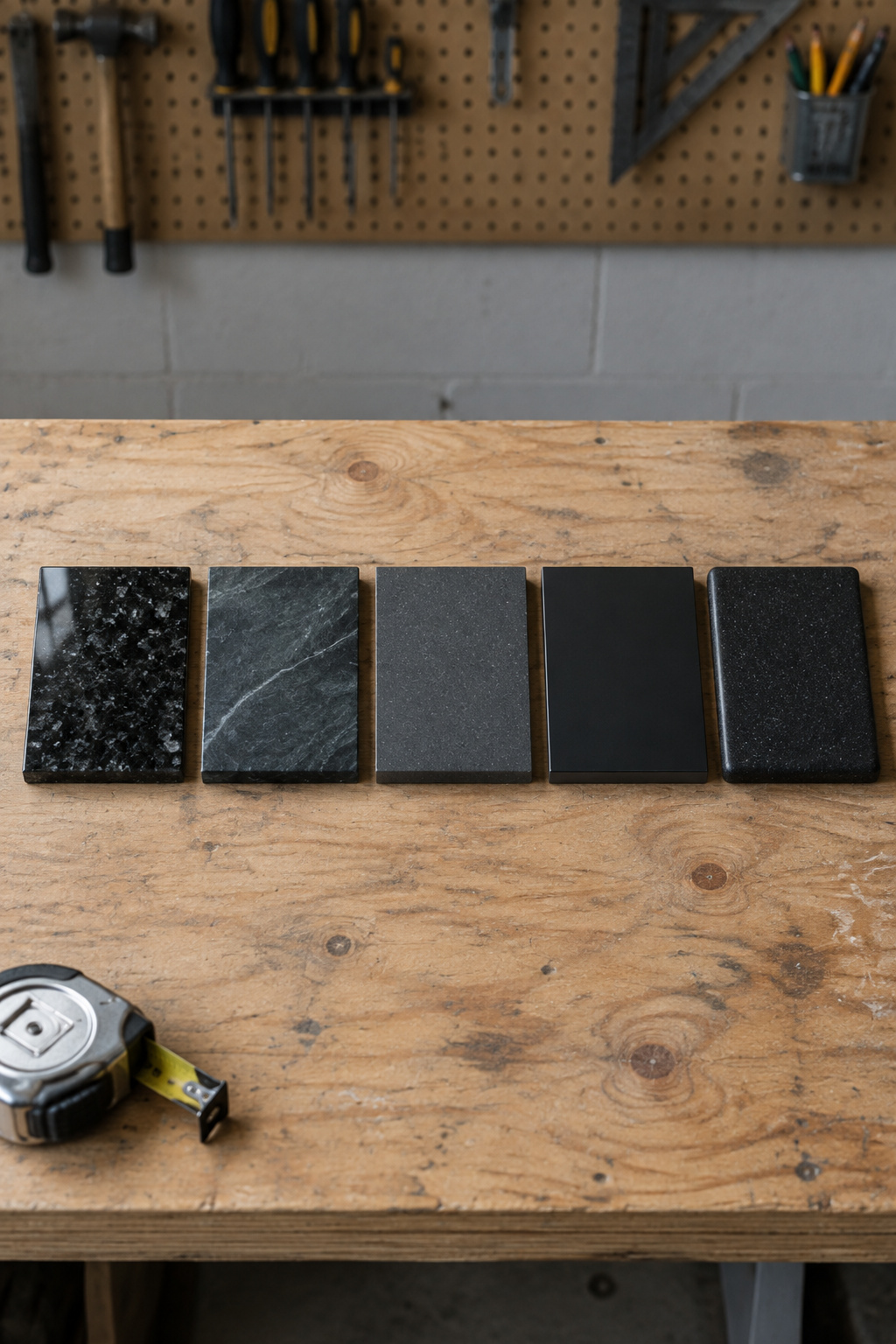
The table uses one guide for every row so the prices at least compare. Read across for the mark first.
| Material | The mark it shows | How it’s cleaned | Fixr, Jan 2026, per sq ft |
|---|---|---|---|
| Soapstone | Scratches, nicks, uneven darkening if not oiled | Mineral oil to keep it black | $50–120 |
| Black granite | Water spots, fingerprints, dust on polish | Wipe and dry after meals | $40–150 |
| Dark quartz | Fingerprints, limescale, scratches on solid colors | Warm soapy water, no sealing or oil | $50–200+ |
| Black laminate | Water spots and prints in gloss; heat blisters | Wipe; no steel wool or abrasive pads | $15–60 |
| Dark solid surface | Scratches, uneven finish on dark patterns | Rinse and towel-dry; scratches buff out | $40–100 |
Fixr doesn’t say whether those figures include installation, and region moves them too, so get a measured, installed quote before you fall for a row. Dark wood counters are a separate question, covered in the best-wood-for-butcher-block article.
Soapstone and Black Granite: The Marks That Come Back and the Ones That Sand Out
Soapstone is soft. It sits at 1 to 2 on the Mohs scale, so it scratches and nicks. It also isn’t black until you oil it. “Un-oiled soapstone is a light gray, while oil brings out a rich black shade,” says Madisyn Watson of Vermont Soapstone. The oil is cosmetic; it doesn’t protect anything, and the stone needs no sealing.
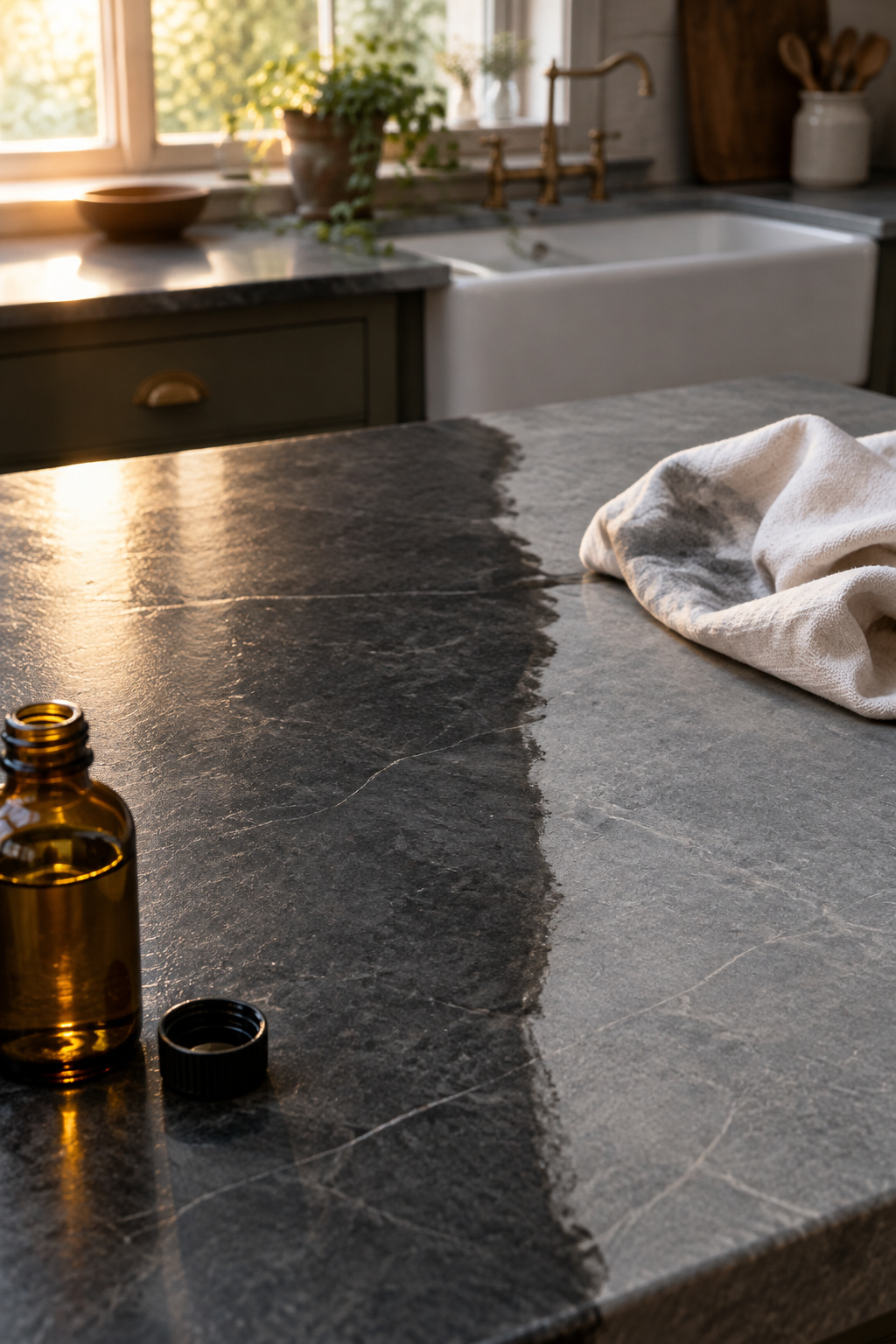
How often you oil depends on who you ask. Vermont Soapstone says weekly for the first few months, then roughly monthly or every two to three months for an average household, and sooner if you cook every day. Other producers stretch it to once or twice a year once the patina settles. Reapply when water stops beading.
Scratches sand out. Producers recommend anything from 60-grit worn paper to 400-grit, and the advice that makes sense to me is to start finer than you think and work up only if the scratch stays. Use a sanding block, or wrap the paper around a scrap of pine if you’d rather not buy one. Oil the spot afterward. Sanding out a soapstone scratch is a first build. Some fabricators say many people embrace the scratches as part of the natural patina.
The mistake people make is skipping the oil for a few months to see what happens. The stone darkens anyway, but unevenly, with darker patches around the sink and wherever hands and pots land most. You can’t stop that darkening, only even it out. Oil the whole top, not just the light areas, and keep going until the color catches up.
Black granite is the opposite stone: hard and heat-tolerant, but polished black shows fingerprints and dried water spots because it reflects. Fabricators split on which finish shows what. Most say a honed finish on dark stone shows prints and oil more than polish does; a few say honed hides prints or hard-water rings better. That one stays open, and I won’t pick a side.
Sealing splits the same way. The Natural Stone Institute’s position is that “most granite countertops do not need to be sealed” if you clean them after each meal. Stone sellers tell you to seal once a year. Test it yourself, the way one seller does: if water soaks in and darkens the stone within 5 minutes, reseal.
Dark Quartz, Laminate and Solid Surface: The No-Oil Options and What They Still Show
No oil doesn’t mean no mark. My spare drill has been lent out so many times it carries three different neighbors’ tape on the handle. Anything that gets used shows it. Engineered surfaces are the same. They just show it in different places.
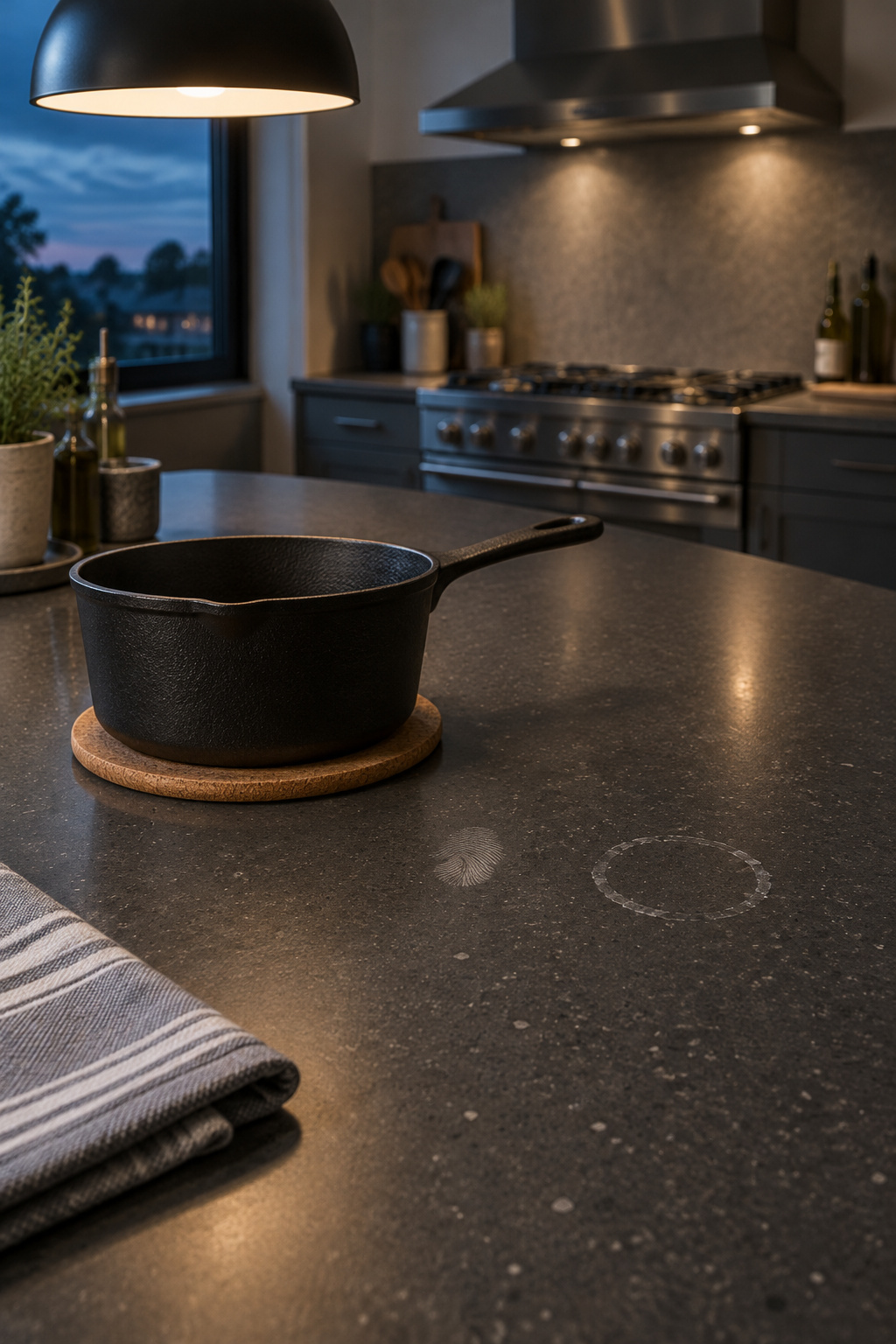
Dark quartz never needs sealing or oil. Its makers say plainly that dark surfaces show fingerprints and limescale more than light ones, and that solid, single-color designs show surface marks more than speckled or veined ones. Caesarstone adds that dark colors scratch more visibly and that honed or textured finishes need more cleaning than polished. It is not heat-proof, and the numbers don’t agree. MSI’s blog puts the point where the resin starts to break down at roughly 150°F (65.6°C). Caesarstone’s technical pack says don’t expose it above 100°C (212°F). Two companies, two limits, one answer: use a trivet. Caesarstone also warns that a hot pot set straight down can start cracks over time, more likely near cutouts. If your new cooktop cutout means moving a gas line, that’s a pro job. Don’t argue with me about it.
Black laminate is the cheapest dark counter, and a real option. In gloss it will flag every water spot and print; matte or satin is more forgiving. Treat heat and seams as its weak points. One laminate guide says a hot pan blisters it in seconds, for good, and that sheets top out around 96 to 144 inches, so a run over about 10 feet usually needs a seam, where water can swell the core and lift the surface.
Solid surface has the color all the way through, so scratches buff out with an abrasive cleaner and a damp pad. Deeper cuts may need a fabricator. Darker patterns need more frequent attention to keep an even finish. A matte finish needs the least upkeep of the three sheens.
Matching a Dark Counter With Dark Cabinets Without Losing the Edge Between Them
Put a dark counter on dark cabinets with the same sheen and the edge between them disappears. You get one dark mass where the work happens, and you lose the line your eye uses to find the counter’s edge.
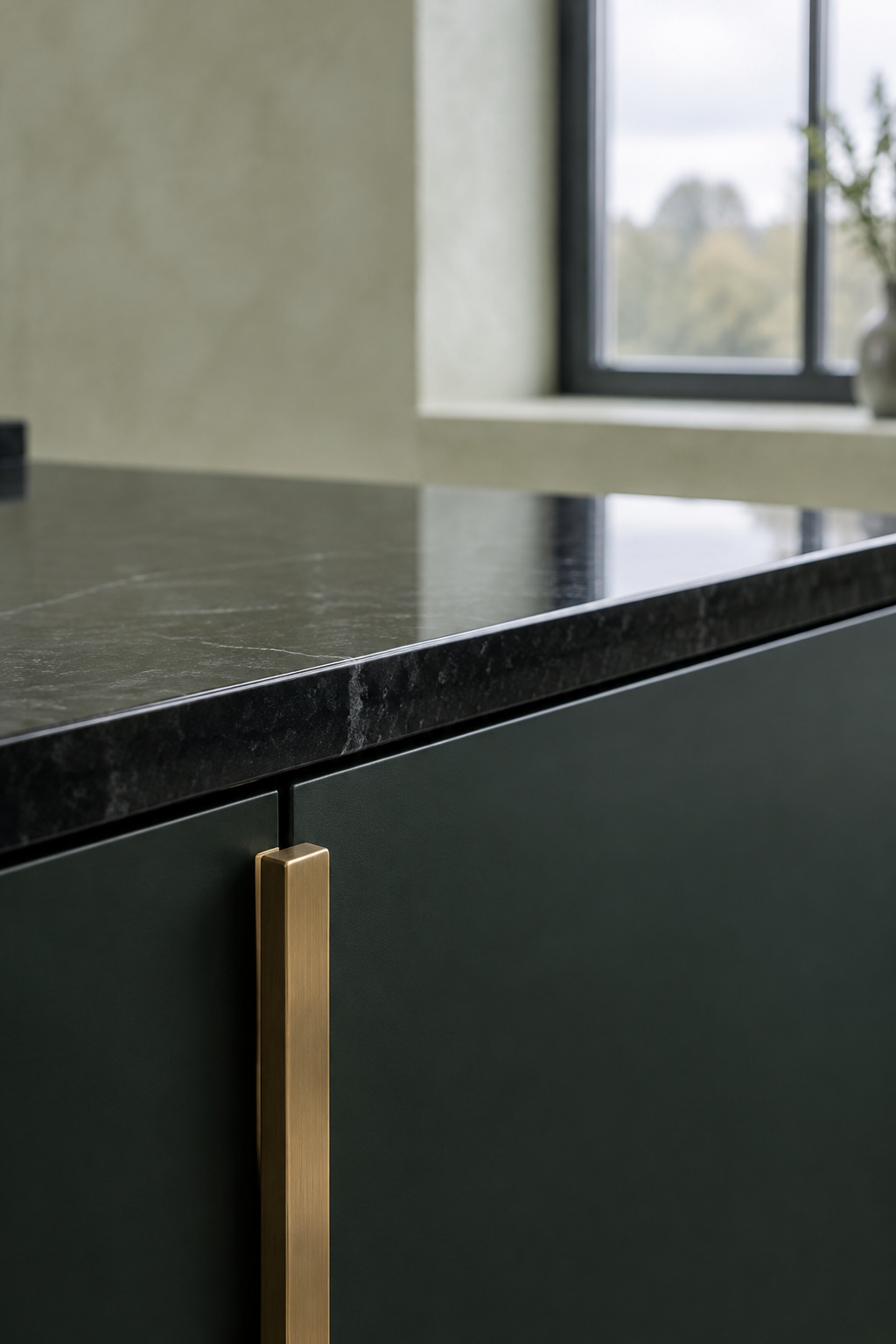
My rule is simple: let one of the two carry the shine. A polished counter over flat cabinet fronts keeps the edge, and so does a honed counter over a satin door. The pair then shows two different marks instead of doubling one. The counter shows water, the fronts show their own wear, and you know which cloth goes where. How the cabinet side wears, chips and all, belongs with black cabinets above a dark counter, so choose the two together rather than one after the other.
How Dark Counters Look in Bright and Low-Angle Light
Before I trust my level on a job, I check it against itself by flipping it end for end. Check a dark counter the same way: look at it from both sides of the room. Marks on dark stone change with the angle and brightness of the light.
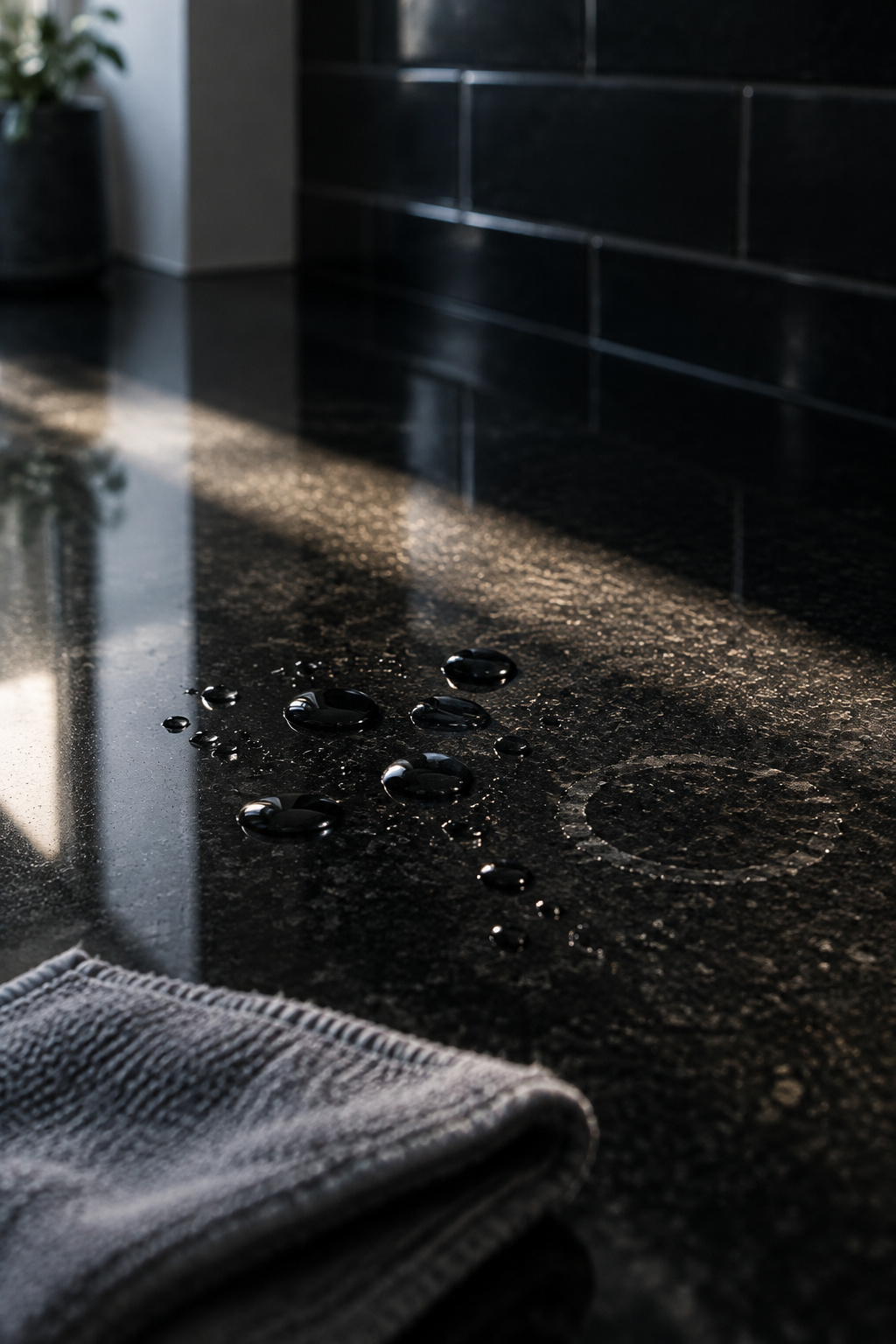
Direct sun on a shiny dark surface shows fingerprints most. Low morning light raking across dark granite shows dust. Bright light in general shows dust, water spots after cleaning and soap residue near the sink. Which finish hides dust better is disputed, and it depends on the slab and the room.
So judge a large piece in your own kitchen at the hours you cook. Then plan task light without glare on a dark counter, because where the light lands decides which mark you see first.
Three Households, Three Verdicts, and the One Sample to Order This Week
The daily wiper
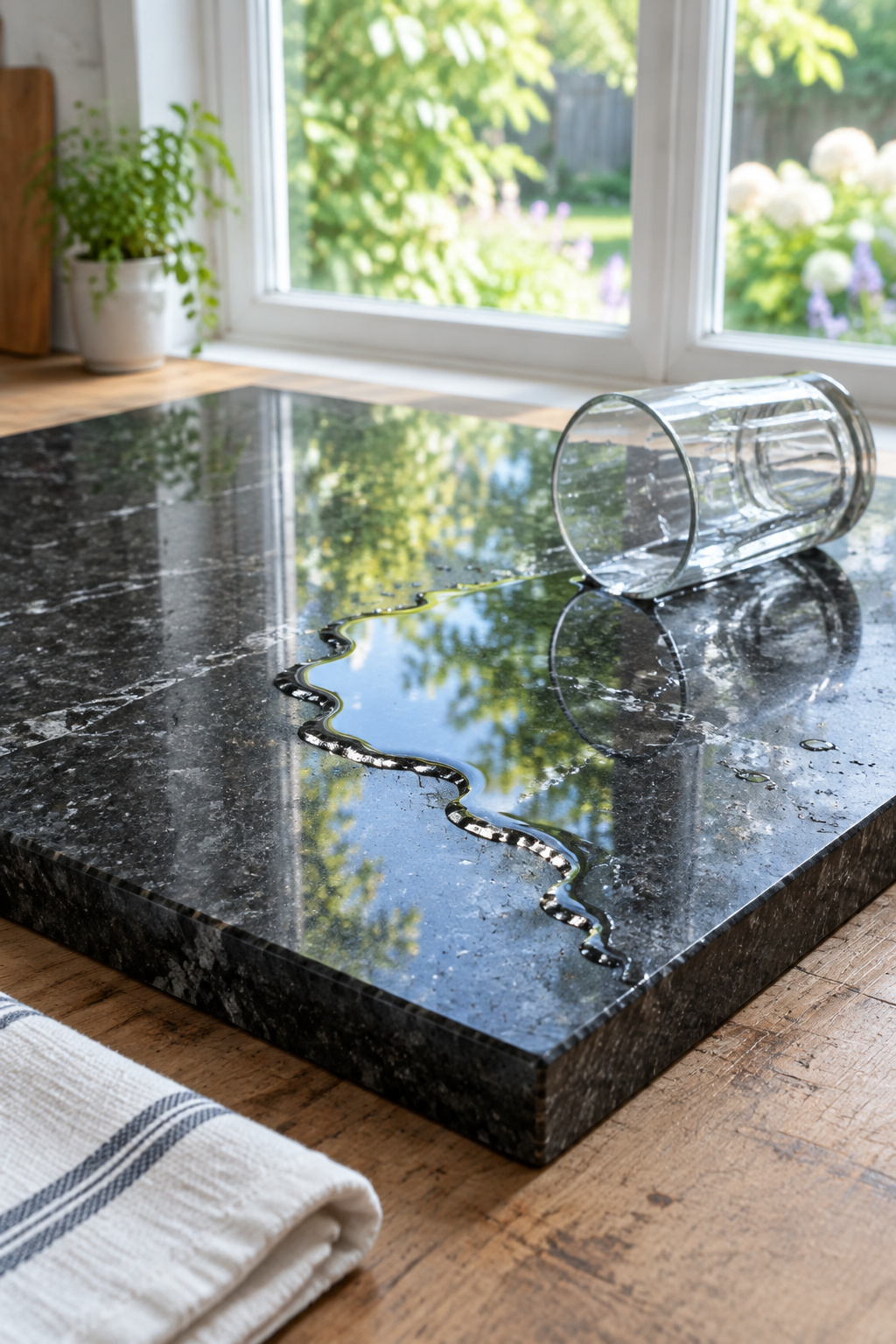
You wipe down after every meal and dry the counter as a habit. Choose polished or leathered black granite, or a dark quartz. One fabricator says leathered hides fingerprints, water spots and smudges better than polish. Granite cleaned that often rarely stains, which is the trade body’s own argument against routine sealing. Dry it with a soft cloth, and rinse first if you used cleaner, because leftover cleaner leaves a film and streaks.
The monthly oiler
You like a small job on a schedule and don’t mind a scratch with a story. Choose soapstone. It takes hot pans (use a trivet for cast iron), needs no sealer, and sands back to smooth. You’ll see scratches and the slow fade back toward gray, and you’ll oil it before either bothers you. Skip it if you want black without oil, or if every nick will nag at you.
The household that does neither
Nobody dries the counter, and nobody is going to oil anything. Choose pattern and a low sheen: a veined or flecked dark quartz, or matte solid surface. On a tight budget, matte or satin laminate works if you respect its heat and seam limits. You’ll still see liquids that dried before anyone wiped them; no dark surface needs no care at all. Movement in the pattern just hides the daily dust that flat black shows.
This week, order one sample of your verdict. Put it on the counter beside the sink for a week. Spill water on it, drop a little cooking oil, leave a coffee ring, and wipe it the way you really wipe. Ask for the biggest piece they’ll send. Keep it out of my scrap bin by the garage door, the one the neighbor’s kids are allowed to raid, so it’s beside the slab on install day. Once it has told you which mark you can live with, the wider guide to dark kitchens picks up from there.
FAQ
Are black countertops going out of style?
No. Black is a minority choice, though. In the Houzz 2026 kitchen trends study, 9% of renovating homeowners chose black countertops, against 37% for white. The drop is on contrasting islands, where black fell from 18% to 8% while wood rose to 39%.
Do you need to seal black granite countertops?
Often not. The Natural Stone Institute says most granite countertops don’t need sealing if they’re cleaned after each meal, while many stone sellers recommend sealing yearly. Dense stones like Absolute Black go longer either way. Test it: if water soaks in and darkens the stone within minutes, reseal. Sealing makes stone more stain resistant, not stain proof.
Can you put a hot pan straight on soapstone?
Yes. Soapstone producers and fabricators agree heat doesn’t damage it, and a pan straight from the oven is fine. Two cautions apply. The stone absorbs heat and can get too hot to touch, and rough-bottomed cast iron can scratch the surface, so use a trivet for cast iron even though the heat itself is no problem.