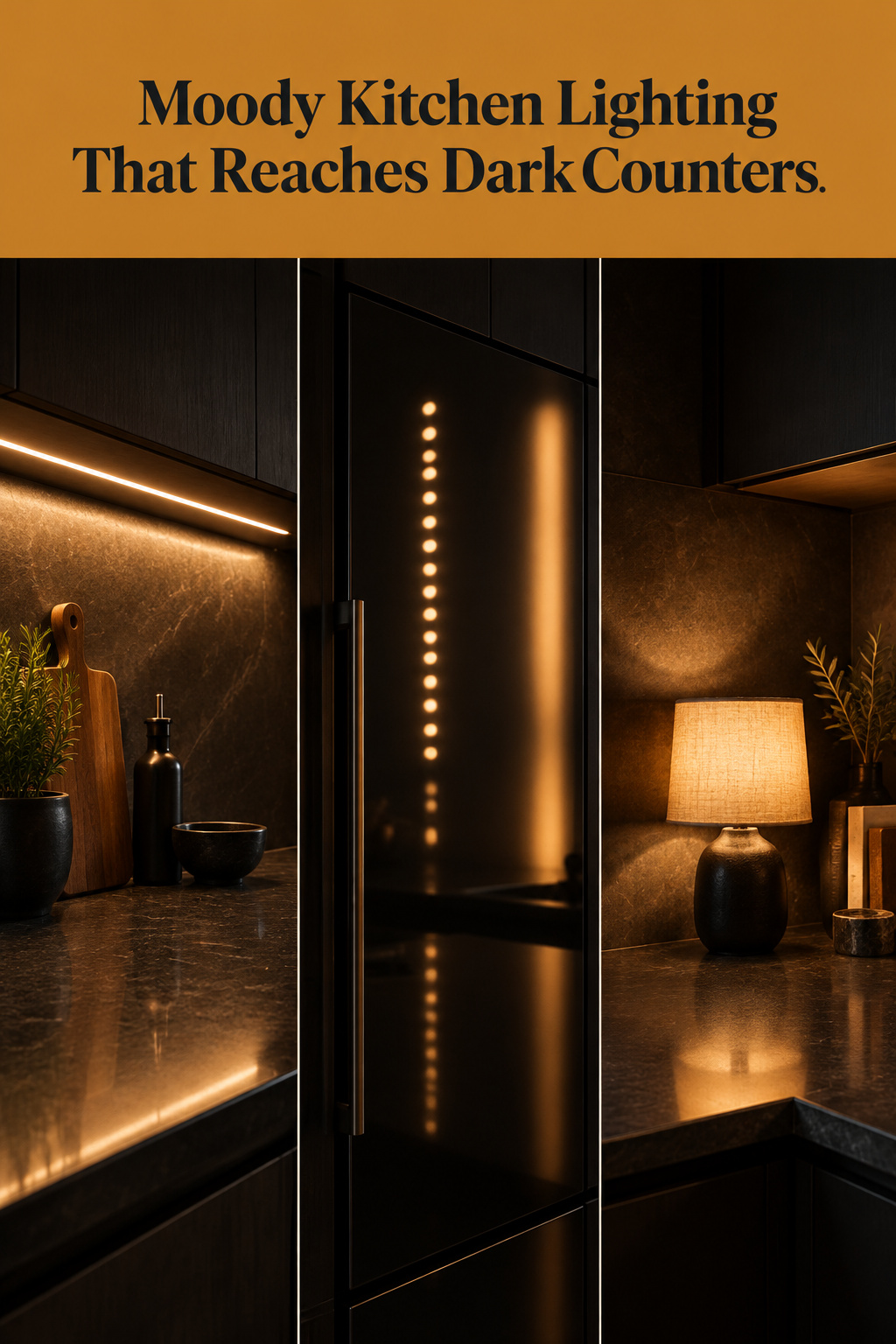
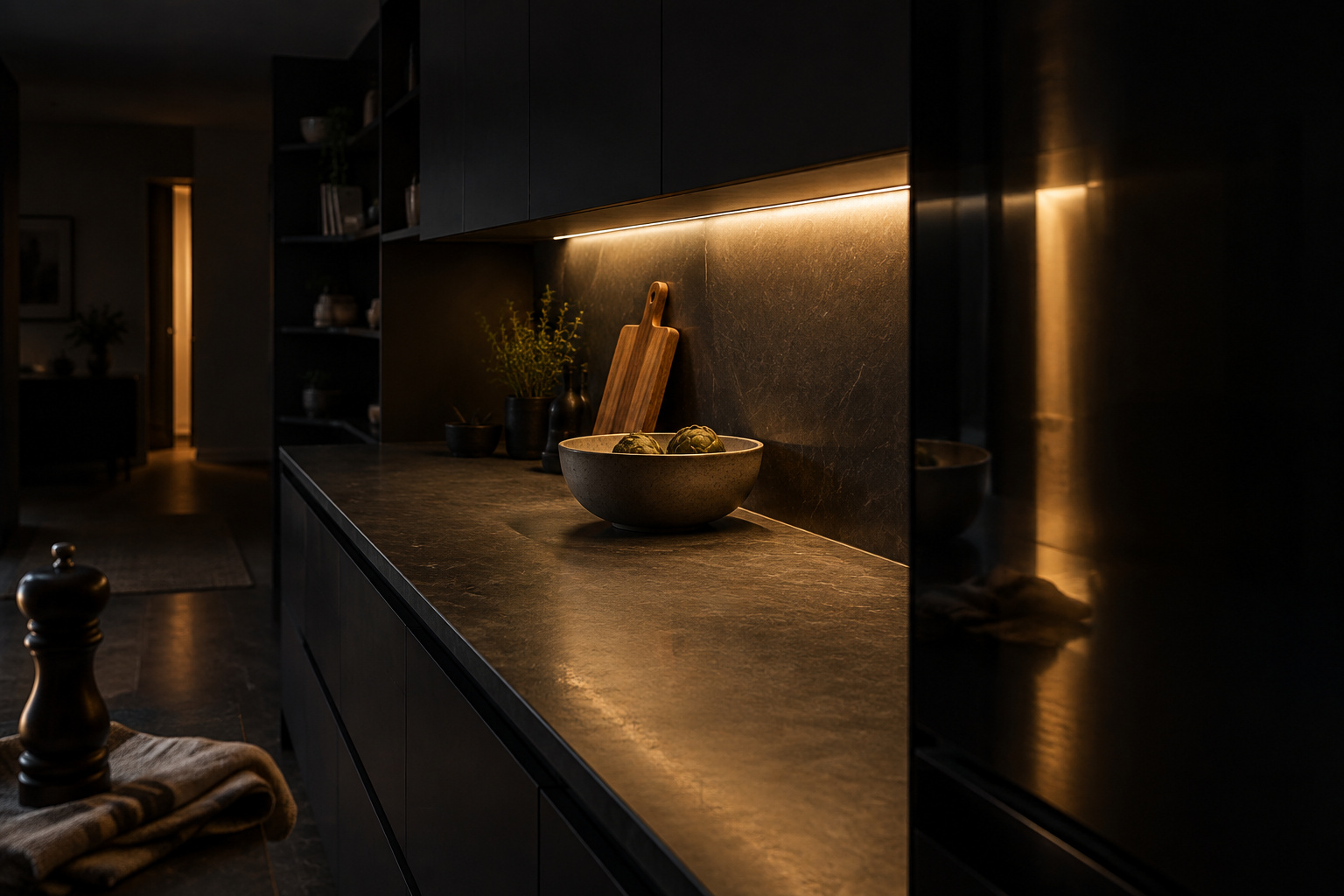
You are slicing an onion on the dark stone counter. A row of small white dots shines back at you from the stone. When you lean in, the dots slide. The board sits in the shadow of your own hands.
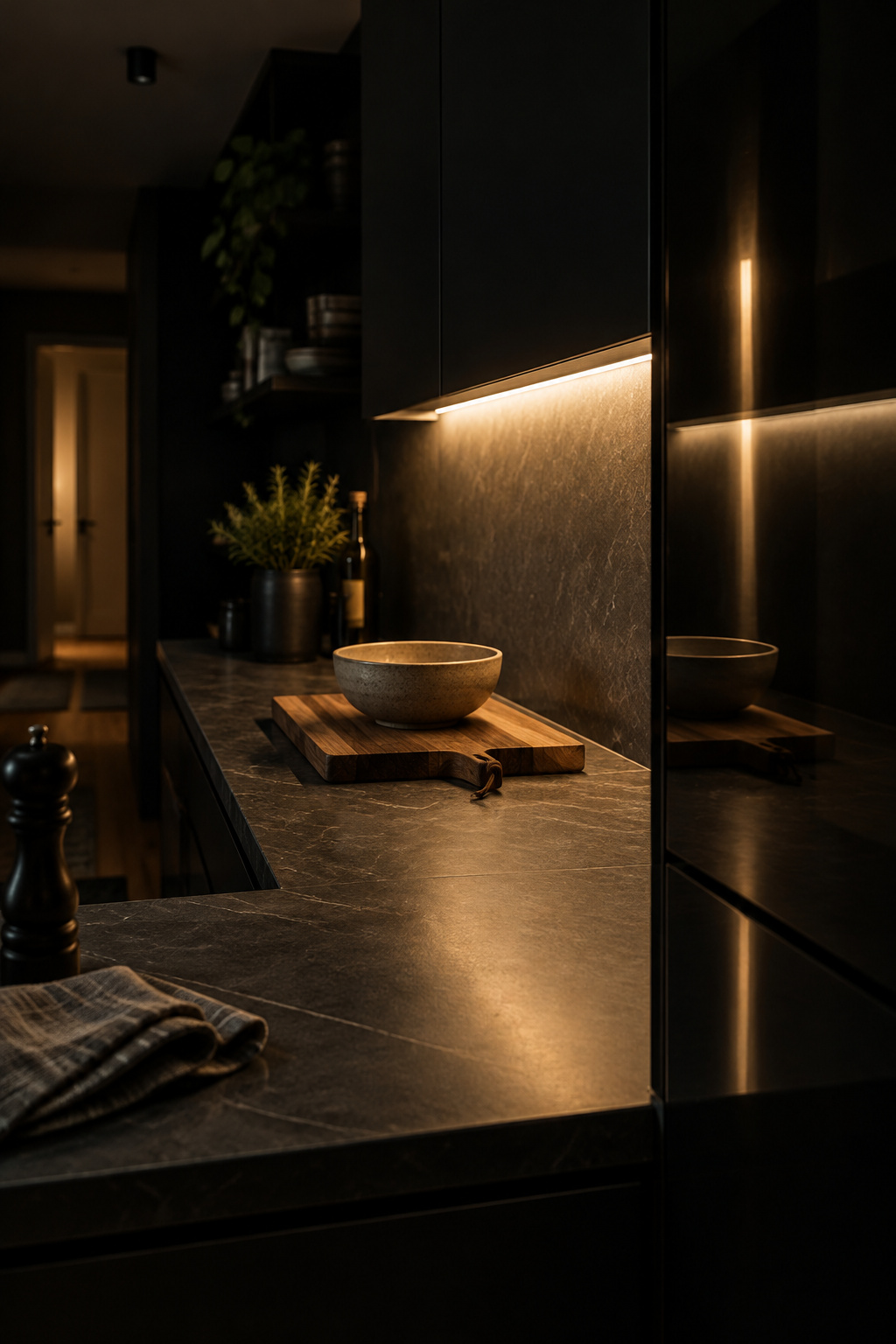
That is how moody kitchen lighting usually goes wrong: plenty of fixtures, light landing in the wrong place. Another pendant won’t fix it. Put task light on the dark work surfaces first, then diffuse it, shield it, angle it and test it, so the dark finishes stay rich and the gloss shows you less of every source.
TL;DR
- Mount under-cabinet light toward the front of the upper cabinet, just behind the front rail, so it lands on the counter where your hands work instead of on the backsplash.
- On polished dark stone, glass or lacquer, a lensed or diffused strip softens the dots, but the surface still mirrors a line of light, so shield it, angle it and test it with a torch before anything is fixed in place.
- Pick one color temperature for every source in sight, warm (2700K to 3000K) over wood and stain, then add one low, shaded lamp for after dinner.
Moody Kitchen Lighting Starts at the Counter: Where Under-Cabinet Light Should Sit
A dark counter should feel easy to work on and quiet to look at. Too many feel dim instead, even with the overheads on.
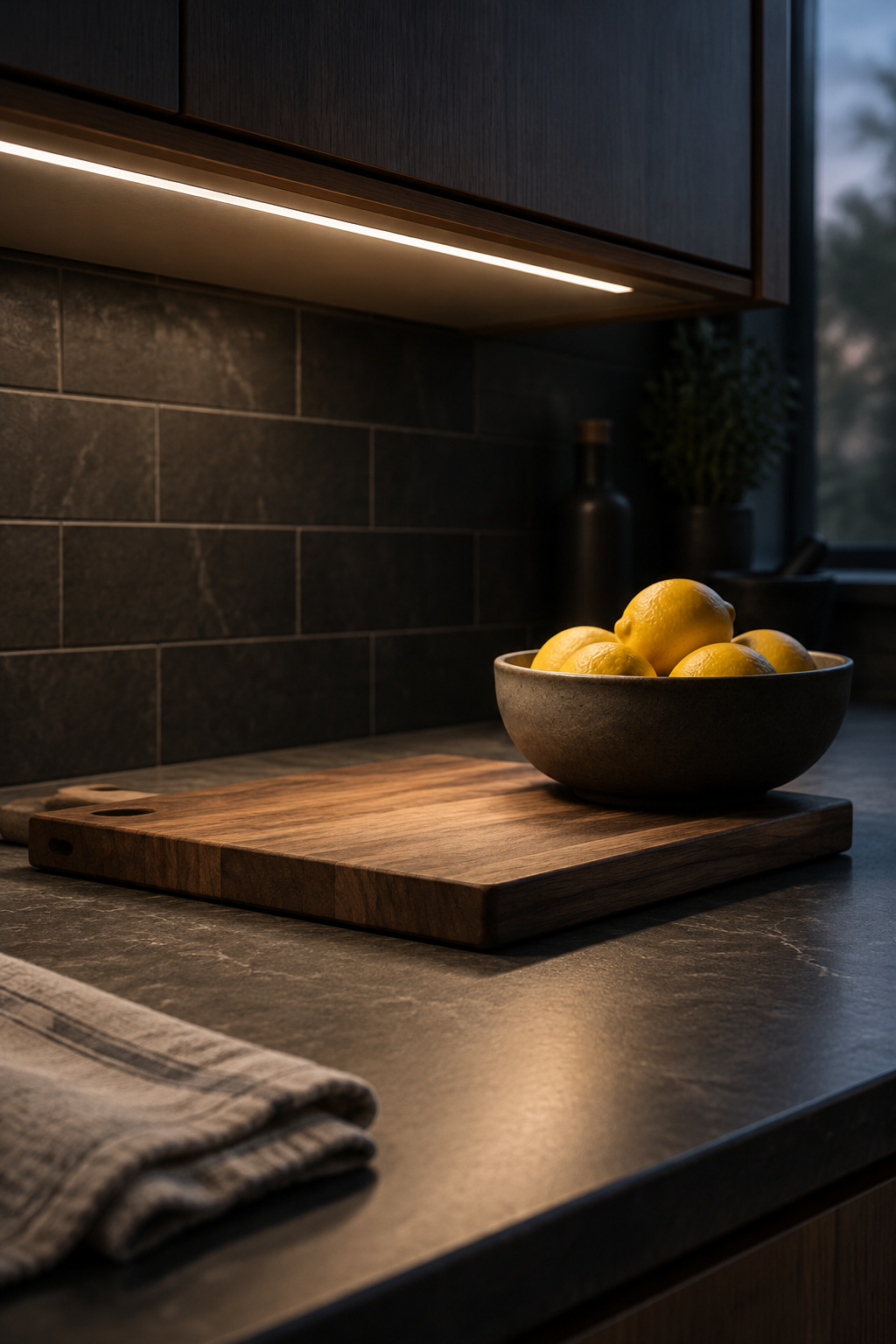
Your eye doesn’t see the light falling on a surface. It sees the light coming back off it, which is the light arriving multiplied by how much the surface reflects, divided by pi. 500 lux on a counter that reflects 5% sends back about 8 cd/m² (500 × 0.05 ÷ π); on a counter that reflects 50% it sends back about 80 (0.50 in place of 0.05). Ten times brighter to the eye, from the same fixture. So the light has to be on a dark counter, not near it.
The NKBA’s planning guidelines are clear on the job: Guideline 31 says every work surface should be well illuminated by appropriate task lighting. A ceiling fixture behind you doesn’t do that; your head is in the way.
The architect Doug Walter tells installers who mount lights against the back wall to stop. Just behind the front rail, a fixture throws light forward and back and puts more on the front of the counter, where you chop. At the back it mostly lights the backsplash, and a glowing backsplash is not a lit counter. One LED maker argues the opposite over polished stone: mount inside the lip and face the strip back toward a pale backsplash, because the front edge is where reflections are worst. I would start at the front and keep the backsplash-facing position as the one to try if your stone is very glossy.
Test both tonight, before anyone drills:
- Come into the kitchen at the hour you usually cook.
- Find every work surface and see which are actually lit.
- Hold a phone torch face down just behind the front rail, then at the back facing the wall, and watch the counter each time.
- Put your hands where you chop and look for their shadow.
I care far more about where the light lands than how many lights there are. Mark the spot for the strip with a piece of tape before you go to bed.
Dark Gloss Throws Light Back: Stopping Hot Spots on Stone, Glass and Lacquer
Stand at the counter and take one step sideways. On polished stone the row of dots moves with you, because it isn’t on the stone at all. It’s the fixture, reflected.
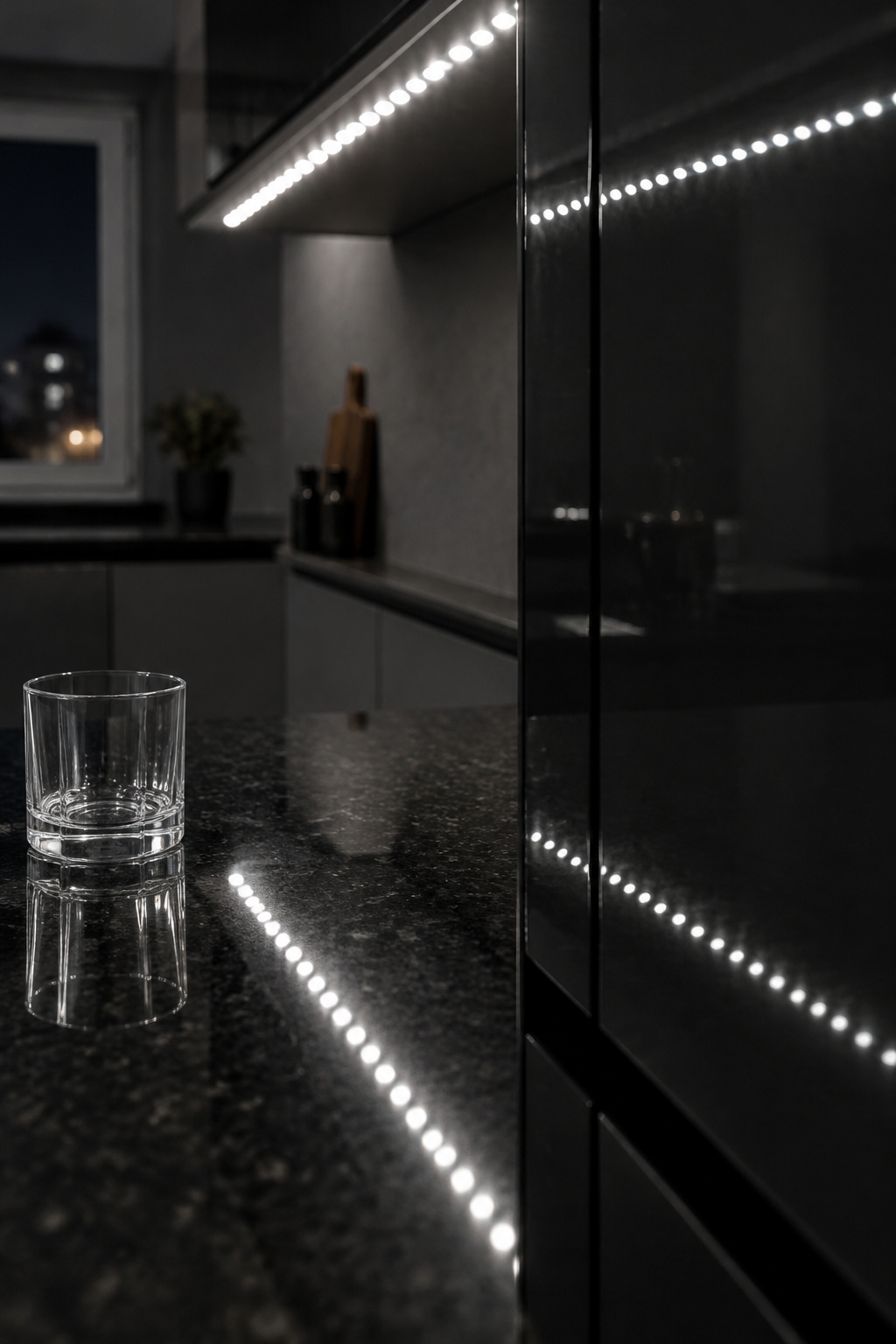
“A specular surface is a mirror,” as the lighting designer Randall Whitehead puts it, and you can’t make a mirror stop reflecting unless you change the surface. I’ve come to think the darkness doesn’t add any glare. It only makes the reflection easier to see, the way a lit window shows best against a black night.
So there are three levers, and you usually need more than one: diffuse the source so the dots blend into a bar, shield or angle it so the bar sits outside where you look, and, where you have the choice, pick a honed or matte surface that scatters the reflection. Here is what dark gloss tends to do with each kind of light:
| Light source | What dark gloss does with it |
|---|---|
| Bare LED tape | Mirrors a string of bright beads; the worst case |
| Diffused strip in a channel | Blends the dots into one soft bar that still mirrors |
| Battery pucks | Separate hot spots, with uneven light between them |
| Strip shielded by the front rail or aimed back | Hides the source from direct view; the reflected line can be steered out of your sightline |
The IES residential lighting practice is blunt: glossy kitchen counters are best avoided, and if you have them, use diffuse light, place the fixture carefully and test with samples. It admits you will see reflections at times; the aim is that they don’t bother you.
Check from where you cook and from any nearby stool. When a reflection catches you, notice where your shoulders go; mine creep toward my ears. Don’t fix it by dimming until the dots fade, though. That puts the work back in shadow, and the fix for glare is rarely less light.
Choose a Color Temperature the Dark Finishes Can Wear
Warm light keeps dark wood deep. Cool light can flatten it.
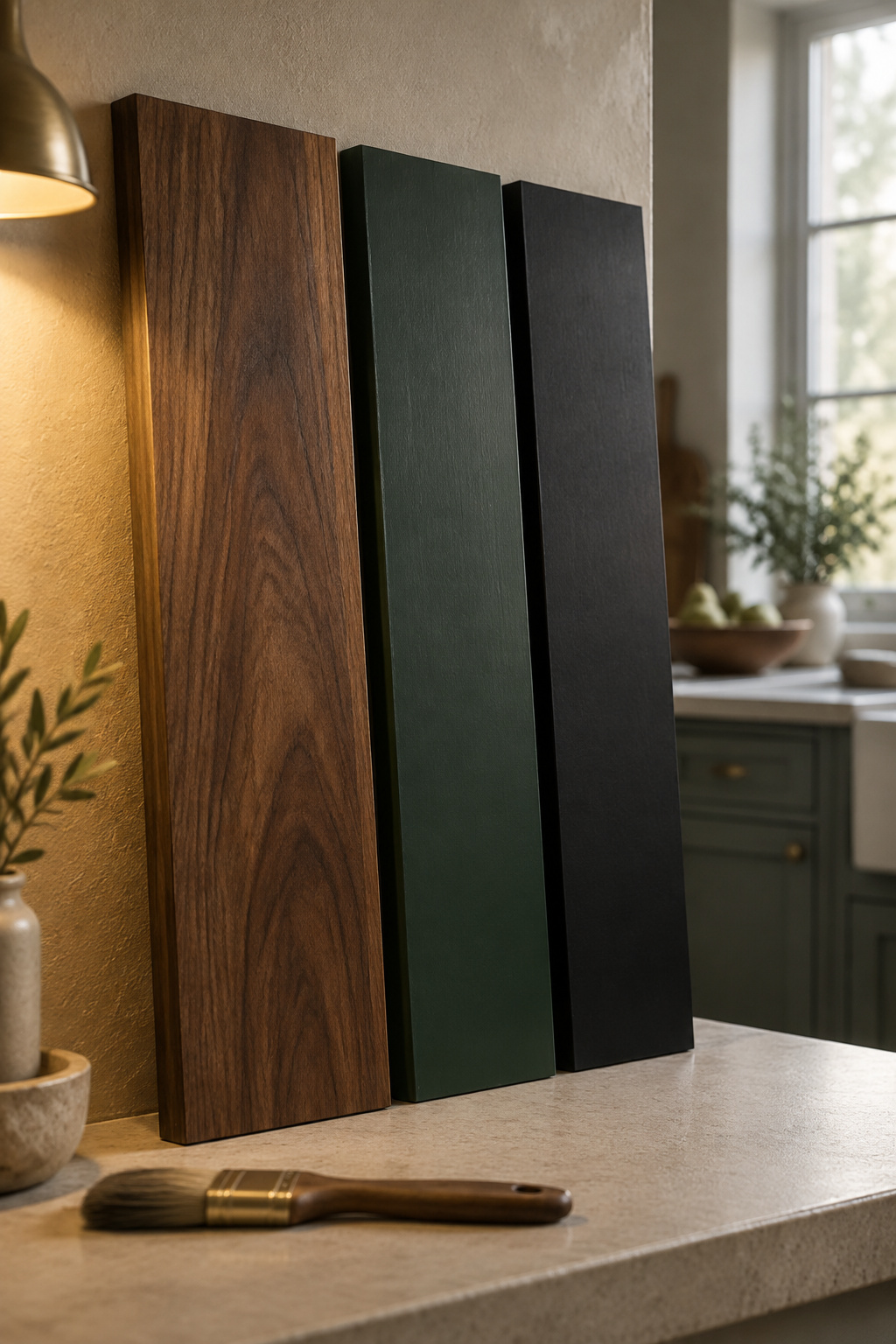
The designer Linda Hayslett keeps kitchens within 2700K to 3000K, the same on every bulb, and warns that in a dark kitchen the wrong temperature makes everything feel dull; at 4000K, she says, “it’s giving hospital break room.” The kitchen design consultant Fabiana Williams adds a split: dark stains like espresso and walnut gain depth and grain under warm light and mute toward flat black under cool 4000K to 5000K, while navy and dark green can go muddy under warm light. One retail guide goes further and recommends cooler light for dark painted cabinets altogether.
Those are two honest answers, and the finish decides between them. I’d start at the warm end for wood and stain, and hold a cooler bulb up to painted navy or green before ruling it out. Whatever you pick, keep one temperature for every source in sight: the strips, the ceiling, the lamp, even the light in the hood.
Paint shifts more than people expect, so judge the dark colors the light falls on under the bulb you plan to buy. Hold a sample under one bulb tonight and see whether it stays rich.
Wash or Spot: Lighting Dark Walls Without Flattening Them
A dark wall should feel like it holds the room, not like it swallows it. If the walls get no light, the room looks dark however well the counter is lit. Where a surface can’t be lighter, light the wall itself.
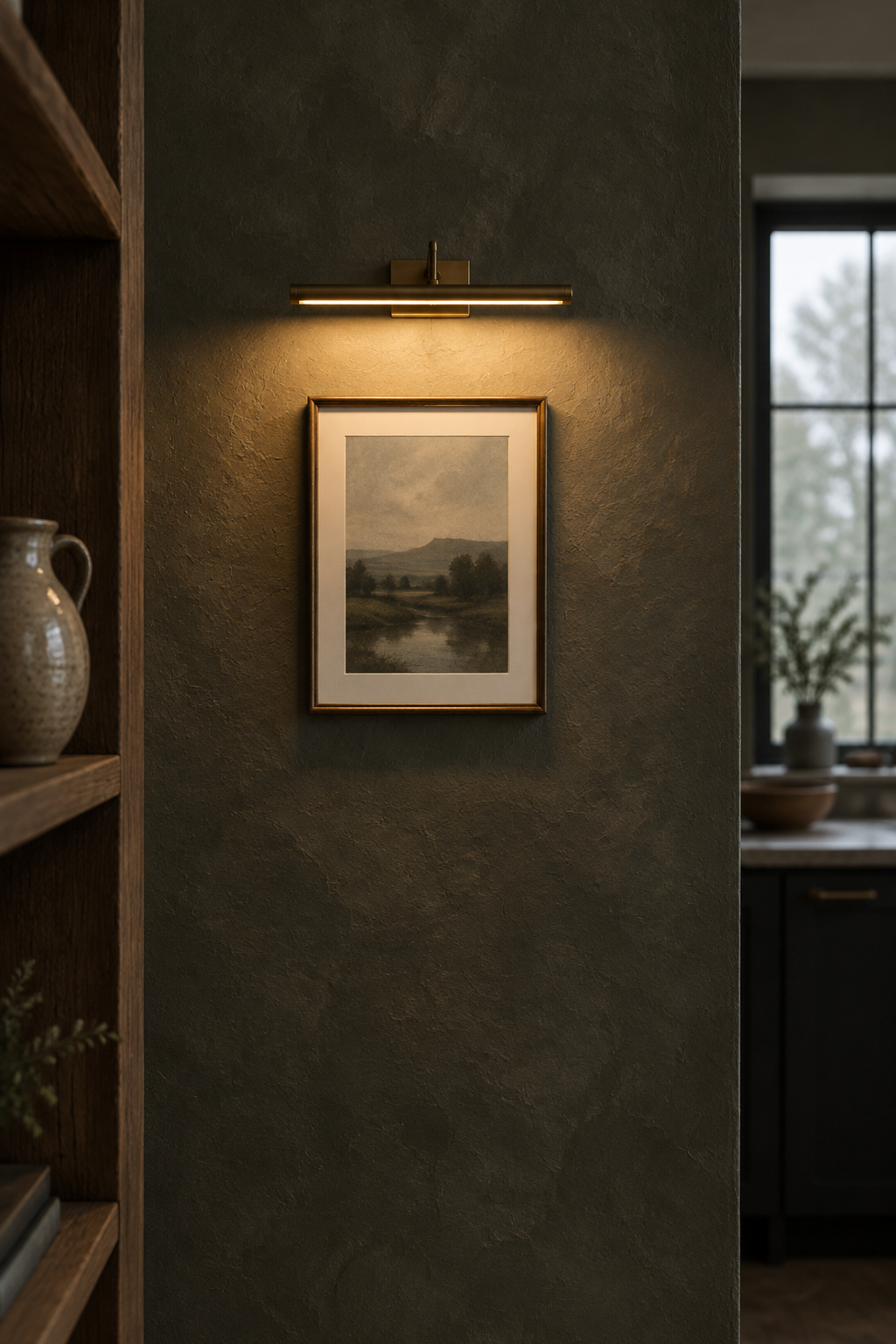
Washing a wall so it deepens
A wash is even light climbing the wall from a rail or from above the cabinets, so the wall gives some light back instead of reading as a black box. If you uplight from above the cabinets, the IES residential practice asks for at least 1 ft (0.3 m) between the cabinet tops and the ceiling. Nobody publishes a distance or beam angle for washing a dark kitchen wall at home. Tape a light up, step back at night and move it until the glow looks settled.
Spotting one thing and leaving the rest dark
A spot picks out one object and lets the rest stay dark. Decide which job each wall has; spot everything and nothing stands out.
Before you aim anything, ask what can leave. Dal, my cat, watches the alley from the sunroom sill every morning, which is why nothing is ever kept on that sill, and I’ve never missed what isn’t there. Light makes every object on a dark wall louder, so settle what to keep out on dark walls and shelves before you light them.
One Low Lamp for After Dinner, Once the Work Light Is Right
Most rooms are too bright in the evening. Once the cooking is done, a kitchen wants something lower and warmer than work light. My view is that a few dim lamps at different heights beat one ceiling fixture every time. That’s my opinion, not a measurement.
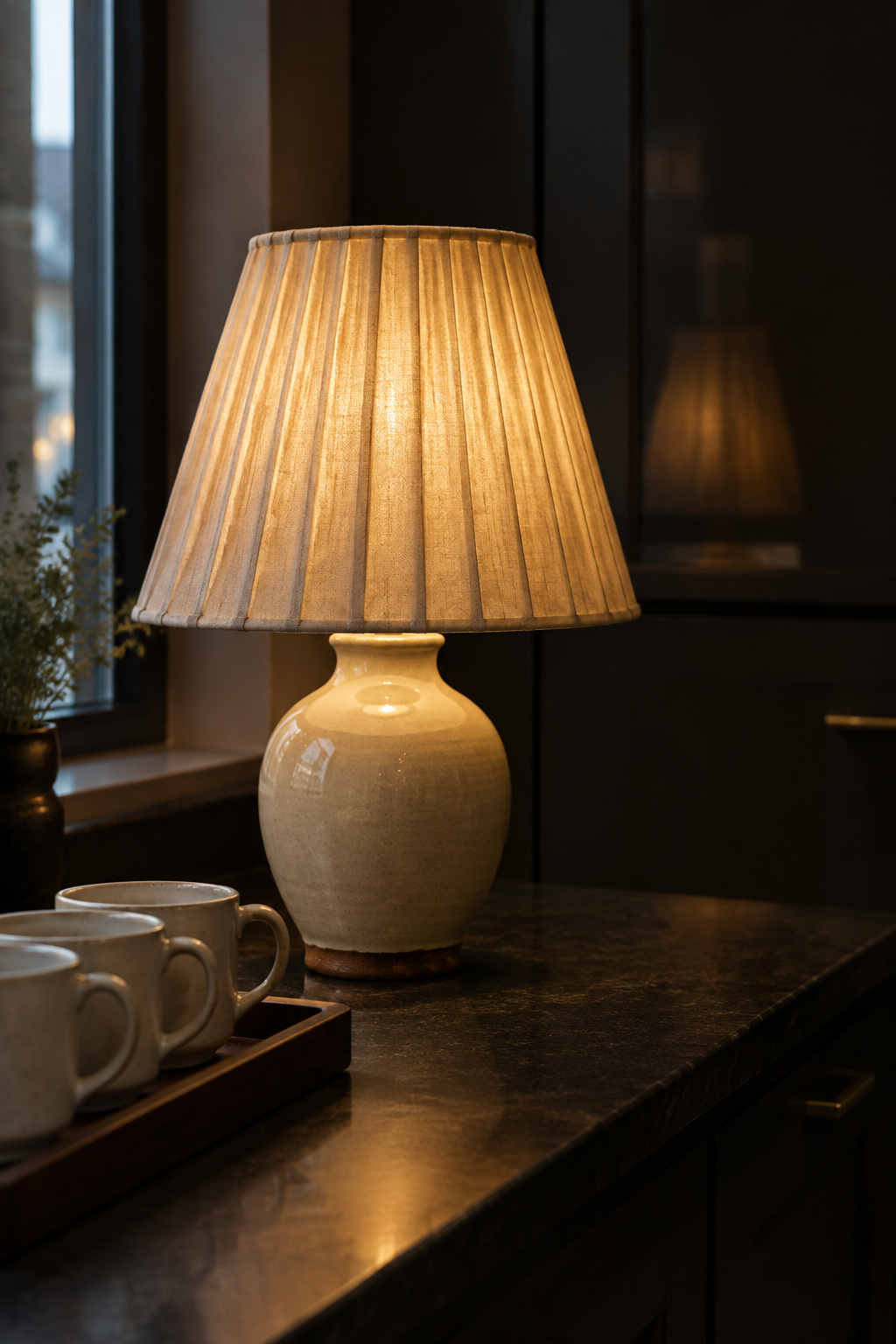
At dusk I turn lamps on one at a time and stop at the first moment the room feels finished. It’s usually sooner than I expect. My mother calls my sunroom “the empty room” and keeps offering to lend me a chair for it. She means it kindly. Let it be a little empty.
Put the lamp on a counter corner well away from the sink, or a shelf end, always away from the cooktop, with the cord clear of water and heat and of any cabinet door. Choose an alabaster, frosted or opal glass shade that turns the bulb into a glow; a bare bulb at eye level throws a new reflection onto your gloss.
Then turn the task strips down or off and let the lamp carry the room. The switching and dimming plan itself lives in our galley kitchen lighting article.
A Walk-Through at Dusk: Four Checks That Prove the Light Lands Where You Work
My own sitting space is a former sunroom with an old radiator that knocks in winter. I learned what that room needed by sitting in it at the hour I used it, not by planning it, and kitchens are no different. Sit with it for ten minutes at dusk, then walk to the counter and check four things in order:
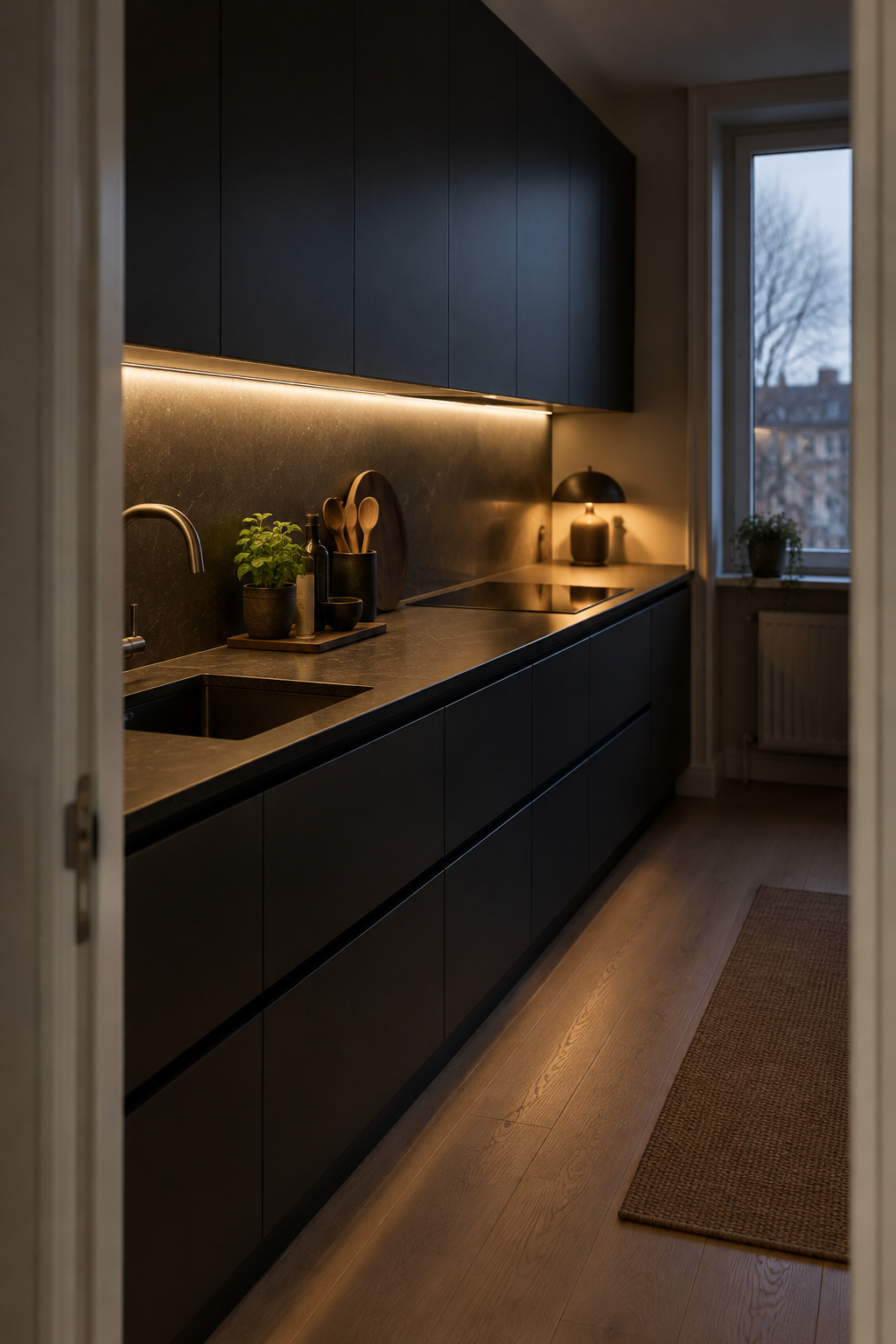
- The counter is lit where you chop, with no shadow from your hands.
- No dots or bright lines show on the gloss, standing or seated.
- Every source in sight is the same color temperature.
- One low lamp is ready for when the cooking stops.
The kitchen you started with had lights and still felt dim and glary, because the light came from behind your hands and the source showed in the stone. Now it sits on the work, and the dark finishes can stay dark.
If you want a number to hold a strip up against: a 10 ft by 2 ft run needs about 1,000 lumens landing on it at a rule-of-thumb 50 lumens per square foot, before the fixture and the stone take their share. And if you’re still deciding how dark your kitchen should go, light the counter first and decide the rest with the lamps on.
FAQ
How many lumens does a dark kitchen need for cooking?
No standard gives a lumen figure for a dark kitchen, or a percentage extra for dark finishes. One guide quotes the IES residential practice at about 50 footcandles on the counter, and a footcandle is one lumen per square foot. A 10 ft counter 2 ft deep is 20 sq ft, so about 1,000 lumens should land on it, before losses.
Can I add under-cabinet lighting in a rental without hardwiring?
Yes. Plug-in low-voltage bars fixed with adhesive or a few screws, or rechargeable battery bars on adhesive or magnetic plates, need no new wiring; hard-wired line-voltage lighting is a job for an electrician. Mount toward the cabinet’s front edge, test the adhesive on a hidden spot first, ask your landlord, and keep cords away from burners and sinks.
How much does a window help a dark kitchen in the daytime?
It helps most near the glass. A common daylighting rule puts the useful reach of window light at about 1.5 to 2 times the height of the window head. Deeper in, more of the light has bounced off the walls, so dark walls cut how far it reaches. A counter on the far side will usually still need its own task light.