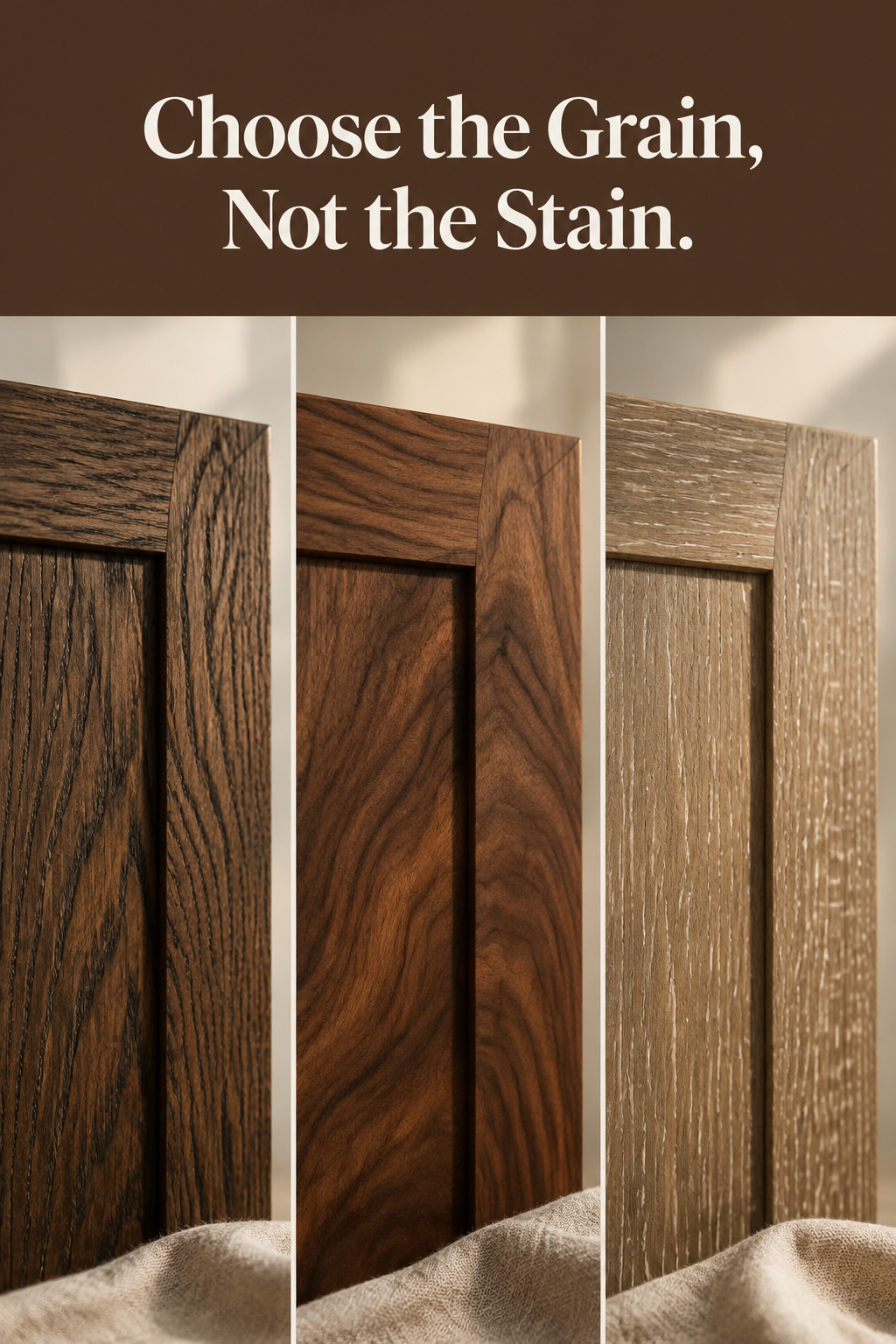
You hold two cabinet doors side by side, both finished in the same espresso stain. The oak looks deep and alive. The maple looks as if someone wiped it with a muddy rag.
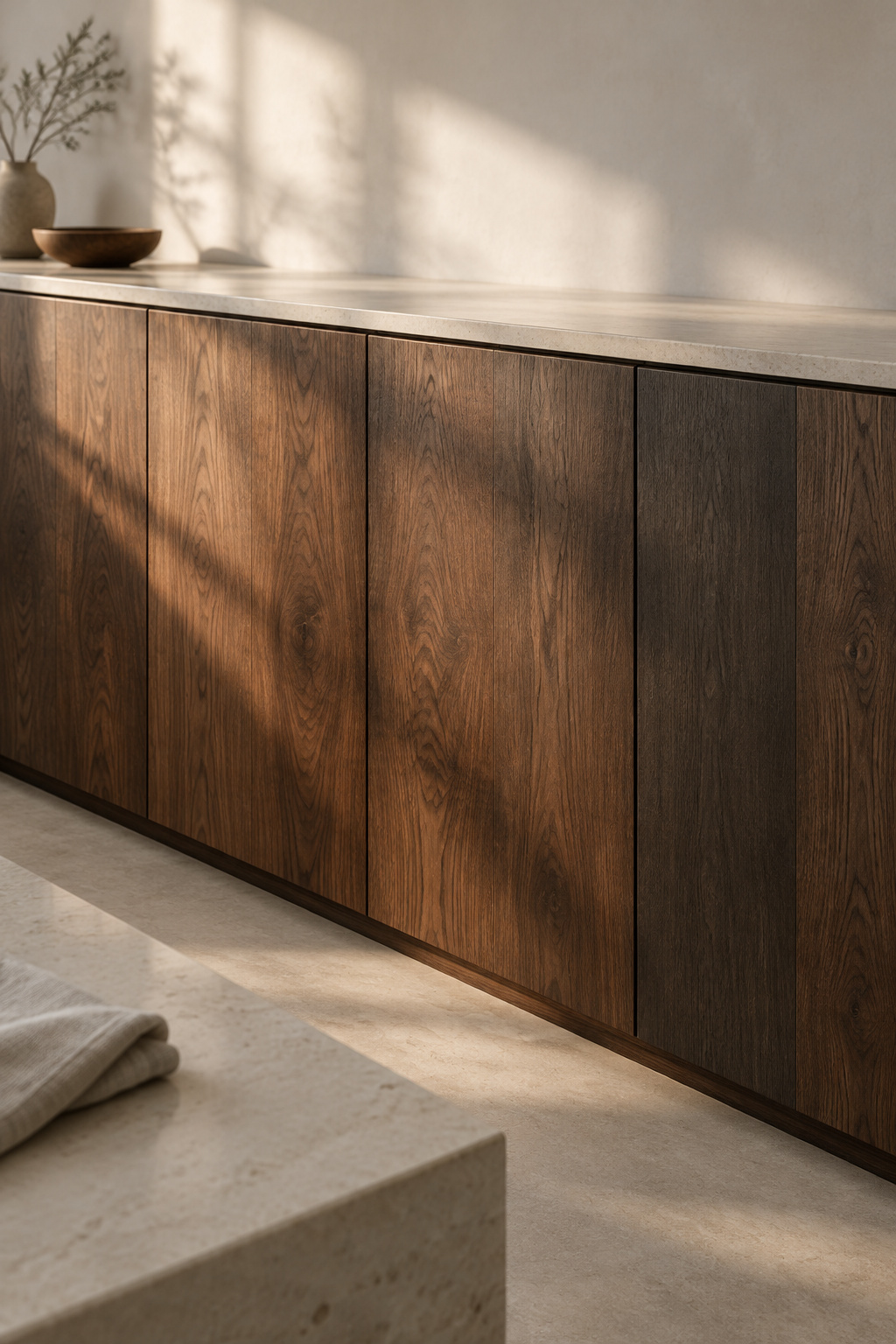
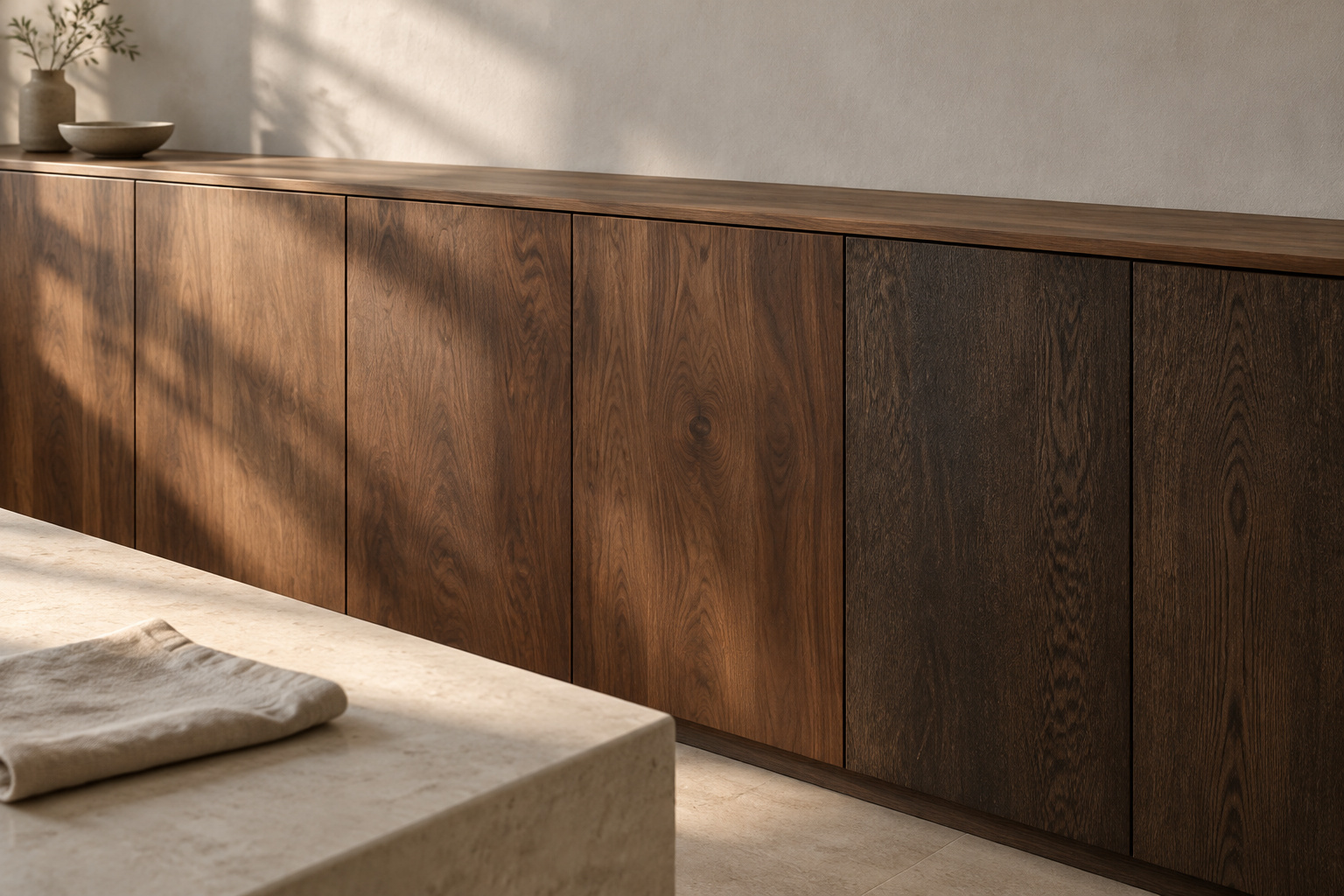
The difference is the wood, and it decides more about dark wood kitchen cabinets than any stain chip does. Oak taken dark keeps its figure. Walnut is dark already and rarely needs stain at all. Put the same dark stain on maple, birch, cherry or pine and it tends to go blotchy. So choose the grain you will see from across the room first, and the color second.
TL;DR
- Buy oak or walnut for a dark kitchen: oak’s open pores take dark stain and keep the grain visible, and walnut’s heartwood already runs from pale brown to dark chocolate, so it is rarely stained.
- Maple, birch, cherry and pine absorb stain unevenly because their density varies inside each growth ring, and dark pigments make the blotching worst; sanding finer does not fix it.
- Real wood veneer is a slice of timber about 1/42 in thick on a stable core and shows real grain, while printed foil gives itself away where the pattern stops at an edge.
Why one dark stain looks rich on oak and muddy on maple
Stain color travels as pigment, and pigment lodges wherever the wood lets it. Oak has large pores in its earlywood, the early growth in each ring. They catch more pigment than the dense latewood, so the stain draws the grain in dark lines.
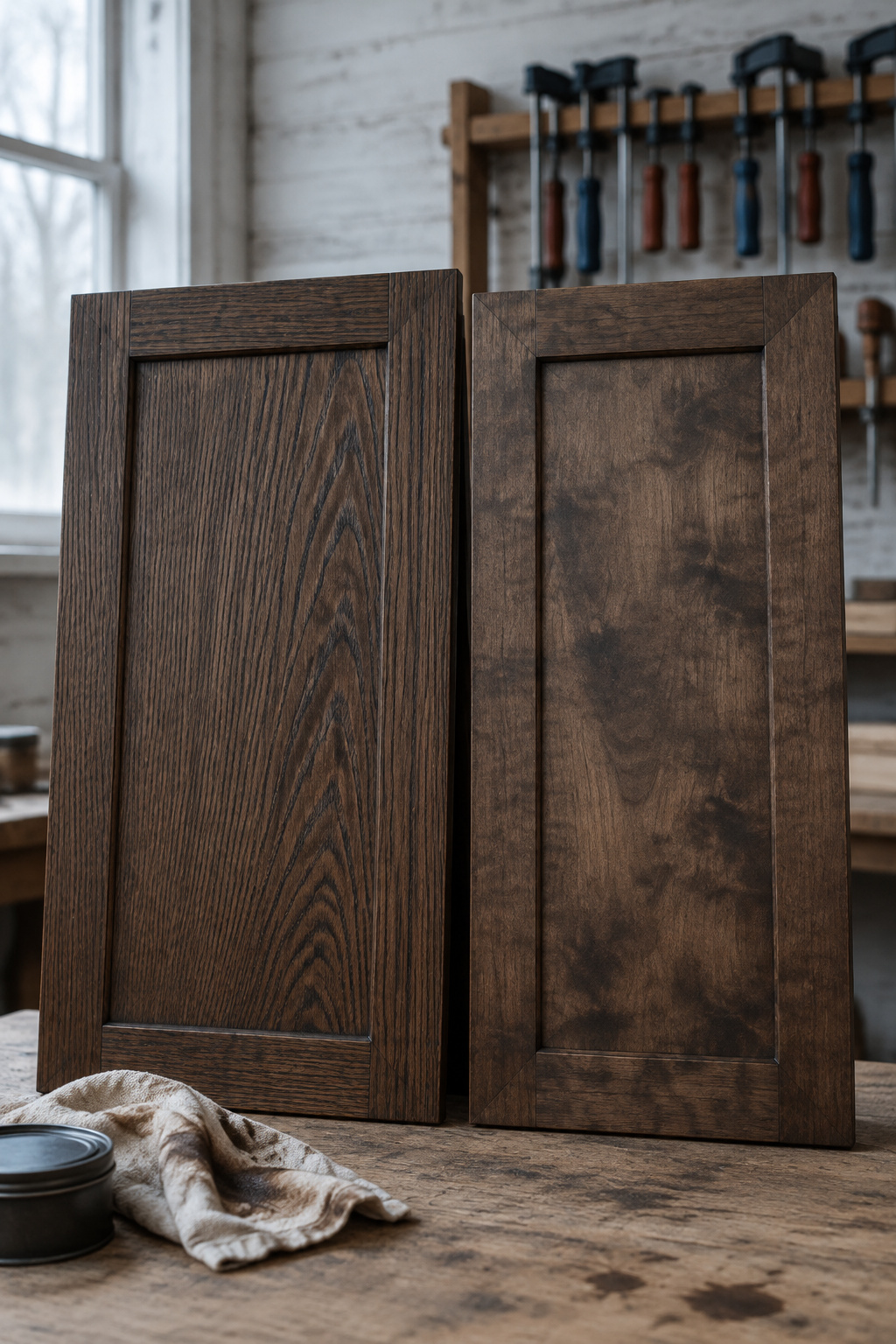
Maple, birch, cherry and pine work differently. Their density varies inside the growth rings themselves, so spongy patches drink more stain than hard ones, and dark and light areas land at random. In cherry, the finisher Jeff Jewitt points to hidden resin deposits from kiln-drying as the usual culprit.
Sanding finer will not save you. Bob Flexner sanded one cherry panel to 400 grit on one side and 150 on the other, and both sides blotched equally.
Dark makes all of this worse. Black and very dark pigments blotch worst. There is a limit on oak too: in very dark colors it is difficult to reach full color without also covering the grain, and an espresso stain shows oak’s figure mainly up close. That is why I say oak taken dark, not oak as dark as it will go.
My own test is the doorway. I stand where I would walk into the kitchen and look at a full door, because that is the distance you live with. A chip held in the hand flatters every wood. The wider ideas for a dark, moody kitchen start from the same question of what the dark sits on.
Dark wood kitchen cabinets by species: what holds and what blotches
The finishing trade’s lists agree more than they disagree: pine, cherry, maple, birch and alder are the woods most likely to blotch. The common cabinet species sort like this.
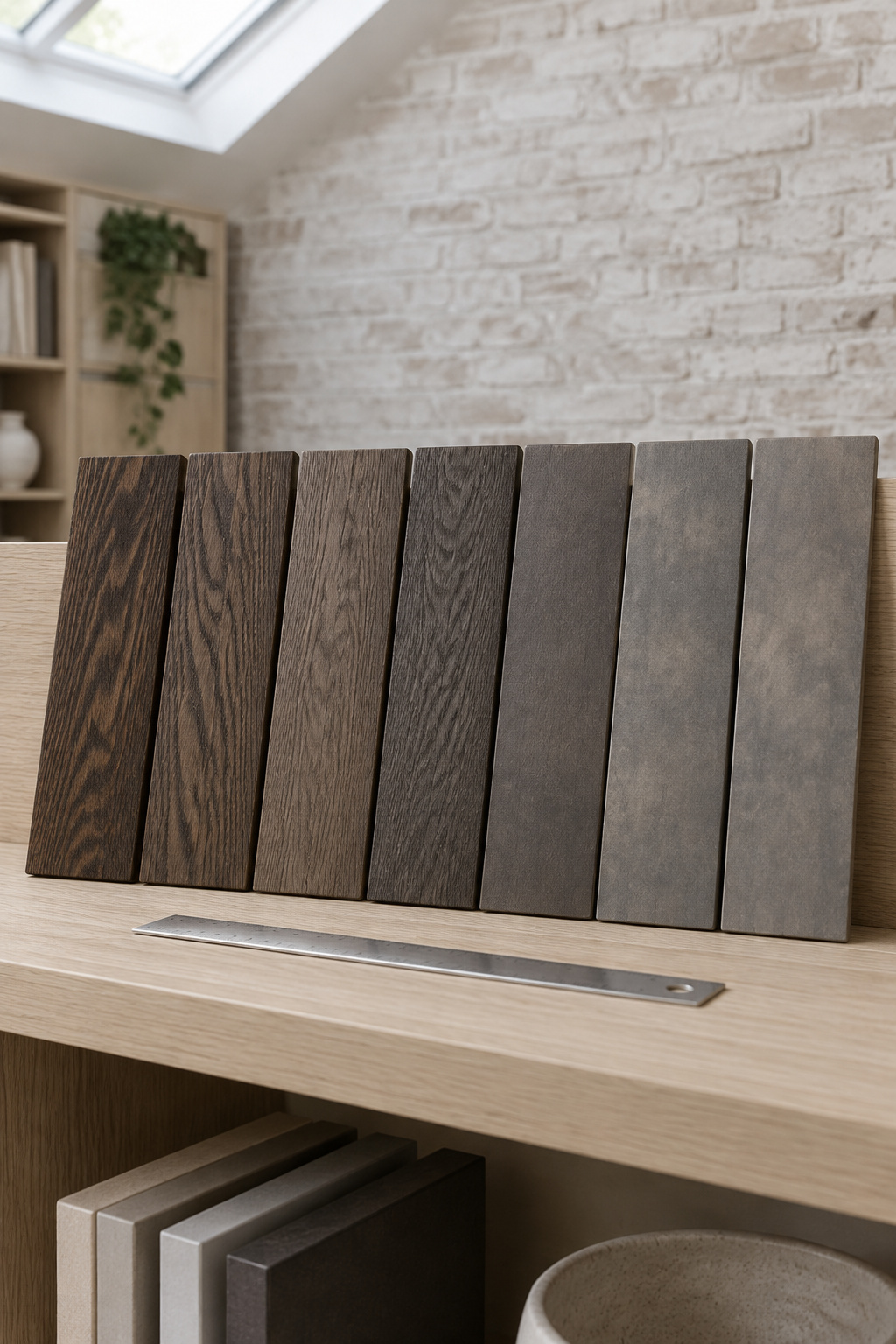
| Species | Under a dark stain | From the doorway |
|---|---|---|
| White oak | Takes it evenly; fumes well | Grain visible, olive-brown cast |
| Red oak | Sources split on blotching | Grain visible, warmer pinkish cast |
| Ash | Very large open pores, like oak | Open grain in lines |
| Walnut | Rarely stained | Its own chocolate figure |
| Maple | Blotches | Patchy, or smooth and near-opaque once controlled |
| Birch | Blotches | Patchy unless evened out |
| Cherry | Blotches, often from resin | Patchy |
| Pine | Blotches | Patchy |
If I had to choose one row, it would be white oak. It takes dark evenly, it can be fumed, and its grain carries across a room.
Oak is not perfectly clean under dark pigment either: stain collects in its large pores, and the furnituremaker Kevin Rodel likens the result to thousands of dark specks.
Red oak is where the trade splits. One lumber supplier says red oak can blotch under dark stain and white oak takes dark more evenly. WOOD Magazine says oak absorbs liquid stain evenly. I would ask for a red oak door in the exact stain before signing anything.
My own kitchen has its original birch cabinets. Birch is on the blotch lists, and I would not ask it to go dark.
Buy the wood that is already dark, and the oak that is taken dark
Walnut needs almost nothing from a finisher. Its heartwood runs from pale brown to dark chocolate, sometimes with a gray, purple or reddish cast, and it is rarely stained. It keeps its figure because it starts dark. Its pores have nothing to do with it, since woodworkers class walnut as closed-grain.
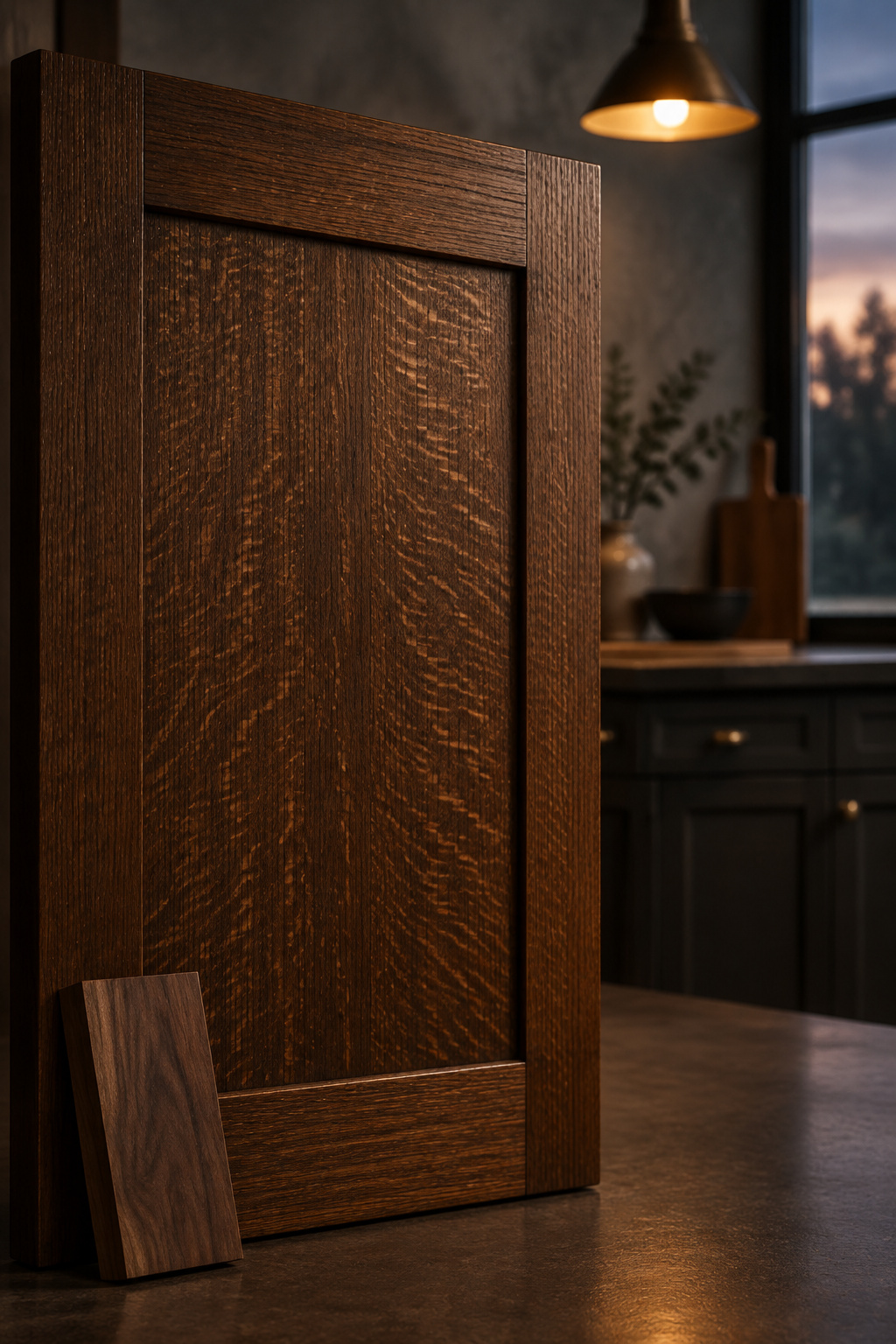
Oak gets dark one of two ways. Stain adds color into the pores and onto the surface. Fuming changes the wood itself: ammonia reacts with the tannin already in the oak and darkens it to a depth of about 1/8 in (3.2 mm), so a fumed door can be sanded without cutting through the color, and the color holds where stains and dyes can fade. It works on tannin-rich white oak. On red oak, the furnituremaker Arthur Reitmeyer says, the result “becomes a sickly green.” It is a factory or workshop process, not a home job.
Reitmeyer prefers wood that grows in the color you need, because every extra process adds cost. I agree, and more bluntly: spend on the species, not on a dark stain over cheap wood. In one retailer’s line, a base cabinet in real white oak stains costs $438.75 against $364.00 painted, about 21% more. To me that is money in the right place. The Houzz 2026 Kitchen Trends Study has wood cabinets at 29%, edging white at 28%.
If what you want is the dark without the wood, that is a different decision, and painted black cabinets and how they wear is the honest comparison, since paint hides the grain entirely.
Veneer, solid or printed foil: what reads as wood from the doorway
I read furniture catalogs from the back, where the dimensions and materials are. Several “oak” and “walnut” finishes in one cabinet line turn out to be woodgrain laminate. The finish name tells you the color, not the material.
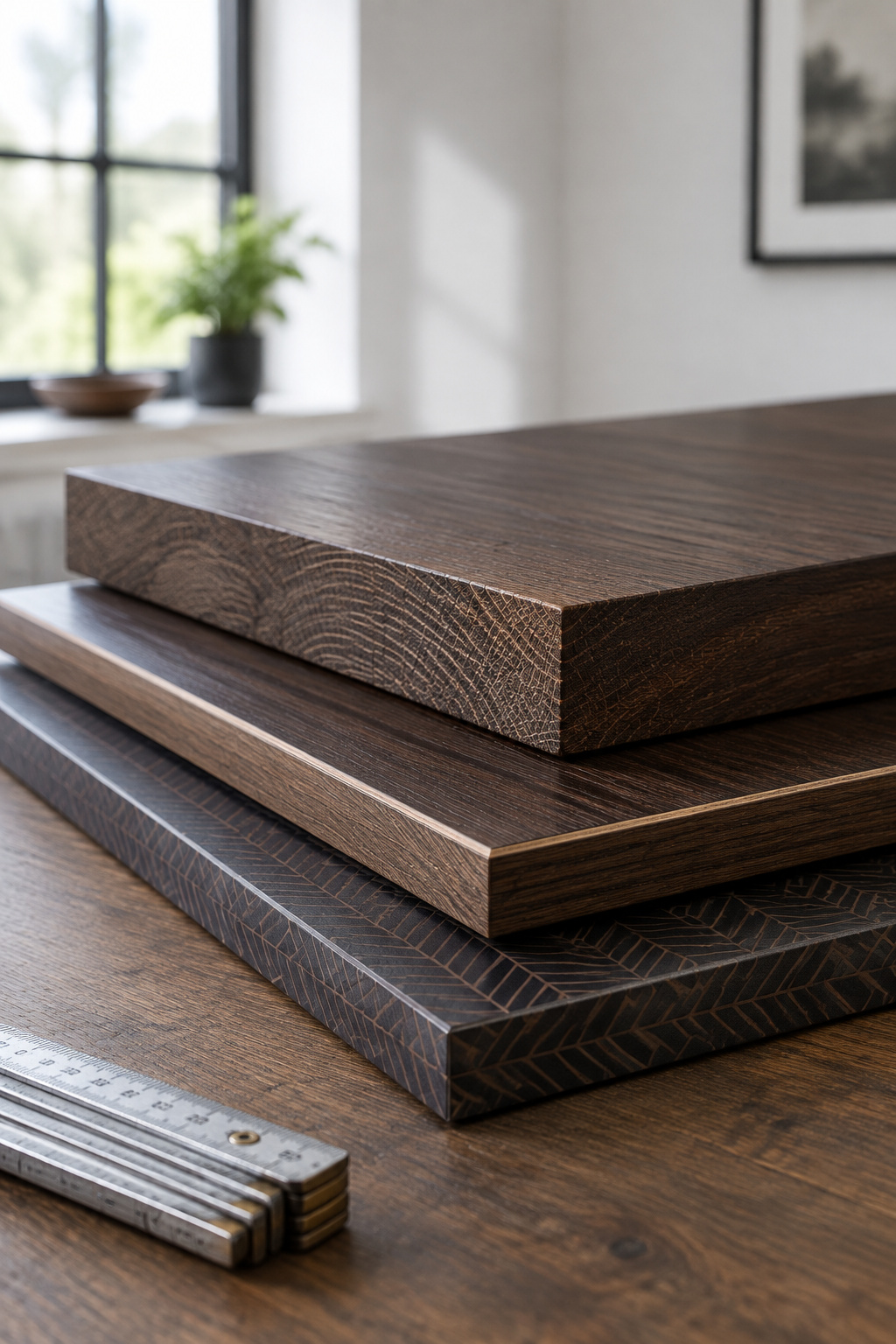
Most “Scandinavian” furniture sold in the US is pale veneer pretending to be wood, and my advice is always the same: buy fewer pieces of actual wood. In a kitchen that rule needs one adjustment, because real veneer is actual wood. It is a slice of timber, the US industry standard being 1/42 in (about 0.6 mm), bonded to a stable core. On a wide flat door that is a good thing: veneer on a stable core resists warping, where solid wood moves with humidity and temperature. What veneer cannot do is be sanded back like solid wood. A chip at an edge or corner can let the facing peel, and water behind it can make a door swell.
Thermofoil is vinyl heated and pressed onto an MDF core, with the grain printed on. That’s furniture for a photograph.
The tells are at the edges. On real veneer the grain runs continuously around edges and corners, and a cut edge shows a thin layer of wood. On printed wraps the pattern often stops or changes at the edge, and laminate shows a dark paper line. A repeating pattern is a weaker clue than people think: it can mean print, but rotary-cut veneer is peeled as one continuous sheet and can repeat too.
In a showroom I pull a drawer all the way out and turn it over. The underside and the edges tell you what the front will not. From the doorway, good veneer and solid wood look the same to me; the difference shows after a chip or a leak. Buy real veneer or solid wood, and leave printed foil out of a dark wood kitchen.
Oil or lacquer: how dark wood ages on a working kitchen cabinet
Most factory cabinets arrive with neither. A typical factory finish is a catalyzed varnish, so the oil-or-lacquer choice matters mainly for custom and small-shop work.
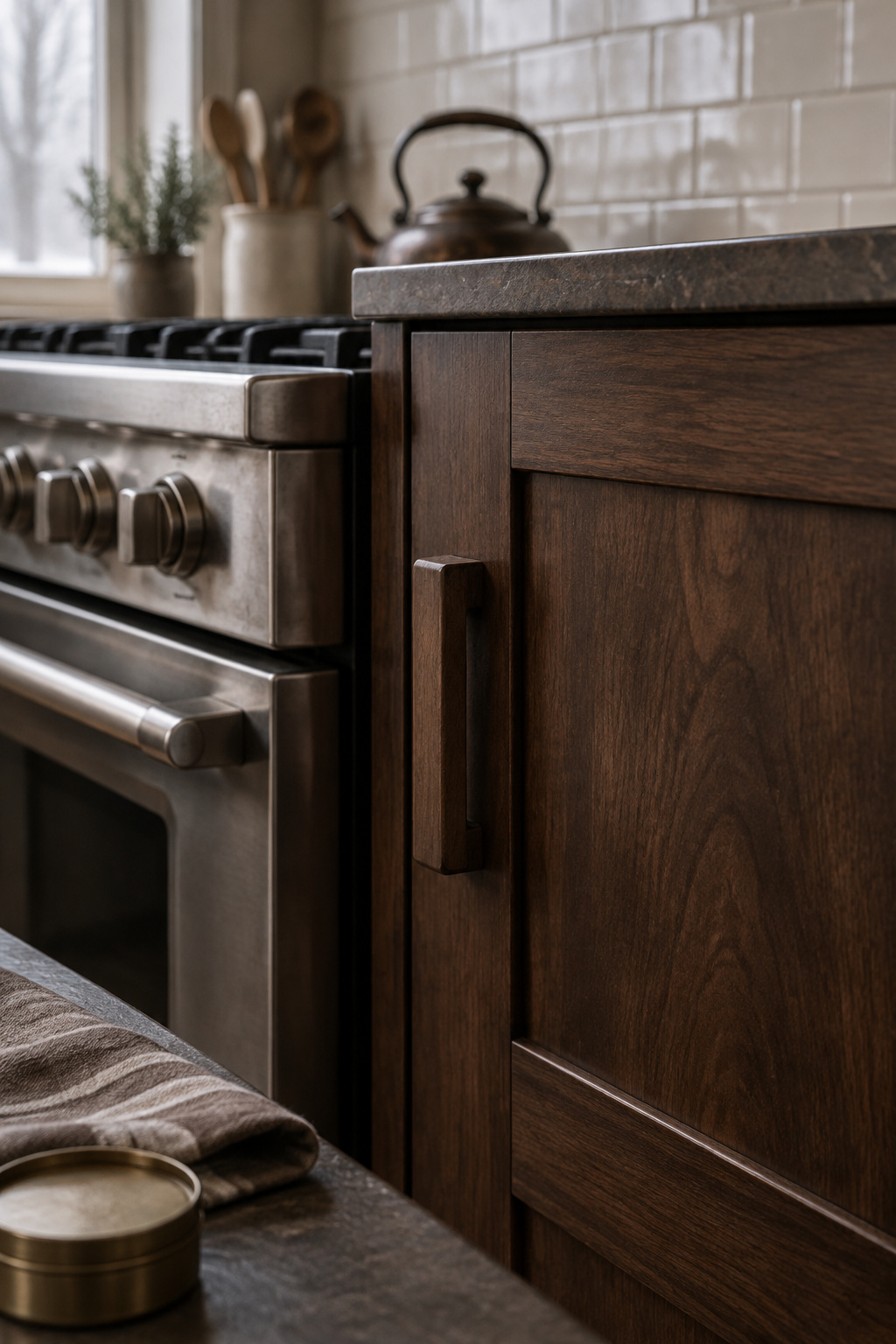
WOOD Magazine puts the trade-off in one line: durability increases as ease of repair decreases. Oil sits in the wood. It is the easiest finish to repair with another coat, but it protects almost nothing against moisture or abrasion and is a poor choice for things used every day.
Lacquer is a film. On repair, the two sides disagree. WOOD says a lacquer repair is as easy as spraying on a fresh coat. Amanda Yoder, who writes on finishes, says film finishes fail locally and a repair leaves a witness line at its edge. Either way, a respray is a shop job, not something done to an installed kitchen.
I oil our breakfast table on the first warm weekend of spring, with the windows open, and I enjoy it. I would not want the same job on every door beside the sink. The weakest places on any cabinet are the top and bottom edges of doors and the raised panels, which often get a thinner build of finish, worst of all below the sink.
Espresso is a stain color, not a finish. Stain colors wood but does not protect it. An oil-based clear coat over it deepens the color and adds amber warmth; a water-based one adds less.
The rules I would give anyone buying dark wood cabinets
I open a cabinet door and look at the hinge before I look at the front. A beautiful door that hangs badly gets cursed twice a day. Buy the better hinge. Then:
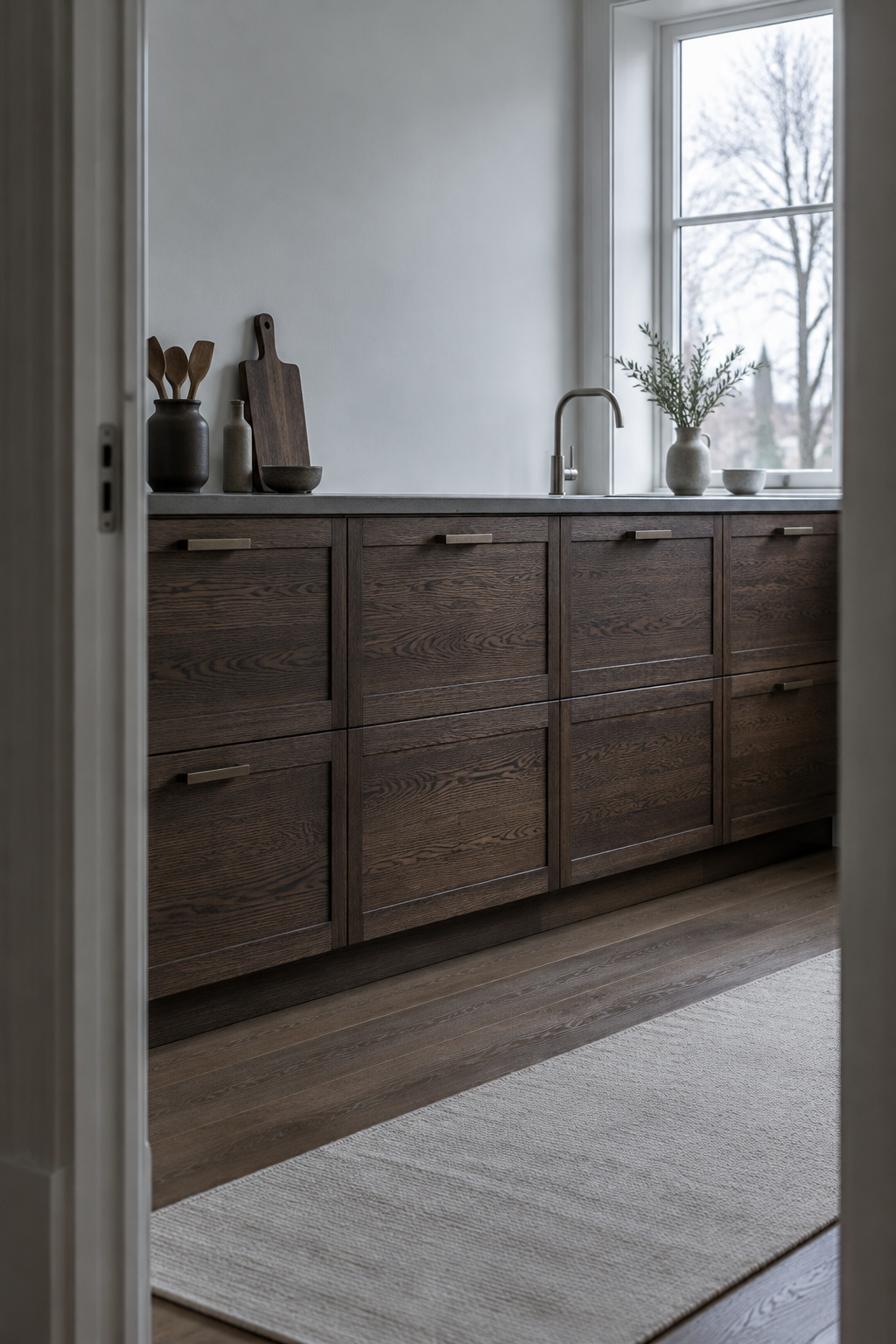
- Judge a full door in the kitchen’s own light, from the doorway. A dark finish can look almost black in a shaded corner and brown beside a window. Try it in February.
- Buy white oak, ash or walnut for dark. Test red oak in your exact stain.
- Want maple, birch or cherry dark? Pay for conditioner, dye-then-stain or a factory toner, and accept a lighter or flatter result.
- Test the whole finishing schedule on offcuts of the actual cabinet stock: same grit, same conditioner, same stain, same topcoat.
- Put the money into the species, not the stain.
The wall around the wood is its own decision, and a wall color that sits with dark wood is best chosen with a door sample in hand. Counters are decided separately again.
I choose wood the way a designer does, by how it looks and lives in a room for years. The chemistry of stains, conditioners and fuming belongs to finishers. Where my rules and your finisher’s samples disagree, believe the samples.
FAQ
What is the difference between espresso and walnut kitchen cabinets?
Walnut is a wood; espresso is a stain color. Espresso goes over maple, birch, oak or occasionally cherry, so it can sit on cheaper wood. On maple it gives a smooth, near-opaque dark brown, while on oak the grain cuts through. Walnut is rarely stained at all. Check the material column, since some “walnut” finishes are laminate.
How do you clean dark wood kitchen cabinets without dulling the finish?
Wipe with a soft, damp microfiber cloth along the grain and dry straight away with a second clean cloth. For grease, use four to five drops of mild dish soap in a gallon of water. Avoid ammonia, bleach, citrus cleaners, abrasive pads, melamine sponges, silicone polish and paste wax, which build up and cloud the finish.
Can you stain maple or birch cabinets dark without blotching?
Yes, with preparation. Flood on a wood conditioner, wait 20 minutes and wipe it off, or use a shellac seal-coat or gel stain. Each leaves a lighter color, and a second coat of stain deepens it. Dyeing first and staining after gives a deeper, more even dark. Birch can still look patchy, so judge a real door sample.