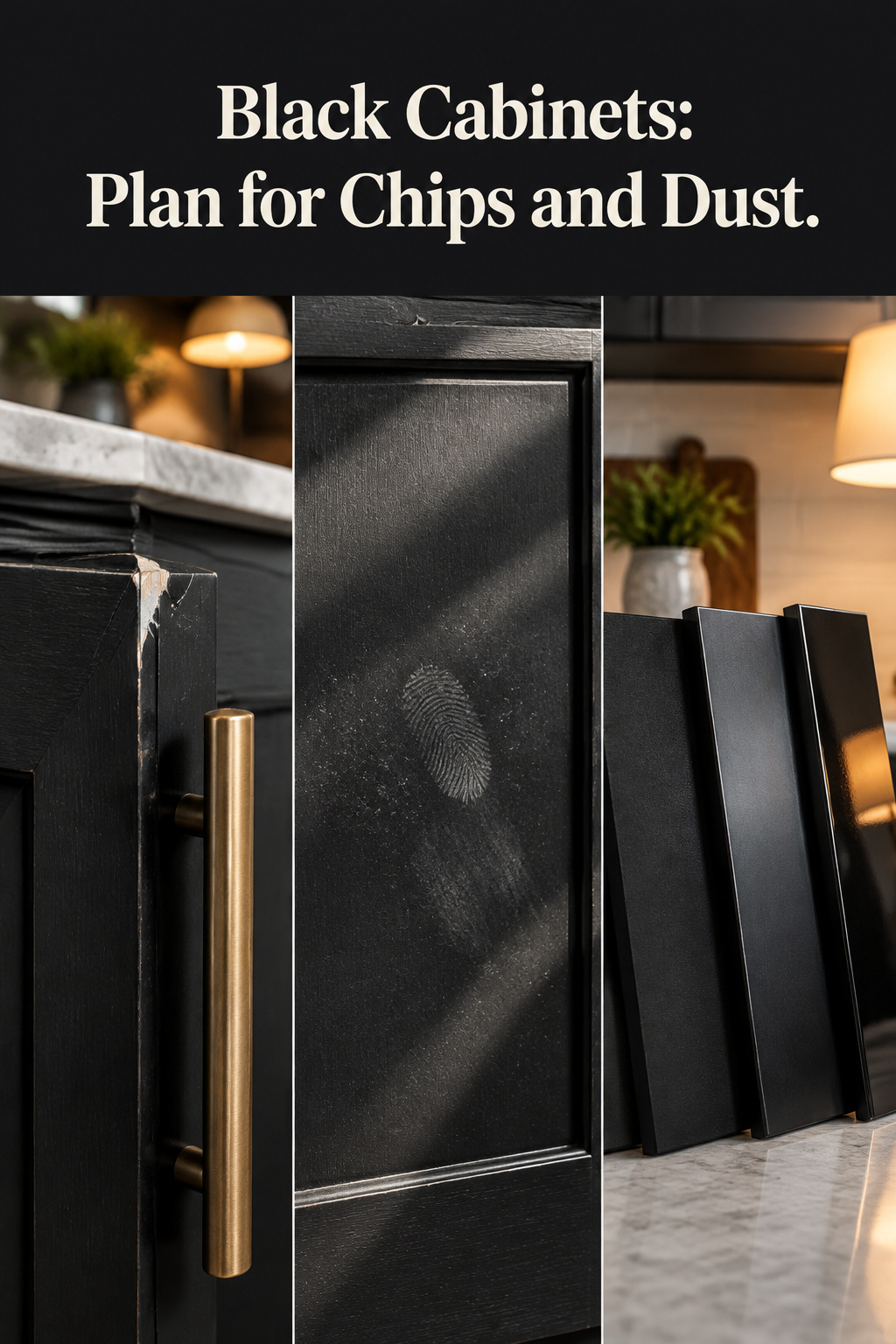
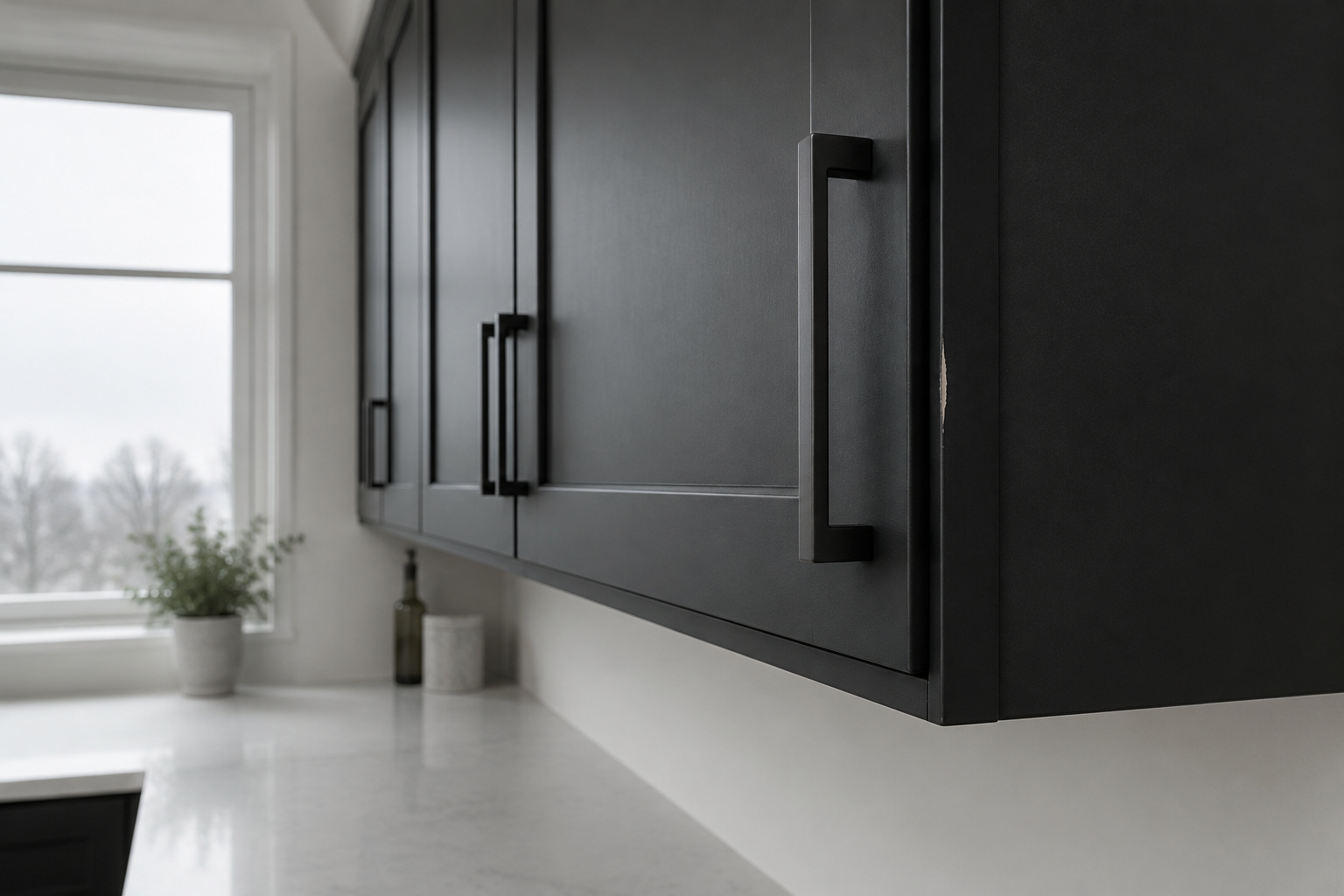

I hook a tape on the edge of a black cabinet door and run it toward the pull. The first chip is never far from the hardware. It sits where a hand, a pot or a dishwasher rack meets the edge every day. Black kitchen cabinets look perfect in a showroom because nobody has opened them yet.
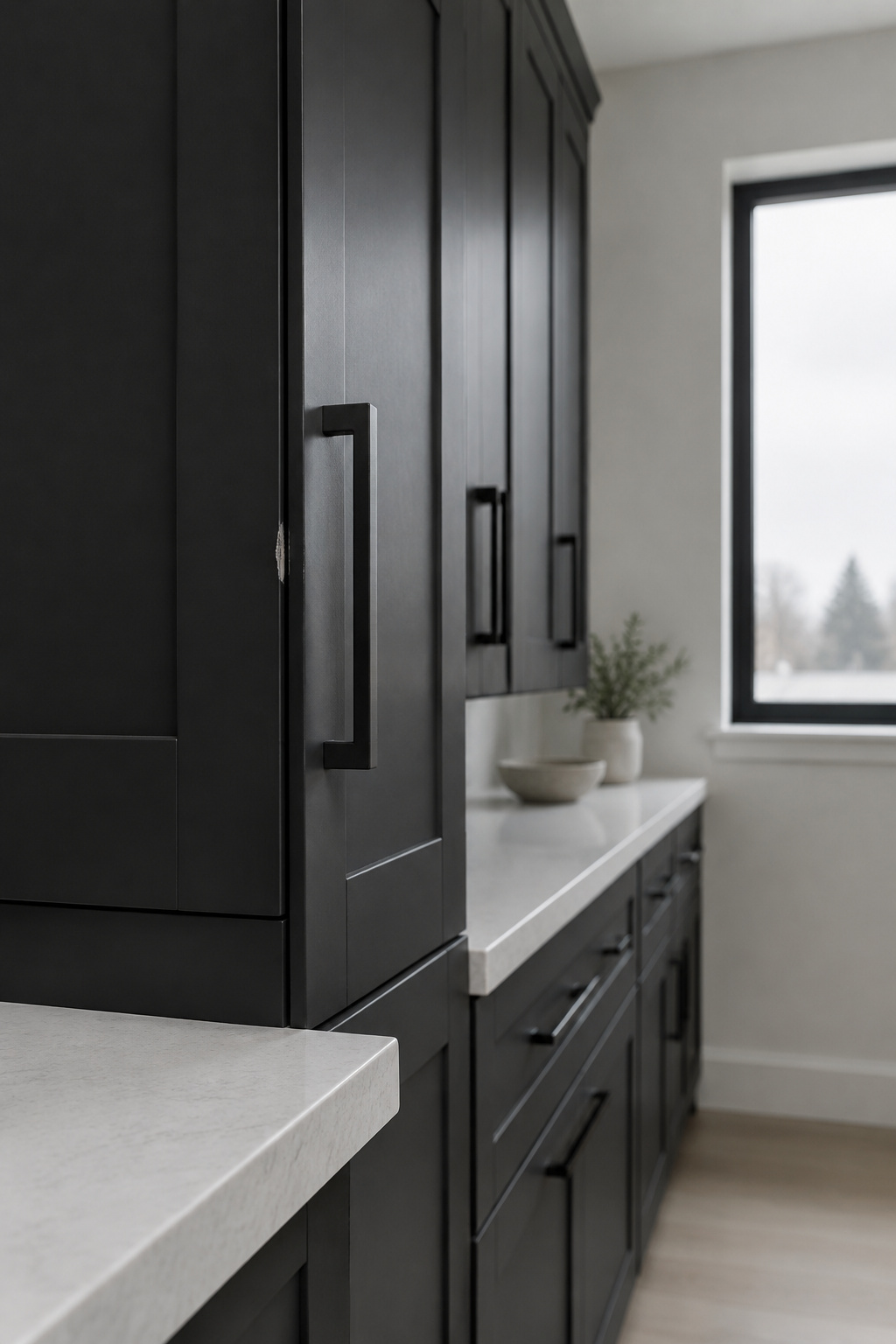
Live with them and two things happen. Edges chip, and the chip shows whatever sits under the black. Flat fronts collect dust, prints and cooking film. So choose a finish you can touch up and a door profile whose trade-off you can live with, and choose the black last.
TL;DR
- Black hides dents and scratches but shows dust, fingerprints and every chip, because a chip exposes the lighter primer, wood or MDF core underneath.
- Painted and factory-finished wood doors can be touched up with maker-matched paint, pens and fill sticks; laminate can’t be repaired, and thermofoil only takes a holding repair on small, stable chips.
- Slab doors wipe fastest but show prints most in black; Shaker, the door 58% of homeowners chose in Houzz’s study, breaks up prints but holds dust in the inside corner.
What black kitchen cabinets hide and what they show every day
Start with what black does well. Dark paint hides dents and scratches better than pale paint does. Furniture painters say pale colors show scuffs, while black shows more dust, dirt and fingerprints than any other color.
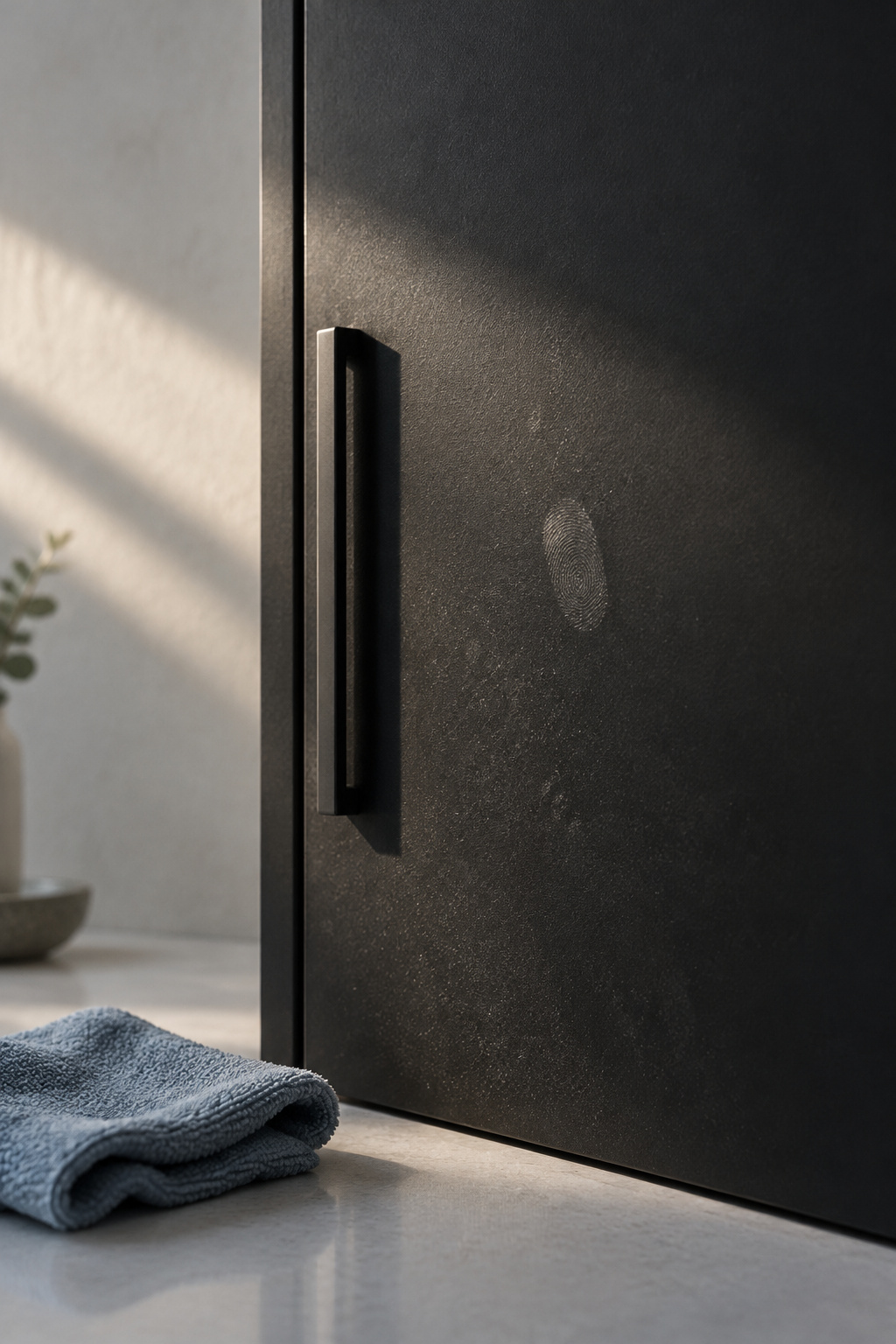
The dust half comes down to contrast and light. Pale dust and dried water spots stand out on a dark door. Skin oil shows when light skims across the surface, so strong spotlights, bright under-cabinet strips and low sun all make prints look worse. Near the range there’s a second version: cooking film dries a little glossier than a matte finish and shows as a faint shiny cloud when you look along the door.
The damage half has one exception, and it’s the one that matters. A chip is the only damage black shows more than white does, because it exposes a lighter layer.
That leaves two places to plan for: chipped edges, and dust and prints on flat fronts. I’d rather know where a finish fails before I pay for it than find out in year two. It’s the first practical decision in a dark moody kitchen.
Where black cabinets chip first, and what sits under the black
Walls lie. Doors don’t. In my experience the chips gather in the same few places: the edge beside the pull, the lower corners of base doors, and the stile next to the dishwasher, where the rack comes out swinging. Nobody has measured where cabinets chip first; that’s crew habit talking.
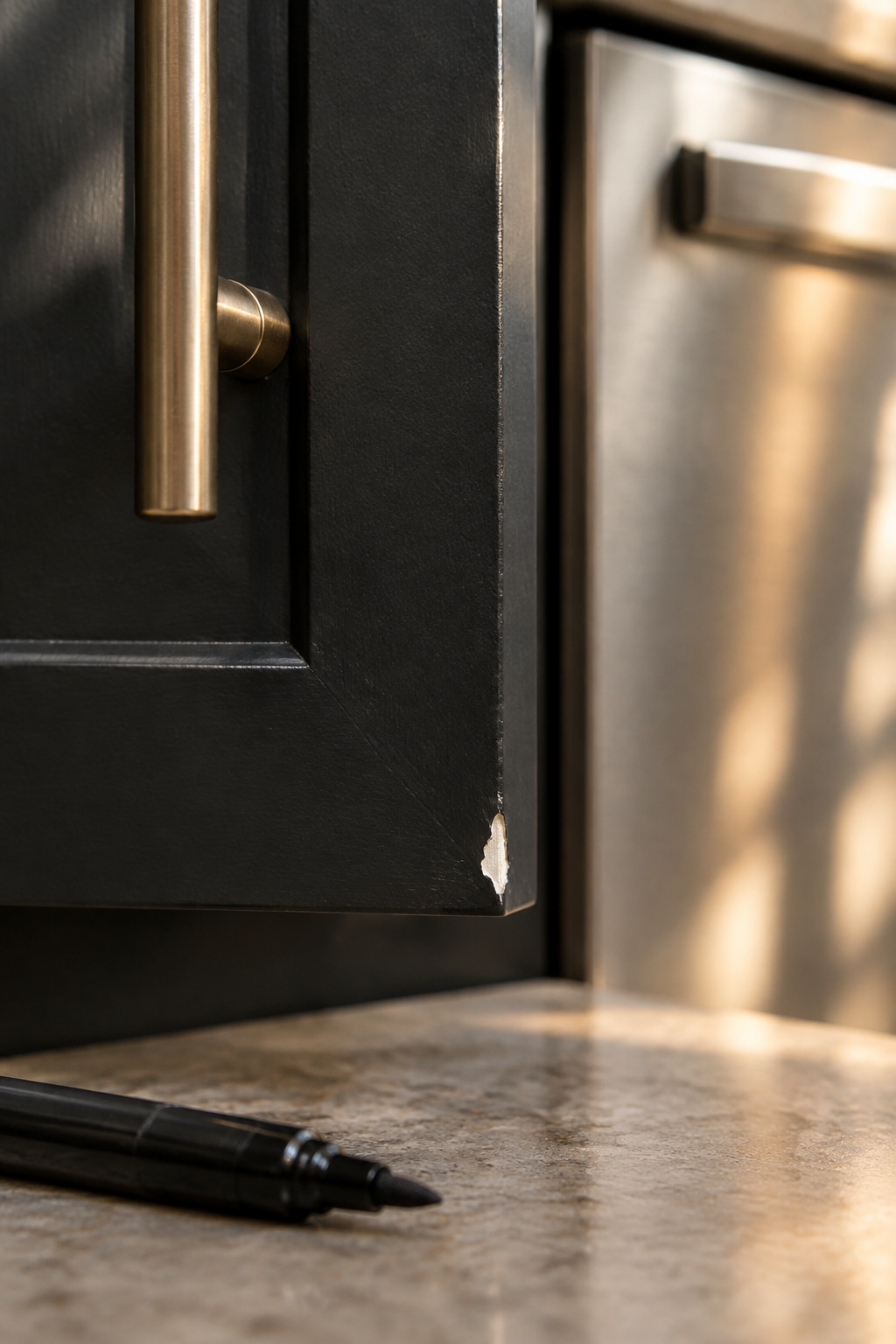
Construction agrees: on a slab door, the thin edge band chips first where hands grab.
What you see when it chips depends on what’s under the black. One UK door maker puts a white primer under the color coat on its painted MDF doors, so a knock leaves a white fleck. It warns the doors “can chip easily if knocked” and sends owners to a matching touch-up pen. Thermofoil and wrapped doors show the tan or gray MDF core. Site-painted wood shows primer or bare wood.
Two choices are mine to recommend. Set pulls so the hand lands on the hardware, not on the door edge. And if you’re torn about going all black, black lowers alone are a durability choice: base doors take the kicks and scuffs, and black hides scuffs.
If your black is going over oak, the grain and tannin come through in their own way, and the painting oak cabinets guide on the site covers grain fill and bleed-through properly.
Matte, satin or semi-gloss: choose the sheen you can touch up
Sherwin-Williams lists satin, semi-gloss, gloss and high gloss for cabinets, and other paint makers steer cabinets toward satin or semi-gloss too.
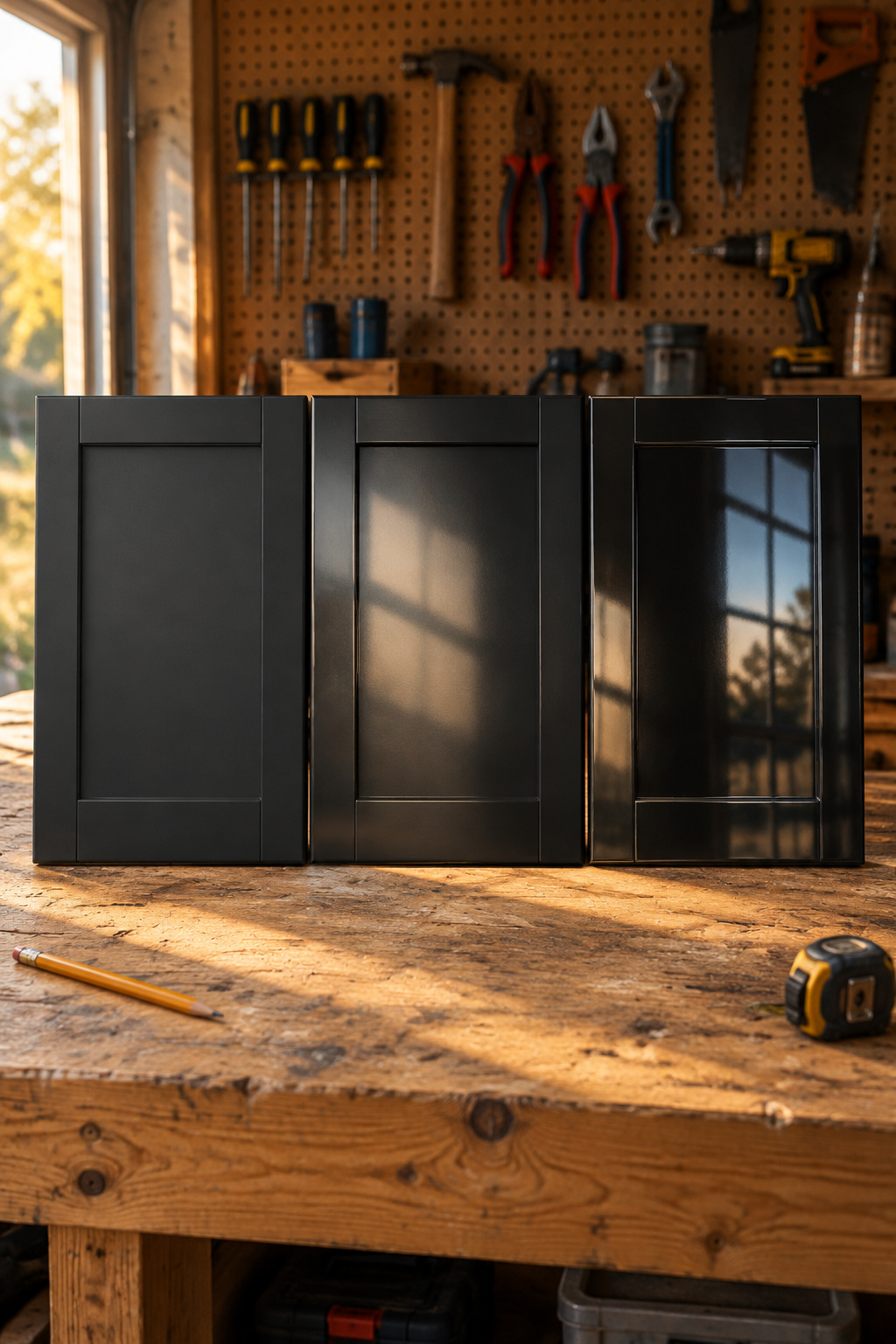
Matte has one known problem. It burnishes. Rub a low-sheen finish in the same spot often enough and it polishes to a shiny patch, worst on dark colors and worst at the edges and pull areas.
Touch-up is where the experts split. Cabinet refinishers say matte is the hardest sheen to spot-repair, because the dab dries at a different gloss and shows at an angle. Wall-paint makers say the opposite: flatter paint scatters light, so it touches up more easily, and a sheen makes a patch harder to hide. They’re answering slightly different questions, walls against cabinets, and neither side tested black cabinet doors. The point I plan around: the darker the color, the harder any touch-up is to hide, at every sheen.
For why a dab of black flashes on a painted wall, I’d point you to the black entryway ideas article. On cabinets the mismatch grows with age, because a painted door’s sheen drops with exposure to light, by as much as 20% according to one door maker.
Fresh paint also needs time before you wash it. Benjamin Moore’s data sheet for its satin enamel says washable after two weeks; its own how-to says wait at least 30 days. I go with the longer number, because nobody ever regretted waiting on paint.
- Satin for a busy household that wipes often.
- Matte only where you’ll wipe gently and weekly, never with a melamine sponge.
- Semi-gloss and higher wipe easiest but show every patch and print.
- Whatever the sheen, touch up in thin coats with the same kind of applicator as the original.
Painted, factory-finished, laminate or thermofoil: which black can be touched up
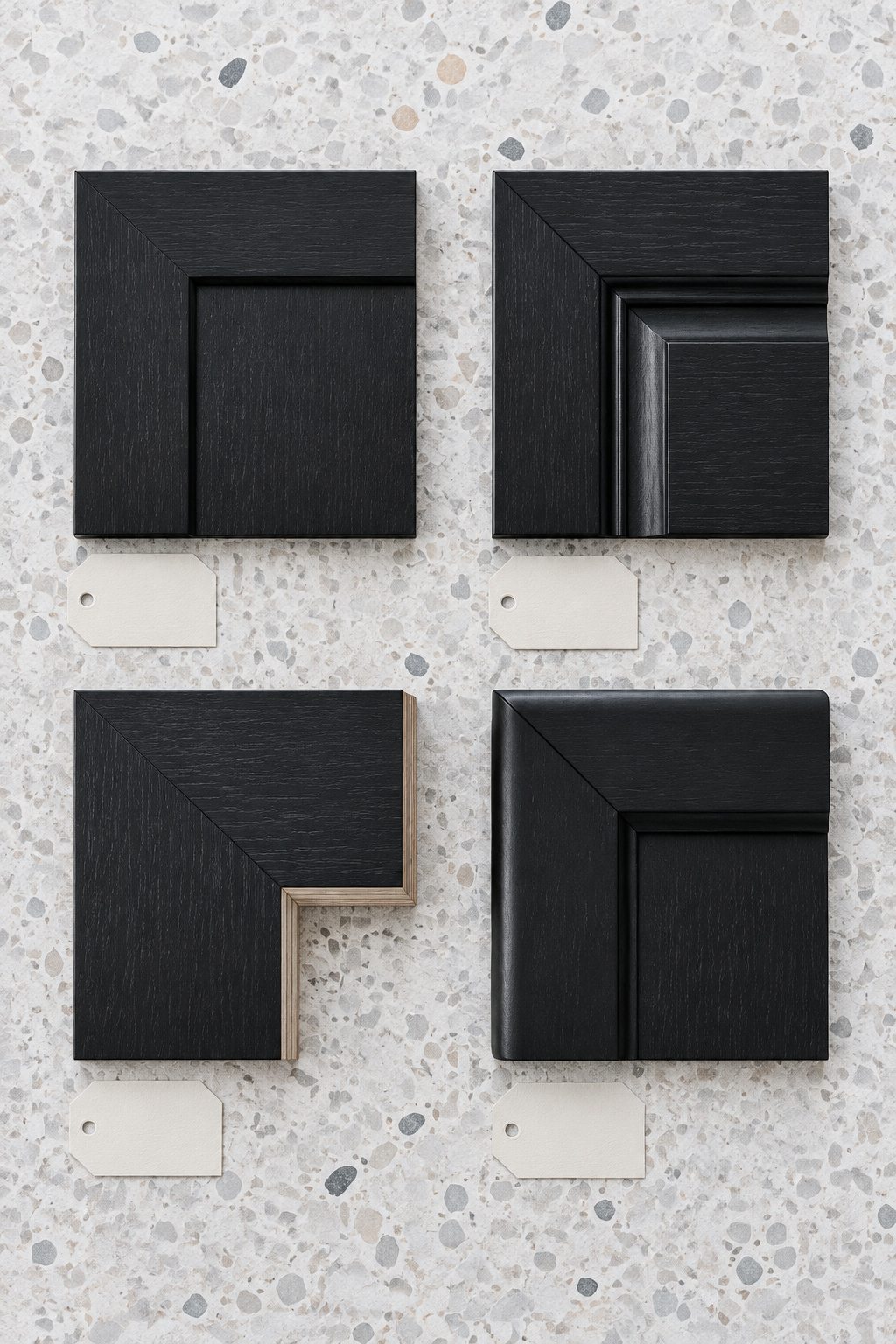
The construction decides whether a chip can be fixed at all. No maker rates touch-up on black specifically, so read each row as what that construction allows.
| Finish | What a chip shows | Can you touch it up? | What to do instead |
|---|---|---|---|
| Painted (site or shop) | White primer or bare wood | Yes, with maker-matched paint in thin layers | Keep the leftover paint, labelled |
| Factory-finished wood | The layer under the finish | Yes, for scratches, nicks and worn edges, with the maker’s pen and fill stick | Leave substantial repairs to a refinisher; no spray lacquer on nicks |
| Laminate | The darker substrate at the edge | No; a damaged laminate surface can’t be repaired | Filler kit for small chips, or a new door |
| Thermofoil | Tan or gray MDF | Only small, stable chips (a touch-up vendor says under about 1 cm), never invisibly | Replace or reface the door once the film lifts |
Painted and factory wood are the two blacks I’d buy. A pen-and-fill-stick touch-up is a first build. Anything bigger on a factory finish is a pro job.
Ask for the touch-up kit when you order. KraftMaid sends one with orders of 10 or more cabinets. Every screw I take out of a wall goes in a coffee can until the job is finished, and that kit deserves the same treatment: one known place, not the junk drawer. Keep the receipt in the truck’s sun visor, because something is always going back.
Black thermofoil beside a range or dishwasher has a second problem. Heat lifts the film, and that delamination often comes back after a repair.
If paint is the worry, dark wood cabinets instead of painted black get you to dark by a different route.
Door profiles that shed dust and profiles that keep it in the recess
Cabinet makers rank doors the same way for cleaning: slab, then Shaker, then raised panel. On black, that ranking cuts both ways.
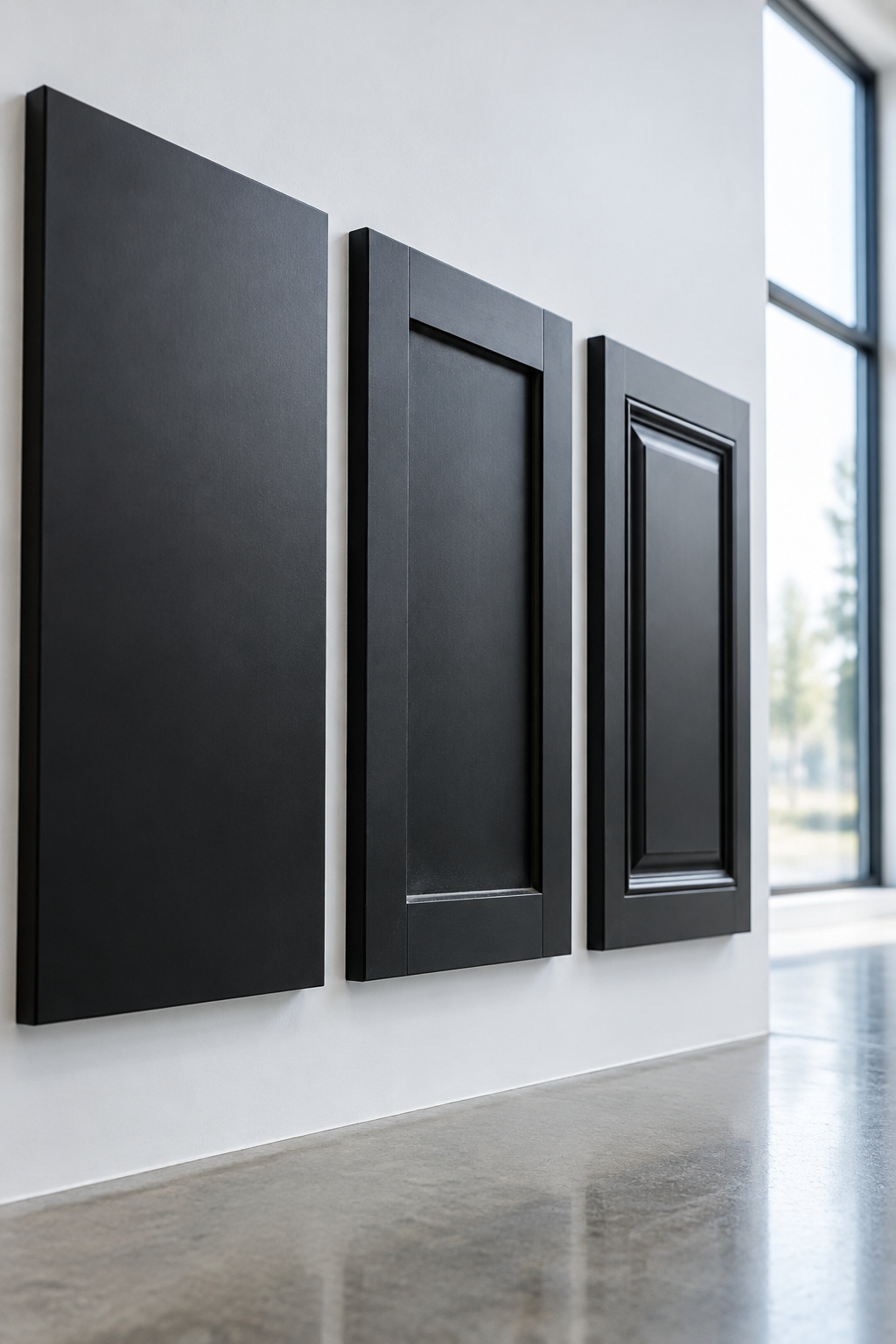
A slab has nowhere for grease or dust to hide, so a cloth does the whole door in one pass, but it shows every fingerprint, most of all in dark gloss.
Shaker’s frame breaks up prints, and its shadow lines hide small dings. The cost is the inside corner where frame meets panel. Grease settles there, dust lines the lower panel edge, and water spots sit on the bottom rail. Near the stove that means a regular wipe, not a disaster.
Raised panels and beaded inside edges add more grooves for grease and dust, especially beside the cooktop.
Shaker is what most people pick anyway: 58% of the 1,780 homeowners in Houzz’s 2026 study, against 22% for flat panel. For a household that won’t wipe weekly, my pick is Shaker in satin. The prints disappear into the frame, and the dust in the corner waits patiently for whenever you get to it. If you cook lightly and wipe often, a slab stays cleaner with less effort.
- Slab: fastest to wipe, shows prints most in black.
- Shaker: breaks up prints, holds dust and grease in the inside corner.
- Raised or beaded panels: the most grooves to clean, so keep them away from the cooktop.
Test two finishes on one door before you order the rest
I put every project together once with no glue and walk away for the length of a coffee. A test door is the same dry fit, stretched to a week.
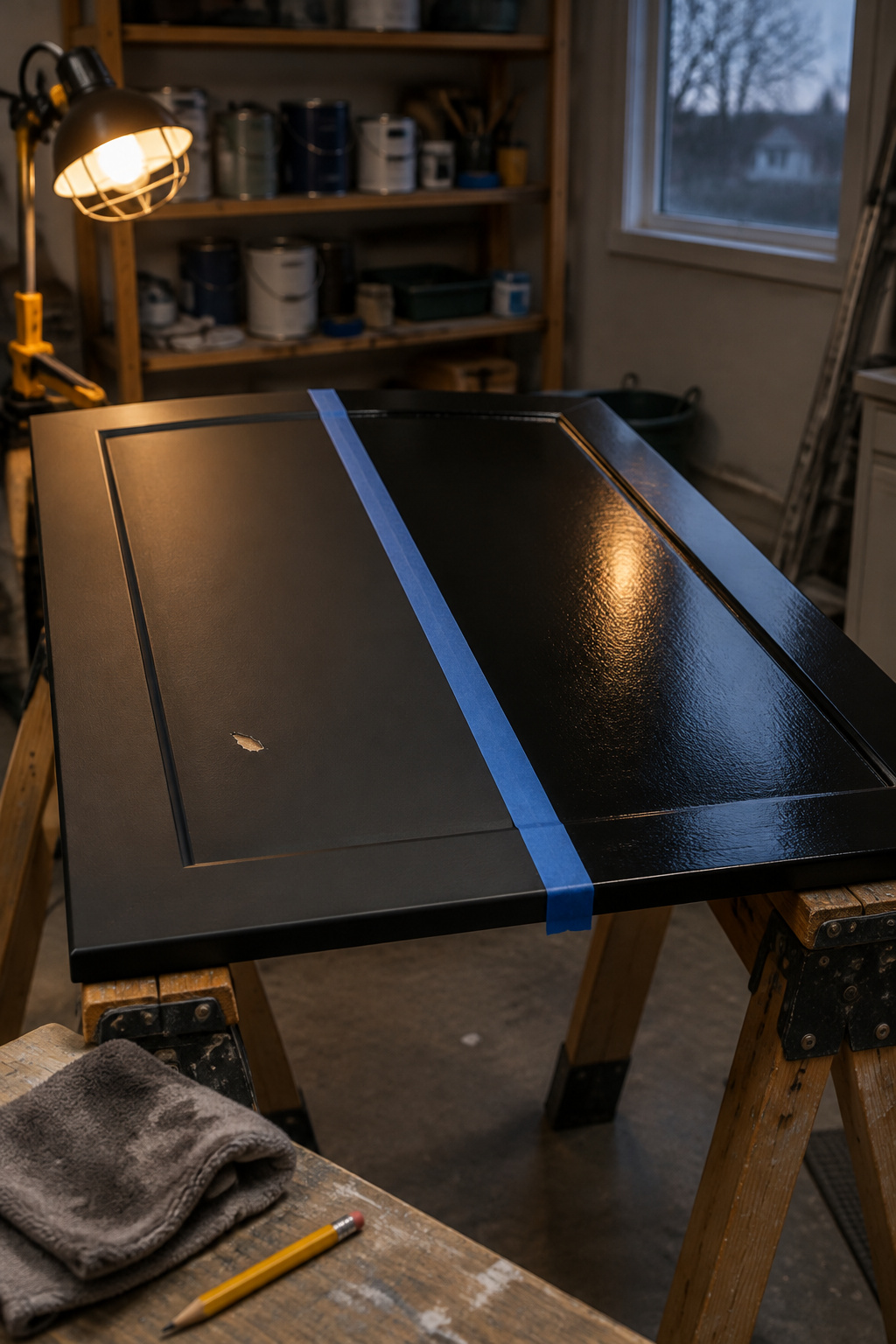
- Get one spare door from the maker and finish it in two sheens, split down the middle.
- Write which half is which, and the date, on the back, the way I write a cut list on a receipt and tape it to the first board.
- Let it cure for the full time the can or the maker gives you.
- Chip one edge on purpose and repair it with the maker’s pen or matched paint.
- Press a greasy thumb on each half and wipe it the way you really will.
- Stand it near the range for a week and look along it in your evening light.
- Choose the half you’d rather live with.
The mistake here is impatience. Wipe a test door before the paint has cured and you’re testing soft paint, not the sheen. If you’ve done it, let the door cure and test again on a fresh strip before you decide anything.
A sample door costs time before money: a cure, a week of looking, and one more weekend than you planned. When you do order, buy 10% more than the plan says, and add a spare door if the maker sells one.
Once a door has passed, look down. Black cabinets put the counter question next, and a dark countertop under black cabinets shows its own marks, so choose that surface the same way.
FAQ
Are black kitchen cabinets going out of style?
Opinions split. Janiece Lonvelin of Velene Design House expects all-black cabinets to start declining in 2026; solid black can read stark. A cabinet company argues black is a neutral and that what has faded is wall-to-wall flat black, while black on an island or the lowers stays current.
How do you clean black kitchen cabinets without leaving streaks?
Use a soft microfiber cloth, warm water and a drop of mild dish soap, rinse with a clean damp cloth, and dry the door straight away; drying is what stops streaks. Use cloth rather than paper towels. Skip melamine sponges, scouring pads and strong citrus or solvent degreasers, and never put polish, wax or oil on matte.
Do black kitchen cabinets show dust and fingerprints?
Yes, more than mid-tone colors, and most of all in gloss. Skin oil is a thin film that interrupts a glossy reflection, and pale dust and water spots stand out against black. Matte isn’t immune: near the range, grease can show as a shiny cloud, and hard rubbing burnishes shiny patches into the finish.