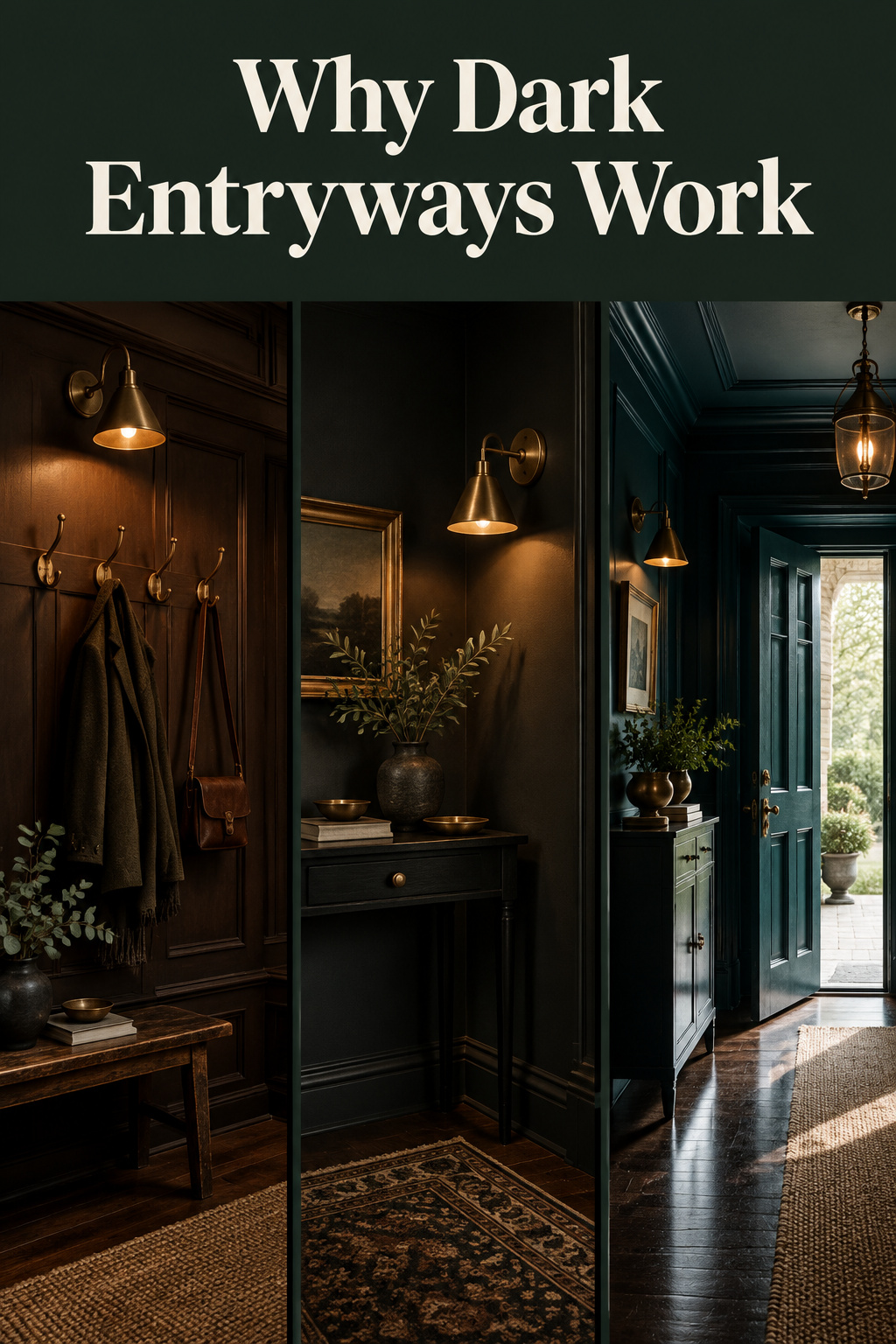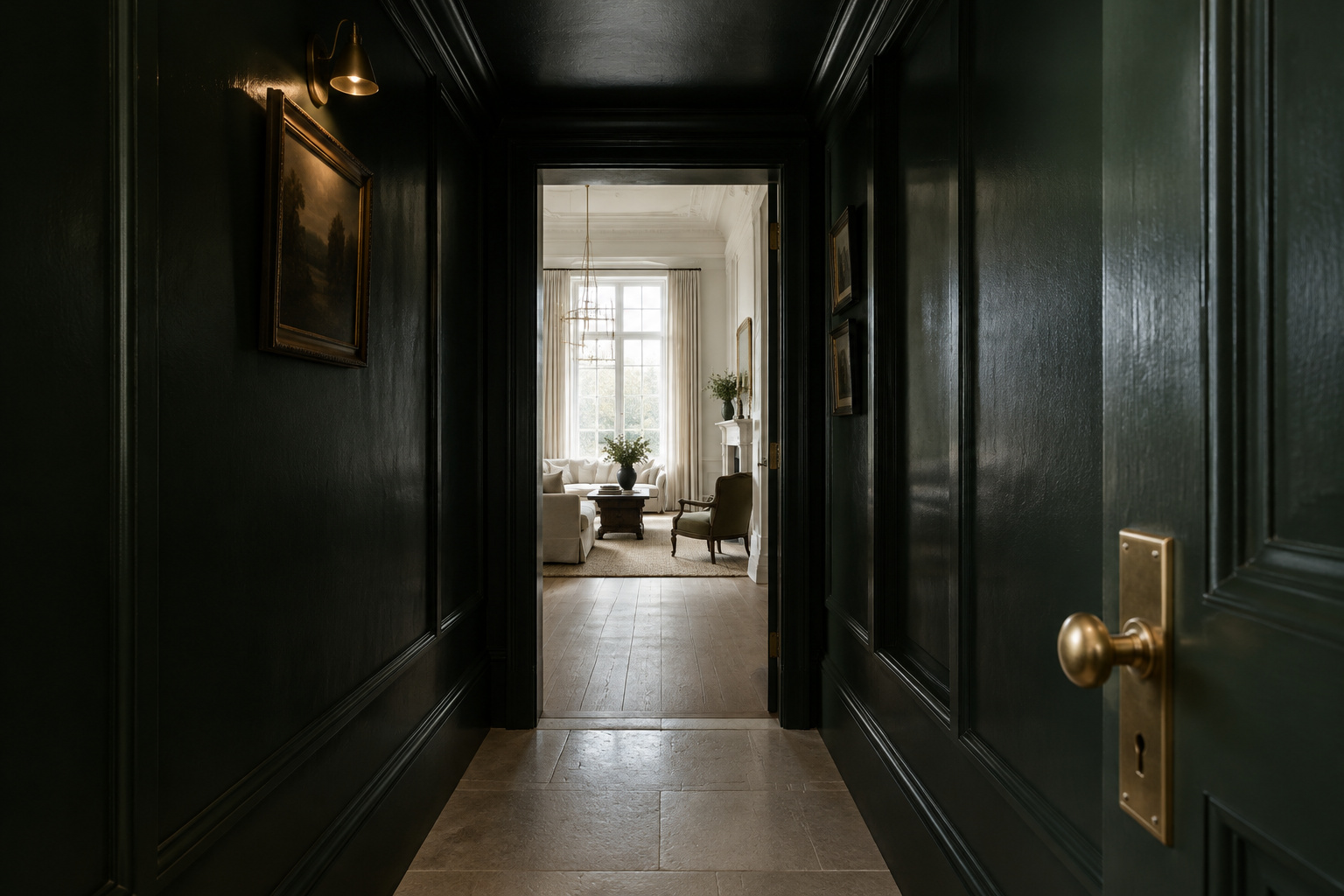

The brass latch is cold under your thumb, and it gives with the small, worn click of a door opened ten thousand times. You step in out of a bright afternoon and the door swings to behind you. The street goes quiet. For a breath the hall closes around you, with deep green walls, one low lamp and the smell of wool coats on their hooks. Then you look ahead, where a doorway stands open onto the front room. The room is full of light, brighter than it looked from the sidewalk and larger than you remembered.
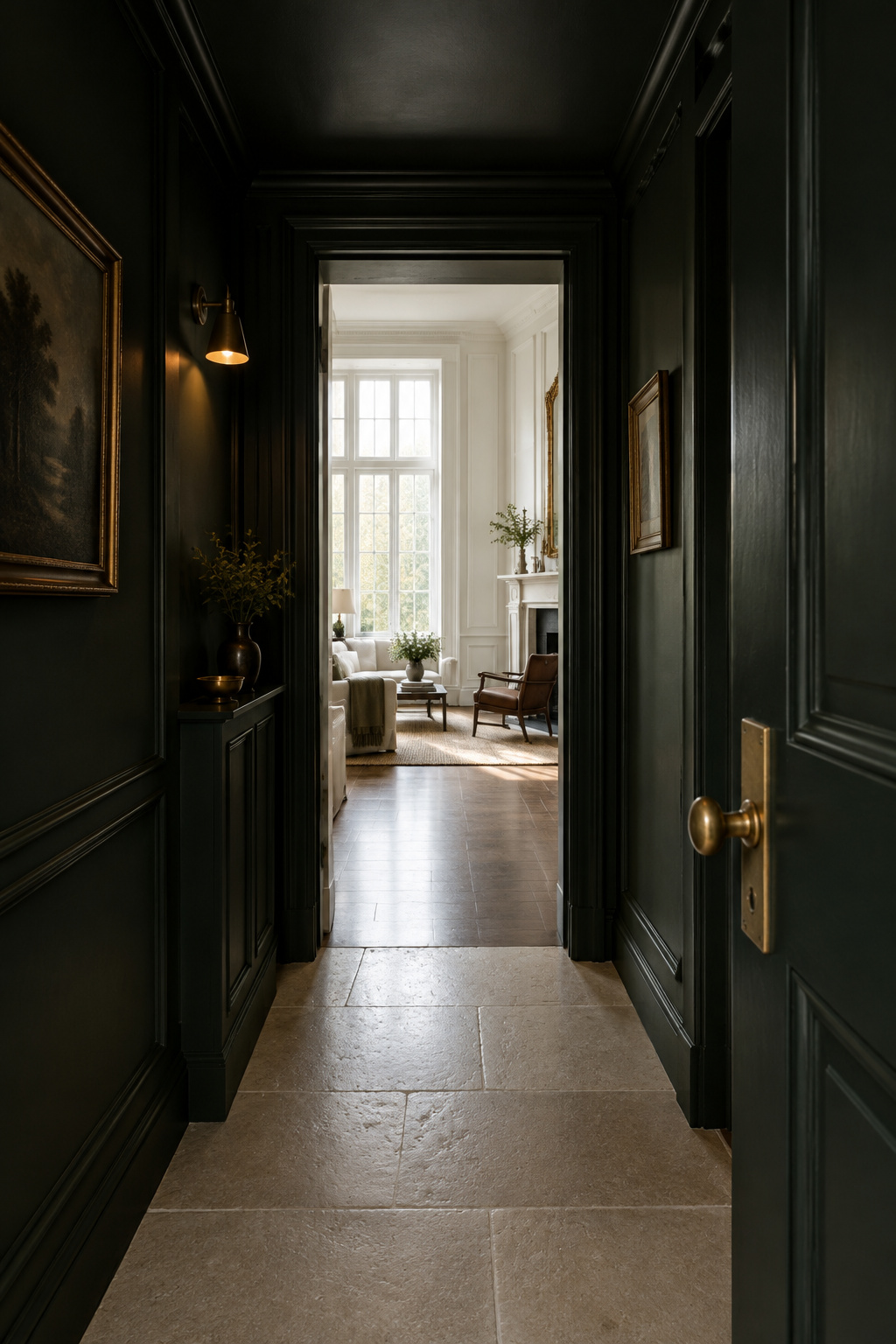
That second, the squeeze and then the opening, is what a dark moody entryway is for. Most people who hesitate over one fear the opposite, that a dark hall will make the whole house feel darker. It doesn’t, and houses built long before anyone attached the word “moody” to paint knew it.
Crossing the Threshold Into a Dark Moody Entryway
Think about how often you cross your own entry. Every visitor and every resident passes through the same fixed point, on the daily rhythm of leaving and coming home, and no other room is walked through by everyone every day. Older houses treated the hall as a threshold to be designed, not a corridor left over once the good rooms were placed.
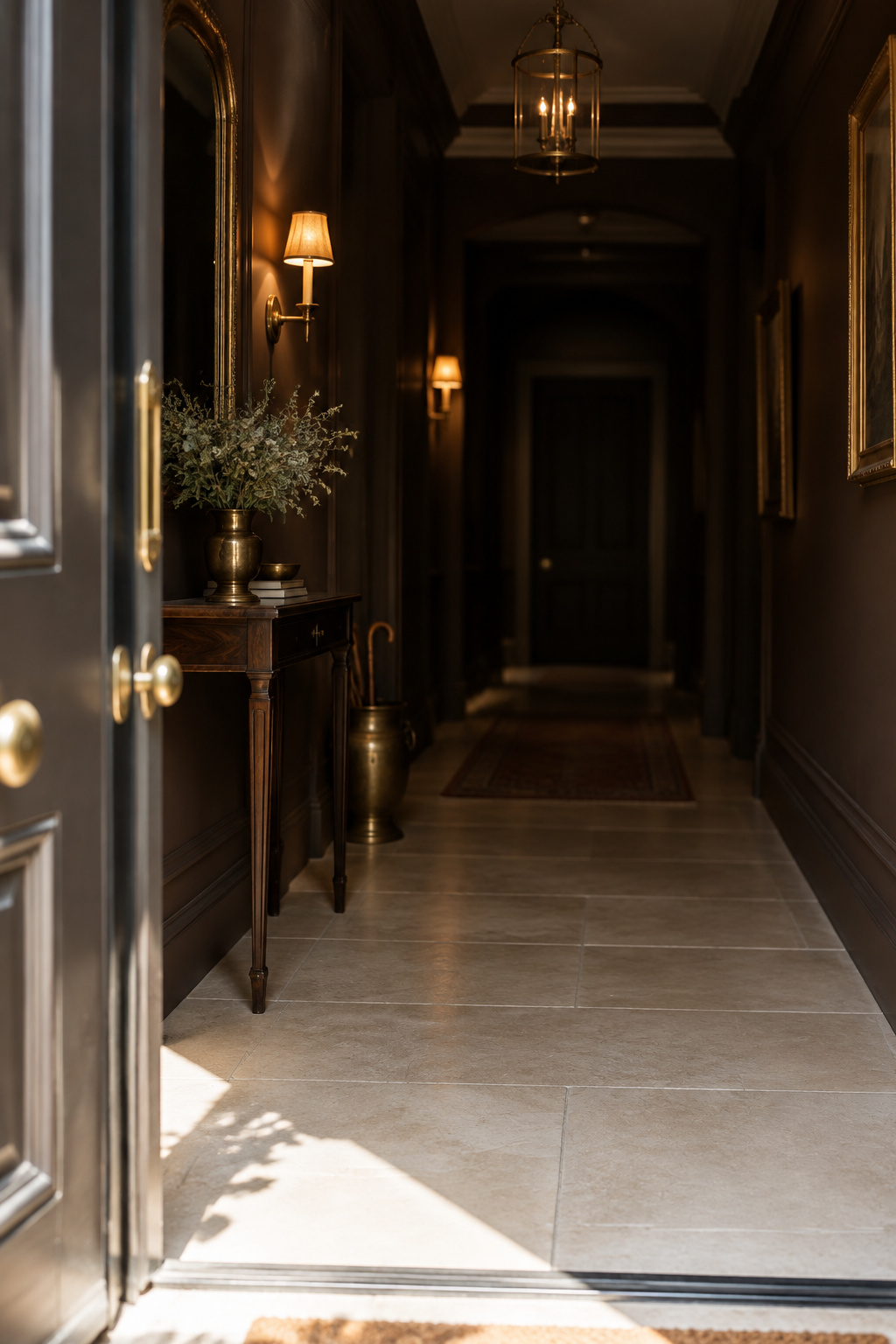
What you felt in that opening scene has a name: compression and release, as architects call it. The close, dim, contained space comes first, the larger, brighter room second, and the first changes how you read the second. Your eyes need a moment in the hall, and by the time they have it you are already stepping into the light.
The obstacle here is a reflex, the sense that “dark” in the first, smallest room a guest sees must be a mistake. This guide takes that reflex apart in two ways: the evidence for why a dark hall works, and the period hall that did it before anyone called it a trend. Then it walks through the decisions that build one.
Seven decisions build one, and each has a full article of its own on this site. Here is the map.
| Decision | The question it answers |
|---|---|
| The wall color | Does it hold its depth with the front door open? |
| Black | Is black a separate commitment, and can you live with how it wears? |
| The drench | Which surfaces take the color, and which are deliberately left out? |
| Paneling below a rail | Should the lower wall carry the dark and the wear? |
| The door’s inside face | Does the door match the walls or stand apart from them? |
| The hallway | How far does the dark carry past the entry? |
| The objects | What still reads when there is little light to read by? |
I make firm calls on two of them, because they decide the rest: how dark, and how far the dark reaches across the room.
Compression and Release: Why a Dark Hall Makes the Rest of the House Feel Bigger
Compression and expansion, often called compression and release, is the recognized architectural term for leading people through a small, narrow, often dark space into a larger, brighter one. The contrast does the work: the second room feels bigger than it measures because of what you walked through to reach it.
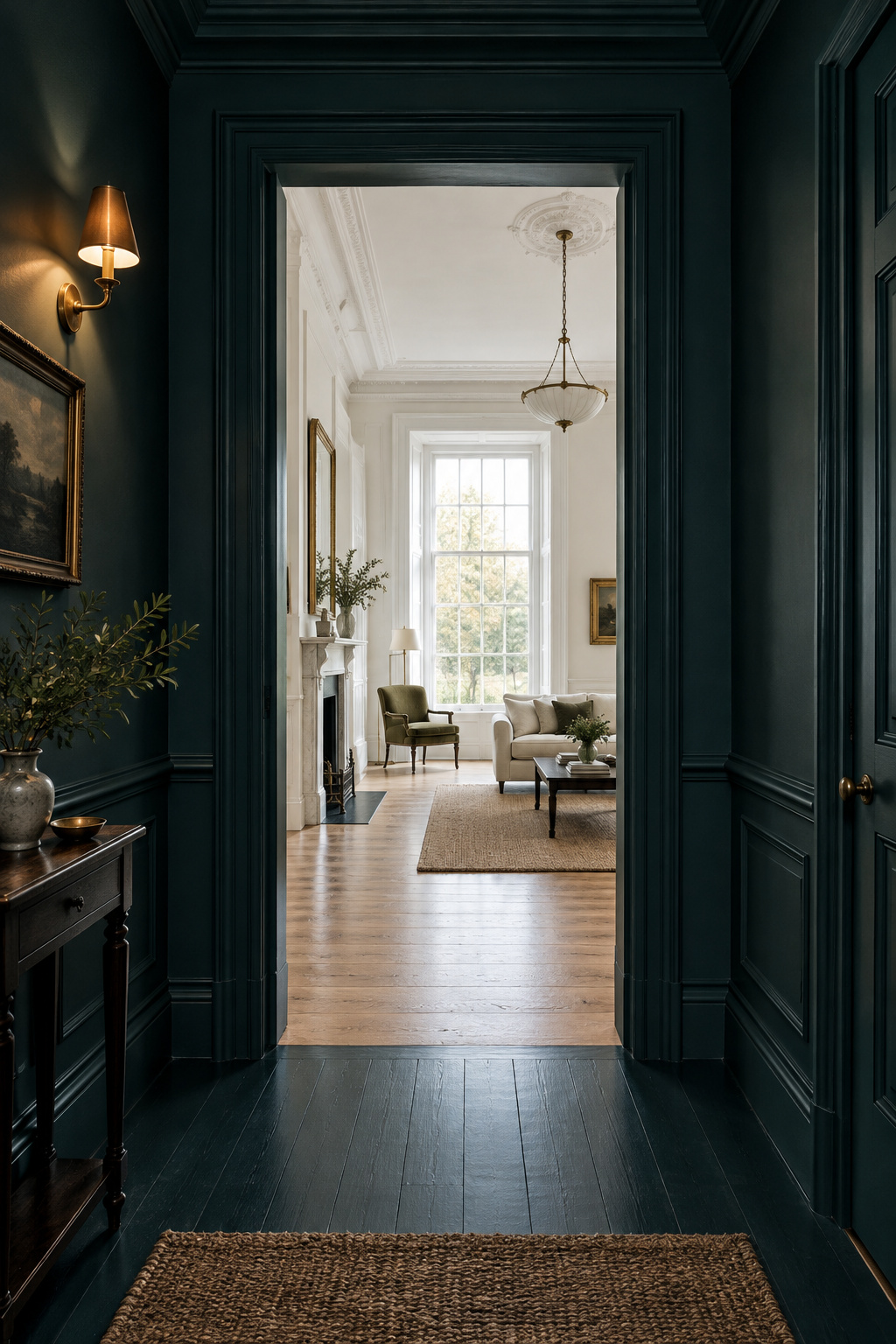
Frank Lloyd Wright is the name usually attached to it, and he did more than anyone to make it famous, most visibly at Fallingwater, where a low, compressed entry sequence gives way to taller, more open living spaces. He named and popularized an idea that predates him, though. The technique is older than the man who branded it, and the Victorian hall belongs to that older history.
For a long time the evidence was the testimony of architects and the experience of visitors. That changed this year. A 2026 study from Aalborg University, by Hussein, Djebbara and colleagues, put freely moving participants through transitions in immersive virtual reality and measured how they judged the change. It is a preprint posted on PsyArXiv, so treat it as strong new work rather than settled textbook fact.
What it found is the most useful thing I know about this subject. People’s judgments did not scale with the geometry. At the tested ratios, going from a higher ceiling to a lower one, they undershot the decrease by 33.45%. Going from a lower ceiling to a higher one, they overshot the increase by 12.11%. The response was nonlinear, not a simple scaling of what was built.
Read those two numbers together and the logic of the hall falls into place: the squeeze registers as less than it is, and the release as more than it is. You barely notice going in; you notice coming out.
Now the limit. The Aalborg team measured ceiling height, and nobody in that study walked from a dark wall into a pale one. Carrying the result across to a dark-to-light transition is an analogy. I make it because the architectural principle treats darkness and low ceilings as the same kind of compression, not because the study tested color. Take it as a strong hint about how we read thresholds, not as proof about your paint.
The old worry gets one clause here: whether dark paint shrinks a small room is a separate question, settled elsewhere on this site, and this guide doesn’t turn on it. A dark entry doesn’t work by fooling you about its own size. It works on the room after it.
The Period Hall That Did This First
The house that turned my history degree into a trade was a Victorian row house my father and I spent two years restoring. Its hall ran dark below the rail and pale above it, and what I remember is less the paint than what the hall did to the front room. Coming in off the street, past that dark lower wall, you found the room at the end lighter than it had any right to look. I had no name for it then.
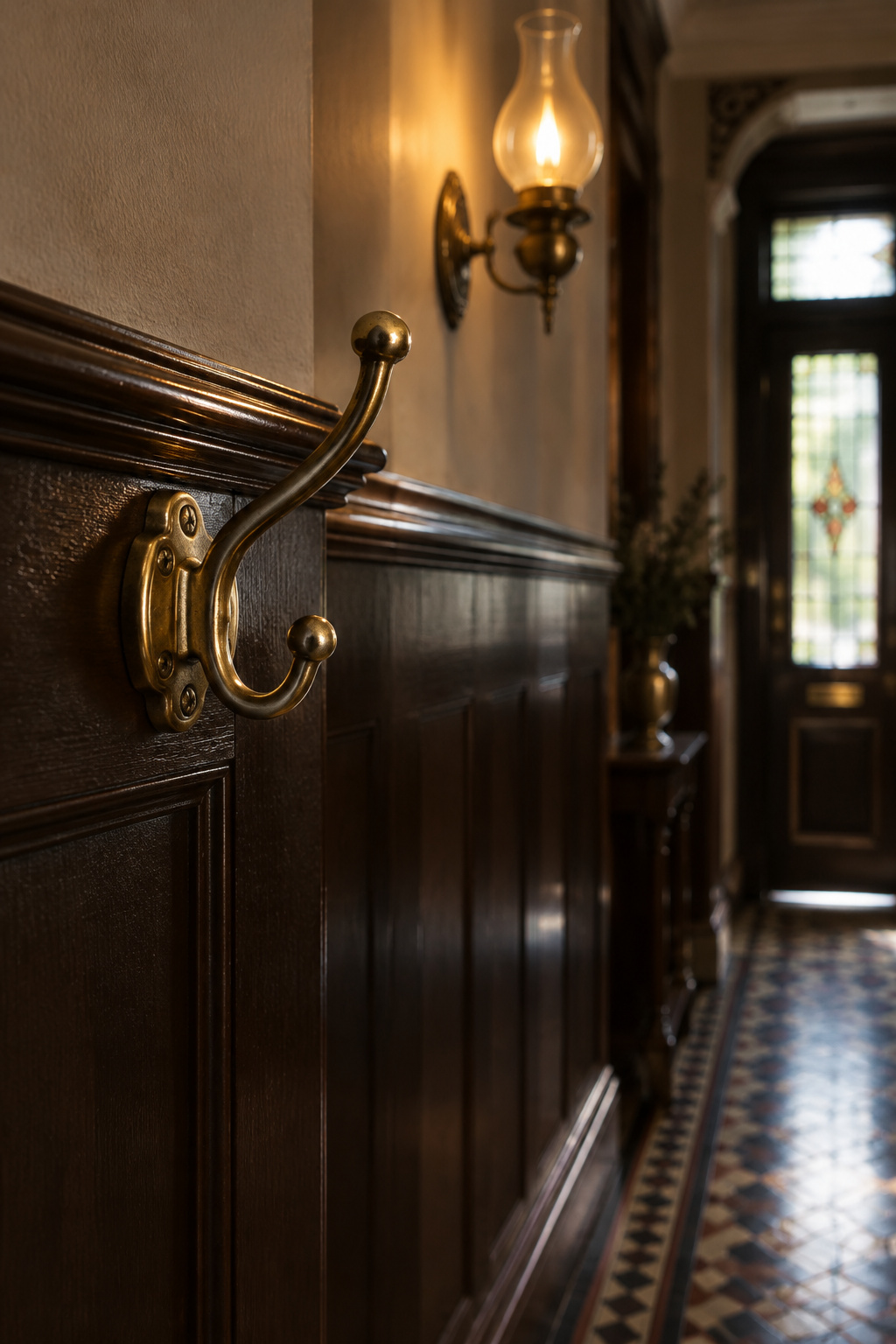
The Victorians didn’t paint halls dark for effect alone. A hall was a working room, and the practical reasons and the atmospheric ones turned out to be the same decision.
The first reason is wear. The dado rail is usually explained as a wear boundary, set where chair backs and passing traffic struck the wall, though its origin is argued over and the lower-wall article sets out both sides. The picture rail above it had a plainer job, letting a household hang pictures without driving nails into the plaster. Both rails are working joinery before they are decoration. A hall that took the coats, the mud and the daily comings and goings needed a lower wall finished to take that traffic.
The second reason is light. For most of the Victorian period an ordinary house was lit by candles, tallow and spermaceti and later paraffin wax, and only toward the end of the period by gas. Electric light became common later still. A hall lit that way had very little artificial light to lose to a dark wall, so deep color cost a period household almost nothing it had. That is part of why their halls could go dark without feeling like a sacrifice.
Together they make the period hall: dark where the wear was, dim because light was scarce anyway, and, as a happy consequence, a compression before the brighter rooms beyond.
That logic still holds in a house with electric light in every room, and in some ways it holds better, because now you choose the darkness instead of inheriting it. Paint is also the most reversible thing you can do to an old hall: whoever lives there after you can paint it pale again in a weekend, but they cannot put back a stripped rail or a plastered-over panel.
Choosing a Dark Color That Survives the Open Door
Here is the first committed call. Choose the dark that still looks right with the front door wide open on a bright day. If it holds its depth there, it will hold everywhere else in the house. The reverse doesn’t follow.
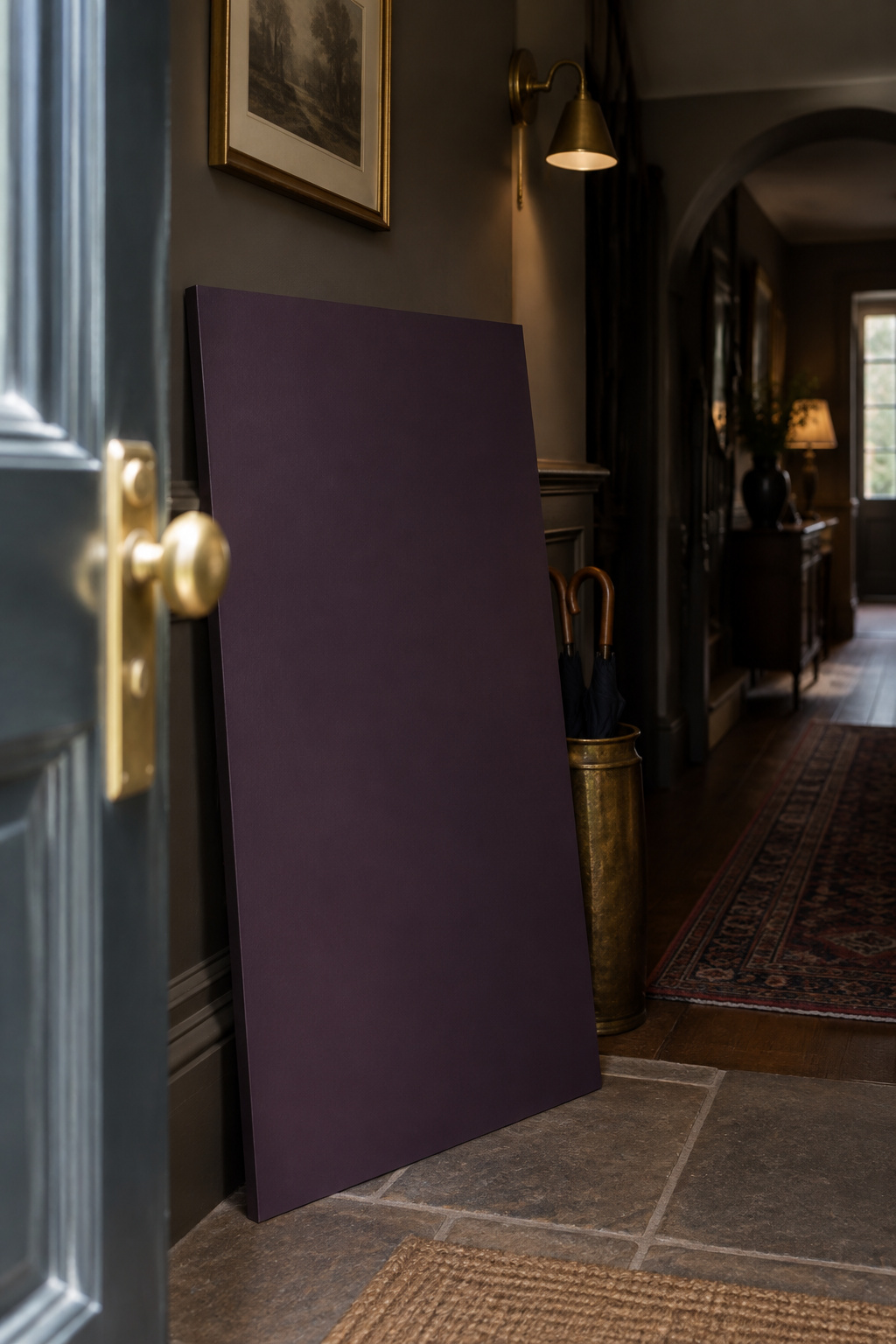
An entry is the hardest place in a house to judge a dark color, because you see it at two extremes. In the first, the door opens and a full slab of daylight falls straight across the wall. A color that looks rich and velvety in a closed, lamp-lit hall can go flat or muddy the instant that light lands on it, and that is the version your guests meet first. The second moment is quieter: you stand in the brighter room beyond, looking back, and the entry is a dark rectangle framed by the room you are in. The color has to belong to both views.
A paint chip under store lighting tells you about neither, so the test has to happen in the entry itself, on a proper sample, with the door standing open. The full method, and the families of green, navy, aubergine and brown that hold up at a threshold, belong to choosing and testing a dark wall color, where the numbers live.
I’d add only a restorer’s instinct. The period hall was finished for the heaviest traffic in the house, not the kindest conditions, so choose its color for the worst light it will face, not the best.
Black Is Its Own Decision
Is black simply the darkest point on the same scale? No, and treating it as one is how people end up disappointed with it.
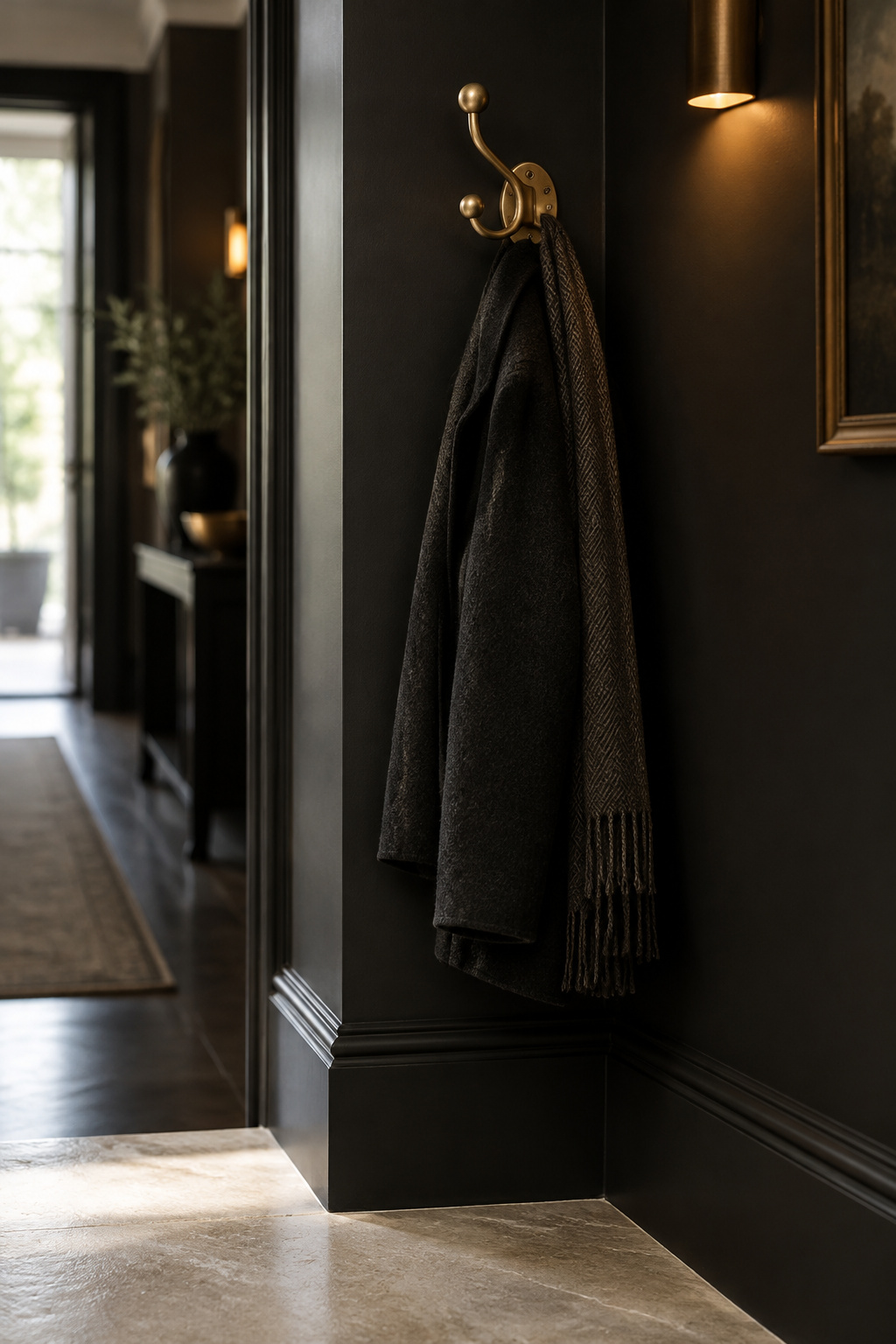
Every other dark on the chart has an undertone to fall back on, the green in a deep green or the red in a brown. That undertone softens scuffs, the shift between daylight and lamplight, and the look of a touched-up patch. Black has much less of that cushion. Even the near-blacks behave oddly: a deep green-black looks black for most of the day and shows its green only when strong light finds it, so “black” in an entry is rarely as flat and simple as it looks at the door.
Black also wears in ways people don’t expect. It forgives some kinds of mark and advertises others, and which is which surprises most people who live with it. Sheen changes the answer as much as color does.
So decide on black as its own commitment, after the color decision above and not as a step further along it. If you’re drawn to it, read black walls and how they wear before you buy the gallon. That article argues the case for black honestly, including the part the photographs leave out.
How Much of the Entry to Drench
Color drenching means painting walls, ceiling, trim and doors in one hue, so no contrast lines tell your eye where one surface stops and the next begins. The room reads as one continuous volume. Here is the part that decides the whole question: leave one surface out and the drench works in reverse, because the one untouched boundary becomes more visible than it would have been if you had never drenched at all.
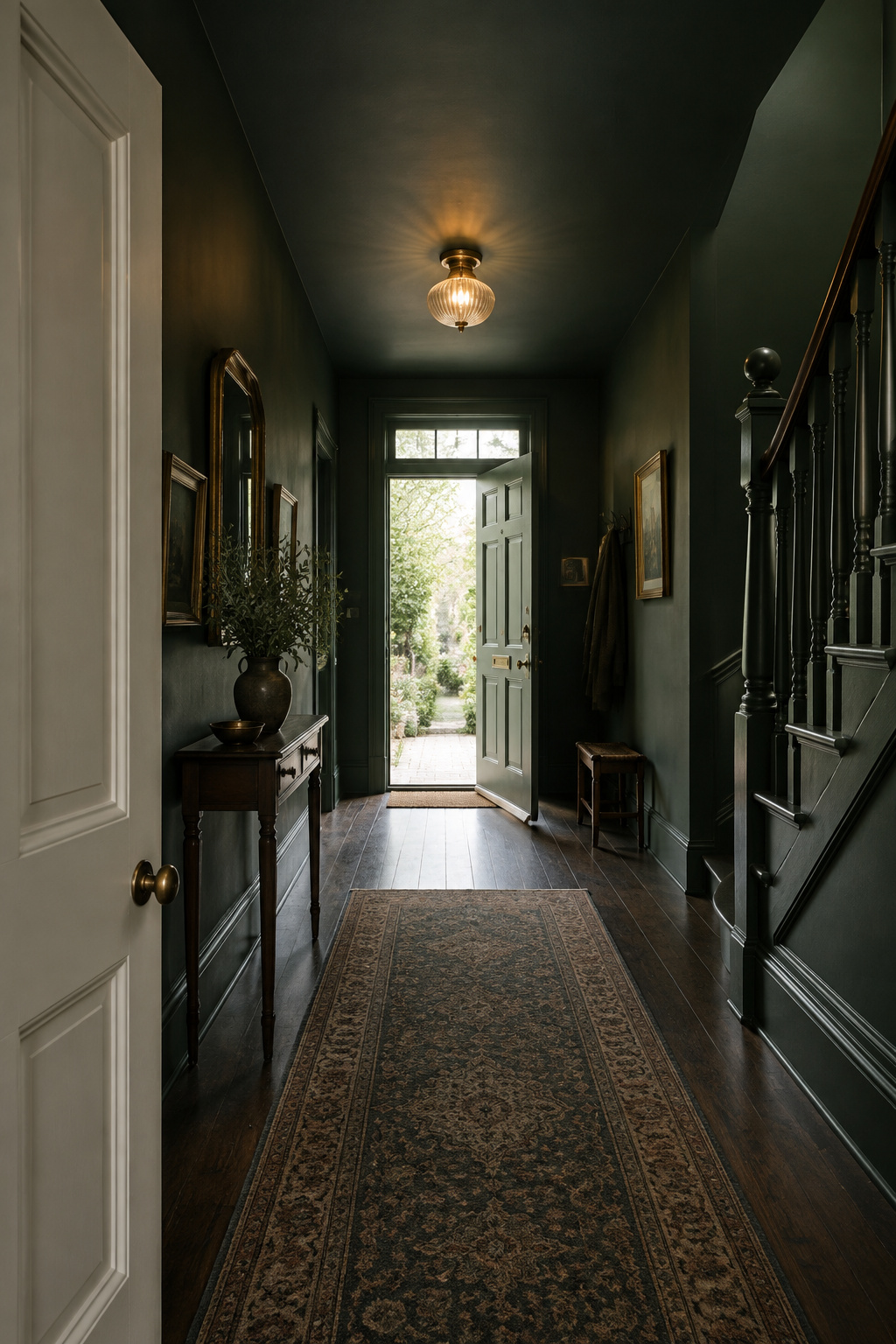
That makes this my second committed call. Drench all of it or none of it. That means walls, ceiling, every run of trim, every door and its casing, and the radiator if there is one. Leave out, on purpose, only what was never a surface to begin with: the door glass, which is where your daylight comes from; the hardware, which should stay metal; and the stair treads and the floor, which have their own finishes.
An entry makes this harder than any other room, because it has the most doors per square foot in the house: a front door, a closet door, one or two interior doors, perhaps the foot of a stair. The drench in an entry is mostly woodwork, and the doors, not the walls, set how long the job takes.
The inclusions, the exclusions, the sheen per surface and the real paint quantities are worked out in drenching the whole entry in one color, with the working shown. Read it before you promise yourself a weekend.
Below the Rail: Paneling, and the Front Door’s Inside Face
Two surfaces sit close to hand in any entry, and each deserves its own decision rather than a default: the lower wall and the inside of the front door.
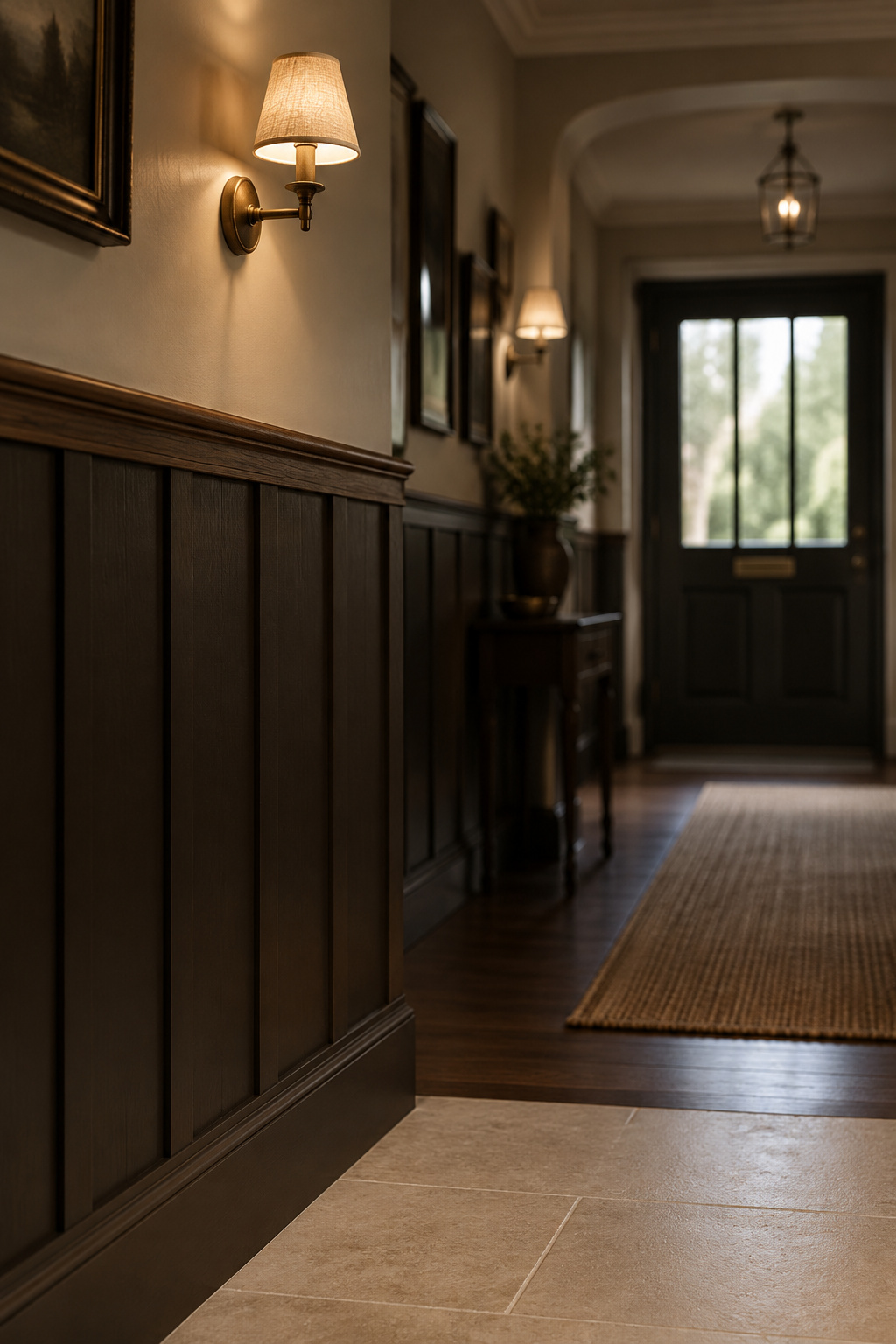
Dark paneling below a dado or chair rail
A dado, cottage beadboard and tall Victorian-style paneling under a plate rail are three different pieces of joinery, with different origins and proportions. People commonly lump them into one sliding height range, which is where most lower-wall projects go wrong. Which one belongs in your entry depends on your ceiling and on what the house already is.
What they share is the period logic from the section above. A dark lower wall still does the job the Victorian dado did, taking scuffs and traffic marks at exactly the height they happen while the paler wall above stays easier to keep fresh. It is the one place in a dark entry where the darkness is practical before it is atmospheric. The heights, the finishes and how to read original paneling before you cover it are set out in dark paneling below a rail. If your hall still has its original boards under later paint, read that first, because old paneling tells you its age through its joints and its nails.
The inside of the front door as its own surface
The door is the largest single surface in the entry, and its inside face is usually the least considered. It is a separate decision from the street side and from the walls around it. Match the walls and the door disappears into the dark; contrast it and it becomes an event, the frame for that slab of daylight every time it opens. If you drench the entry, the choice is already made.
Either way the door asks more of its paint than a wall does: it is handled daily, carries its own hardware, and closes against weatherstrip that a fresh coat can stick to. The choice between match and contrast, and how to paint the door so it does not fight you for weeks after, lives in the inside of the front door.
What Darkness Needs From Light, and How Far It Carries
Light as the thing that makes a dark wall work
A pale wall returns most of the light you give it, and a dark wall gives almost nothing back. That single fact changes how you light the entry. You are no longer lighting a room but objects and surfaces, set against a ground that absorbs everything else.
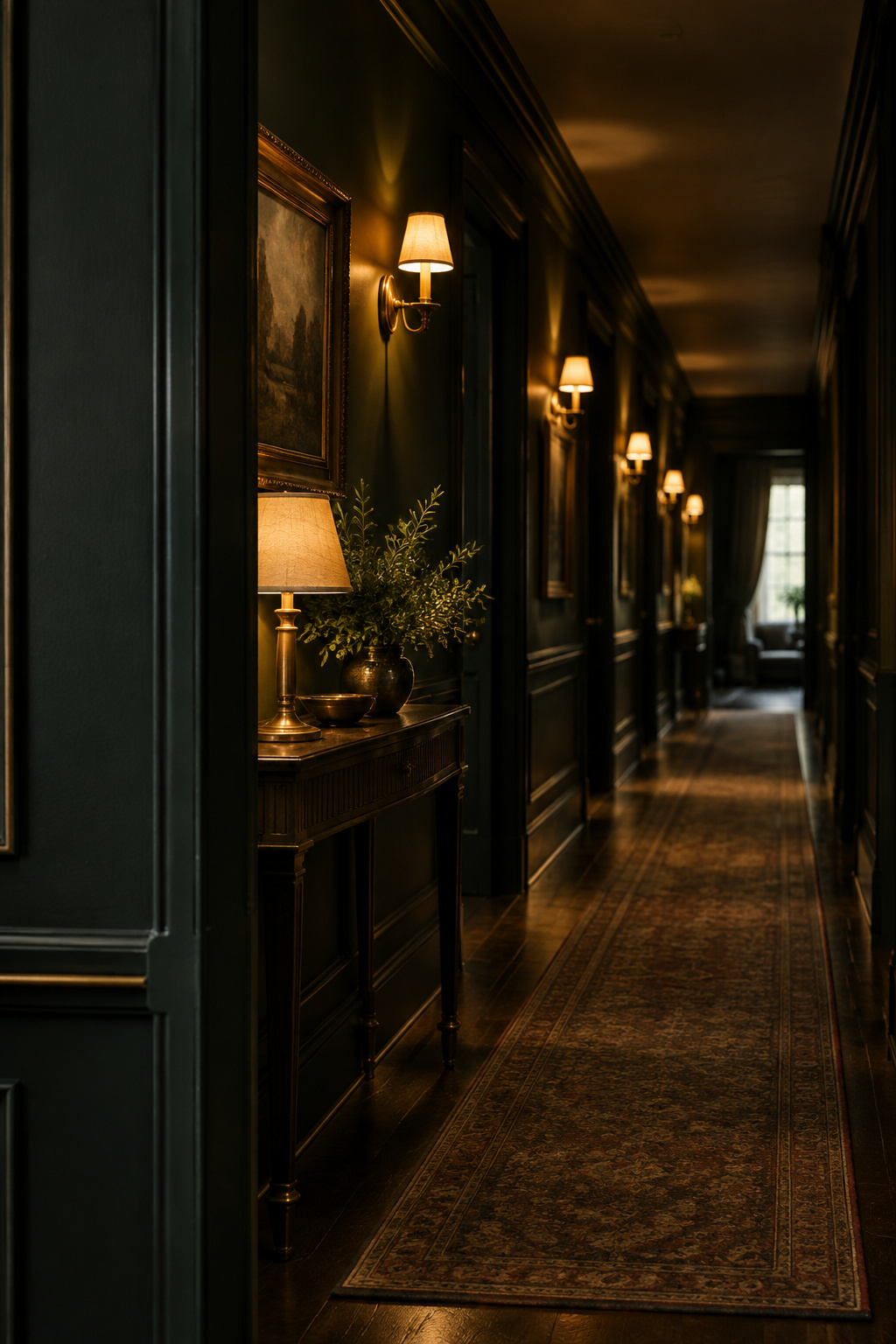
It changes which light you choose, too. A dark color picked for warmth and richness goes flat and gray under cool white bulbs, the most common reason a carefully chosen dark disappoints once it is on the wall. Keep the light warm, around 2700K, and the color you tested at the door stays the color you live with at night.
Which fixture to hang, pendant, flush mount or chandelier, and how big, is its own subject, and the site’s Cottage Entryway Lighting Ideas covers it properly. The only lesson here is what a dark wall does to whatever light you add.
Carrying the dark down the hallway
Once the entry is dark, the next question is where the dark stops. If the entry opens into a passage, the color can end at that opening or keep going, and neither answer is automatic. Continuing depends on how much borrowed daylight the hall receives, how long it runs and how it is lit. A long dark passage lit in warm pools can extend the compression before the release, while the same passage lit badly is just a dim corridor.
That choice has conditions and no default, and carrying the dark down the hallway treats it that way, including the route for a reader who would rather brighten the passage than lean into it.
Last come the objects, and there are fewer than you think. In a dark entry after dusk, an object that cannot catch light or be given it disappears. Texture, a few metals, art with its own light, a plant that tolerates the shade: the objects that read in low light sorts what stays, and it begins with taking things away.
So come back to the door. Your thumb finds the same cold brass latch, and the hall closes around you, dark below, dim above, one warm lamp. Now you know what that squeeze is doing: it sets up the room at the end of the hall to feel bigger and brighter than it is, as period builders did with candlelight and a dark lower wall. Choose the color at the open door, commit to the whole room or none of it, and let the rest of the house be the light you walk into.