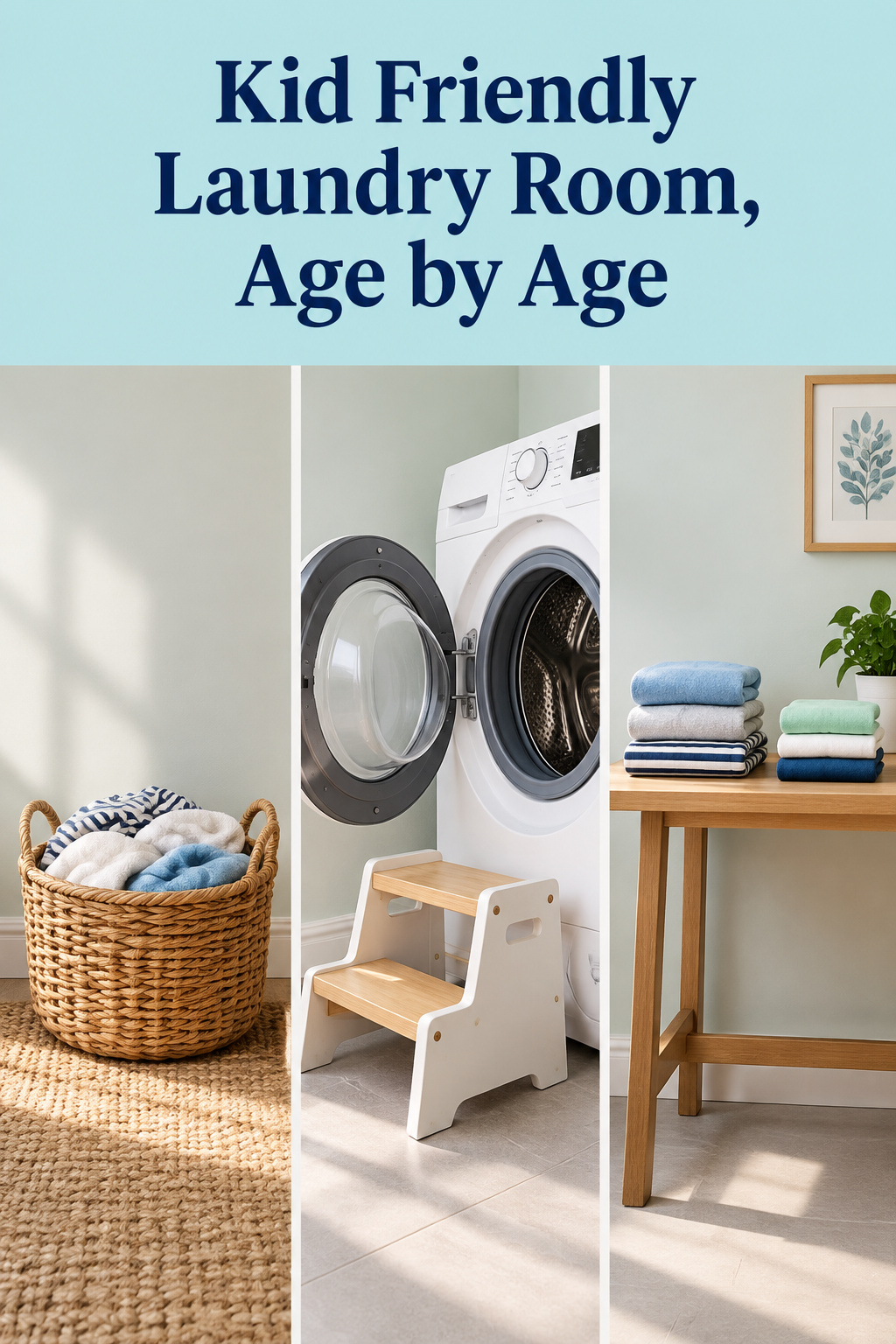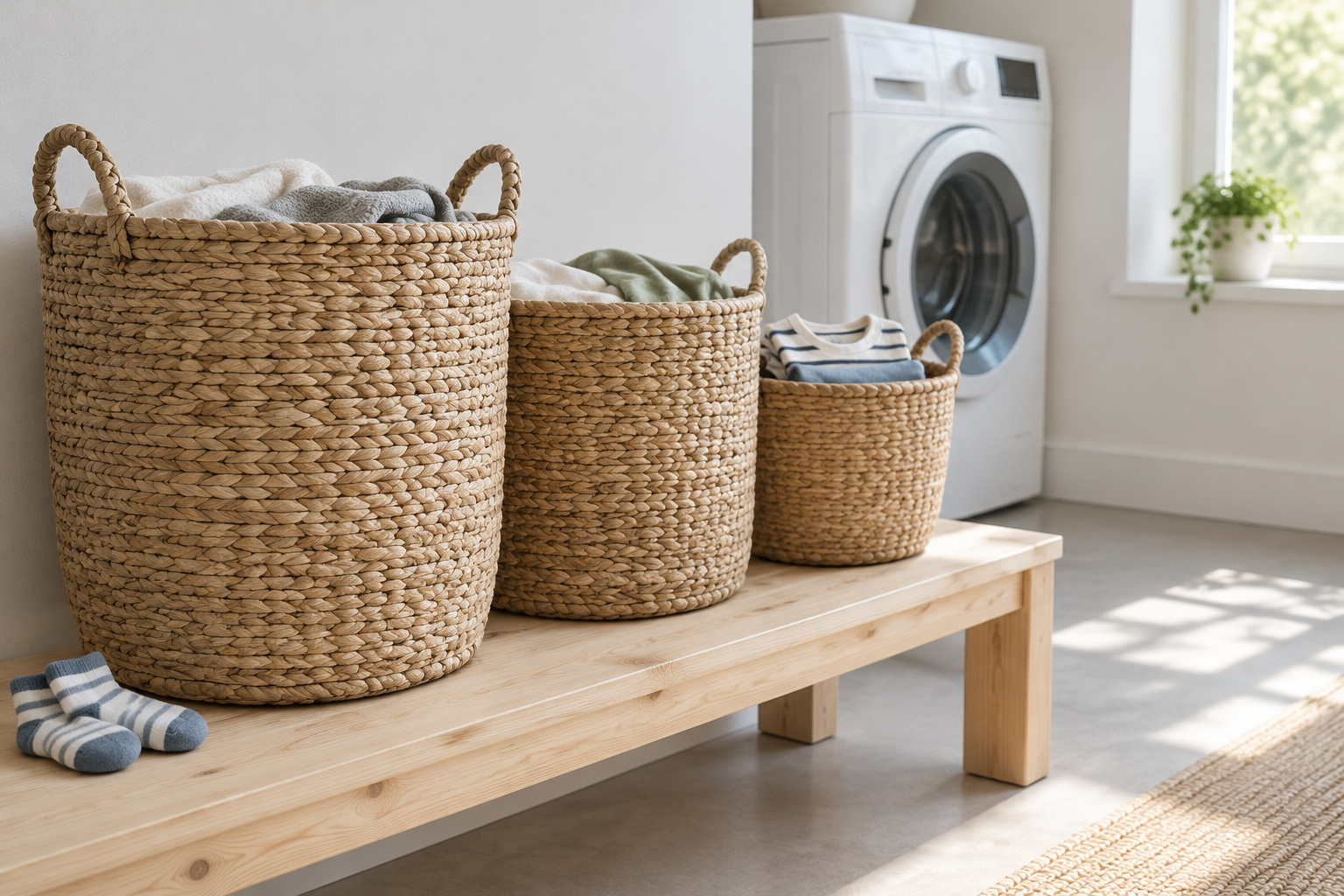

I used to buy matching storage bins. My kids couldn’t tell which one held what. Now every bin in our house has a picture label. My younger one drew them, so one bin is officially “dinosors.”
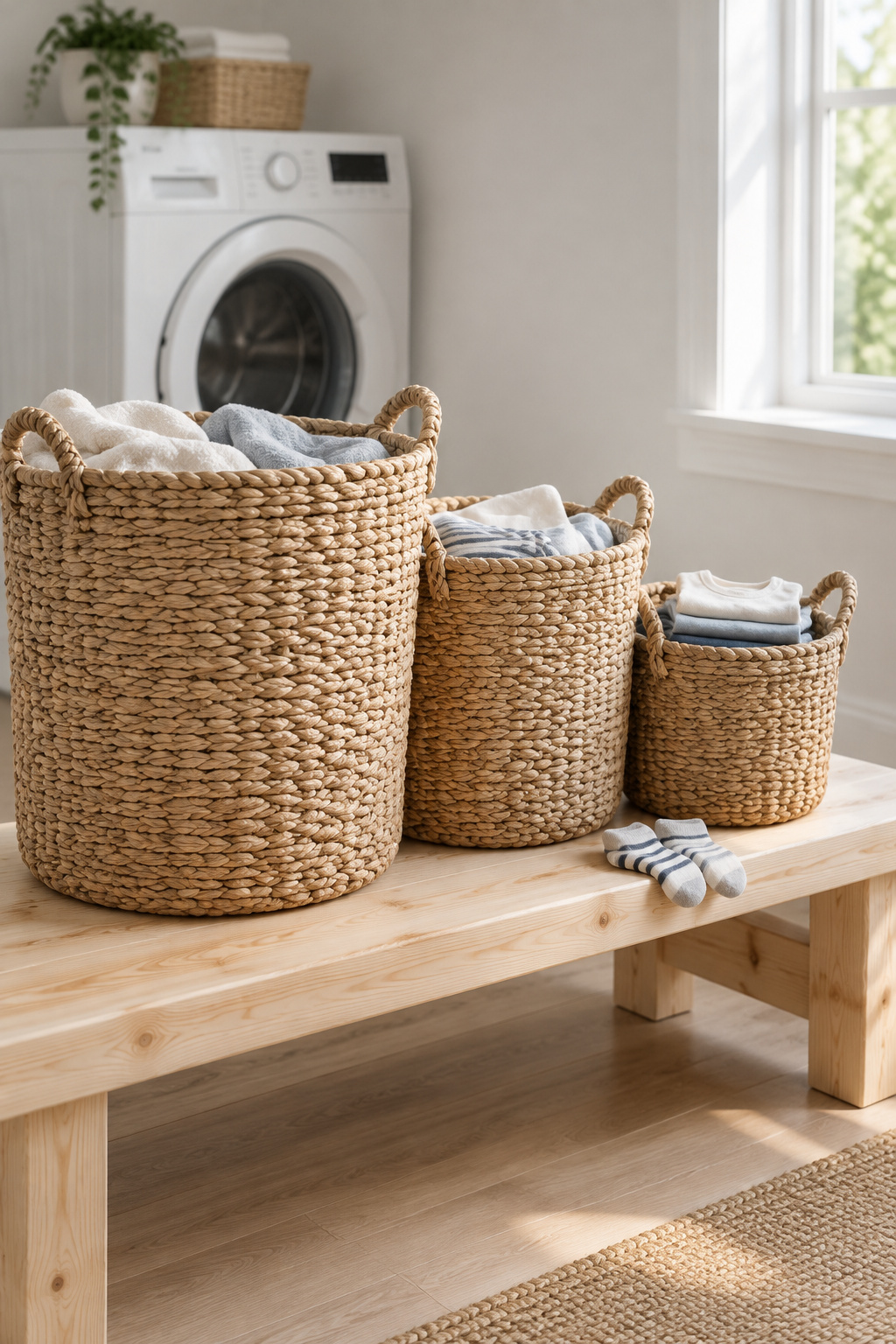
A kid friendly laundry room starts from the same lesson: a child uses a system they can read and reach, and ignores one they can’t. Every machine in the room was sized for an adult. Don’t fix that with a whole kid-sized setup. Find the next step your child can take over, sorting first, then loading, then running a load, then folding and putting away, and build only what that step needs.
TL;DR
- The first step is a basket each, with its rim at or under the child’s fist height (about 15.7 in at three, 17 in at four); build nothing else yet.
- A front-loader’s door already sits between a small child’s elbow and shoulder, while a top-loader’s 36⅞–38⅞ in rim needs a low, wide step of about 3 to 5 in at five and is still a lean at nine.
- The AAP puts sorting at 5 to 7, putting away their own laundry at 8 to 10, and doing and folding laundry at 11 to 12; other lists have children using the washer from 7 or from 10.
A kid friendly laundry room is built one step ahead of the child
Before I change anything in a child’s room, I walk it on my knees. Do that in your laundry room before you buy a thing. Get down to their height and look at what they see.
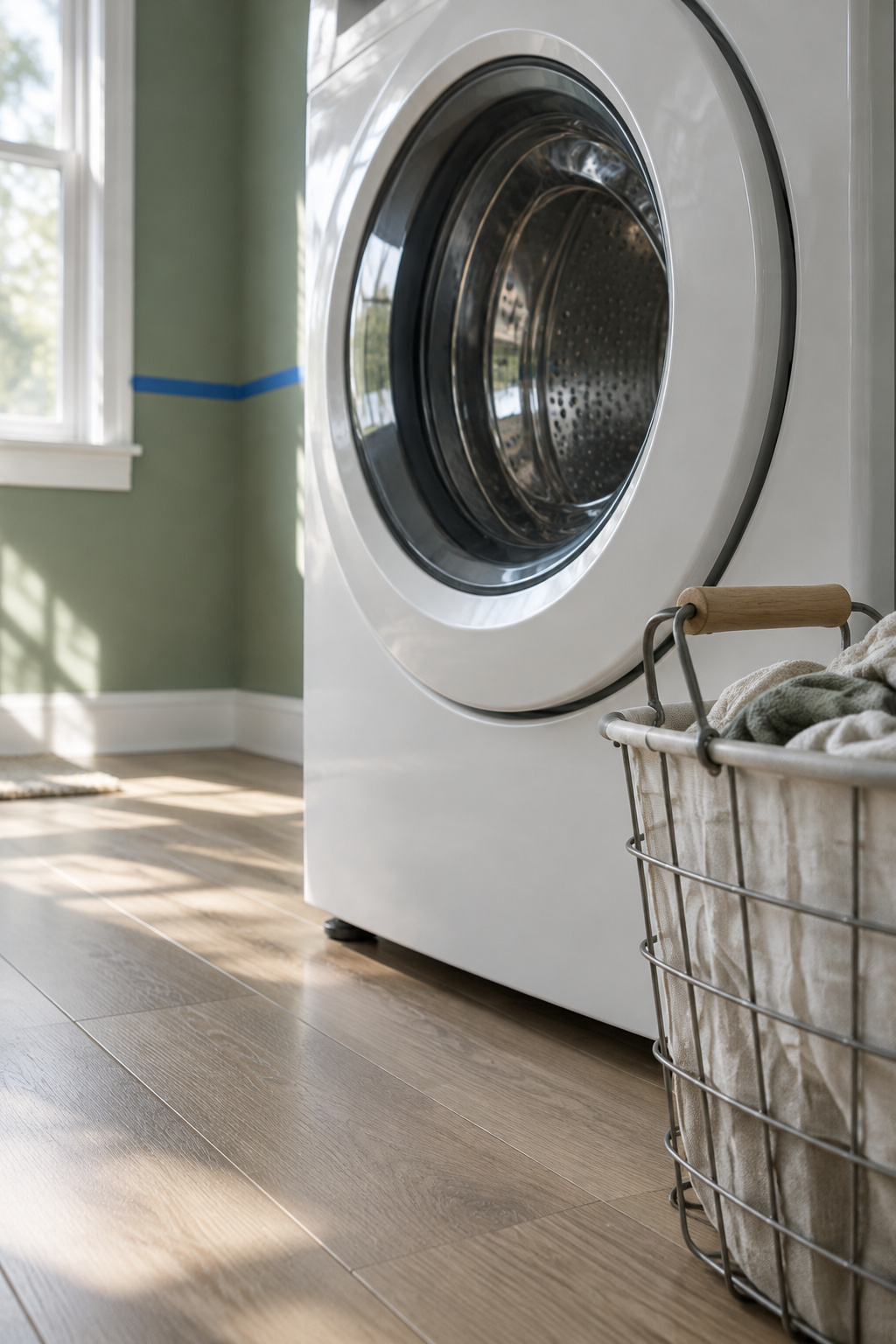
The kneel is deeper than you’d guess. In European child-size data, a three-year-old’s eyes sit about 33.9 in off the floor, and a five-year-old’s at 38.9 in, roughly level with the top of a front-loader. One looks up at the machine; the other looks across it.
Toddlers learn by copying what adults and older siblings do, so the wish to help arrives long before the reach. The room decides whether that wish becomes a job or a frustration.
The American Academy of Pediatrics gives the rule I’d build the whole room around: start with one new task at a time, and don’t expect perfection. In the room, that means one change per step. Make the next step reachable and leave everything else alone until they’ve got it.
The first step: sorting into a basket each, at a height the smallest one can reach
A two-year-old carrying pajamas down the hall is doing laundry. It needs one thing: a basket at their height.
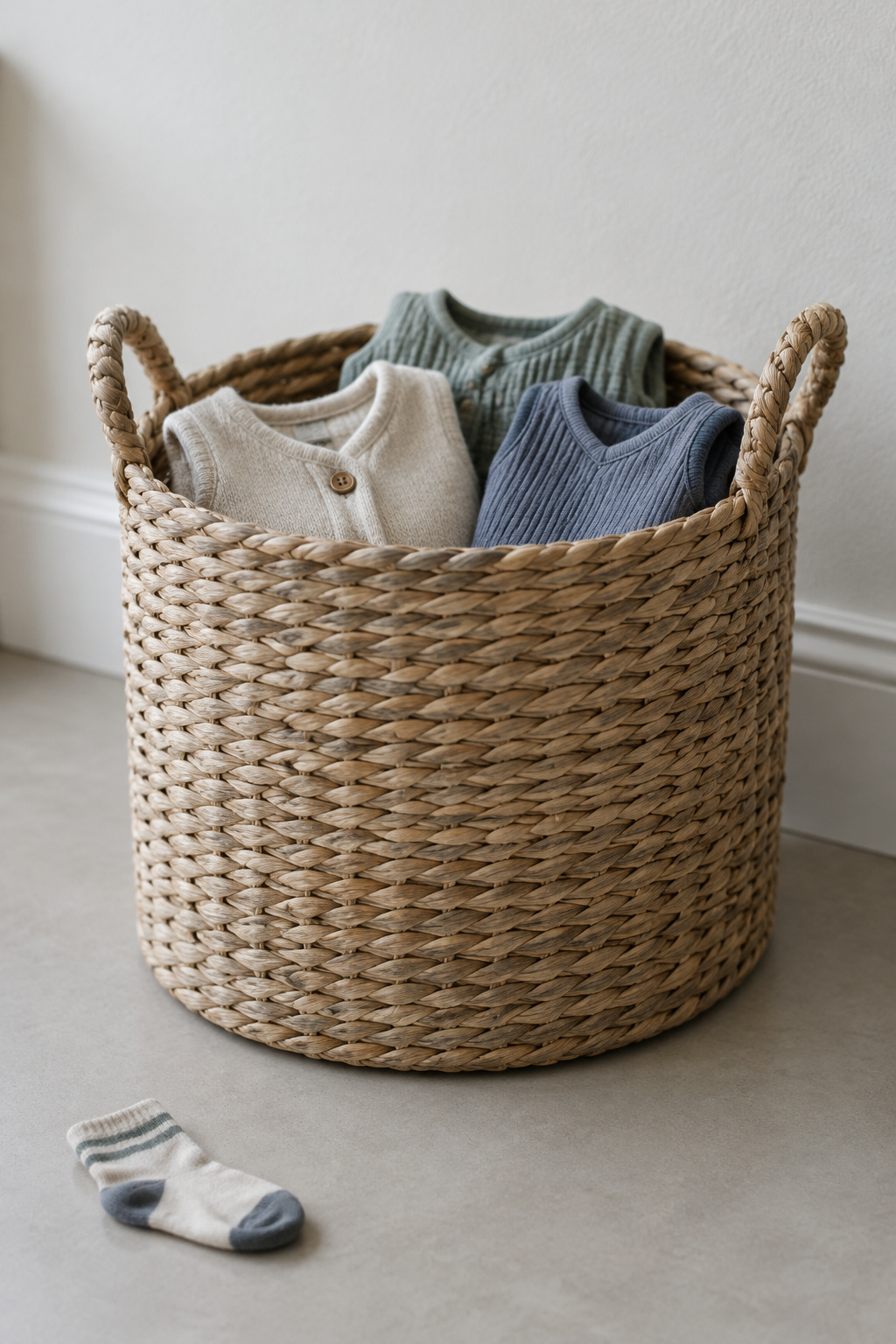
Sorting comes first on most lists. The AAP’s laundry jobs start at 5 to 7, with sorting and the hamper, and it gives no list for younger children; University of Arkansas Extension has children using a hamper from 2 and sorting from 4. The toddler ages are softer, and every child gets there at their own pace.
Give each person their own basket, so a child always knows where their clothes go. My rule is to set the rim at or just under the child’s fist height, where the hand hangs at their side, so they drop clothes in instead of lifting them over. That puts the rim at about 15.7 in for a three-year-old and 17 in for a four-year-old.
Keep it in the open: a three-year-old’s forward reach is about 16 in, so a basket behind a chair won’t get used. A two-handle basket carried at the side handles the trip down the hall. I’d put a basket on the floor before I’d buy anything with a lid.
In three years the same child will sort colors from whites alone, and the basket becomes what they carry to the machine.
The next step: loading the machine, from a stable step to one detergent rule
A five-year-old at a front-loader stands square to the door, arms full, and pushes. At a top-loader they’re on tiptoe, belly against the rim, fishing for a sock. One family-education list has four- and five-year-olds helping load, and the machine you own decides how hard that is.
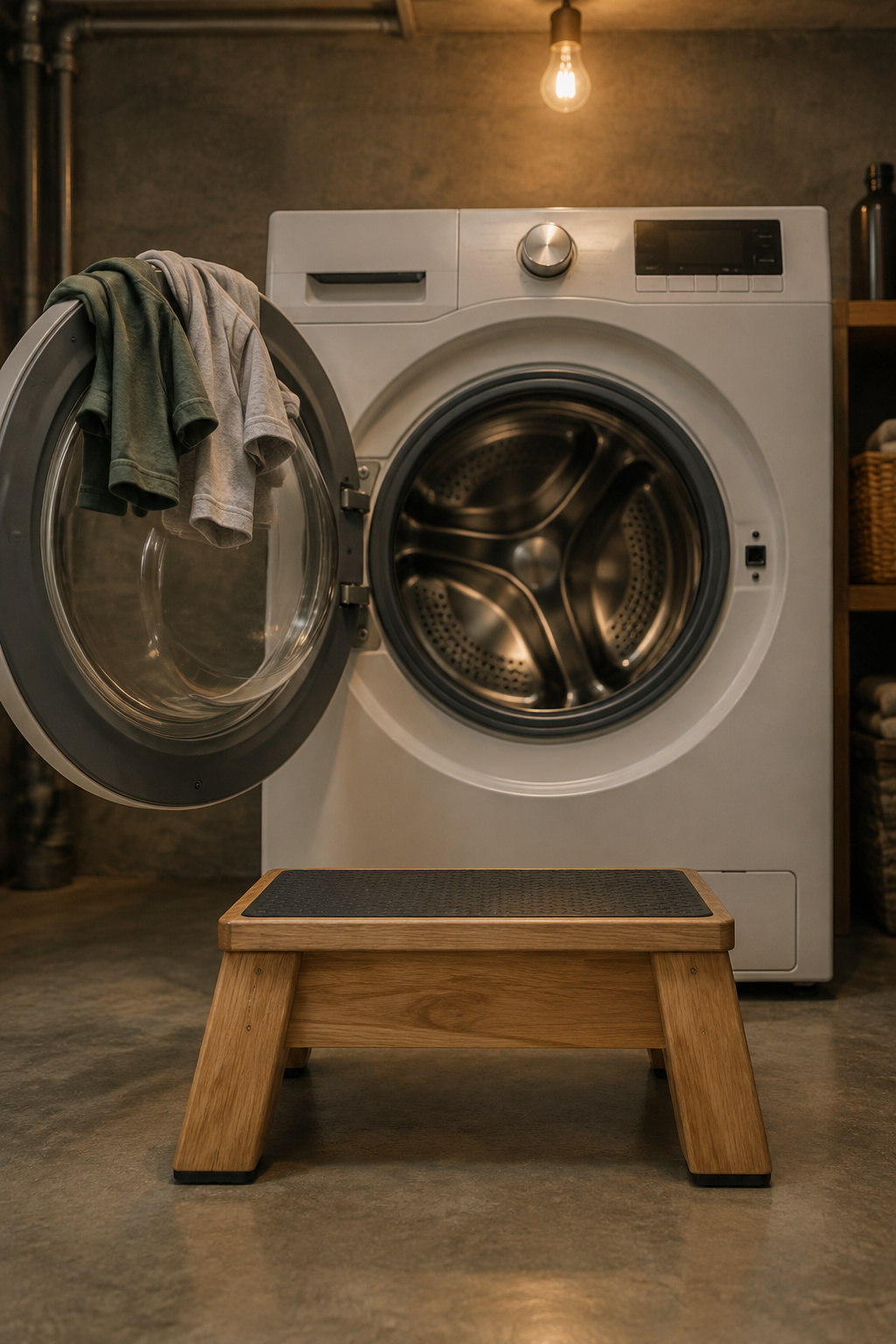
Front-loaders: reach to the door and the drum
A front-loader is the child-friendly machine. On one Whirlpool front-loader, the door panel runs from 9½ in off the floor to about 35.2 in, and its midpoint, about 22.3 in, matches a three-year-old’s elbow height of 22.6 in. The opening itself starts a little higher, 14.6 in up on one maker’s sheet. From about three to six the door sits between a child’s elbow and shoulder, and no step is needed. Drum depth isn’t published, so watch how far they reach in. Mind the open door: it swings about 23 in into the room, right where a small helper stands.
Top-loaders: how far a child has to lean in
A top-loader is a lean, not a reach. On current Maytag top-loaders the rim sits 36⅞ to 38⅞ in off the floor, above a five-year-old’s shoulder at 34.1 in. Bringing that shoulder to the rim takes a step of about 3 to 5 in; by seven the step can go. The machine still beats the arm: these run 26¼ to 27⅞ in deep, and a nine-year-old’s forward reach is 22.1 in, so the far side is reached by leaning over with both feet planted.
Make the step low and wide, light enough for a three-year-old to carry. In April 2026 the CPSC told owners of about 3,600 kids’ 35 in standing towers to stop using them because of entrapment, tip-over and fall risks. That warning covers one product, but it’s why I’d keep a child’s step short. For the adults and older kids sharing a front-loader, raising the washer on a pedestal brings the drum up instead; just know it moves the door away from a small child.
One detergent rule: if anyone in the house is under 6, use a traditional liquid or powder, not pods. From 2014 to 2022, US poison centers logged 114,826 exposures to liquid laundry packets, and 86.8% were children younger than 6. Those are exposure calls, not confirmed injuries, and pediatric researchers still advise skipping packets while little ones are home. Where the bottle lives is covered in our childproof laundry room storage guide.
Then a load of their own: controls, line and all
Here the lists split. The AAP has children putting away their own laundry at 8 to 10 and doing and folding it at 11 to 12. A child-development organization puts using the washer and dryer at 7 to 10, and a university extension list says 10 and up. I read that spread as permission to start a load together around eight and to expect a whole load alone a couple of years later. In between, the set-up does the remembering.
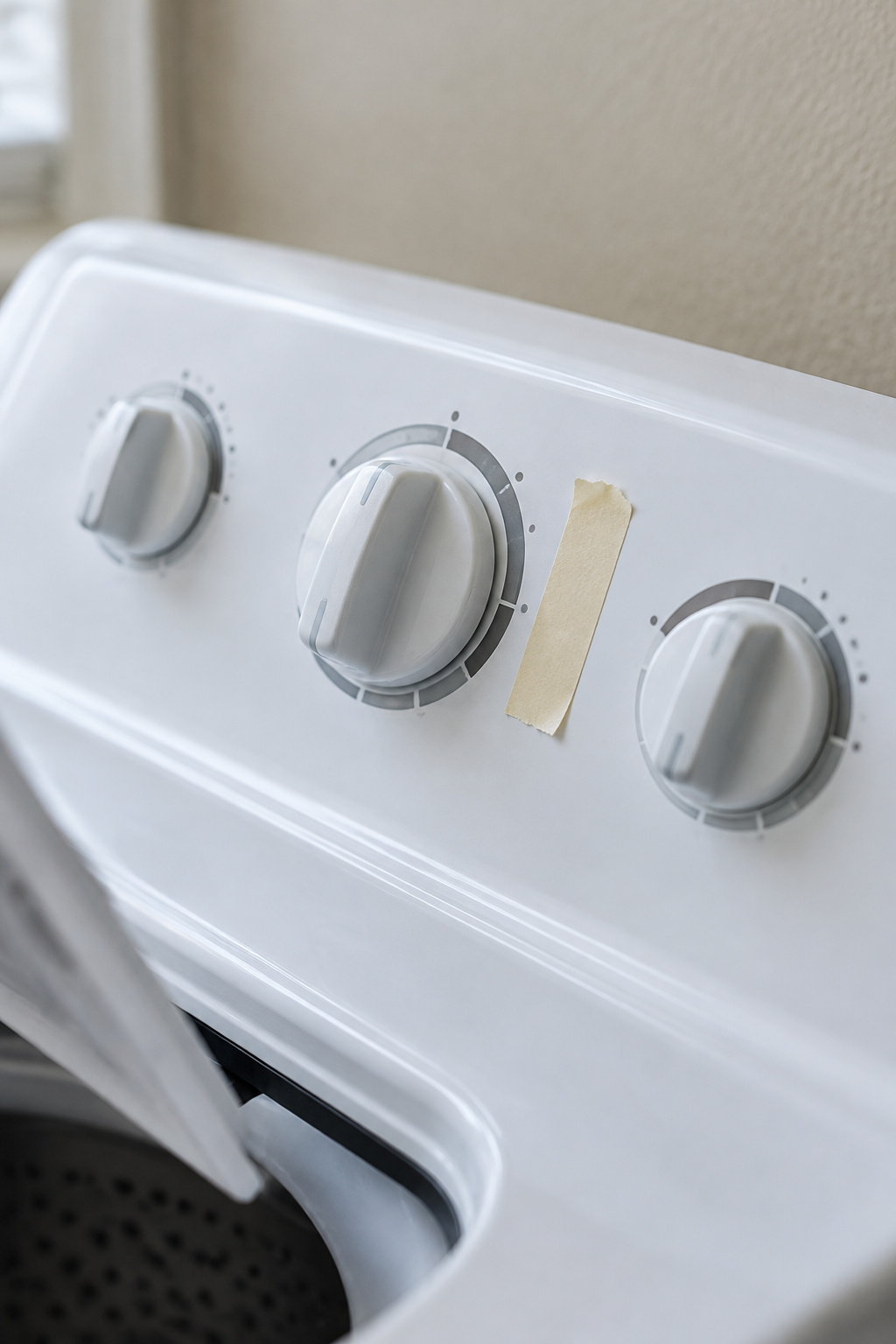
A front-loader’s panel needs a step at five and is within reach by seven or eight; a top-loader’s console reaches shoulder height around ten. Asko lists a child lock on the display of one front-loader, and it’s worth using while the youngest still presses every button. Teach one setting, the one you use most.
The routine a child follows, from basket to started cycle:
- Carry your own basket to the machine.
- Empty the pockets and read the care label on anything new.
- Load the clothes loosely.
- Fill the marked cap to the line. On an HE washer, use HE detergent only.
- Pick the one setting you practiced together and press start.
A red sock will ride in with the whites eventually. When each person washes their own basket, the damage stays in one child’s clothes, and the fix is a conversation. Praise the effort and move on. I’d rather lose one shirt than keep running every load for them.
Outside, a low line is a child-sized step of its own. My target for hanging without a stool is a line below a child’s vertical grip reach, about 61.4 in at eight; a backyard line kids can reach covers where to put one.
Folding at child height and putting it all away
Folding is a surface-height decision. Light work goes best near elbow height, and a seven-year-old’s elbow is 29.3 in off the floor, an eight-year-old’s 30.9 in. The kitchen table, at 28 to 30 in, already fits. A 36 in counter is another story: a seven-year-old needs about 6.7 in of lift to fold there. Skip the children’s folding station and use the table you already eat at. It’s a room, not a museum.
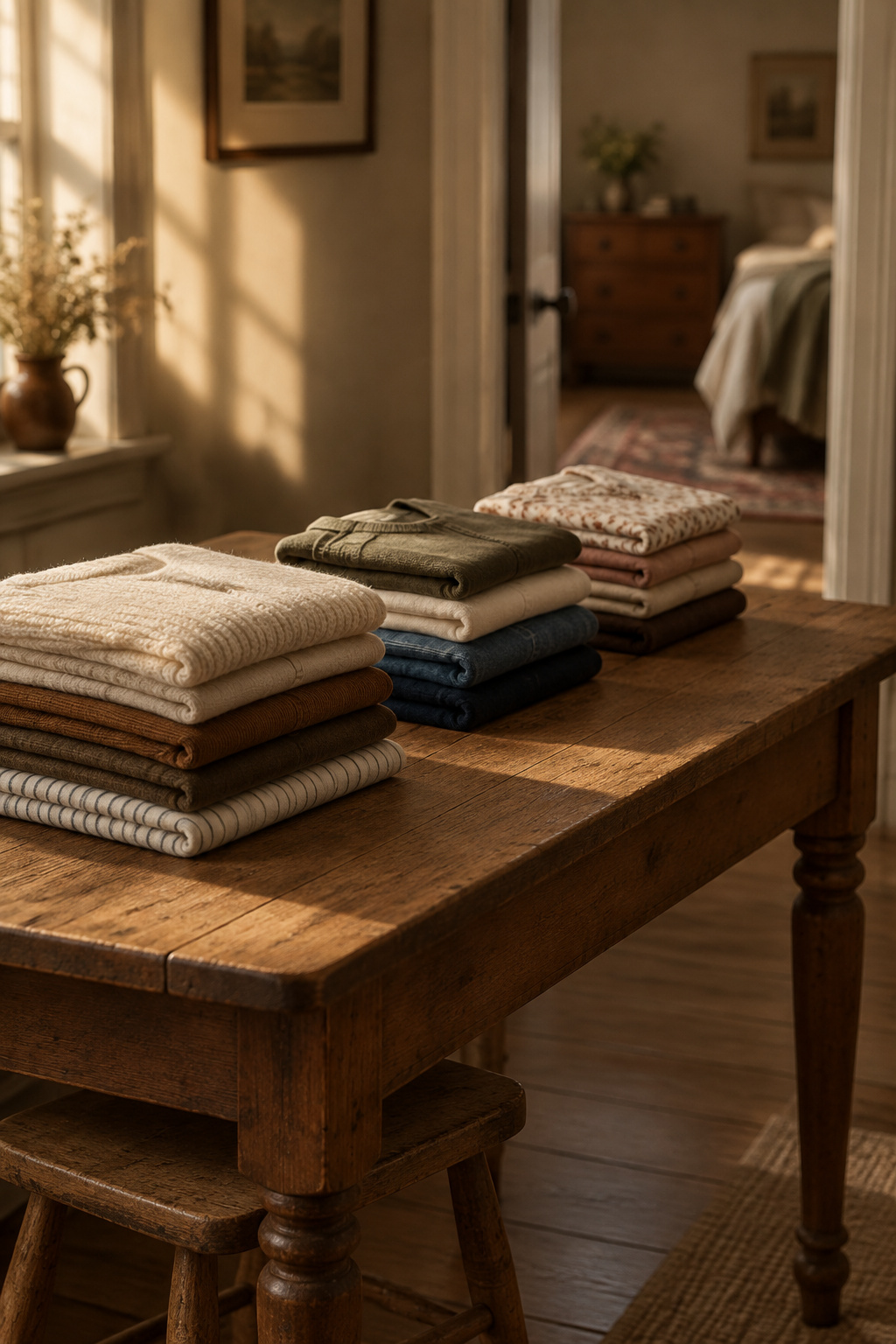
Putting away is where my classroom habit still shows. I say “find it a home” when I mean “put it away,” and a home only works if the child can reach it and open it. My rule for drawers is a pull between the child’s fist and elbow height, so it opens without lifting the arm; at five, fist height is about 18 in. Skip lids small hands can’t lift.
A low hook does more for tidiness than any organizer. A sweatshirt goes on a hook in one move, and a child who can do it in one move will do it tired.
In our house tidy-up lasts one song, and the kids choose the song. Try it on a clean pile: fold until the song ends, deliver it, and bring the empty basket back to the start.
The whole ladder at a glance, and the next step for your own room
Here is the ladder in one place, with the ages as the sources give them and the one change each step asks of the room.
| Step | Ages the lists give | What the child takes over | The one change to the room |
|---|---|---|---|
| Sort | Hamper from 2, sort from 4 (Arkansas Extension); sort at 5–7 (AAP) | Carries clothes to their own basket, then sorts | A basket each, rim at or under fist height (15.7–17 in at 3–4) |
| Load | Helping from 4–5 (a family-education list); not on the AAP list | Loads the machine | Front-loader: no step; top-loader: a low, wide step of about 3–5 in at five |
| Run a load | 7–10 (child-development organization); 10+ (Arkansas Extension); 11–12 (AAP, do laundry) | Starts a load with the set-up doing the remembering | A marked detergent cap and one practiced setting |
| Fold and put away | Put away at 8–10 (AAP); folding from 2 to 12 across lists | Folds and delivers their own pile | A table at elbow height (about 26–31 in), reachable drawers, a low hook |
Name your child’s next step, then build the cheapest version of it you can undo. For a toddler that’s a basket on the floor. For a five-year-old at a top-loader it’s a low step you can move. None of it is permanent, which matters, because children outgrow each step fast. For the wider room, see the whole room in wash-day order.
When my older daughter outgrew the low shelves, she asked for one high shelf the younger one couldn’t reach. Plan for the next stage, and let the child tell you when they’re ready for it.
FAQ
How do I get a teenager to do their own laundry without nagging?
Stop reminding and set a fixed time instead. The AAP says badgering or scolding doesn’t build responsibility; tie laundry to a regular routine, use a checklist, and agree the deal at a family meeting. A teenager is well past the age most lists give for doing laundry, so the job can be fully theirs.
How much detergent should a child use for one load?
Whatever the label on that detergent says, because no single cup measure fits every brand. For a normal load, one dose is typical, and HE washers need HE detergent. Too much leaves residue and a film that can turn to mildew. With a child under 6 at home, give the older one a marked cap, not pods.
What should I do when a child shrinks or stains a favorite shirt?
Treat it as practice, not a disaster. Praise the effort and don’t criticize the result, or a child may start resisting the job altogether. Then show them the care label on the next shirt: it has to warn when a normal wash would harm the garment. Reading it first is the habit that saves the one after that.