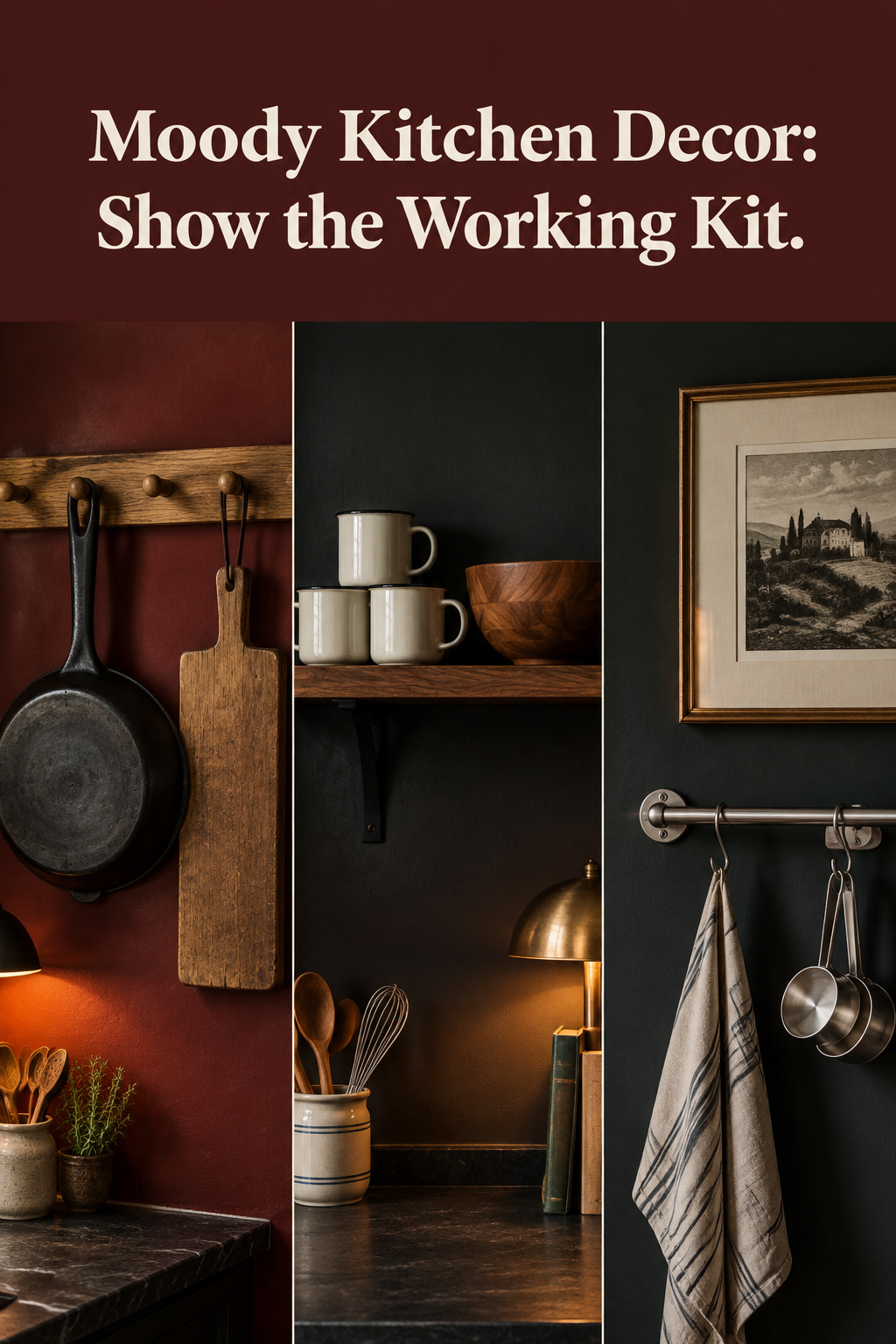
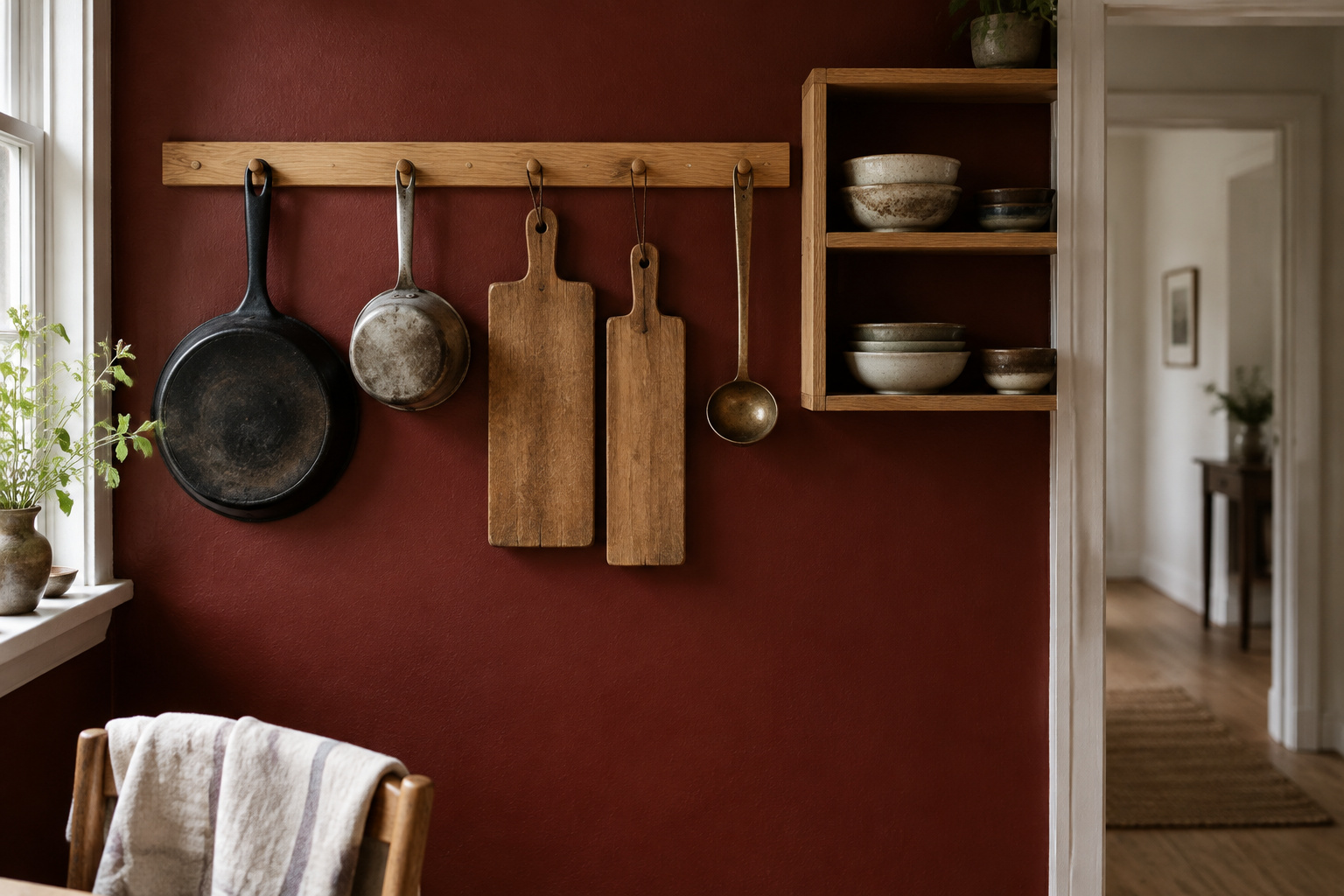
A cast-iron skillet hangs on a dark green wall in late-morning light. Its handle is worn pale where a hand holds it. Nothing else is near it.
For years I would have taken it down. I used to insist that rooms for sitting quietly be completely bare, until clients told me a bare room felt like a waiting room. Now I keep one meaningful object in a room, and in a kitchen the meaningful objects are the ones you cook with. That is where moody kitchen decor starts for me: on dark walls and open shelves, keep out only what you use every week, in one loose color family, and let the dark make those used things stand out so the wall never needs bought props.
TL;DR
- Keep on a dark kitchen’s walls and open shelves only what you cooked with this week; a dark backdrop makes each used piece stand out, so props add nothing.
- Choose one loose color family of two or three materials, such as wood, enamel and steel, rather than a matching set that shows every missing or chipped piece.
- Code sets 30 in (760 mm) above a cooktop to combustibles and cabinets, 24 in (610 mm) with protection; nothing covers a rail beside the range, and an IKEA S-hook is rated 4 kg (about 9 lb), so fix rails into studs.
Moody Kitchen Decor Starts With What You Cook With Every Week
Dark-kitchen decor roundups tend to open with a shopping list: brass lamps, bold chairs, a white vase of fresh flowers, a wooden bowl of lemons. Few of them put a working pan on the wall. The suggestion is that the dark needs dressing, and that the dressing comes from a shop.
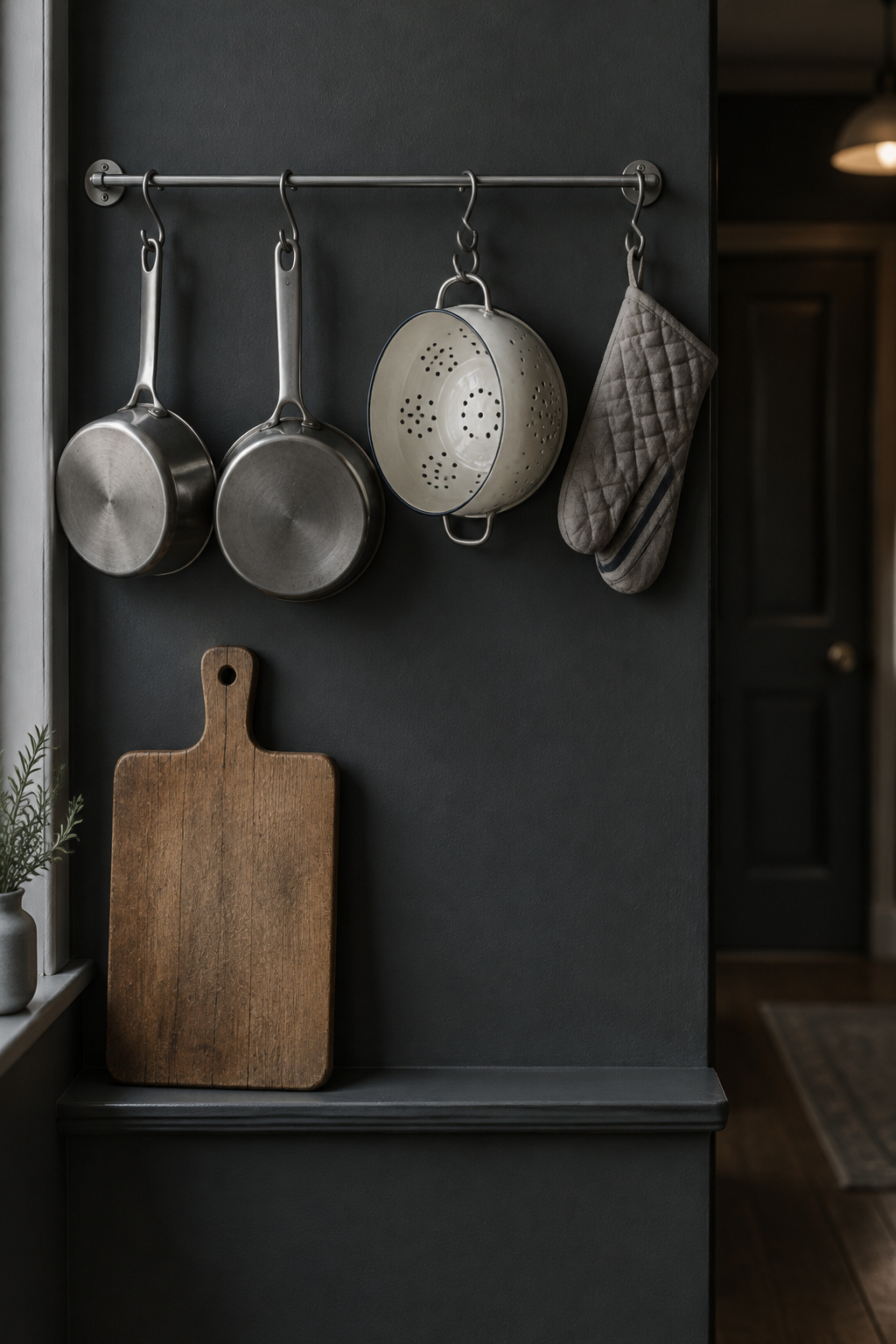
A client once gave me a large scented candle as a thank-you. It is in the hall closet, unlit. I’m grateful for the thought, and it still has no job in a room I use. That is the test I bring to a dark kitchen wall: what did you cook with this week? The colander you drained pasta in stays. The copper mold from a housewarming goes into a cupboard. Weekly use decides, not how something photographs and not the fact that it was useful once.
Designers who style open shelves land somewhere close. Alex Crecelius treats open shelving “more like curation than storage”, with fewer, better things on show. In a kitchen, better mostly means used. If you are still deciding what the dark in a kitchen is for, settle that first; what goes on the wall follows from it.
Today, take down one thing you haven’t touched since last month.
Why a Dark Wall Lets the Working Kit Stay Out Instead of Hidden
A dark kitchen should feel still before it looks like anything. I notice a refrigerator’s hum before I notice a wall color, and I usually mention it first, because the sound tells me how quiet the room already is before a single hook goes up. Only then do I look at the wall.
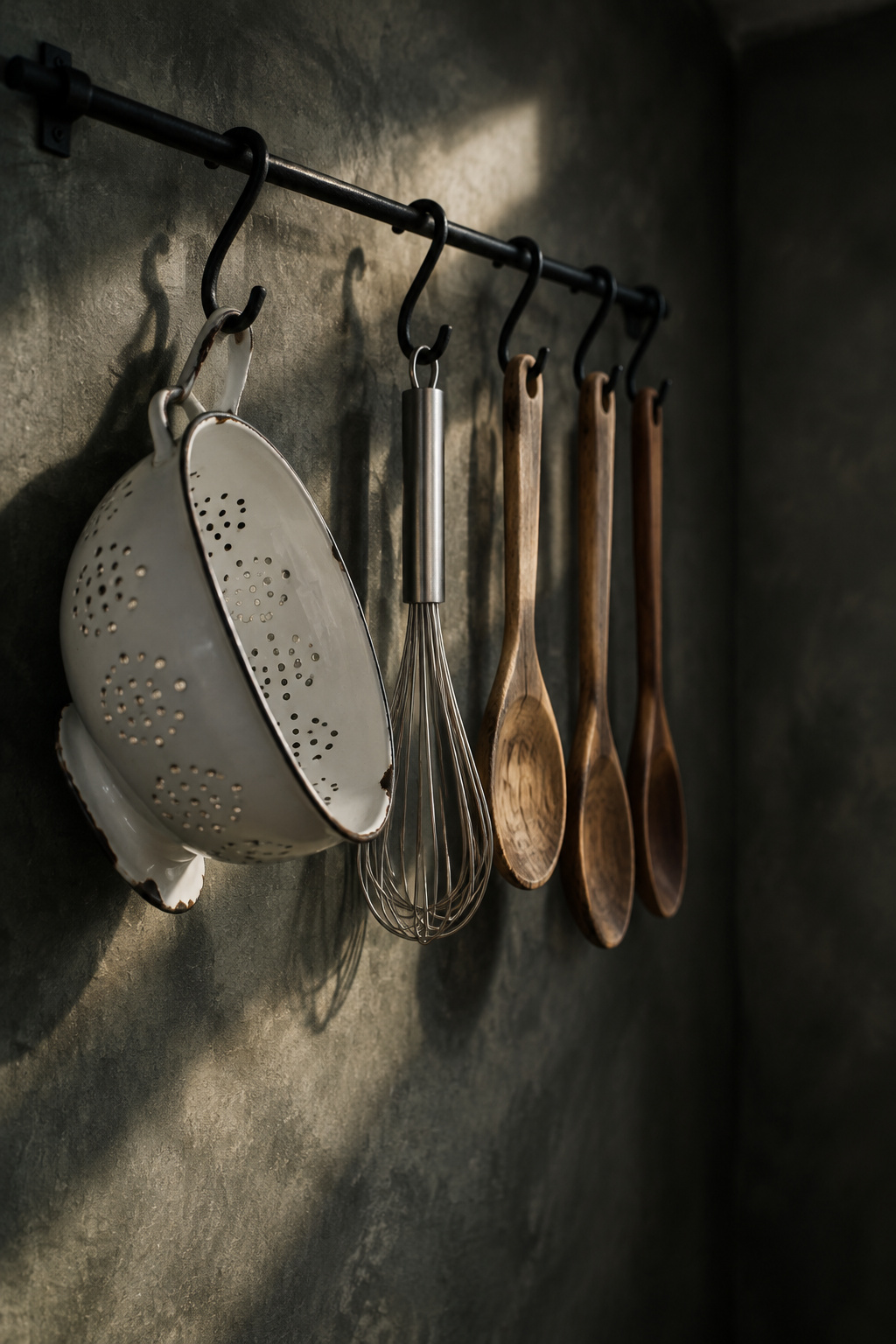
A dark wall works as a backdrop. Kelly Wearstler says darker colors “act as a great backdrop” that make pieces “stand out dramatically”, and the same logic carries to a kitchen wall. Against deep paint, a pale wooden spoon jar or a steel colander shows its whole outline, so each piece looks chosen rather than left out.
What the dark does not do is make a collection look like it belongs together. That comes from the palette: a cohesive set of colors, or a thoughtful mix of materials, is what makes open display feel intentional. A dark wall with a jumble on it is still a jumble, only sharper.
There is a trade. Dust shows on a dark wall, so the things you keep out had better be things you wash anyway. What hangs well also depends on the dark wall colors behind your kit, so choose the paint before the hooks.
One Loose Color Family, Not a Matching Set
Matching sets look calm in photos and fussy in life. Some people will tell you a matched set is the tidy answer. I see it differently, and here’s why. A matched row of canisters or utensils has to stay complete to work. The day one lid cracks or one spoon goes missing, the gap is all you see. A loose family absorbs that. Replace the cracked bowl with another in roughly the same tone and nobody, including you, notices.
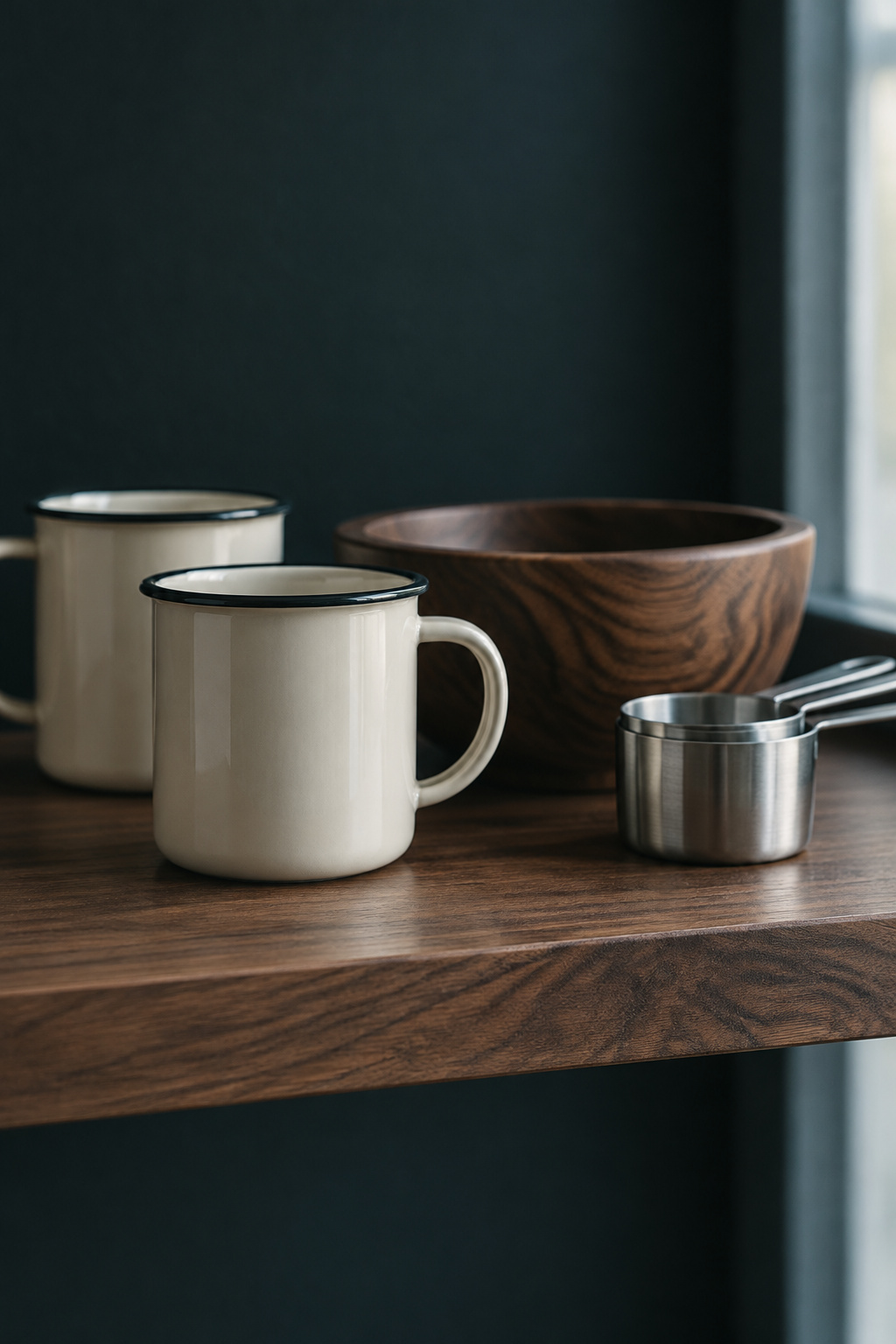
A loose family is two or three materials that already live in your drawers: wood, enamel, steel, and nothing outside them on the wall. A dark wooden board, a cream enamel pot, steel tongs. Designer Leslie Kramer warns that if everything on a shelf “is the same shape or sitting at the same height, it all begins to blend”, which is one more quiet case against the matched set, since matched pieces usually match in shape too.
Start from what you own. Lay out everything you used this week on the table and look at which materials keep turning up. That is your family. Anything outside it can still be used; it just lives in a cupboard. Give it a few minutes before you hang anything, because the family you think you have and the one on the table can differ.
Rails, Hooks and Peg Rails for the Pots You Reach For
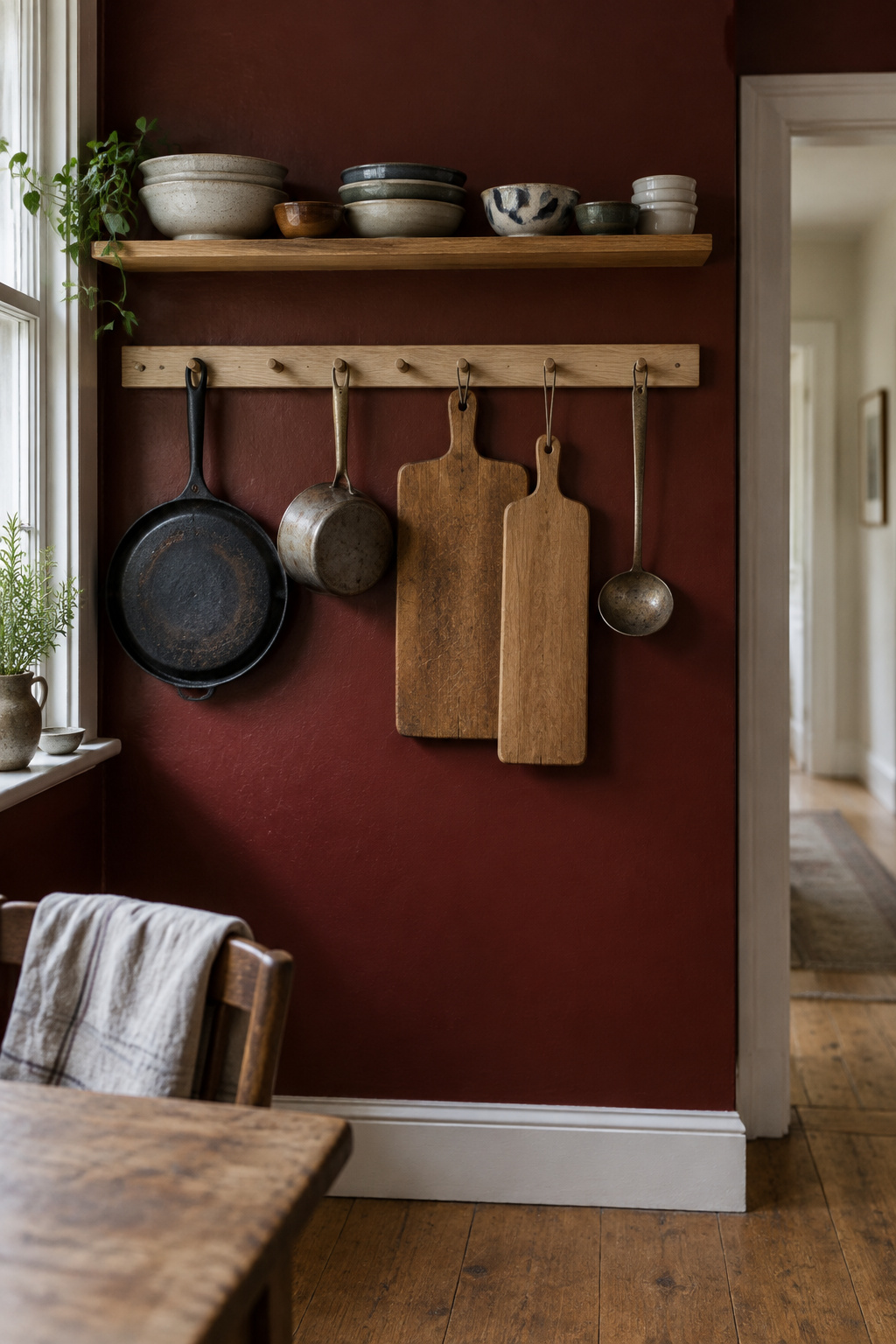
A rail carries what you reach for weekly, in one row, hung where your hand already goes. Before you add a hook, take something down. What can leave? Usually:
- the utensil you hung because the set came with six
- the decorative board nobody cuts on
- the second ladle
- anything you have to move to reach something else
Hanging anything near the range
The clearance rules people quote are about what sits above a cooktop. Code requires 30 in (760 mm) of vertical clearance from the cooking top to combustible material and metal cabinets, or 24 in (610 mm) with approved protection such as a metal hood at least as wide as the appliance. Nothing in the code sets a distance for a rail of pans or wooden spoons beside the range; your range’s own installation sheet is the document to read. I keep hung kit off the wall beside the range altogether, wooden tools and cloths most of all. They burn, and that wall takes the steam and the splatter.
Fixing a rail so it holds a full pan
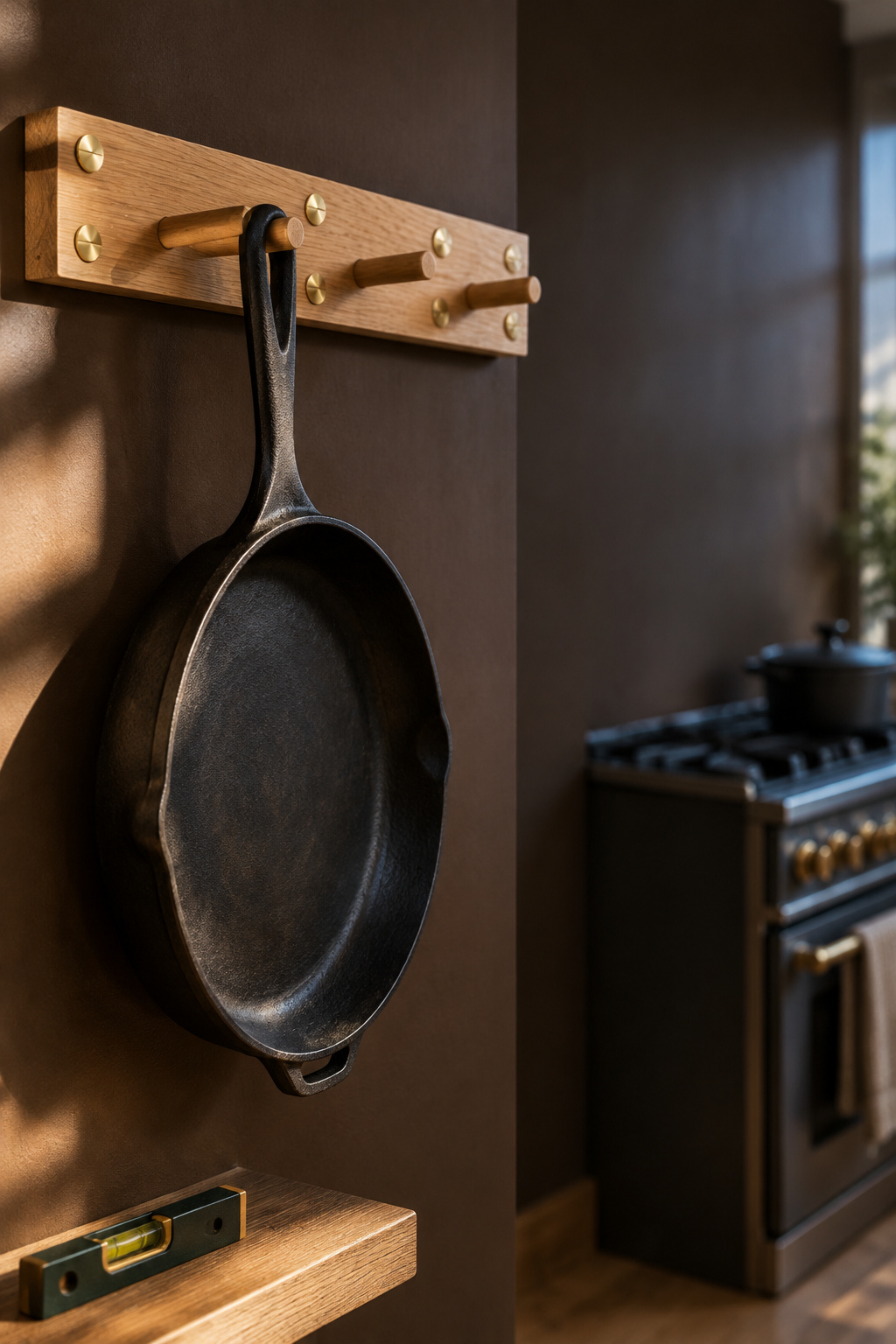
The hook rating is printed; the rail rating usually isn’t. IKEA rates its KUNGSFORS S-hook at 4 kg (about 9 lb) and gives no maximum load for the rail itself. A 12 in cast-iron skillet weighs 7.68 lb, so one skillet fits one hook with little to spare, and a second item on that hook takes it over. Four skillets on one rail come to about 31 lb (4 × 7.68 = 30.7), a load no one rates.
So fix the rail for its heaviest day. Screw into studs where you have them; where you don’t, use plugs suited to your wall, because different walls need different fixings. Load the rail fully once and check the fixings hold before you trust it. Drilling through backsplash tile needs a carbide-tipped bit and can’t be undone, so renters should ask first.
Art, Shelves, Scent and Sound on a Dark Wall
Art on a dark wall
A kitchen wall should feel settled, not like a gallery. One piece is plenty. The Canadian Conservation Institute is blunt here: it says kitchens where cooking fumes are present are not appropriate for displaying paintings. Keep canvas out of the kitchen. If you want art, choose framed paper under glazing, with the back sealed and a spacer holding the glass off the work, so grease lands on glass you can wipe. Hang it as far from the range as the room allows, never above it, because rising heat carries dirt up with it; a framing supplier also advises higher rather than lower.
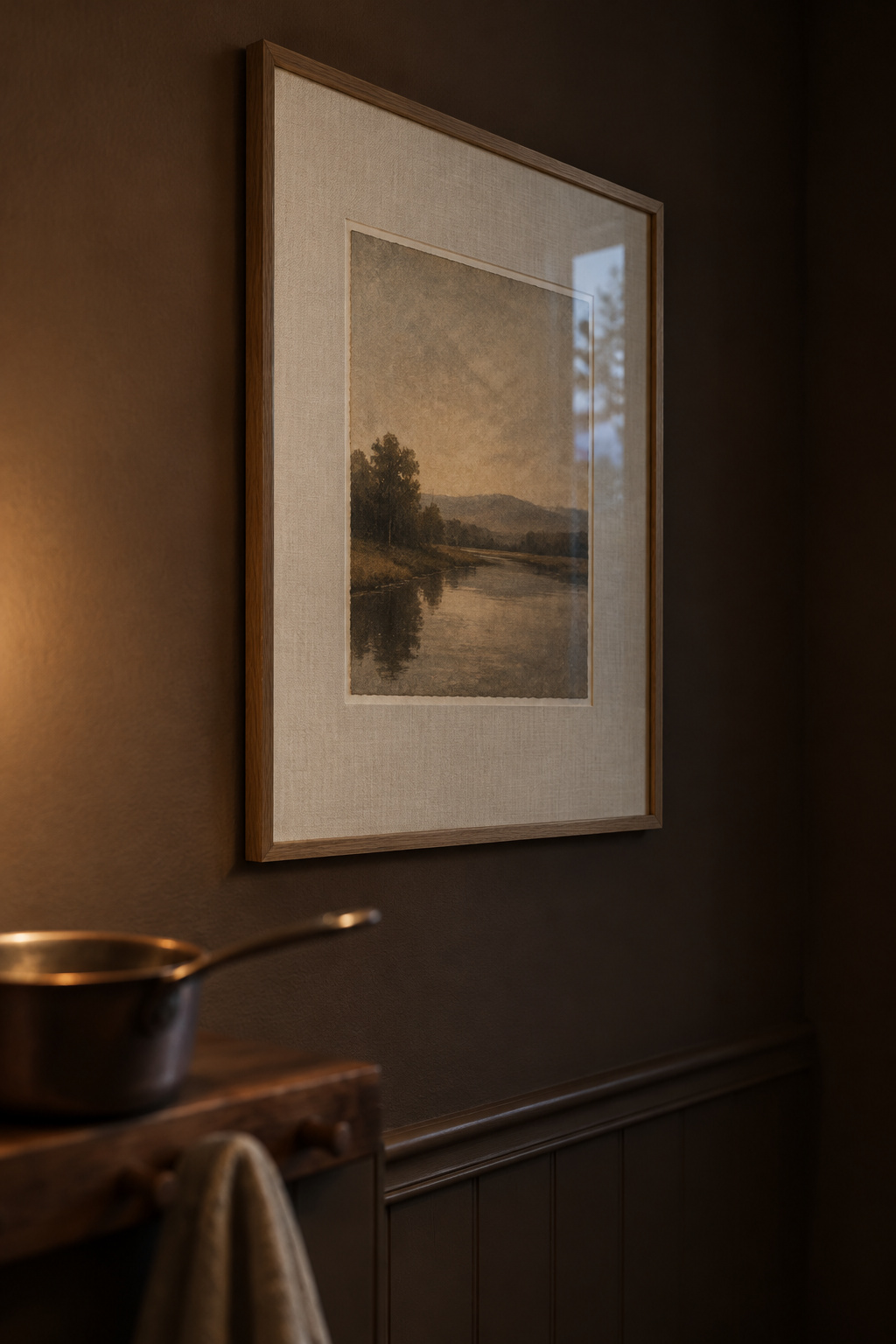
Not everyone puts strong art on dark paint. Joa Studholme advises a lighter wall behind a strong piece, and for a bold painting I think she’s right. A black-and-white print or a small drawing near the rail sits well on the dark. How any of it looks after sundown depends on lighting dark surfaces without glare.
The open shelf follows the rail’s rule: the bowls and glasses you use weekly, nothing staged. There is a separate guide on styling open kitchen shelves if you want the arrangement in detail.
Scent and sound, kept short
Scent and sound are materials in a kitchen as much as paint is.
| Input | What it does to the room |
|---|---|
| Steady appliance noise | Sets the room’s baseline before anything is seen |
| A kettle filled before you sit | Puts one deliberate sound in the room |
| A strong scented candle | Argues with whatever is cooking |
| The extractor fan | Clears steam and smell, adds its own noise |
I fill my cast-iron kettle before I sit, so what I hear next is mine. Cooking already supplies the scent, which is why a bought one usually competes with it. Listen to what is left when the fan stops.
Sort Your Own Wall in One Evening, Then Let the Rest Stay in the Drawer
- Take everything down from the wall and the open shelf, and lay it out.
- Put back only what you cooked or served with this week.
- Keep the pieces that fall into one loose color family; the rest go in a drawer.
- Fix the rail where your hand already reaches, into studs where you can, away from the wall beside the range.
- Step back at dusk and look at the wall in the room’s evening light.
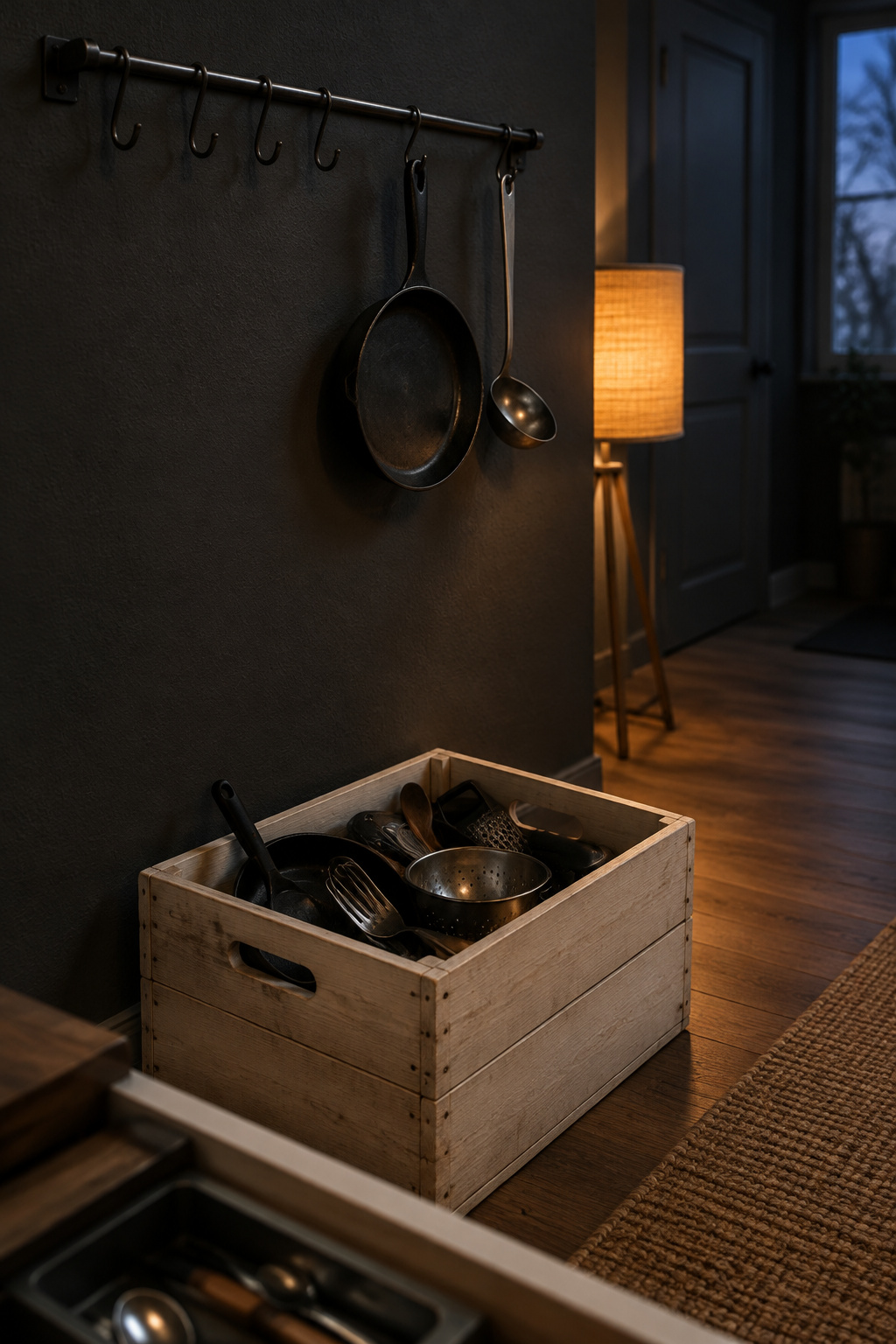
The moody entryway piece argues for fewer unused things by the door; here the case is for keeping the used things out. The two agree.
Then look at the skillet again. It is the one meaningful object I once thought a room couldn’t hold, hanging on a dark wall because it was used this week, and the dark around it does the rest. The next time the wall seems to need something, look at what is already in your hand.
FAQ
Can you hang art in a kitchen where it gets steam and grease?
Paintings, no: the Canadian Conservation Institute says kitchens with cooking fumes are not appropriate places to display them. Paper art copes better in a sealed frame, with a spacer holding the glazing off the work, because grease lands on the glass instead. Hang it as far from the range as the room allows, never above it, and run the extractor fan.
How do you keep wall-hung pots and utensils from getting greasy?
Keep them off the wall beside the burners, where steam and splatter land, and run the hood fan while you cook, since airborne grease settles as a sticky film on nearby surfaces. The weekly rule helps most: things you use every week get washed every week, so grease rarely has time to build up.
Do open shelves in a dark kitchen show dust more?
Dust does show against dark surfaces, and shelves near the cooking collect it faster than shelves elsewhere. A quick two-minute dust each week and a damp-cloth clean once a month keep them in hand. Holding only weekly-use bowls and glasses helps too, because they move often and rarely sit long enough to gather much.