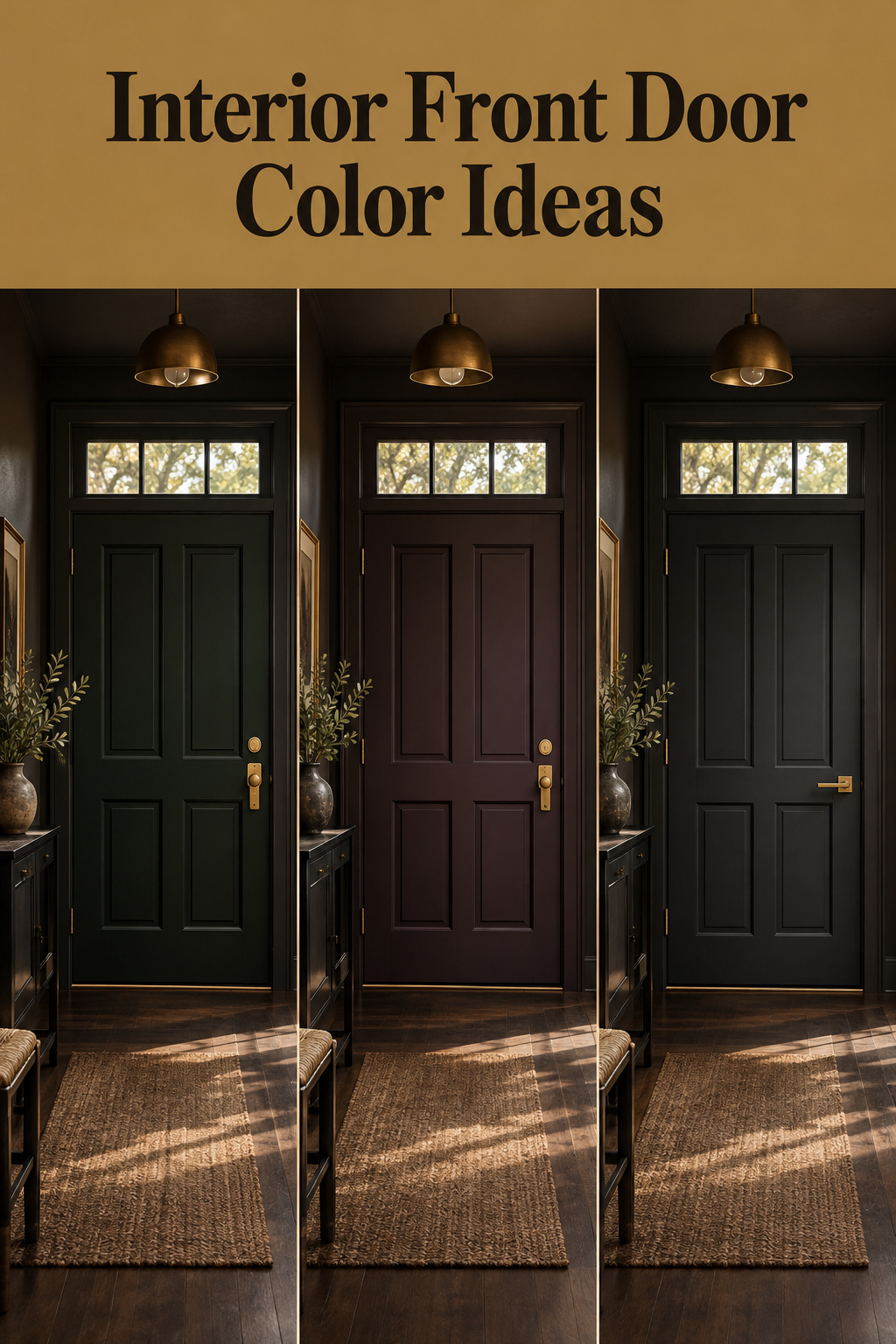
When did anyone in your house actually choose the interior front door color? Most front doors get painted twice and decided once. The street side gets the samples and the arguments. The inside face gets whatever was left in the can, or the factory white it arrived in. So it often fights the room it opens into, and designers call it the most overlooked paint surface in a house.
TL;DR
- The inside face is its own decision: match the walls when the door opens straight into living space, and go darker or contrast when the door sits in its own foyer and can carry a personality.
- The hinge edge takes the exterior color and the latch edge takes the interior color on an inward-swinging door, per Sherwin-Williams’ own instruction. It is the one detail that separates a deliberate two-tone door from an unfinished one.
- Paint it with a door enamel and respect the cure, not the dry: Benjamin Moore Advance recoats at 16 hours but can take up to 30 days to reach full hardness, so pull the weatherstrip or choose a block-resistant enamel.
Interior Front Door Color, Decided on Purpose: Match, Darker, or Contrast
Start with what the door opens onto. Livingetc draws the line cleanly. A door that opens straight into a living space favors a color that blends with the walls, to “shut the hustle and bustle of the outside world out,” while a door in its own foyer can be bold and act as a divide.
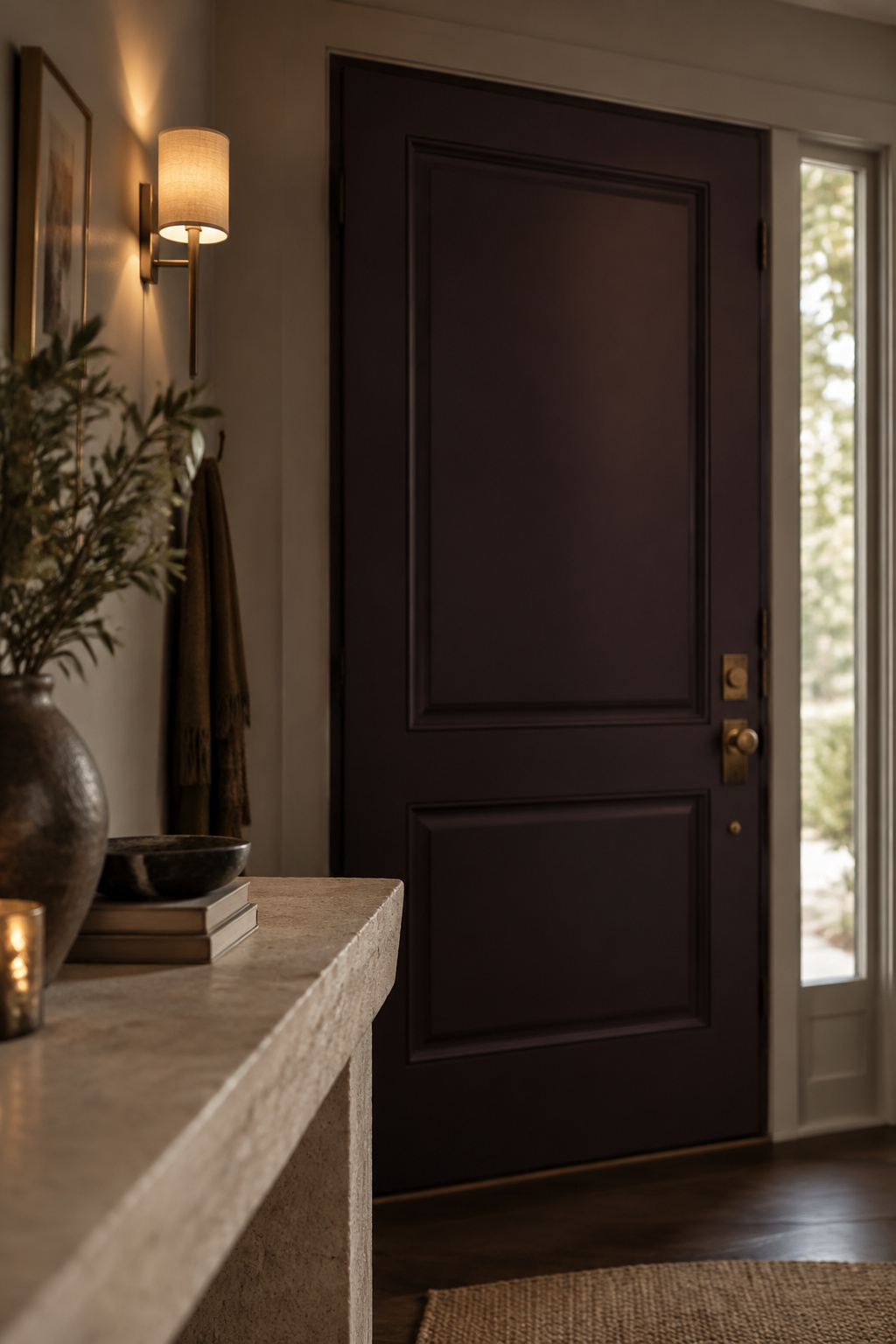
Match the walls and the door disappears, which suits an entry that is barely an entry. Go darker and it anchors the space without shouting, and accent colors on interior doors tend to come from the darker end of a paint strip. Contrast and it becomes a deliberate event. Whichever you pick, the inside face should coordinate with the exterior color without matching it. Where the walls are already saturated, the door has more freedom. Patrick O’Donnell, brand ambassador at Farrow & Ball, suggests taking the cue from a hall runner or a piece of art already in the space.
In a whole-entry drench the decision collapses to “match” by definition, and matching the door as part of a color-drenched entry has its own recipe for sheen and sequence.
Where the Two Colors Meet: The Door Edge and What Shows From Outside
On otherwise careful jobs I keep seeing both door edges painted one color, which leaves a sliver of the wrong color showing on one side of the threshold every time the door swings.
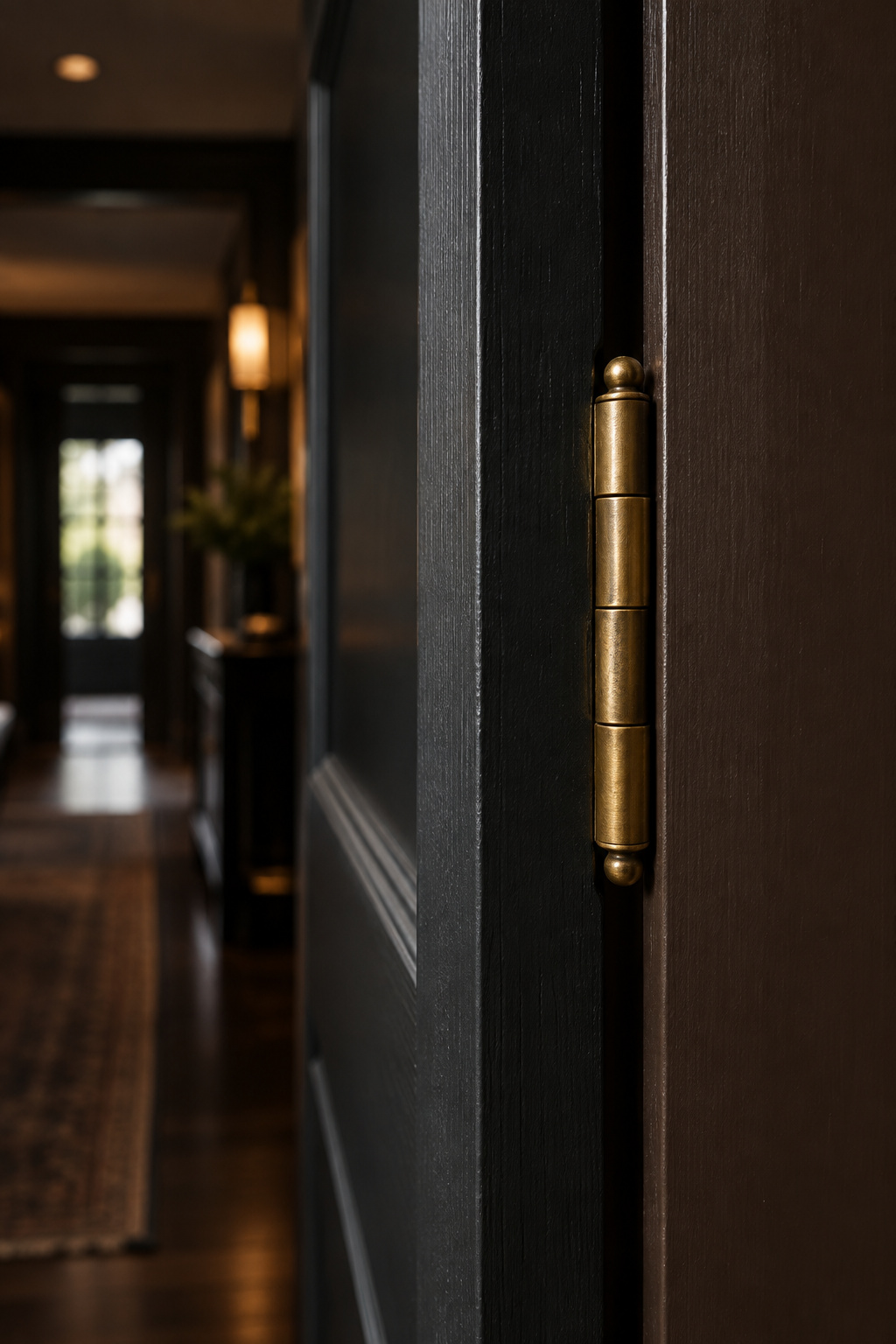
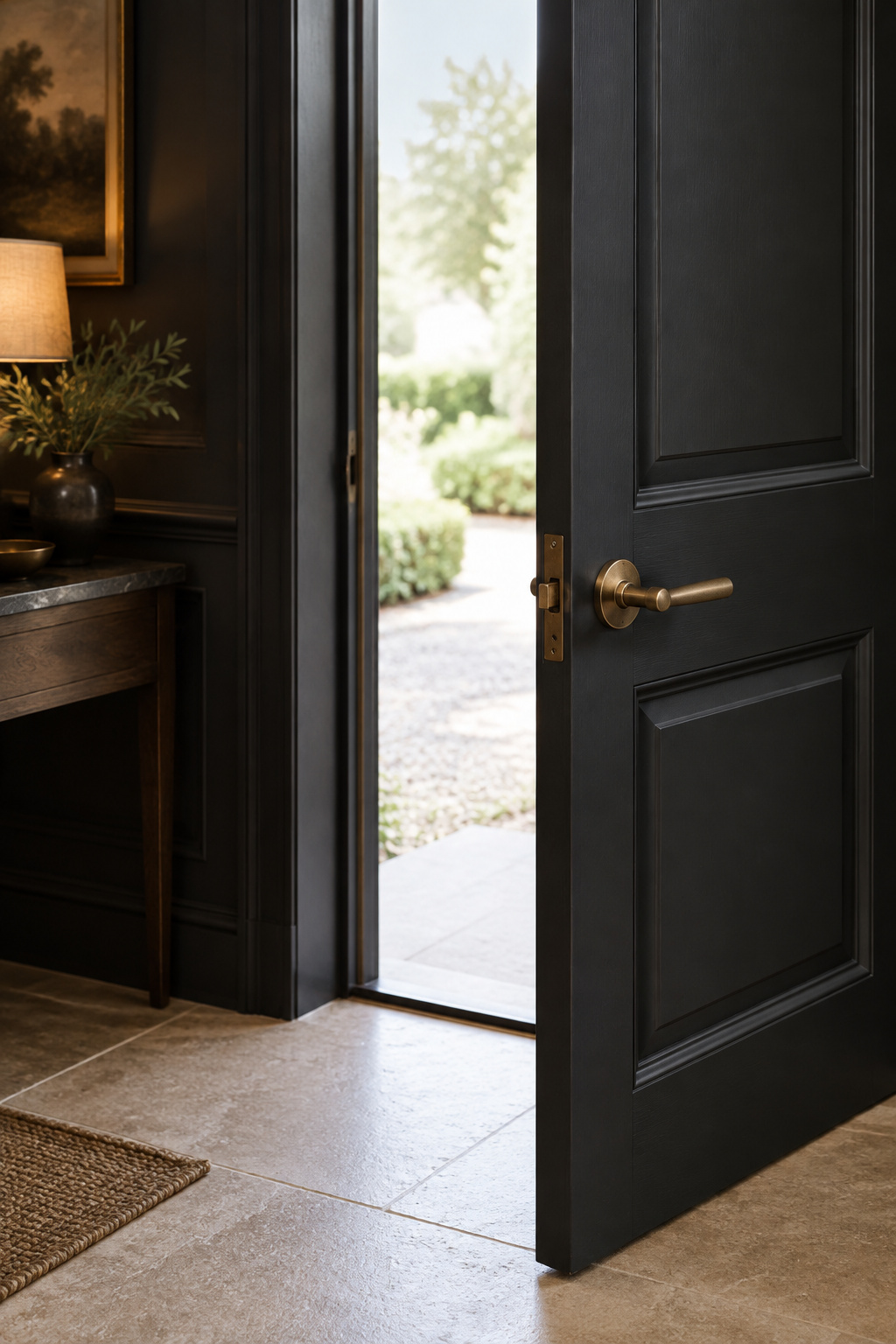
The convention is settled, and Sherwin-Williams’ own how-to states it: paint the hinged edge with the exterior color and match the interior color to the latch edge. On a standard inward-swinging door the reason is physical. A visitor sees the hinge edge from outside when the door stands open, and you see the latch edge from inside as the door swings toward you.
Give each edge the color of the face it belongs to, and let one side dry fully before you turn to the other. The color line then stays at the true arris of the door. The jamb’s interior faces take the interior trim color. The exterior face is a separate job with its own exterior product, so I’ll leave it there.
A stained or clear-coated wood door is the exception. It stays uniform on both faces and edges, because a split on bare timber looks like damage repair.
A paneled door has stiles, rails and raised fields that are joinery in their own right, and keeping a paneled door’s joinery in step with paneled walls matters more than the paint does.
Glass and Sidelights: Reading Color Through Light, Not Beside It
Nobody sees a glazed door as a flat swatch. From inside, you read its color partly in silhouette against the daylight coming through the glass.
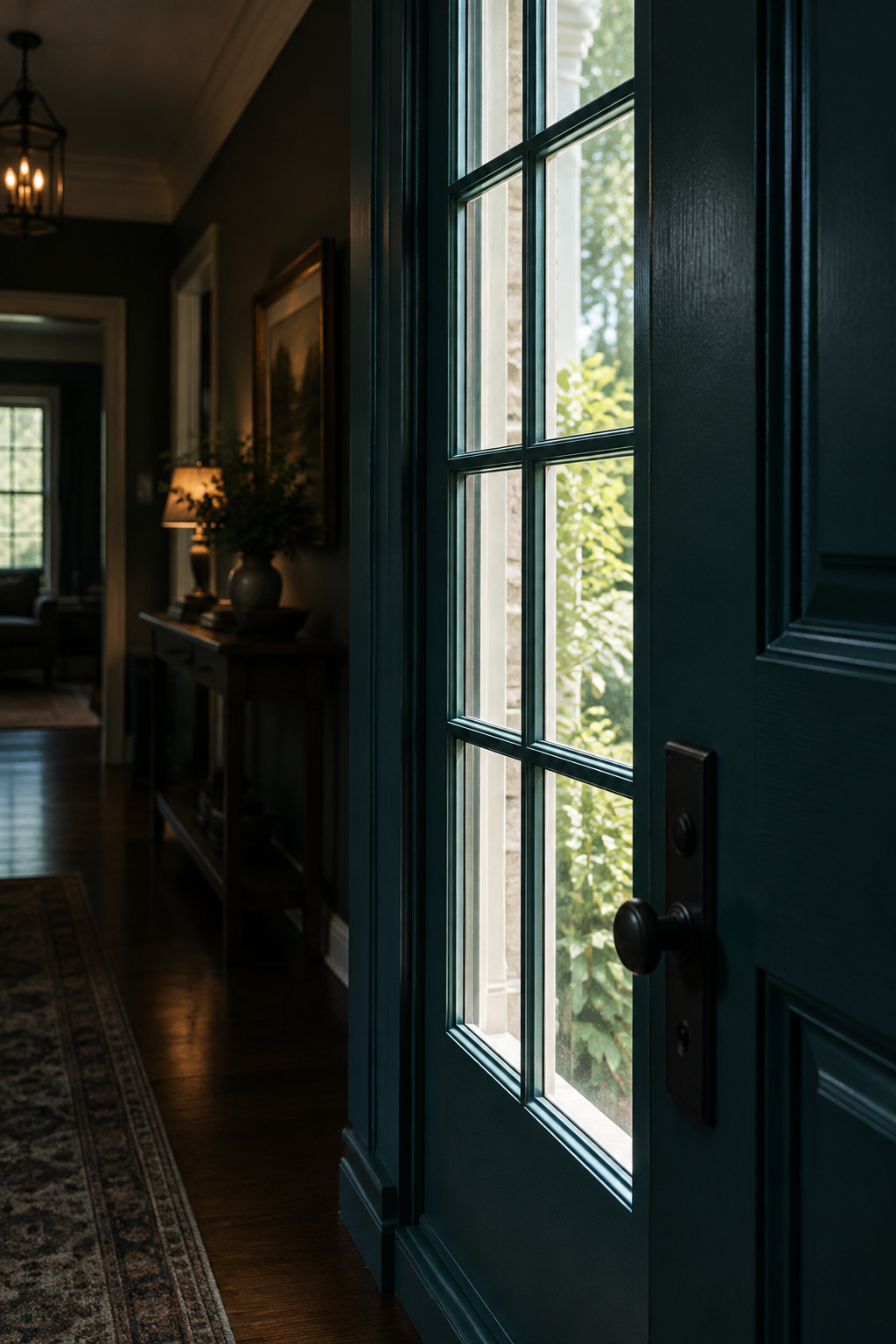
Cassie McDowell of brick&batten sorts sidelights by how much of the frame is glass. A thin-framed sidelight that is mostly open glass acts as an extension of the doorway’s light and pairs comfortably with a dark, wood-toned or black door. A wide-framed or part-glass sidelight acts more like wall and is usually kept in the trim color. Her rules are written for the street view, and carrying them inside is my adaptation.
Metamerism is why a door color can disagree with itself. A match that holds under one light source fails under another, because each source has a different spectral distribution. A color approved under the hall lamp at night can look like another paint against the cooler daylight at the sidelight.
Glazing bars are where I’m speaking from practice alone. In my experience they look best painted the door’s own color on each side, interior color inside and exterior color out, rather than picked out in a third accent. The door then reads as one surface with a window in it. No source tests this, so take it as a restorer’s habit.
Hardware Finish Against a Dark Door
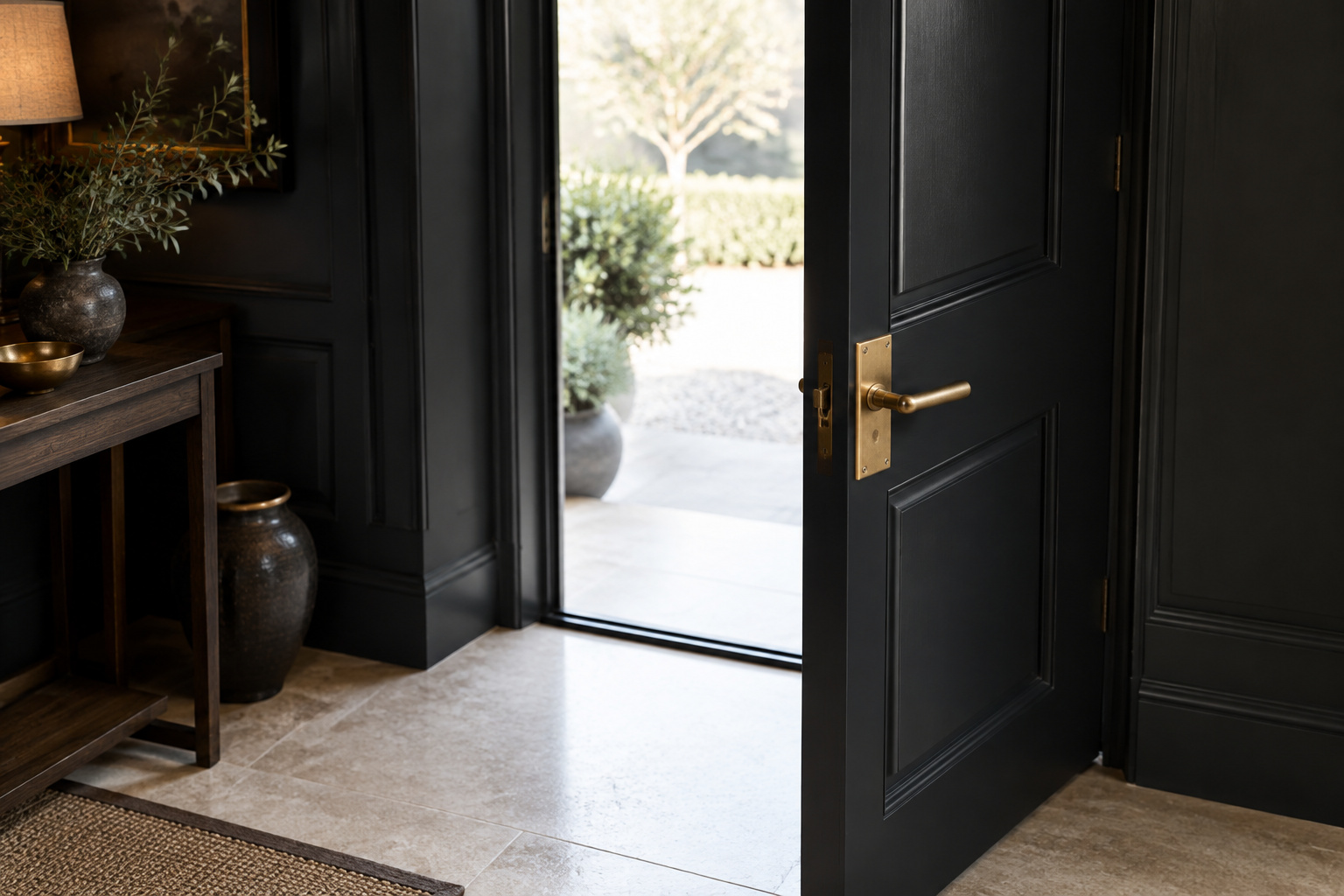
On a dark door the hardware is the brightest thing there, and two variables decide how it behaves. The first is contrast or blend: hardware close in tone to the door stays quiet, and hardware far from it makes the statement. The second is warm or cool. Brass, bronze and copper sit on the warm side, nickel, chrome and pewter on the cool, and mixing across that divide in close quarters is the most common reason a hardware scheme clashes.
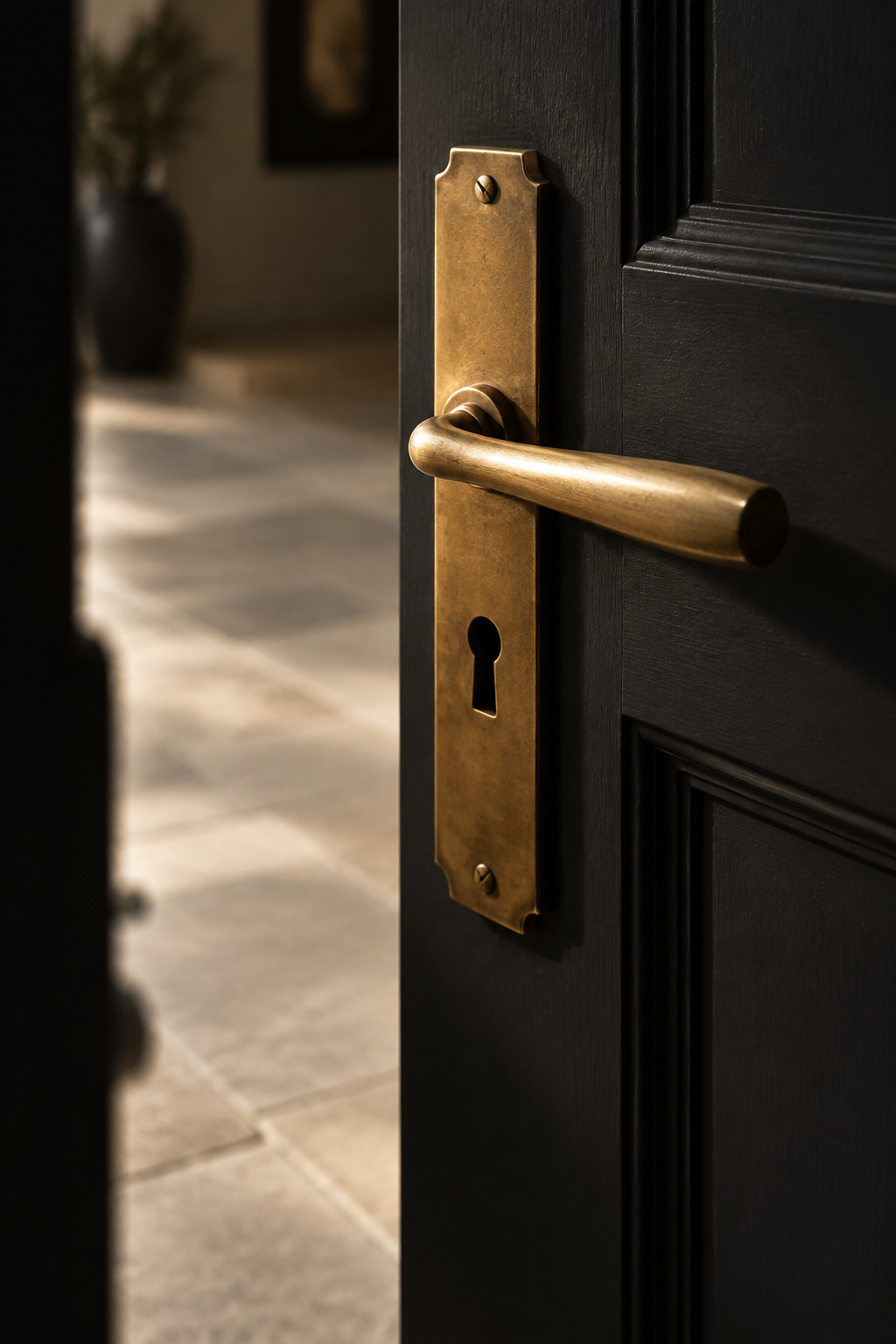
My verdict for a black or near-black door, which is the pairing the sources actually support:
- Satin nickel for sharp, classic contrast that stays understated because the satin sheen doesn’t flash.
- Aged bronze for a subtle, rustic character with no strong visual jump.
- Polished brass as the boldest and most deliberately dramatic of the three.
For other dark families, go by the warm-or-cool rule, since I haven’t found a pairing chart worth trusting. Carry one dominant finish through the sightline, with one or two secondaries.
Then think about wear. One hardware maker reports that budget electroplated zinc alloy shows wear at high-touch points within 8 to 12 months, while a harder substrate stays essentially unchanged for about 2 years. That is a single trade source, so treat it as a direction. Still, a dulling lever shows more against a dark door than a pale one.
Finish-First: What’s Already on the Door, Primer, and Door Enamel
At nineteen I ruined an oak chest by stripping it with the wrong solvent, because I never asked what finish was on it. Every door since has started with that question. Primer, sanding and enamel all depend on the answer, and front doors are layered.
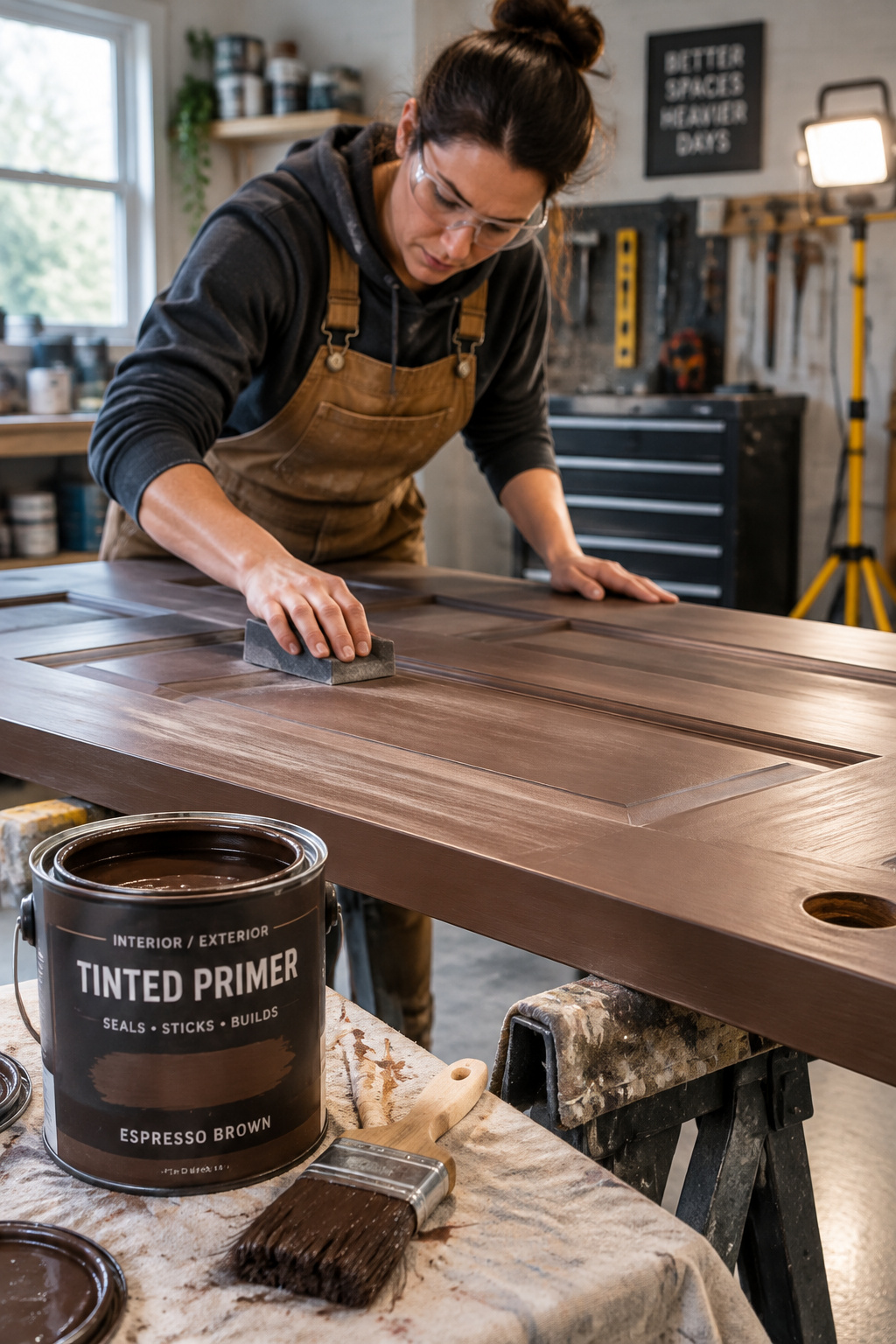
- Establish what’s on the door. Old oil, bare wood and prior latex each take a different route. If you can’t tell, choose the primer that forgives it.
- Choose the primer for the substrate. Over old oil, an oil alkyd primer such as Zinsser Cover Stain needs a 220-grit scuff-sand first on glossy surfaces. It touch-dries in 2 to 4 hours, yet it still wants an overnight wait before a water-based topcoat, despite its 1-hour label recoat time. A shellac-based primer such as Zinsser BIN bonds to cured oil paint, glossy alkyd trim and old varnish without scuff-sanding, so it is the faster route when you don’t know the door’s past.
- Tint the primer toward the topcoat when you’re making a big shift into a dark color, so the old one doesn’t ghost through.
- Finish in a door and trim enamel, not wall paint. Benjamin Moore Advance is a block-resistant waterborne alkyd for doors, trim and cabinets, and glossy alkyd underneath needs sanding first. Sherwin-Williams Emerald Urethane Trim Enamel is a urethane-modified alkyd that recoats much faster.
Don’t skip the scuff over oil, and don’t go finer than 220 grit. Exterior paint’s lifespan claims don’t transfer either, since that paint is rated for weather this face never sees. Proper prep also lets the next owner strip the door back cleanly, which is the reversibility this whole job owes them.
Cure Time and Blocking: Why a Freshly Painted Door Sticks to the Weatherstrip
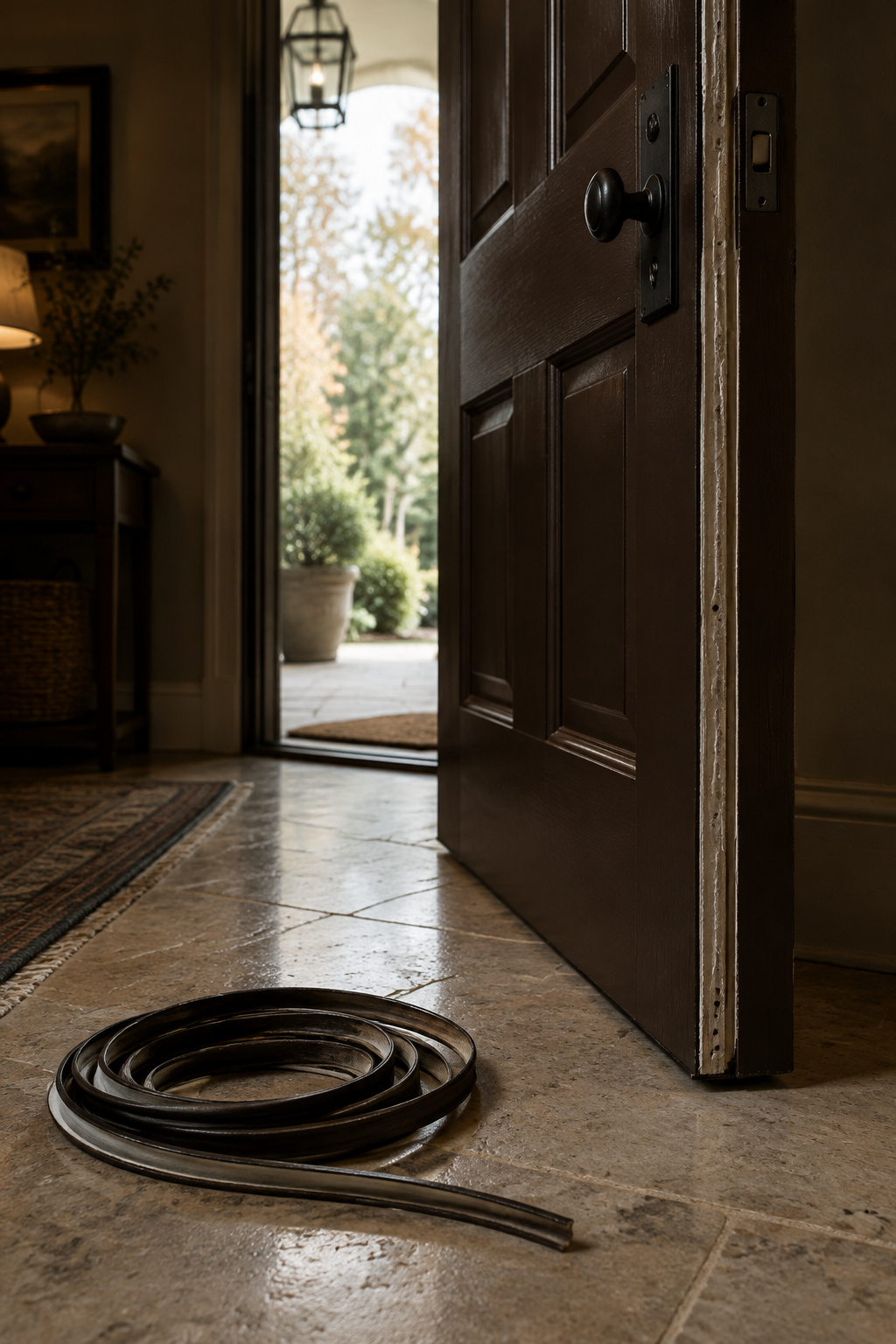
Dry and cured are different states, and the weatherstrip knows it. A dry surface has lost its tack. A cured one has finished a chemical hardening that takes days to weeks. Tim Carter of AskTheBuilder points out that a tight weatherstrip blocks the evaporation the cure depends on whenever the door is shut, which is why some doors keep sticking for a year or more.
The two enamels run on very different calendars (technical data sheet figures at 77°F and 50% relative humidity):
| Enamel | Touch dry | Recoat | Before normal use |
|---|---|---|---|
| Benjamin Moore Advance | 4-6 hours | 16 hours | No heavy use for 3-5 days; full hardness up to 30 days |
| Sherwin-Williams Emerald Urethane Trim Enamel | 1 hour | 4 hours | Set by its own data sheet, not by touch |
A door swinging against weatherstrip every day is exactly the abrasion the Advance sheet warns against. The trade fix is to pull the weatherstrip before painting (most jamb-applied strip lifts out of a groove), let the door cure with it out, and reinstall after two to three weeks, sooner in hot dry weather. If the door can’t stand open that long, painters name Benjamin Moore Command and PPG Breakthrough, chosen for early blocking resistance.
For the door in the context of its whole room, see where the door sits in a dark moody entryway.
I can’t give you a single cause for the sticking. A door-installation specialist reports a second mechanism entirely. The vinyl bulb on older jamb-applied weatherstrip adheres to latex enamel however long it has cured, and swapping to a silicone bulb fixed doors that extra waiting hadn’t. Both camps have evidence, and nobody I’ve found reconciles them. If your door still sticks well after the cure window, stop waiting and look at the bulb.
FAQ
Do you need special paint for a front door, or will regular interior wall paint work?
Use a door and trim enamel, not wall paint. Enamels such as Benjamin Moore Advance are made for high-touch surfaces and described as block-resistant, which is what a door closing against weatherstrip needs. Let the chosen enamel’s own data sheet set the recoat and cure schedule.
Should interior door hardware match the exterior front door hardware finish?
No. You see each side at a different moment, so each finish only has to suit the surfaces immediately around it, and each side should stay within one undertone family, warm or cool. Check your lockset first, though, because some deadbolt and multipoint hardware ties both finishes together as one product.
Is it fine to paint just the inside of the door and leave the outside as it is?
Yes, for a painted door, since the two faces are separate color decisions. Paint the latch edge to match the interior face and allow the full cure before normal use. A stained or clear-finished wood door is the exception. It should stay uniform on both faces, because painting one side looks like a repair.