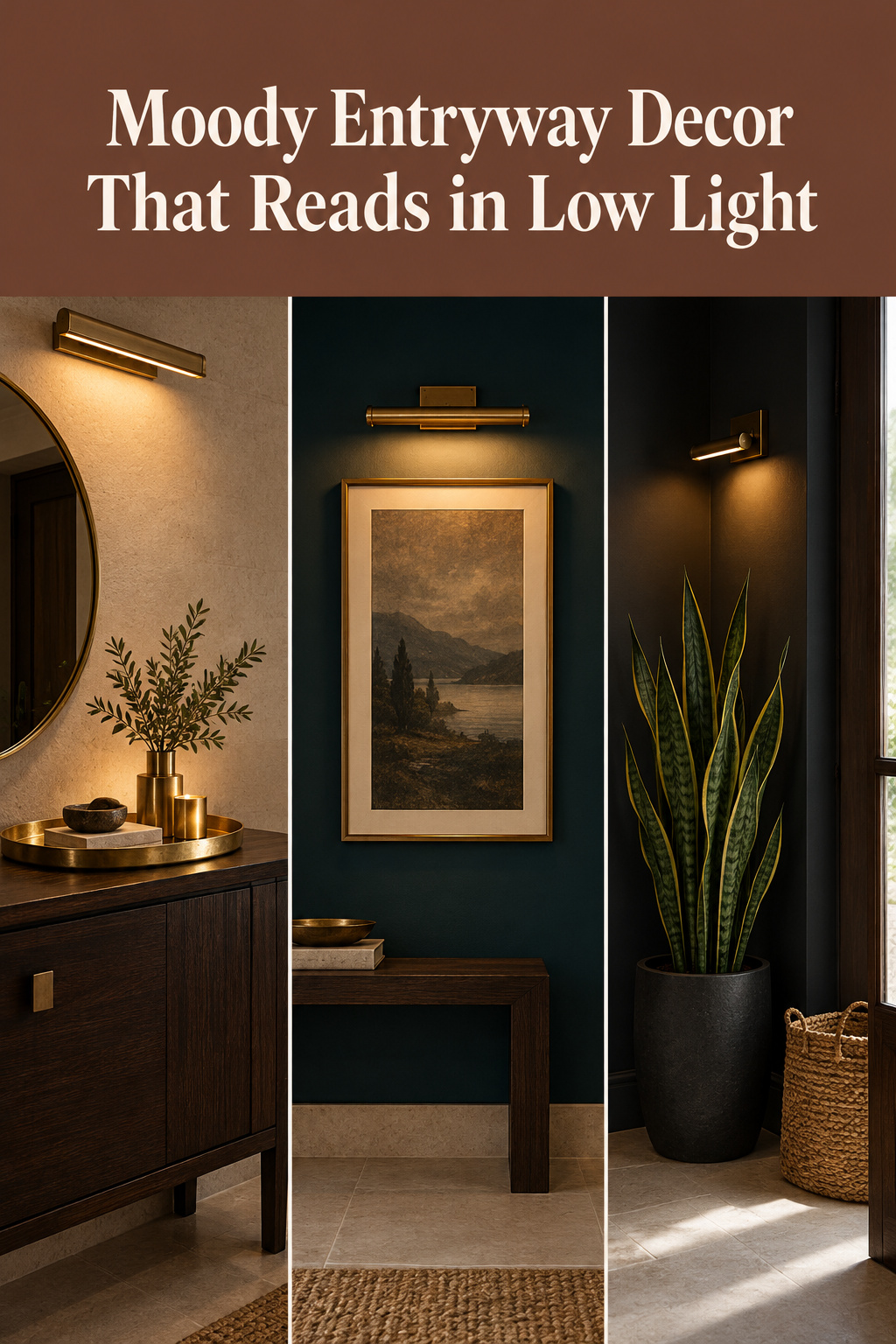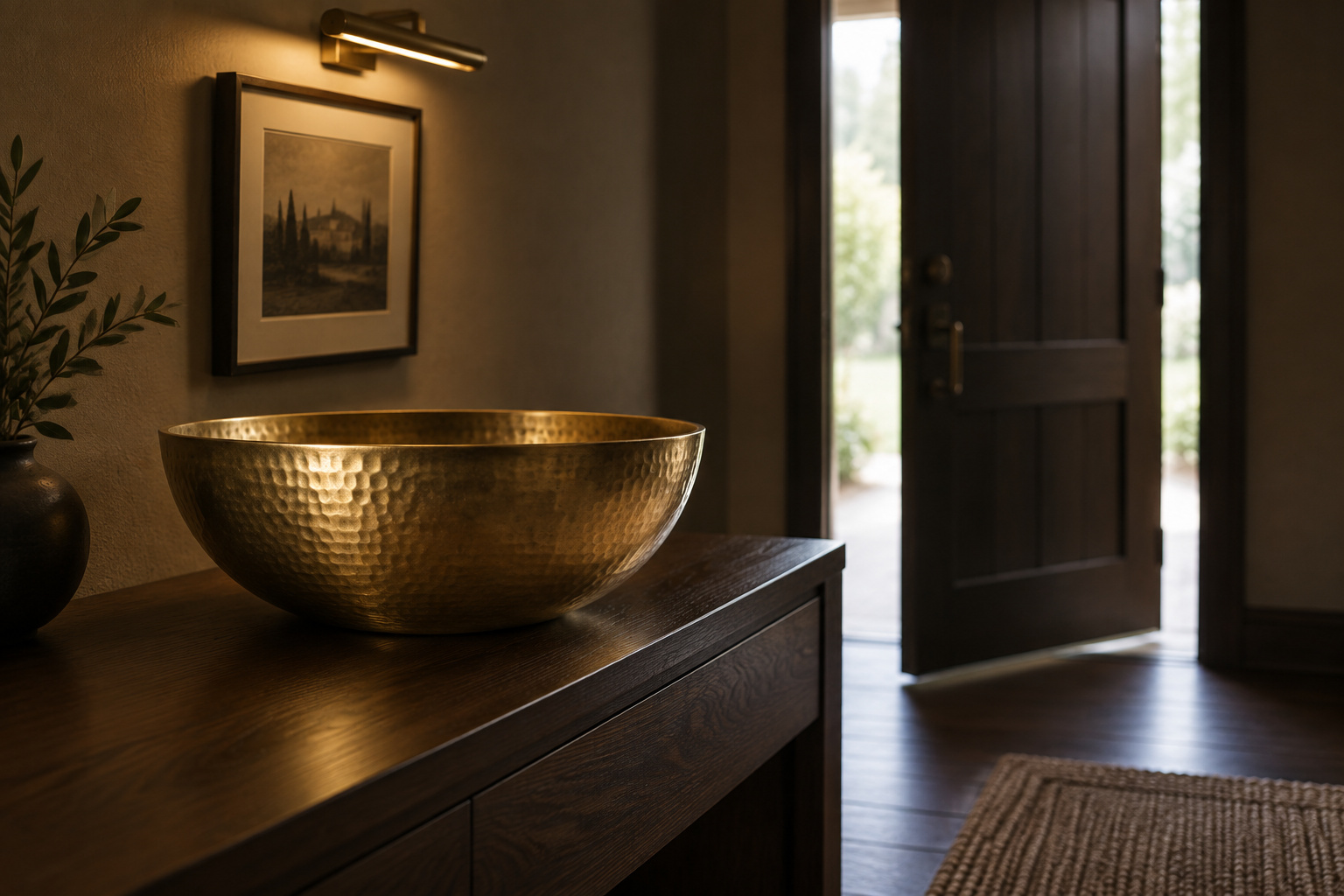
What a dark entry lacks, most evenings, is light to spare. Nearly every object we carry into it was chosen somewhere brighter, on a shop floor or a sunny afternoon, so most moody entryway decor is quietly failing at the one job it was brought in for: being seen. So an entry can be full and still feel like nothing.
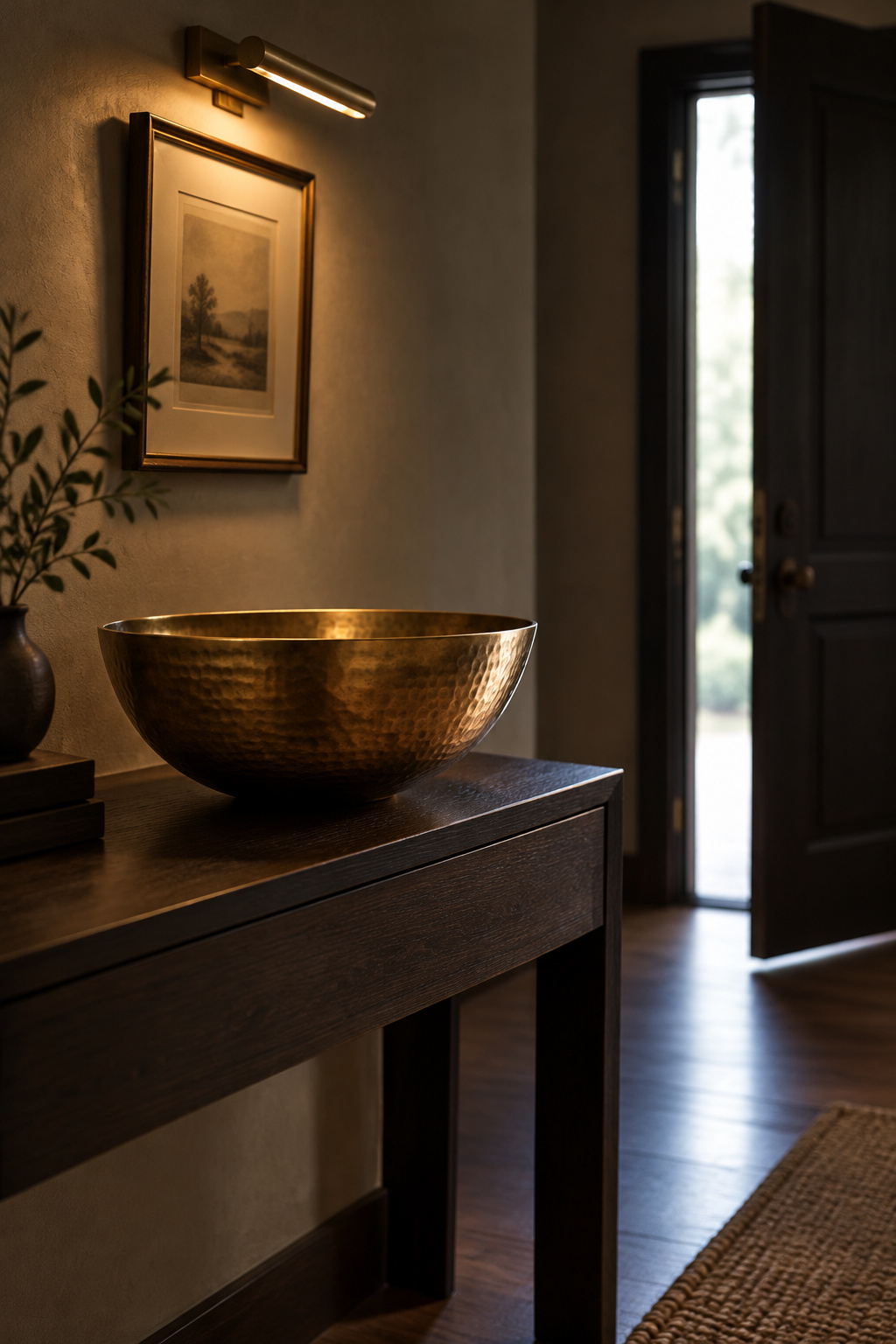
Underneath sits an older question: how do you want to be met when you come home? By a few things that hold you, I think, rather than many that ask. What follows sorts what still shows in low light and gives you permission to take out the rest.
TL;DR
- Most unlit decor disappears after dark. Home evening light runs around 50 lux, against roughly 400 lux under office lighting (Northeast Document Conservation Center reference figures). Unlit art on a dark wall is essentially invisible at night.
- Keep what catches light. Raw texture (jute, unglazed ceramic, hammered metal) works, as do two to three metal finishes split roughly 70/20/10, each finish appearing in at least two places.
- Light the art, choose tolerant plants. Mount a picture light about 6-7 inches above the frame, no wider than 50-75% of the artwork. For plants, pick snake plant, pothos, cast iron plant or ZZ, and keep it above 55°F near a drafty door.
Why Low Light Changes What Moody Entryway Decor Means
Fifty lux. By the Northeast Document Conservation Center’s reference figures, that is roughly what ordinary home lighting gives a room in the evening, against about 400 lux under office lighting and around 30,000 in direct sun. After dark, an entry lit only by its own fixtures behaves like a different room.
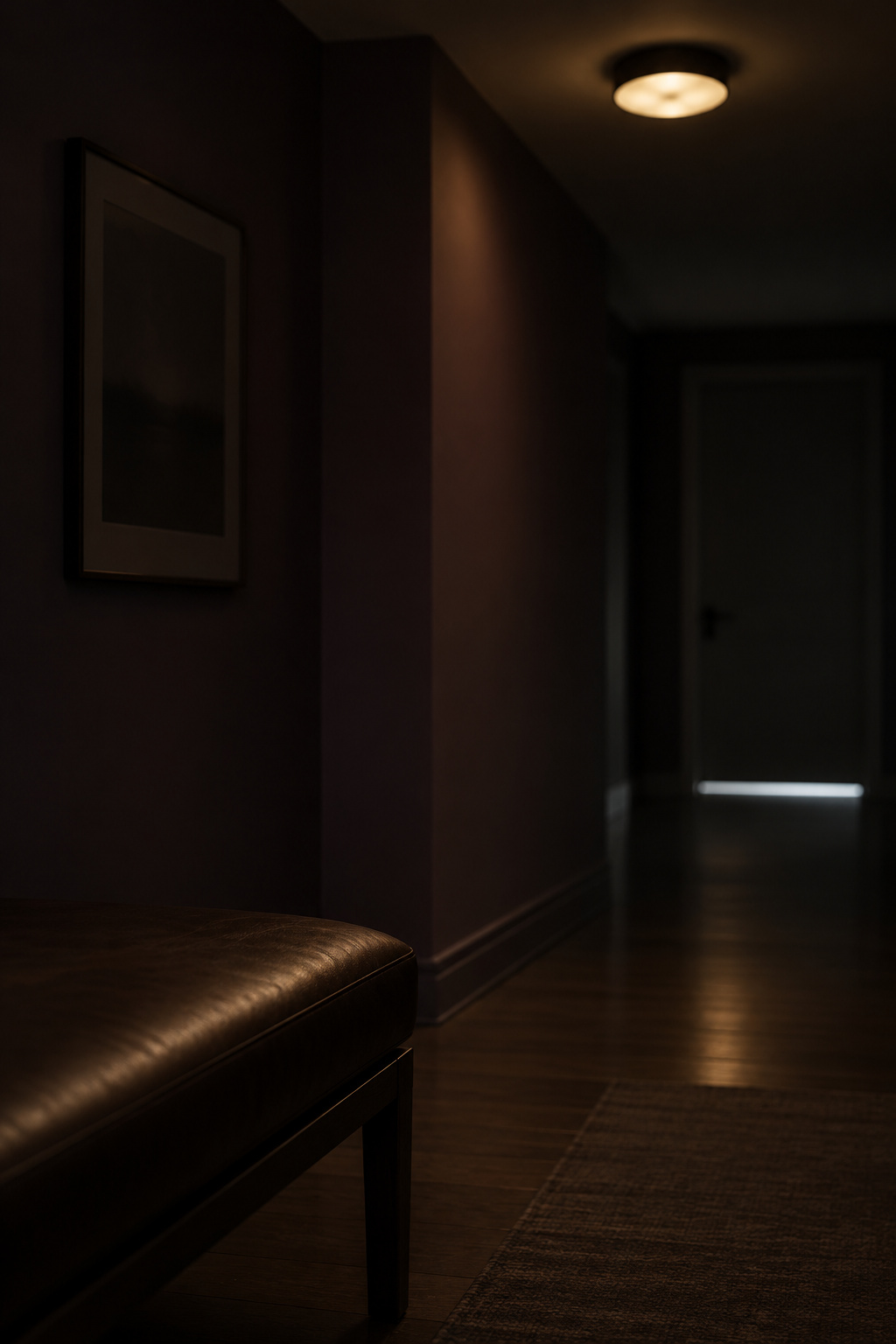
In a bright room, an object stays because you like it. In a dark entry, liking isn’t enough; it has to be visible. It shows itself by sending light back to your eye, and when there is very little to send, the work falls to its own surface, its texture and sheen, or to a small lamp of its own.
This article keeps returning to one diagnostic. After dark, switch off everything except the entry’s own lights, with no glow borrowed from the kitchen or the hall beyond, and look at what you can actually see. Whatever has vanished isn’t doing decorative work, whatever it cost.
Try it tonight.
Fewer Objects, Better Lit
The usual mistake is a generous one. The entry feels unfinished, so we add a dish, a candle, another dish, until the surface is full and the room still feels empty after dusk. Each unlit thing competes for the same thin supply of light, and each one loses.
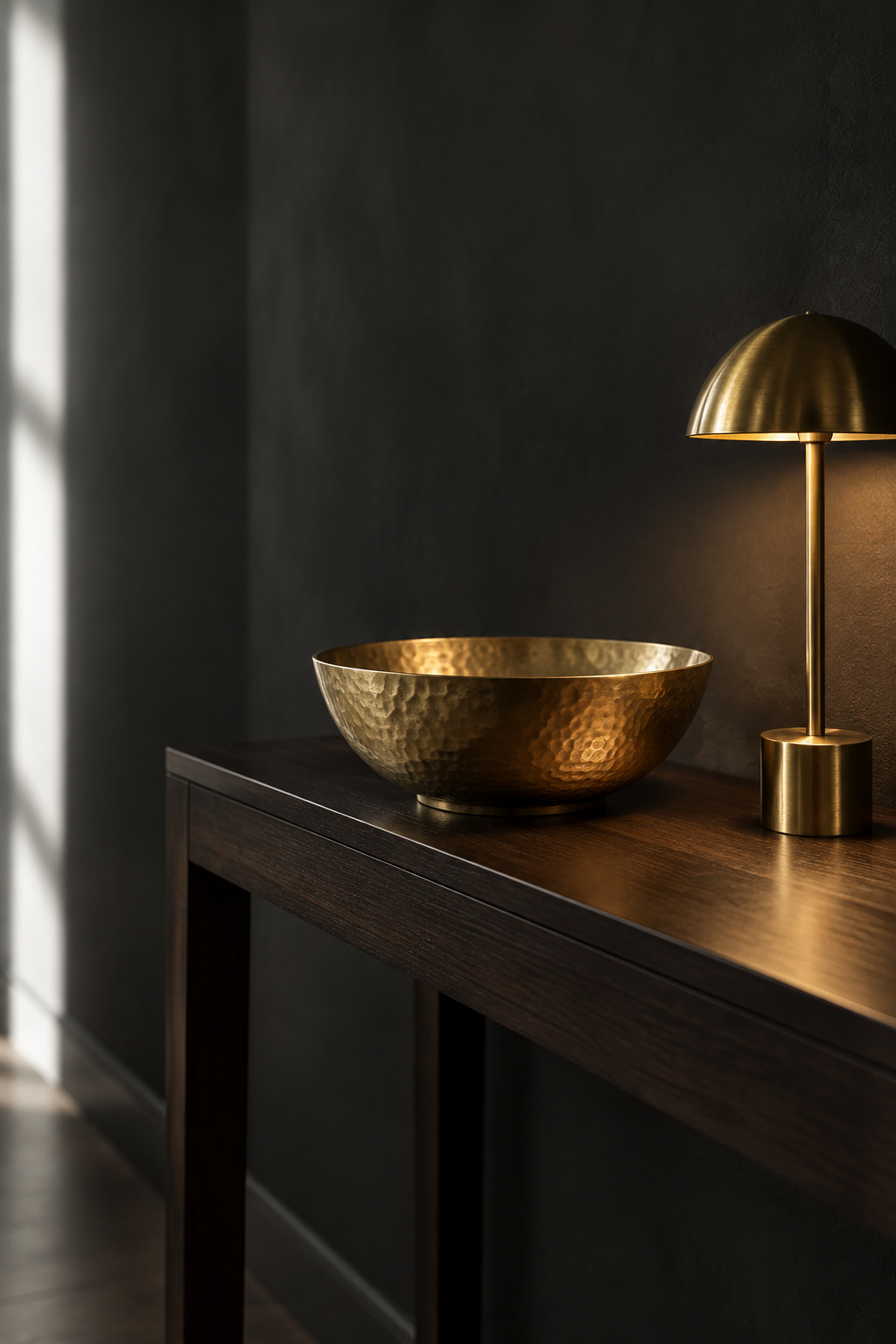
Subtracting works better. Choose one or two objects and give each its own small source, whether a plug-in accent lamp, a puck light or a picture light. With no ambient fill to share around, one lit object does more visible work than a second or third unlit one. The console becomes a landing place for a single thing, a lamp or a bowl in a lamp’s pool, rather than a display.
Interior designer Kathy Kuo puts it plainly: “When you pare back and create breathing room, your true stars get to shine.” In a dark entry they shine literally or not at all. The mind can settle on one lit object, but six half-seen shapes keep it searching, and searching is the opposite of arriving.
Clear the console down to one object, and give that one a light.
Texture and Metal That Catch What Light There Is
A dark entry should feel quietly alive, with surfaces that glint a little as you pass instead of a row of silhouettes. That comes from texture more than color. Raw and woven surfaces make tiny shadows and highlights across themselves, so they register when there’s barely any light to register by. A flat, matte, single-tone object reflects so evenly that it simply isn’t there.
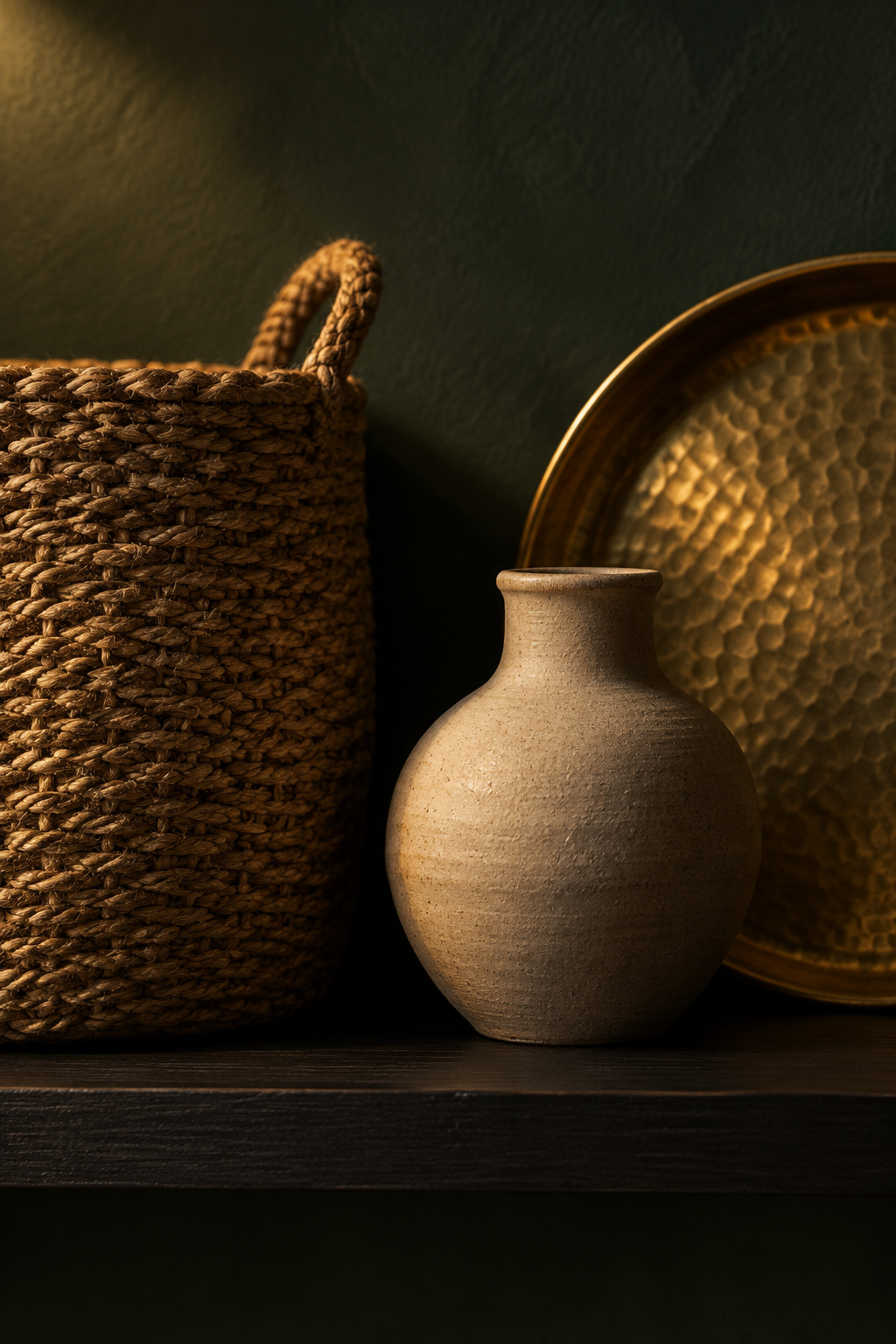
The materials that hold what little light there is:
- Jute and other woven fibers, whose weave throws its own small shadows
- Unglazed ceramic, rough enough to catch the edge of a lamp’s pool
- Aged or hammered wood, where grain and dents do the work
- Hammered or brushed brass, which breaks light into points instead of one flat glint
Metal needs a limit, and designers agree on it: two to three finishes in a room, weighted roughly 70% dominant, 20% secondary and 10% accent. Miriam Silver Verga and Hillary Kaplan of Mimi and Hill add the part people skip: “each type of metal should be seen in at least two places in a room.” A single chrome piece in an otherwise brass entry looks accidental, not chosen.
A mirror is its own question, and not one this article answers.
Pick up the flattest object in your entry and ask whether you’ve ever really seen it after dark.
Art That Needs a Picture Light, or Isn’t Really There
Art on a dark wall after dusk is not dim. It’s gone. Evening light is thin to begin with, and a deep wall reflects almost none of it back onto the piece. Apply the after-dark look to your framed work and most of it turns into dark rectangles on a dark wall.
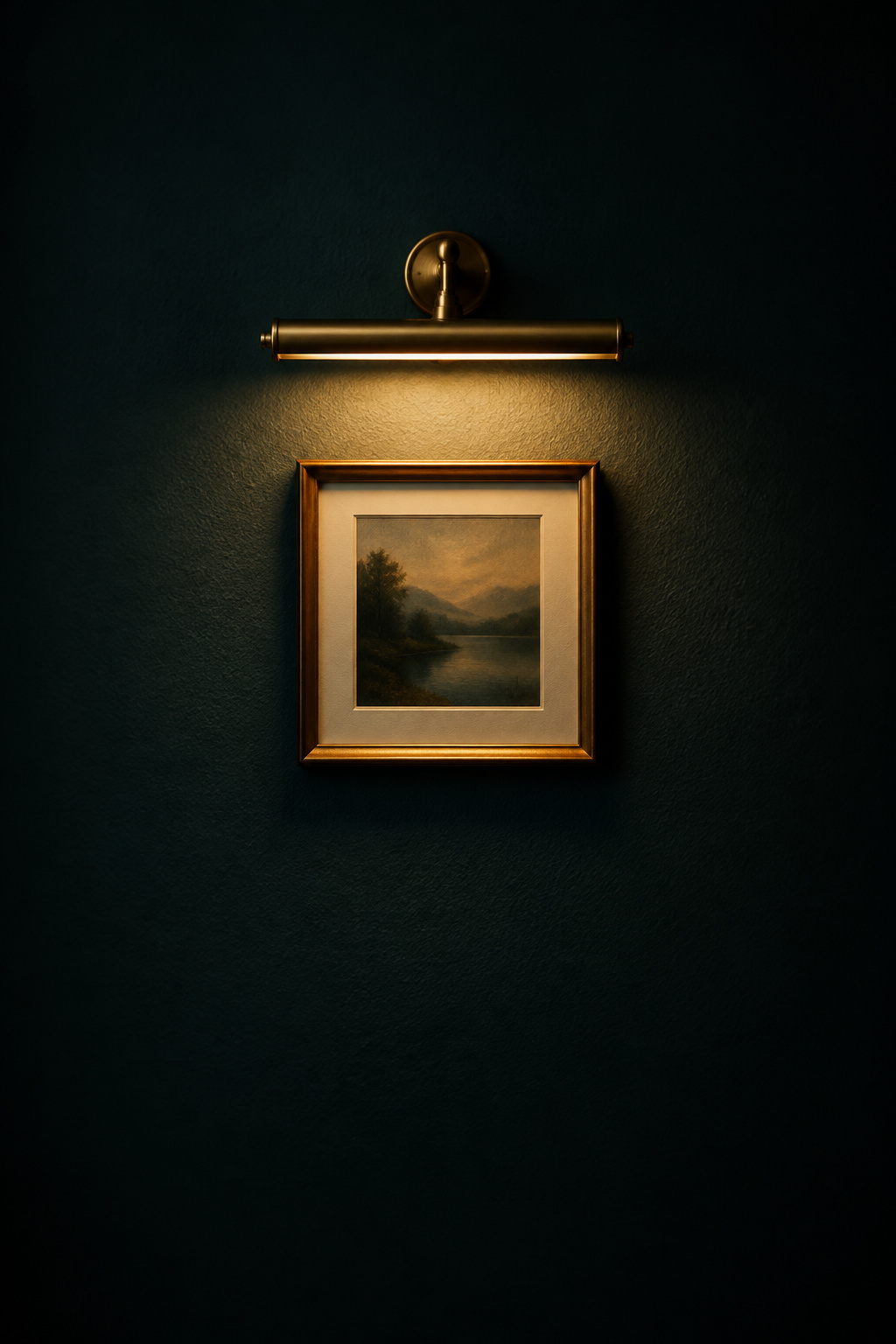
So the decision that matters is picture light or no light. Frame and subject come second. A print you love with no light on it does less for the room than a bare wall, because the bare wall at least isn’t asking you to squint.
If you light it, the placement figure holds steady across several lighting guides. Mount the fixture about 6-7 inches above the top of the frame, no wider than 50-75% of the artwork. Treat that as a starting point, since Viva Vanity’s guide is candid that projection, beam spread and frame depth all shift it. For color, the lighting retailer Edishine recommends dimmable 2700K warm white at home, rather than the 3000K used in institutions, with a CRI of 90 or above. That spec rests on a single source, so hold it lightly.
Where a piece hangs along the route matters too, and how the light along the passage decides what gets seen is its own study.
Hang nothing new until you know where its light will come from.
Plants That Tolerate an Entry’s Dark Corners
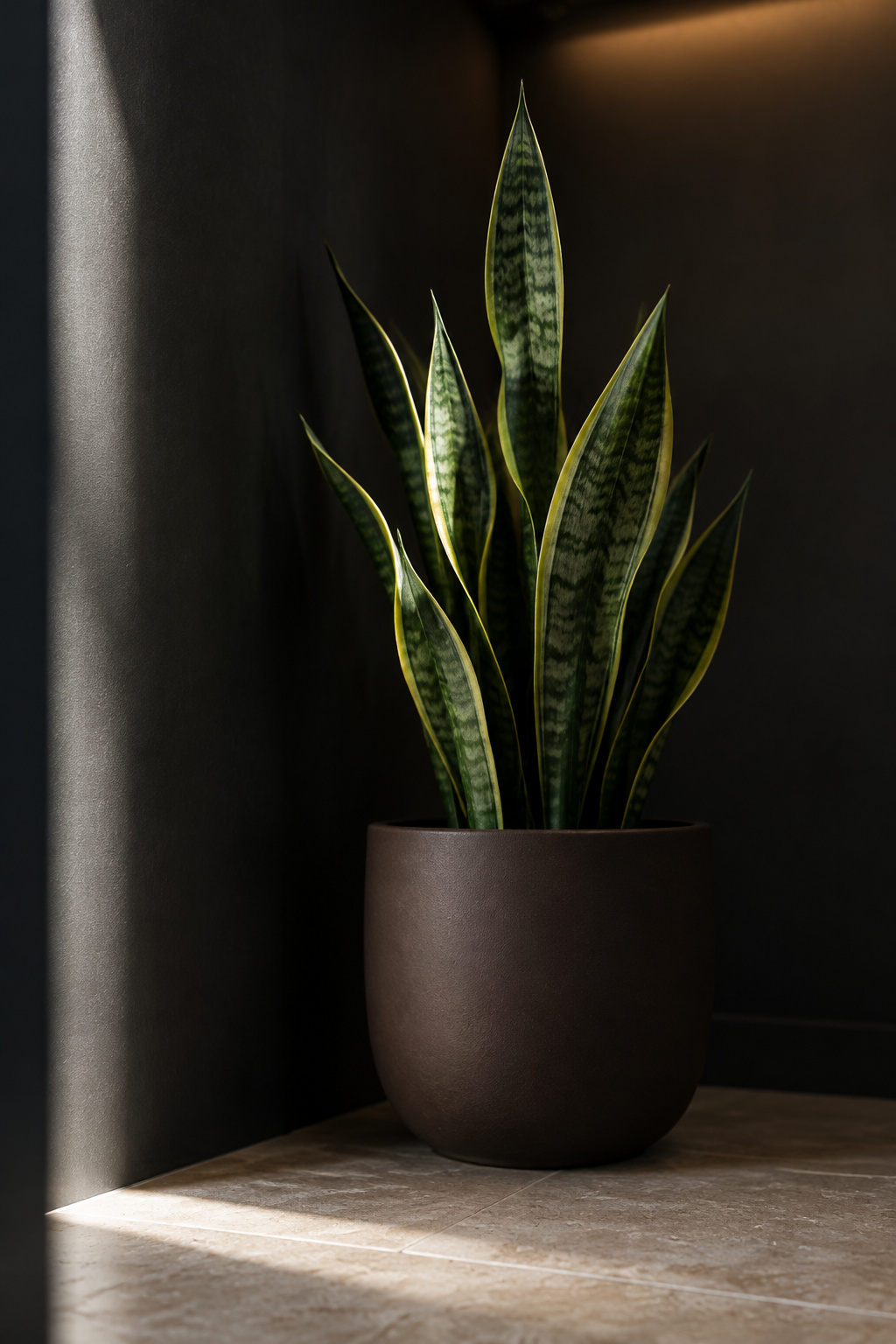
Can anything living settle here? Yes, if you’re honest about what an entry offers a plant, which is a brief spell of daylight, a draft every time the door opens and cool air near the floor. Below about 25 foot-candles, even the hardiest species need a grow light to survive long-term. Above that, a short list genuinely copes. The four worth choosing between compare like this:
| Plant | Light | Near a drafty door | Care note |
|---|---|---|---|
| Snake plant | Almost any, low to direct | Forgiving | Overwatering kills it far more often than shade |
| Pothos | Low to moderate | Prefers average room temperature; keep it a few feet back | Let soil dry moderately between waterings |
| Cast iron plant | Low, indirect (direct sun scorches) | Tolerates cold drafts better than most | Keep above 55°F |
| ZZ plant | Low (trade sources) | Listed as cold-tolerant by trade sources | Water every 1-3 weeks |
Iowa State University Extension names snake plant and pothos as the pair that cope with low light and inconsistent watering. Cast iron plant goes nearest the door. ZZ plant’s case rests on trade sources rather than an extension service, which makes it a reasonable bet and no certainty. Note that “cold-tolerant” means forgiving, not frost-hardy, so keep any of them above 55°F.
Like everything else, a plant is seen against a wall, so what reads against the wall color behind it is worth settling before you choose the pot.
If there’s a pothos by your front door, move it a few feet back this week.
The One Object That Holds the Whole Entry Hostage
A client of mine in tech once had a beautiful new meditation room and couldn’t use it. The trouble was the wall clock. I took it down and the room became usable, the same room — minus one object. I think of that clock whenever a space feels wrong in a way nobody can name. One object with the wrong presence, whether too demanding, too loud or unrelated to what the room is for, can undo everything chosen well around it.
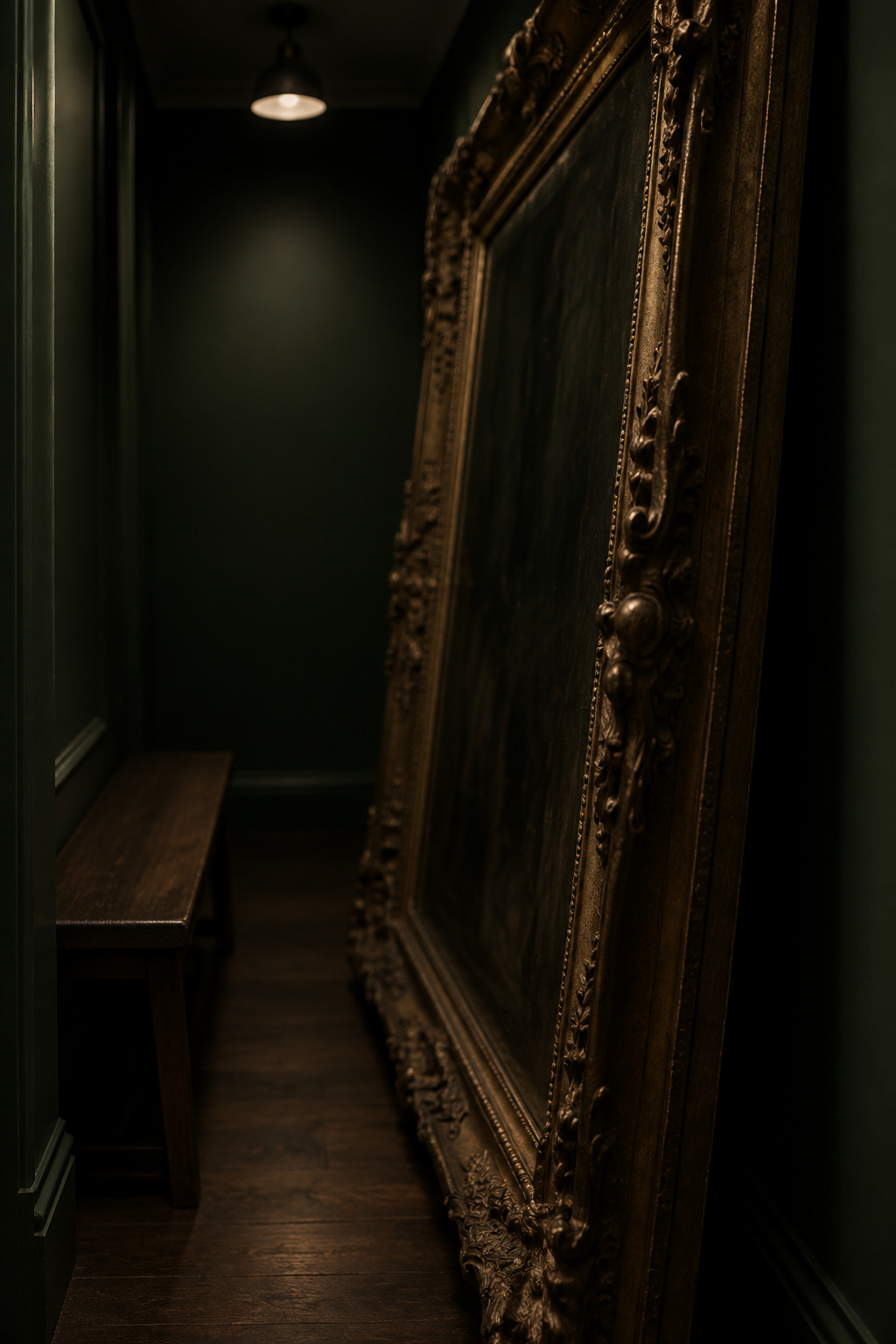
This is my own observation, not a rule: a dark room punishes the wrong object more than a bright one does. In a well-lit room, an awkward piece blends into the general glow. A dark entry has no glow to blend into, so the wrong object either takes the only pool of light you have or sits in shadow, unseen and still in the way.
So remove before you add. The first candidates to go:
- Anything that vanished in the after-dark look
- The piece you keep only because of what it cost
- A metal finish that appears exactly once
- Anything that demands attention the moment you arrive, like a busy pattern or a crowded surface
Sound and scent count too, since a rattling fan can hold an entry as surely as a clock. What stays is short: texture and metal that catch light, art with its own lamp, a plant that tolerates shade. The rule is simple. If it can’t be seen after dark and can’t be given a light, it goes. How these objects sit with the wall, the door and the light lives in the full shadowed-entry plan.
The cheapest version costs nothing and undoes in a minute. Choose the one object you suspect and put it in a cupboard for a week. If you miss it, it goes back, and now you know why it belongs. If you don’t, you’ve found what was holding the room, and what’s left is the entry you wanted to be met by.
FAQ
Do I need a mirror in a dark entryway?
No. A mirror is its own decision, separate from the objects covered here. If you already have one, it can count as one of your few lit objects when a light source sits close by. Texture, metal, lit art and a tolerant plant all work without one, so nothing here depends on a mirror.
What houseplants actually survive in a windowless or low-light entry?
The most consistently named are snake plant, pothos, cast iron plant and ZZ plant, with cast iron plant the best choice near cold drafts. A truly windowless entry is harder. Below about 25 foot-candles (roughly 270 lux), even these need a grow light to survive long-term. Keep any of them above 55°F.
Should entryway art be lit differently than art in the rest of the house?
Not in method, but more urgently. With home evening light around 50 lux, unlit art on a dark entry wall is close to invisible after dusk, so a picture light is nearer a requirement than an upgrade. Mount it about 6-7 inches above the frame, warm and dimmable, with a high color rendering index.