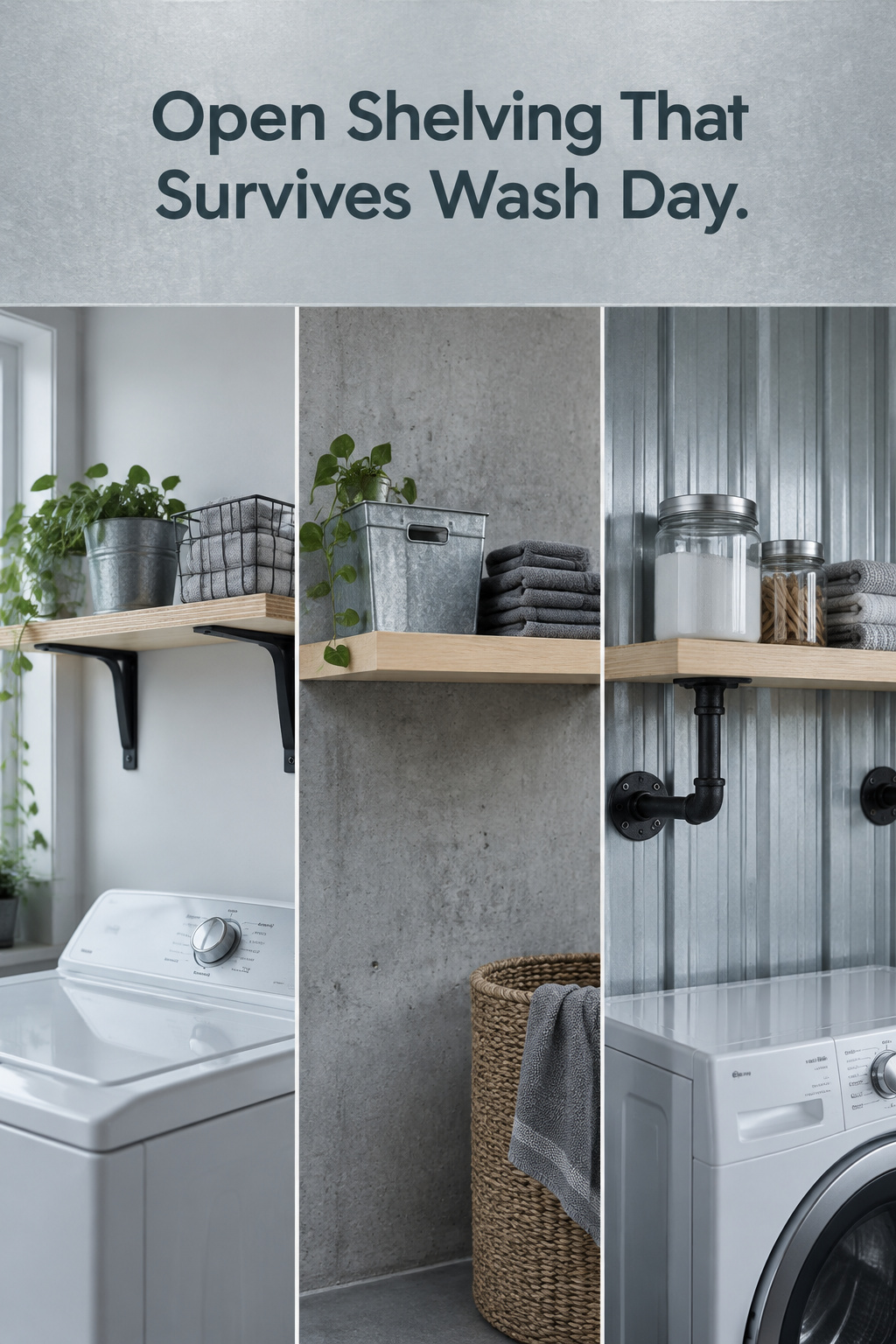
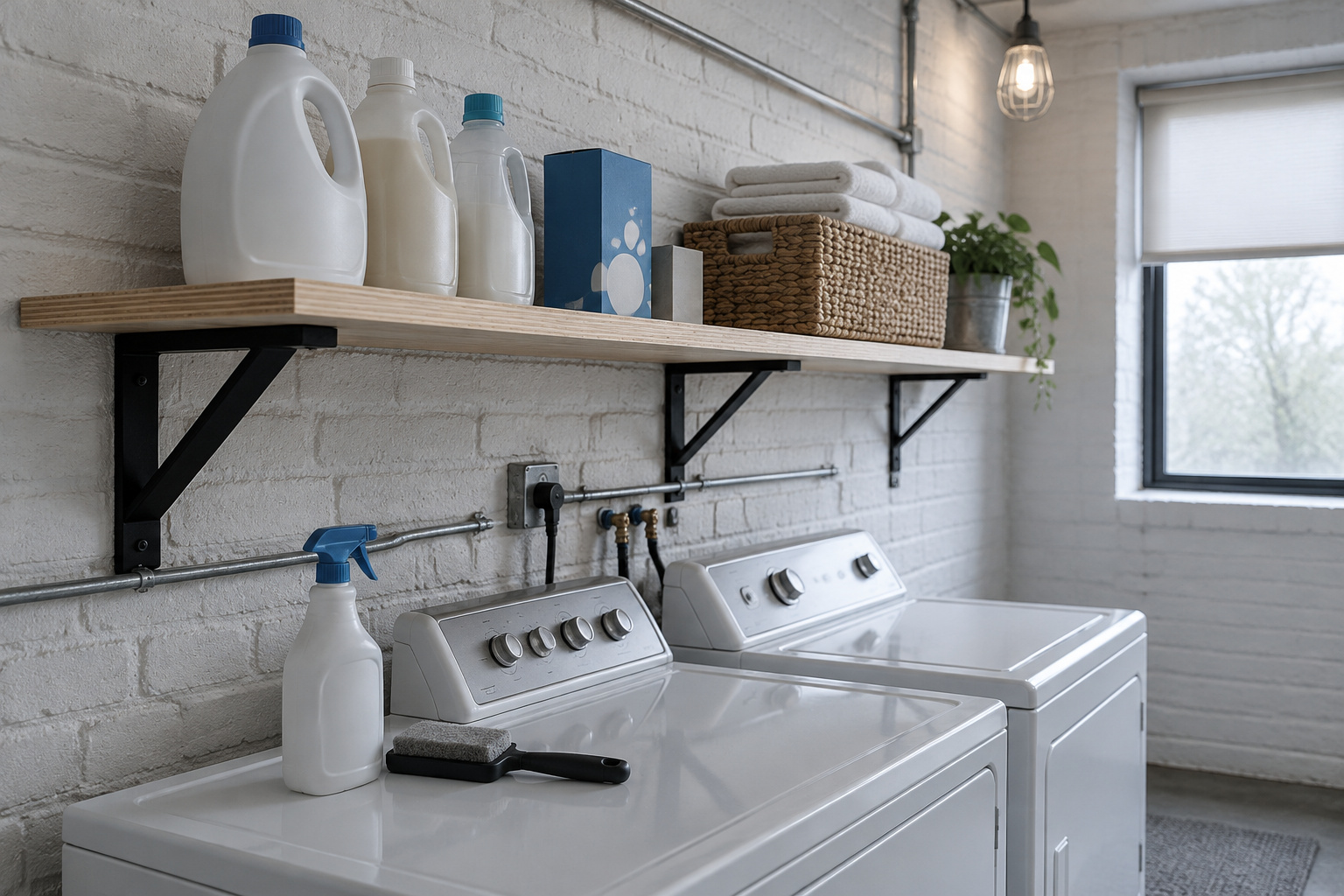
One hand is still in the washer, untangling a knot of damp sleeves, when the other goes up for the detergent. Beside you the dryer is mid-cycle, a dull tumble and a breath of warm air at your shins, and the room smells of hot cotton and the faint sweetness of the jug your fingers are already searching for. You find the cap before your eyes do. The jug is full, heavier than you remembered, and for half a second it rocks on the lip of the board before your grip closes and it comes down to you. The shelf answers with a small creak, and nothing falls.
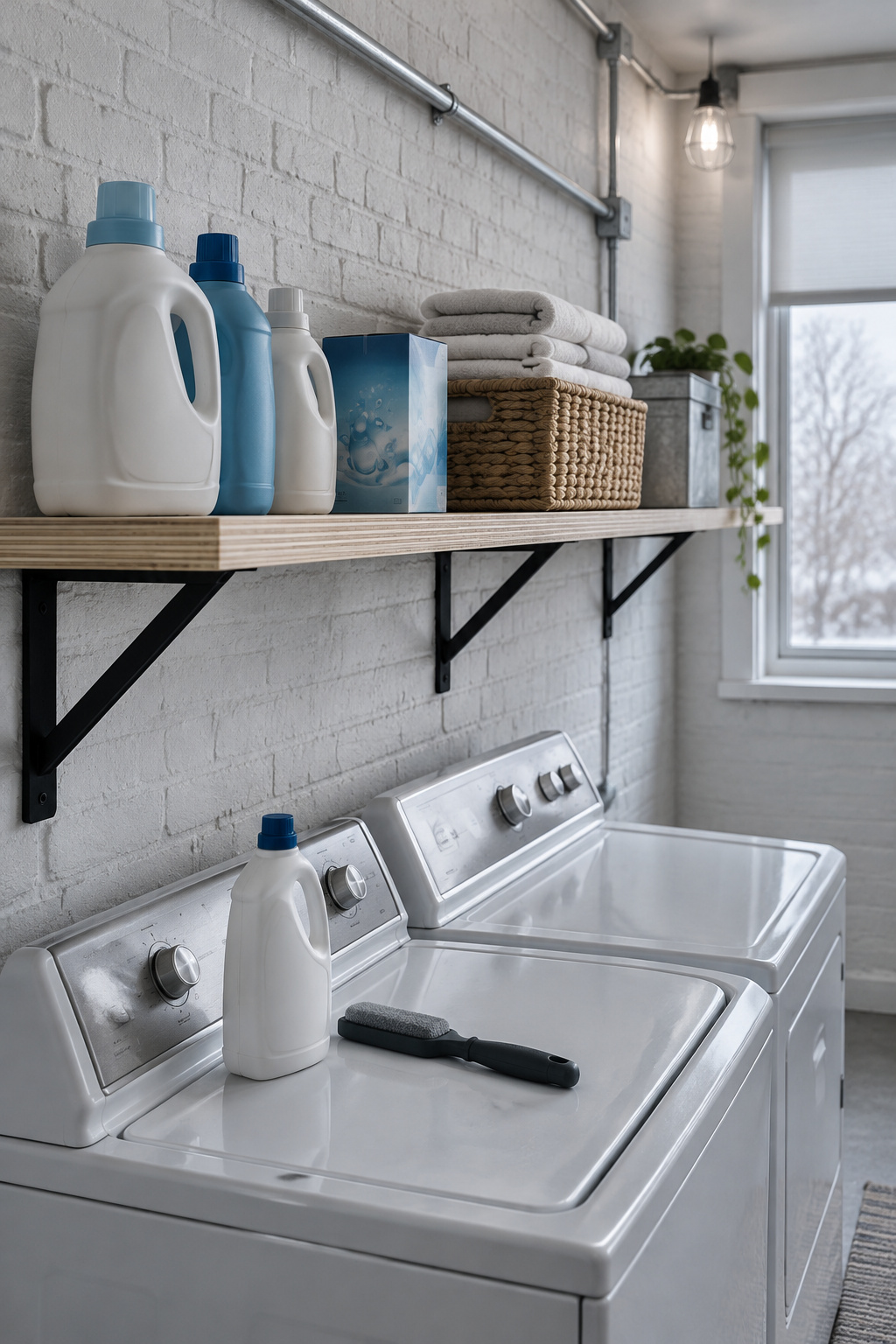
That half second is laundry room open shelving doing its real job, with nobody photographing it. For most of the day the shelf is furniture, and for a few seconds of every load it is equipment. In those seconds it should give you no feeling at all: a reach that lands, a weight that comes down cleanly, a board that keeps quiet. That calm can be built, out of a handful of decisions made before the first hole is drilled, each one about something the shelf must survive: the machine beneath it, the weight on it, the hands that reach for it and the air of the room around it.
Laundry room open shelving: two calls to make first
The photographs that sell laundry shelves were all taken on the one day a shelf has nothing to prove: the jugs are new, the towels have been folded by someone paid to fold them, the lid below is shut, and no small child is anywhere in the room. Nobody meant them to be compared on the only grounds that matter, which are what each shelf has to carry, clear and keep away from whom.
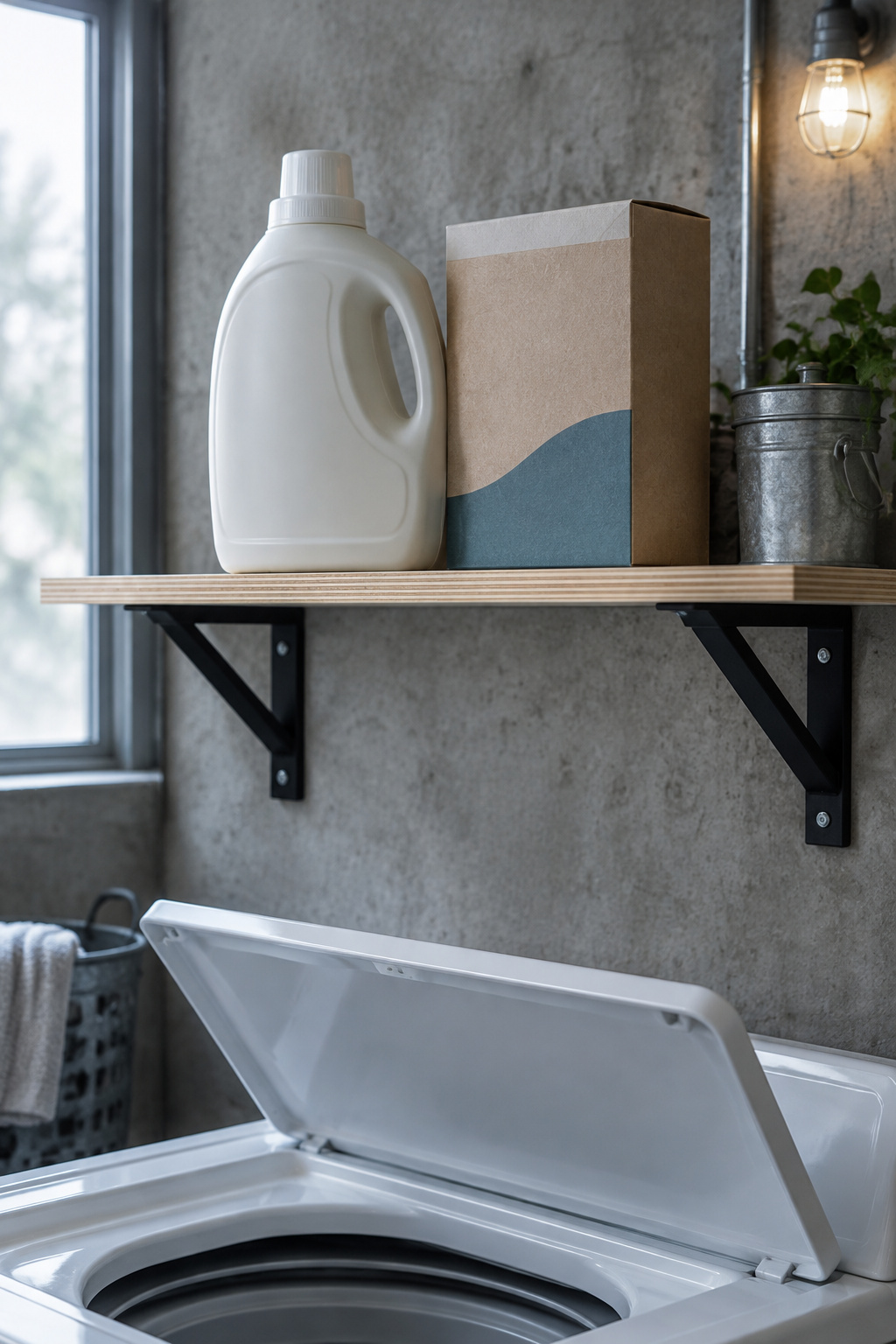
Library science, my first discipline, settled this kind of argument long ago. S. R. Ranganathan’s laws of library science begin with “books are for use” and later ask the librarian to “save the time of the reader”, a scholarly way of saying that shelving is judged in the act of retrieval and not in the act of admiring it. A laundry shelf deserves the same test, so before the survey come two calls, made flat and early so that you can disagree with them.
First call: over a top-loader, I would hang a plain board on visible brackets. That is my pick, and I will admit it rests on judgment more than on any standard. Its case comes from retailers. Wallniture and CITA Interior both describe exposed brackets as carrying more margin than hidden-rod shelves, because the load runs straight down the bracket arm into the fixing, and CITA puts it simply: visible brackets “transfer weight directly downward into the wall.” No neutral trade body has said the same, and the design blog Maisonly argues the opposite for top-loaders, preferring hardware hidden inside the board so that knuckles and lid never meet a bracket arm. My answer is placement. A visible bracket can be set to the side of the lid’s arc, which gives you the simpler load path without the bruised knuckle.
Second call: in a house with children, laundry packets, concentrated bleach and strong cleaners never sit on an open shelf. This one is the consensus of the people who answer the phone when it goes wrong, not my judgment. The American Academy of Pediatrics puts a high, locked cabinet first, and America’s Poison Centers asks for containers “closed, sealed and stored up high, out of sight and reach of children.” An open shelf can be high but cannot be out of sight. Packets need a lid and a latch at the very least, the pediatricians would rather a lock, and neither of those is a shelf.
Whether a given wall should be open at all is a real question too, and a mixed answer is common, with bulk goods behind doors and the everyday things out. That choice has its own test, which comes later.
Five shelves a laundry room can carry, set side by side
Picture the five walls you meet in every inspiration roundup, one after another, and file them as a catalog rather than a gallery, sorted by what each asks of the wall and what it survives well. No numbers sit in the table on purpose, since each setup’s numbers belong to the guide that measured them.
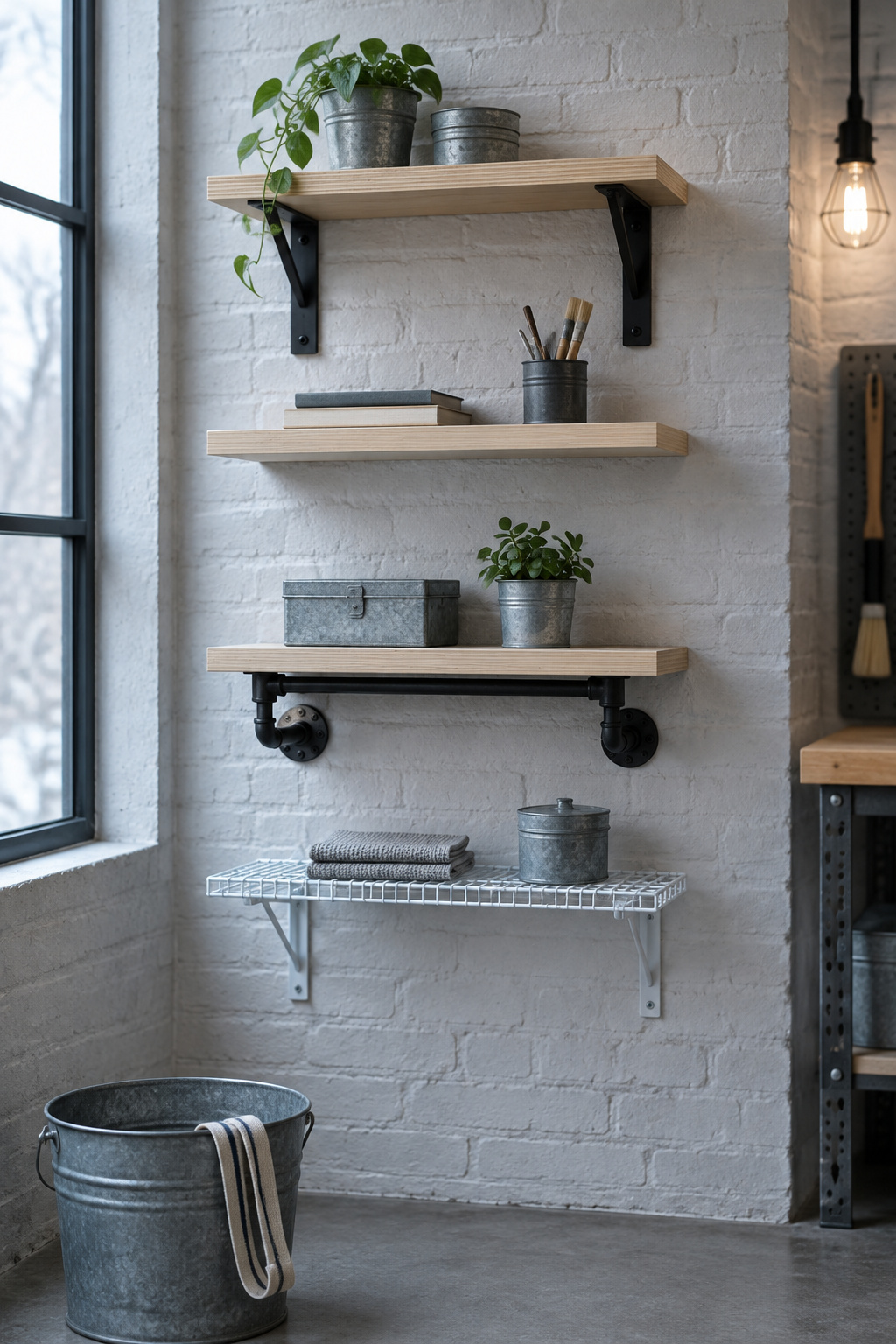
| Setup, pictured | What it asks of the wall | What it survives well | Where its numbers live |
|---|---|---|---|
| A plain board on visible steel brackets over a top-loader | A bracket on each stud, set clear of the lid’s arc | Full jugs and heavy supplies; the simplest load path | The guides to shelf height and to load |
| A floating shelf with no visible bracket | Studs exactly where the rods go; a board with room for the hardware inside | Towels and lighter supplies; the cleanest line | The floating-shelf build |
| Black iron pipe and flanges with a board on top | Flanges fixed into studs; iron cleaned and sealed first | A support that is the look itself | The pipe-shelving build |
| The wire shelf that came with the house | Clips sound in whatever the wall is made of, and front supports | Light, airy storage, while the clips hold | The wire-shelf makeover |
| A shelf with a hanging rod beneath it | One fixing carrying both shelf and rod; clear air below | Garments straight from the dryer | The hanging-rod guide |
Read down the second column and the five stop looking alike. In a photograph a cleat-hung floating shelf and a bracketed board may hold the same towels, yet they lean on the wall in different ways. Even the humble wire shelf is specific about its wall: ClosetMaid’s own specification fixes its wall clips with different parts for wood studs, drywall and concrete, and requires the shelf to be supported at the front. Bracketed boards come in kinds as well. A trade supplier such as Cascade Iron Co. sells J brackets, which are space-saving, and L brackets with no front lip, which fix to the board directly and suit heavier shelves. The cataloger’s habit is to file by function first and appearance second, and that habit is all this table is.
The machine below and the weight on it: boards over a top-loader
Picture the pick from the first call in use: a plain board on two dark brackets, a top-loader beneath it with its lid thrown back against the wall, and your arm reaching through the gap between them. Two things are being negotiated in that gap at once, the space the machine needs and the weight the shelf carries.
Height: clearing the open lid
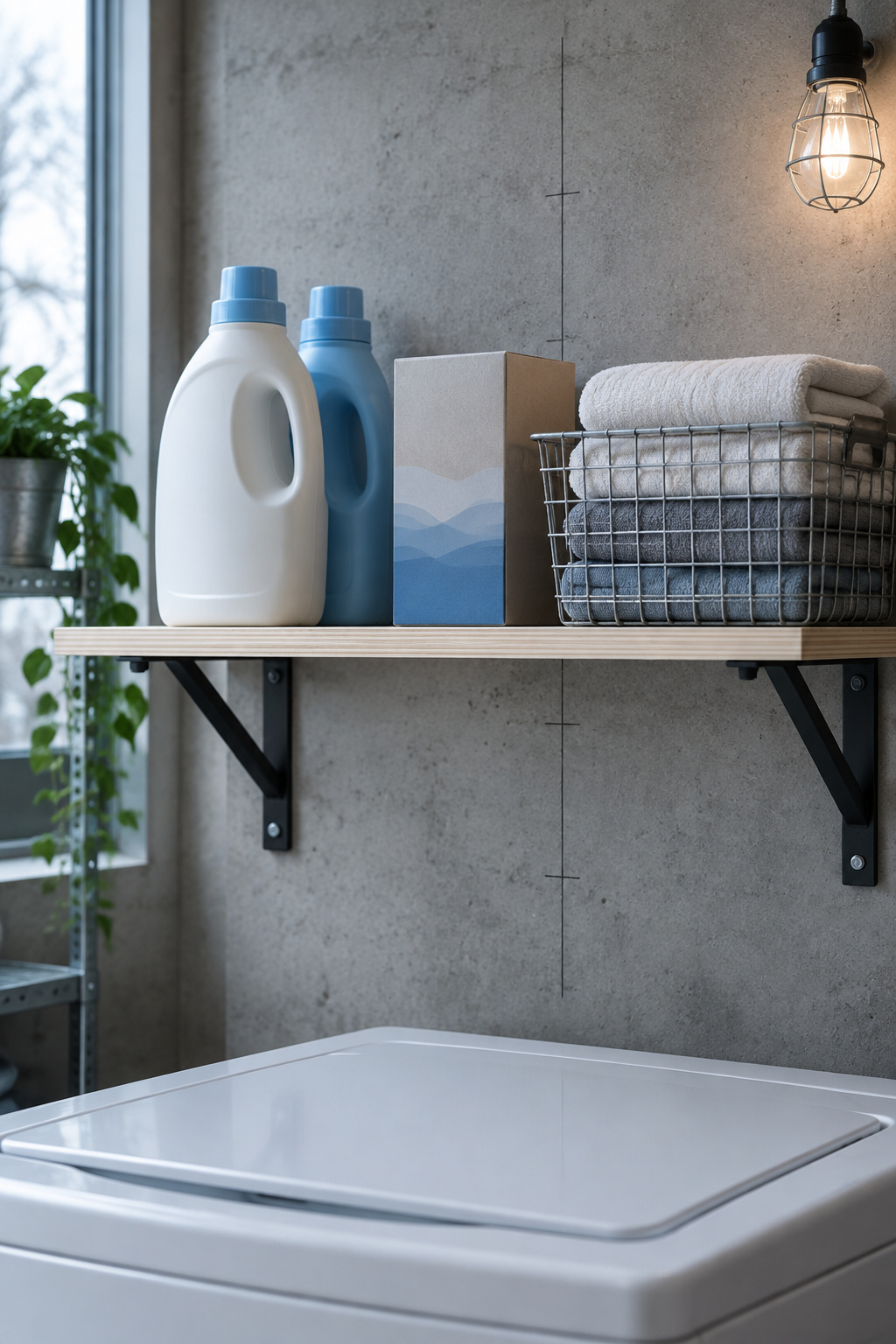
The commonest mistake with a shelf over a top-loader is measuring the machine with its lid shut. For a few seconds of every load the lid is the tallest thing in the room’s lower half, and that is the height that matters. Manufacturers know it: Fisher & Paykel’s top-loader guide and LG’s builder spec sheet both print a minimum vertical space from the floor to any overhead shelf, and LG’s installation page asks you to “allow the top door to open fully.” The rule is to clear the open lid and your hand, and the number that does it is printed in your own machine’s paperwork, not in a rule of thumb. How to work it out for your model, and how far up a second shelf can sensibly go, is laid out in how high to hang shelves above a washer and dryer. Machine sizes and stacking are another subject, covered in the stackable washer and dryer guide.
Load: a wash-day shelf on its worst day
I have owned the same reading chair for fifteen years and had it re-upholstered twice rather than replace it. I bought it for the long sit, the third hour of an evening when the book will not let go, and not for the showroom; a chair chosen for that hour gets through the ordinary ones without noticing them. Twice the cover has given out, and twice the chair underneath was worth keeping.
That is the whole thesis of this page, and I will state it once: specify the shelf for wash day, not photo day. The photograph shows a shelf on its lightest, emptiest, stillest afternoon. Wash day brings every jug full after a shopping trip, a basket of towels shoved on top and the machine below working through its spin. A shelf chosen for the first gets tested by the second, and the test is not one you schedule.
The load travels a fixed path, from the board into the bracket, through the fixing and into whatever the wall is made of. That last link sets the ceiling, which is why a bracket screwed only into drywall is a different shelf from the same bracket in a stud, whatever the packaging says. The wall also stands beside a machine that moves: GE notes that an out-of-balance washer is designed to shift to reduce the forces on the floor, and a shelf above shares that wall through every cycle. Totalling what your shelf will carry, and matching fixings and brackets to the total, is the subject of what a loaded laundry shelf weighs and what holds it. Do the sum there before you trust any bracket here.
Two ways to build for looks: a floating shelf and a pipe-and-flange run
What do you want the wall to say? Some laundry rooms want the shelf to vanish into a line of wood, and others want the support to be the point. Both are honorable choices, and each does one thing beautifully and has one thing it must survive.
The floating shelf with no visible bracket
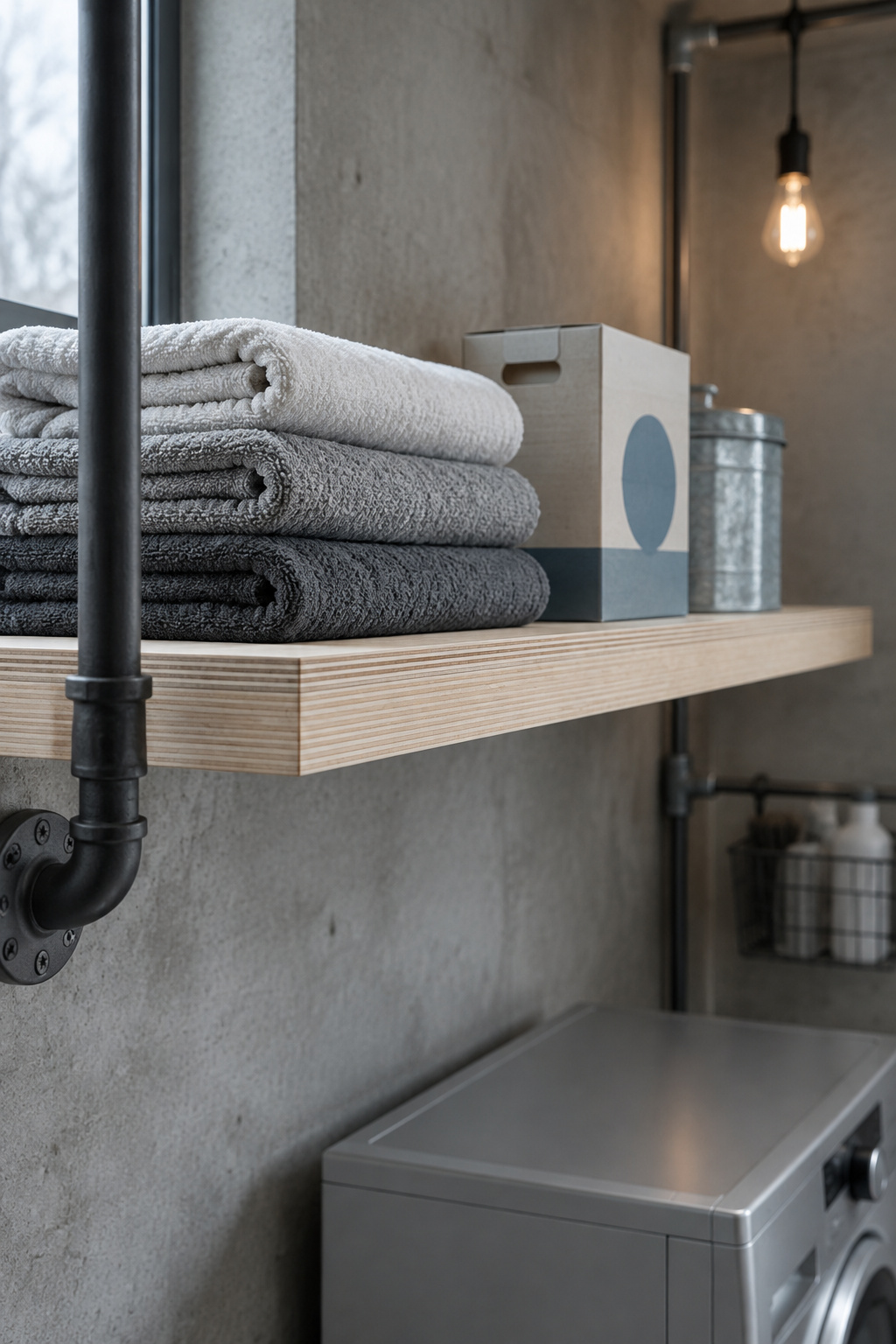
Picture a single thick board on a smooth wall above the dryer, its edge clean and nothing beneath it. This Old House describes floating shelves as having “no visible means of support,” and their dado-and-cleat version slides a board over a wall cleat so that no fastener or bracket shows. The virtue is entirely visual, since the shelf shows only wood.
What it must survive is the load you put on it, because a hidden-rod shelf leans on steel rods and on how deep those rods sit in the studs. Wallniture, which sells both kinds, says the maximum recommended load for a hidden-bracket shelf is “typically a bit lower than a comparably-sized bracketed shelf.” I would take that at its word and give the floating shelf the lighter duties of the room, the towels, dryer sheets and stain remover, not the row of full jugs. It is a weekend build, and the order of work, from choosing the hardware to load-testing it on your own wall, is set out in building floating shelves over the machines.
Pipe and flange, board on top
Now picture the opposite: black iron pipe rising from round flanges, an elbow turning it outward and a board resting across the top. Here the support is the look. In Spalding Ace Hardware’s version the flanges screw to the boards and the pipe fittings carry the load, and both Spalding Ace and Bob Vila fix the flanges or backrest into wall studs.
What a pipe shelf must survive is its own past. New black pipe carries a factory film from the mill, and anything that touches it, a white towel included, can pick it up, so the iron is cleaned and sealed before any linen touches it. The fittings, the costs and that cleaning order are worked through in pipe-and-board shelving for a laundry room. For either build, how a given wood copes with a humid room belongs to the guide to wood laundry room ideas.
Starting from what you already own: the wire shelf and the shelf with a rod
Not every reader is choosing from a blank wall. Many are standing under a white wire shelf, slightly bowed, with a stain pen lying on its side where it slipped between the wires. Emily Henderson calls them “those wire shelves all homes seem to force on you,” and the phrase lands because it is true, since this is the shelf most laundry rooms begin with.
The wire shelf you already have
The mistake is to treat the wire as the whole shelf, when the part that gives first is usually what holds it to the wall. Whether a wire shelf deserves to stay therefore turns on what is holding it up and on the wall behind it, more than on how it looks. Lining it, cladding it with a board or pulling it out and patching the holes are three different answers to that question, and upgrading the wire shelf you already have helps you tell which one your shelf is asking for.
A rod beneath the shelf
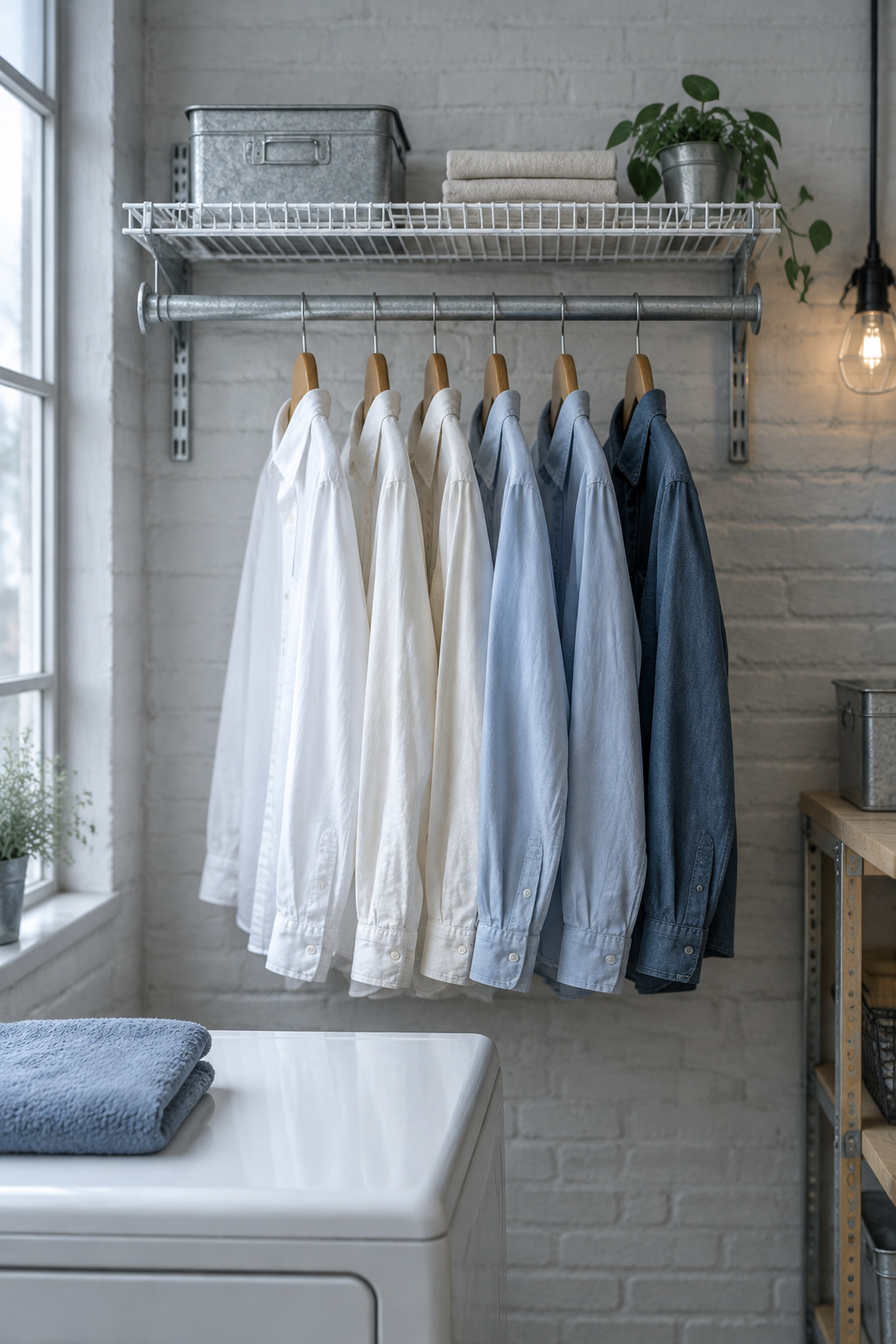
The second thing many laundry rooms already own, or want, is a rod. ClosetMaid makes the combination a standard product, with the hang bar set a fixed distance from the wall as part of the shelf. A designer quoted by Homes & Gardens calls a hanging rod a great way to use the room’s vertical space for clothing that needs to air dry, while Henderson suggests a rod on the wall above the machines for the same reason.
The rod is for garments coming straight from the dryer or finishing on their hangers; racks, airers and pull-out dryers are left to the Scandinavian laundry guide to drying racks. A rod also changes the shelf above it, because a shirt hanging from it occupies the same air the lid swings through and whatever sits on the shelf over a rod becomes harder to reach. Where the rod belongs, how high, and what it does to the wall’s load are answered in adding a hanging rod under a laundry shelf.
Hands and small hands: what an open shelf must never hold
Lower your eyes to the shelf nearest the floor, the one at about the height of a kitchen chair seat, and imagine on it a clear tub of laundry packets, bright as boiled sweets, lid pressed on. Now imagine who else in the house can see it.
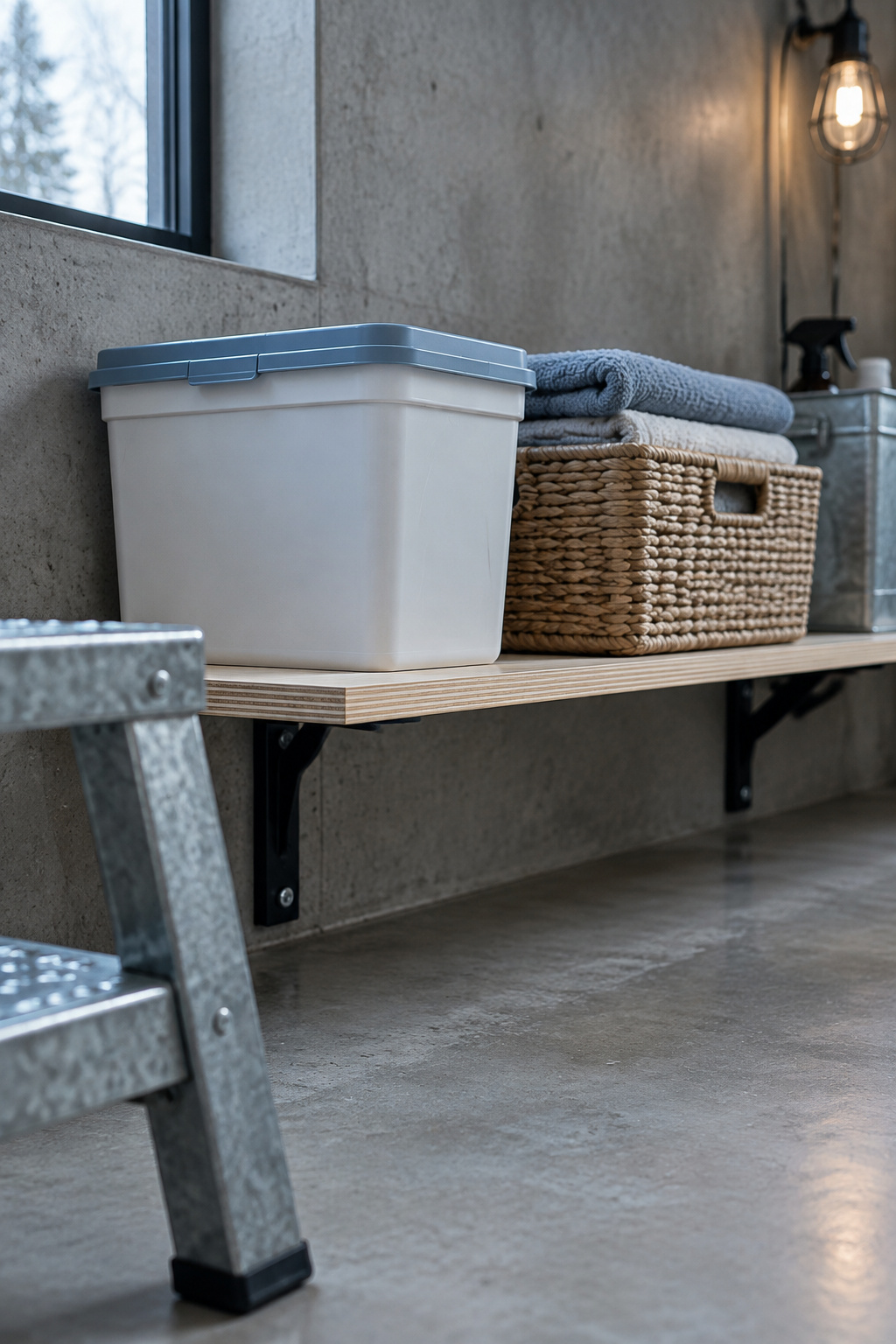
Every serious research library keeps some of its holdings in closed stacks. Readers do not browse them; they ask, and someone who knows what the item is fetches it, because some materials should only be retrieved by a hand that understands what it holds. A laundry room in a house with children has closed-stack items too, and they are few and specific:
- Laundry packets. HealthyChildren and the American Cleaning Institute ask for the original container, and all three bodies, America’s Poison Centers included, ask for it out of sight and out of reach.
- Concentrated bleach, and any bleach decanted. The National Capital Poison Center warns that bleach left in a cup on a counter or machine can be mistaken for a drink.
- Spray bottles and concentrated cleaners. HealthyChildren’s instruction is to store spray bottles “up and away.”
Then there is the jar. The tub on that low shelf is bad, and a glass jar of packets on a styled shelf is worse, because it throws away the packaging that was doing the protecting. The American Cleaning Institute runs a campaign on exactly this point, and its senior vice president, Brian Sansoni, says decanting cleaning products, “while aesthetically pleasing, increases the risk of an accident.” Nationwide Children’s Hospital adds the uncomfortable footnote that child-resistant packaging “is not child proof.” I have spent a working life arguing against books treated as props, and a jar of packets arranged for its color is much harder for me to forgive than a shelf of spines turned backward.
What stays open in such a house is the soft stuff, towels, empty baskets, folded linens. Packets, concentrates and sprays need a barrier with a latch at the least, and where ordinary liquids and powders sit is more of a judgment call. The practical sorting, the barriers worth buying and the climbing test are in keeping laundry supplies safe from children.
Steam, lint and the eye: what the shelf must survive in the room itself
Look at a shelf that has lived through a season of wash days and you will see which room you have: a gray felt along the back edge, or a board that wipes clean. The difference starts in the dryer manual. Two makers’ manuals say that a dryer not vented outdoors puts its fine lint and a large amount of moisture into the laundry area, and that venting outdoors keeps both out of the room. The climate on your shelf is therefore not a given. It depends on how your dryer is vented and how you run your cycles, and a well-vented room with sensible habits asks far less of a shelf than an unvented one running loads back to back.
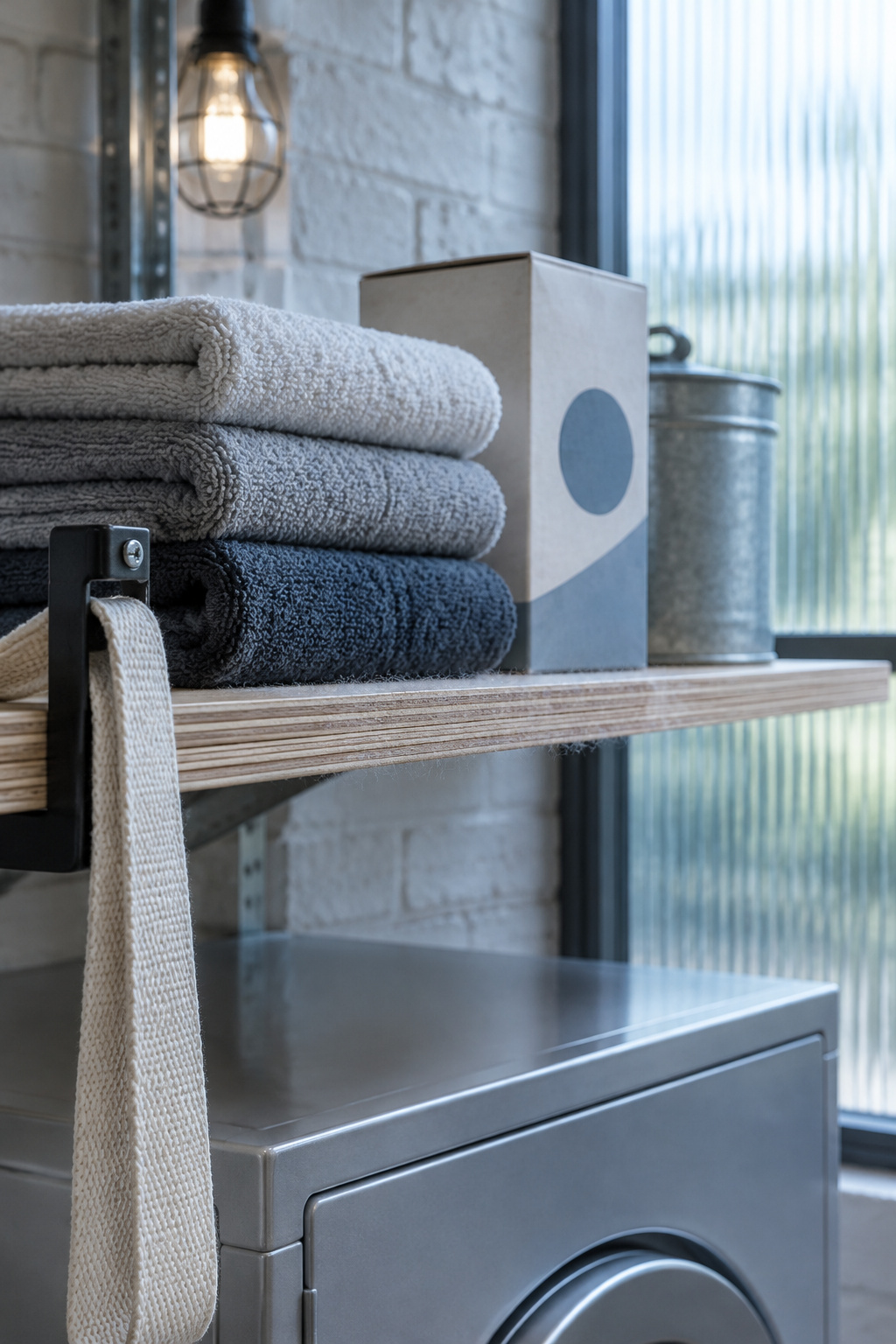
Three things follow. The U.S. Fire Administration asks you to keep the area around the dryer free of items that can burn, and a shelf directly over the dryer is part of that area, which argues against cardboard boxes and stacked spare towels parked hard against it. Material matters too: the Composite Panel Association notes that particleboard and MDF swell with high humidity and that the swelling does not reverse, so an unsealed composite board is a poor tenant over a damp machine. Third, there is your eye: an open shelf shows everything every day, the half-empty bottle, the brand you did not choose, the tub with the cracked lid.
Whether that visibility suits your room is the open-versus-closed question, and I will not settle it here, because it depends on your supplies, your air and what you see from the machines. The test for it lives in whether open shelves or cabinets suit your laundry room. Arranging what stays on display is a separate craft, covered in the laundry shelf decor guide. I will add only the librarian’s warning: a shelf you cannot find the stain remover on is not storage. It is a wall treatment.
Back to the reach: a shelf that survives wash day
Return to the jug. You are reaching for it again, the dryer turning at your shins, the cap finding your fingers, and this time you know what the shelf above you is.
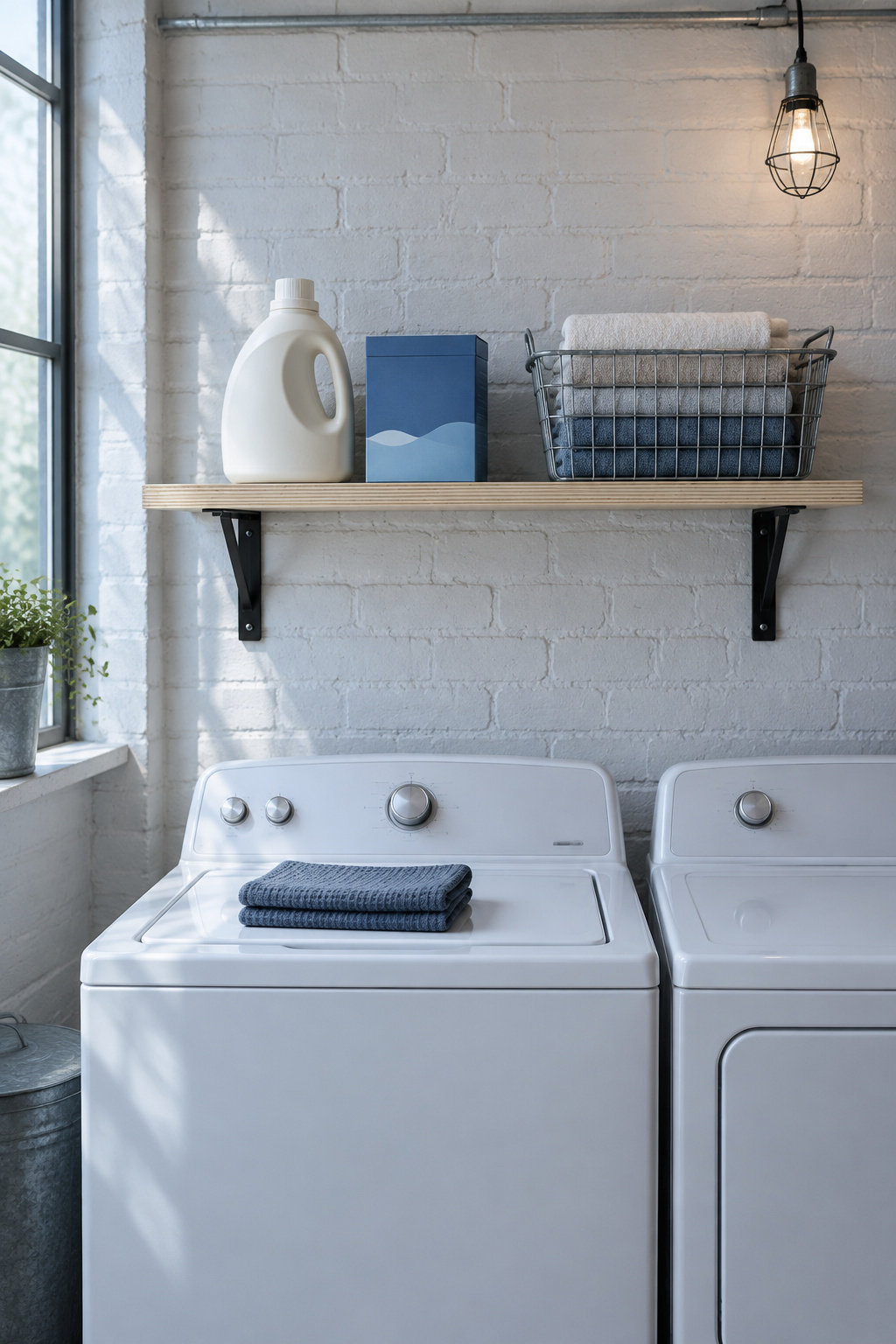
You know its type, because you chose it by what it had to survive rather than by which photograph you liked. If it hangs over a top-loader and carries the heavy supplies, it is a plain board on visible brackets, set clear of the lid’s swing, and that is my pick. If it hides its hardware, it carries the lighter things. If it is the wire shelf you inherited, its clips and its wall decide its future. You know its two non-negotiables, that it clears the open lid and your hand and that in a house with children it holds no packets and no concentrates, and you know the decision to settle first, which is the open height of the lid below and then the wall behind the board.
Each deeper question has somewhere to go, and none needs answering from a gallery again. The jug comes down into your hand cleanly, without a rock and without a creak, and the board above it says nothing at all, which is all a good shelf should ever say.