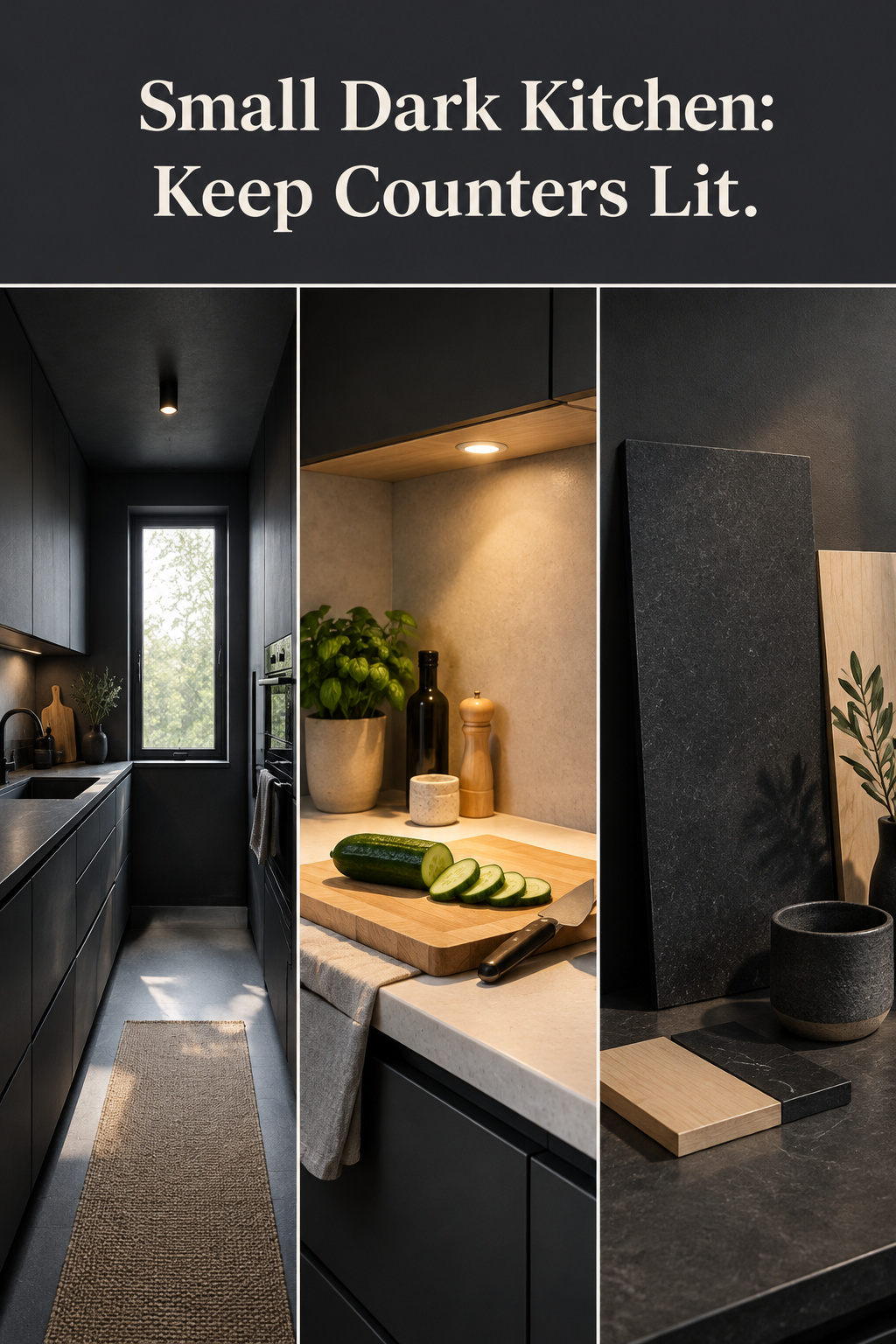
I fill the thermos at the counter before it is properly light. The kitchen is grey-blue at that hour. My one mug waits beside the kettle, rinsed from yesterday. Then I take the coffee out to the back step, and the room behind me stays dim until the lamps go on.
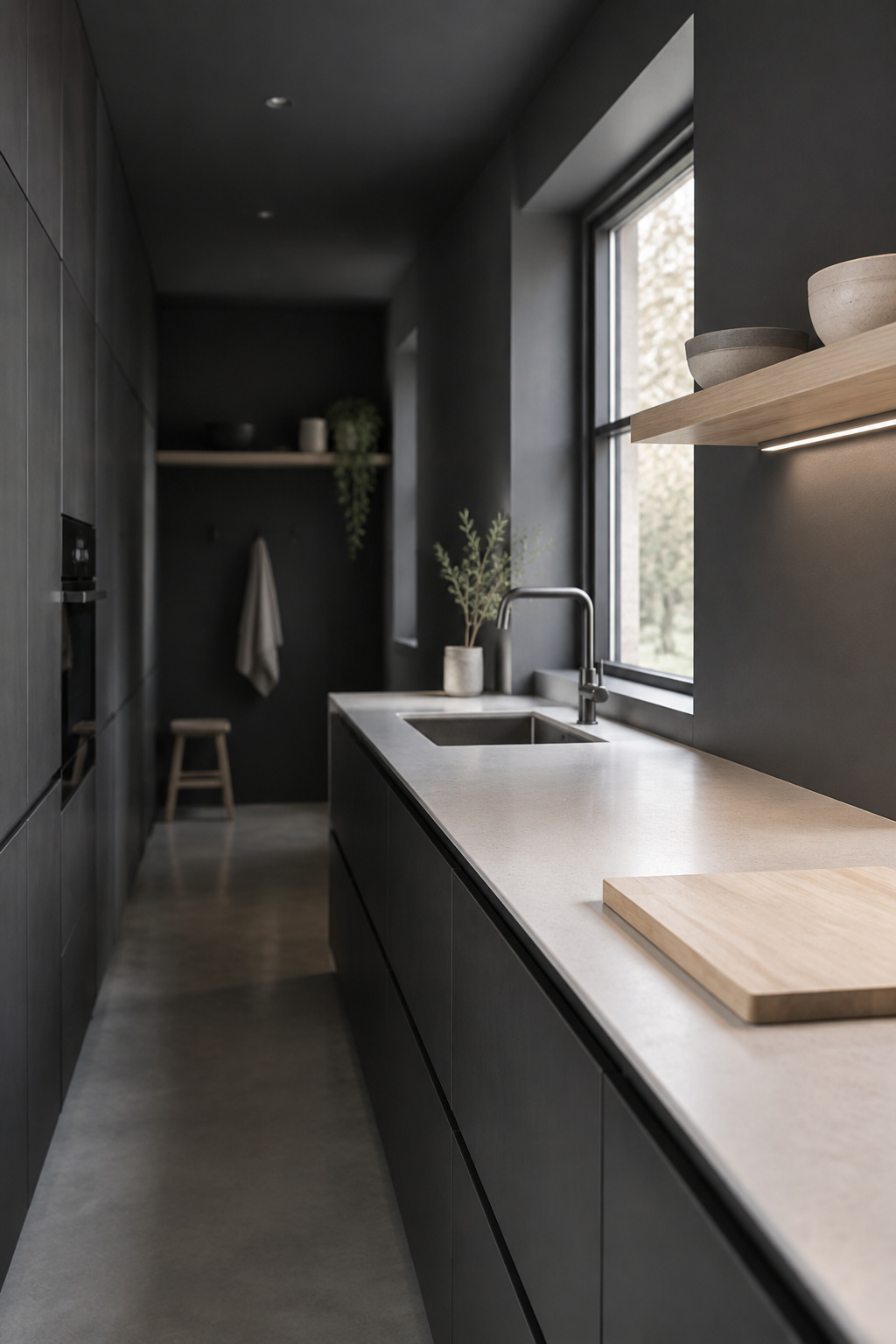
A small dark kitchen worries people more than it should. The old rule says dark colors make a small room look smaller, so paint it white. Designers who work with dark color mostly advise something else: take the whole room dark, walls, ceiling, trim and cabinets in one family, and keep the counters brightly lit. What they say makes a small kitchen feel cramped is a dark block set against white, because the eye stops at every edge.
TL;DR
- Designers advise taking a small dark kitchen dark all over, walls, ceiling, trim and cabinets in one color, and varying the sheen instead of the color; a dark block against white is what they say stops the eye.
- In lab work, color mattered far less than floor area once the amount of light was controlled (r = .14 against r = .60), and no study has tested a whole dark room against a dark block in a kitchen.
- The condition is light where you work: task light on every counter before you commit to the paint.
A Small Dark Kitchen Works When the Whole Room Goes Dark
Our kitchen is narrow and faces north. It never gets bright, not in June and certainly not in January. That makes it a fair test case, because a small room that never gets bright is exactly where people are told to stay pale.
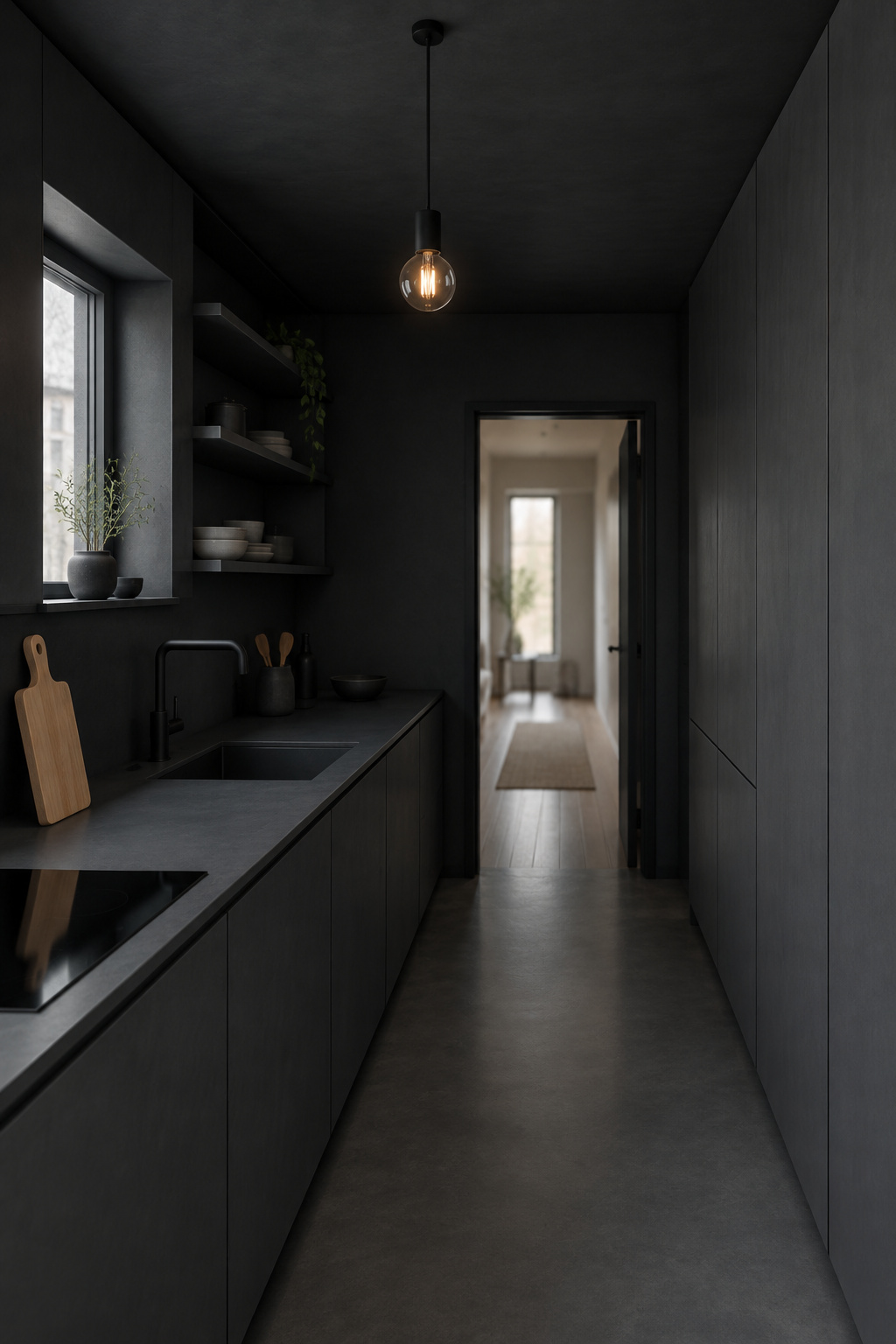
Two designers give the same instruction for a low-light kitchen. Patrick O’Donnell of Farrow & Ball and Laura McGarity, who teaches color theory at the University of Louisville, say to paint everything the same, from walls and ceilings to trim and cabinets, and to vary sheen rather than color. Another designer puts the reason plainly: white trim “cuts off the eye and is extra information to process.”
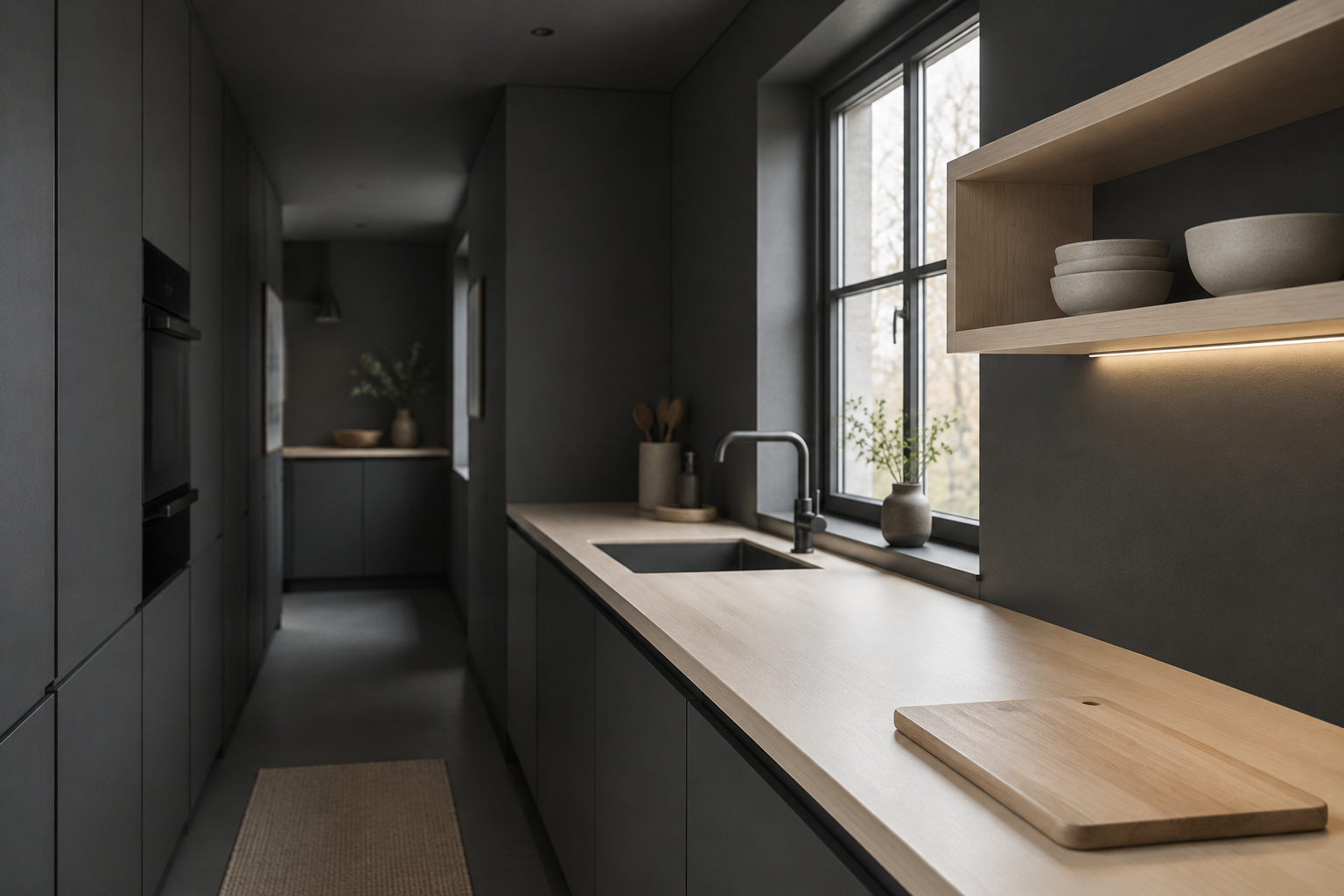
A dark cabinet run inside white walls is a box with a hard outline, and the eye stops on it. Take the walls, the ceiling and the trim into the same color and there is no outline left to stop on.
| Dark block against white | Whole room dark | |
|---|---|---|
| What goes dark | Cabinets only | Walls, ceiling, trim, cabinets |
| Edges the eye meets | Every cabinet, trim line and ceiling line | Very few |
| Who argues for it | One food site, with light walls and counters as contrast | The designers above |
Take the right-hand column. If you are going dark at all in a small room, go all the way. A kitchen with fewer edges is also quieter to stand in, and I would rather have that than a clever contrast.
Do Dark Colors Make a Small Kitchen Look Smaller? The Test, in Plain Terms
The belief goes like this: dark surfaces soak up light, so a dark kitchen closes in on you. One food site puts it as dark cabinets that “overwhelm your space by sucking up all of the room’s precious light.” It is a reasonable worry. It is also less settled than it sounds.
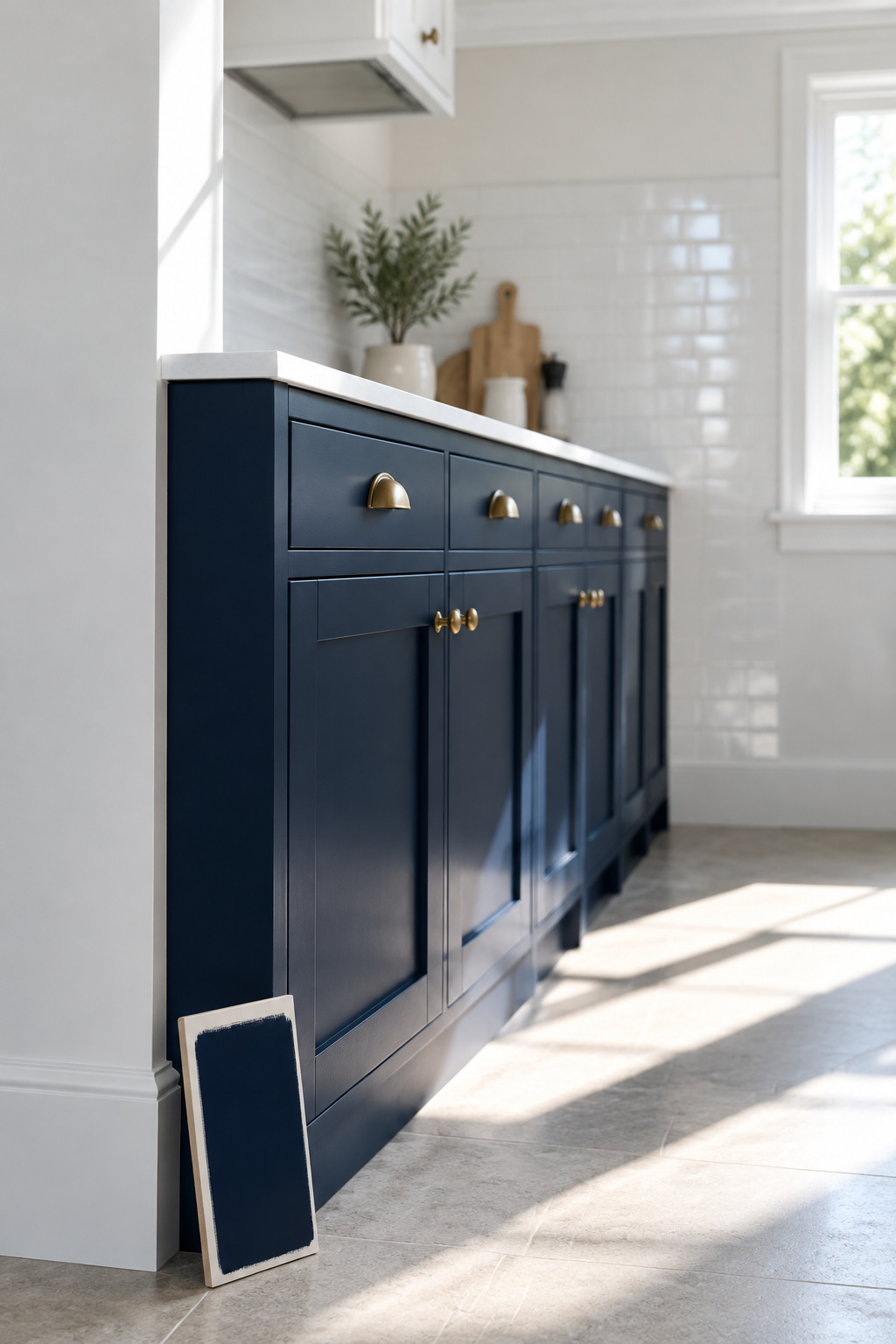
Lighter rooms do tend to look somewhat larger in the lab. Keishi Yoshida and Masato Sato tested this in a one-tenth scale model room with 20 subjects and found that lighter surfaces raised the perceived size of the space. A surface darker than the rest of the room lowered it. When the base color of the whole model was dark, the differences between patches stopped being significant. The authors put that down to the all-dark room being unusual and its corners hard to read, which is not the same as saying a dark room looks big.
Arthur Stamps ran a broader set of experiments in 2010. Floor area had by far the strongest effect on how spacious a room felt. Color, once the amount of light was held steady, had a small one.
Lighter surfaces help a little, and floor area matters far more. Nobody has tested a whole dark kitchen against a dark block on white walls, so the case for going dark all over rests on designers’ judgment and on what you can see in your own room. The study on wall and ceiling lightness, and the long dark end wall, are covered in our galley kitchen paint colors article.
I don’t think a small kitchen is ruined by dark paint. I think it is ruined by a dark object with a white frame around it.
Take the Dark All the Way: Walls, Ceiling and Cabinets in One Family
I always settle what the room is for before anyone opens a fan deck. A kitchen that should feel calm and enclosed at six in the evening needs one color family running through it. A kitchen that needs to look bigger in listing photos is a different room with a different brief.
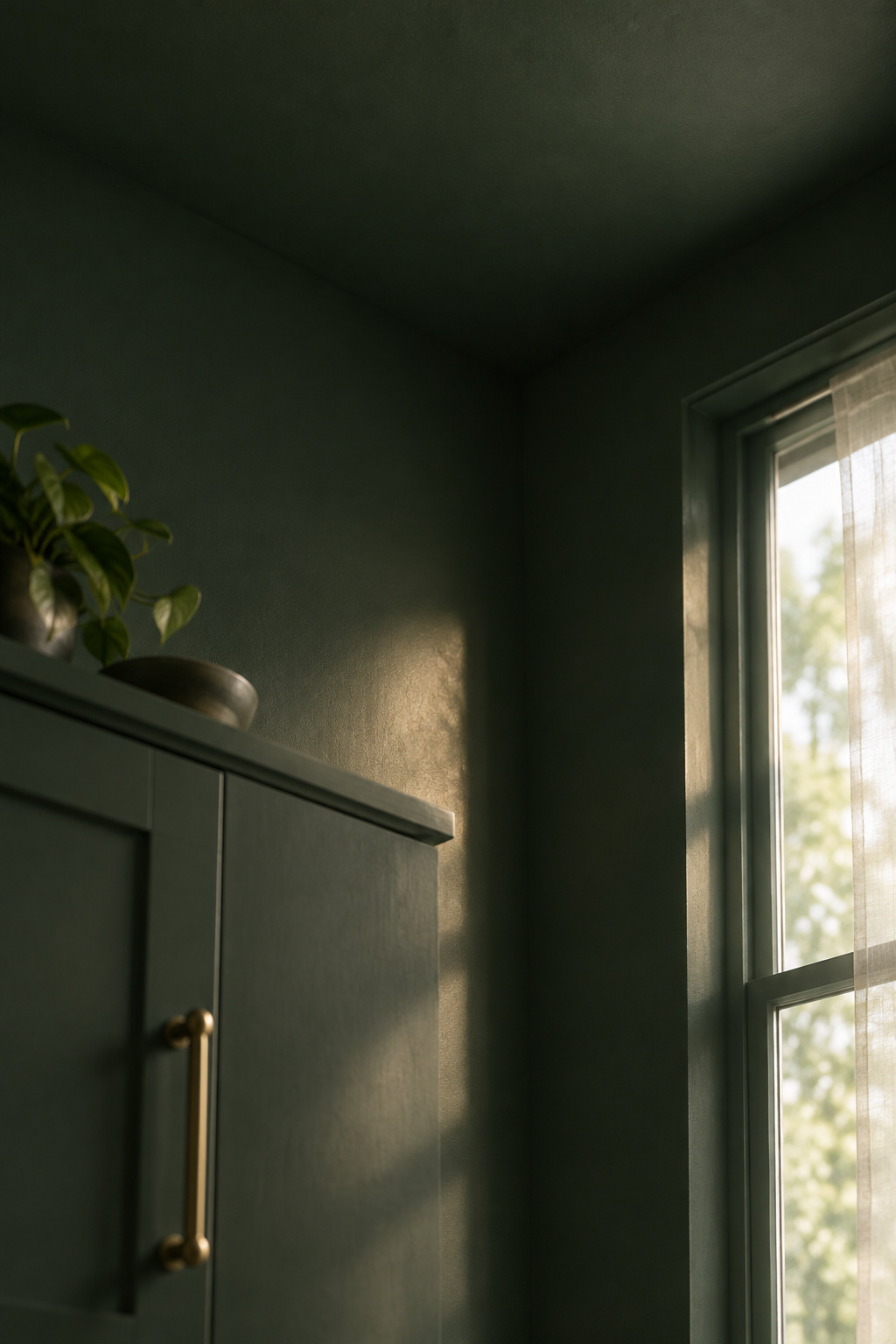
Once you have chosen enclosed, the rules are short:
- Paint walls, ceiling, trim and cabinets in one color family.
- Change the sheen between surfaces, not the color.
- Keep the ceiling with the walls, or a lighter version of the same color.
McGarity compares a ceiling in a different color to rolling up your pant legs. It breaks the line, and I have not been able to unsee that. Emily Henderson makes the same point from the other side: a white ceiling over dark walls “almost stops your eye and makes the ceiling feel lower.” Dark ceilings work best at 9 feet or above, and in a room with a standard 8-foot ceiling a dark ceiling belongs to a full drench, never as a dark lid over light walls. Matte keeps reflections down on the darkest surfaces but polishes where hands rub; the sheen choice itself is a paint question. For the color family, start with dark paint colors for the whole room.
If the whole room is not possible, and in a rental it often isn’t, dark lowers under lighter uppers is the fallback. Keep the dark below the counter, keep the counter in the same family as the uppers, and leave it there. That is one decision, not a two-tone scheme to build a kitchen around.
Enough is a good word. One color, a change of sheen, and stop.
A North-Facing Small Kitchen Suits Dark Better Than White
North light is cool and flat, and white paint depends on light to bounce around. A north kitchen gets little. One paint maker says white “can often look drab” with little natural light. Farrow & Ball’s advice is not to fight it, but to embrace the cooler light with darker walls for a cocooning feel.
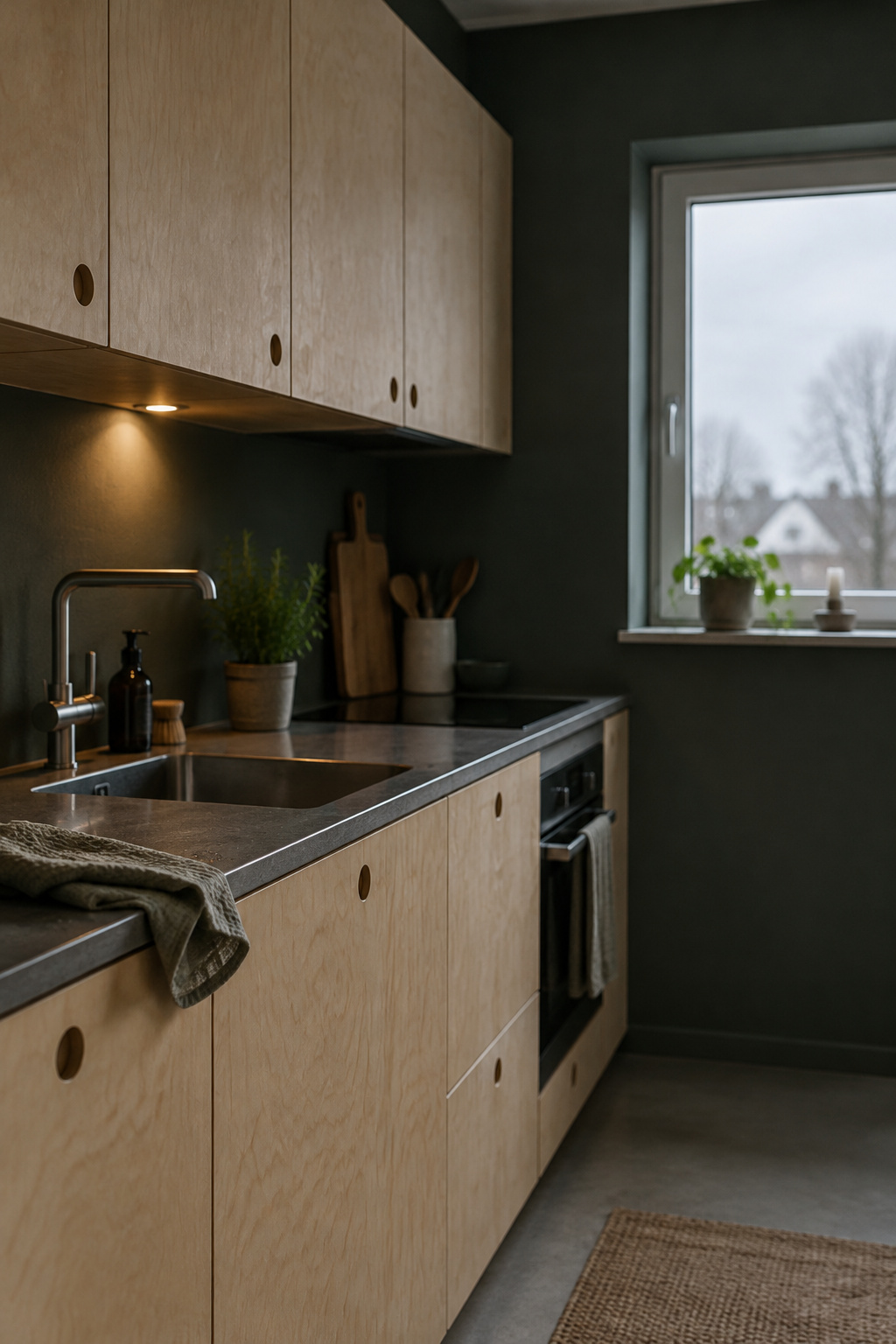
That matches what I see at home. From October I leave one lamp on in the kitchen window, so the house looks lived in when I ski back up the road. From the road, in the blue light, the warm window looks right. A room that is going to be dim most of the year might as well be dim on purpose.
There is a real counter-view. Sherwin-Williams points out that north-facing rooms get the least light and advises warm undertones and a higher LRV even if you pick a bold dark. I would take the warm undertone and leave the higher LRV. A cool, grey dark in a north room turns cold, and nobody wants to cook in a cellar.
Keep the window itself clear. Whatever daylight a north kitchen gets is the daylight you have, and it should reach the counter.
Keep One Working Surface Bright: Counter Light in a Small Dark Kitchen
Overhead lighting is for cleaning, not for living. In a dark kitchen I would go further: a single ceiling fixture puts your own shadow on the board and leaves the dark walls looking grubby. The light has to come from just above the work, where the hands are.
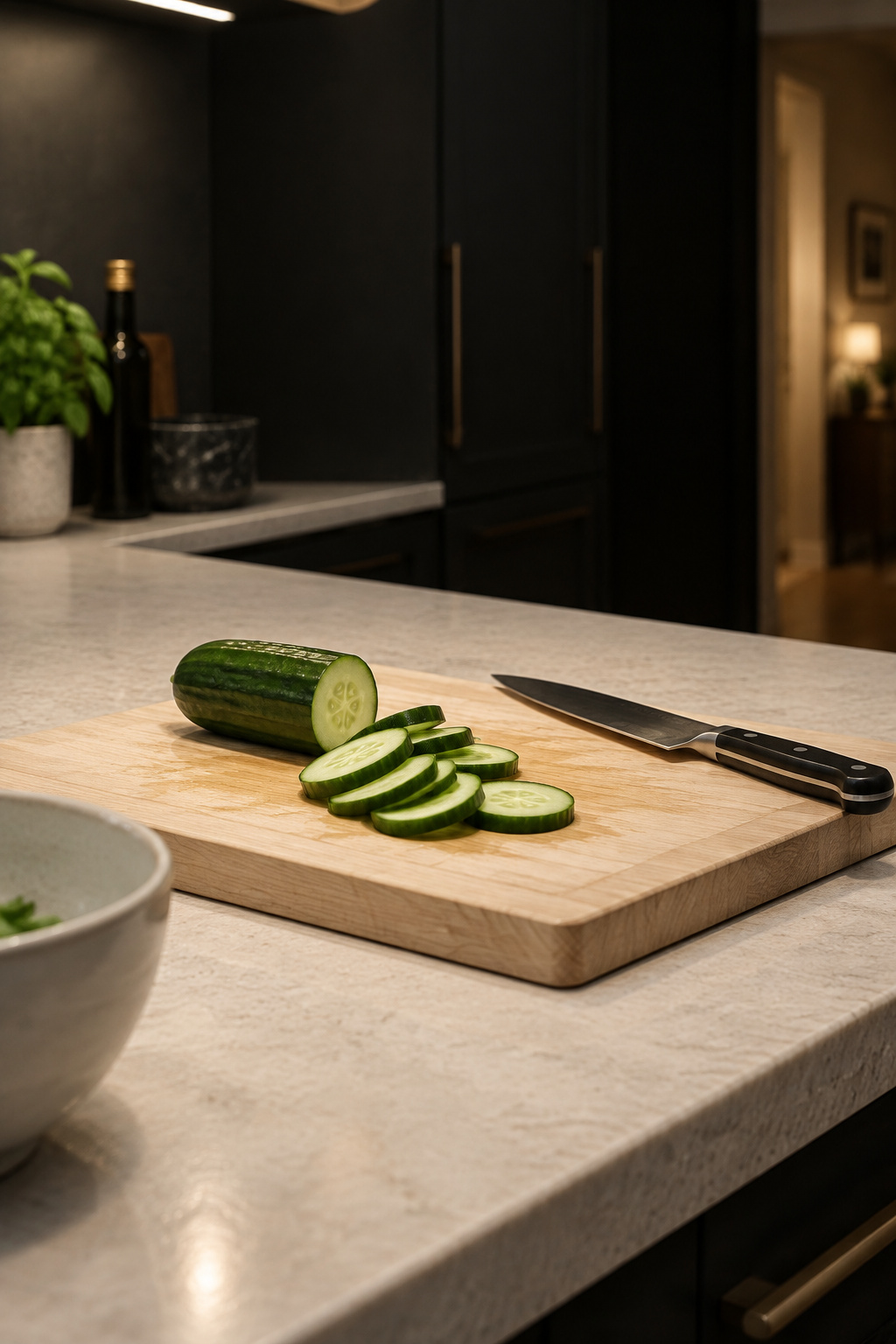
The rule follows the work surface, not the paint. NKBA’s planning guidelines call for task lighting on every work surface, and that is the condition the whole argument rests on. If you can’t light the counters properly, don’t take the room dark.
What stays bright in a small dark kitchen:
- the main work counter
- the light under the cabinet directly above it
- one pale cutting board, so you can see what you are chopping
That last one is my habit. A pale board on a dark counter tells you where the work happens, and it costs nothing. The fixtures, the color temperature and where the strip goes are worth getting right, and lighting the counters in a dark kitchen covers them properly.
Go Dark All Over, Keep the Counters Lit: The Small-Kitchen Call
You probably came here believing that dark makes a small kitchen smaller. The truer version is narrower. Lighter rooms read a little larger in the lab, color matters less than floor area, and what designers say makes a small kitchen feel cramped is the dark block with a white frame round it.
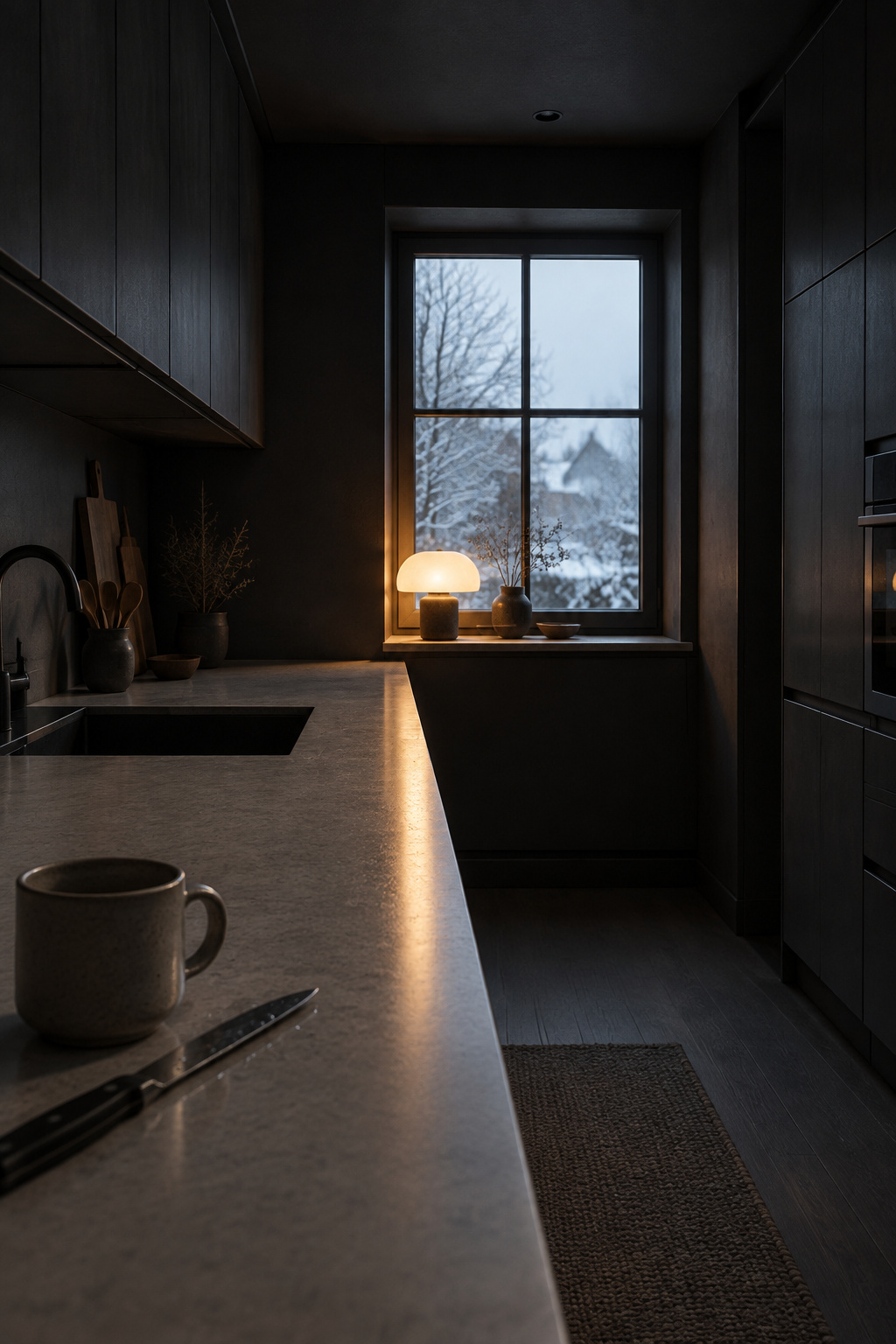
So the move is simple. Choose one dark color family for walls, ceiling, trim and cabinets, and light the counter before you open a tin. The rest of the room’s choices sit in our dark moody kitchen ideas.
The disagreement doesn’t go away, and I won’t pretend it does. Tasting Table would keep the walls and counters light and let the dark cabinets stand against them. Farrow & Ball’s own ambassador says a deep drench gives a room intimacy and elegance, not a larger look. I think that is right, and I think intimacy is what a small north kitchen should be for. If you want your small kitchen to look big, paint it pale and accept the grey. If you want it to feel good at four in the afternoon in winter, go dark and light the counter. I would not repaint mine pale.
FAQ
Does a dark small kitchen hurt resale?
There is no clean answer for small kitchens. Zillow’s 2023 survey asked more than 4,700 buyers to react to images of rooms painted in 11 colors, and they put a charcoal gray kitchen at an estimated $2,512 above similar homes. That is a reaction to pictures, not a sale price. Paint for the people living there.
Can a windowless small kitchen go dark?
It can, if the lighting carries it. Farrow & Ball’s O’Donnell says it is really hard to create light through paint; a trade blog argues dark matte swallows fixture light and prefers satin. The code asks for glazing of 8 percent of floor area unless artificial light averages 6 footcandles (65 lux). The building department decides how that applies.
How do I test a dark color in a small kitchen before committing?
Paint a large board, at least A2, and move it around the room. Look at it again after dark, under the bulbs you actually use, because that is when a kitchen gets used. Our dark kitchen paint colors article gives the full method.