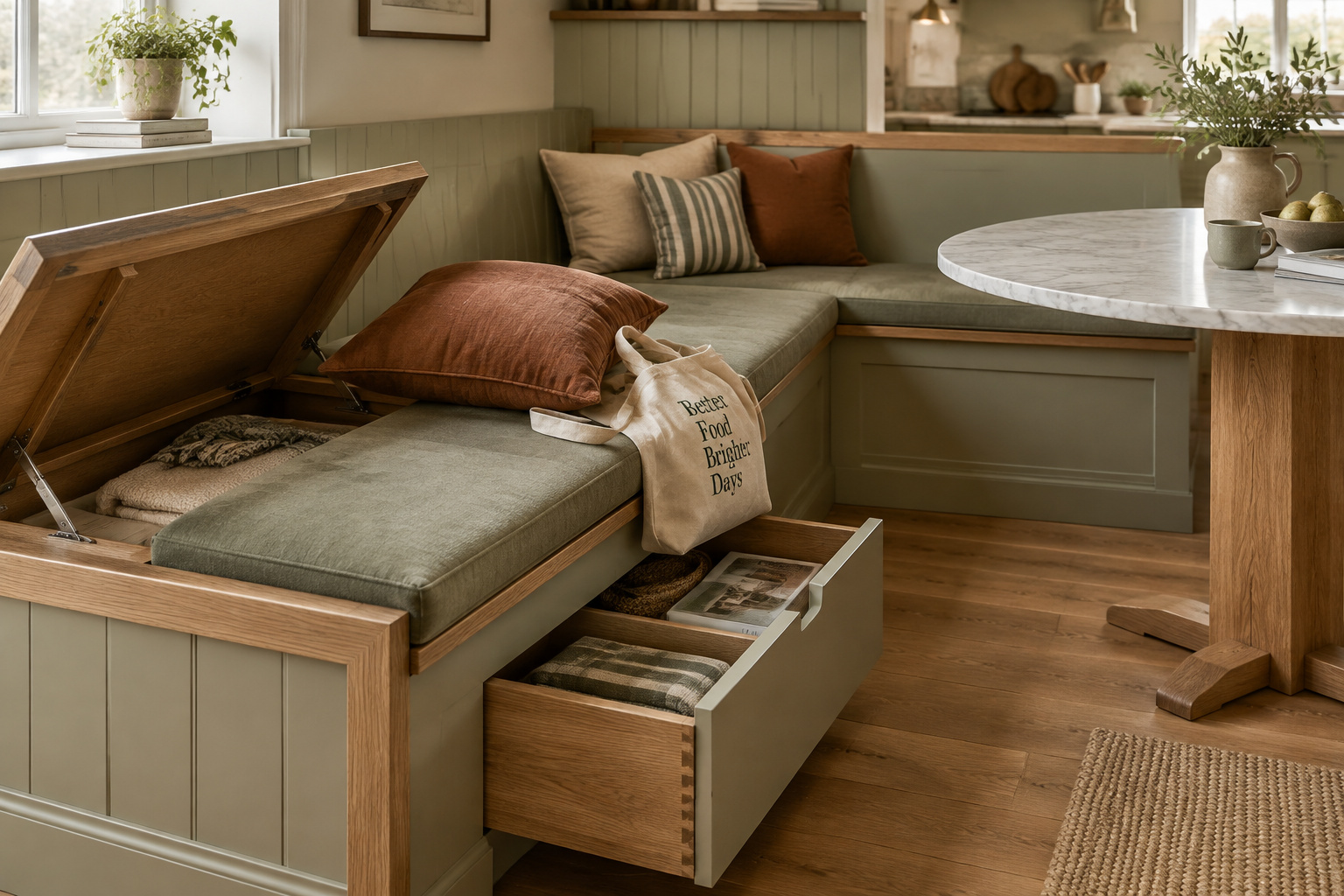
Banquette seating with storage fails in one quiet, specific way: the lid nobody lifts. The bench gets built, photographed, loaded once with whatever had no other home, and then the cushion goes back down and stays down. I recognized the pattern from a job years earlier, when I put a forward-facing bookshelf in a toddler’s room (every cover showing, genuinely lovely) and watched it come off onto the floor daily, because pulling with one hand was the only motion the shelf offered a two-year-old. Catalog photos show the volume. They never show the motion.
TL;DR
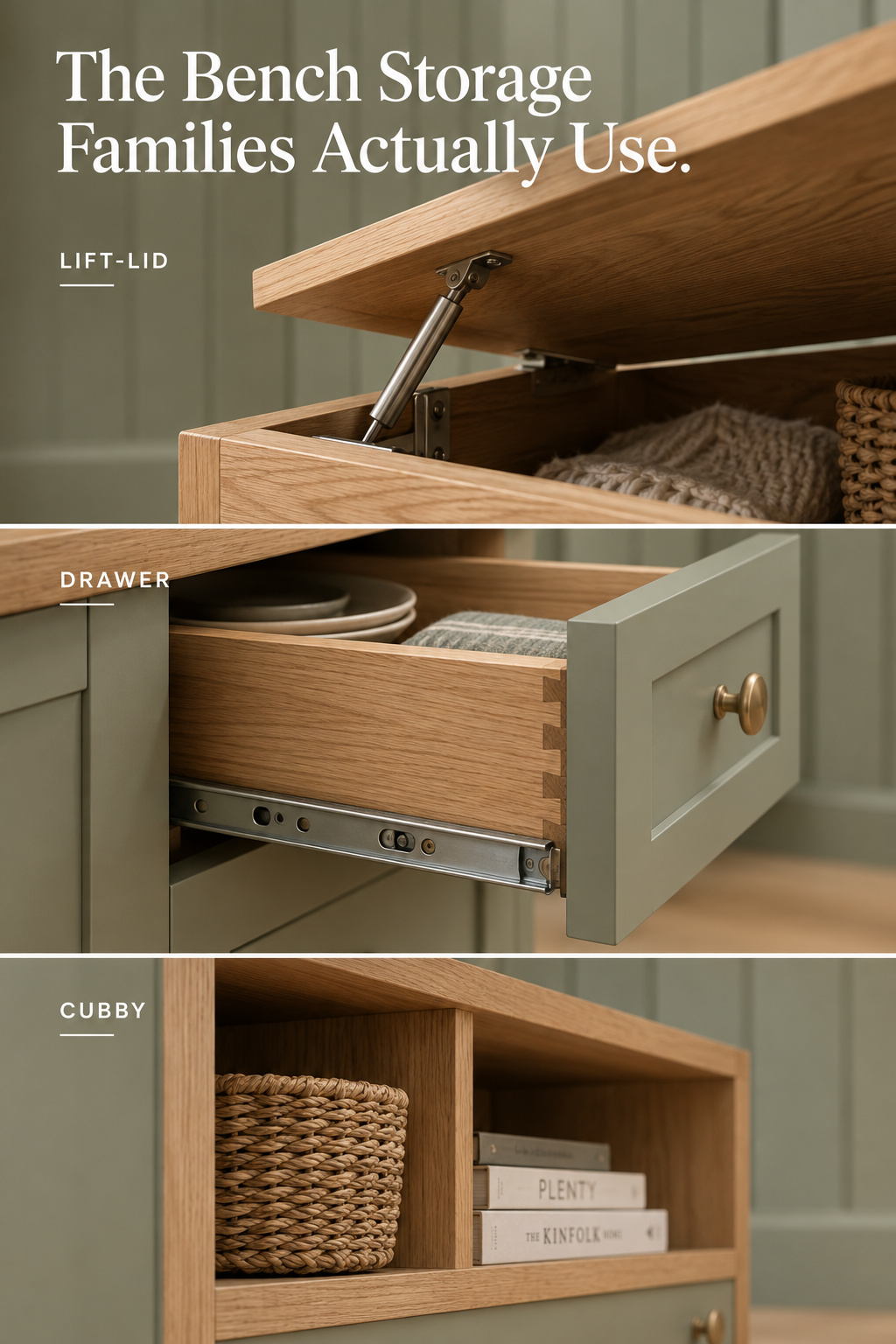
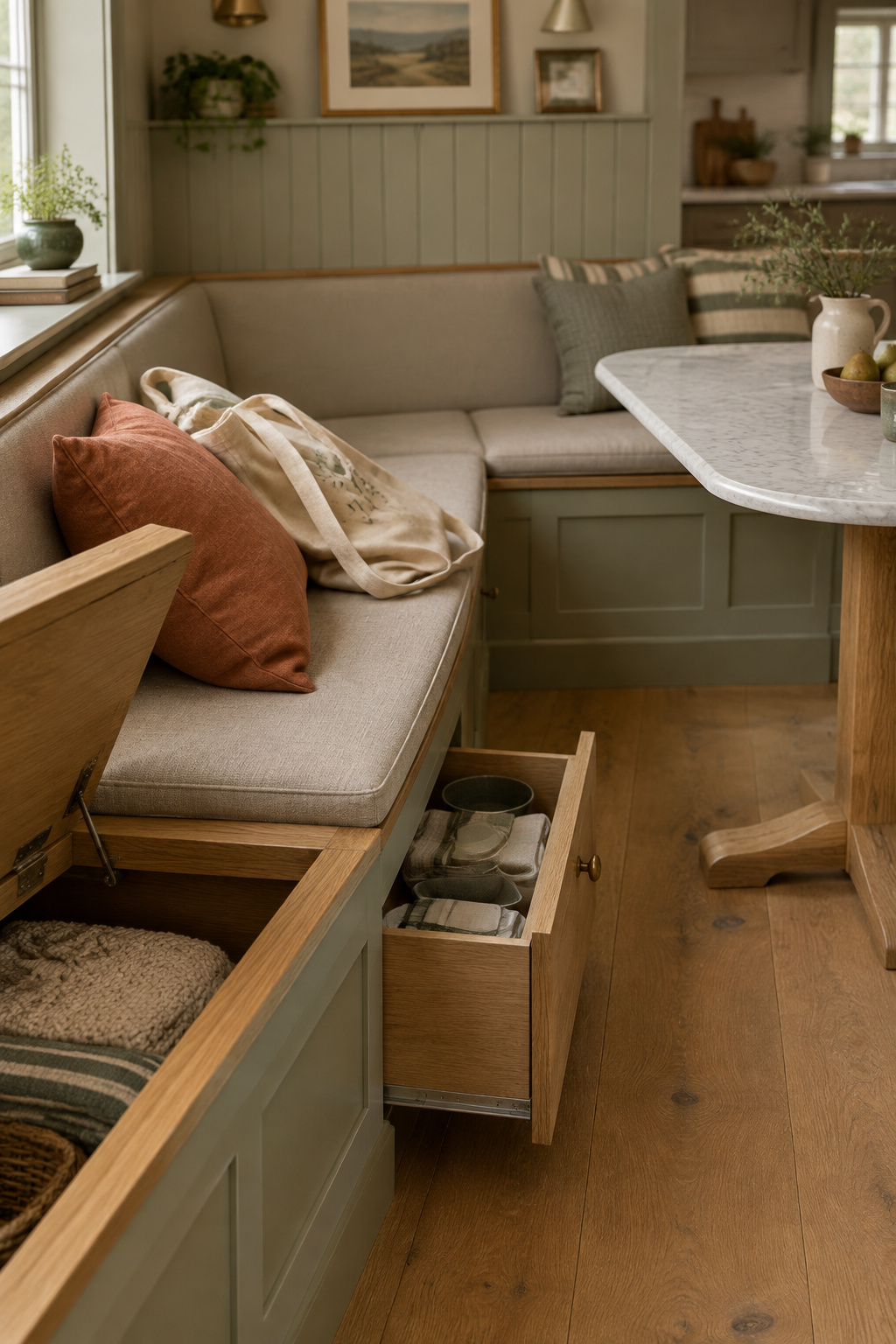
- The three mechanisms are not interchangeable: open cubbies need no hardware and are fastest to reach into, front drawers give one-motion access but lose interior width to their slides, and a lift-lid trades the most demanding hardware for the whole box.
- Only the lift-lid has hardware doing safety work. Sugatsune sizes lid stays by torque (lid weight times its front-to-back dimension, divided by two), and CPSC says a lid support must hold the lid open in any position it is placed in.
- Choose by access frequency, not capacity. Anything you reach for twice a week does not belong behind a cushion and a hinged lid.
Banquette seating with storage: the three mechanisms, and what each one costs you
There are only three ways into the box under a bench seat, and choosing between them is part of planning a built-in bench from the kitchen out rather than a decision made at the hardware counter afterward. The mechanism is structural; you cannot swap it later like a finish. Each one charges you in a different currency: hardware, interior volume, or tidiness.
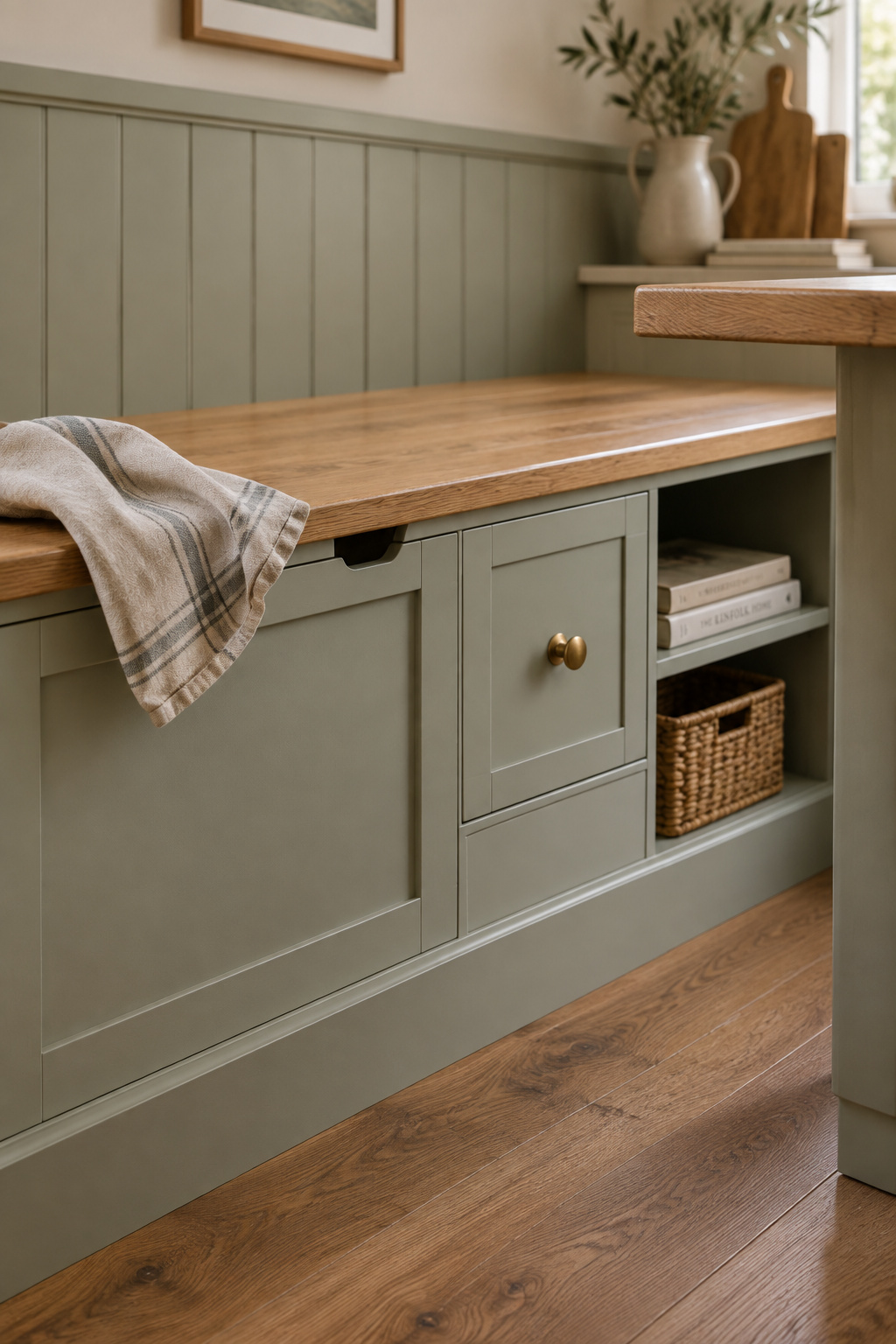
| Mechanism | What it costs to open | Hardware it needs | What the cushion does |
|---|---|---|---|
| Open cubby | Nothing — reach in | None | Never moves |
| Front drawer | One pull, if nothing blocks it | Slides, rated by load | Never moves |
| Lift-lid | Clear the seat, lift lid and cushion together | Hinge plus a load-rated lid stay | Lifts with the lid |
The market already reflects the split. Winston Porter’s line puts a front drawer and a lift-top on the same bench, and several models run independent lift-tops over side-by-side cavities. But no manufacturer, retailer or standards body ranks the three against each other, which is why the choice feels impossible from a product page: every listing photographs the mechanism at rest, and the difference between them lives in the motion.
Open cubbies: no lid, no excuse not to use it
Pottery Barn’s cubby banquette is built around a basket rather than a shelf: the opening frames the basket, and the basket is the thing you pull out. A cubby has no hinge to work loose, no slide to bind and no lid stay to replace, so the only maintenance question is the basket.
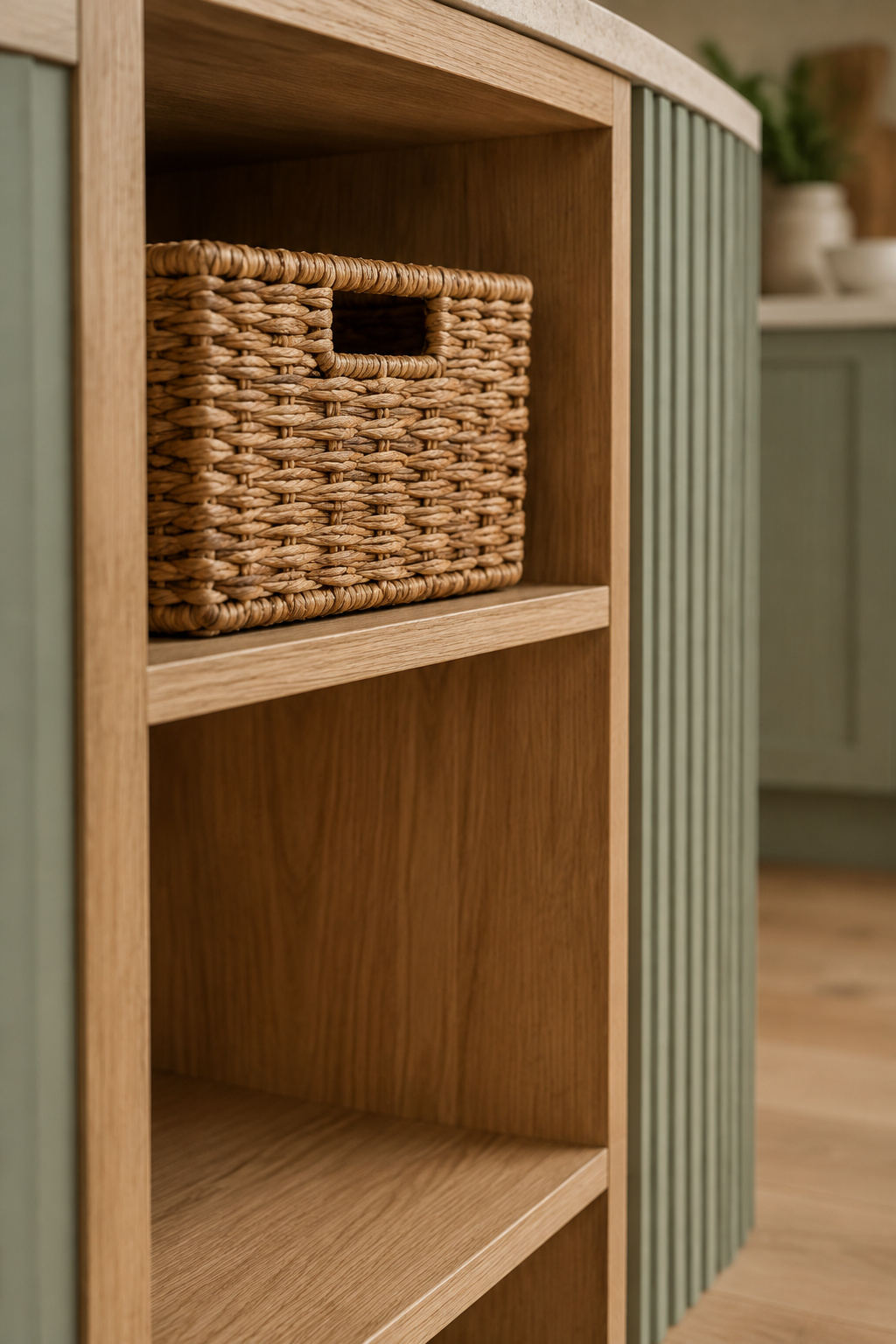
It is also the one mechanism a five-year-old can operate unassisted, which is the whole argument for it in a family kitchen. If a child cannot reach it, open it and put it back, the bench looks finished but does not work as storage. Put the placemats and the crayon tin in a cubby and they come back to it, imperfectly, most nights.
The price is permanent, though. No manufacturer, retailer or trade source describes a seal, splash guard or door on an open cubby base. The opening stays exposed to steam, crumbs and spills down a bench end. Anything not held in a basket is on display, and it will stay that way.
Front drawers: faster access, less volume
Half an inch per side does not sound like a design decision until you subtract it. Side-mount slides need 1/2 in to 17/32 in of clearance on each side of the box, taking roughly a full inch of width out of the opening; undermount slides need only 3/32 in to 5/32 in per side.
Drawers still buy the fastest repeatable access of the three, because nothing above has to move: no cushion, no diners, no place settings. They do have a banquette-shaped enemy, though: the table leg. One documented build ended up needing the table shifted before the drawers below would open. Kneel at the bench, with the table where it will really sit, and pull an imaginary drawer before you commit.
Full-extension vs. partial: the volume you actually get
The industry defines a full-extension slide as travel of 90% or more of the drawer box’s depth. A three-quarter extension slide exposes about 75%, leaving the back quarter inside the cabinet on every opening.
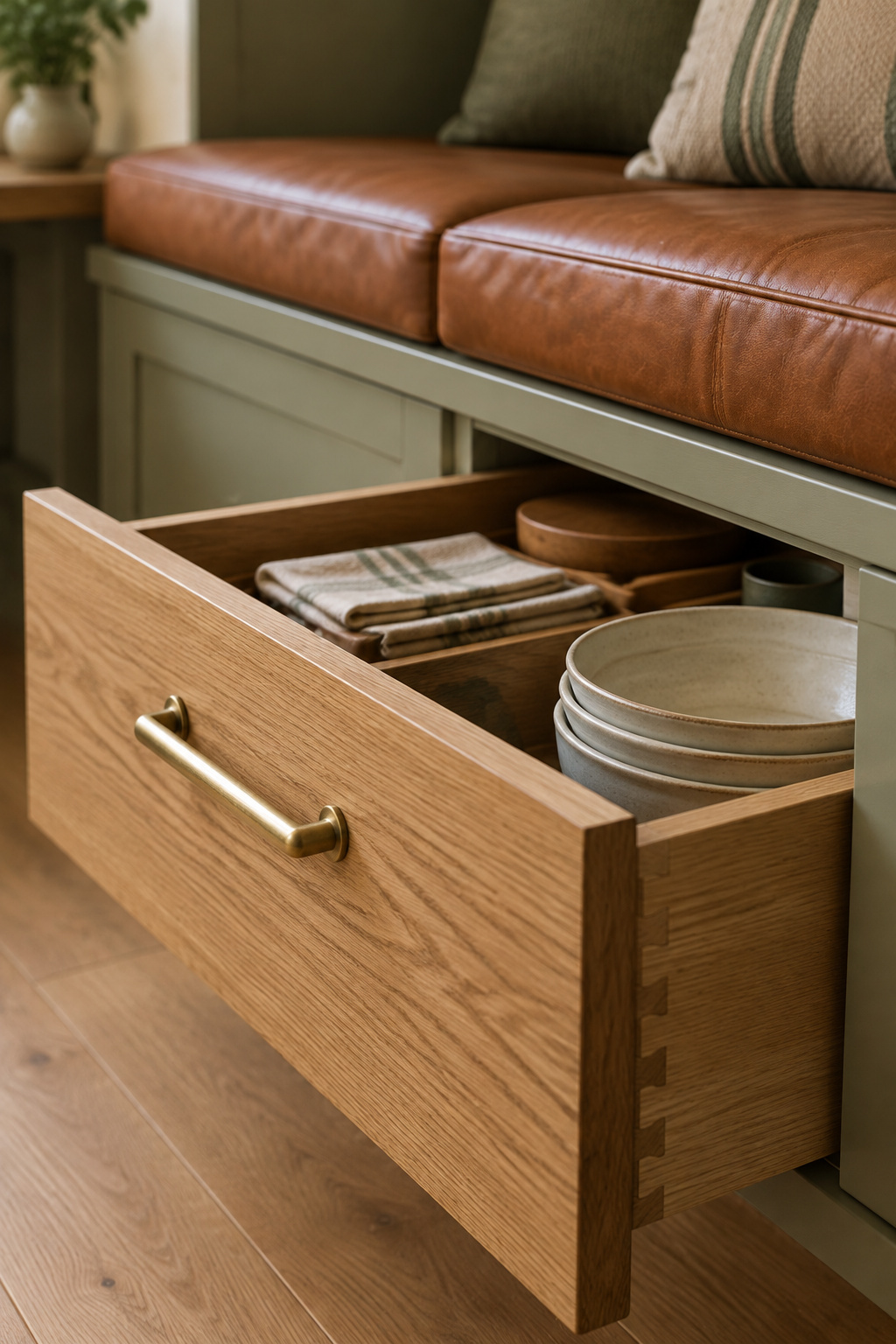
A 20-inch-deep drawer box at 90% gives 18 inches of reachable length; the same box at 75% gives 15 inches. Three inches of your own drawer, permanently out of reach, which is where lost mittens go to live.
Load rating is the other spec worth reading. ANSI/BHMA A156.9, the national cabinet-hardware standard, grades slides by tested load rather than marketing tier: Grades 3 and 2 to 50 lb static, Grade 1 to 75 lb, heavy-duty grades to 100 and 200 lb, all cycle-tested to at least 50,000 openings.
Lift-lid storage: full access, if the cushion cooperates
HGTV’s published DIY banquette-storage build specifies 48-inch piano hinges on the lids and names no lid stay anywhere in the instructions. A hinge lets a lid swing. It does not hold a lid open. That difference is the safety question on this mechanism, and it is the first thing I check before a lift-lid goes into a house with small children in it.
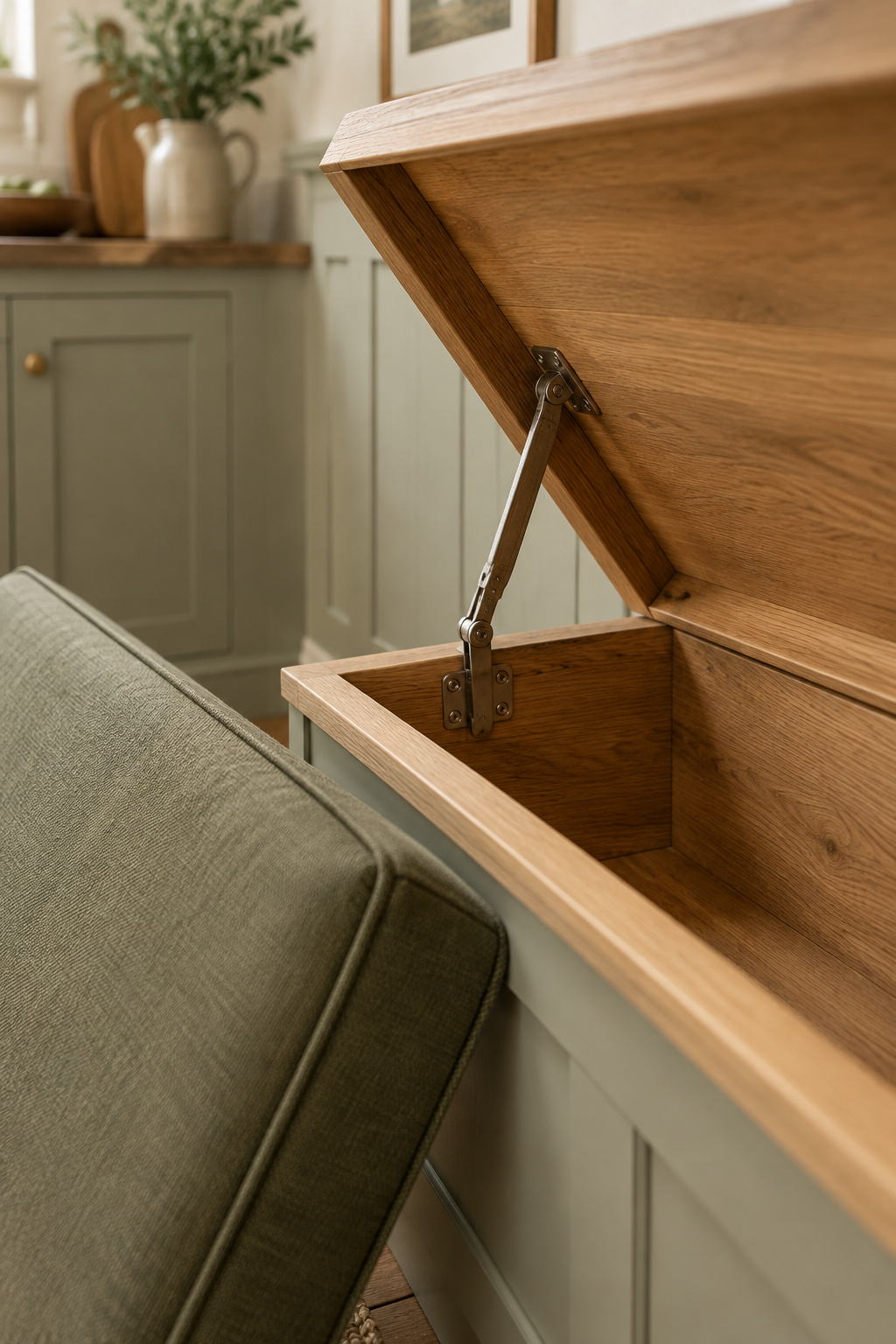
The volume is real: nothing but the lid intrudes on the box. What you trade for it is a heavy, cushioned panel held open against gravity over a cavity a small child can reach into. Children do not so much lift a lid as get underneath it and push, then let go with both hands to grab what they came for.
Hinges and lid stays: what the hardware actually has to do
This part is specification territory, not my trade, so here it is from the people who make and regulate the hardware. Sugatsune, the manufacturer, sizes lid stays by formula rather than rule of thumb: required torque equals the lid’s weight multiplied by its front-to-back dimension, divided by two, and the company names bench-seat and toy-box lids as the application. A Sugatsune-made bench-seat stay sold at retail is rated per pair in three tiers, 121-173 in-lb light duty, 173-216 in-lb medium and 216-260 in-lb heavy, holding open at 70 degrees.
The safety threshold comes from the regulator, not the hardware maker. A hinged lift-lid bench shares its hazard class with a toy chest, which is why the applicable standard is written for chests: ASTM F963 section 4.41 requires lid-support performance testing to prevent pinching, crushing, laceration and suffocation hazards. CPSC’s 1983 voluntary standard set the testable version: a lid may not drop more than 1/2 inch when lifted more than 2 inches, and up to 60 degrees, from closed. CPSC’s publication 5099 puts it plainly: a lid support should hold the lid open in any position in which it is placed, and a screw-adjustable one needs rechecking as it loosens.
Soft-close is a different feature. It governs the last few degrees of a lid coming down; the load-rated hold-open mechanism is what stops it coming down at all.
What should actually live under a banquette (and what never should)
When did you last take anything out of the bench? That question sorts storage faster than any measurement, and it is why unused under-seat storage shows up as the most common banquette regret rather than as a capacity complaint. The mechanism rarely fails for being too small. It fails because the household stops opening it.
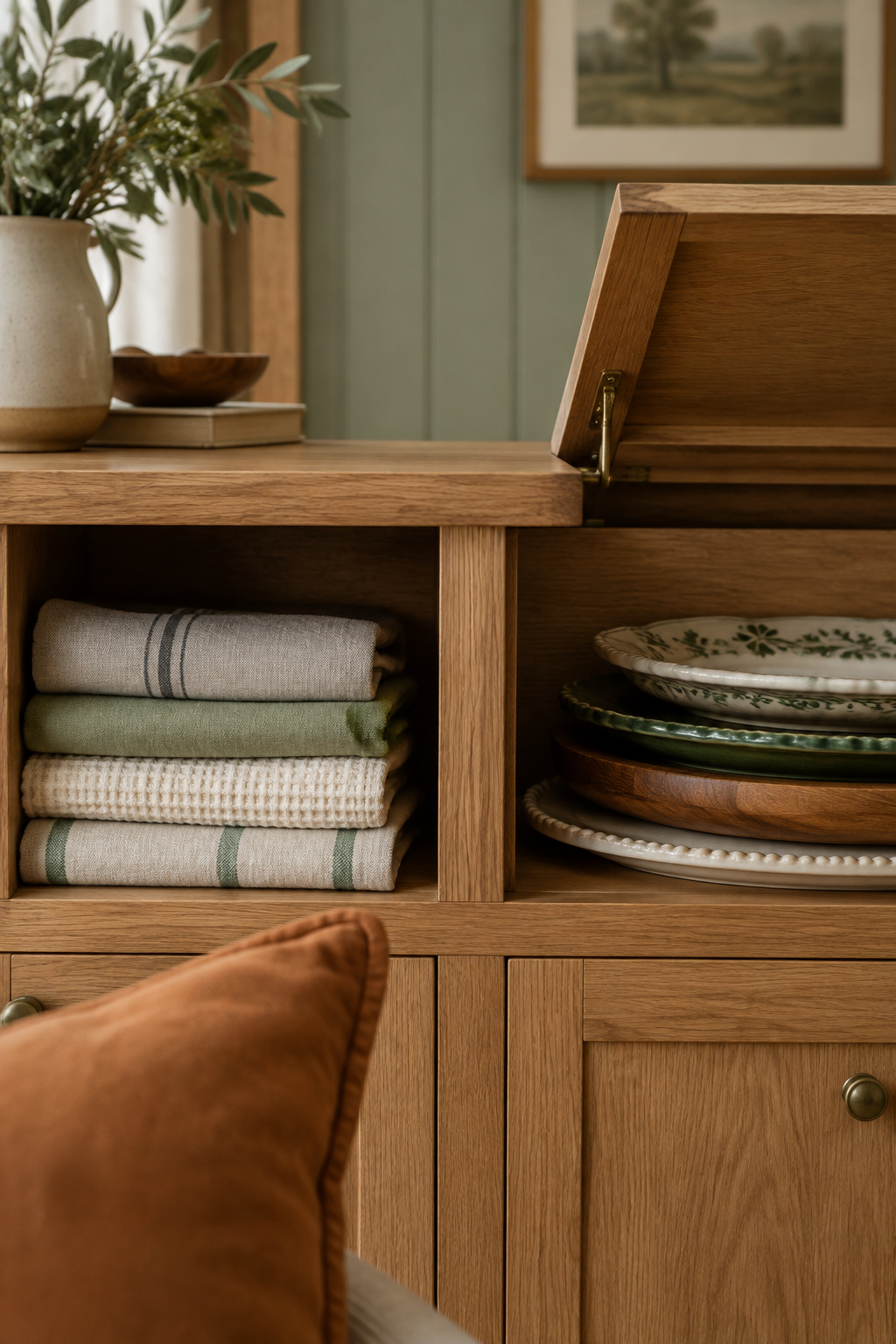
The daily-use test: if you’d reach for it twice a week, it doesn’t go under the bench
A lift-lid penalizes anything needed often, because opening it means clearing the seat first. CapnMac, posting on a Fine Homebuilding forum thread about built-in banquette seating, called after-the-fact access to seat-bottom storage “such a huge operation to get every thing off the seat bottoms.” That is a builder describing a chore, not a spec.
So sort by retrieval cost. Candidates for a lid or a deep drawer, reasoned from that access logic rather than taken from a published list:
- Table linens between the meals that need them
- Seasonal and holiday serveware
- Board games and puzzle boxes
- Picnic gear and spare chair cushions
Load it one stage ahead, too: the bench holding bibs this year holds a game stack in four, so buy for the stage after next.
What never belongs under a banquette
Anything reached for during a meal. A lift-lid sits beneath people who are seated and eating, so opening it mid-meal means asking someone to stand up. Everyday napkins, condiments, the kids’ plates: cubby, shallow drawer, or the kitchen proper.
Anything past the hardware’s rating, too. A lift-lid’s ceiling is its stay’s torque rating and a drawer’s is its slide’s load rating. Overloading either fails the specification; it is not a judgment call.
And anything you have not measured against the interior depth, which is smaller than the seat above it. The 18-22 in finished seat depth a dining bench needs, minus an estimated 2-4 in for the front rail, apron and hinge-side blocking that carries a seated adult, leaves roughly 14-19 in of usable interior depth. That subtraction is this article’s own arithmetic. No manufacturer, trade or standards source publishes an interior box depth for a banquette.
Choosing your mechanism before the box gets built
Practitioners on that same Fine Homebuilding thread agree on sequencing: settle the mechanism and its dimensions before the frame goes together, because retrofitting a hinge or a slide into a finished box is much harder than building the clearance in. Hardware sets box dimensions, not the reverse. So decide before building the box once the storage mechanism is decided even starts.
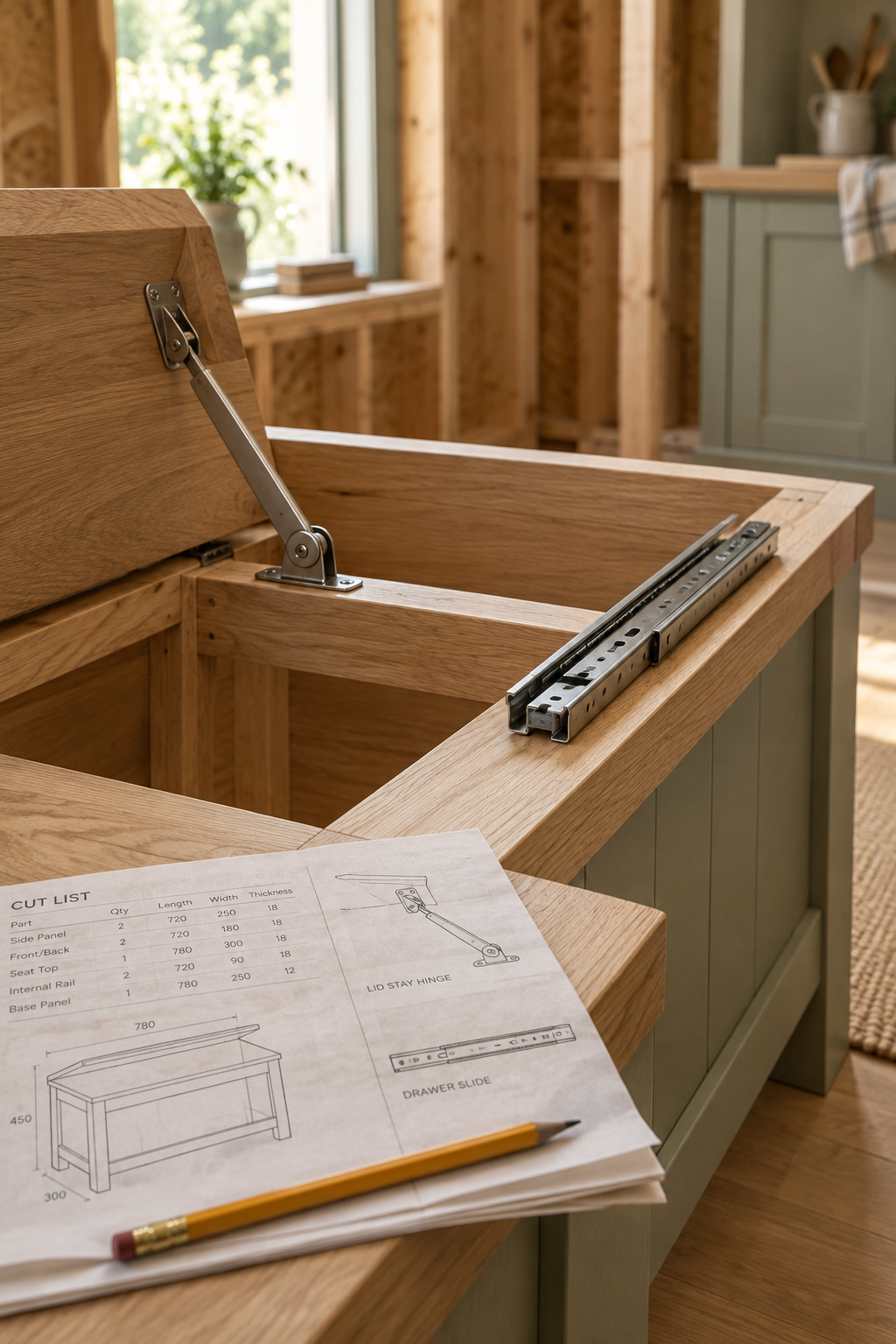
A corner-return bench narrows which mechanism is practical before storage is on the table at all, because the corner join constrains lid size, hinge placement and drawer geometry differently than a straight run. Which plan shape to build is a different article’s argument, and this one does not make it.
Name what you would put under the bench, then how often you would go and get it. Monthly or less, any of the three works, so pick on volume. Weekly, skip the lid and use a drawer. Daily, you want an opening with nothing over it.
So, tomorrow: put the holiday platters and the picnic basket under the lid, where a once-a-season retrieval cost is fine. Then take the everyday napkins back out, into a basket in a cubby a six-year-old can reach, and watch how much more the bench gets opened.
FAQ
Is under-bench banquette storage deep enough for large pots and pans?
Probably lying flat, but measure rather than assume. The derived 14-19 in interior range above is an estimate, not a spec. A 12-quart camp-style Dutch oven runs about 18 in across and 5.5 in deep. It lies down near the top of that range, and will not stand upright at the bottom.
Can you add storage to an existing banquette bench after it’s built?
Yes, though it is harder than building it in, and practitioners on Fine Homebuilding’s banquette thread say so consistently. An open cubby retrofits most easily, because cutting an opening into a solid base is a smaller change than adding a lid-stay-rated lid or a slide-rated drawer box.
How do you keep a lift-lid banquette cushion from sliding when the lid opens?
Hook-and-loop fastening between the cushion’s underside and the top of the lid: sew-on tape for fabric-backed cushions, adhesive-backed for smooth or hard-backed ones. Because cushion and lid travel as one unit, the fastening only resists sliding during the lift; it carries no load under a seated adult.