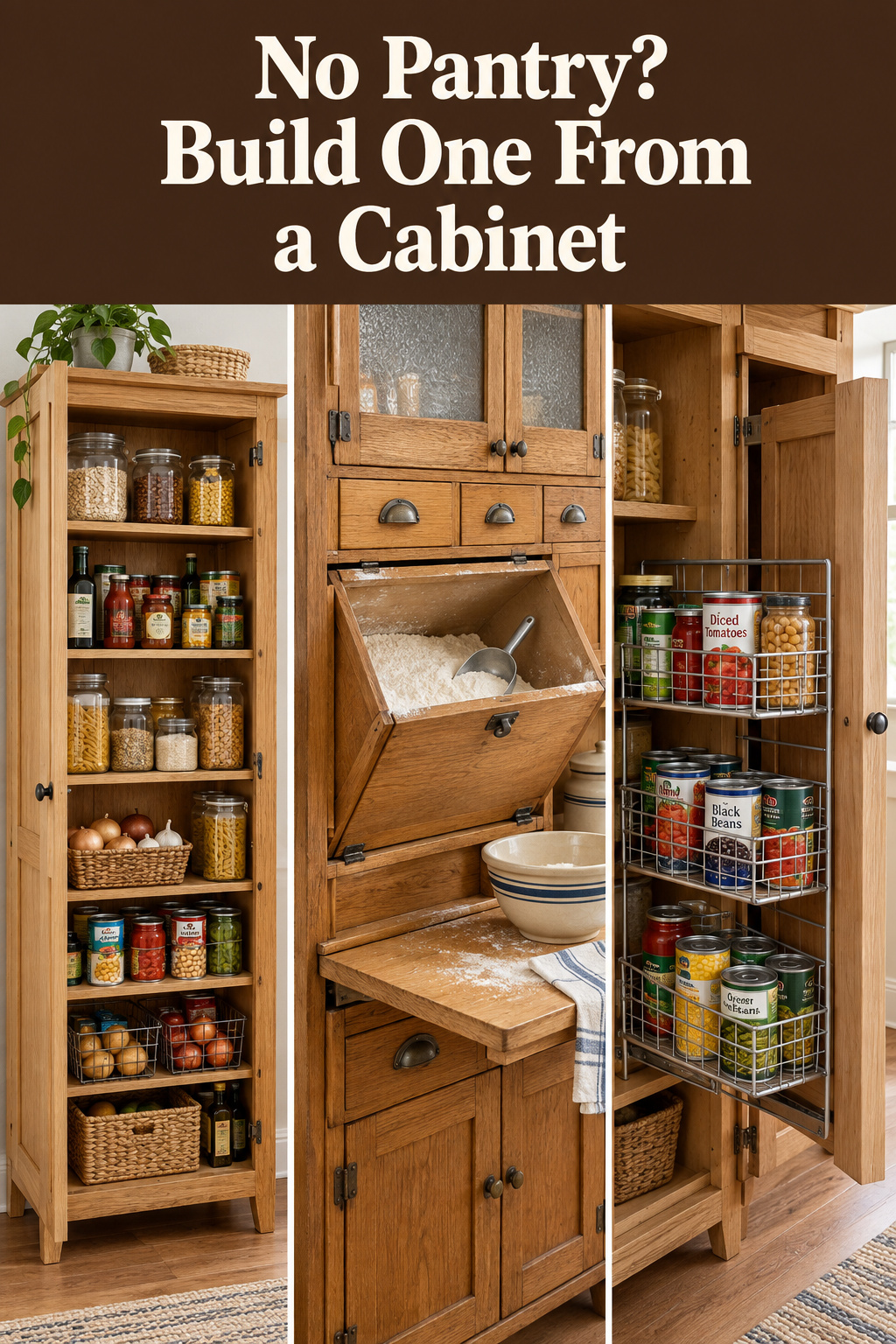
There is no pantry in your kitchen, no closet behind a door or room off the back hall, just a stretch of wall. A century ago most American kitchens had the same absence, and by the 1920s roughly one household in ten had answered it with a Hoosier cabinet: a pantry built as furniture, standing on its own feet. Good pantry cabinet ideas still come down to a piece that stands or a cabinet that is built in, and every listing photo makes its option look like the answer. Depth, mechanism and soundness decide it, and looks come last.
TL;DR
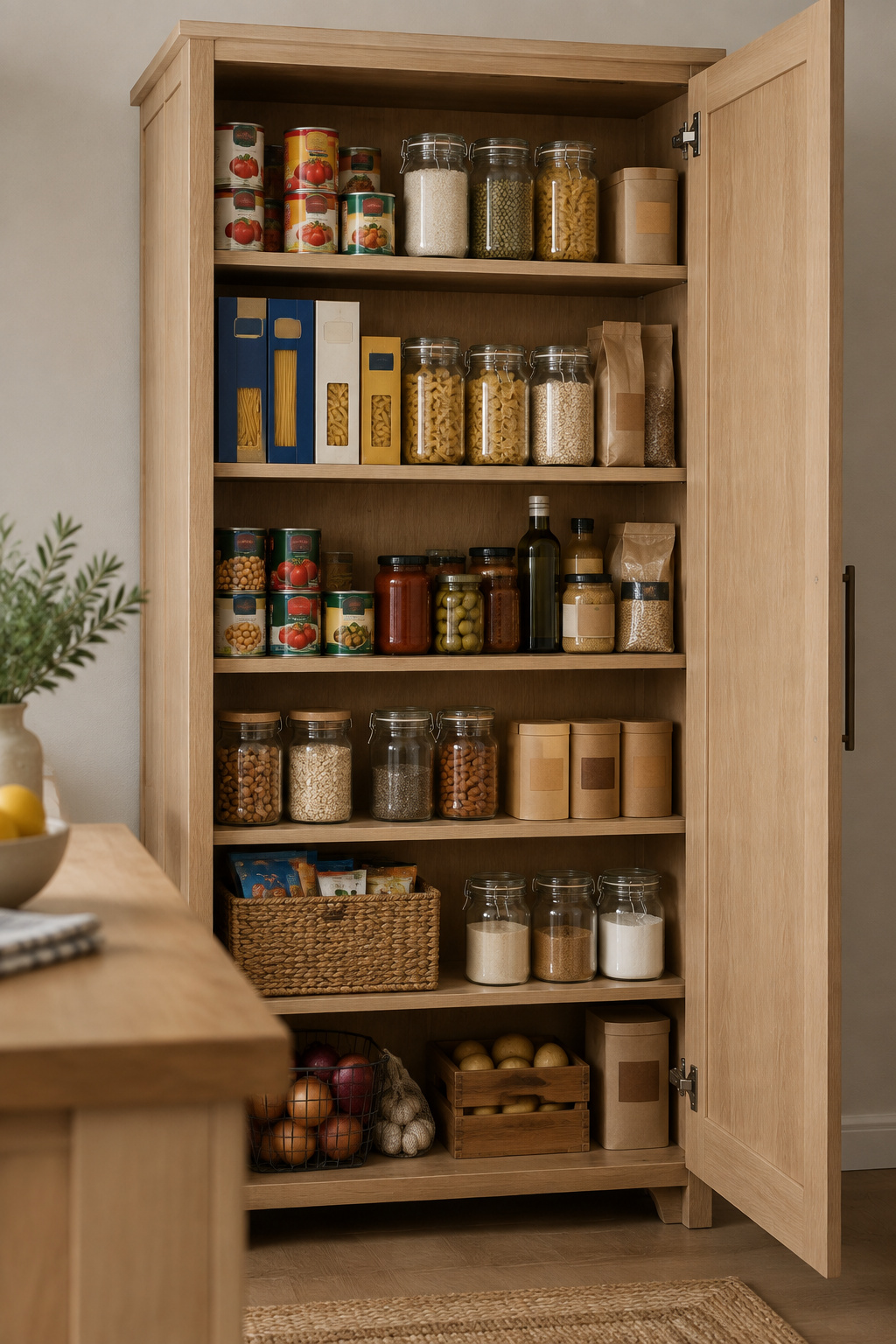
- Pick the path by reversibility and budget. A flat-pack tall cabinet from IKEA’s SEKTION line runs $116-$199, a vintage Hoosier $400 to $5,000, and a built-in semi-custom run is fixed to the wall and sized to your ceiling in 84-96 in heights.
- Depth is the bigger decision. A 12 in cabinet matches wall cabinets and keeps one visible row; a 24 in one matches base cabinets and doubles shelf area, but hides the back row unless you add full-extension pull-outs.
- Vet any old piece before food goes in. The federal lead-paint rule covers only furniture made after February 1978, so test the finish, rock the joints and smell the interior first.
No pantry? These pantry cabinet ideas solve it two ways
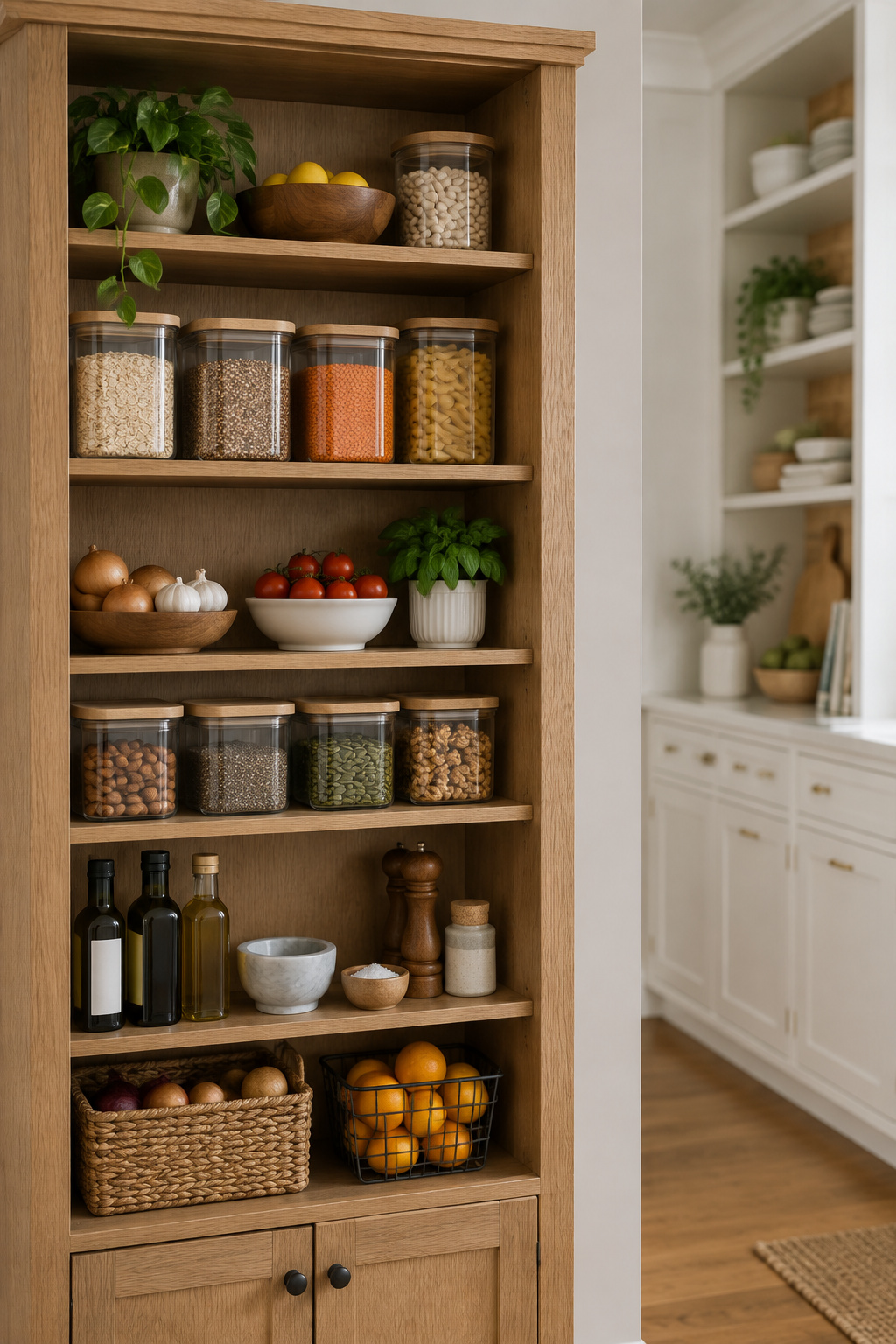
A kitchen without a pantry has exactly two structural answers. Either the storage stands free, needing only floor space and door clearance, or it is built into the cabinet run and fixed to the wall. A new flat-pack unit and a converted armoire are both variations on the first. The biggest difference between the paths is in the last column, reversibility:
| Path | Typical cost | Install effort | Capacity | Reversibility |
|---|---|---|---|---|
| Freestanding, new (flat-pack tall cabinet) | $116-$199 (IKEA SEKTION, 80 in and 90 in heights) | Assembly only; needs floor space and door clearance | 15 in wide x 24 in deep x 80 in tall for the $139 unit | Fully reversible: sell it, move it, replace it |
| Freestanding, vintage (Hoosier-style) | About $400 fixer-upper to $5,000 at auction | Delivery plus vetting and any restoration | Varies by piece | Fully reversible |
| Built-in tall cabinet (semi-custom) | Priced by quote; no figure in my sources | Measuring to ceiling and soffit, often professional install | 84-96 in tall, 12 or 24 in deep | Fixed; removal leaves a gap or patch job |
The usual assumption is that built-in is the permanent upgrade and freestanding the cheap stopgap, but a good vintage Hoosier can cost more than a new built-in, and it leaves with you when you move. Reversibility is the test I apply to every intervention in an old house: can the next owner undo this? A freestanding cabinet passes without a scratch on the wall.
Either way, the cabinet is only the container; the zoning that makes it work is in the broader pantry organization ideas.
Freestanding pantry cabinets: what to measure before you buy
Measure three things before you fall for anything: the footprint, the height to the ceiling, and the arc the doors sweep. A built-in run was planned around its doors. A freestanding piece lands in a room that was not, and tall doors that hit the refrigerator handle get opened halfway forever.
New freestanding cabinets share the built-in dimensions, 12 or 24 in deep and roughly 80-96 in tall, so the depth argument below applies to them too.
Hoosier cabinets and other vintage freestanding pieces
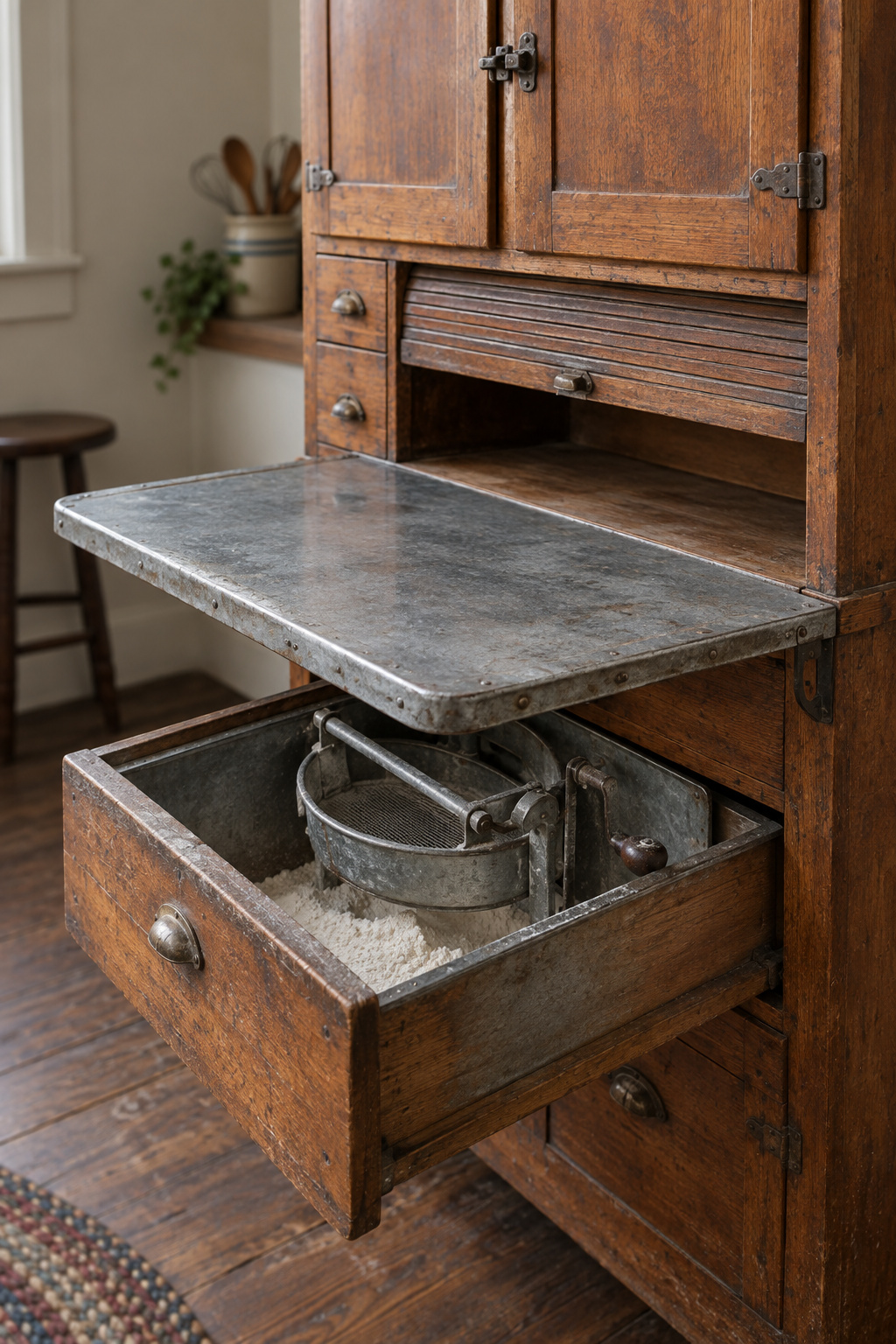
The G.I. Sellers Company of Elwood, Indiana, is credited with the first Hoosier-style cabinet in 1898, and by the early 1940s more than 120 Indiana-area companies had made them. Nancy Hiller’s history in the Indiana Magazine of History traces the fall too: built-in shelving became cheaper to make and easier to clean under.
They were sold as labor-saving machines. The efficiency engineer Harrington Emerson claimed in period advertising that Coppes’ Napanee Dutch Kitchenet saved the average housewife 1,592 steps a day. It was a marketing figure, not a measurement, but it tells you what the buyer thought she was getting. By the late 1920s Coppes was building roughly 23,000 cabinets a year.
A genuine piece shows its working parts: a metal-covered pull-out worktable, side drawers, a shallower upper section, and flour and sugar bins with a sifter. These are the parts reproductions most often fake, and a flour-bin front with no sifter behind it is a costume, and I would pass on it the way I pass on sand-through-paint “aging.”
For dating, the Coppes Commons museum publishes useful markers, with a caution: it descends from the company, and these specific years have no second source.
| Marker | What it indicates |
|---|---|
| Name tag “Coppes, Zook & Mutschler Co.” | 1902-1912 |
| Name tag “Coppes Bros. & Zook” (the most common) | 1913-1935 |
| Name tag “Napanee Kitchen Compact” | 1936-1938 |
| Clear shellac or lacquer on white oak | 1898-1920 |
| Painted finish | 1920s onward |
Finish condition and whether the bin, sifter and table still work account for most of the gap between a $400 fixer-upper and a $5,000 auction piece.
Built-in tall cabinets: 12 inches vs. 24 inches deep
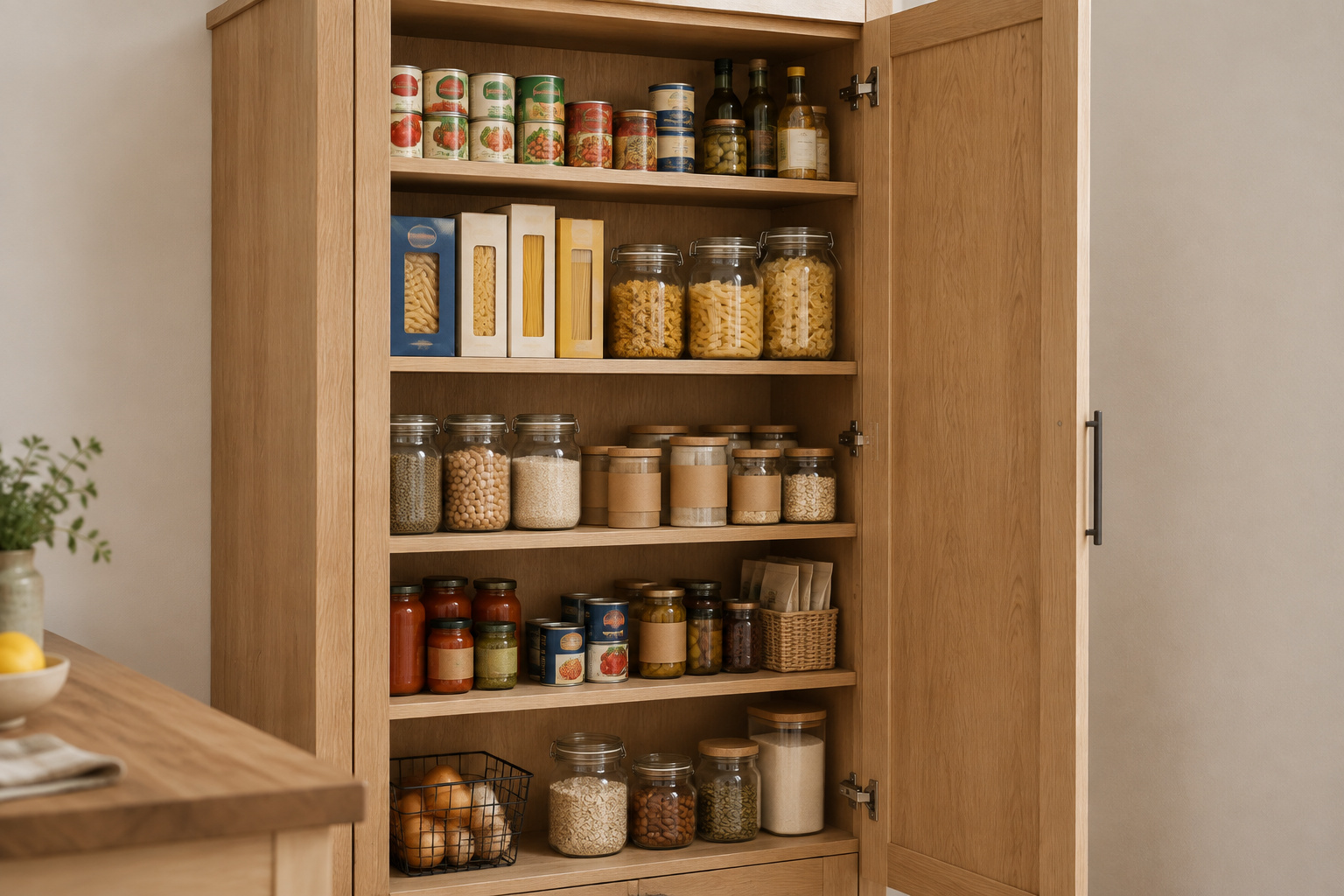
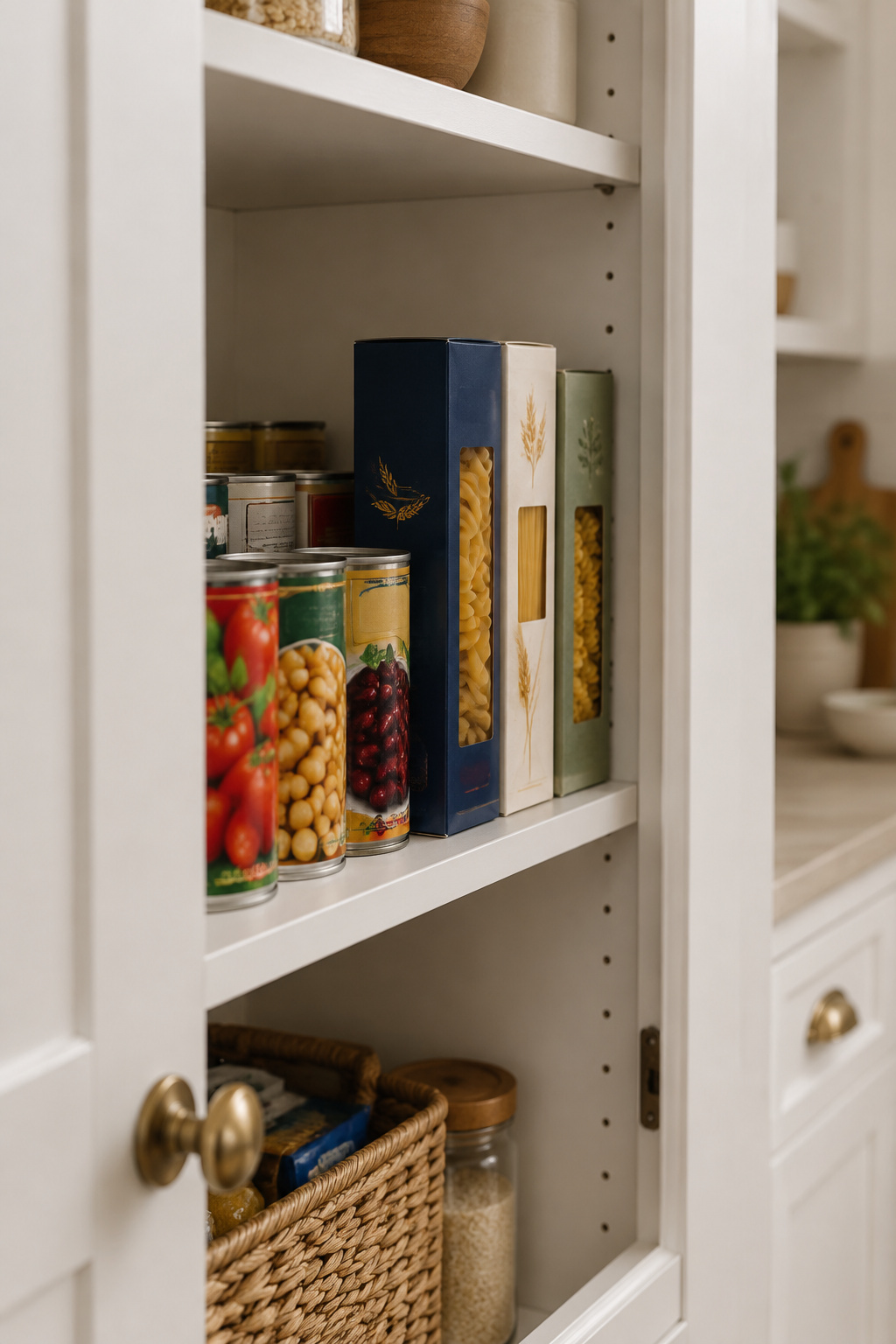
Tall pantry cabinets come in only two depths because they are designed to line up flush with the cabinets beside them. A 12 in depth matches standard wall cabinets; 24 in matches base cabinets. Semi-custom lines such as KraftMaid run the heights from 84 to 96 in in 3 in steps, sized to the room: an 84 in cabinet fills an 8 ft ceiling with a 12 in soffit, and a 90 in cabinet aligns its top with a 36 in wall cabinet hung 54 in off the floor.
The two depths do different jobs:
| Depth | Matches | What you see | Best for |
|---|---|---|---|
| 12 in | Wall (upper) cabinets | One row, nothing hidden | Cans, jars, spices, boxed pasta |
| 24 in | Base cabinets | Front row only on fixed shelves | Bulk goods and tall items, with pull-outs |
At the same width and height, a 24 in cabinet has twice the shelf area of a 12 in one (24 ÷ 12 = 2). All of that extra area sits behind the front row, though, and stock you cannot see is stock you forget you own. A shallow run shows you everything you have.
The common mistake is choosing 24 in for capacity with no plan for reaching the back. If you go deep, how deep shelves inside a cabinet should be matters as much in a tall cabinet as in a walk-in.
Pull-out shelves vs. fixed shelves inside the cabinet
The usual error is buying a slide by its label. “Heavy-duty” means nothing on its own. The grading that counts comes from the ANSI/BHMA A156.9 hardware standard, which rates slides by tested load and cycle life:
| Grade | Initial load | Static load |
|---|---|---|
| Grade 3 | 20 lb | 50 lb |
| Grade 2 | 30 lb | 50 lb |
| Grade 1 | 50 lb | 75 lb |
| 1HD-100 | 100 lb | 100 lb |
| 1HD-200 | 200 lb | 100 lb |
Every grade is cycle-tested to at least 50,000 openings. In practice, most full-extension kitchen slides from Blum, Accuride and Fulterer are rated 75-100 lb per pair. The 450 lb figure you will see is Fulterer’s top pantry tier, one commercial line for institutional kitchens, rated by the vendor and well above what a pantry slide typically holds. A full shelf of cans can outrun a 50 lb slide, so read the rating stamped on the hardware.
Choose full extension, because a slide that clears the opening makes the back of a 24 in cabinet as reachable as the front.
A DIY pull-out runs about $50-$90 per shelf in materials, against $100-$300 professionally installed. No-drill adhesive kits cost roughly $30 and leave the cabinet floor untouched, fully reversible for renters, but they hold less and need a flat, clear floor.
Fixed shelves have no moving parts to wear out, so my verdict follows the depth: fixed shelves in a 12 in cabinet; in a 24 in cabinet, pull-outs on at least the heavy lower shelves.
Repurposing an armoire or larder as a pantry
Most of what I know about dating a case piece I learned at estate sales across three counties, pulling drawers in other people’s houses and reading the corners before the price tag. The habit that stuck is judging a piece by what it was built to do before deciding what it can do now.
A larder was built for air: small windows covered in fine mesh to keep insects out, slate or marble shelves 2-3 in thick to hold the cool, and a place on the coldest side of the house. By the 18th century it held bread, milk, butter and cooked food as well as meat, the same broad role we now ask of a pantry cabinet.
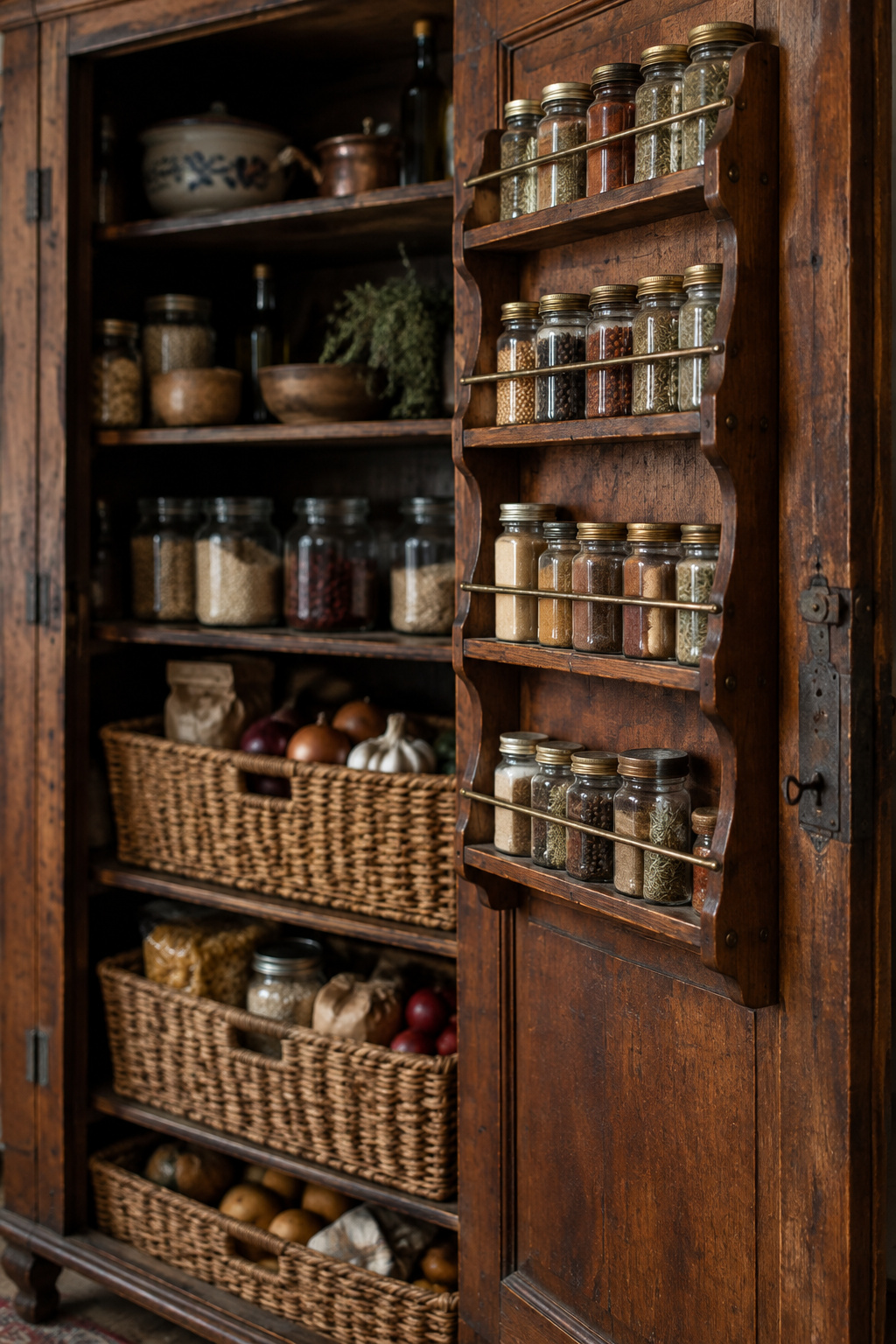
An armoire has none of that airflow, and sealing one tight does not make it food-safe, because the larder depended on moving air. The conversion itself can be light: racks on the inside of the door panels for spices and small packets, baskets in place of fixed drawers. Both lift out and leave the carcass unaltered, which is the only kind of work I would do to a sound old piece.
I can’t give you a ventilation figure, because no source I found sets an airflow or moisture specification for a converted piece. The vetting below is the practical substitute, and I’d trust it over a number I made up.
What to check before food goes anywhere near an old cabinet
A piece can be beautiful and still not be food-safe, and the rule people assume protects them is narrow. Under 16 CFR Part 1303, the Consumer Product Safety Commission bans lead-containing paint on furniture manufactured after February 27, 1978: above 0.06% lead by weight until August 14, 2009, and above 0.009% since. As I read the regulation’s definition, “furniture” excludes fixtures such as built-in cabinets, so this rule speaks to movable pieces like an armoire, a larder cupboard or a Hoosier. Any piece made before 1978 was never covered at all, so the old freestanding cabinet you most want is the one no federal rule has ever vetted.
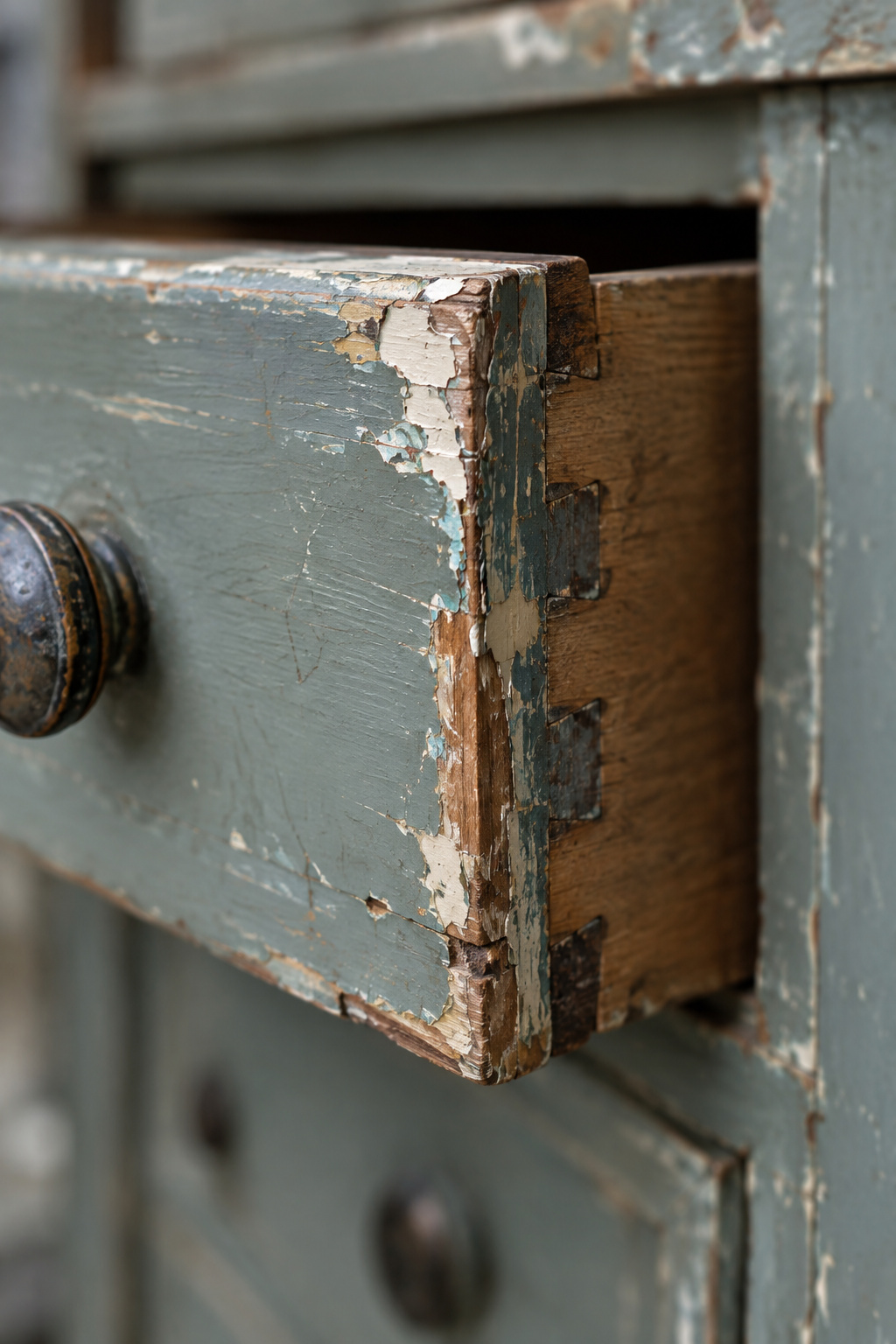
Pre-1955 white paint may contain up to 50% lead, and Minnesota’s health department advises assuming any vintage piece contains lead until verified. Check in this order:
- Test the finish with an XRF device, a certified lab sample or a home kit. If the paint cannot be fully removed, a sealant over it reduces lead dust and debris.
- Inspect the rubbing surfaces. EPA guidance says lead paint in good condition is usually not a hazard; the risk is peeling or chipping paint and surfaces that rub, like a door edge or drawer runner.
- Check anything that touches food directly, such as a tin flour-bin liner or painted metal insert, for lead.
- Rock the carcass to test the joints. Dovetailed drawers signal quality; stapled corners signal construction prone to failure. Solid wood knocks heavy and resonant, engineered board hollow.
- Smell the interior. Must, mildew or chemical odor means moisture history and possible mold. Bubbled veneer usually cannot be sanded out the way solid wood can.
A piece that passes all five is ready, and once it is in place, the same small-space rules that apply to a reach-in pantry decide what goes on which shelf.
Start with the wall you have and measure it for depth before style: 12 in if you want every can in sight, 24 in if you will commit to pull-outs. Once you have that number, you’ll know which listings are worth opening.
FAQ
Can any tall cabinet be used as a pantry?
Most tall cabinets can hold food storage, but depth decides how well. A 12 in cabinet matches wall-cabinet depth and keeps everything visible in one row; a 24 in cabinet doubles the shelf area but hides the back. A vintage or secondhand piece must also pass a lead-paint test, sound joints and a clean-smelling interior.
What’s the load rating on a pull-out pantry shelf?
It depends on the slide’s rating. The ANSI/BHMA A156.9 standard grades slides from 20 lb initial and 50 lb static up to heavy-duty grades, all tested to 50,000 cycles. Most standard full-extension kitchen slides hold 75-100 lb per pair. Commercial pantry lines go higher, so read the rating on the hardware.
Is a Hoosier cabinet safe to store food in?
Only once it has been vetted. Hoosier cabinets were made from 1898 into the early 1940s, so any original paint predates the 1978 lead ban and should be assumed to contain lead until tested or sealed. Check that the tin lining, flour bin and sifter are sound, rust-free and free of pest or moisture damage.