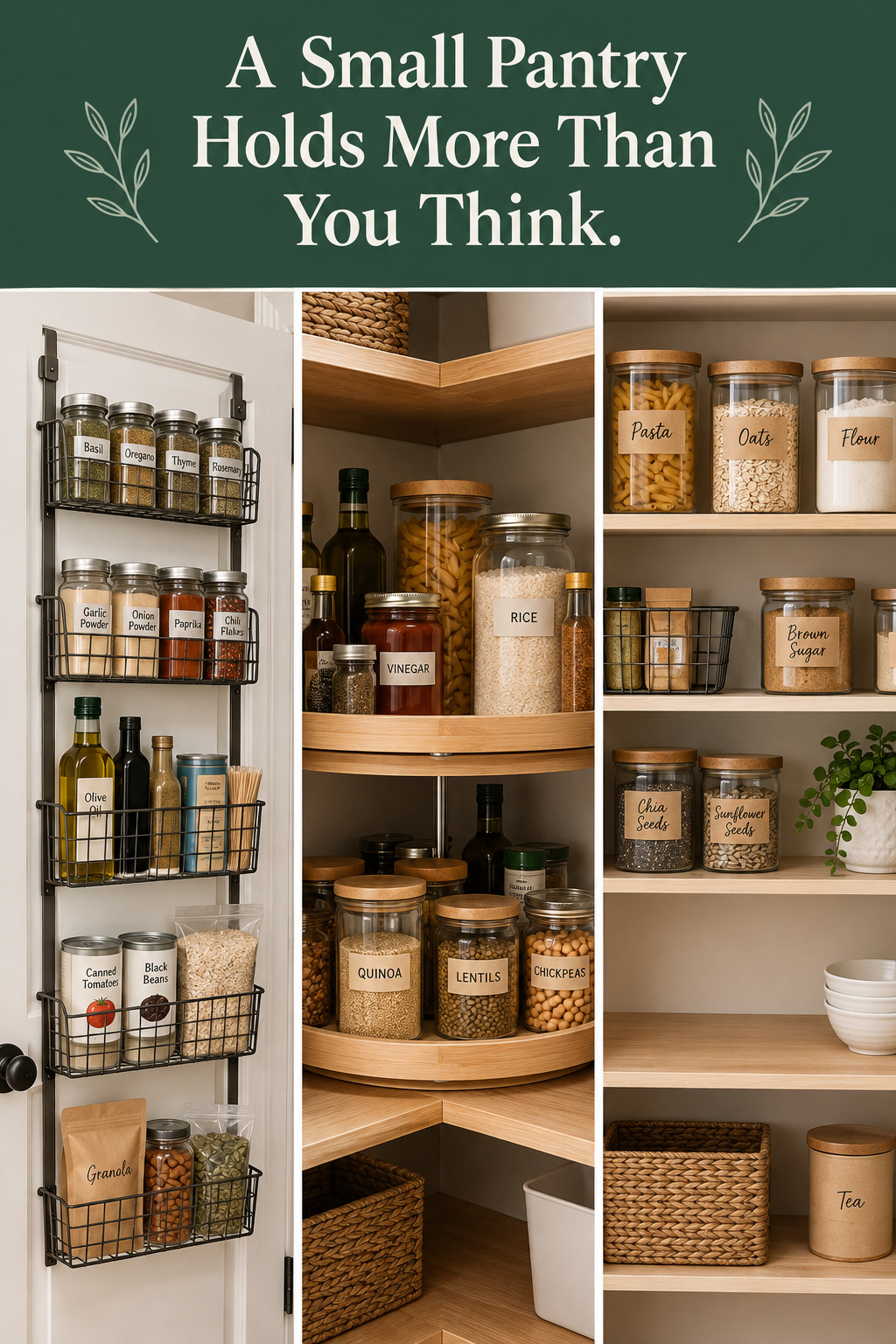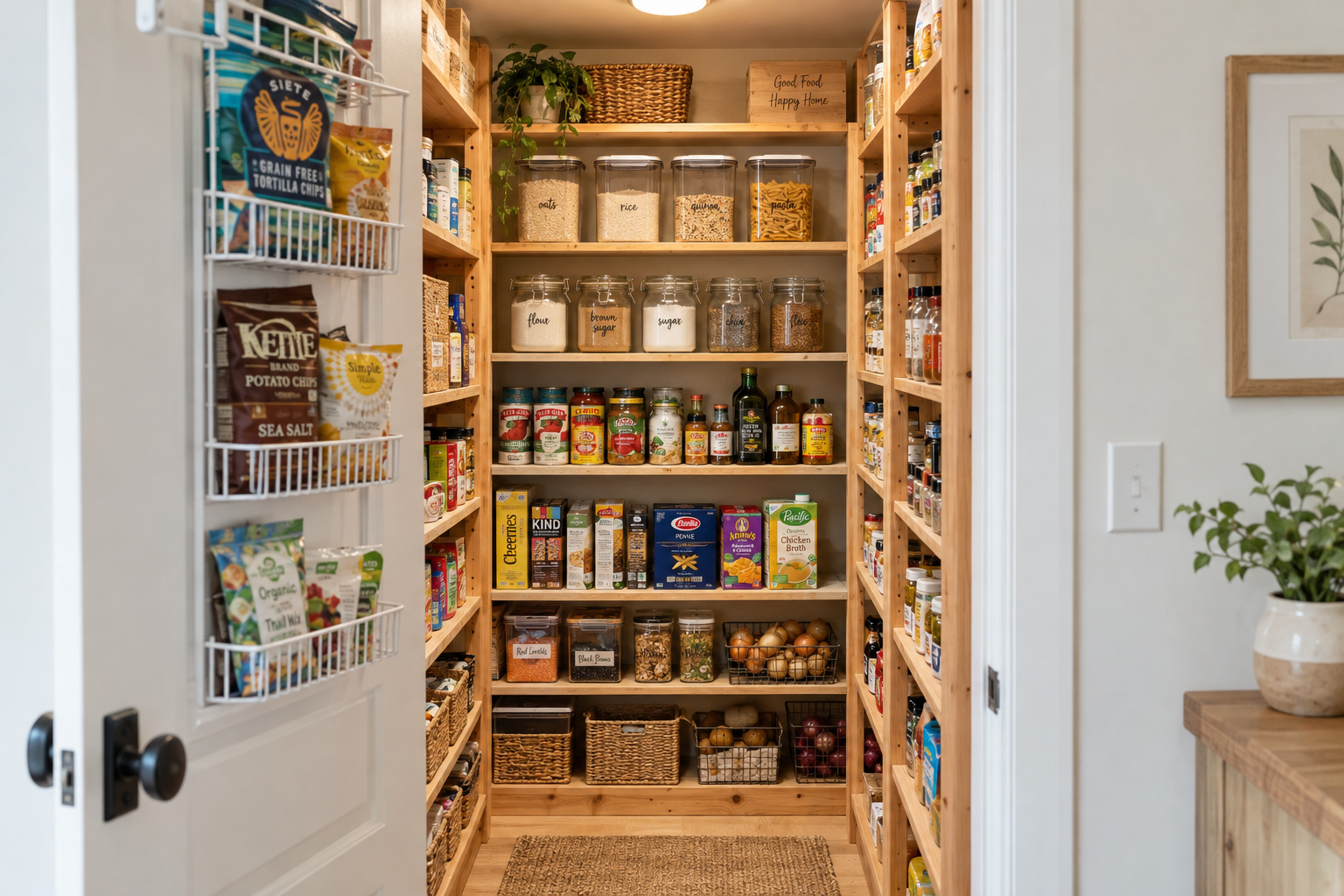
The door gives a small click and swings toward you. Cool air, a faint smell of cumin and coffee, the soft tick of a jar settling against wire. Your eyes find everything before your hand moves: breakfast on the left, cans in the middle, snack bags in a rack on the door, one strip of bare shelf. You reach once, and close the door a little quieter than you opened it.
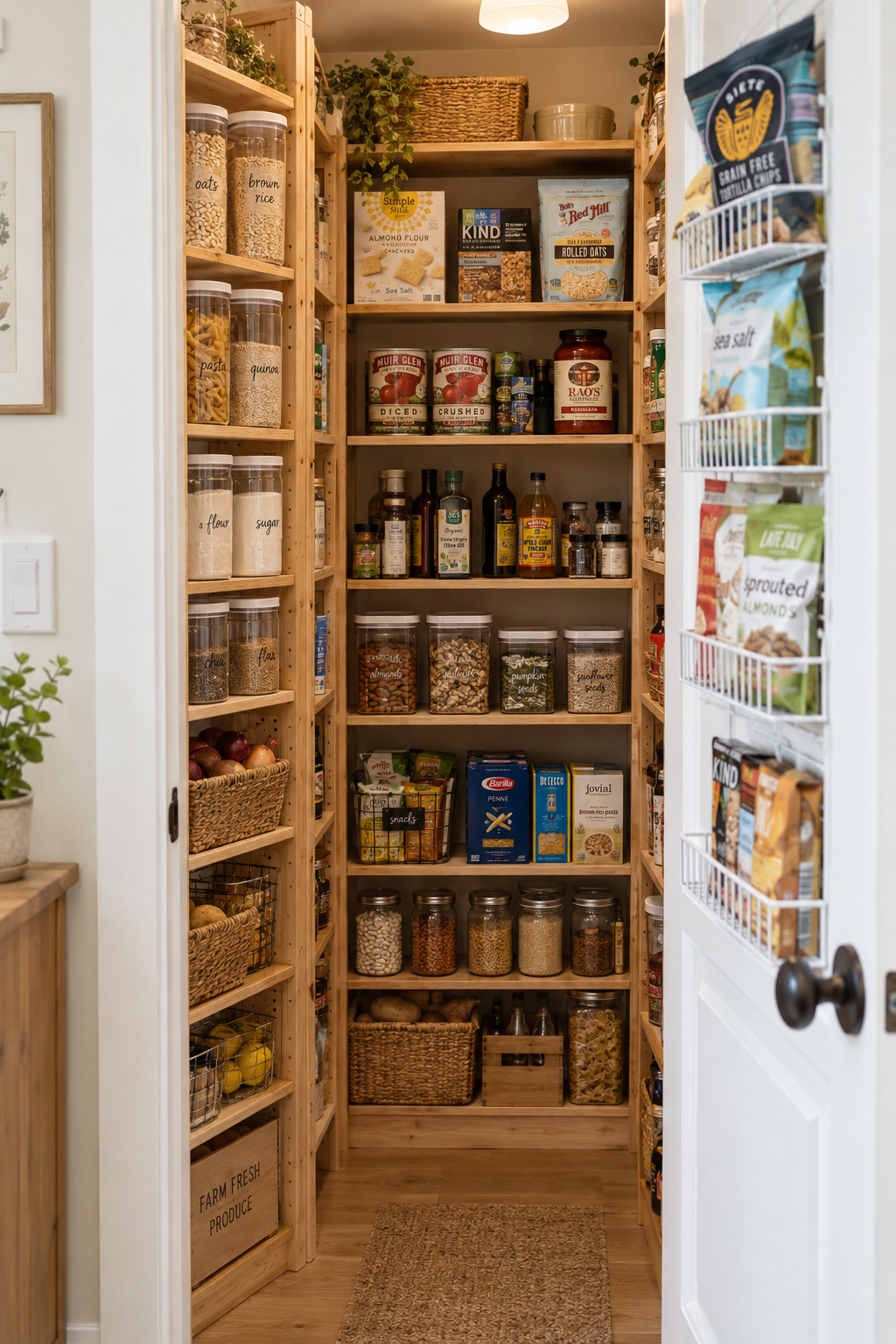
Most small pantries give the opposite: a wall of packaging, something sliding, the door closed again without the thing you came for. Small pantry organization is usually taught as a hunt for more room, but it comes down to what has been asked to live behind that door. A reach-in, a closet pantry or a narrow slot can each become the calm version above inside the footprint it already has.
TL;DR
- Use the door first. An over-the-door rack hangs from the door’s top edge, and one manufacturer spec sheet rates it at 10 lb per shelf; measure for roughly 5 to 7 in of clearance between the closed door and the first shelf before you buy.
- Reclaim the corners with a turntable. Corner turntables come in 24, 28 and 32 in diameters, with 28 in the most common; measure the inside corner opening, subtract about 2 in, and let the smaller measurement pick the size.
- Subtract before you shop. Gadgets untouched for a year, bulk duplicates, empty containers and non-food overflow leave first, and the space they free costs nothing and needs no fixture.
See everything first: why visibility beats capacity
A pantry should feel settled when it opens, something you can read in a single breath.
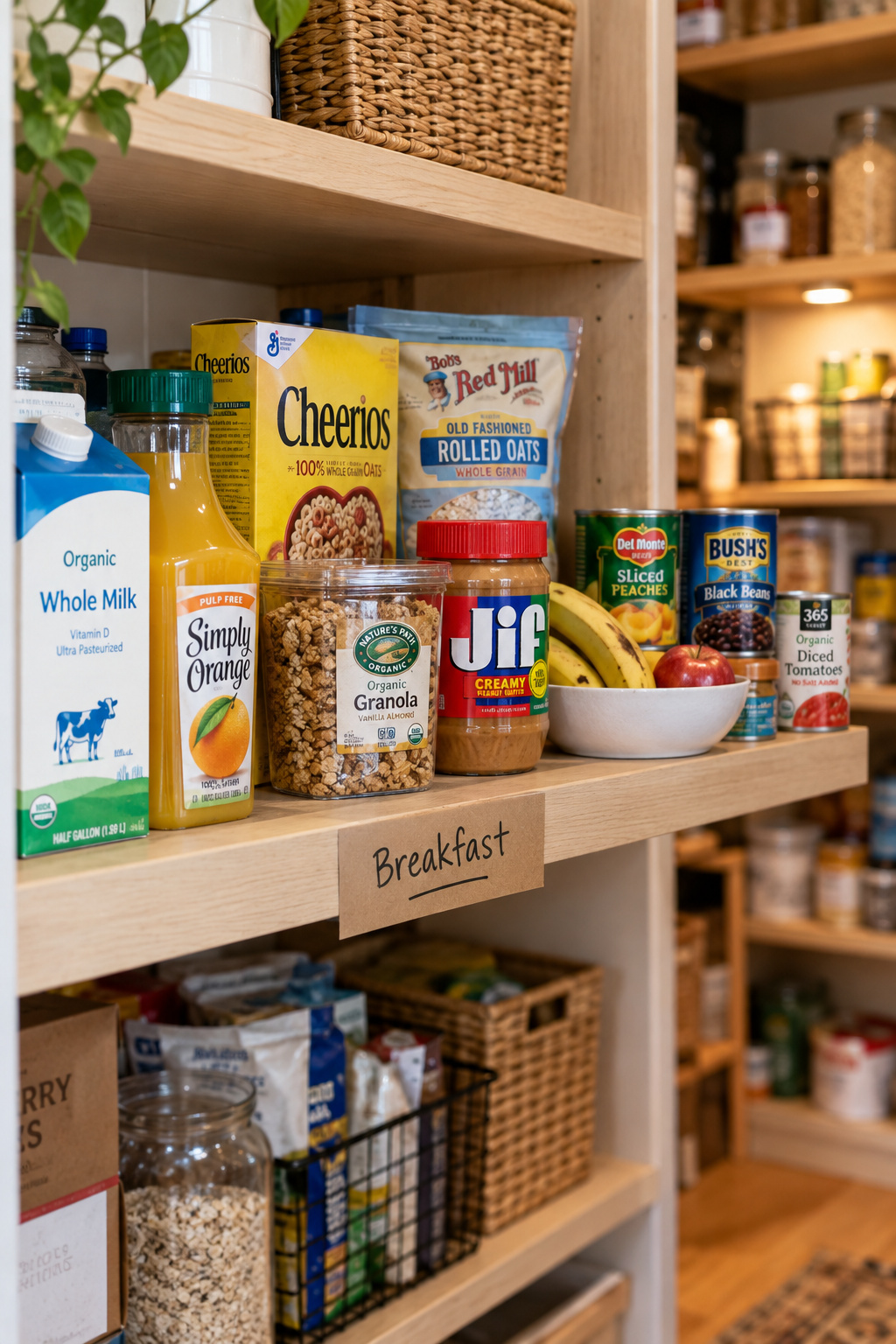
That feeling is the whole brief for a reach-in. A walk-in is a room, so it can let a case of water sit on the floor and still feel roomy, but a reach-in has no such buffer. Every shelf is shown to you in the same single glance each time the door opens, and whatever that glance cannot find, you effectively do not own. So I ask for visibility before capacity.
Kath Younger learned this from the other direction. When she moved from a walk-in to a closet-style pantry, the first rule she set involved no product at all: don’t store more than you actually need. Fewer items stay visible without extra shelving, and she came to find a smaller pantry easier to keep organized than a larger one once everything had a purpose and a place.
Treat small as a constraint to design with. The grouping that sits underneath the whole pantry organization system still applies here; a reach-in simply has less room to hide its mistakes.
Open your pantry door once today, count to three, and name everything you saw without moving a box.
Small pantry organization starts with the door
Most over-the-door racks need a gap of five to seven inches between the closed door and the first shelf behind it. Everie’s 9-tier rack asks for at least 5.5 in, STARTUG’s 6-tier for 5 in plus half an inch for its hooks, and VEVOR’s for 7.1 in.
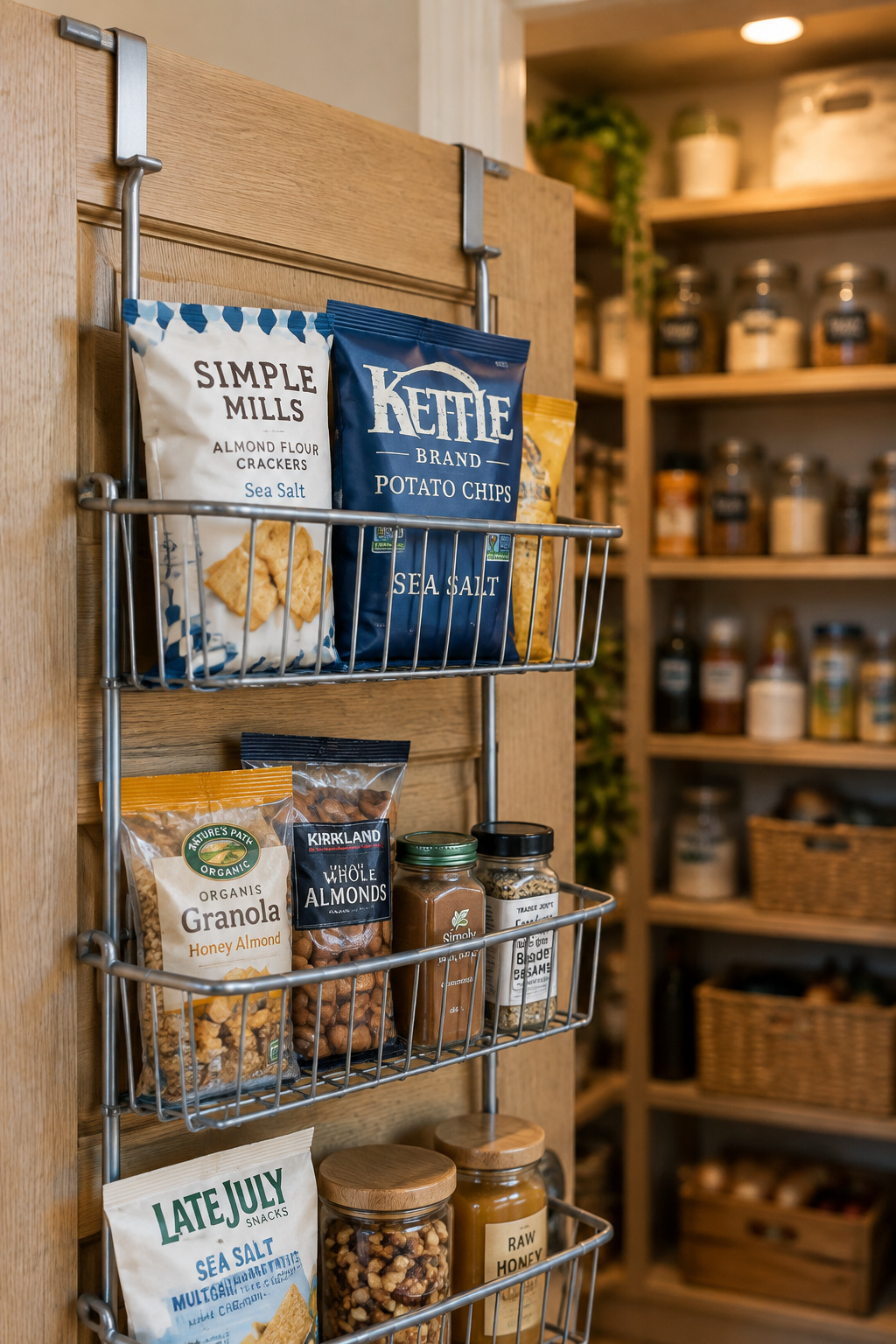
There are two weight figures here, and they blur easily. A standard over-the-door rack hooks over the door’s top edge with no drilling, so its load travels into the top rail and hinges rather than the hollow panel, which is why manufacturers rate the rack and not the door. A Lowe’s manufacturer spec sheet gives 10 lb per shelf; a Slickblue unit gives 10 lb per basket and 110 lb in total. Anything screwed into the face of a hollow-core door is a different load path entirely: hardware guides put an unanchored load on a hollow panel at only around 5 to 15 lb, rising to 20 to 50 lb or more with a toggle or molly bolt. One is a rack’s rating and the other is a thin panel’s limit, so neither figure is “what a door holds.”
Here is what carries the weight in each of the three door options:
| Door option | What carries the load | Published figure | Check before buying |
|---|---|---|---|
| Wire over-the-door rack | The door’s top edge, rail and hinges | About 10 lb per shelf (Lowe’s spec sheet); up to 30 lb per basket on heavy-duty models | 5 to 7 in clearance; door thickness up to 1.88 to 2 in |
| Over-door fabric pouch | The door’s top edge | No published rating found | The same clearance gap |
| Shelf unit screwed to the door | The hollow panel face | 5 to 15 lb unanchored; 20 to 50+ lb with a toggle or molly bolt | Hollow or solid core; anchor type |
Fabric pouches look forgiving, so they get loaded like steel. Let them hold tea, spice packets and snack bags, and let wire hold the jars.
Close the door and measure from its back face to the front edge of the first shelf; that measurement decides which rack fits.
The dead corners a reach-in always loses
In a closet pantry with wraparound or L-shaped shelves, the things you forget end up in the back corners. A corner is reachable in theory but never in a single motion, so whatever gets pushed there drifts out of mind, the same loss a blind kitchen base cabinet suffers.
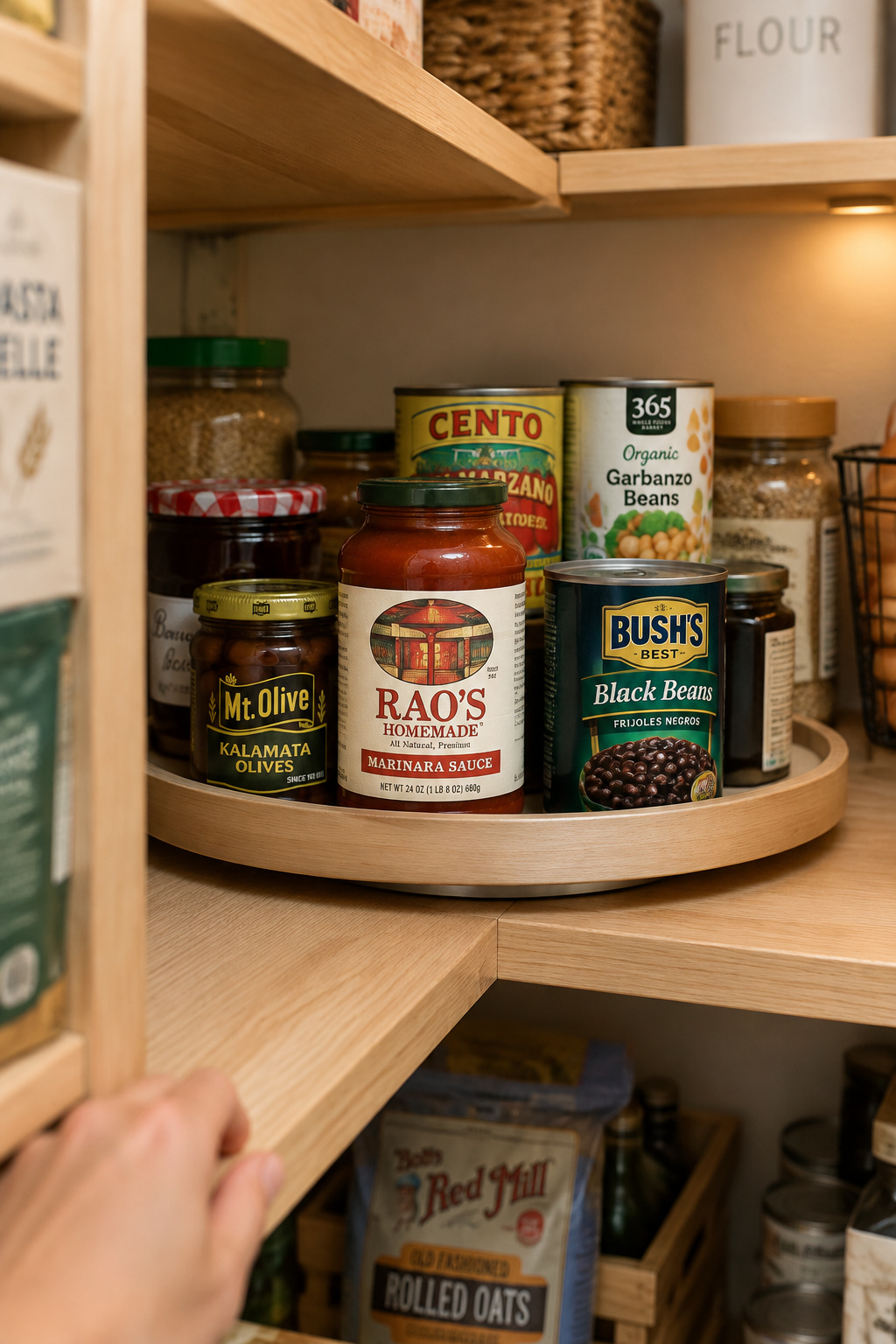
A turntable brings the corner forward. Corner lazy Susans for cabinets commonly come in 24, 28 and 32 in diameters, with 28 in the most widely used. To size one, measure the inside corner opening in both directions, subtract about 2 in for clearance, and let the smaller of the two numbers choose the diameter. Order by the cabinet’s outer width instead and it will not turn.
The ratings tell you what kind of object you are buying. Marathon Hardware’s M-Series wood lazy Susan is rated at 20 lb per square foot and states compliance with ANSI/BHMA A156.9-2003, the American National Standard for Cabinet Hardware, at Grade 1, which is an industry test rather than a marketing number. Rev-A-Shelf rates its 28 in kidney-shaped wood model at 64 lb per shelf. The two do not compare directly: one is per square foot, the other per shelf, and converting needs the shelf’s real area.
If you would rather have nothing that spins, a blind-corner pull-out tray is the no-moving-parts alternative. It draws straight forward and holds irregular shapes a round plate cannot. Where the depth runs straight back rather than around a corner, a container shaped to reach that far back does the same job.
Put a hand into your back corner and bring out whatever is there; if you had forgotten it, that corner needs a turntable.
Closet-style or narrow: working with the shape you have
My first real sitting space was a corner of a rented Chicago apartment, four feet deep and six wide, marked out by nothing more than a jute rug and a single cushion. It never felt cramped, because nothing else had been asked to be there, and it taught me that practice does more than square footage to make a space hold.
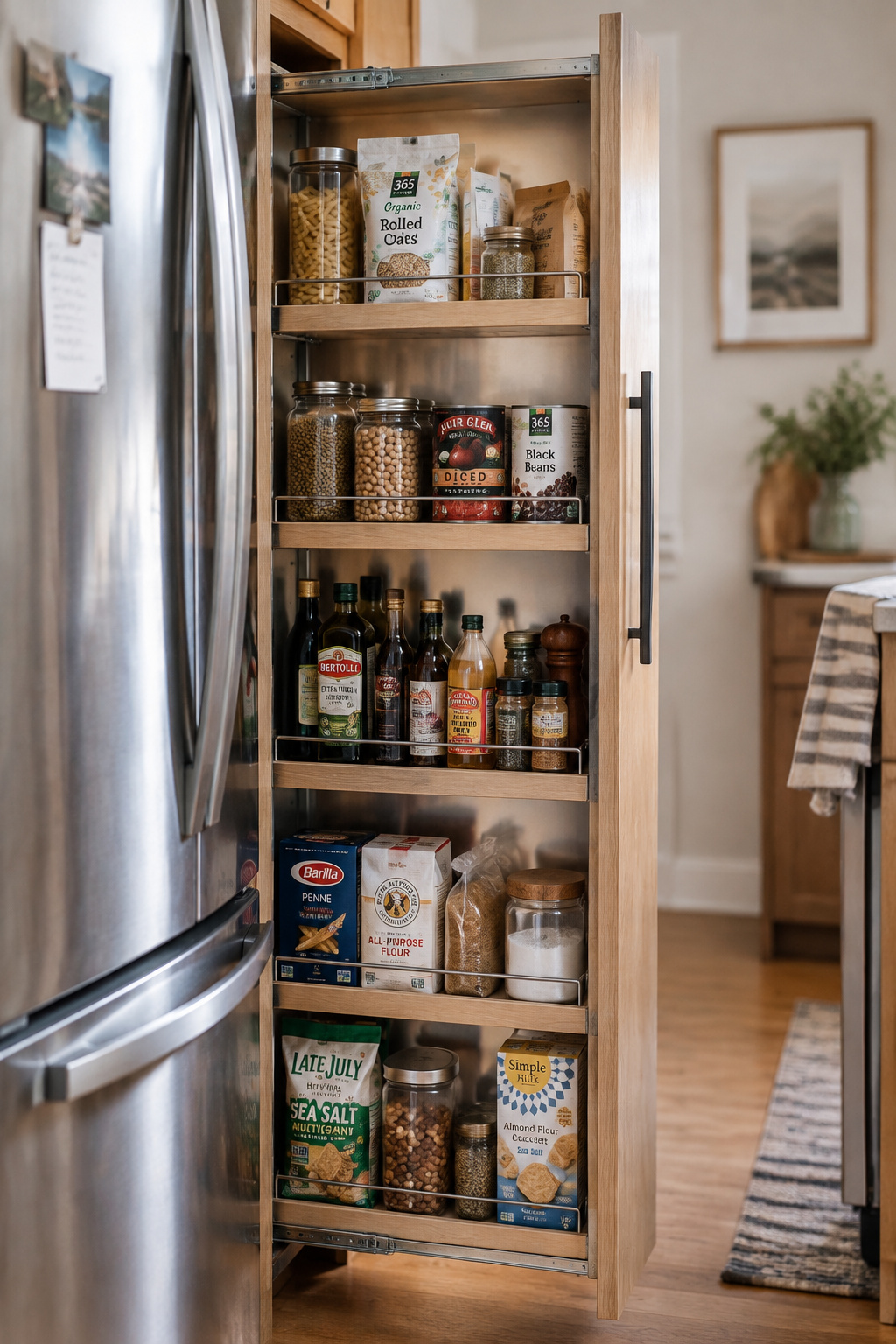
A closet-style pantry is a repurposed closet: shelves fill what was built as a closet, and you reach all of it from the doorway without stepping in. Its question is vertical: how to stack a fixed footprint, because widening it is off the table. Using the door and corners means the shelves no longer have to carry everything.
A narrow pantry is a different creature. It is a slim slot, commonly built or retrofitted between 6 and 18 in wide, beside a fridge, a range or at the end of a cabinet run. Trade sources describe rough bands: a raw 3 to 6 in filler gap takes a filler pull-out frame, 6 to 12 in takes a proper slim cabinet, and 9 to 18 in is the common factory range for a full narrow pantry cabinet. A fixed shelf in a narrow unit lets its back half disappear from view, while a pull-out slides the whole shelf into the room, so nothing ever hides behind anything else. If you rent, a rolling cart in the 10 to 15 in range slides into the gap and out again with nothing to install.
Stand at your pantry and name its shape out loud (closet or slot) before choosing which fix suits it.
What to leave out so the space stays calm
The most common small-pantry mistake happens at the checkout: new bins and canisters bought before anyone has decided what should leave. Subtraction comes first, and professional organizers keep naming the same few things to go.
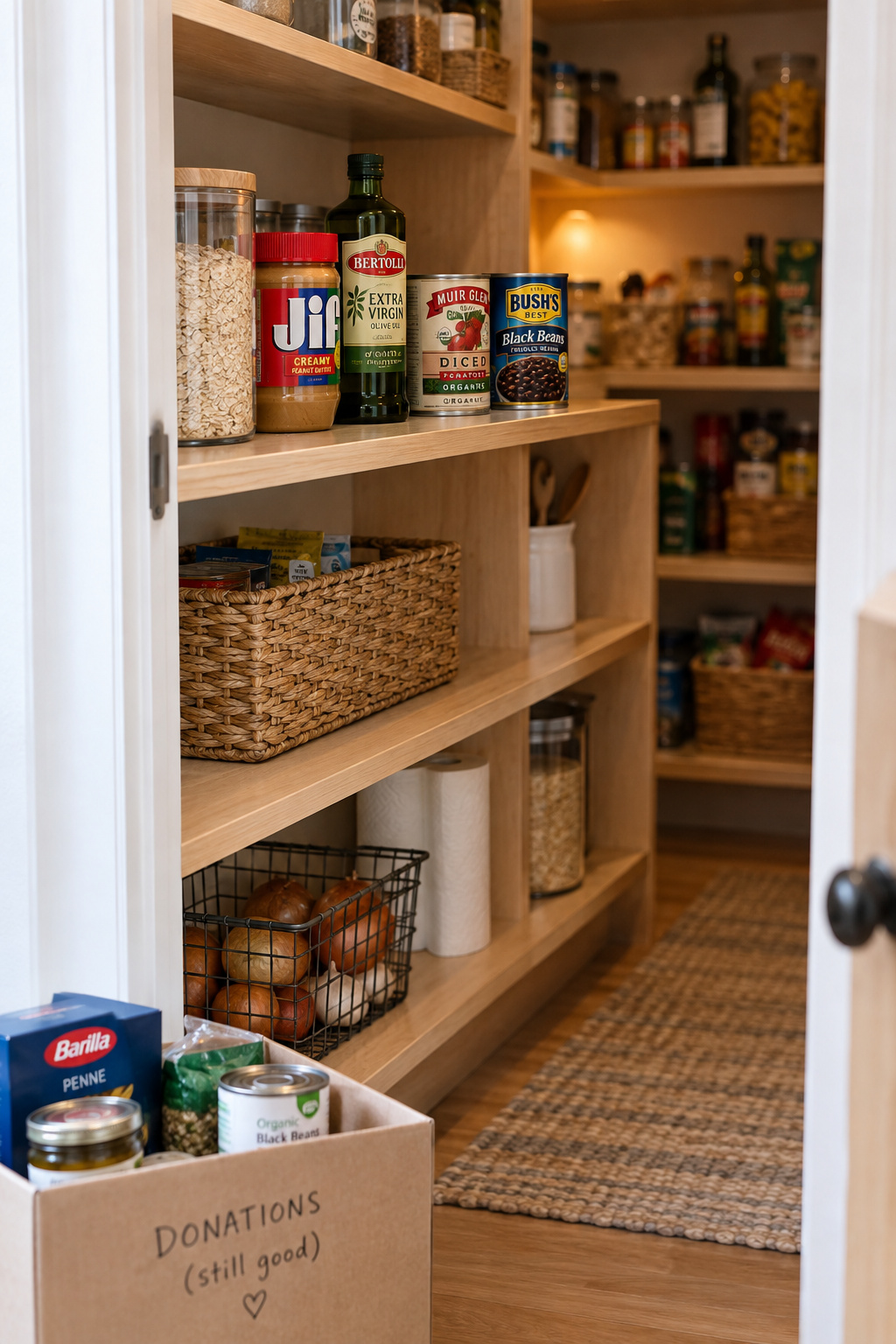
- Gadgets untouched for a year, like the avocado slicer and the apple corer. A professional organizer quoted in The Pioneer Woman puts the rule plainly: if you haven’t touched it in over a year, it doesn’t belong in your kitchen or pantry.
- Bulk duplicates. Keep one in the pantry and send the rest to overflow storage elsewhere in the home.
- Empty containers. Organizer Sabrina Quairoli lists “containers you are not using” as a category of their own, meaning jars kept in case they get refilled that hold nothing but shelf.
- Things that aren’t food, such as small appliances, serving pieces and paper-goods overflow. The Kitchn’s organizers and Younger both say to relocate them rather than shelve them more cleverly.
What remains will leave gaps, and they should stay, because a stretch of empty shelf lets the first glance settle.
Pick one thing from this list and carry it out of the pantry before you close the door again.
From a cramped reach-in to a pantry that works
Nothing here added an inch of floor: the rack hangs on space you had, the turntable turns in a corner you owned, and the purge made room by subtraction. How much a reach-in can hold depends on what is asked to live inside it more than on its square footage.
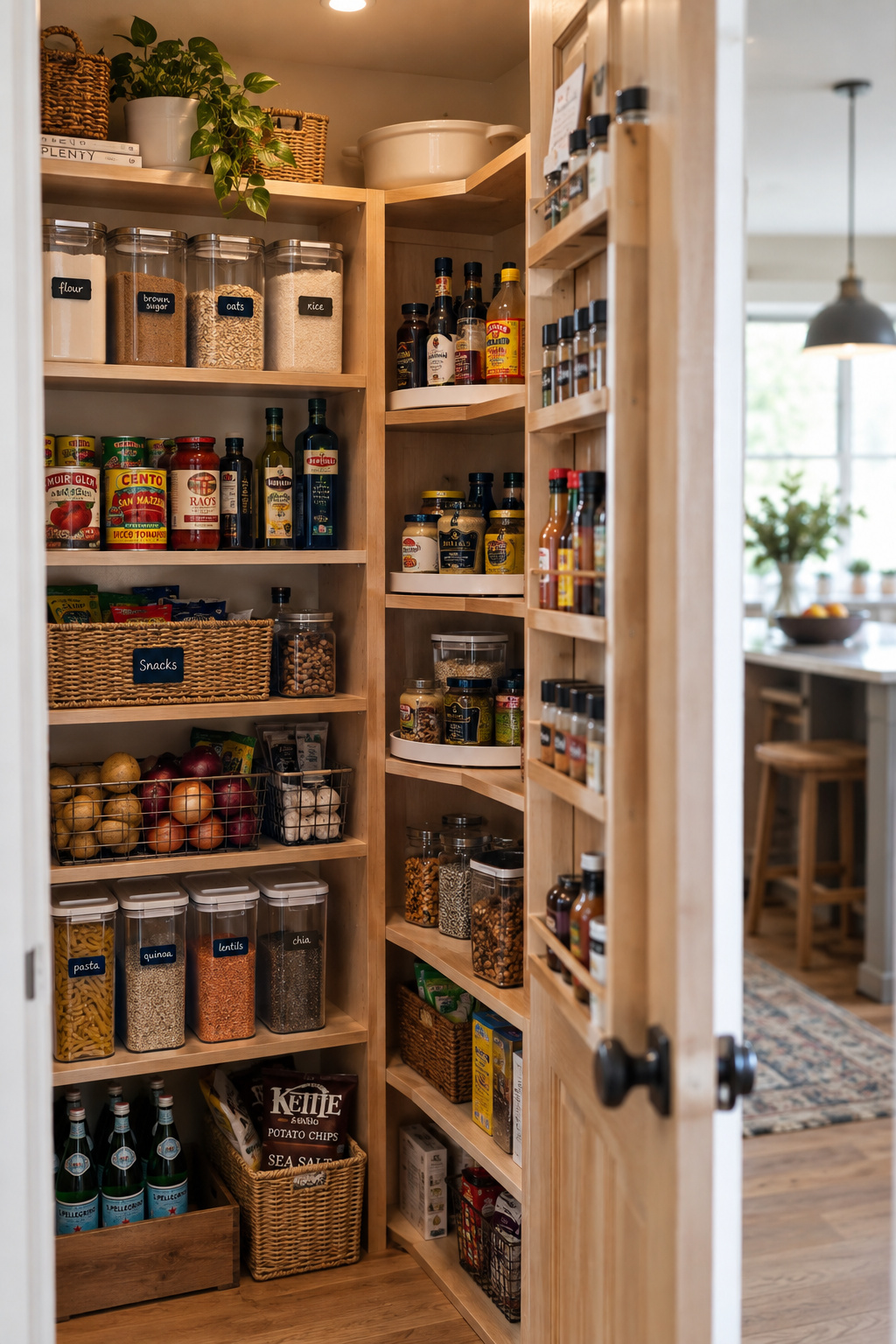
Younger’s closet-pantry experience and the organizers point to the same order: purge and zone first, then use the door and the corners, and only then ask whether you truly need more volume. If you have done the first two and still run out of room, the next move is a tall cabinet, a separate piece beside the pantry rather than a way of squeezing the reach-in harder.
Then go back to the door and open it to the click, the cool air, the cumin and coffee. This time the glance finds breakfast, cans, the rack of snack bags and one strip of empty shelf, and your hand moves only once.
FAQ
What’s the difference between a reach-in and a walk-in pantry?
A reach-in pantry is used from the doorway without stepping inside: shelving lines a shallow closet, so everything stays within arm’s reach of the opening. A walk-in is a small room you step into, shelved on two or more walls around an aisle. Neither is better by default; a well-organized reach-in trades aisle space for vertical shelving.
How much weight can a pantry door organizer hold?
Most wire over-the-door racks are rated around 10 lb per shelf or basket by their manufacturers, with roughly 100 to 110 lb across the whole unit. Heavier-duty models claim up to 30 lb per basket, so check your specific product. That rating belongs to the rack hooked over the door’s top edge, not to the door panel itself.
How do I organize a small pantry with no extra shelves?
Start by purging and zoning what is already there; organizers and real closet-pantry conversions both treat it as the highest-leverage step. Then add capacity without new shelving: a rack or pouch on the door, a turntable or pull-out tray in the dead corners. Finally, remove unused gadgets, empty containers and non-food overflow entirely.