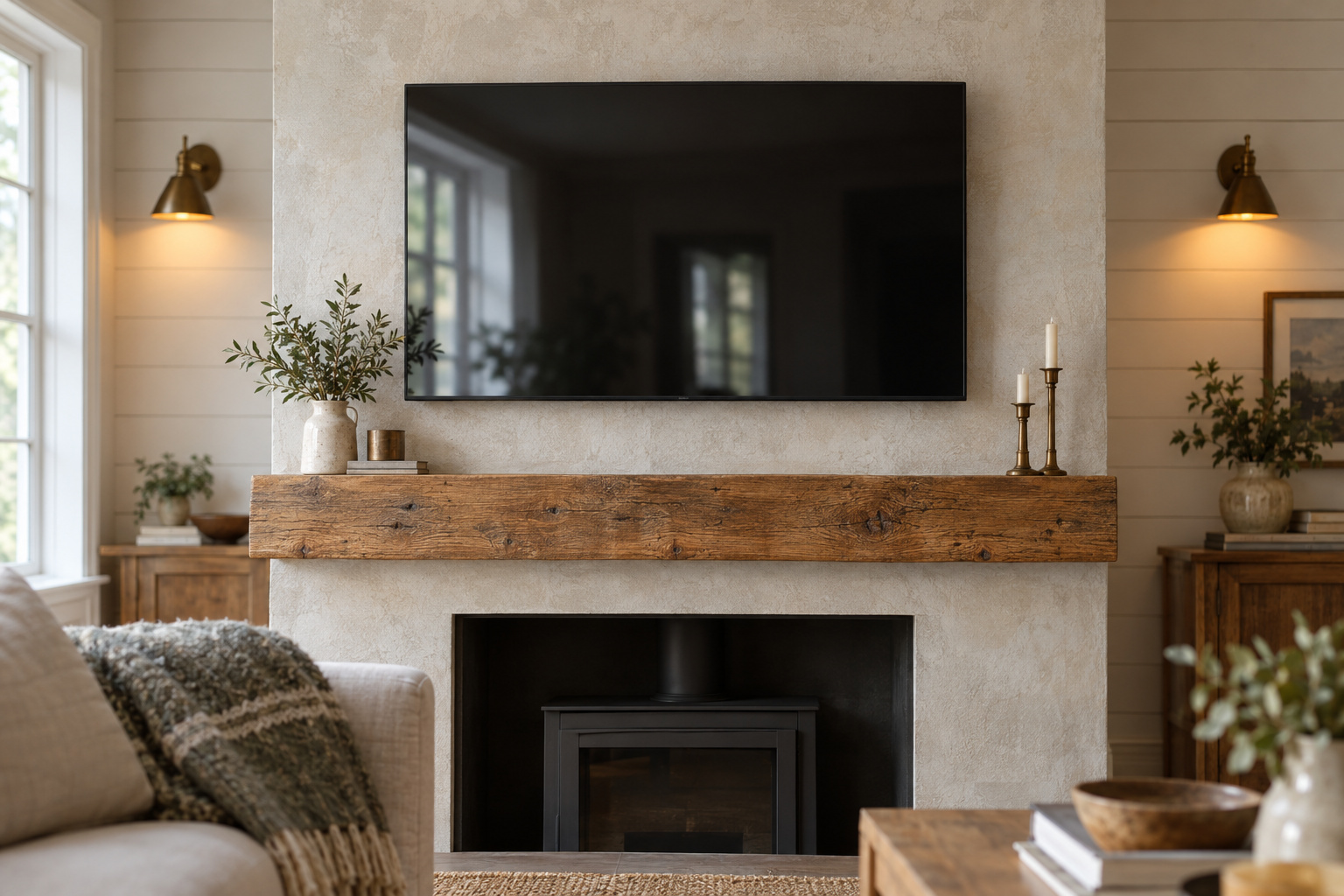
Most TV above fireplace setups are off by somewhere between a foot and a half and two and a half feet, and the owner never knows, because nobody measures a wall before they love it. That gap is not a matter of taste: it is two tape-measure readings subtracted from each other.
TL;DR
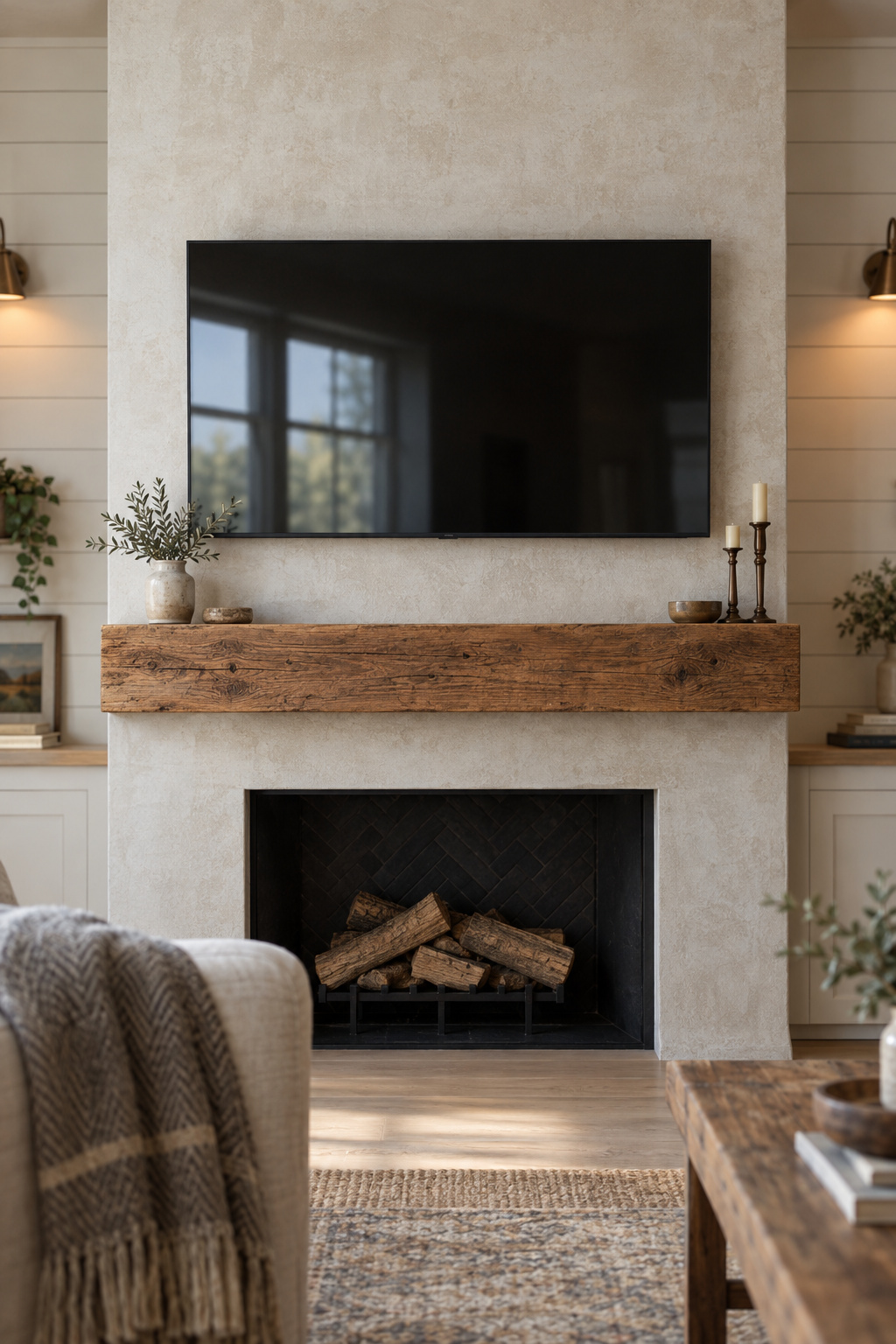
- A standard mantel sits 52-58 in off the floor, so a screen mounted just above one lands with its centre near 65-70 in, while the ergonomic target for a screen centre, viewed from a sofa, is 42-48 in.
- Run the ratio: rise from seated eye level to the planned screen centre, divided by distance to the wall. Above about 0.27 (the tangent of 15 degrees) you are past comfortable on a fixed mount.
- Heat depends on the firebox. Gas and wood push 20,000-35,000 BTU/hr up the wall against a TV’s 104 °F operating ceiling; electric units mostly blow forward.
The Real Gap in a TV Above Fireplace Setup
Three heights get quoted here, and they measure three different things. Read them as rival opinions about one number and the trade looks self-contradictory.
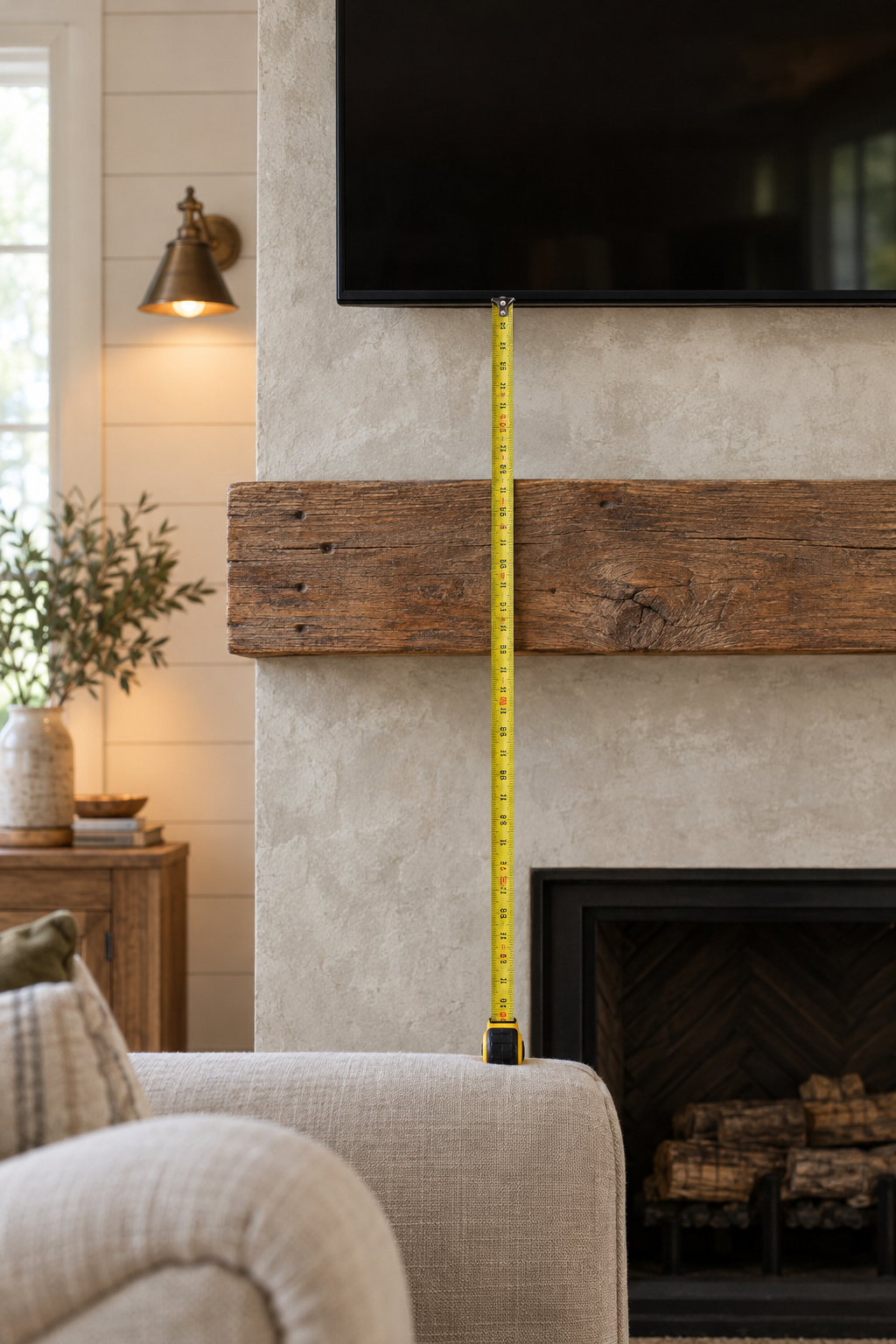
Mantel height versus ergonomic TV height
| Figure | What it measures |
|---|---|
| 42-48 in | Where a screen’s centre should sit for a neutral neck on a normal sofa — seated eye level |
| 52-58 in | Where a standard residential mantel actually sits, off the finished floor |
| 65-70 in | Where the screen’s centre lands once the mantel has decided the mounting position |
None of the three cancels another. The first is a comfort target for the screen centre, the second is a survey of where mantels get built, and the third is what the first two produce when a television goes up just above the shelf. Subtract the comfort target from the landing position and you get 17-28 inches of excess height, which is how a room can be beautifully composed and still uncomfortable at hour two.
The 15-degree test you can run with a tape measure
Here is the sentence I would rather write than any number above: no standards body publishes a residential TV mounting height. A named ergonomics guideline body publishes the principle, screen centre at the seated viewer’s eye level, verified across a field survey of 393 viewers in 83 households. It published no inch figure, because the measured heights ran roughly 60-100 cm and tracked each family’s seating, not their televisions. The familiar 42-inch figure is an industry average assuming an 18-inch cushion, wearing a standard’s clothes. Comfortable height depends on your sofa, and no committee has sat on it.
So measure. Sit where you watch, note your eye height, the distance to the wall and the planned screen centre, then divide the rise by the distance. Above roughly 0.27 you are past the comfortable threshold, and at a normal 8-10 ft sofa distance a 17-28 in gap clears that line easily.
One caution, because the numbers collide: CEDIA/CTA’s CEB23-A, derived from SMPTE guidance, publishes its own 15-degree maximum. Genuine standard, different measurement: CEB23-A measures to the top or bottom edge of a screen in a dedicated theatre room, while the test above measures to the centre of a TV from a sofa.
Is the Heat Actually a Risk
The heat is real for some fireboxes and internet folklore for others, depending on what burns.
Gas and wood versus electric fireboxes
Gas and wood fireboxes carry the genuine risk. A typical gas unit produces 20,000-35,000 BTU per hour, and as Valor’s installation guidance explains, the mechanism is convective, with warm air rising off the firebox and travelling up the wall, not radiant heat off the flame. Electric units are the safe category: they direct roughly 5,000 BTU/hr forward into the room instead.
“Gas” is also not one category, since a sealed direct-vent unit runs cooler at the same wall position than an open or ventless one. How much rising air the mantel deflects depends on how far the shelf projects, a clearance question that belongs to Rachel Blackwood’s piece on how the mantel height gets set.
The real temperature threshold
The threshold is a manufacturer spec, not a rule of thumb. LG’s product information sheet lists an operating range of 0-40 °C (32-104 °F) for a standard consumer set. Testing against it costs nothing. Tape a thermometer at the planned screen centre, run the fire hard for two hours and read it. Above 100 °F you are within four degrees of the limit with no heat shield.
Four Honest Resolutions
My first theatre was a bedsheet stretched flat on a wall in a graduate-house common room, with a borrowed projector balanced on textbooks. We watched everything on it for a year, and it remains one of the best rooms I have watched a film in. So when the geometry says a beloved fireplace wall is compromised, “your setup is wrong” is never the useful sentence. Here is what it costs you, and four ways to buy some of it back.
| Resolution | Cost | What it changes |
|---|---|---|
| Move the seating back | Free | Lowers the angle without touching the mount |
| Pull-down mount | $300-1,000 | Closes the height gap itself |
| Smaller screen | Price of the TV | How much of the excess height you feel |
| Different wall | Room-specific | Removes the mantel and the heat from the problem |
Accept it and change the seating
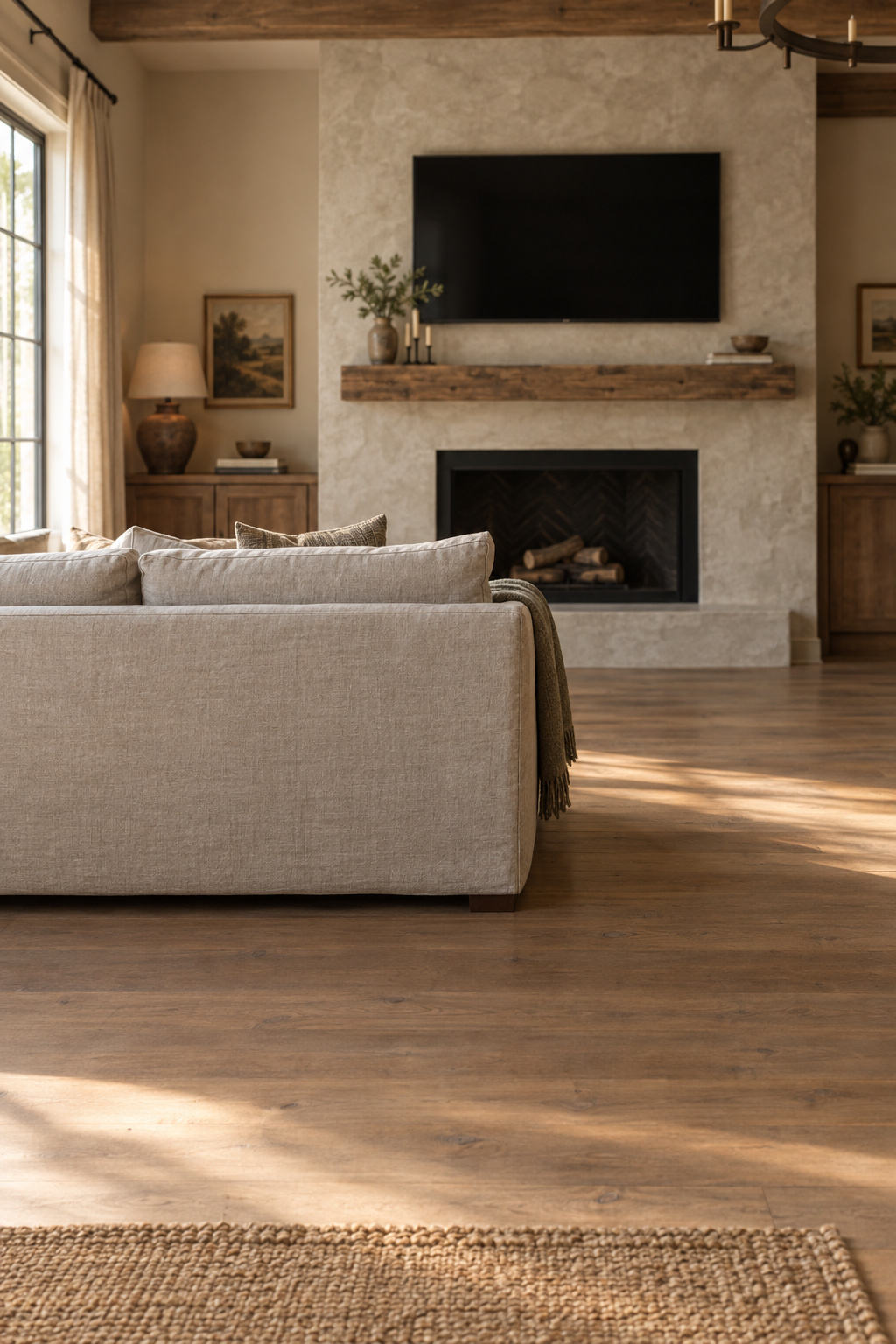
The comfort test is a ratio, so the denominator is a lever. Push the sofa from 8 feet to 12 and the same fixed screen height drops below the 15-degree line. The tradeoff is the seat: a deep, reclined, low-backed sofa puts your eye level further beneath the screen and raises the angle again.
A pull-down mount
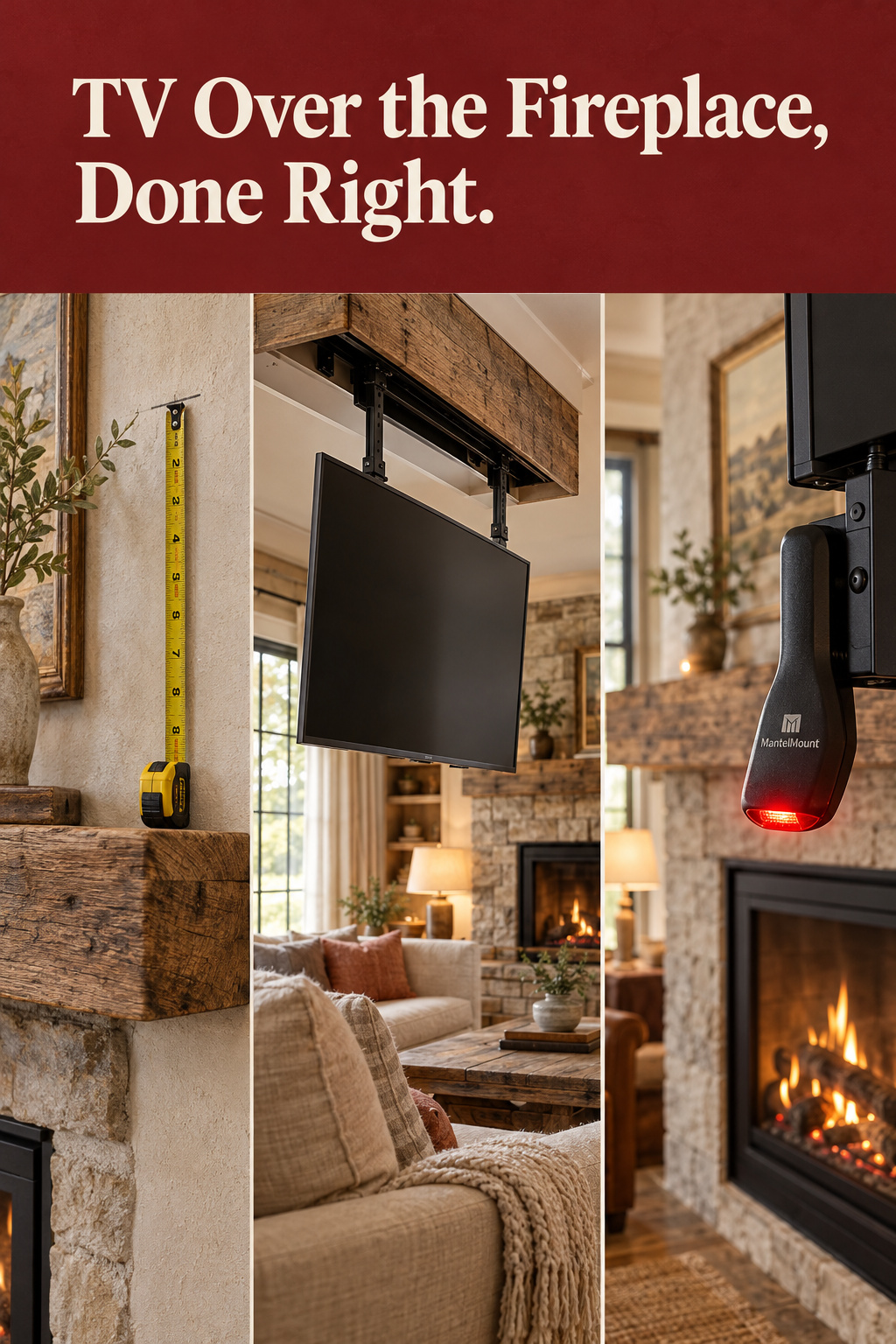
An arm lowers the screen toward eye level, then returns it to a stowed position above the mantel. It is the only resolution that closes the gap instead of compensating for it, and it gets its own section below.
A different screen size
A smaller screen at the same height changes no arithmetic. It changes whether the picture still sits inside its recommended viewing range at your sofa’s distance, which the table two sections down settles.
A different wall
The most complete fix is the most expensive. Move the screen to an adjacent wall and the mantel stops dictating anything, and the heat question leaves with it. There is no credible total to quote here, and the cost swings entirely on the wall you move to.
What a Pull-Down Mount Actually Closes
Above-fireplace pull-down mounts travel twenty-four to twenty-nine inches vertically, no coincidence given the 17-28 in gap it brackets.
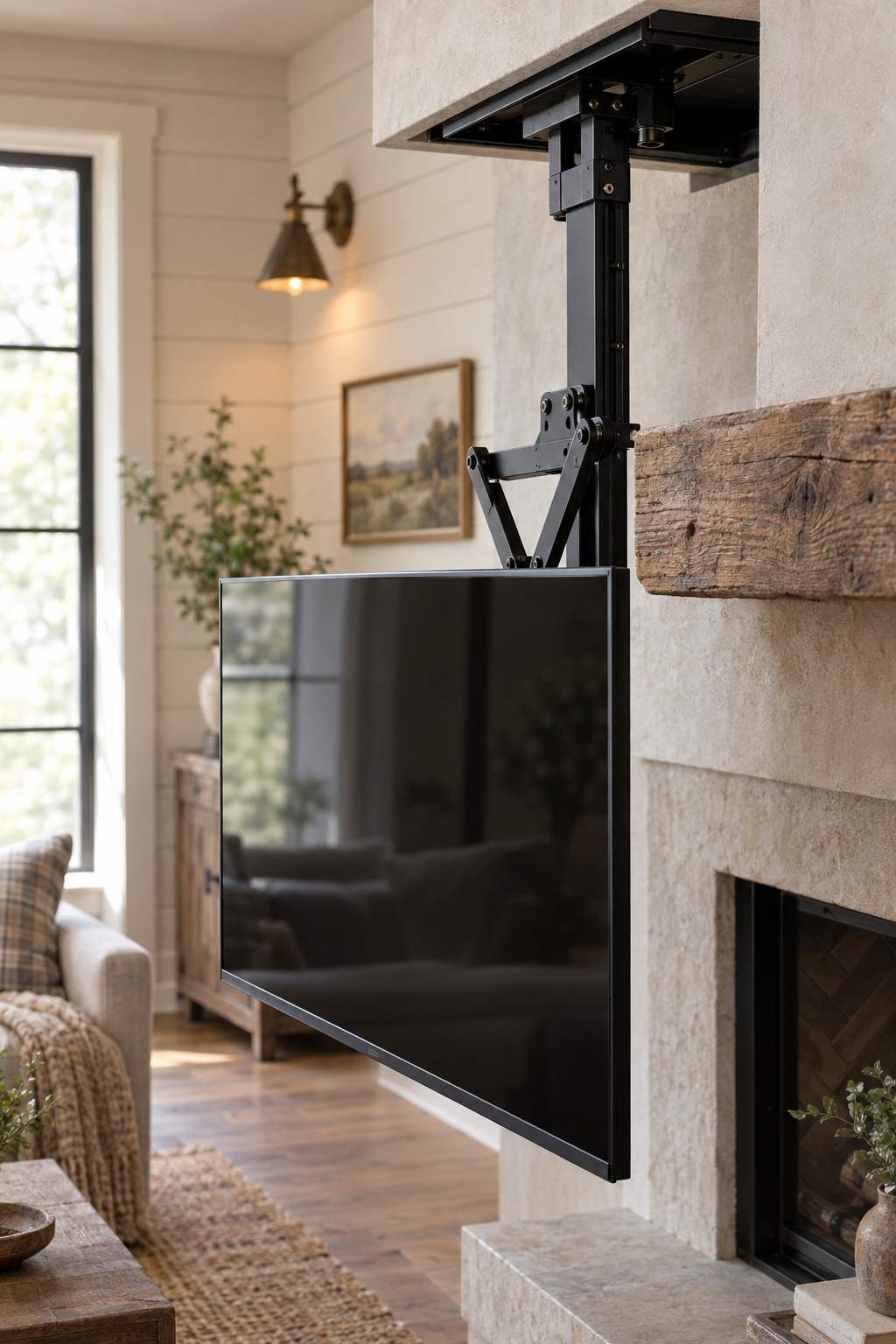
Vertical travel versus the gap it needs to cover
MantelMount’s MM340 and MM540 both provide 27 inches of travel, and the MAX1 provides 29. Against a 17-28 in excess, that closes even the top of the range: the screen drops from its stowed position near the mantel to roughly the ergonomic target, then returns when the film ends.
Heat-sensor safety features
The MM540 and MM700 carry heat-sensing handles that turn red at 110 °F. Worth having over a gas or wood firebox, but read it correctly: 110 °F sits above the 104 °F operating maximum on the TV’s own spec sheet. By the time the handle turns red, the screen has already spent time above its rated ceiling.
That is not a design flaw. It is a mount specification protecting the person reaching up for a hot handle, not a television specification protecting the television. Treat it as a late warning and let the thermometer decide the position.
What the models cost in 2026
| Model | Price (June 2026) | What it adds |
|---|---|---|
| MM340 Standard | $299.95 | 27 in travel, 44-80 in TVs, 90 lb capacity |
| MM540 Enhanced | $469.95 | Heat-sensing handles, 9° tilt, 30° swivel, soundbar attachment |
| MM700 Premier | $624.95 | 45-90 in TVs, 115 lb capacity |
| MAX1 Full Motion | $729.95 | 29 in drop, 40° swivel, 3 in flush profile |
| MM815 Motorised | $999.95 | Remote control, two memory presets |
The $170 step from the MM340 to the MM540 buys the heat sensor, and over a gas or wood firebox I would spend it. The step to the $999.95 MM815 buys motorisation and memory presets, which are convenience rather than geometry.
Changing the Screen Instead of the Wall
The common mistake here is arithmetic. People average a retailer’s distance table against a standards body’s multiplier, then mount to a number neither organisation endorses.
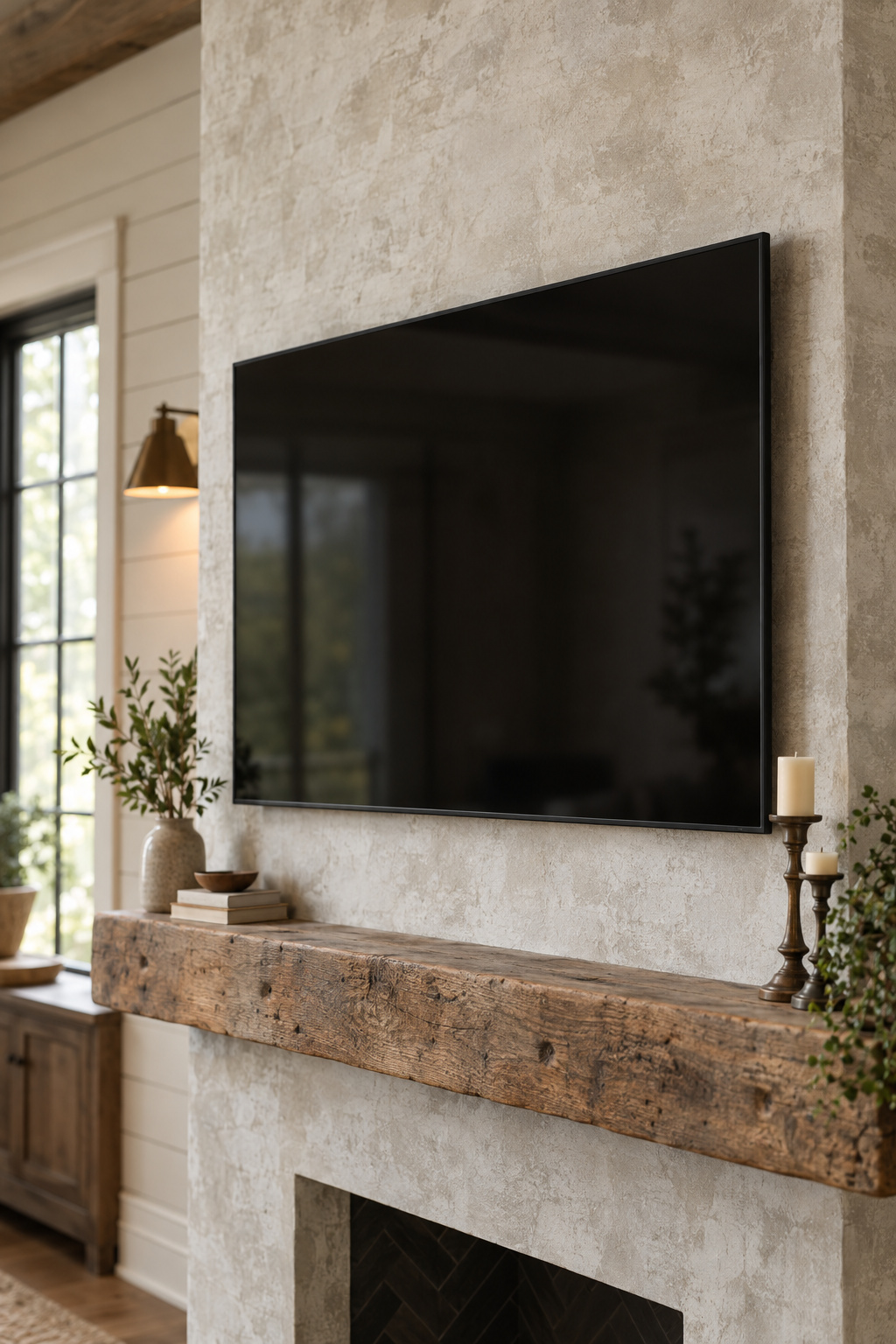
Viewing distance versus screen size
| Screen | Recommended distance (Crutchfield, 4K) |
|---|---|
| 40 in | 3.3-5 ft |
| 43 in | 3.6-5.4 ft |
| 50 in | 4.2-6.3 ft |
| 55 in | 4.6-6.9 ft |
| 65 in | 5.4-8.1 ft |
| 75 in | 6.3-9.4 ft |
Read the row that matches your sofa. A 55-inch screen at 8-9 feet sits inside its band, while a 75-inch at that distance is pressed against the near edge of its own. The smaller screen can sit lower on the chimney breast without the picture shrinking out of range.
Two standards, and why not to blend them
SMPTE recommends roughly 1.6× the screen diagonal for mixed viewing, a 30-degree horizontal field of view. THX recommends a closer 1.2-1.4×, or 36-40 degrees. They are not disagreeing. As THX’s viewing guide sets out, one optimises for comfortable general viewing and the other for cinematic immersion. The Crutchfield table above is a third thing again, a retailer’s practical chart. Pick one framework and follow it. Fifteen degrees of upward tilt is survivable through a sitcom, but not through the back half of The Return of the King.
If the Screen Doesn’t Belong There at All
Sometimes the measurement says no. Stack a masonry chimney breast, a deep sofa that cannot move back and a firebox that runs the wall hot, and the screen goes elsewhere.
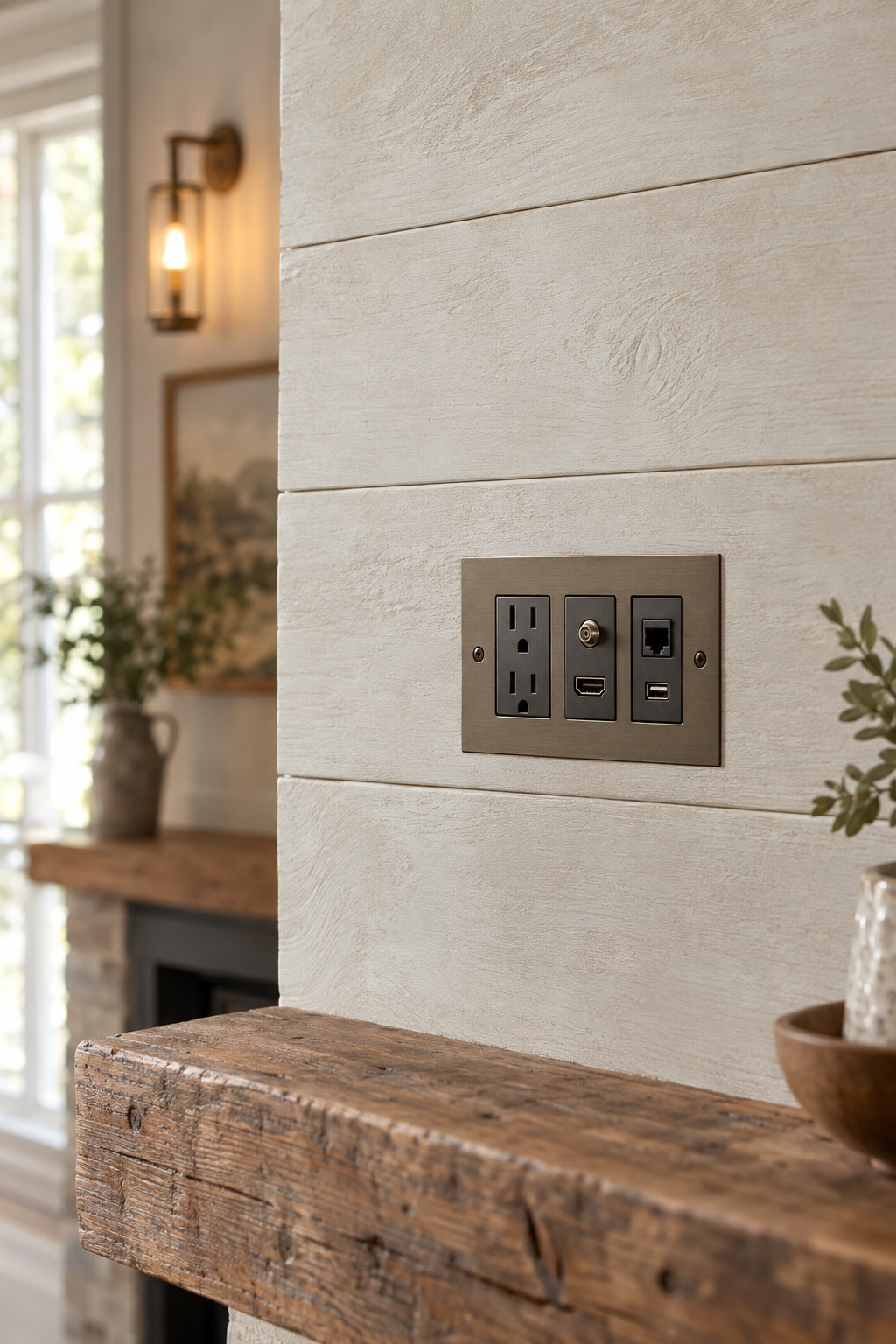
Hiding the cable run properly
If cable is going to that wall regardless, put both the power outlet and the low-voltage signal box 12-15 inches above the mantel top, which keeps the connections reachable and hidden behind the screen. Keep the central stud bay clear and offset the outlets into the adjacent bays. Recessed in-wall kits retail for $50-100 (PowerBridge’s ONE-CK is about $60-70) but need roughly 3.25 inches of wall depth, which drywall over studs has and solid brick does not. On masonry, use a paintable surface channel.
What goes on the wall instead
An empty chimney breast is not a failure state. What fills it (one oversized piece, a mirror, texture alone) I hand to Marcus Thompson on what to hang there instead, and the fireplace wall’s place in the scheme sits in how the rest of the room comes together.
Measure the ratio before you drill: rise over distance above 0.27 is a fact about your room, not an opinion about your taste. Test the wall with a thermometer and a two-hour fire. 104 °F is the manufacturer’s line, and 110 °F is a handle telling you that you crossed it. Then choose: moving the sofa is free, a heat-sensing pull-down mount is around $470, and motorisation is comfort rather than correction. Do not mount at 65-70 inches by default, because the mantel landed where it landed and nobody asked where your eyes were.
FAQ
Is it bad to mount a TV above a fireplace long-term?
Not as a blanket rule. Long-term risk depends on the firebox and the mounting height. Gas and wood units push convective heat toward the 104 °F consumer TV operating limit, while electric units mostly do not. A fixed mount also typically sits 17-28 inches above the seated eye-level target.
How much does professional TV mounting above a fireplace cost?
A standard drywall mount runs roughly $125-255 by TV size, with masonry or above-fireplace work commonly adding about $95, so expect $150-400 for a typical job. Nationally, quotes span $120-900 once cable concealment (around $95-125) or a pull-down upcharge (around $72-135) is included.
Can you hide all the cables when mounting above a fireplace?
On drywall over studs, yes: a recessed in-wall power and signal kit costs $50-100 and routes both through the cavity, sitting 12-15 inches above the mantel top. On solid masonry, no: those kits need about 3.25 inches of depth that brick lacks, so use a paintable surface channel.