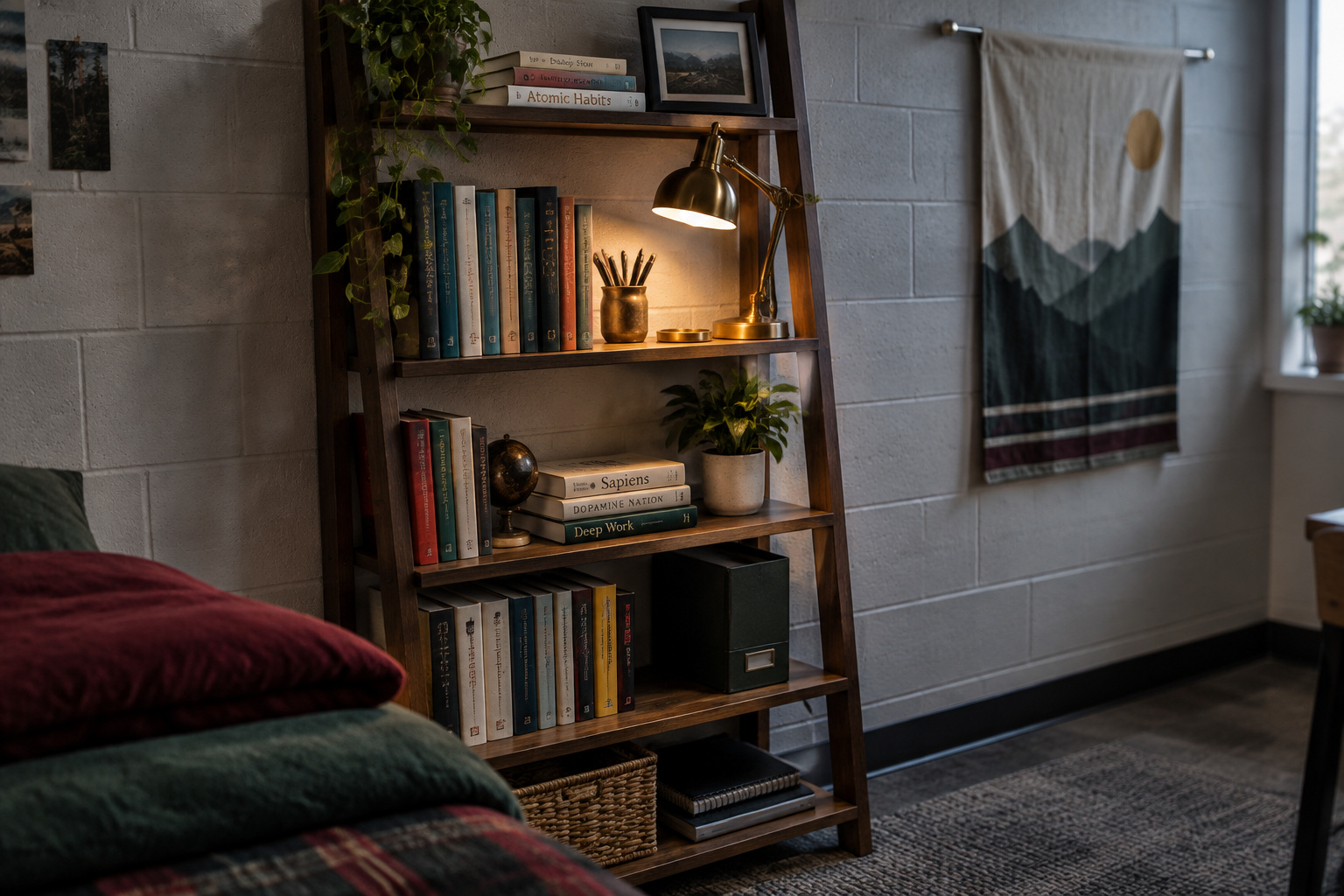

You can build a dark academia dorm room without paint, a drill or anyone’s permission. The room you saved to a board has painted walls, built-in shelving and a hook sunk into plaster, and your housing contract forbids all three. What separates that photo from your cinder block is hardware, a fire code you haven’t read yet, and a fair fear of buying things that won’t survive May.
TL;DR
- Only one adhesive line is specified for the wall you actually have: 3M’s Command Heavyweight utility hooks, rated for painted cinderblock and concrete at Large 5 lb, X-Large 10 lb, Extra Large 15 lb.
- Shop by joint type. A stacked crate has no fastener hole to strip. In particleboard, the weak point is the hole tearing out around the cam-lock; the cam-lock itself holds up.
- Read your own handbook. Six universities handle the same short list of objects six different ways: a $100 fine, a 1,600-square-inch cap, a 50-percent rule, an NFPA 701 label, a flame-retardant treatment, and a plain no.
What sticks to cinder block without paint or holes
3M’s Command Heavyweight utility hooks come in 5, 10 and 15 lb sizes, and they are the only product here whose specification names painted cinderblock and concrete outright. Everything else is rated against a generic “wall,” meaning smooth painted drywall, which is a far more forgiving surface than the one you were issued.
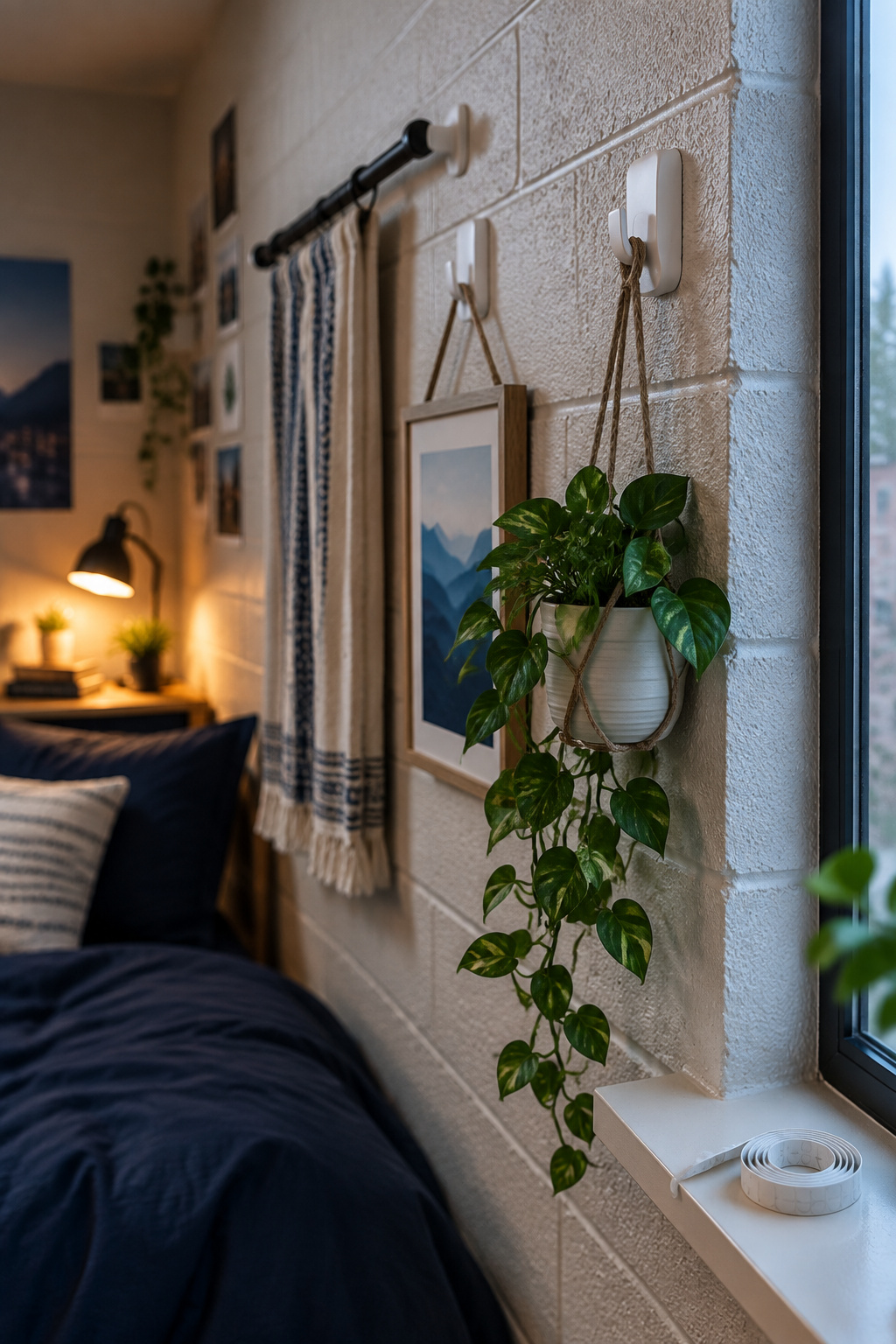
Command’s picture-hanging strips are rated per pair, from 1 lb for smalls up to 5 lb for extra-larges. Their hold drops 25 to 50 percent below the lab rating in warm, humid conditions or on matte paint, which describes most un-air-conditioned residence halls in August and again in May. Capacity also roughly halves with each step up in texture: near the rating on smooth drywall, around 8 lb on light texture, about 4 lb on heavy. Painted block counts as textured.
Tension rods come with two numbers for the same object, and people quote the wrong one. Wedged between two returns as a hanging point, a rod carries roughly 5 to 20 lb depending on its diameter, and up to 26 lb for a heavy-duty rod across ten feet. Used horizontally as a shelf support, it drops to about 15 lb per linear foot. If anything will sit on it, buy on that second number.
| Method | Rated hold | What it’s genuinely for |
|---|---|---|
| Heavyweight adhesive utility hook | 5 / 10 / 15 lb by size | Framed art and hanging objects — the only line rated for painted cinderblock |
| Picture-hanging strips | 1–5 lb per pair; 16 lb needs four pairs | Flat frames on smooth paint; derate hard for texture and humidity |
| Magnetic rod | 2–5 lb, steel only | Almost nothing — most dorm doors and frames aren’t steel |
Paint isn’t available to you, so wall color is fixed. Everything else is a purchase, and the no-drill answer and the cheap answer are usually the same object, as you can see in what a no-drill version of this room actually costs.
Furniture built to survive three moves
Three is my own working number; nobody publishes how many times a student moves. I still think it’s the right question, because I ask it about every piece of furniture I specify: what does this become when its owner is three years older? A dorm is the stage after next for a teenager’s bedroom, and a first apartment comes after the dorm. Buy for the apartment and let the dorm borrow it.

Flat-pack furniture usually fails somewhere other than where the internet says it does. Particleboard is wood chips pressed with resin, with no continuous grain, so when a fastener hole strips, the material can’t re-grip the way solid wood does and the hole is gone for good. Peer-reviewed joinery research finds that cam and bolt fasteners are engineered for repeated assembly and disassembly; the board around them is what fails. No cycle count applies. The trigger is lifting an assembled piece by its carcass, which hangs the whole weight of the thing on its joints. Empty it, take it apart and carry it flat. I’ve opened enough children’s flat-pack storage to know the sound of a hole that’s already gone: a soft crumble instead of a crack as the cam turns.
So judge furniture by its joints. The 13×13-inch cube is the dominant module in cube storage (IKEA’s KALLAX openings, its DRONA box and ClosetMaid’s bin all work to it), so bins bought for one brand’s frame generally fit another’s in the next apartment. The bins outlive the carcass. A full 4×4 KALLAX, 71⅝ inches square at $249.99, looks the most finished of anything in the room and depends the most on careful disassembly.
| Piece | Joint type | What it’s worth |
|---|---|---|
| Stacked plastic crates | None | ~50 lb per crate at retail; industrial equivalents spec 44–88 lb — check the SKU |
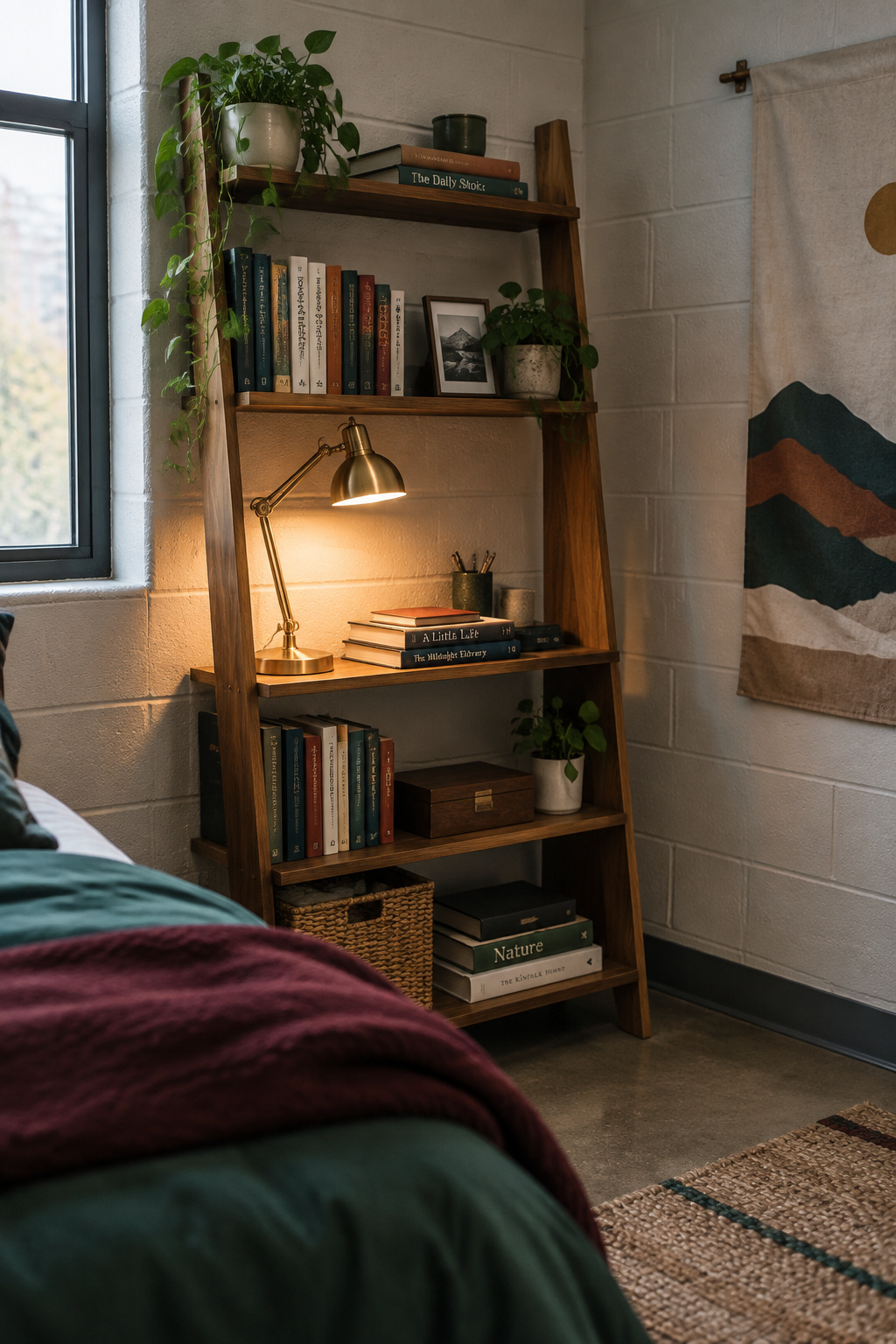
| Leaning ladder shelf | None; gravity | Goes flat against any wall, in any room, forever |
| Cube unit with fabric bins | Cam-lock in particleboard | The 13×13 bins transfer between brands; the frame is the fragile half |
| Bamboo lap desk | Folding hinge | Lab testing rated bamboo tops excellent; a budget laminate model chipped and gouged |
| Collapsible fabric ottoman | None | No manufacturer publishes a weight capacity for these — so I can’t give you one |
A shelf of real books is much heavier than people expect, which is why a dorm’s books should stand on the floor instead of hanging on a wall. I can’t put a number on that, and I can’t put one on the collapsible fabric ottoman either, because no manufacturer publishes a weight capacity for them.
The one box you pack first: bedding and soft goods that travel
At two in the afternoon on move-in day, with a loaded car, a shared elevator and a room that still smells of industrial cleaner, whatever you unpack first is what the room looks like for the next four hours. Make it the textiles.

Soft goods change the look of a room more per pound than anything else going up those stairs: a duvet, a throw and a rug cover more visible surface than furniture of the same weight. Dorm Therapy’s dorm-specific breakdown lists a $33 duvet and a curated $20 box of objects among the highest-impact items in a room it assembles for under $150. Those are that source’s figures for its own list, and they aren’t a budget for your room. Tucked Nook’s renter’s guide, written for apartments in general, is blunter: “dark academia is the most forgiving aesthetic on the renter list, because almost all of it is mood, and mood is cheap.”
Pack the first box in this order:
- Bedding on top, because the bed is the largest visible surface in the room
- One throw and one rug, which do the most work per pound of anything in the car
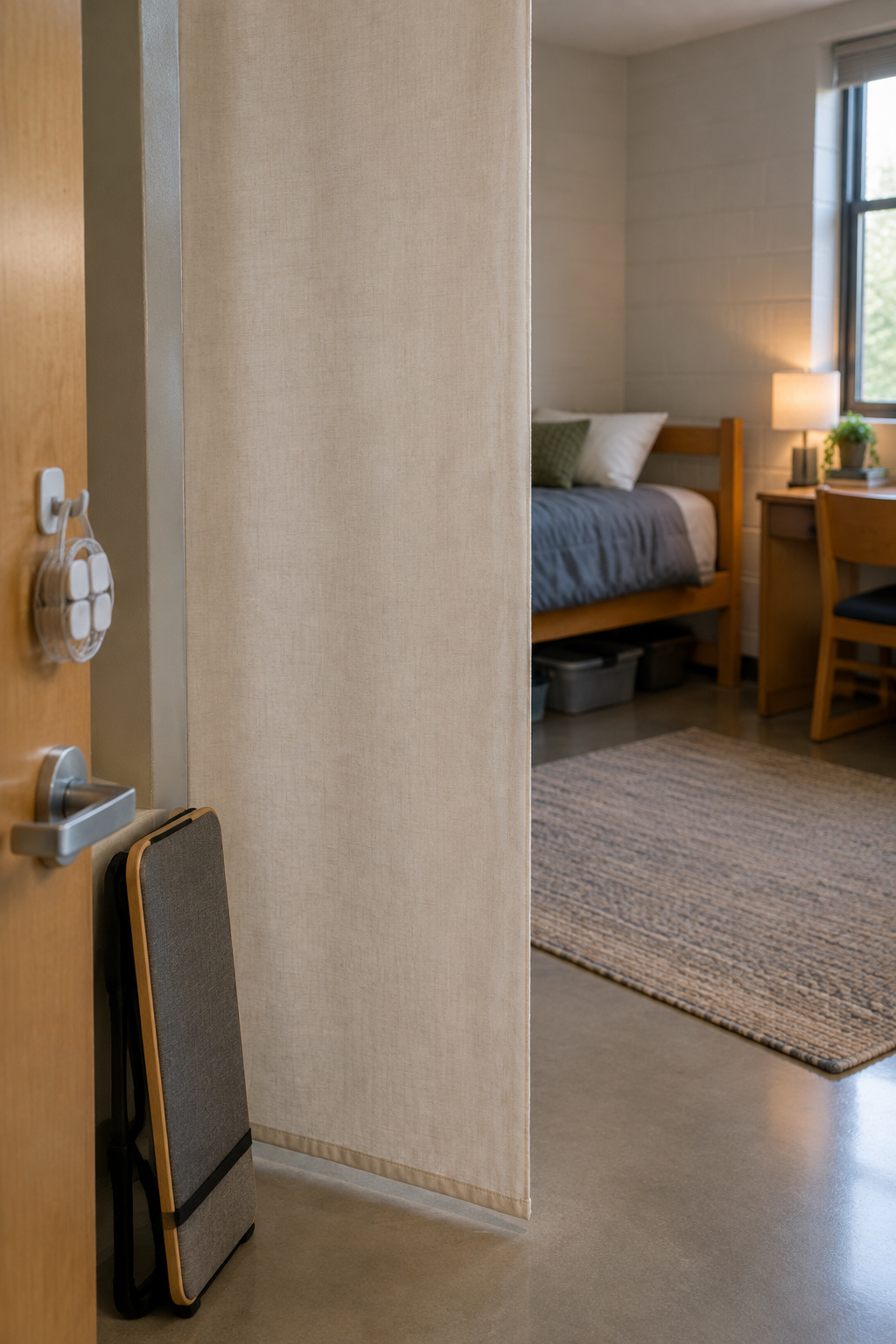
- A fabric panel and its hardware, which comes down the way it went up
What that bedding is made of and what color it is make a separate decision, and it matters: what to actually put on the bed turns on fiber and warmth, not on how dark it photographs.
The fire code and lease lines that matter
My expertise stops at the reasoning: buy for the stage after the one you’re in, and design a room its occupant can put up and strike alone. I have never written a housing policy. Everything below is quoted from a named university’s own current fire-safety or prohibited-items page, and your school’s page outranks all of it.
What’s banned on the campuses checked
Candles and open flame are prohibited at every campus checked, though the wording varies. Brown bans “candles of all kinds (including birthday cake candles) and incense,” at a $100 fine per candle. Rochester bans possessing an unburnt one. Virginia Tech makes an exception only under an approved Open Burn Permit for a religious ceremony. If you want candlelight, buy flameless tapers.
Plain extension cords are restricted or banned everywhere checked. Brown permits only grounded 15-ampere surge protectors. Rochester states flatly that multi-plug adapters, power taps and extension cords are not surge protectors, and Virginia Tech requires every strip to plug directly into a wall outlet. Indiana and Rochester both ban daisy-chaining one strip into another. National code points the same way: NEC Article 400.8 forbids running flexible cord through holes in walls or concealing it behind them.
One oddity, given the wall you’re working with: UVA prohibits cinder blocks and lofts used to prop up beds.
What most residence halls let slide
Past the outright bans, the schools split. Six of them handle the same short list of objects six different ways.
| Mechanism | Where | The actual line |
|---|---|---|
| Flat fine | Brown | $100 per candle, all kinds included |
| Square-inch cap | Brown | No unframed combustible wall covering over 1,600 sq in |
| Percentage cap | Rochester | Fabric covering under 50% of a wall and 50% of a door |
| Certification | Virginia Tech | Tapestries and flags factory-labeled NFPA 701, hung flush, never as curtains |
| Treatment | CU Boulder | Tapestries, fishnets, parachutes and sheets only if flame-retardant treated |
| Category ban | UVA | Curtains, draperies, hangings, banners, fabric flags: not permitted |
None of that carries over to the next campus, so a friend at another school is the worst possible source. The one item allowed almost everywhere is a UL-listed surge protector plugged straight into the wall, and even that varies: Virginia Tech caps students at two and wants an integral breaker or fuse. LED string lights are allowed at two of the six, with conditions. Rochester requires each strand to plug into a surge protector instead of another strand, and never hung from the ceiling; Virginia Tech allows two or three strings, switched on only when the room is occupied.
NFPA 701 is worth learning because you can check for it on a product page. After a 12-second flame exposure, the fabric must self-extinguish within 2.0 seconds and keep char length under 6.5 inches. Many states already require it for fabric in schools and theaters. A tapestry carrying that tag is a different purchase from one a seller calls “flame resistant.”
Packing it down in May, setting it up again in August
The whole reversibility test is one question: can you explain how to remove it? Ask it before you buy anything.
Adhesive hardware passes because its manufacturer publishes the answer. 3M’s procedure is to clean the wall with isopropyl rubbing alcohol (not household spray), press the strip for 30 seconds, press the hook to it for 30 seconds, and wait a full hour before hanging anything. To remove it, stretch the strip slowly straight down at least 12 inches, never outward. If a product’s packaging describes no removal method, assume it will leave a hole, whatever it calls itself.
Most “deposit-safe” advice borrows its yardstick from HUD’s wear-and-tear guidance. It treats nail and pin holes as normal wear with no deduction, while large screw holes or dozens of them with drywall damage count as property damage at $50 to $200 per repair. That standard governs rental housing; campus billing works separately.
CPSC adopted its tip-over standard after 234 people died from clothing-storage-unit tip-overs between 2000 and April 2022, 199 of them children under five. If you’re stacking anything tall, hybrid anti-tip kits use small drywall pins and an adhesive disc, rated to 200 lb, with no screw into wall or furniture.
You can set up the cheapest reversible version of this room this weekend with a bottle of rubbing alcohol, one pack of heavyweight hooks, and the books you already own stacked beside the bed. Clean the wall, press, wait the hour, then hang the one framed thing you care about. You can strike that room in an afternoon and rebuild it identically in the next building. When you finally have walls you’re allowed to paint, there’s the permanent version of the look.
FAQ
Are tapestries or canopy-style fabric against dorm fire code?
It depends entirely on the campus. Of six policies checked, UVA bans hangings and fabric flags outright, Virginia Tech allows them flush on the wall with an NFPA 701 label, Rochester permits fabric under 50 percent of a wall, Brown caps unframed coverings at 1,600 square inches, and CU Boulder requires flame-retardant treatment. Check your own handbook.
What’s the actual penalty for nail holes in a dorm wall?
No single answer exists, because campus housing offices bill damage under their own systems. The closest yardstick is HUD’s rental wear-and-tear guidance: nail and pin holes count as normal wear with no deduction, while large screw holes or dozens of nail holes with drywall damage count as property damage, typically $50 to $200 per repair. Confirm against your housing contract.
Can this look work in a shared dorm room with a roommate who isn’t into it?
Yes, because none of these methods span the room or stay permanently. Freestanding crate shelving, a tension rod confined to one closet opening, and adhesive hooks placed only on your side of a shared wall all stay inside your own half without needing a roommate’s participation. That is my reasoning, since no handbook addresses taste.