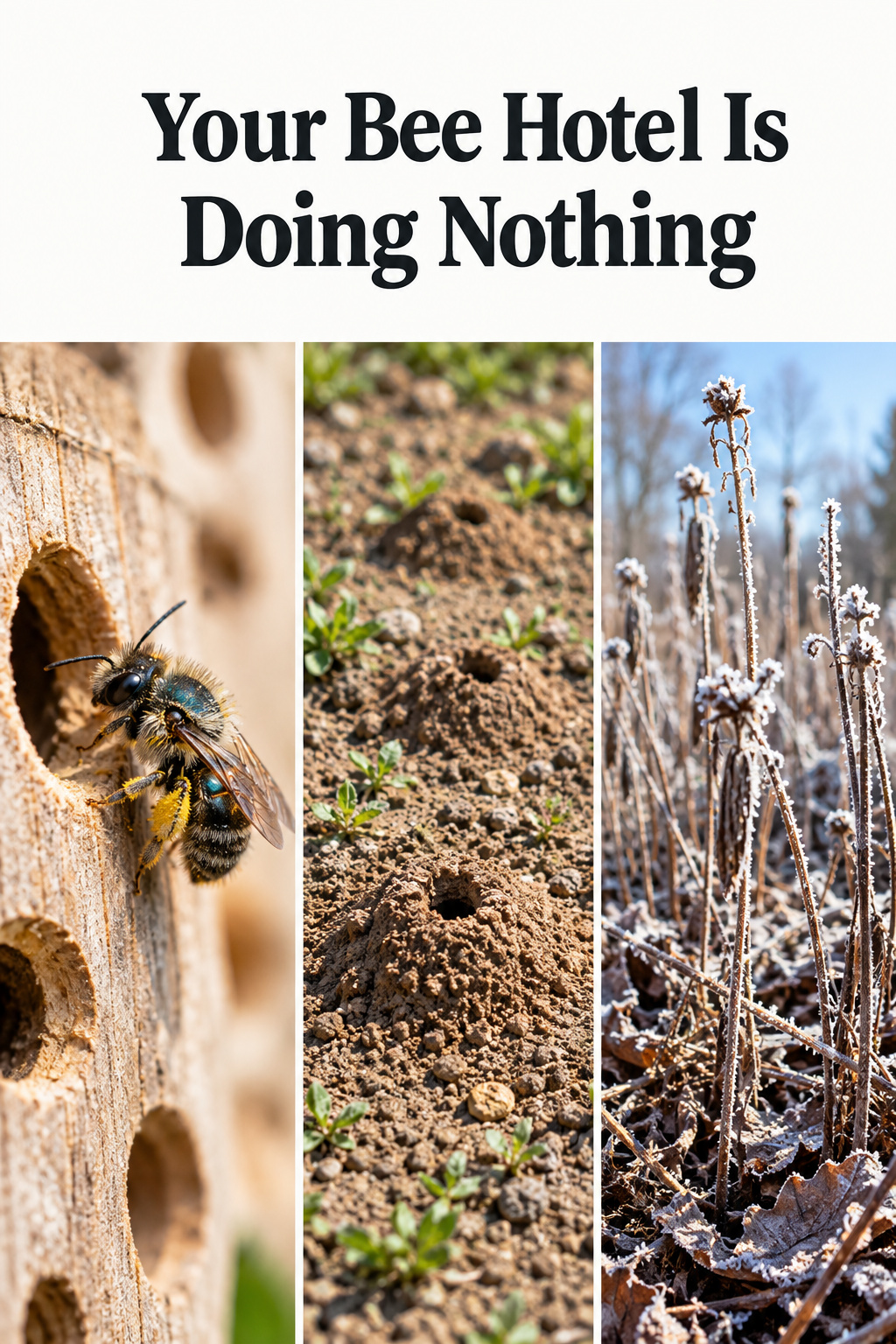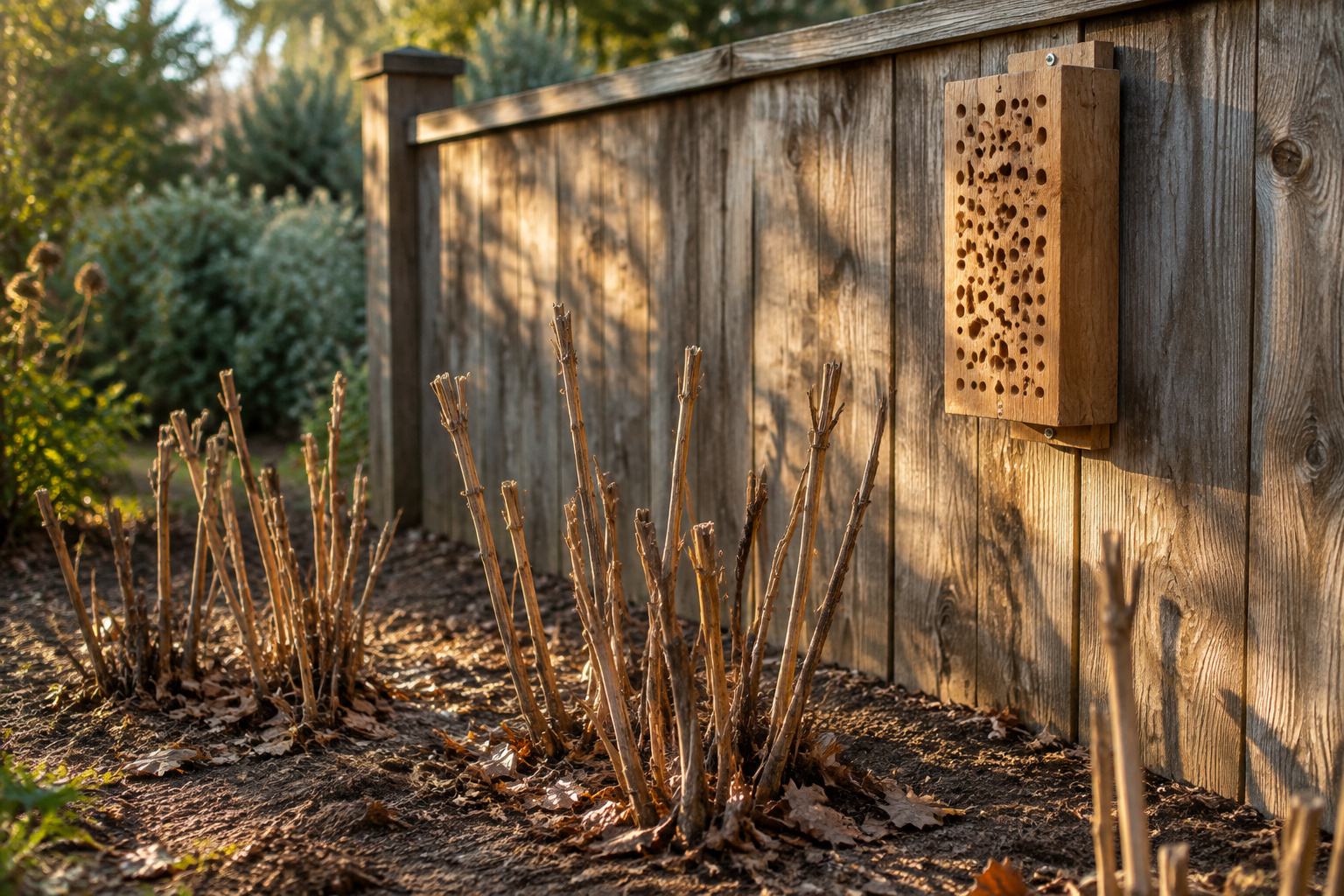
Hang the bee hotel, plant the flowers, call it habitat: that’s the usual advice, and it misses most of the bees in your yard. Roughly 70 percent of native bee species nest underground rather than in hives or boxes, and Oregon State Extension built a whole publication around that number. Real bee nesting habitat is three unglamorous things: dirt you stop mulching, stems cut high on purpose, and, optionally, a block drilled to an actual spec.
TL;DR
- About 70% of native bees nest in the ground and roughly 30% in tunnels, so an unmulched sunny patch reaches far more bees than any box you hang.
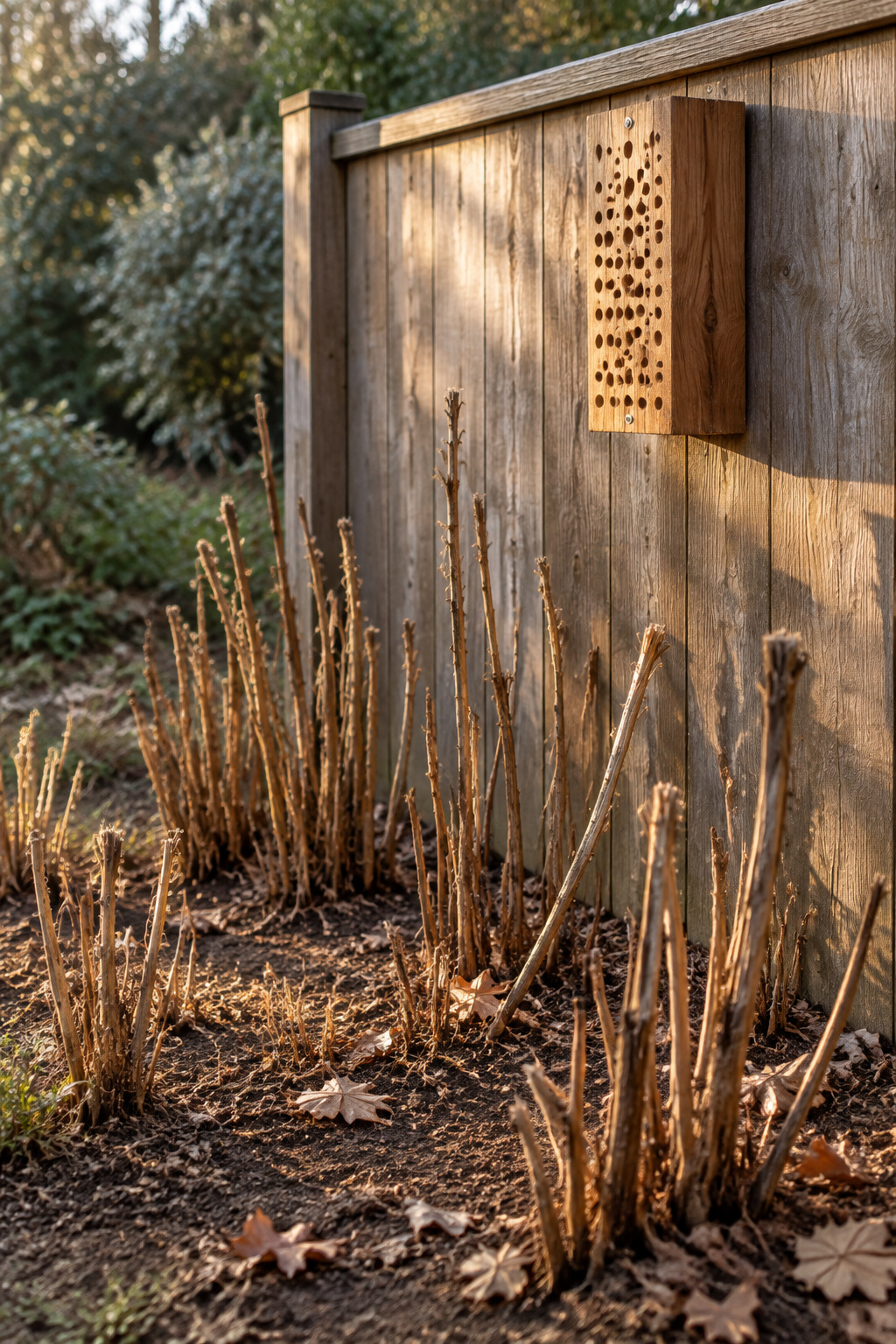
- Cut dead stems to varying heights between 8 and 24 inches instead of to the ground, and skip the “50°F for seven days” cleanup rule, because no research supports it.
- Drill holes 3/32 to 3/8 inch at 3/4-inch centers. Go 3–4 inches deep under 1/4 inch and 5–6 inches above it, close one end, and wash or replace the block every one to three years.
Why Your Bee Hotel Is Probably Doing Nothing
The box on the fence isn’t neutral, and it houses the wrong tenants.
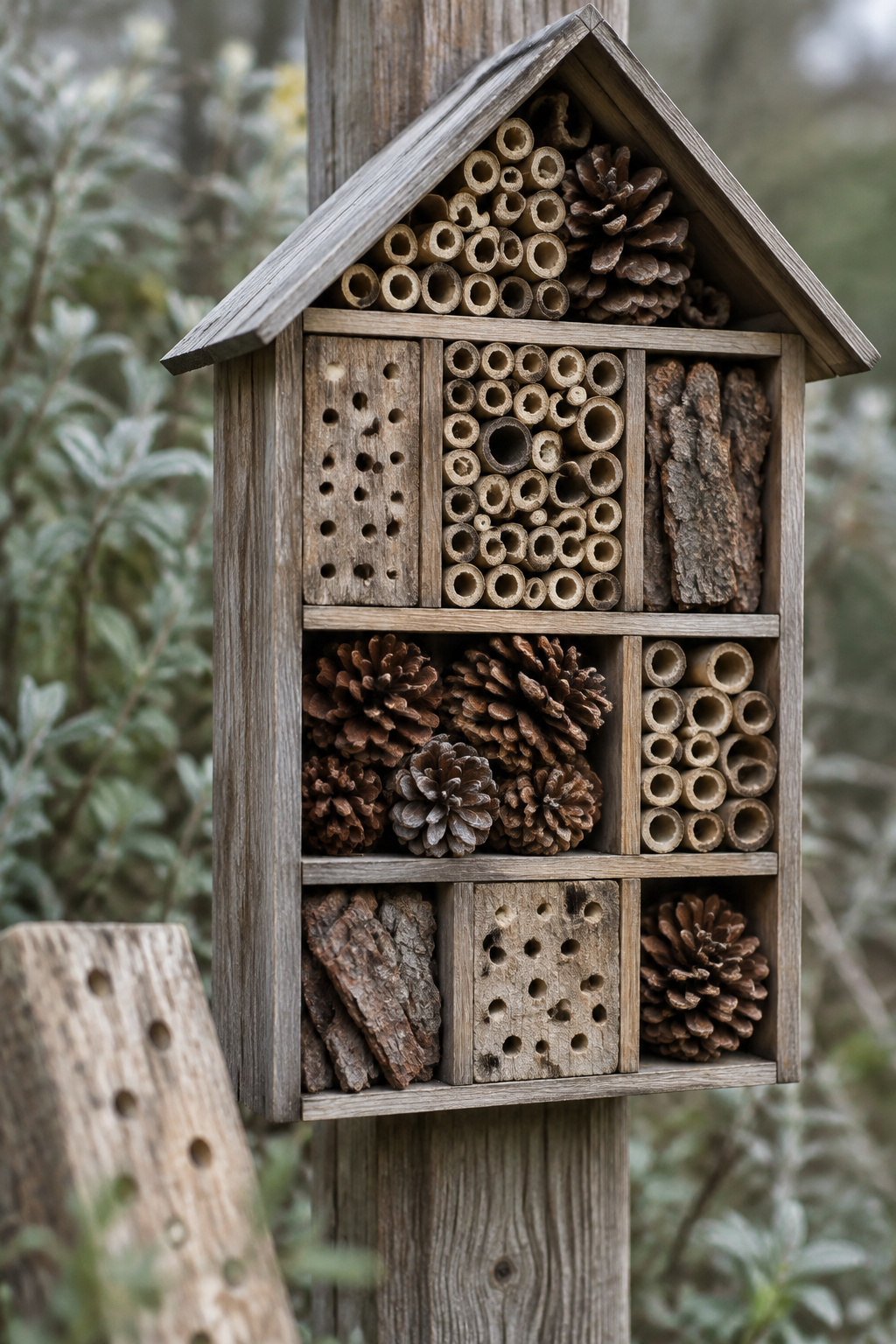
The 70-percent stat flower-focused advice skips
Only around 30% of native bees are tunnel nesters like leafcutter and mason bees, the only ones a block can serve at all. The other 70% nest underground. With more than 4,000 native bee species in the US, a fence-mounted hotel aims at under a third of the roster.
What’s actually wrong with most store-bought bee hotels
The evidence is blunt. In a peer-reviewed study, MacIvor and Packer found native bees made up only 27.6% of all bees and wasps reared from bee hotels, against 37.8% for native wasps. Native bees in them were also parasitized significantly more often than the introduced bees sharing the same boxes. Per NC State Extension, much of a decorative hotel’s volume is pinecones, moss and bark, materials no bee nests in at all.
What this guide replaces them with
Three pieces: bare soil, stems cut correctly, and a block cleaned on a schedule. Building the bed from scratch? Owen Gallagher’s full habitat garden guide covers siting and layout. This one covers everything that doesn’t flower.
The Sunny Patch of Bare Soil You Should Stop Mulching
Nothing here photographs well, and that’s the point.
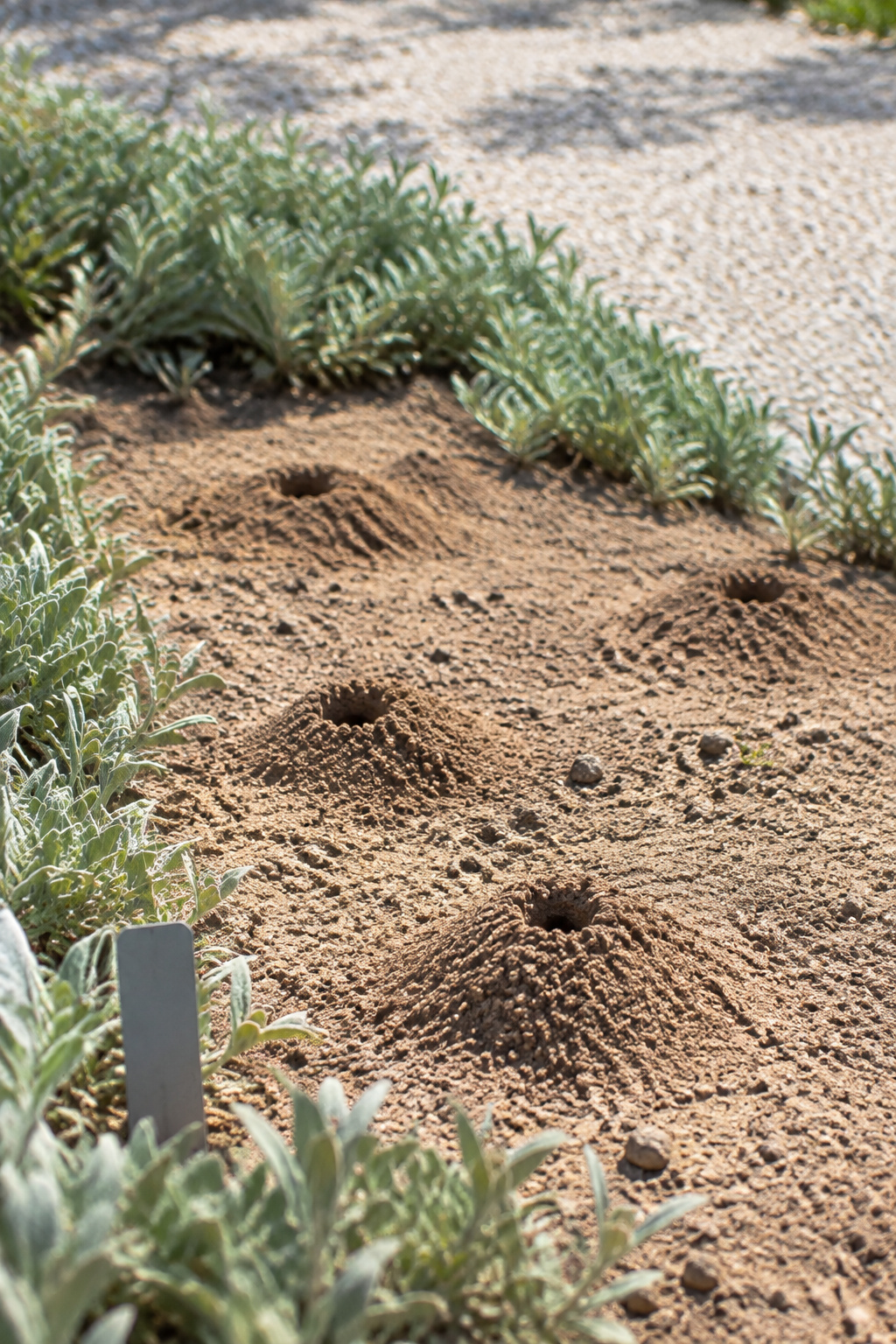
How much bare ground ground-nesting bees need
Nobody publishes a square footage. No extension service states a minimum area or percentage, so be suspicious of any number you see quoted. The character of the patch is documented, though. Xerces points you to an open, south-facing slope, where sun warms the bees enough to start their day and the soil doesn’t stay muddy. It has to be loose and undisturbed too. A female digs her own tunnel with mandibles and saliva, then lines the walls with mud or a waxy secretion that keeps moisture out. Compacted ground fights her.
Where to leave it in the layout
Stop covering it. Xerces says plastic mulch, landscape fabric and heavy wood chips form impenetrable layers that limit nesting. Utah State University Extension says weed fabric is as impervious to a digging bee as pavement. Pebble “mulch,” compost or leaf litter still lets a bee dig through.
Signs bees are already using it
Look for small heaps of excavated soil ringing a pencil-width opening, usually through spring. The bees hovering there are mostly stingless males, and the digging females are solitary and rarely sting, having no hive to defend.
Back in my crew days a $40 oscillating multi-tool lived in the gang box and nobody would claim it. It had no badge value, and it saved roughly every install we did: the undercut on a jamb, the flush cut nobody planned for. This patch of dirt is that multi-tool. There’s nothing to photograph, and it outworks the handsome box on the fence.
Which Stems to Leave Standing Over Winter
Most of this habitat gets destroyed in autumn, with a clear conscience and a sharp pair of pruners.
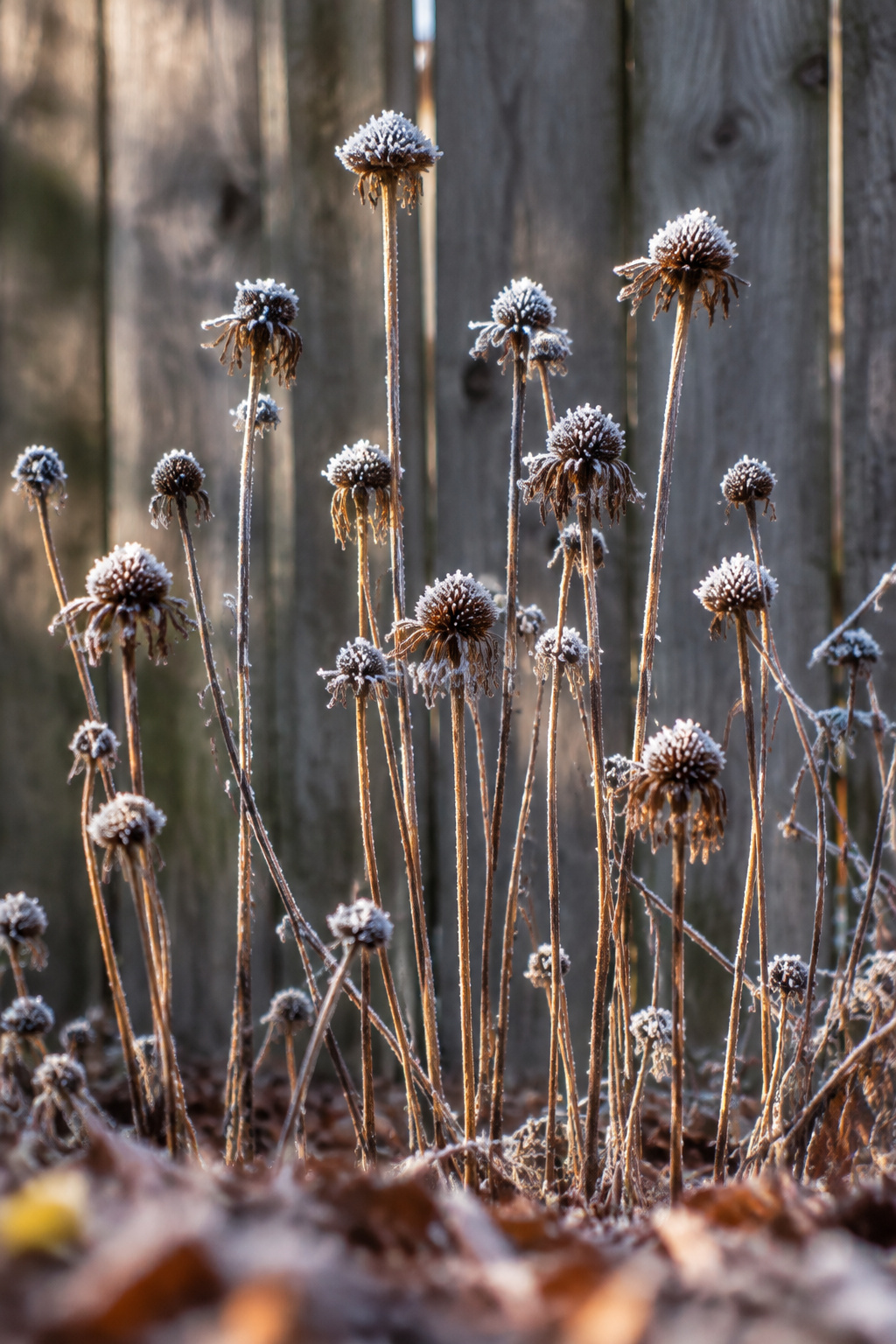
Hollow and pithy stems worth keeping
Match the stem to the bee. Small carpenter bees nest in last year’s dead raspberry canes and wildflower stems. Yellow-faced bees use smaller stems like bee balm and roses, and the larger leafcutter bees take native thistles, cup plant or desert willow. Brambles and grasses count too, and anything pithy or hollow.
How tall to cut them in spring, not to the ground
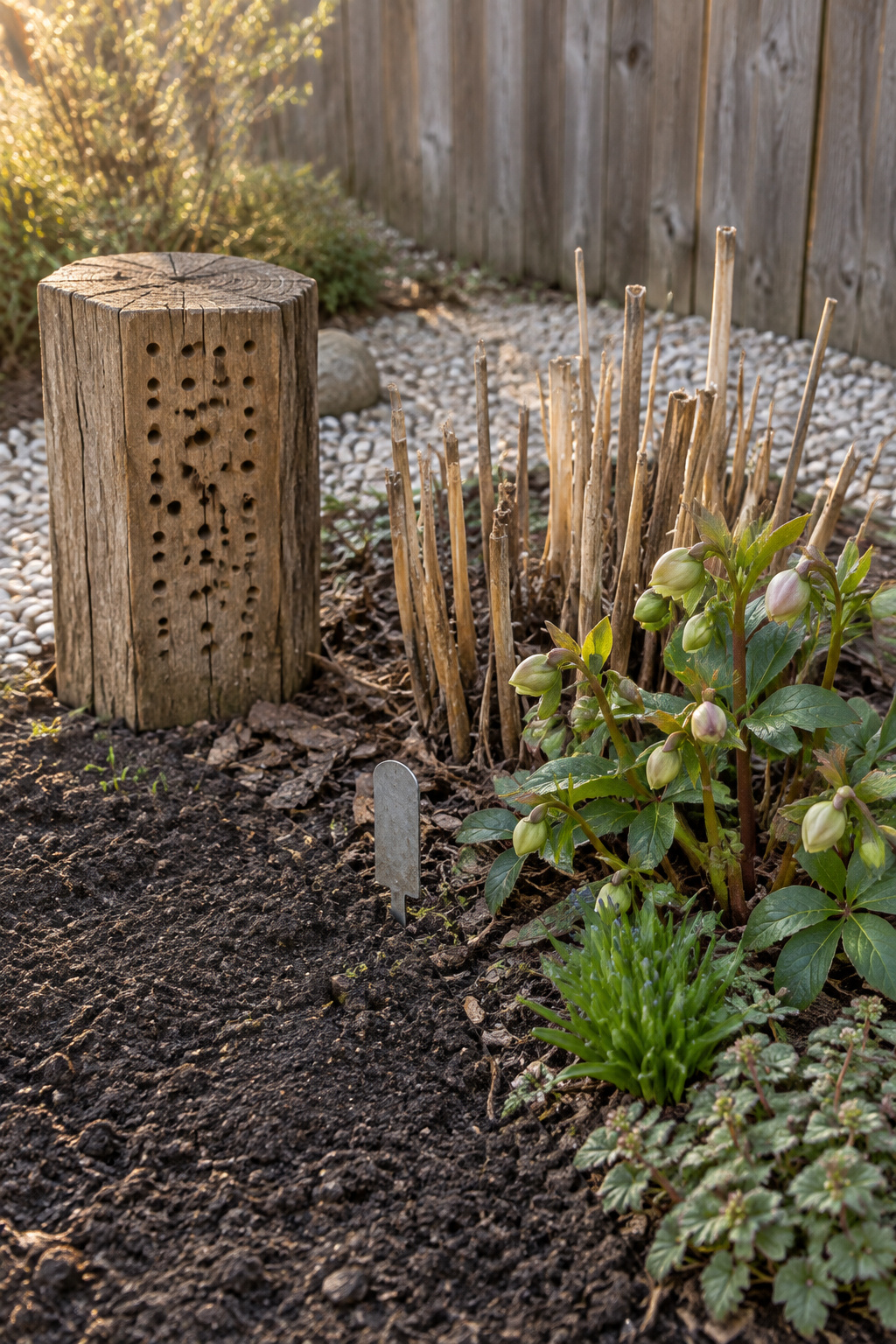
Xerces gives the number most gardeners have never heard: stubble of varying height, 8 to 24 inches, instead of a cut flush with the ground.
- Skip the autumn cutback and leave stalks standing through winter.
- Wait for a regional spring cue, not a thermometer reading.
- Cut stubble between 8 and 24 inches, never flush to the ground.
- Vary heights across the bed so different tunnel widths suit different bee sizes.
- Leave that stubble standing as this season’s growth comes up around it.
When it’s genuinely safe to tidy up
You’ll be told to wait for 50°F across seven consecutive days before spring cleanup, and that rule has no research behind it. Oregon State University Extension entomologist Gail Langellotto went looking for the study underneath it and found none. The figure appears to trace back to a misapplied Wisconsin study on bat foraging and aquatic fly emergence, a different insect group entirely and nothing to do with garden pollinators.
Use regional dates instead. Oregon State’s own Pacific Northwest guidance is to wait until May, because small carpenter bees are documented emerging there in April. Illinois Extension gives northern states mid-to-late April at the earliest, or waiting until apple trees finish blooming.
Building a Nesting Block That Actually Works
This is the only part of the job with real numbers on it.
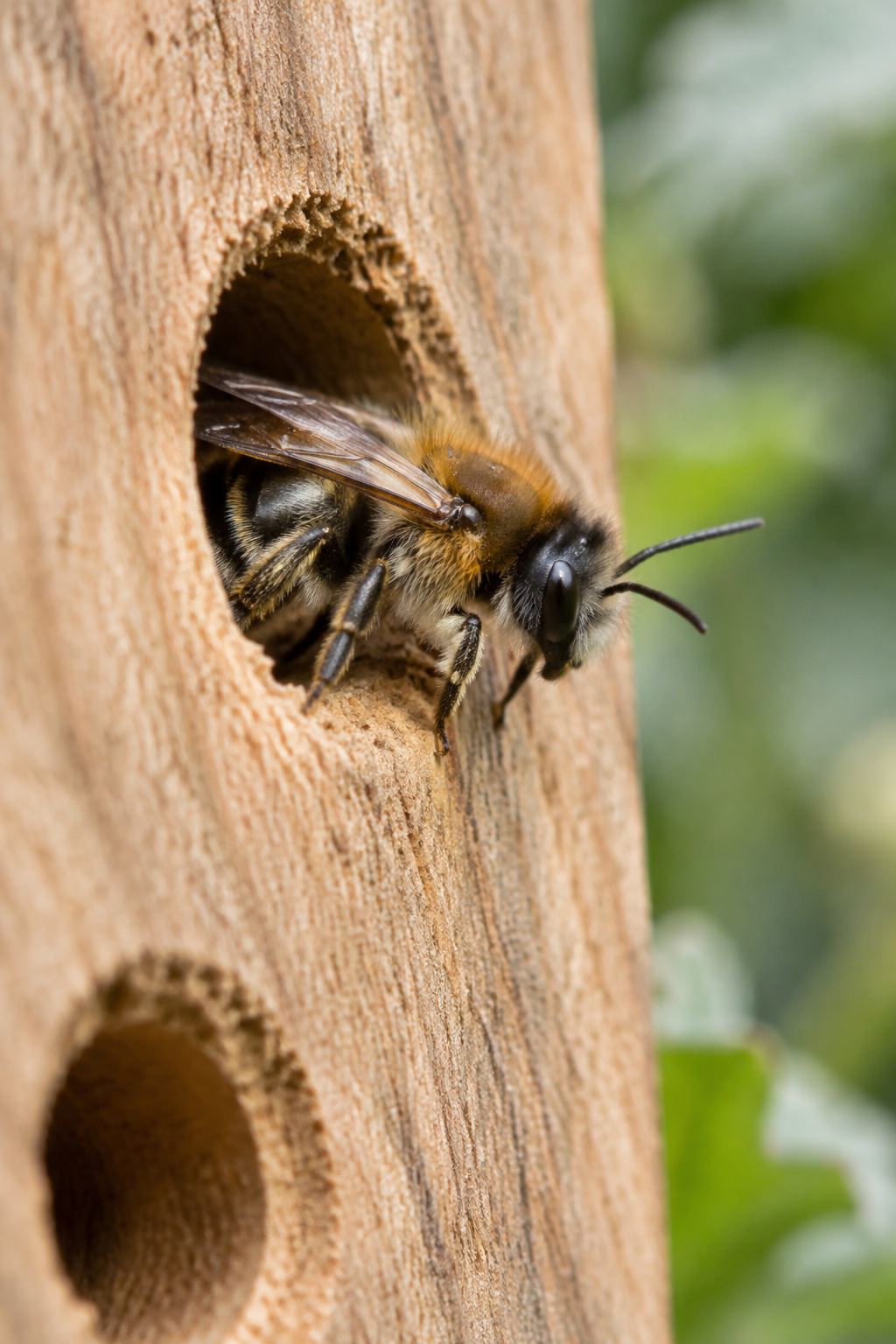
Hole diameter and depth that match real bee species
Drill between 3/32 inch and 3/8 inch in diameter, at roughly 3/4-inch centers. Depth follows diameter: a female finishes her nest with male cells nearest the entrance, so a shallow hole leaves no room for the female cells deeper in.
| Hole diameter | Depth to drill | Bee it suits |
|---|---|---|
| 3/32 in. to just under 1/4 in. | 3–4 in. | small end of the tunnel-nesting range |
| 15/64 in. (6 mm) | 2–3 in. is where they nest most efficiently | alfalfa leafcutting bee |
| 19/64 in. (7.5 mm) | about 6 in. | blue orchard (mason) bee |
| 1/4 in. to 3/8 in. | 5–6 in. | larger tunnel nesters |
The sources don’t agree perfectly, and smoothing that over would do you no favors: a second Xerces sheet gives 3–5 inches for the smallest holes. Set the drill once, 4 inches under 1/4 inch and 6 inches at 1/4 inch and over, and you sit inside every published spec.
Backing material so tunnels aren’t a dead end
Use preservative-free lumber, 4×4 for tunnels 1/4 inch or less and 4×6 for larger ones, and drill with a sharp bit, because bees avoid a rough interior. Every hole closes at one end. If you drilled through, screw on a backing board, since a tunnel open at both ends won’t be used. Start holes at least 3/4 inch in from the edge, because the parasitic wasp Leucospis drives its ovipositor about twice its body length into solid wood. Then keep the block on a cycle: wash it every one to three years, five minutes in roughly 1 part bleach to 3 parts water, or skip the wash and replace it every two years.
Where to hang or place it
Face the entrances east or southeast for morning warmth. Mount 3 to 6 feet up, fixed to a building, fence or stake, never dangling from a branch or a swinging gate: wind-shake disrupts larval development. Several small blocks of four to six tunnels each, well separated, beat one large hotel: less disease spread, and you stay under NC State’s roughly 100-tunnel ceiling.
Leaf Litter as Overwintering Habitat, Not Mess
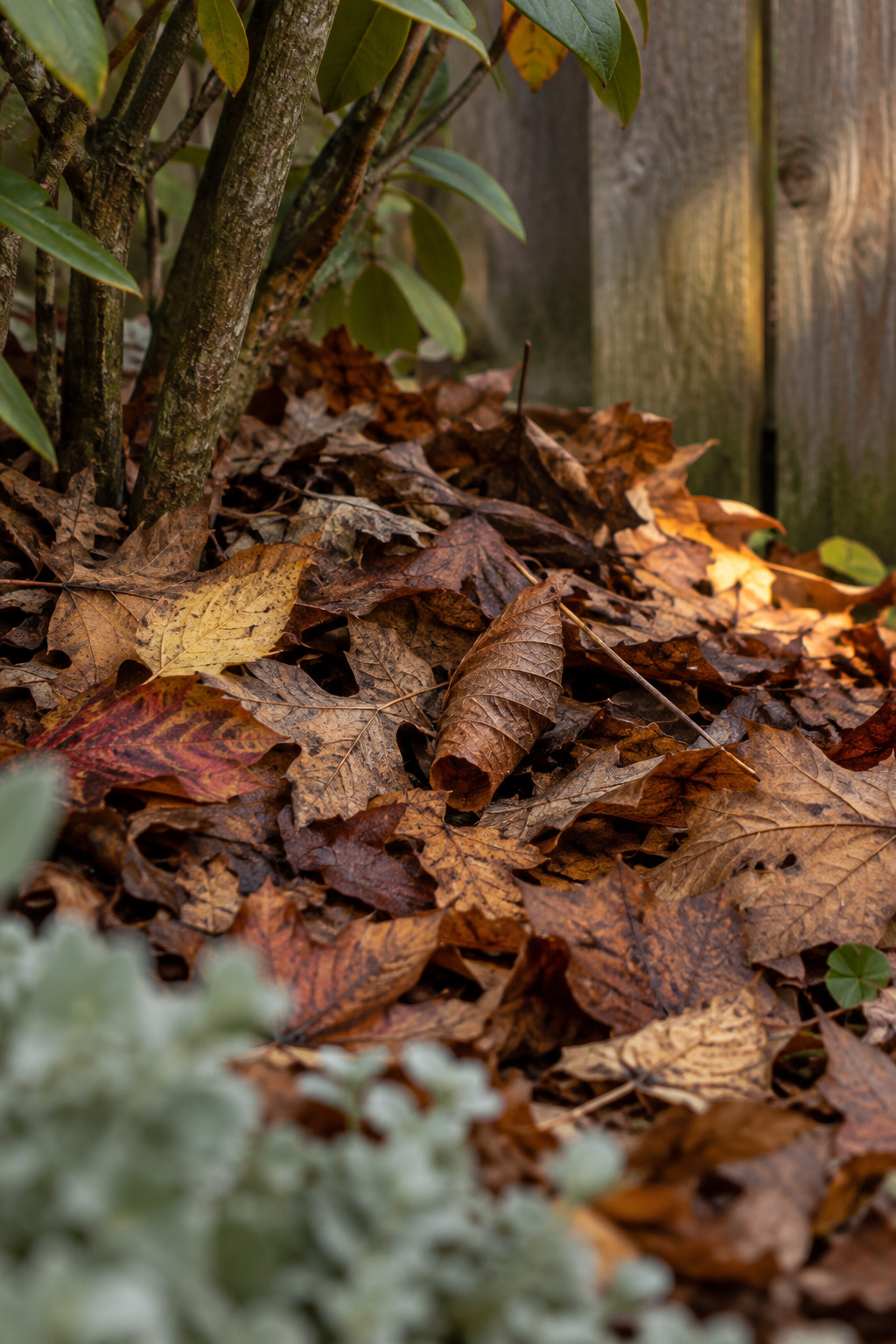
Two inches of dead leaves under a shrub does more work than it looks.
What actually overwinters in a leaf layer
Per Xerces, great spangled fritillary and woolly bear caterpillars tuck into leaf piles, and red-banded hairstreaks lay eggs on fallen oak leaves. Luna moths and swallowtails disguise their cocoons as dried leaves. Mated queen bumble bees hibernate an inch or two into the earth, right under the cover a fall cleanup removes. Firefly larvae spend one to two years in leaf litter.
How long to leave leaves before clearing
Depth comes first. A couple of inches mimics natural leaf-fall and insulates, where a thin scatter doesn’t. On timing, Xerces again declines a date and says wait until late in the season, because those species emerge on a staggered schedule.
Where to pile them if you must tidy
Rake them into beds, around trees and shrubs, or into a holding area instead of bagging them for pickup. Piling at the perimeter banks the habitat value while the lawn still looks tended, though stubble and leaf drifts are genuinely visible from the street, and that trade-off deserves its own treatment.
Why Bee Nesting Habitat Only Works Next to the Right Plants
Build all three elements correctly and you can still get little back, depending on what’s planted around them.
Why treated plants undo the habitat
Neonicotinoid contamination in “bee-friendly” big-box plants fell from 51% in a 2014 test to 23% in a 2016 follow-up. Those are still the newest figures out there; nobody has retested since. Real progress, probably, but still one in four, so treat it as the best data available, not this year’s shelf. Persistence is what matters. Residues can stay in soil for months or years after one application, and have been found in woody plants up to six years after a soil drench. Whether that meaningfully exposes ground-nesting bees is an open research question, and Xerces itself says so. Henrik Larsson’s guide to buying untreated native plants works the sourcing side through properly.
What certification programs actually require here
Shelter is a scored line item, not a bonus. The NWF’s Certified Wildlife Habitat program asks for at least two places to raise young alongside food, water and cover, and the Xerces Pollinator Protection Pledge names providing nest sites among its four principles. Owen Gallagher’s piece on what certification actually requires has the criteria.
Putting it all together for spring
Five habits, not one project: leave the patch alone, cut stems high, wait for a regional cue, clear litter gradually, and clean the block on its cycle.
Start with the cheapest this weekend. Find a sunny, south-facing spot you’ve been mulching out of habit, pull the chips and fabric back, and leave the soil alone. No store trip, no bill, no build, and that patch reaches more bees than the box on your fence ever will.
FAQ
Is it true that most bee hotels attract the wrong insects?
Largely, yes. A peer-reviewed study found native bees made up only 27.6% of bees and wasps reared from studied hotels, against 37.8% for native wasps. Native bees were also parasitized significantly more often than the introduced bees sharing them. Chalkbrood and pollen mites build up in uncleaned material too.
How do I know if a bee nesting in the ground is safe to leave alone?
Assume it is. Ground-nesting bees are solitary rather than colonial like honeybees or yellow jackets, and they generally don’t sting because they have no hive or honey store to defend. The insects swarming visibly over a nest are mostly stingless males, and the nest stays active only weeks.
Do I need to clean out a bee nesting block every year?
Not every year, but on a schedule. Wash it every one to three years, five minutes in roughly 1 part bleach to 3 parts water, or skip the wash and replace the block every two years instead. Chalkbrood and mites build up if you don’t.