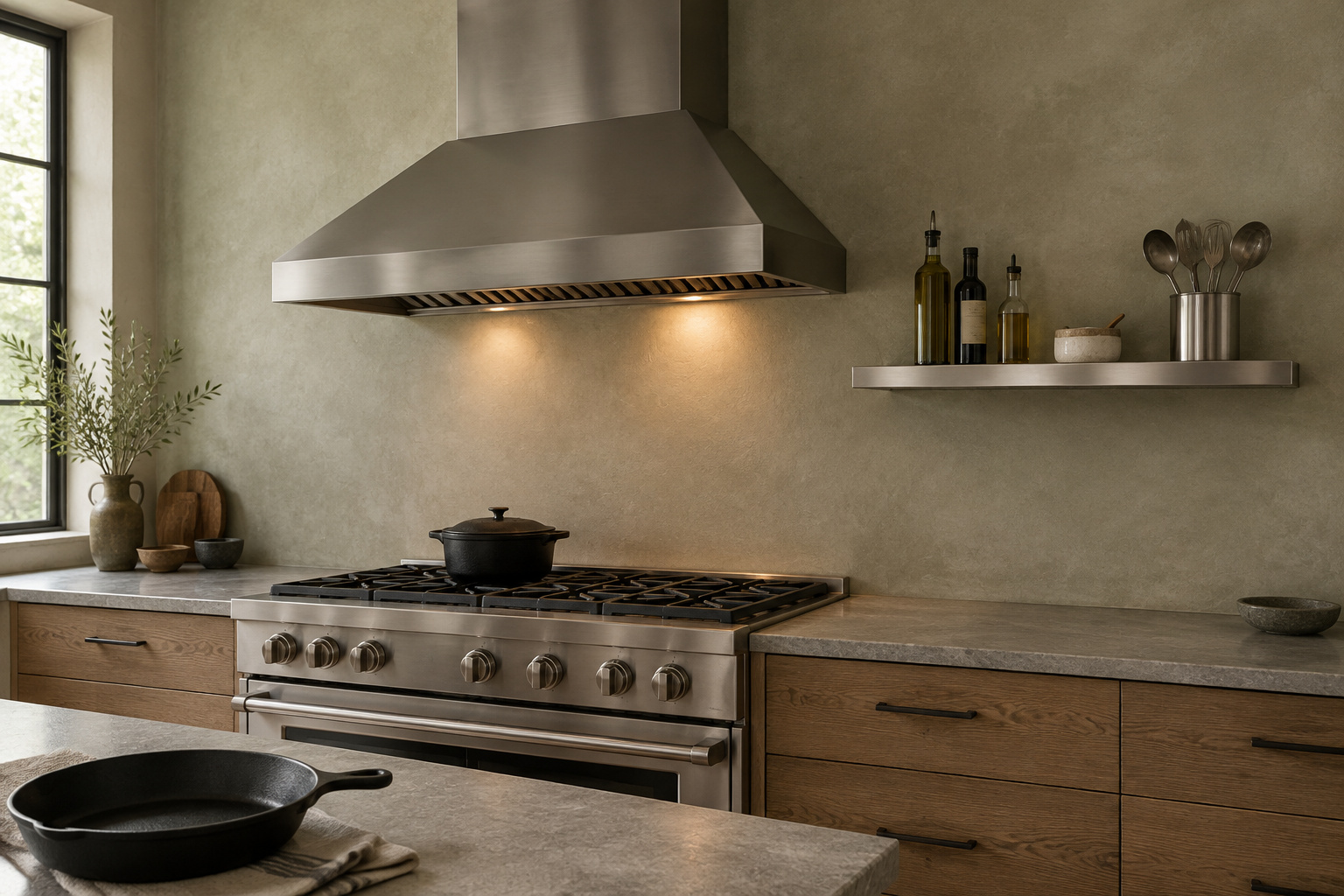

Ask anyone about open shelves near stove burners and you’ll get the same number back: keep them 18 inches away. Then open a backsplash guide, ours included, and there’s another 18 inches, this time the height the tile should run behind a range. Same digits, two different jobs, and neither one is the distance from a burner to a shelf. The places that actually set rules, the range’s installation manual and the building code, never mention an 18-inch shelf distance. What they do set is stricter in one direction and looser in the other. Once you know which is which, a shelf beside the stove is a perfectly reasonable thing to build.
TL;DR
- There’s no 18-inch shelf rule. Above the cooktop the line is 30 in to anything combustible, 24 in with a qualifying hood, and 36 in on some manuals.
- Beside the range the number belongs to your model, anywhere from 1 3/16 in to 11 13/16 in, and a deep hood that covers every burner does more for the shelf than a few extra inches.
- Dust weekly, degrease every other week, and re-oil a wood shelf about once a year, or sooner the day water stops beading on it.
What the Range Manual and Code Actually Say About Space Above a Burner
So we’re clear whose numbers these are: the clearances here come from the code and the manufacturers, not from me. My own ground is finishes, heat and fat, learned around grills and outdoor kitchens where smoke has nowhere polite to go.
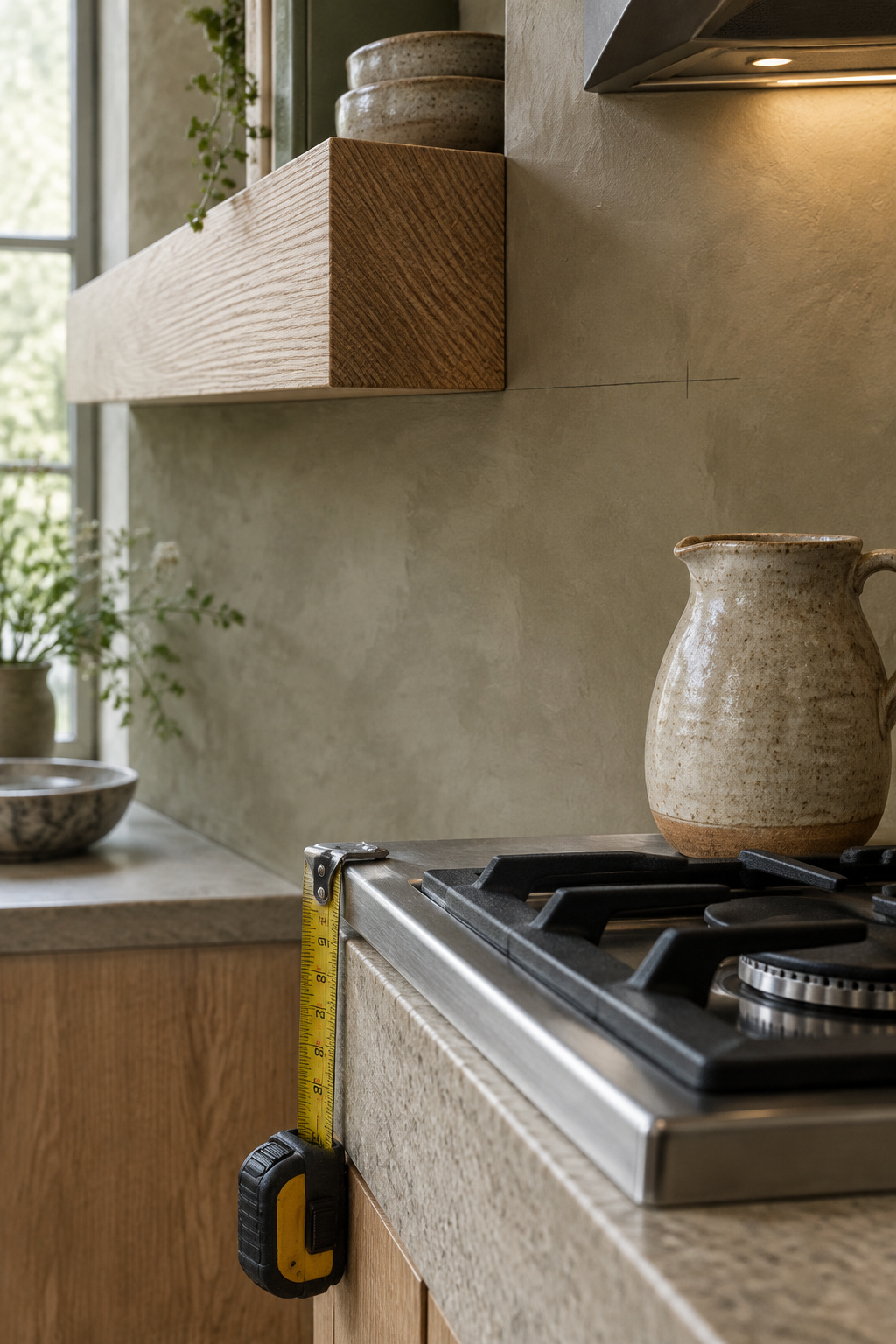
Your range’s installation manual is the number that counts. It was written for that exact appliance, and the code defers to it: the International Residential Code says cooking appliances go in according to the manufacturer’s instructions, so where the manual is stricter, the manual wins.
| Where | Figure | What it means |
|---|---|---|
| Above the cooktop, unprotected | 30 in (Canada: 750 mm) | Distance from the cooking surface to anything combustible overhead |
| Above, with a qualifying hood or protection | 24 in (Canada: 600 mm) | Needs a metal hood at least as wide as the range and centered, or noncombustible protection |
| Above, on some premium range manuals | 36 in, or 30 in protected | Cooking surface to the cabinet above |
| Beside the range or cooktop | 1 3/16 in to 11 13/16 in | Edge to the nearest combustible wall, set model by model |
| Canada, the zone around the cooktop | 450 mm, about 18 in | Combustible finishes inside it need 9.5 mm gypsum board behind them |
Above the cooktop the code’s floor is 30 inches to anything that can burn, and a wood shelf can burn. You only get down to 24 with that qualifying hood or protection. The premium manuals often ask more, and some ask you not to bother at all: on one of its 36-inch dual-fuel ranges, Fisher & Paykel says cabinet storage above the surface units “should be avoided.” That’s about as blunt as an installation guide gets.
The manuals don’t agree with each other, either, which is why the only number worth working from is the one printed in yours.
The Verdict on the 18-Inch Stove Rule for Shelves
So where does 18 come from? The folk figure most plausibly borrows from three real measurements that happen to share the number.
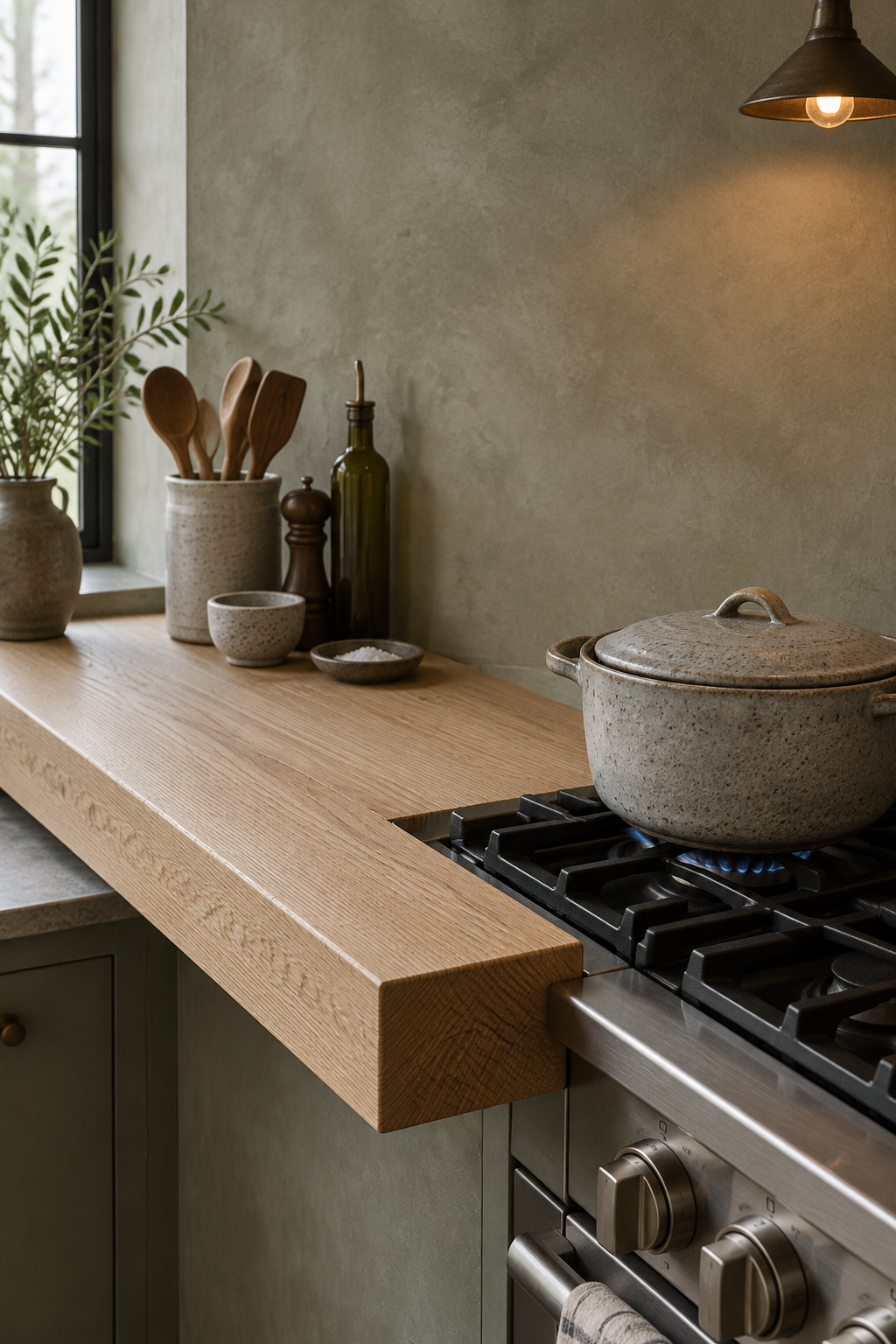
The first is the gap between the countertop and the bottom of the cabinet above, a work-height convention with nothing to do with heat. The second is the backsplash, a wall-covering height. The third is a genuine fire rule from Canada’s building code: that 450 mm zone around the cooktop, inside which combustible finishes need gypsum board behind them. It protects the wall. If you’re in Canada and planning a bare wood shelf inside that zone, I’d want the wall behind it protected too.
Mash the three together and you get a number that sounds official and falls apart the moment you hold it against a manual. Straight above the burners, 18 inches is short of every manual and code figure going. Beside the range, it’s often more than the manual asks. Thermador wants 3 inches between its Pro-Grand range and a combustible side wall. One KitchenAid gas cooktop asks 4 5/8 or 5 1/4 inches, depending on width.
You’ll also meet a confident temperature figure for the wall behind the burners. Installation manuals and the code set distances, not wall temperatures, so a temperature quoted without a manual behind it is a guess. Go by the distances.
Open Shelves Near the Stove Work When the Hood Captures the Steam
It’s a Friday night and something’s frying on the front left burner. Where does the fat go? The answer depends far more on the hood than on the shelf.
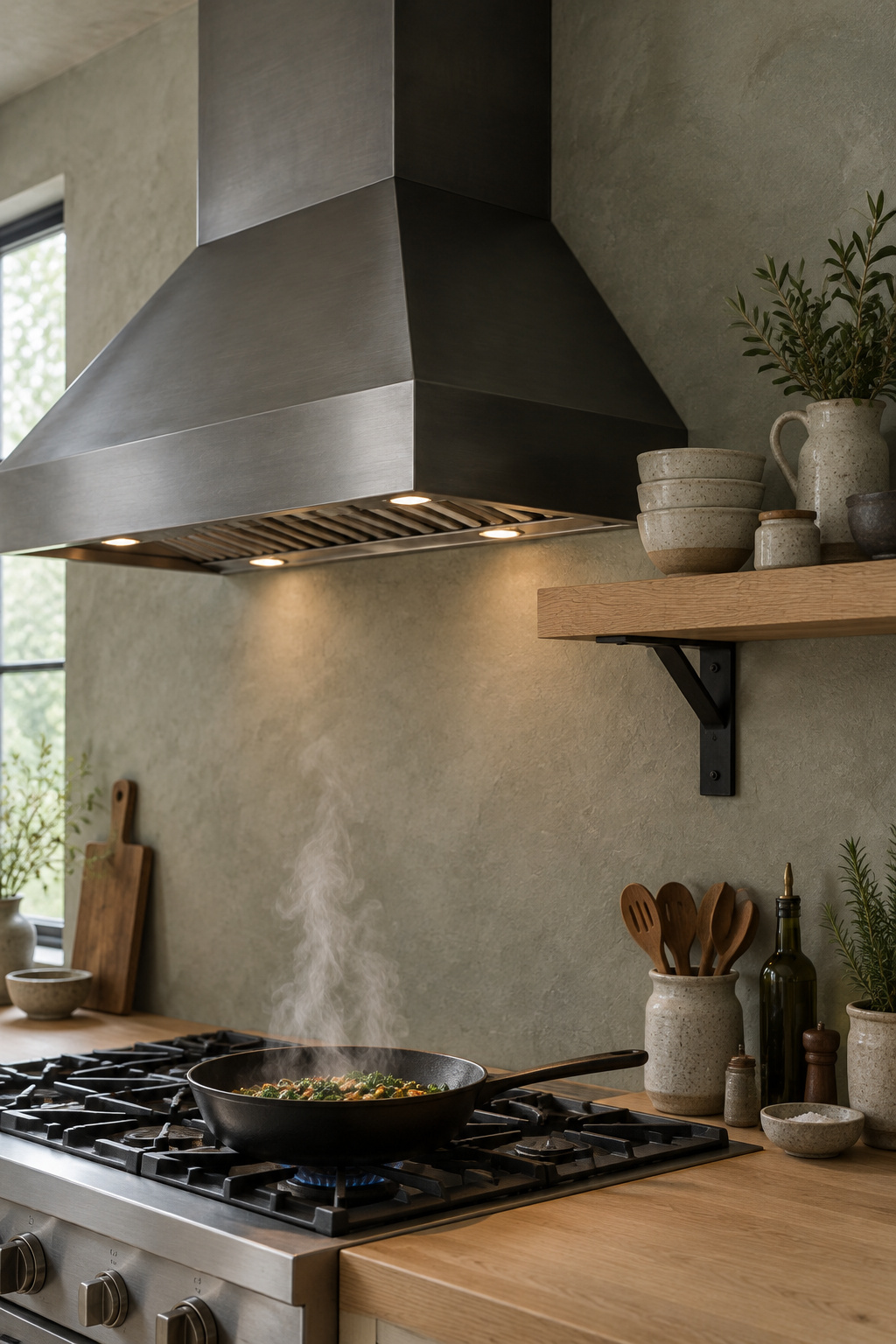
The hood should be as wide as the cooktop and hung at the height its maker gives. After that, depth and coverage decide it. Thomas Phillips, summarizing Lawrence Berkeley lab and field studies, sets the bar at catching 80% or more of what comes off the burners, and the hoods that capture best are deep and wide enough to cover every burner. Flat designer hoods and over-range microwaves catch much less. Front burners are the weak spot: at 200 cfm, lab capture ran about 80% over the back burners and anywhere from 25 to 80% over the front ones. When something spits, cook at the back.
The most useful evidence for a shelf comes from a lab study that tracked oil droplets onto kitchen surfaces. With the hood running, small droplets on flat surfaces dropped by more than 95.8%, and on vertical surfaces by more than 77.7%. Large splashed droplets didn’t change at all, and turning the fan up gave the surfaces no extra benefit. It comes down to droplet size: the hood works on the fine mist, and heavy spatter is beyond its reach, fan or no fan.
There’s no tested distance for how far grease travels onto a shelf beside a range, so work from your manual’s side clearance and a hood that captures well.
If your household fries most nights under a slim slab of a hood, closed doors may serve that wall better, and weighing closed uppers against open shelves is worth doing before you buy brackets.
Finishes That Take Heat and Fat
Kitchen-rated wood finishes are rated for spills, not heat. Osmo’s TopOil, a worktop finish, is tested against water, wine and coffee, and its dry film is classed B2, “normally flammable,” under the German DIN 4102 standard. It carries no wall-temperature rating, and makers of oiled-wood kitchens tell you not to set hot things straight on the wood.
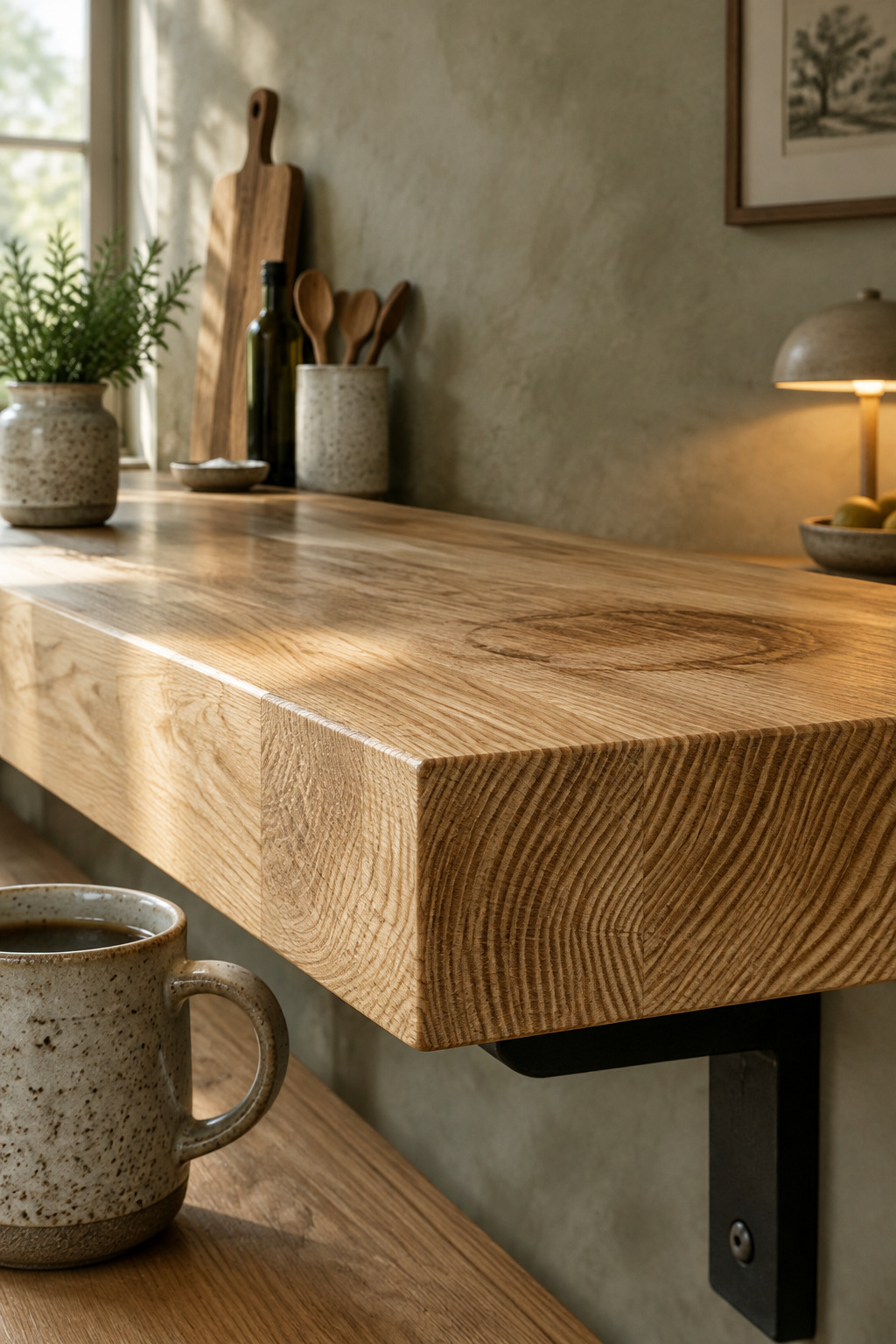
So I stop asking which finish resists heat and ask which one I can repair where the fat lands.
- Raw, unfinished wood has no place beside a range. It drinks fat and you can’t wipe it back out.
- Hardwax oil fully cures in 7 to 14 days and spot-repairs: sand the dull patch lightly and recoat.
- Polyurethane, water-based or oil-based, can’t be patched invisibly, so a worn spot near the hood stays worn.
I learned that kind of upkeep at sixteen. My uncle and I built a cedar deck that year, and I’ve re-oiled it every spring since. I don’t think of it as a chore; it’s closer to keeping in touch. A stove-side shelf is the same arrangement on a faster clock, since it takes steam and fat every evening where the deck takes sun every summer. Its cue is a few drops of water, not the season.
What Earns a Spot on the Shelf Beside the Range
Start with the board itself. In that droplet study, flat surfaces collected more oil than vertical ones, so the top of the shelf and anything lying on it carry most of the load. That decides what belongs there.

Good beside the range are stoneware, glass, metal and cast iron that you handle and wash often, plus the things you reach for while cooking, which get rinsed anyway. Keep away anything porous, like unglazed clay, linen, paper, baskets and untreated wood, because they soak up fat and can’t be degreased. Keep anything fragile or precious out of splash distance of the front burners.
Everything on that shelf picks up a little film, so it should pass through the sink regularly. The heirloom bowl that sits untouched for a season is the one most likely to turn tacky. A simple test: if you wouldn’t wash it this month, it lives on the far side of the kitchen.
What looks good on the rest of the wall is its own question, and arranging the dishes you use every day is where to work out which pieces go where.
How Often to Wipe, Degrease and Refinish a Stove-Side Shelf
Across the room from the cooktop, an open shelf gets by on a two-minute dust each week and a damp-cloth clean once a month. Beside the range it collects fat as well as dust, so add a degrease on the rhythm cabinet fronts get, at least every other week: warm water with a few drops of dish soap, never dishwasher detergent, on a damp cloth, then a dry one. Test a hidden spot first.

On oiled wood, follow the finish maker. Andover’s care sheet for its oil asks for pH-neutral soap and rules out abrasive pads, bleach, ammonia and solvents. It also points out that oily rags are combustible, which is worth remembering a few feet from a burner.
Refinishing is where everyone wants a number, and none of the makers gives one for a shelf. Andover says it plainly: “There is no universal oiling schedule.” Its cue is a water test. Every three months, or whenever the finish looks dull, drip some water on it, and if it soaks in within 15 minutes, oil it. Another maker says to re-oil just before the color fades, and Snek, a kitchen maker, says parts near heat want oil at least once a year. That annual floor is the nearest thing to a number for a stove-side shelf, so plan on oiling it yearly and do it sooner the day water stops beading.
Drop the 18 inches and a stove-side shelf can join most of the places where open shelves work in a kitchen. Respect the overhead clearance your manual sets, give the side the inches it asks for, let the hood catch the mist, and keep the shelf something you can wipe. Then, before you mark a single bracket hole, find your range’s installation manual, turn to the clearance page, and photograph it or bookmark it with the range paperwork.
FAQ
Is a pot rail a better choice than a shelf beside the stove?
Often, yes. A rail hangs things vertically, and vertical surfaces collect less oil than flat ones. Thermador even requires its own Pot and Pan Shelf or Low Back when there’s less than 12 inches of clearance to combustible material behind the burners. A rail still sits under the overhead clearance in your manual, so check that first.
Does an induction cooktop change how close a shelf can go?
Less than you’d hope. One Fisher & Paykel 36-inch induction cooktop still asks 30 inches to an unprotected cabinet above, the same as the gas manuals, though its side clearance is only 1 3/16 inches. The code’s 30-inch rule makes no distinction by fuel, and induction cooking still spatters oil when you fry.
How do you get old, sticky grease off an unsealed wood shelf?
Go gently first: warm water with a few drops of dish soap on a damp cloth, then dry it straight away, after testing a hidden spot. Skip ammonia, bleach and solvents. If the grease has soaked into the grain, finish makers say to scrape or sand the surface and re-oil from the beginning.