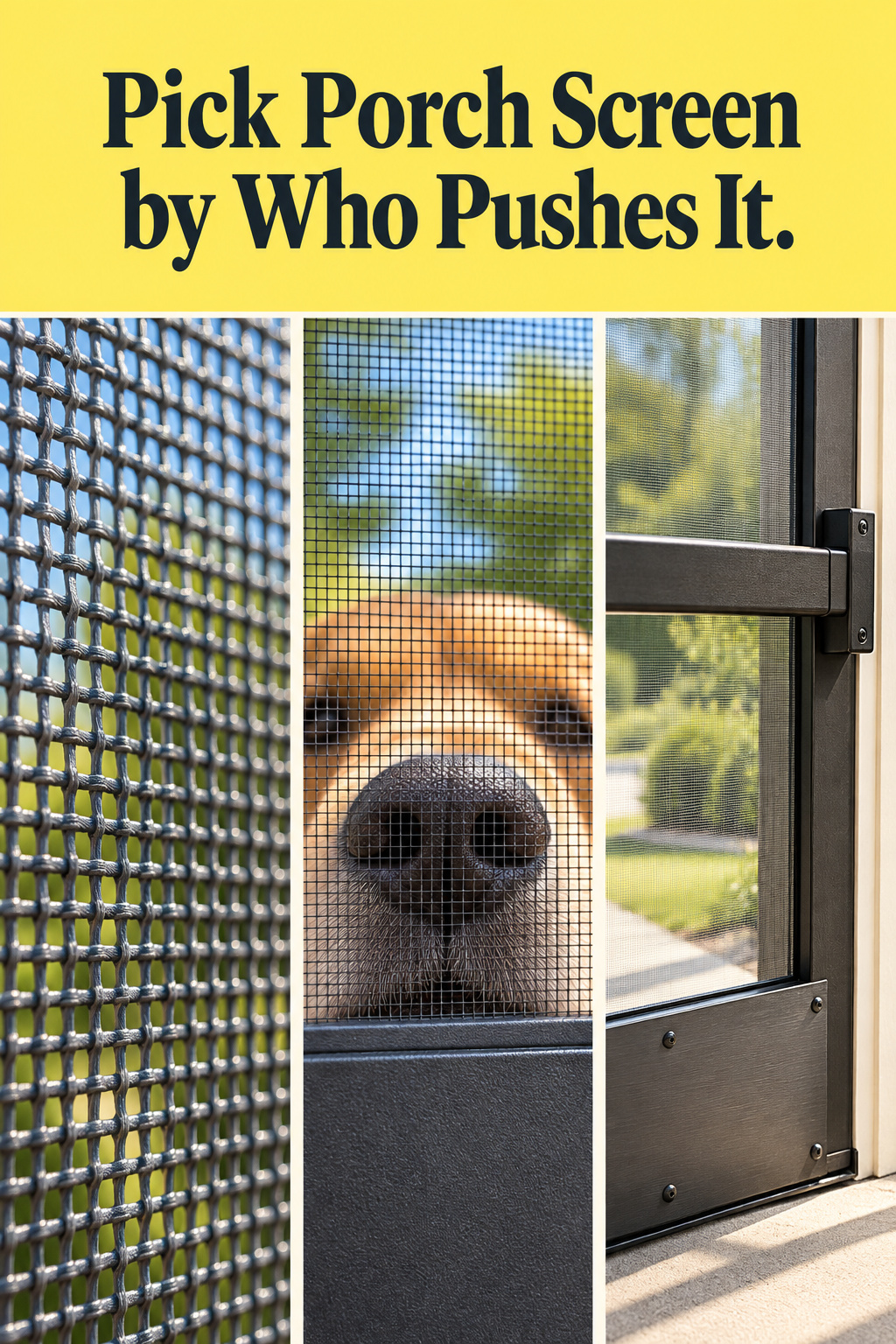

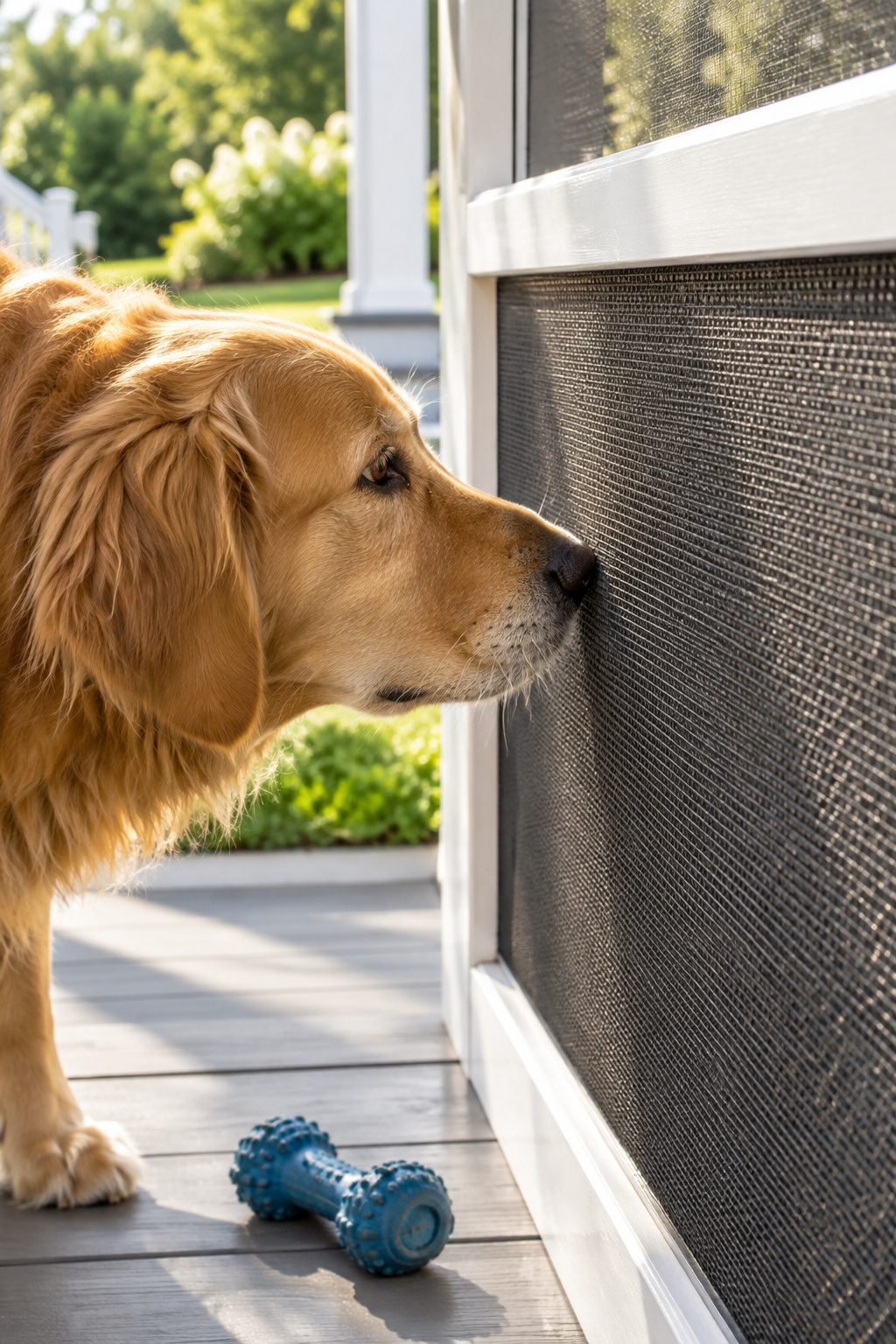
Who actually pushes on your porch wall? Stand in the screen aisle and every roll claims to be the strongest, the clearest or the finest, as if one of them wins at all three. None does. So when people ask me for the best screen for screened porch walls, I answer with that question first. The dog’s nose, a toddler’s palms, a ball kicked a little too hard: they land in a band near the floor, and the rest of the wall mostly gets looked through. Buy one mesh for the whole porch and you’ll regret it at dog height or at eye height. Pick by who pushes, and the choice gets short.
TL;DR
- Standard porch screen is 18×16 fiberglass, about 59% open; the fine 20×20 mesh Phifer makes for no-see-ums, gnats and sand flies is about 45% open, so it trades some airflow and view.
- Pet screen is vinyl-coated polyester roughly three times as thick as standard mesh and about 36% open. Put it low, where paws and kids land, and keep a clearer or finer mesh above.
- The screen door is the only panel that moves, so give it a pneumatic closer that pulls it shut, a push bar or grille, an 8 to 24 in kick plate and, if you have a dog, a pet door sized by weight.
Read the Mesh Count First: 18×16 Is Standard and 20×20 Is the Fine Option
My sorting rule has two parts: who pushes on the screen, then what you’re keeping out. The mesh count answers the second part, so it’s worth learning to read.
The two numbers are how many yarns run each way in one square inch. An 18×16 screen has 18 yarns one way and 16 the other. That’s the standard, the mesh in most windows and doors, about 59% open space with a thickness of about 0.0125 in. Phifer’s fine 20×20 fiberglass is woven tighter and is, in the company’s words, “designed to control small insects such as no-see-ums, gnats and sand flies.”
Every extra yarn per inch fills in a little of the open space that air, light and your view pass through. The 20×20 is about 45% open, so it gives up 14 percentage points of openness against the standard (59 minus 45). That’s a trade, and some porches should make it. It isn’t a free upgrade.
Wide openings change the math too. One porch-kit maker sends a heavier 18×14 mesh when an opening is wider than 48 in, and that mesh meets Florida’s building code for pool and patio enclosures.
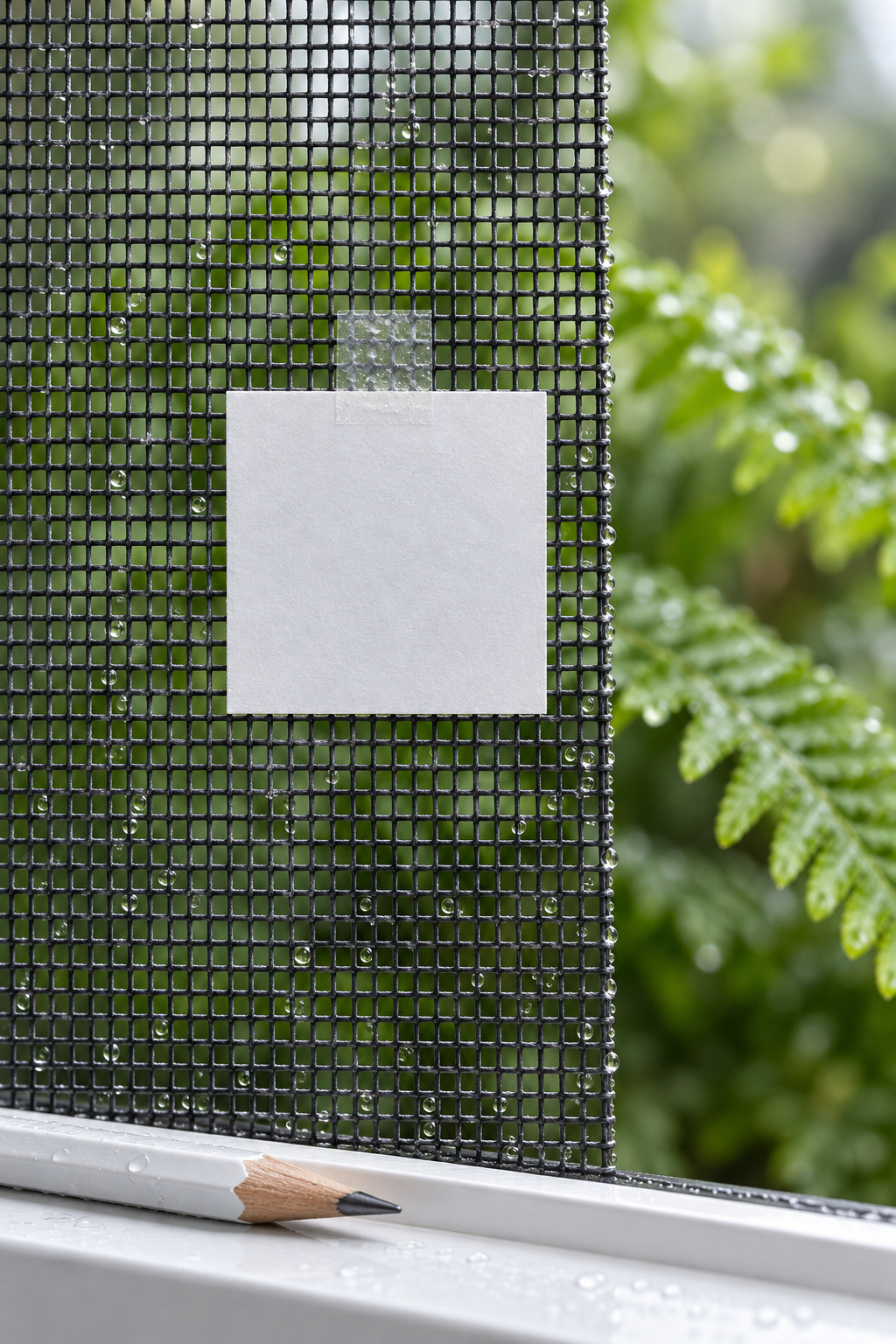
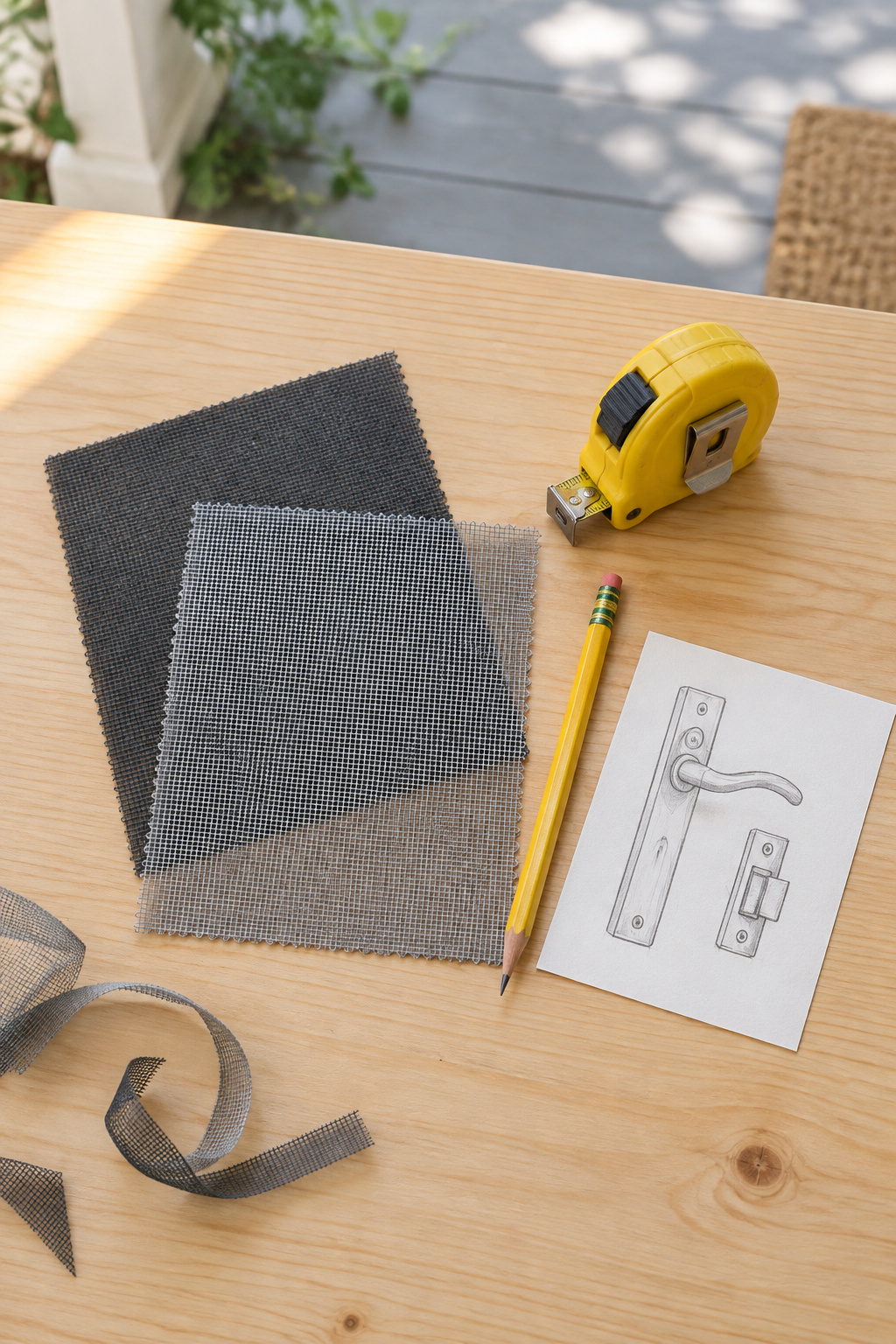
Not sure what’s on your porch now? Tape a one-inch paper square to the screen, then count the openings along one side and then the other. Look at the bottom foot of mesh while you’re there. You’ll usually see where the pushing happens before you count a single yarn.
Fiberglass, Aluminum or Pet Polyester: What Each One Survives
Three materials cover most porch walls, and each one fails in a different way.
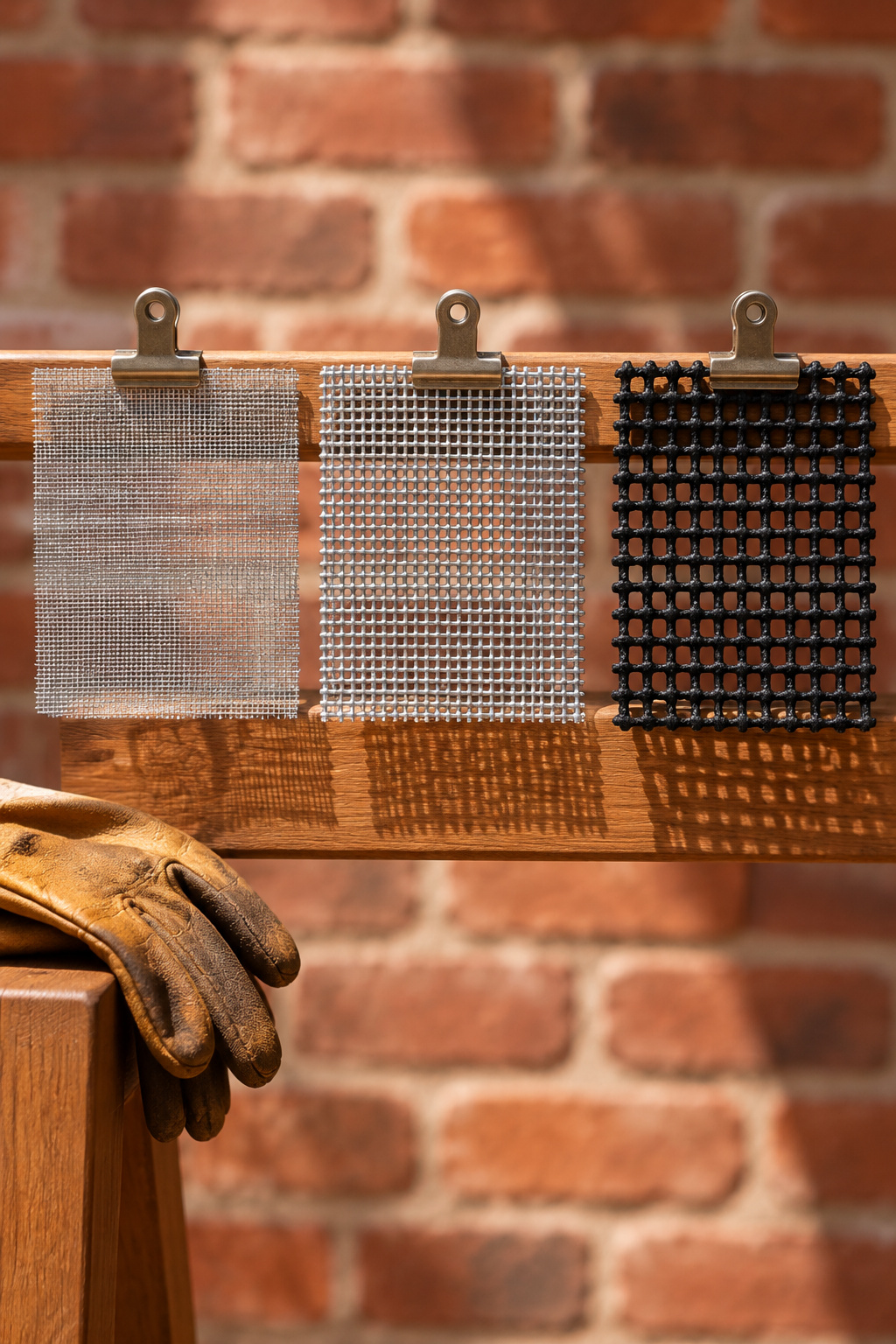
| Material | What it survives | Where it fails | Best spot on the porch |
|---|---|---|---|
| Standard fiberglass, 18×16 | Doesn’t rust, corrode, stretch or shrink; flexible, won’t dent | Tears and punctures; pawing wears it down over time | Upper panels and quiet walls |
| Aluminum, 18×16 | Weather; sags less than fiberglass | Dents under impact | Porches with little pet or kid contact |
| Pet screen, vinyl-coated polyester | Claws, paws and pushes; about 0.036 in thick, 11.2 oz per sq yd | About 36% open, and costs more than fiberglass | The low band and the door |
TuffScreen sits between the standard and pet screen: the same vinyl-coated polyester family, thinner than pet screen, and sold against pets, children and weather.
Phifer is honest about the cost of toughness. Its pet, tough and sun meshes use larger yarns and are less open, and “You’ll have to give up some visibility and air flow with these options.” It still calls the pet screen’s outward view good; it’s just less open.
Before you decide, watch. My older daughter went through a phase of putting every book back on the shelf upside down, and it bugged me until I worked out that it was the only way she could see the covers. A front-facing ledge fixed it. Porches work the same way: spend an afternoon noticing where your dog leans to watch the yard and where your kids brace when they peer out, and the wall will tell you which material goes where.
Finer, Clearer or Shadier: What Each Upgrade Mesh Takes Away
Upgrade meshes are sold on what they add, but each one also takes something away, and that loss decides where it hangs.
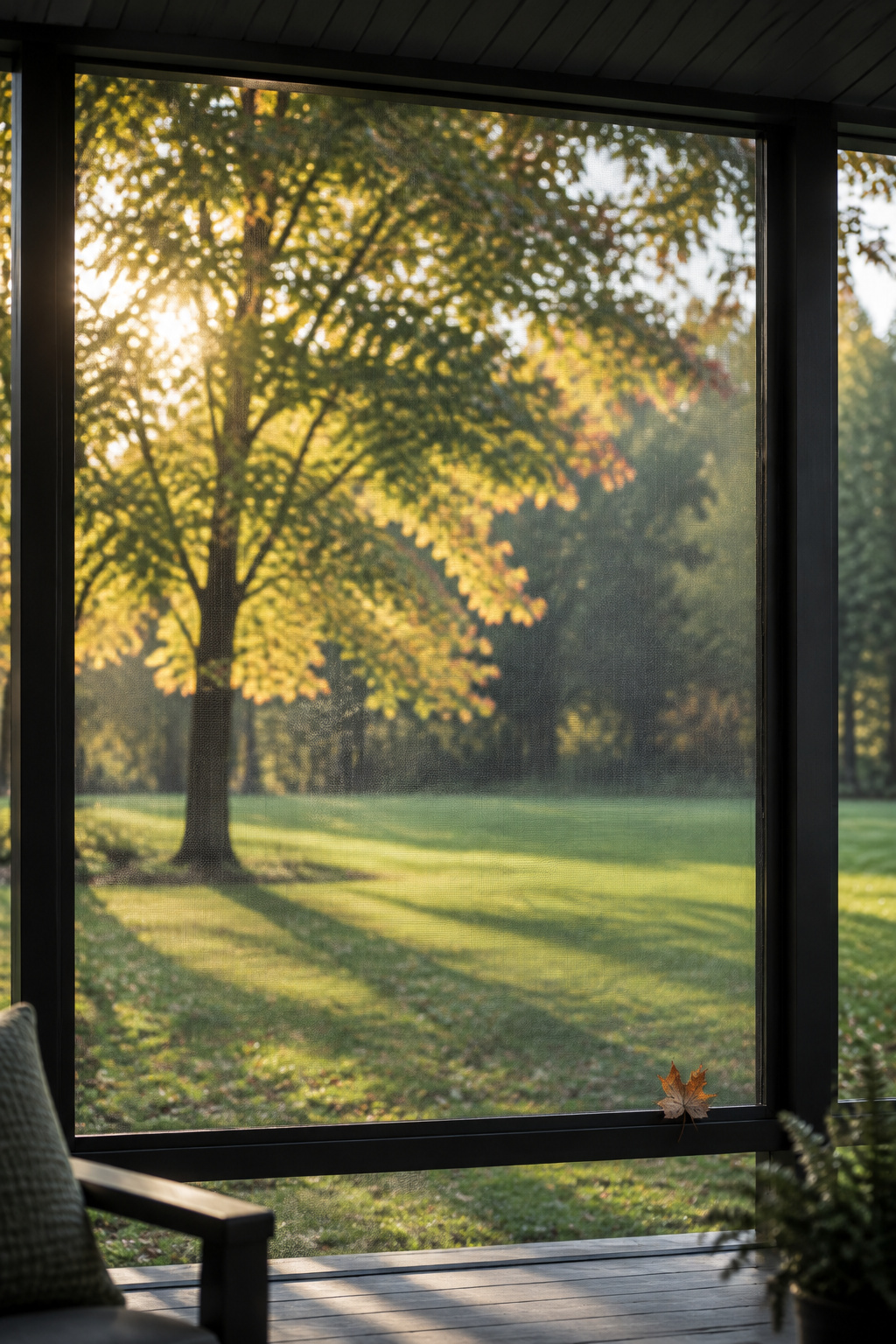
| Mesh | What you gain | What you give up | Where I’d put it |
|---|---|---|---|
| Fine 20×20 fiberglass | Phifer’s small-insect mesh, with some daytime privacy | About 45% open against 59% for standard | Up high, where people sit still in the evening |
| High-visibility (BetterVue, UltraVue2) | Finer yarn; BetterVue lets through 75% of light against 69%, UltraVue2 is 73% open | Some strength per yarn | Upper panels that face the view |
| Solar 20×30 | Stops up to 65% of the sun’s heat and glare; daytime privacy | About 32% open, 27 points less than standard; charcoal only | The sunny side, above push height |
Phifer pulls both ways on high-visibility mesh: finer yarn means you “sacrifice some strength for improved clarity,” yet in the same breath it calls its improved-visibility screens similar in durability to standard, because they weave in more yarns per inch to make up for it. I’d still keep it out of reach of a dog.
Solar mesh on a shaded porch just darkens the view. Save it for the wall that bakes.
If you plan to sleep out there, the details of fine mesh for sleeping outside are their own subject. And clear roll-down panels aren’t mesh at all; they’re weather control, which the furniture guide covers.
The Best Screen for Screened Porch Walls Uses Two Meshes, Split by Height
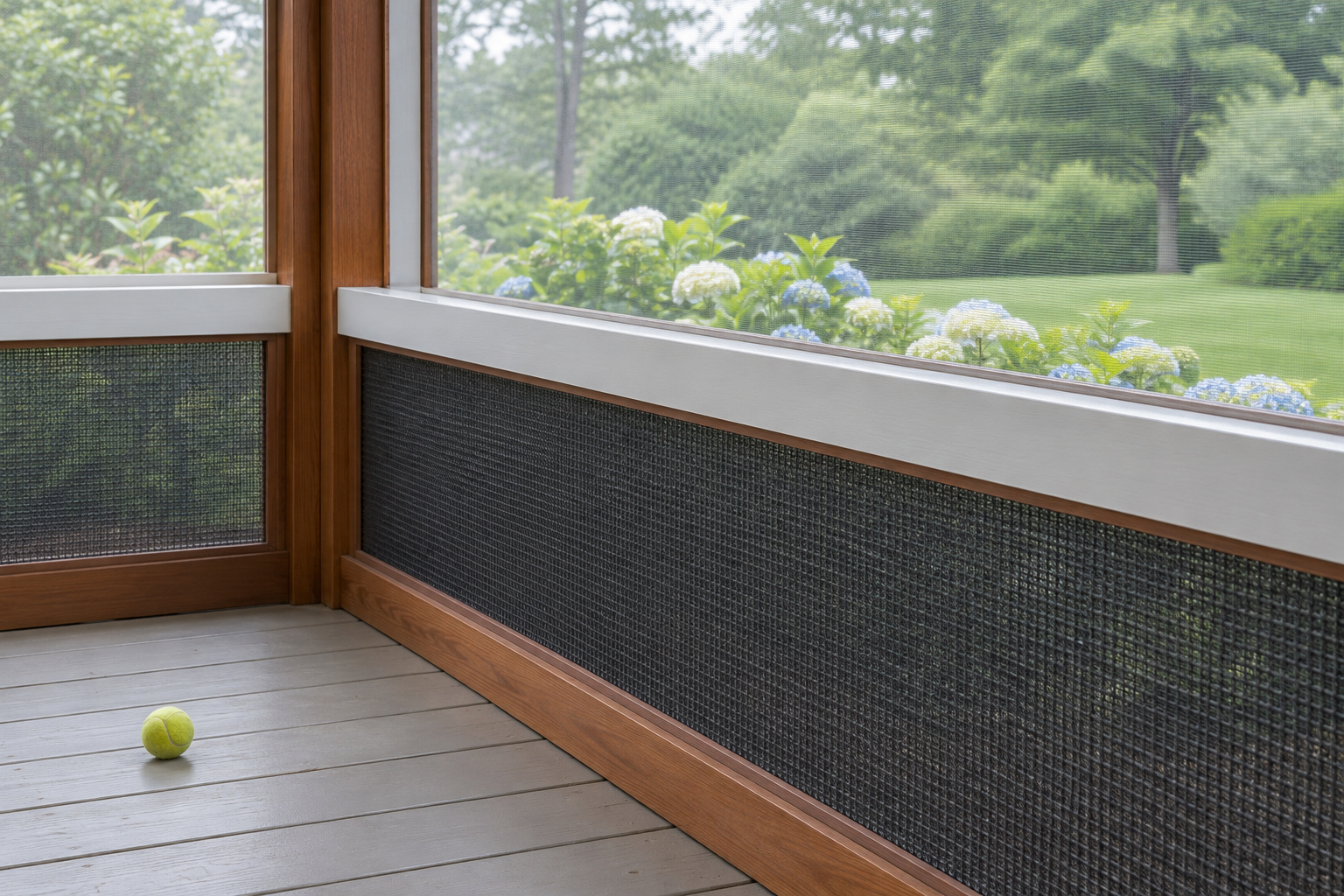
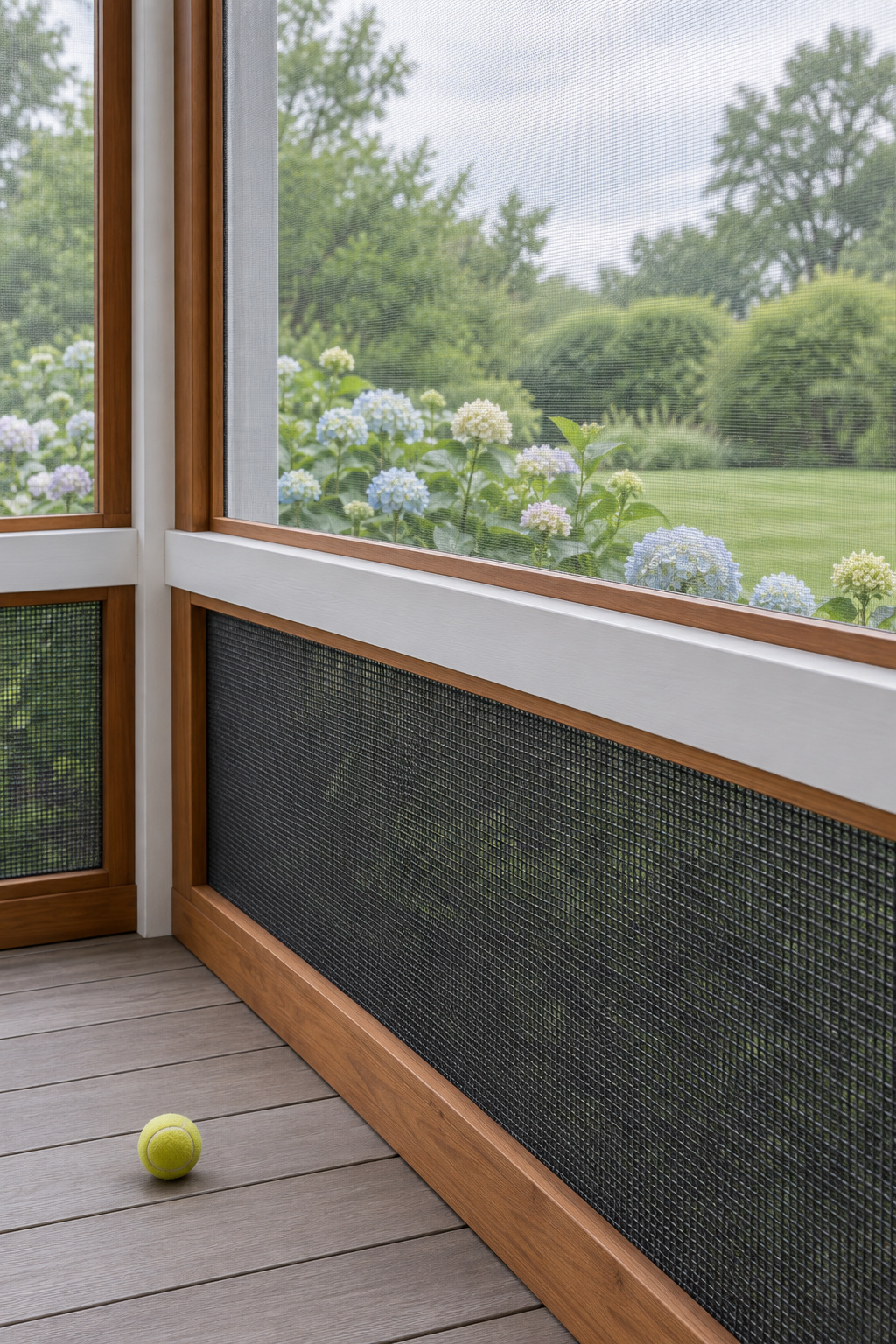
My rule of thumb is tough mesh below where your dogs and kids actually hit the wall, and a clearer or finer mesh above it, meeting at a mid-rail. Each screen panel is its own framed section, so the rail between two panels is a natural seam, and each mesh does the job the other one is bad at.
Where to Put the Line
Nobody publishes a height for the tough band, so you find it on your own porch. Kneel at the wall. Watch where your dog’s shoulder lands when a squirrel goes by. In a house with two kids four years apart, you’re watching two heights, not one, and the higher one keeps climbing. Set the seam above the highest regular push, and remember that a single panel can be rescreened later when the kids grow.
Architect Nancy Lovas specifies solid lower panels on screened porches so that “when furniture, dogs, or kids bang into it” the owners “won’t need to replace the screening,” and she adds that the need is unique to each house. I’d say the same about the mesh line. For more on shaping a porch around a household, see these screened porch ideas for families.
Kick Plate or Low Rail Instead of Tougher Mesh
Sometimes the better move is to protect the bottom rather than toughen it. Westbury’s aluminum kick panels run 11-1/4 in high in 4, 6 and 8 ft lengths, sold for the moment a kid or dog would run through the screen. On doors, US Building Products sells 8, 12, 16 and 24 in kick plates, and 8 in is most popular.
Clutter collects by the door, and a low hook does more for tidiness there than any organizer. Put a leash hook by the screen door at your child’s height. Can a tired kid hang it up there? Yes. Can they reach a basket on a high shelf? No.
The Screen Door Fails First: Closer, Push Bar and Pet Door
The door is the only panel that moves, and every hand, paw and foot on the porch lands on it, usually in a hurry. That’s why I spec it before the walls.
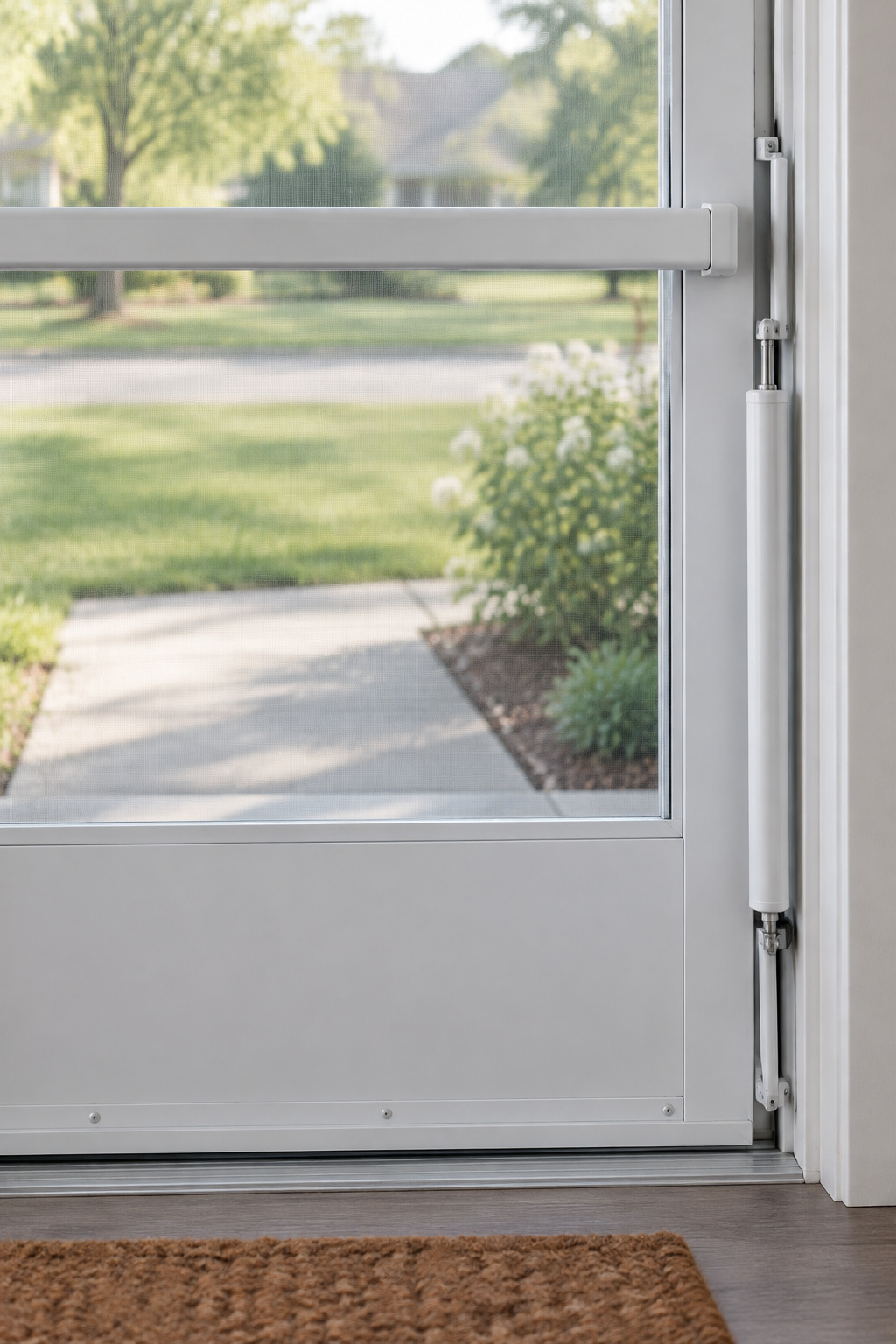
- A closer that pulls it shut. A pneumatic closer uses air in a cylinder to slow the door, so it doesn’t slam, and a thumbscrew sets the speed. A spring closer gives you less control. A hold-open washer or button keeps the door open while you carry groceries through. Heavier full-view doors can take two closers, top and bottom.
- A push bar or grille. Door makers fit one or more bars across the screen, and a lower grille that Vi-Cal says will “minimize screen tear-out or push through by pets, children or just everyday use.” Put the bar where your smallest regular user actually pushes.
- A kick plate. Many aluminum doors come with an 8 in plate as standard, with 12, 16 and 24 in options.
- A pet door, sized by weight. Larson’s built-in pet doors come in 8 x 12 in for pets up to 40 lb, 10 x 17 in up to 100 lb and 14 x 23 in up to 220 lb, with a slide-in cover. Larson also says the flap isn’t meant for children.
Watch one thing with closers: slamming usually means too much tension or too little resistance, and repeated slamming loosens screws. Turn the adjustment screw a quarter turn at a time, clockwise to slow it. Framing and hanging the door itself is a job for the install guide.
Your Decision Rule and the Shopping List to Take to the Store
Who pushes decides the low band. What you’re keeping out decides the mesh count up high. The door gets its own hardware because everything lands on it.
From there, the list:
- Pet screen or TuffScreen for the low panels and the door
- 18×16 for the upper panels, 20×20 where people sit still in the evening, or a high-visibility mesh where the view matters most (18×14 if an opening is wider than 48 in)
- Spline one size smaller for the thick mesh, since pet screen, TuffScreen and SunTex need it; measure the groove first
- A pneumatic closer, a push bar or grille, a kick plate and, if needed, a pet door sized by your dog’s weight
Start small. Kneel at the porch wall with a pencil and mark where the pushing lands. That mark is your seam. Cutting, stretching and splining the mesh into the frames is fitting work, and it’s where I hand over to installing the screen you picked.
FAQ
How long does porch screen last before it needs replacing?
It varies widely with sun, impact and how tightly it was installed. No manufacturer publishes a lifespan for standard fiberglass, and contractors’ estimates run from about three years to twelve depending on climate. Phifer backs its solar screening with a 10-year exterior warranty and TuffScreen No-See-Um with a 10-year limited warranty.
How do you clean porch screens without stretching or tearing them?
Gently, with a soft brush. Rinse metal screens with water only, and wash vinyl-coated mesh with mild soapy water, working top down without hard scrubbing. A one-to-one mix of white vinegar and water handles mildew. Rinse until no soap remains. Plan on once or twice a year.
Can you swap in pet screen later without rebuilding the frames?
Usually, yes, if your frames take spline and you change the spline. Pet screen is roughly three times as thick as standard mesh, so Phifer calls for a spline one size smaller. Measure the groove first, check that the frame is stiff enough, and buy spline to match the groove.