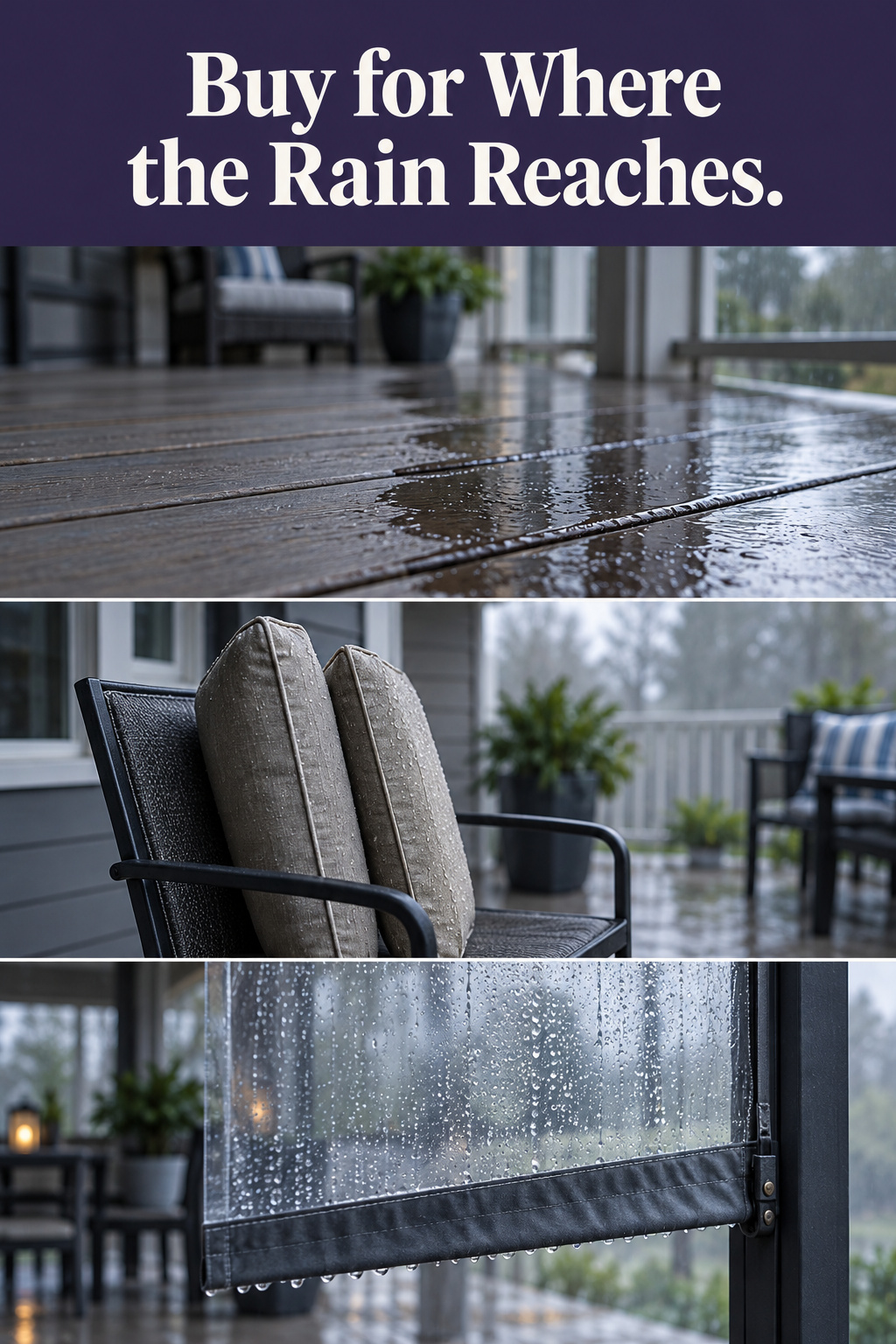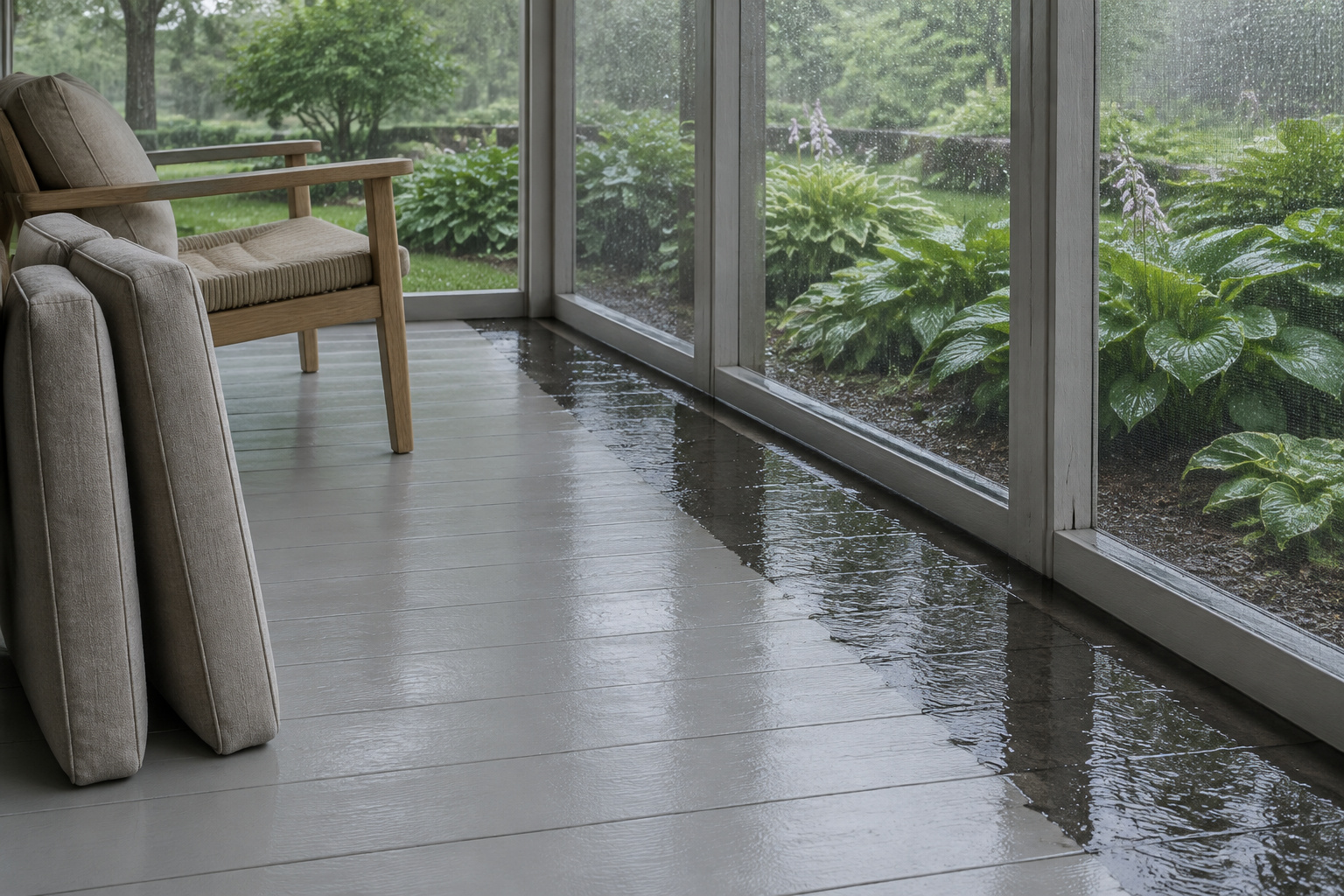
The storm has gone through and the porch smells of wet cedar and cut grass. The gutters are still talking, and halfway to the sofa with your coffee the boards go cold and slick underfoot. There is a dark band along the floor on the side the storm came from, and the sofa sits either behind it or in it. Choosing screened porch furniture well starts right there. The catalog sorts everything into indoor and outdoor; your porch sorts it by where the water reaches, and you can find that line in one afternoon.
TL;DR
- A screen stops insects, not wind-driven rain, so every roofed porch has a wet band on its storm side. How far it reaches differs on every porch, which is why you map your own before you buy.
- Solid pieces with no upholstery can live in the dry zone; anything with foam or fabric stays well back or comes in, because textiles start to grow mold once humidity sits above about 60 to 65 percent.
- Weather curtains move the line: clear vinyl at 20 mil suits most porches, 30 or 40 mil large or windy openings, and one maker’s list prices work out to roughly $2.60 to $5.40 a square foot.
Will rain get into a screened porch? Yes, and the floor keeps the record
Yes. Insect mesh is built to let air through, and wind-driven rain goes with it. A roof handles rain falling straight down, but a fast storm from the open side pushes droplets through the mesh and under the door. How far in it gets depends on wind direction, the depth of the roof overhang, the height of the room and whatever stands outside to break the wind. There is no standard distance.
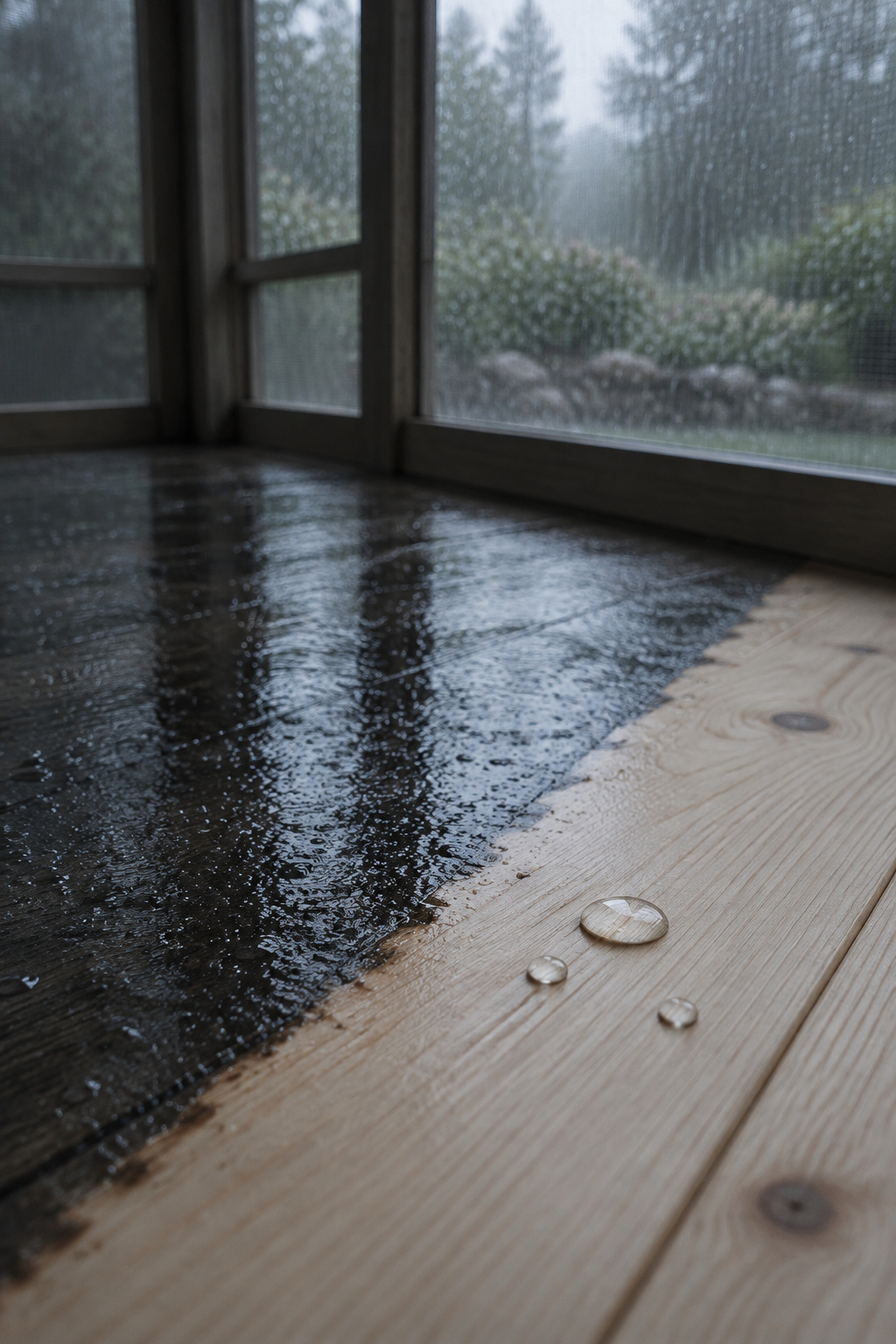
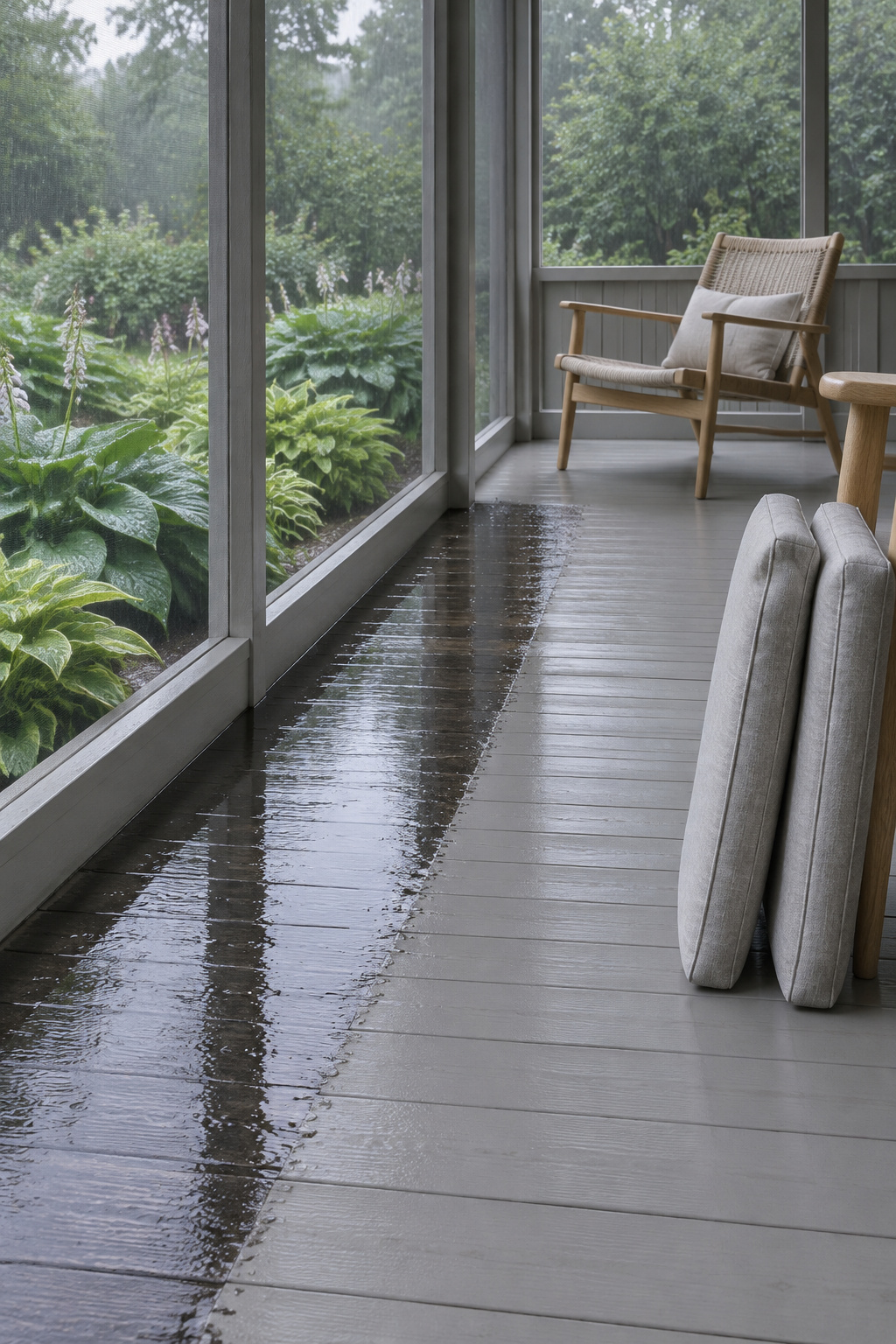
The band of darker boards just inside the screen after a storm is the thing I look for first on any porch. It shifts when a storm comes from a different side, so last month’s band is not this month’s.
Get it wrong and the cost is slow: cushions that never quite dry and a sofa arm that smells of basement by August. What a screen can’t do about mosquitoes is in the bug-free outdoor dining guide.
Find your porch’s wet line in one rainy afternoon and one damp morning
Where does the water go? You find out by watching, and it costs a roll of painter’s tape. If you are still choosing a roof overhang or which way the porch faces, start with planning a screened porch and come back once the roof is settled.
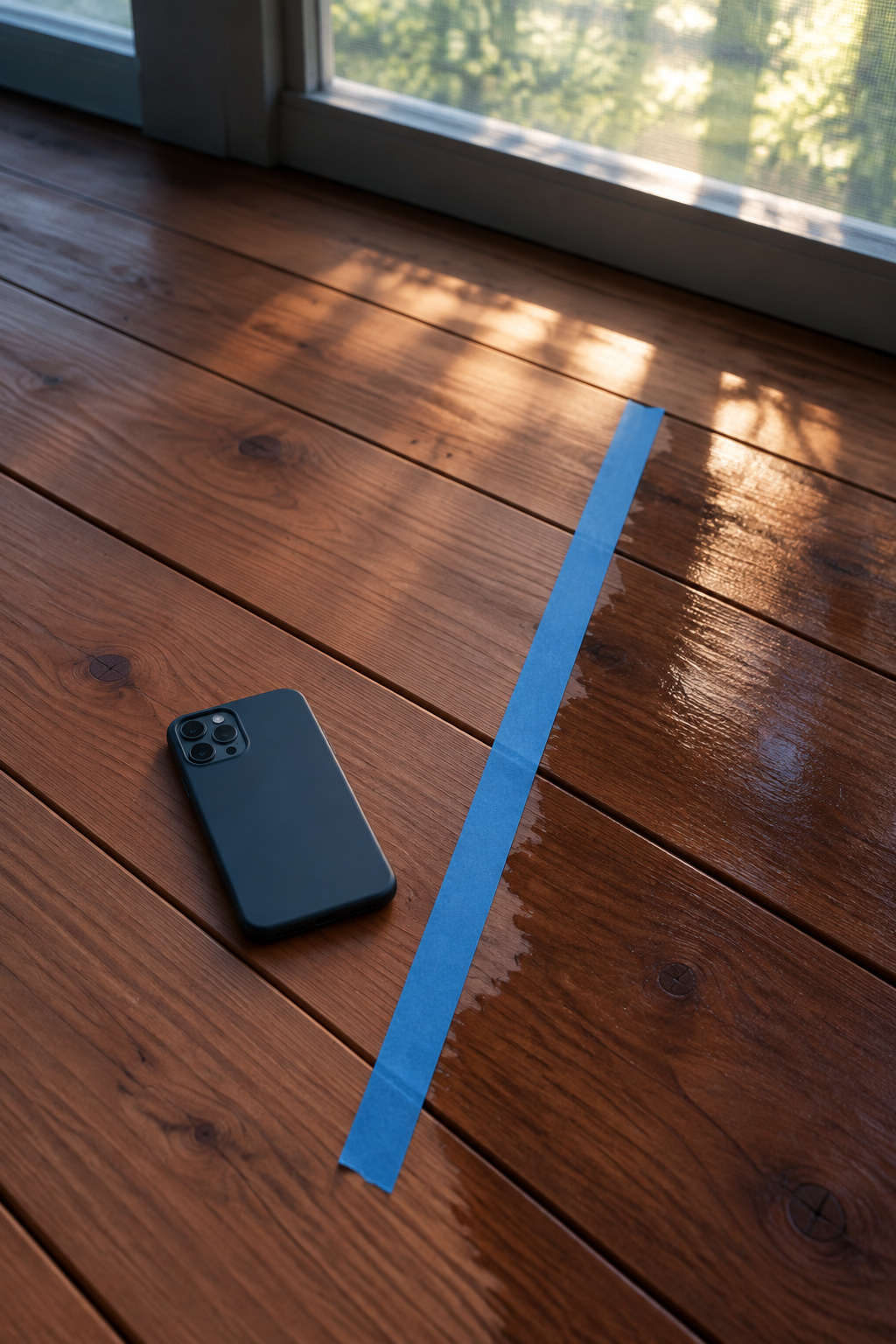
- Go out during or just after a rain with wind behind it. Photograph the first wet spots before anyone wipes them, and note the wind direction.
- Lay tape or chalk along the outer edge of the dark band.
- Check where the water started. Water high on a wall, or a drip at the same joint in light rain, is a leak to fix before you buy anything.
- Come back the next morning and look for damp strips, low corners and the patch under any rug, where moisture lingers longest.
- Sort the floor into three zones: dry (nothing reached it, nothing damp next morning), damp (slow to dry) and wet (inside the tape).
Morning damp is the reach people miss, because the floor can look dry while the air is not. Alan Levitan, a furniture conservator for the National Park Service, puts the risk of mold on textiles at relative humidity above about 65 percent; the Canadian Conservation Institute says mold is unlikely below 60 percent with good air movement. Those are museum figures, but they tell you what a cushion faces on a still, humid night. Every purchase after this follows the map.
What indoor furniture can stay, as long as it stays behind the line
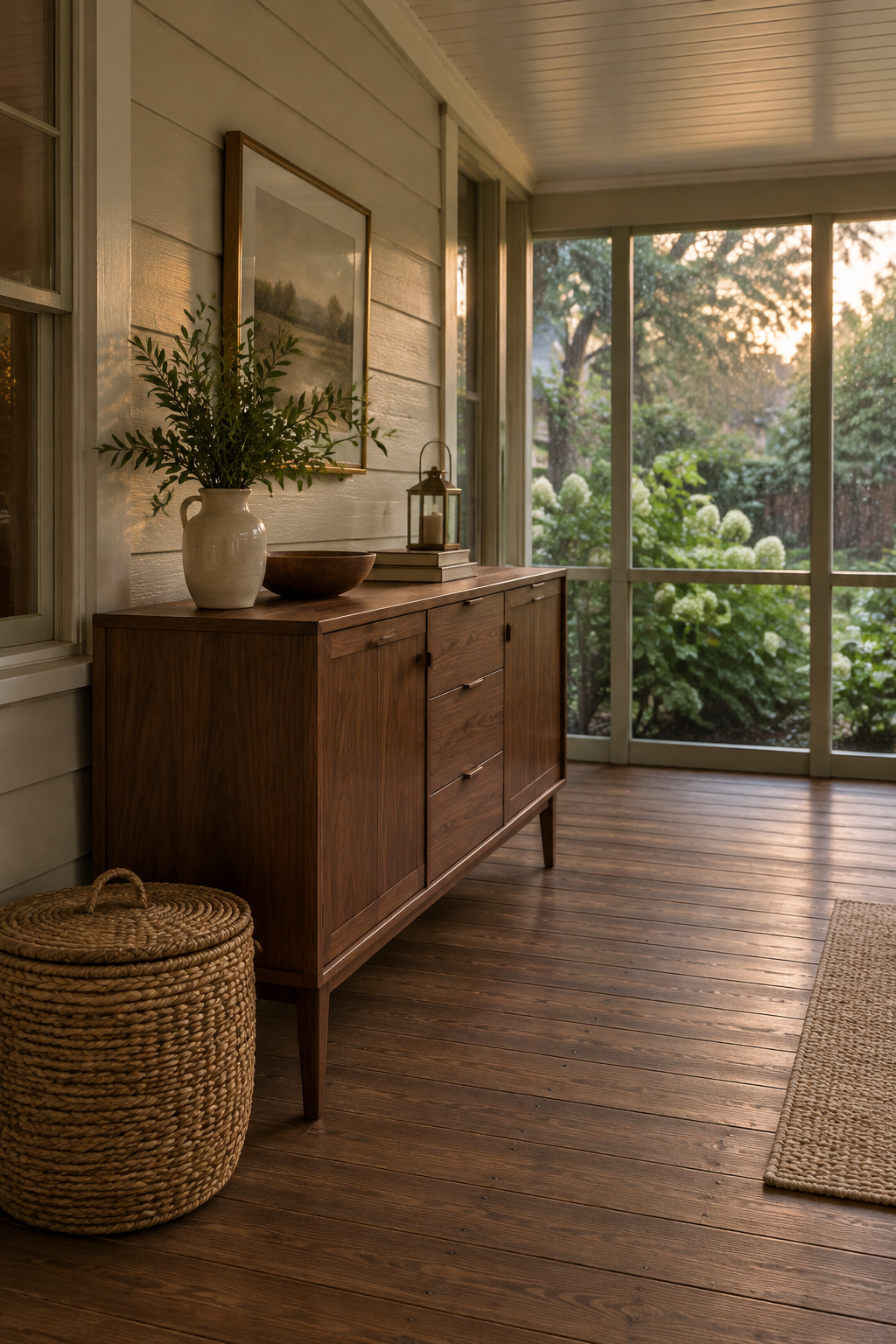
Can you put indoor furniture on a screened porch? Some of it, in the dry zone. Solid pieces with no upholstery are the safe ones: a plain wood bench, a sideboard against the house wall. Even these move with the weather. National Park Service guidance for museum collections says a rise in humidity from 30 to 70 percent can swell wood as much as 2 percent across the grain, so a 2-foot panel grows almost half an inch, enough to split a top or loosen a joint. Standing water is worse. It climbs the end grain of legs and leaves tide lines, so no leg belongs in the dark band.
Anything with foam, stuffing or fabric is a different animal. High humidity breeds mold in upholstery and rusts the tacks and springs inside, which then stain and weaken the fabric and filling they touch. Through a rainy season an indoor sofa stays well back from the line or comes inside.
The maintenance truth here is a habit: if rain is forecast, cushions come in, and they are never covered or stored while damp. If you won’t do that chore, buy for the damp zone even where the floor stays dry. Throws, pillows and anything you sleep on outside are a separate subject, covered in the guide to bedding that tolerates porch damp.
Screened porch furniture built for the wet side of the line
In front of the line, buy frames that don’t rust or rot. Aluminum forms its own oxide layer and does not rust. Powder-coated steel is only as good as its coating, and once that chips in a humid climate it can start rusting within days.
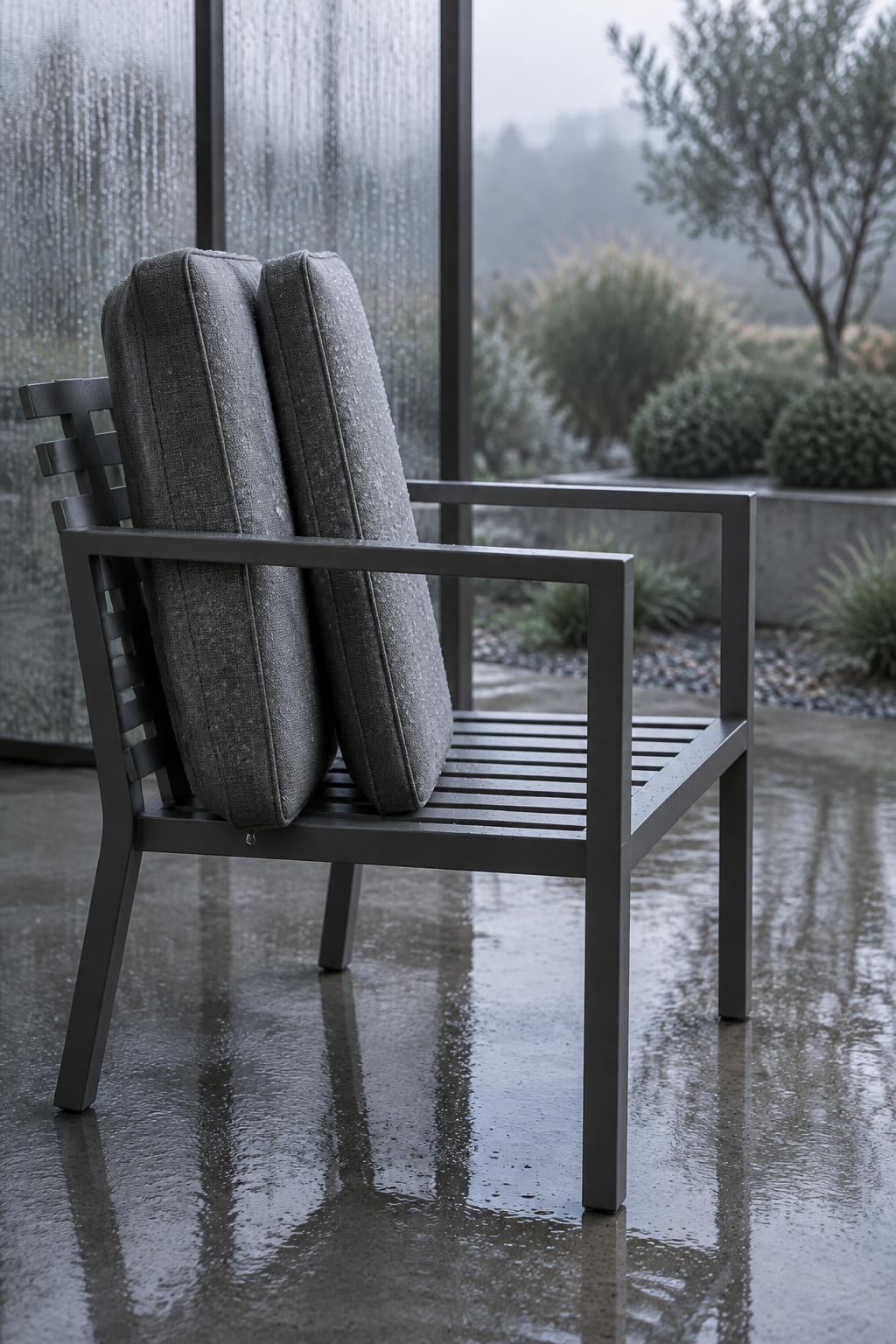
Ordinary polyurethane foam tends to hold water, and wet foam breaks down faster and is likelier to grow mildew. Open-cell reticulated foam, sold as quick-dry, lets water run through like a sieve, but it is not waterproof. It works only if the cover, a vent and a slatted seat let the water out. Put a quick-dry cushion on a solid seat deck and you have built a sponge with extra steps. For fabric, look for solution-dyed outdoor fabric, as in the outdoor dining material guide; the outdoor furniture-care guide covers cleaning it.
Read your tape map straight across this:
| Zone | Indoor piece allowed | Frame to buy | Cushion to buy |
|---|---|---|---|
| Dry | Solid wood, no upholstery | Any, indoor or outdoor | Indoor cushions if you carry them in for rain |
| Damp | None with foam or fabric | Outdoor-rated, aluminum or similar | Quick-dry foam in a vented outdoor cover, stowed when rain is forecast |
| Wet | None | Slatted aluminum that drains | Quick-dry, stood on edge after rain or carried in |
Rugs that dry: treat the porch rug as a seasonal purchase
Outdoor rugs should be treated as seasonal, and the reason is the floor under them. Rico de Paz, who tests paints and stains for Consumer Reports, points out that any rug, natural or synthetic, stays wet for a while after rain and keeps the boards beneath it damp longer than the rest of the floor. A synthetic that won’t absorb water may make the mildew worse. “Mildew-resistant polypropylene” is a finding from indoor wet rooms like laundries. On a porch the fiber doesn’t rot, but mildew grows on the pollen and dust sitting on it, and on the boards below.
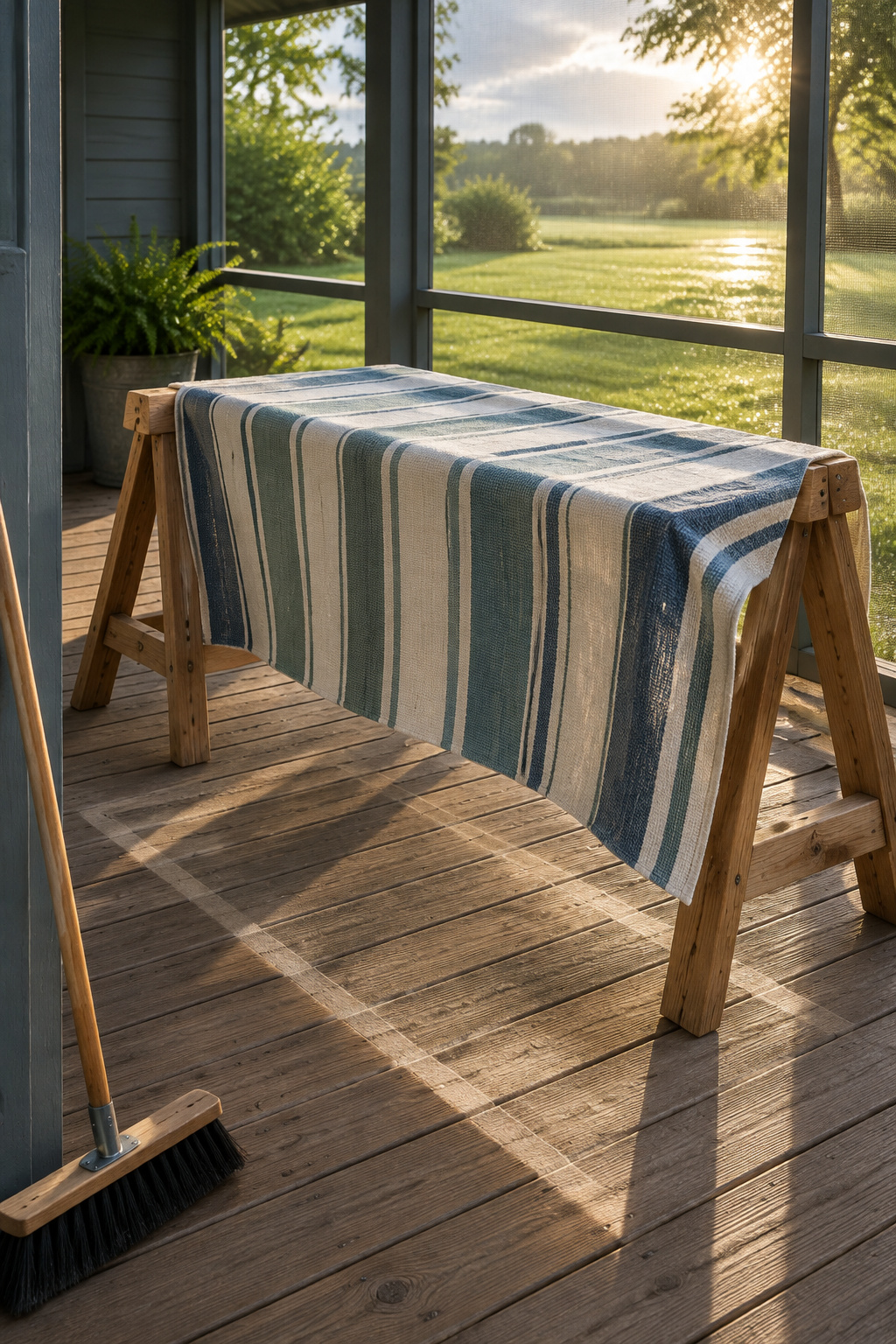
So buy a flat-woven outdoor rug: it dries fastest and rolls up small, where a low-pile rug holds water longer. Skip solid or latex backing, and, as retailers advise, leave six inches to a foot of bare floor around the rug so the edges dry. Jute and cotton belong indoors. If the rug has to sit inside the wet line, lift it after heavy rain and drape it over a rail so both faces dry; hosing it and leaving it flat is how rug and boards both get mildew.
Then, when the season turns, take it up. Hose it, dry it standing and store it rolled, and it goes back down in spring on boards that spent the winter breathing.
Weather curtains and roll-down shades move the wet line, so buy them first
A curtain on the storm side changes the map more than any chair could. Years of designing outdoor rooms in the Portland rain taught me to fix where the water goes before choosing what sits in it.
Fabric weather curtains and roll-down shades
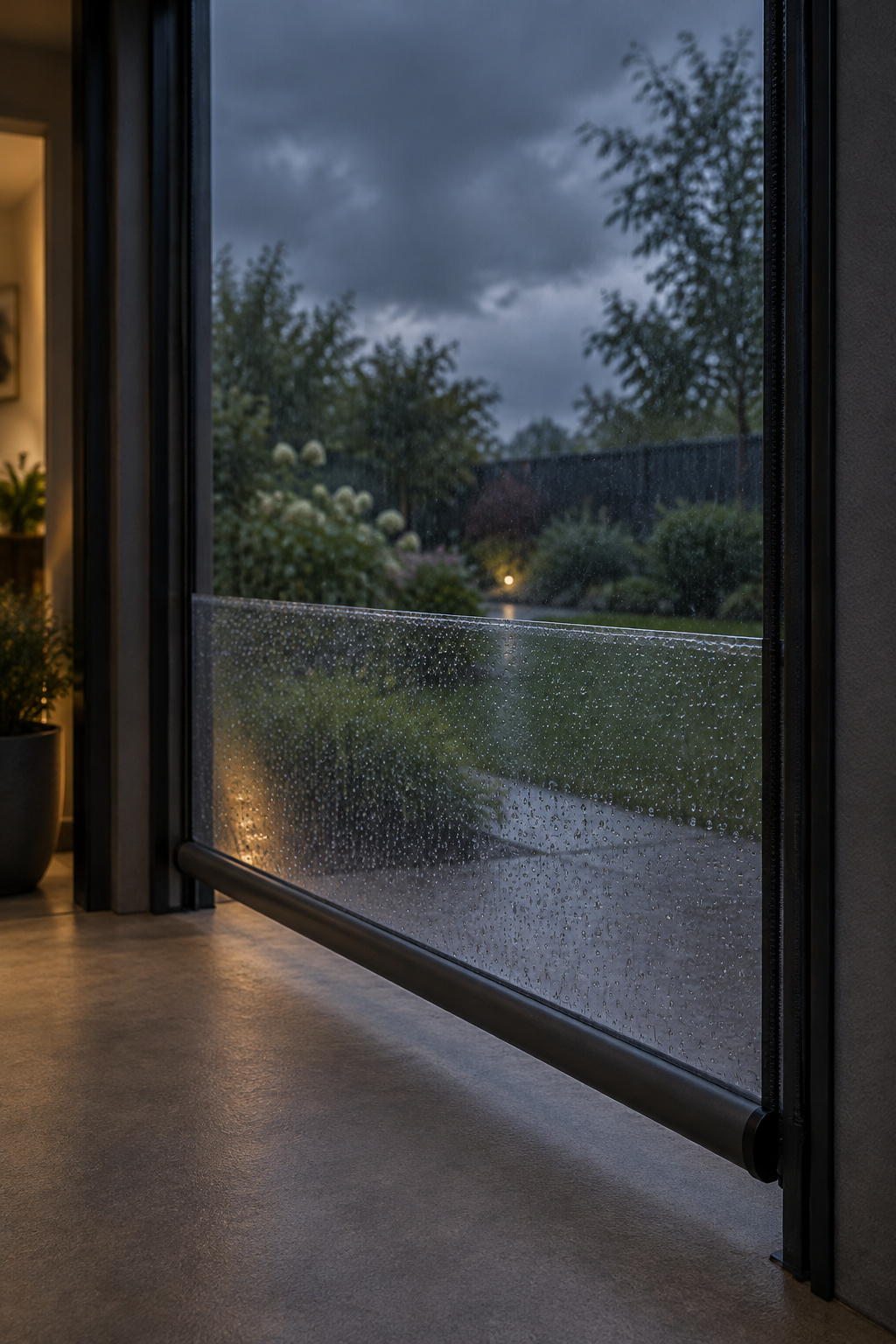
Solar-screen mesh lets mist through and soaks up moisture, so for rain you want a non-porous fabric such as heavy PVC-coated polyester, ideally in a zipper track that seals the sides, with a weighted hem bar to keep it taut so water runs off. One maker’s list prices start an outdoor fabric curtain at about $134 for a 5 by 5 foot panel: $134 over 25 square feet is $5.36 a square foot.
Clear panels: the rain stopper with a trade-off
Clear vinyl keeps rain out and keeps the view. Twenty mil is the usual thickness for most porches; 30 or 40 mil suits large or windy openings. From the same maker, a 5 by 5 foot clear track curtain starts at about $112 ($4.48 a square foot) and an 8 by 8 foot roll-up panel about $168 ($168 over 64 square feet, $2.63).
The trade-off is that clear vinyl turns a breeze room into a greenhouse. Panels trap heat, fog up and flap in wind unless tied down, and cheap vinyl yellows. Buy UV-inhibited vinyl, panels that roll up or come off, and vents near the top and bottom. Wind ratings vary by maker, so read yours; one zip-track maker’s rule is to roll it up, never down, when the wind picks up. Glazing the porch for good makes it a sunroom, a different project.
You don’t need all four sides. Hang one panel where your tape says the storms come from and map again. Once you know what can go where, move on to arranging the pieces once chosen.
The cheapest version costs nothing and undoes in a minute: pull the sofa back behind the wet line and carry the cushions in when rain is forecast. If that is all your porch needs, you’ve saved the price of a curtain.
FAQ
Do you need to cover or store screened porch furniture in winter?
Yes, wherever it freezes. A porch roof doesn’t make it a heated room, and cold and snow still come through the mesh. Bring cushions inside, and drain hollow metal frames so water can’t freeze and crack them. Frames can stay out under a fitted cover once clean and dry; check under it for condensation.
How do you keep lightweight furniture from blowing around on a screened porch?
Put cushions and small pieces away before strong wind, or move them to a sheltered corner. Cushion ties hold cushions on a chair day to day but don’t secure the chair, and grip pads won’t stop it tipping. A loose cover can catch wind. For a piece that must stay out, use the maker’s own restraint.
What is the best way to dry a screened porch floor and cushions after a storm?
Stand soaked cushions on their sides to drain, press out what you can, then dry them in a breezy spot with air all around, a fan helping if possible. Lift the rug, sweep under it and drape it to dry. Moving air and lower humidity are what keep mold away, so open the porch up.