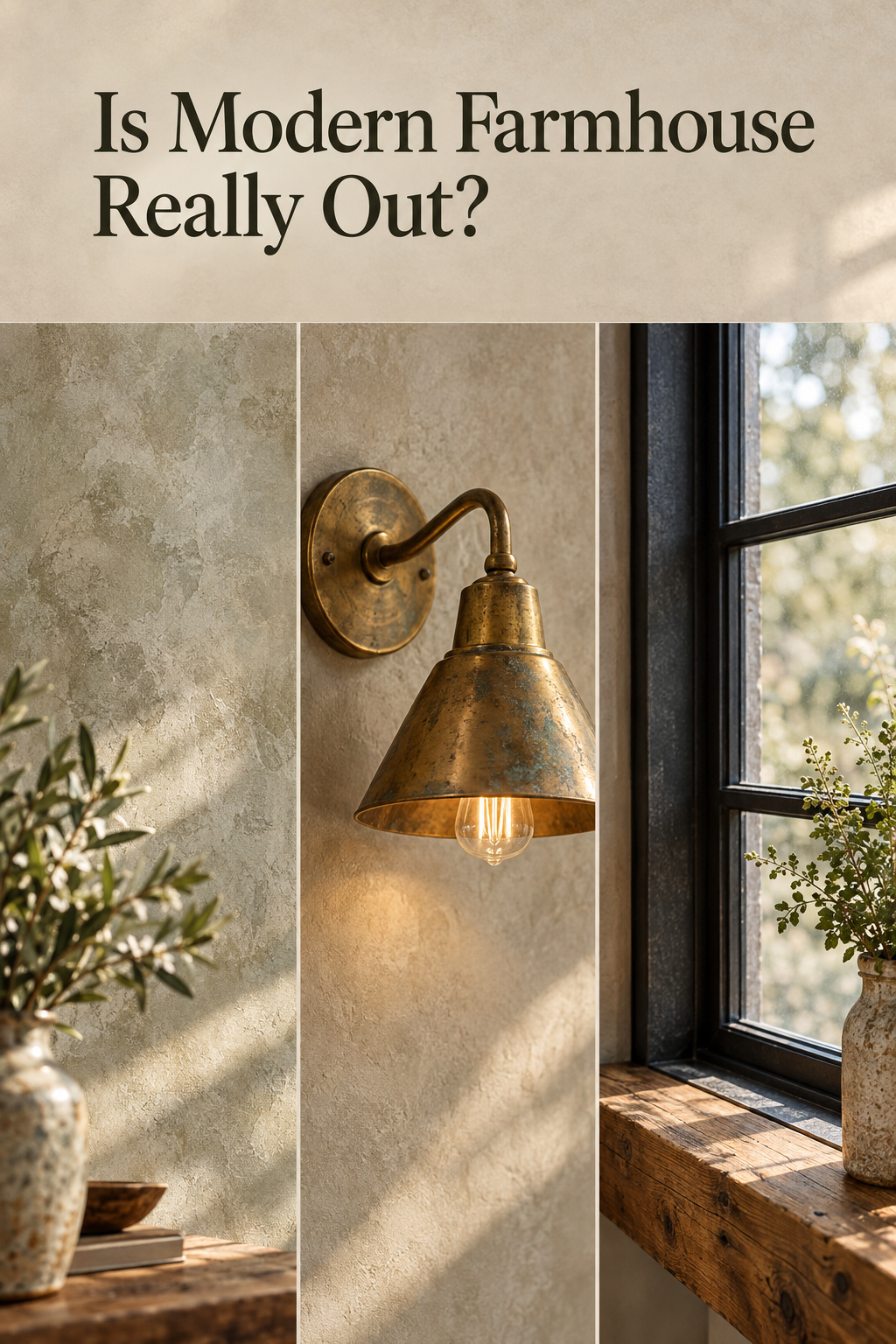
Search “modern farmhouse out of style” and you will be told the whole thing died around 2022. The narrower question is whether your room is finished. A short list of elements has dated. The thinking underneath them has not, and the two datasets people cite do not agree that it is declining.
TL;DR
- The data disagrees: farmhouse held about 33% of Houseplans.com’s plan sales in 2025, while NAHB’s Home Innovation Research Labs survey of 1,200-plus builders, published February 2026, put Contemporary ahead of it nationally.
- Four elements carry the dated verdict: word signage, wall-to-wall shiplap left stark white, the heavy distressed barn door, and black on every fixture with matched sets.
- Fix in the order of what you can undo: paint, then hardware, then a wall treatment. Limewash power-washes off for five days after application, and is permanent after that.
Is Modern Farmhouse Out of Style, or Just the 2018 Version
A style does not die all at once like a lightbulb. It sheds what was copied and keeps what was reasoned.
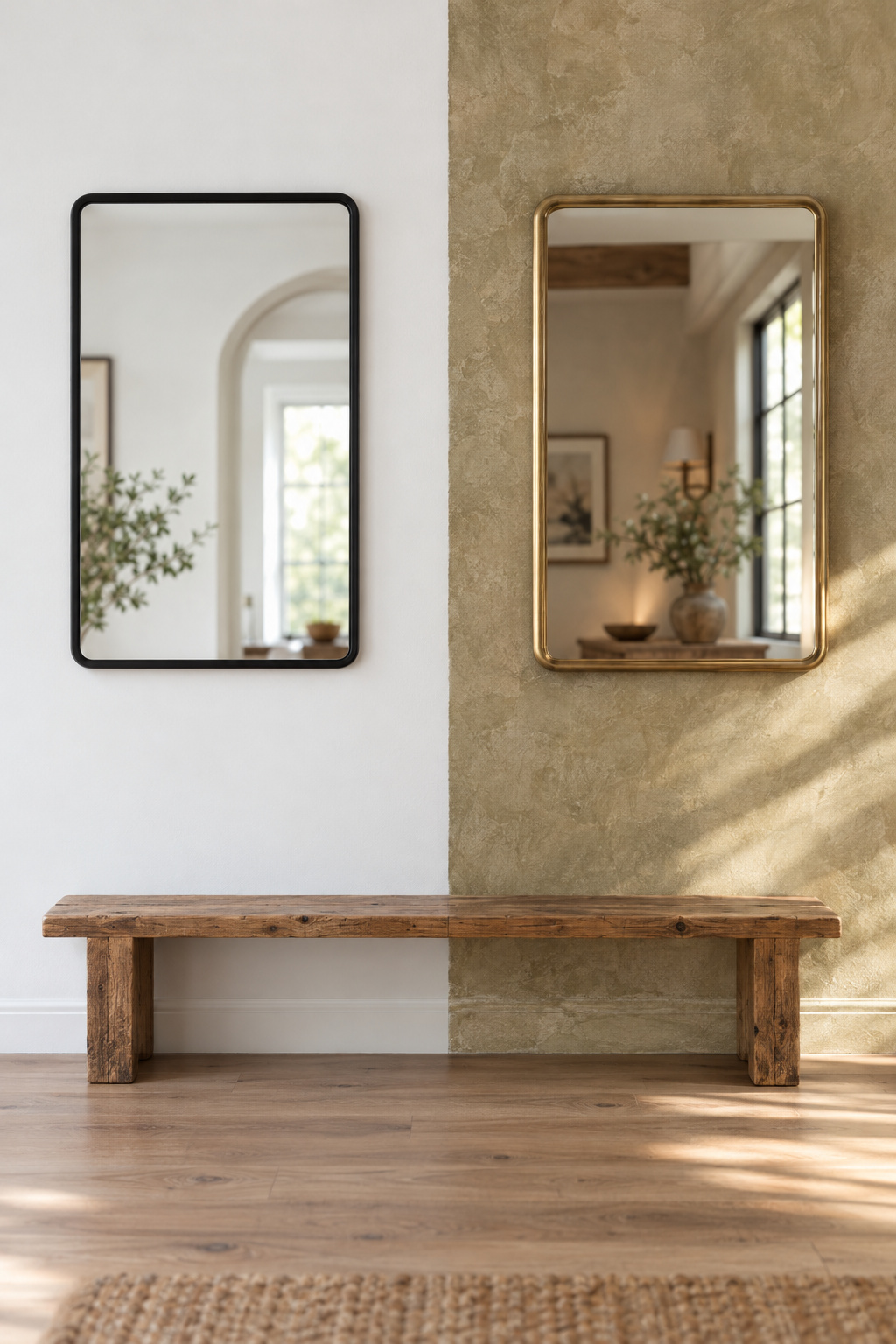
What roughly a third of new house plans still says
Two credible numbers point in opposite directions, and I will leave them that way. Houseplans.com, reporting its own sales, has farmhouse plans at 30% of what it sold in 2023, 32% in 2024 and 33% in 2025, nearly identical two years running by its own description. Home Innovation Research Labs, the research arm of the National Association of Home Builders, goes the other way. It surveyed over 1,200 builders for its 2025 Annual Builder Practices Survey and reported in February 2026 that Contemporary had overtaken Farmhouse as the most popular new-home style nationally.
Both are real trade figures, but they measure different things. Plan sales trail interest expressed years earlier, while the builder survey counts what is being classified and built right now. One reports retail demand for a drawing and the other reports building practice.
Neither measures a living room. They set the weather and leave the answer open.
The ten-year test
My test, which the rest of this runs on: would this element still look deliberate in ten years, or does it date the room to one year? I photograph interiors in February, early, before the sun clears next door’s roofline. The light is thin and grey, with nothing flattering in it, and a room that holds together then is not being carried by styling. The ten-year test does the same to the calendar.
Is Modern Farmhouse Out of Style, Element by Element
Why does a formula of ordinary parts look dated? It arrived all at once. Matched sets, applied distressing, one cool greige, black on every fixture and a sign naming the room were bought together, so they share an age. The eye reads that simultaneity before it reads any single object, and simultaneity is what dates a room.
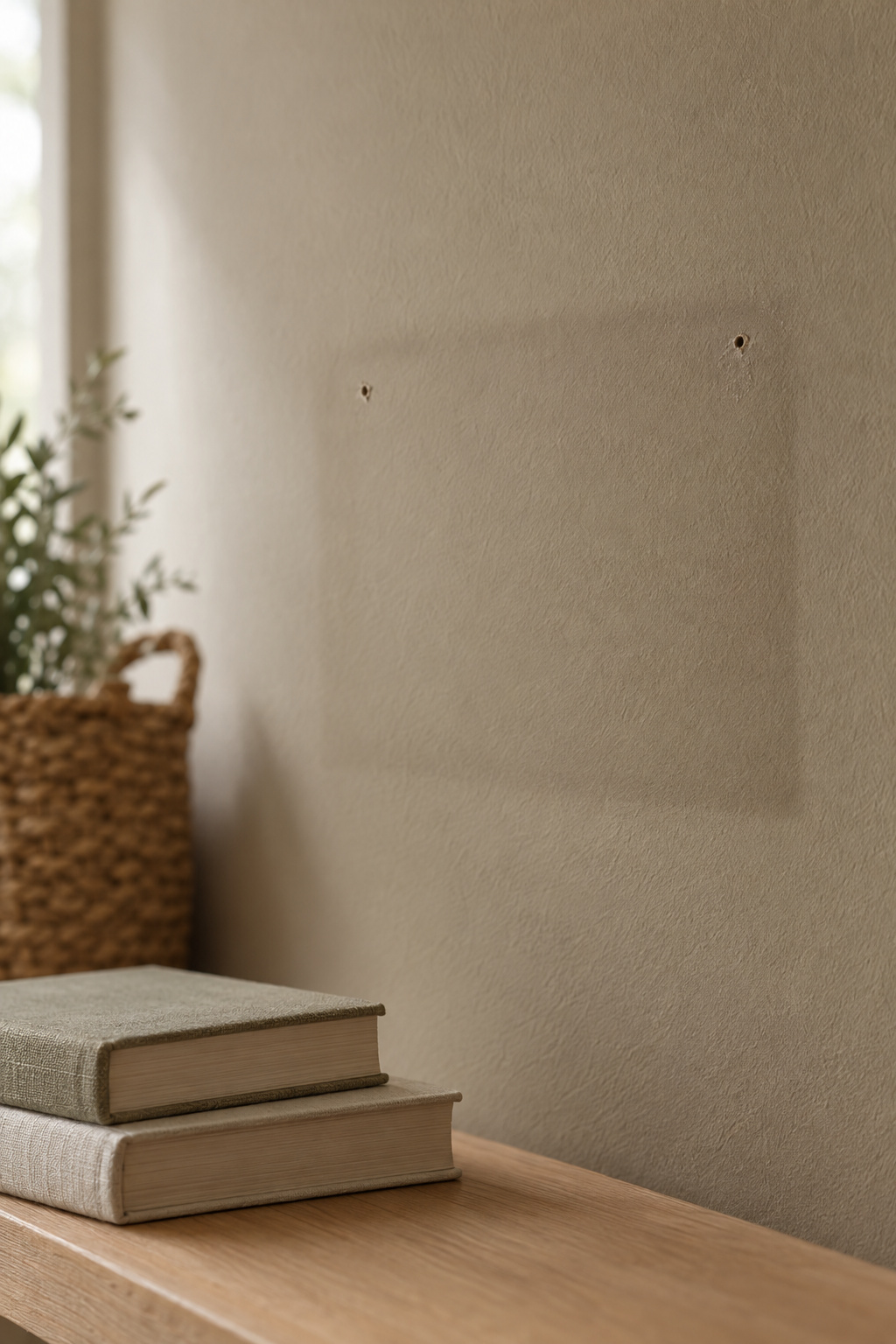
Signage and word art
Designers name word signs first. Interior designer Sophia deDomenico calls them “placeholders” and argues for objects with real personal history. A sign naming the room does the room’s job for it.
Wall-to-wall shiplap
Boards on every wall, left stark white, are the dated element named most often. Becca Meyer of BB Meyer Design told Good Housekeeping in May 2026 that the look “became heavily commercialized and overly templated” and now “feels builder-grade and really cold,” and she named shiplap among the elements responsible.
Nobody credible says tear it out. Jen Levy’s fix in the same piece keeps it: paint the shiplap a warm beige, add a shaker hook or two, and swap black hardware for brass or chrome. Coverage and colour are the trouble, not the boards.
The sliding barn door
I wanted the obvious number here, the collapse in search demand for the 2018 kit, and it does not exist in citable form. Keyword-volume history for niche design terms sits inside paid tools, unpublished.
I am substituting a different measurement that answers a different question: market behaviour, not search behaviour. Zillow’s Amanda Pendleton reports that listings advertising a barn door commanded up to a 13% sale-price premium in 2016, and the phrase “modern farmhouse” around 10% by 2020. Today both sit near 1%. Buyers stopped paying extra for the words.
The verdict is narrower than the headline. Heavy distressed doors have dated and the concept has not, and minimalist glass replaced them. One caveat has nothing to do with fashion: sliding doors seal poorly, so where privacy matters, hinge it.
Black on every fixture, stark white and matched sets
Matte black has been used so heavily “in flip renovations and spec homes that it now reads as builder-grade,” says Micaela Quinton of Copper Sky Design + Remodel. Elizabeth Valkovics of Batten Court Design still uses it in graphic interiors, so this is not a ban on black, only on black everywhere at once. Matched furniture fails the same way, and Anastasia Casey names the “Matchy Matchy Look” among 2026’s fading trends.
What Replaced Each One
Limewash, lime plaster and Roman clay are three different materials, though most writing treats them as three names for one textured wall. That confusion costs people money.
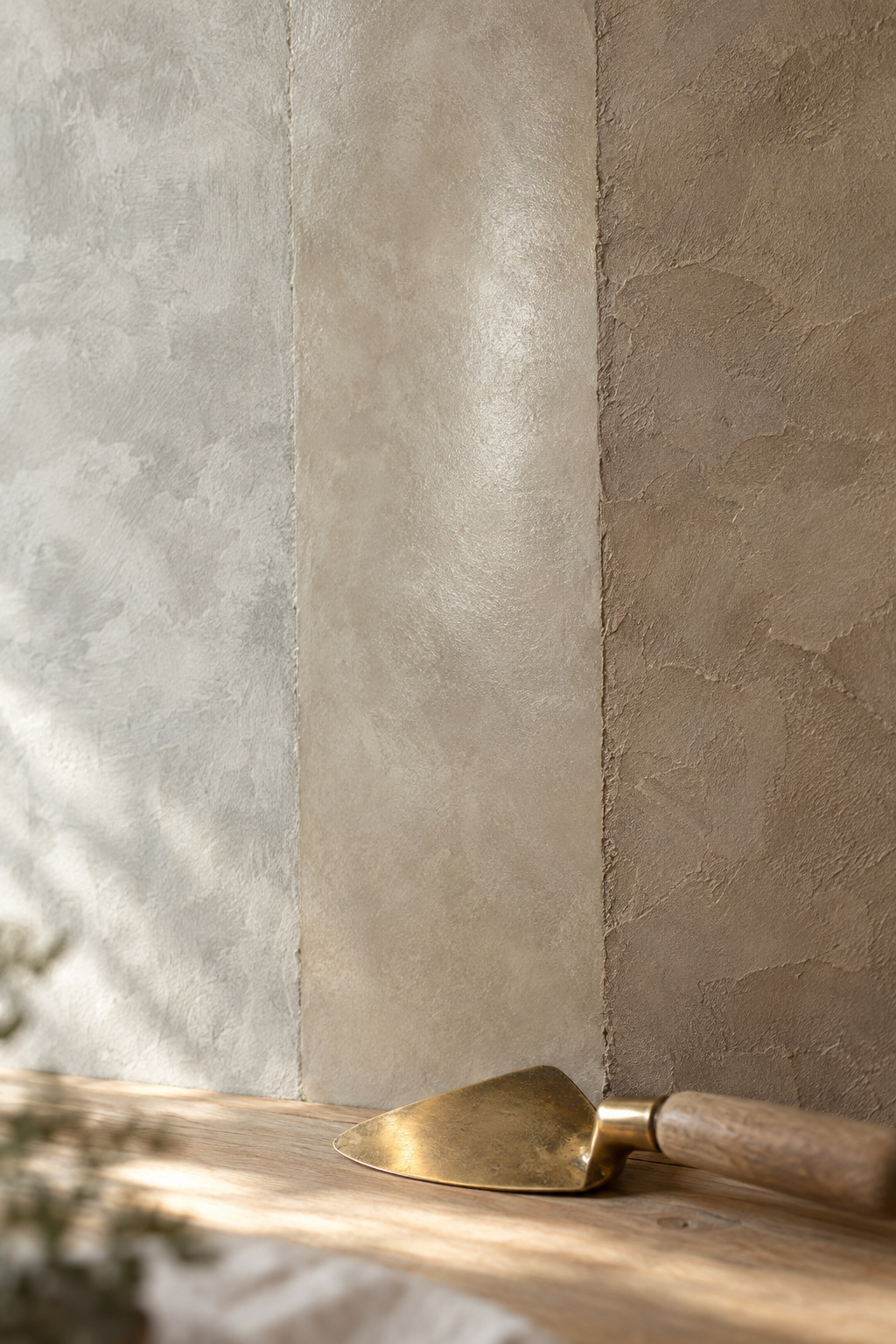
Limewash and lime plaster instead of shiplap
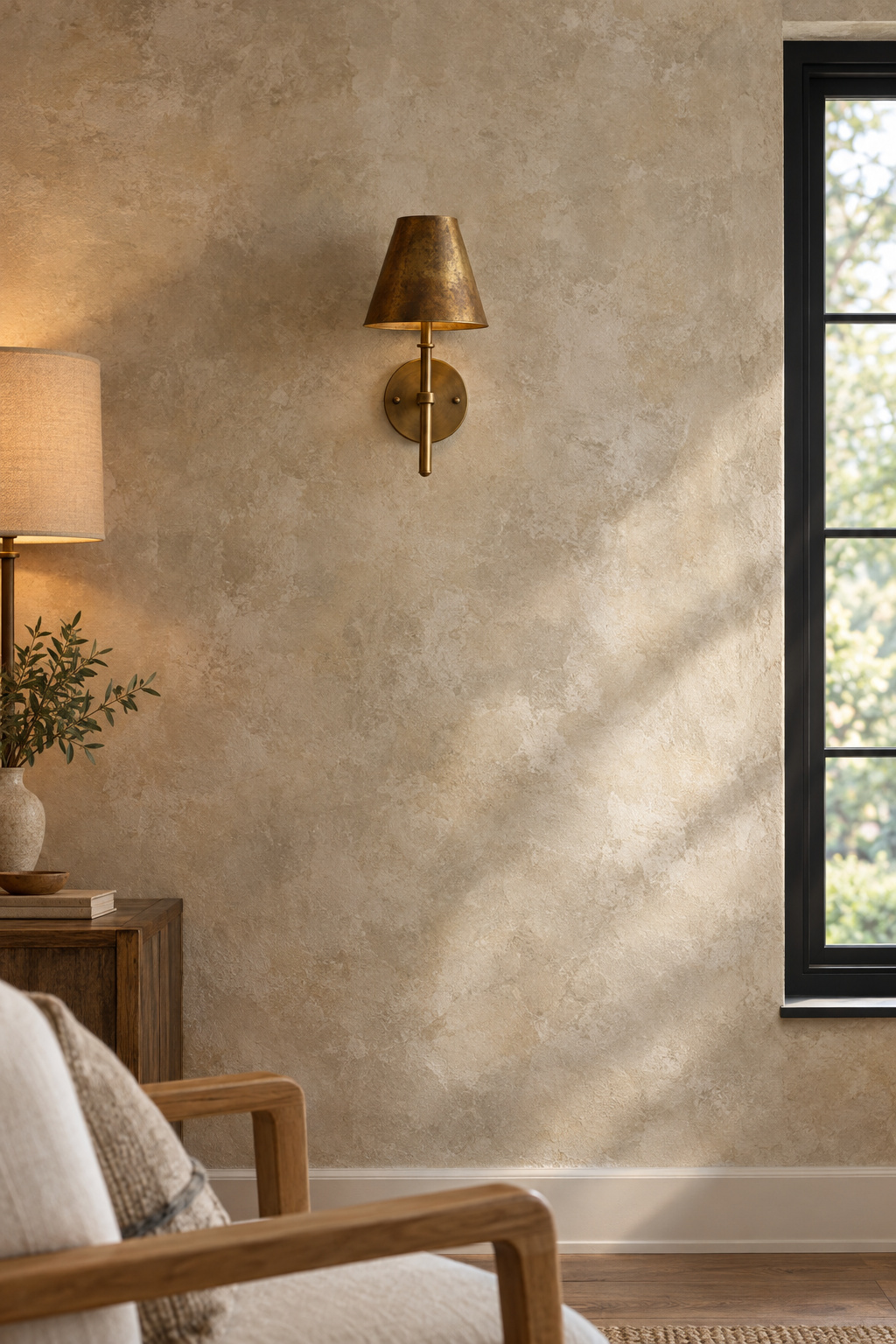
Limewash is slaked lime, water and mineral pigment, brushed on in two to four thin coats. It reacts more than it dries, taking carbon dioxide from the air and carbonating into the surface, so it bonds to porous, breathable surfaces like brick, stone, plaster and primed drywall and refuses glass, plastic and metal. Budget 300 square feet a gallon, at $1.50–$6 per square foot.
| Finish | What it is | Applied | Durability |
|---|---|---|---|
| Limewash | Slaked lime, water, mineral pigment | Brushed, 2–4 thin coats, cures by carbonation | Soft and chalky, can rub off; breathes and resists mould; cheapest of the three |
| Lime (Venetian) plaster | Lime plus marble dust | Trowelled in 3–5 layers, burnished with a steel trowel | Stone-hard and polished; most durable; wax or sealer renewed every few years; most expensive |
| Roman clay | Clay with natural binders | Trowelled or brushed, 1–2 coats | Matte to low sheen, gentle tonal variation; warmer than limewash, softer than plaster; sits between |
Choose by the surface and the finish you want.
Unlacquered brass instead of black hardware
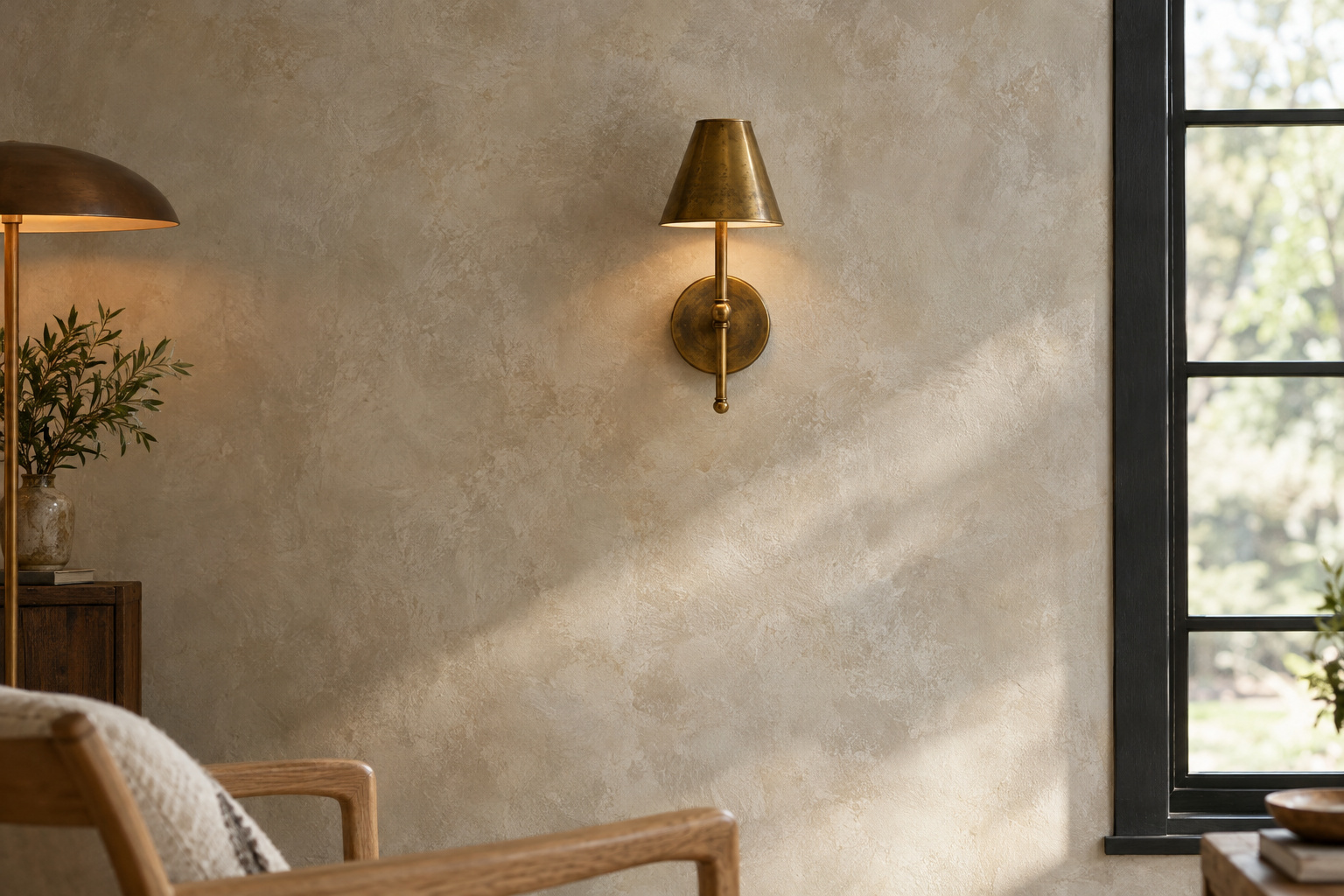
The move is toward unlacquered brass specifically, and polished or faux brass will not do. It changes over time, which is the point. “It is OK with water spots and darker markings over time because that gives it character — a backstory,” says Lindsay Thornton of Cornerstone Design & Build. The patina goes two-tone at four to twelve months and golden-brown by one to three years. That timeline was recorded on daily-handled fittings, so living-room pieces move slower.
Reclaimed timber and real stone instead of applied distressing
Real wear is logical. It gathers where hands went, on drawer edges, chair arms and table feet, and it is gradual, even and smooth to touch. Manufactured distressing scatters damage where nothing was touched, and repeats it.
The Softer Window Trim Decision
Black window trim is not part of the black hardware problem. One black line around the glass is contrast doing work.
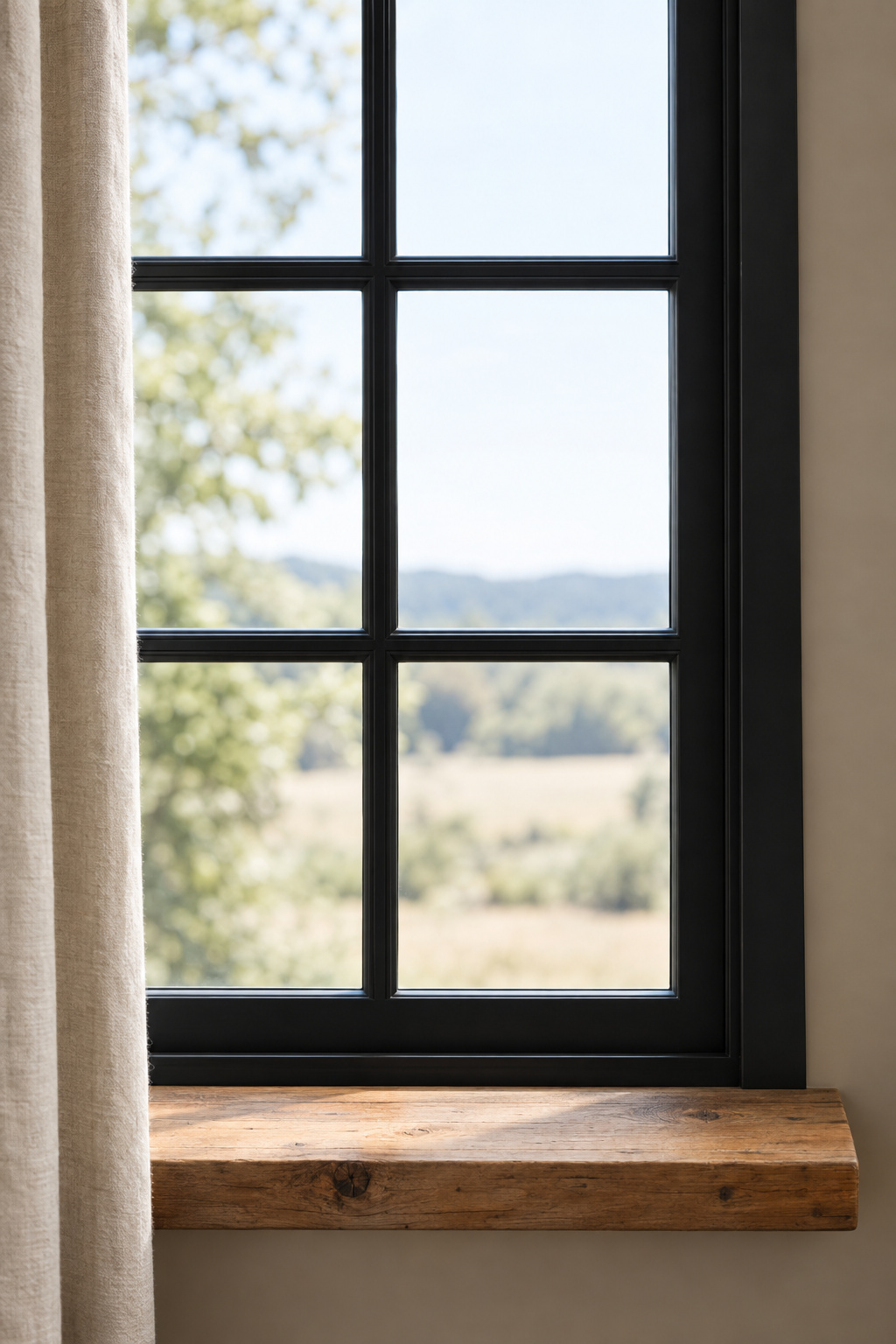
Painting black trim without losing the contrast
Keep the trim black and soften everything around it. The substrate decides the system. Use a good enamel on wood, a bonding primer under it on aluminium-clad, and on vinyl a specialty formulation that flexes as the frame moves.
The heat-absorption caveat on south-facing vinyl
Manufacturers commonly void the warranty on a vinyl window painted below a light reflectance value of 55. That is a frame threshold and no wall-colour rule. Dark colours absorb more heat, vinyl moves more than rigid materials, and sustained heat warps a frame. South-facing windows take the most sun. A vinyl-safe formulation resists blistering but may not restore the warranty.
Ordering the Fixes by Reversibility and Cost
Order these by what you can undo. Any of it can be got wrong, but only some of it twice.
| Order | Fix | If you change your mind |
|---|---|---|
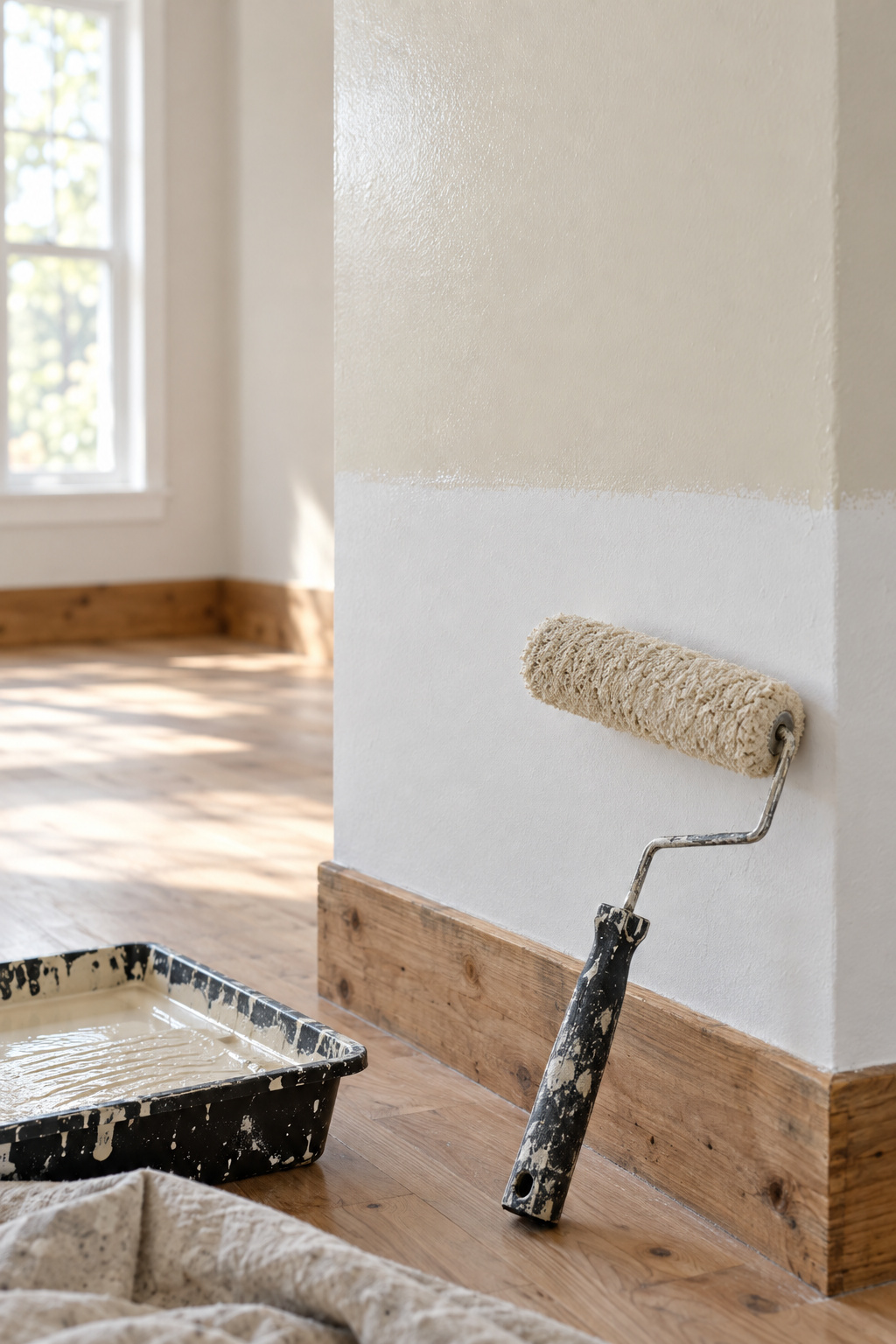
| 1 | Repaint the walls | Another coat. Fully reversible, and it changes shiplap, hardware backdrop and trim contrast at once |
| 2 | Swap black hardware for unlacquered brass | Screw-in swap on standard bore patterns; costs sourcing time, not commitment |
| 3 | Change a wall treatment | Limewash: power-washable for 5 days, permanent after. Whitewash: 20–30 years or stripping. Paint: effectively permanent |
Repaint first
Paint touches every dated element at once, and a failure costs a weekend.
Soften the hardware next
Most fittings need a screwdriver and a matched bore pattern, and the holes stay standard if you swap again.
Replace a wall treatment last
The reversible finish has a five-day window. Limewash can be power-washed off for five days after application, and after that it is permanent. Carbonation, not drying, has cured it into the substrate, where it behaves like stone. Whitewash lasts twenty to thirty years and needs stripping, and paint is permanent in practice.
The Warm Whites to Repaint With
One colour, as an example.
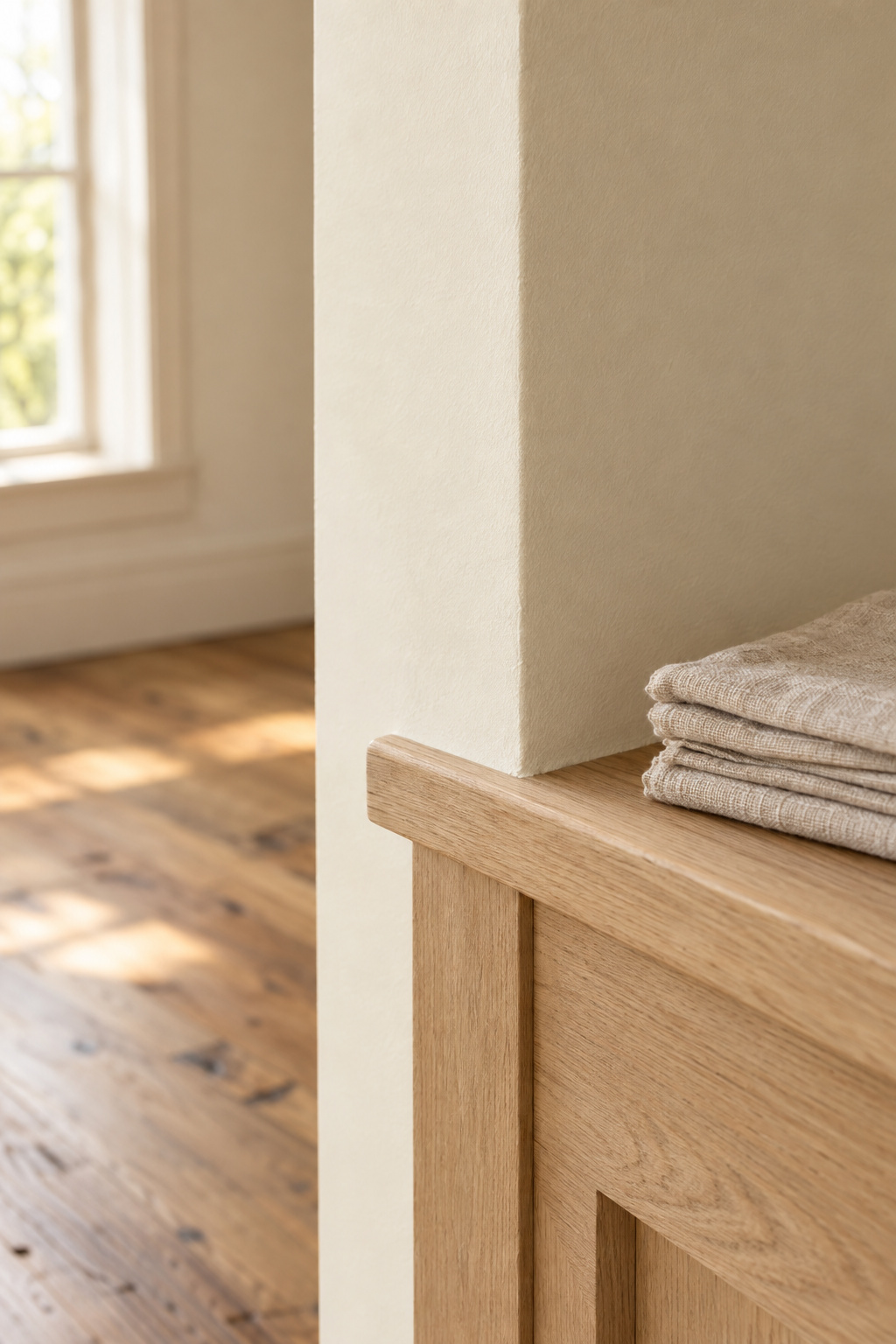
One example, and why it’s the cheapest first fix
Sherwin-Williams Alabaster reads as a genuinely warm off-white rather than the cool blue-white that dates this style, and it holds that warmth under warm bulbs instead of going cold after dark. It is the cheapest fix because nothing structural changes. There is nothing to source or match and no special prep.
Where the full palette lives
I name one and stop on purpose. Aisha Patel compares the warm whites to repaint with properly, covering how each performs in low light and why three whites of near-identical brightness behave three ways in a room.
What Each of These Updates Costs
The limewash figure above is the only price here, on purpose.
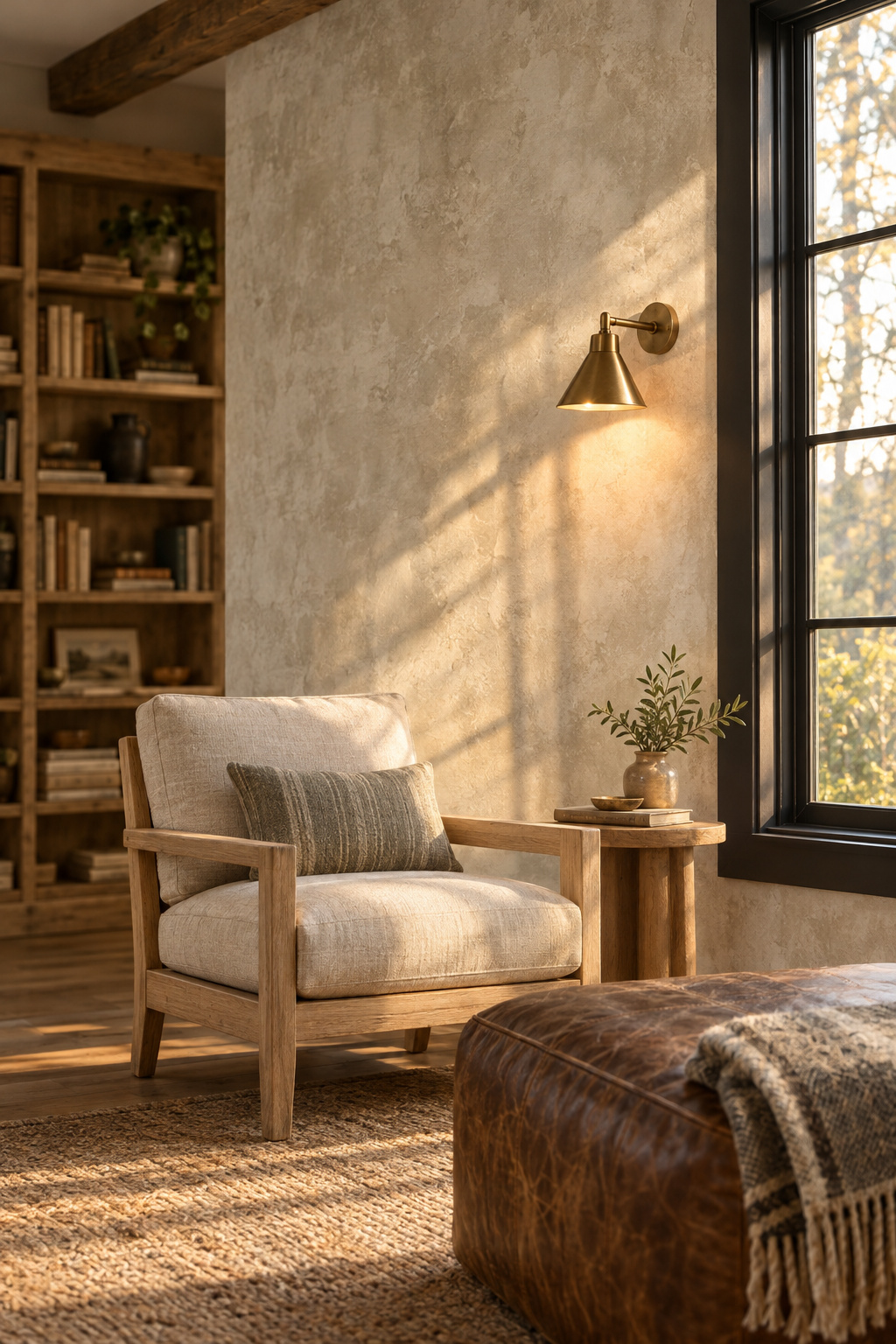
Why this article holds no dollar figures
This article orders updates by reversibility. A second orders the same updates by cost and holds every figure, so each number gets worked once.
Where every price on this list lives
Tess Carver has what each of these updates costs: repaint, hardware, wall treatment, and where money is better spent than saved.
Start today by standing in the room and naming which of these elements are actually there. Most people find two, not five. Then paint, and live with it a season before touching a wall treatment. For the wider argument, Rachel Blackwood’s guide to a farmhouse room built to last ten years sorts the style into structure and costume. You are editing the room, and nothing starts over.
FAQ
Will modern farmhouse style completely disappear?
No, the evidence points to evolution. Good Housekeeping’s May 2026 reporting frames the shift as a move toward “modern cottage”: more colour, texture and layered vintage over the same neutral base. Farmhouse still held a third of house-plan sales in 2025.
Is it worth repainting instead of doing a full renovation?
Yes, and a designer quoted in that reporting agrees. Jen Levy advises against a gut renovation and suggests you paint the shiplap a warm beige, add a shaker hook or two, and swap black hardware for brass or chrome. Paint and hardware are reversible, but a wall treatment is not.
How often should a living room’s decor be updated?
Trade guidance from a paint retailer puts the common range at three to five years, between trend-followers at two to three and long-hold households at a decade. I sit at the far end. Apply the ten-year test before buying, and a good update needs no repeat.