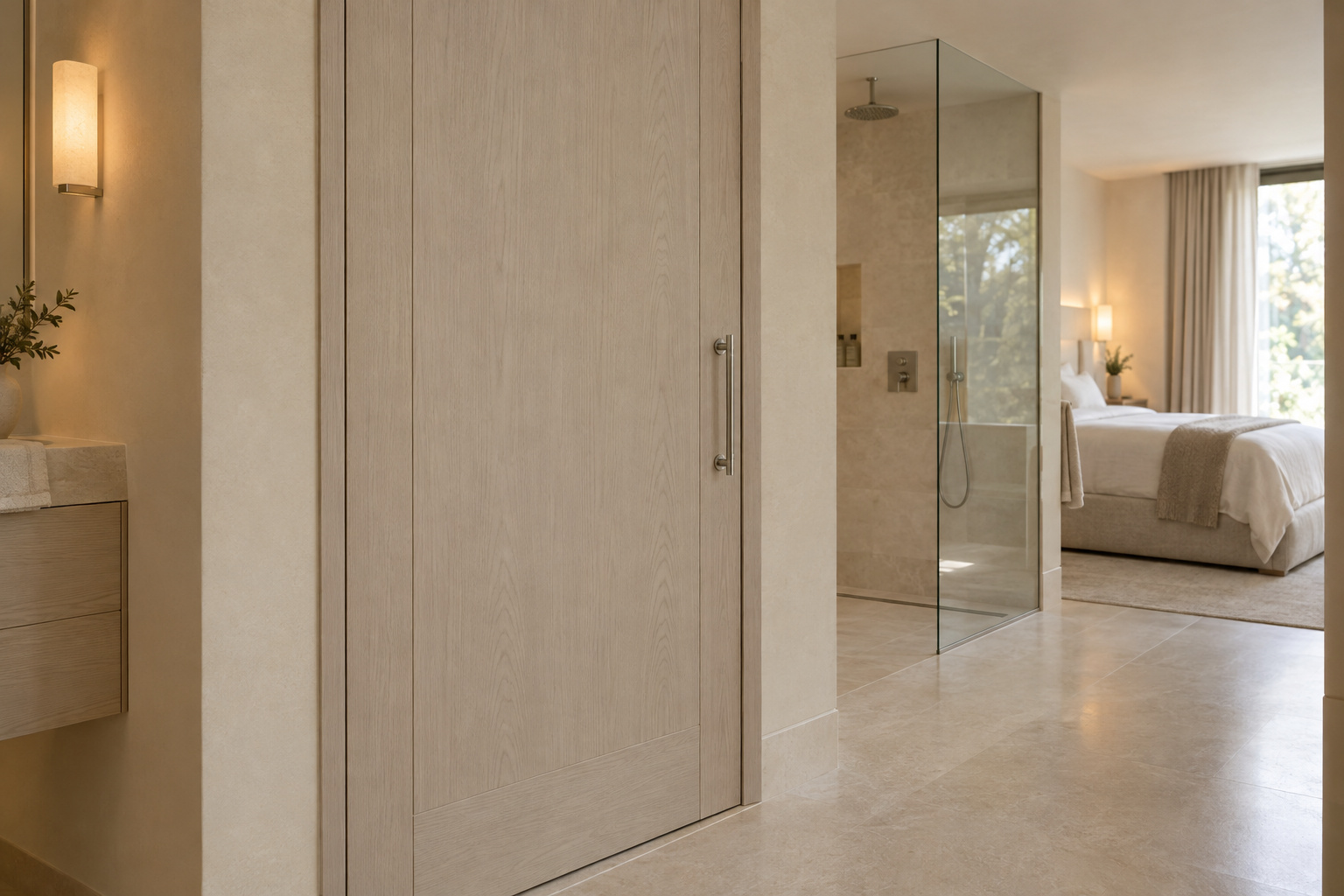

Picture the coat first. You step out of a hot shower and open the closet to a gray wool overcoat, the cloth cool and dry under your fingers, a faint smell of cedar and clean cotton, the fan winding down in the next room. Nothing feels damp. That ease is what a bathroom closet combo promises, and it is buildable, though the coat is keeping a secret. Wool can hold up to a third of its own weight in water without feeling damp, so your fingertips are the worst instrument in the house for judging whether steam reaches your clothes. The answer comes first, and the layout and the door follow from it.
TL;DR
- One steamy shower will not ruin a wardrobe; weeks of damp air will. The Canadian Conservation Institute says mold takes three months or more at 70% relative humidity and only days at 90%.
- Hold the closet at or below about 60% humidity and treat 65% as the line. That is my synthesis of museum guidance. The US National Park Service keeps leather below 65%, and shoes count as leather because no source gives them a figure of their own.
- Put the closet beside the bath, not inside it. Side-by-side off a short dry vestibule, with a solid sealed door on the bath side, keeps out the most wet air.
Does steam reach your clothes? The short answer, then the humidity numbers
Yes, some of it does, and that matters less than people fear. Collections-care bodies agree that textiles tolerate a wide band of humidity and only sustained extremes do harm: fibers swell, dyes transfer, metal trim stains the cloth around it, and mold grows. A single shower is a spike. A wardrobe is ruined by a closet that lives at bathroom humidity for weeks.
I learned to think this way during the years I spent in a university special-collections library, where the climate lesson was never about the dramatic day. It was about drift, the reading that creeps up unnoticed because the room feels fine. That discipline scales down to a home closet well, with one boundary. The humidity thresholds below are my trade’s, written for objects meant to last centuries, and I apply them to your clothes by analogy, so they run stricter than wearable garments need. How bathroom air moves is building science, which I cite and do not claim.
What fabric and leather tolerate
The sources give different mold thresholds because they measured different materials over different durations, so I’ve kept them apart instead of blending them into one number.
| Source | Material | What it says |
|---|---|---|
| Canadian Conservation Institute | Textiles | Mold in three months or more at 70% RH; in a few days at 90% |
| NEDCC (Northeast Document Conservation Center) | Collections generally | Mold risk above 75% for a month, 80% for two weeks, 90% for four days |
| Smithsonian Museum Conservation Institute | Cotton, linen / wool, silk | Risk in stagnant air above 80% for cotton and linen; above 92% for wool and silk |
| US National Park Service | Leather | Keep below 65% RH; stabilized range 40-60%; below 22% it dehydrates permanently |
| Canadian Conservation Institute | Boots, bags, leather | Stable 45-55% recommended; over 65% encourages mold |
| No source | Shoes | No footwear-specific figure; treat leather shoes as leather |
Even a single publisher gives two answers. NEDCC’s web leaflet says keep storage below 55%, while the PDF version of the same leaflet says below 60%, which I take as a reason to sit under 60 rather than at it. My practical line is a synthesis and no single body’s rule: hold clothing at or below about 60%, and treat leather’s 65% as the line nothing in the closet should cross. Nothing I found covers rubber and synthetic soles. This piece sets the humidity target. Fan size is a separate calculation, and how much exhaust an open suite needs is where it lives.
How bathroom air travels into a closet: doors, gaps and open air
Forget the cloud drifting through a doorway. Most moisture reaching the next room is invisible vapor riding on moving air. Joseph Lstiburek of Building Science Corporation puts it bluntly: air-transported moisture is far more significant than vapor diffusion through walls. John Straube describes the vapor as along for the ride, carried through cracks from higher pressure to lower.
A closed bathroom door is leakier than it looks. GreenBuildingAdvisor reported a field test in which Joe Nagan sealed a bathroom’s door undercut and floor register, and the fan still delivered about 92% of its open-door flow, pulling replacement air through cracks in walls shared with neighboring rooms. Semmelhack’s data, from the same publication, shows the sides and top of a closed door leak about as much as the undercut.
How much vapor is there to leak? Two measurements disagree. IEA Annex 14, cited in an Oak Ridge National Laboratory paper, puts a 15-minute shower at about 0.8 kg of vapor, while a Korean field study of 17 households measured about 125 g per shower. Here is the sum: 800 g ÷ 125.3 g = 6.4, so the estimates sit roughly six times apart. The argument needs neither. The Oak Ridge paper also cites a finding that only about half the vapor leaves through the fan, and the rest condenses on cold surfaces and re-evaporates long after the mirror clears.
Walk-through, side-by-side or closet inside the bath: three bathroom closet combo arrangements
What would an archivist build? The National Archives’ storage standard, NARA 1571, says vestibules must be considered to stabilize a storage room, with doorways sealed to limit air flow, and a working room can serve as the vestibule. Carried over to a primary suite, the comparison below is my derivation from the air-transport mechanics above and not a published ranking. No code or standard ranks these layouts, and none sets a separation between a closet and a bath.
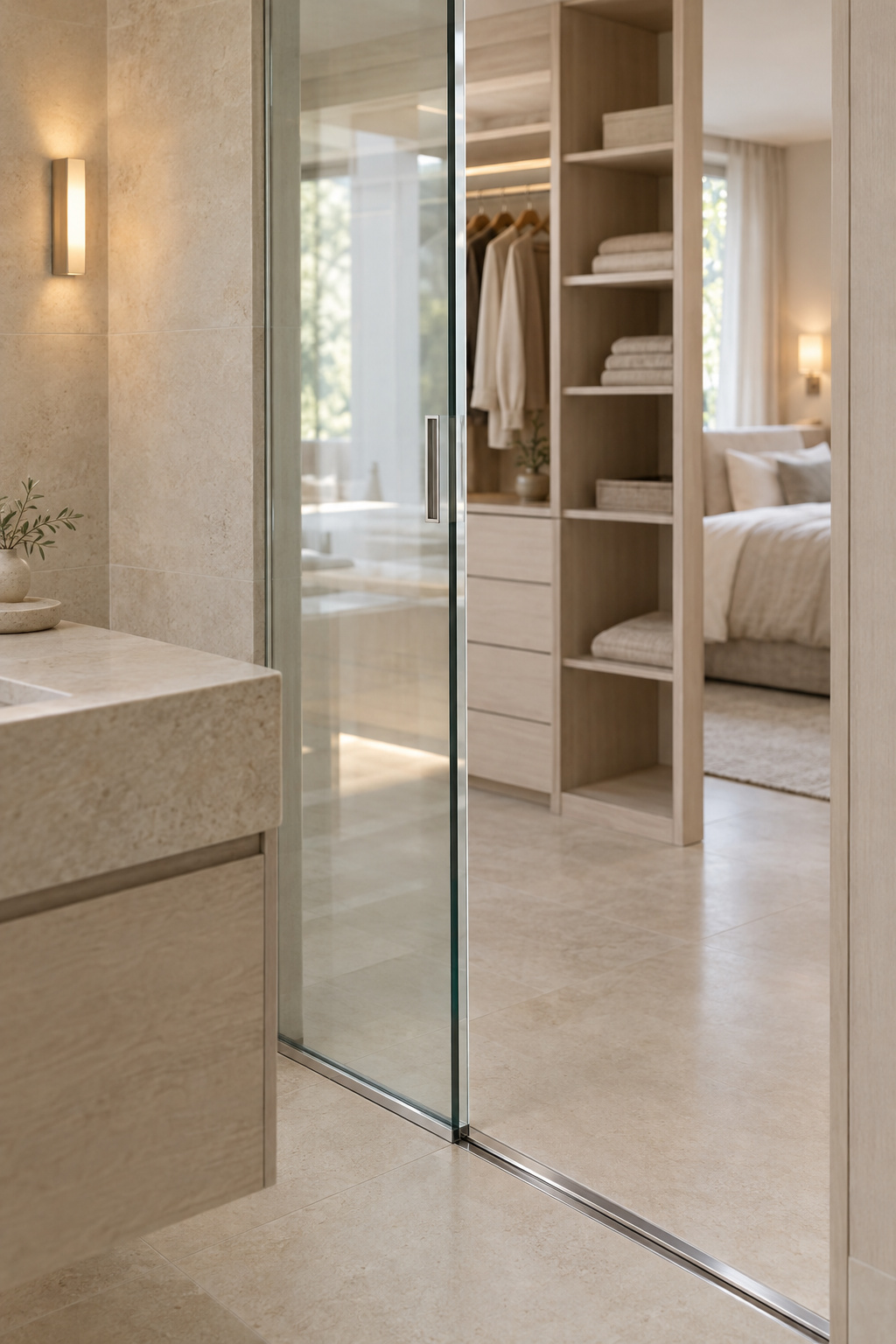
| Arrangement | Where the doors sit | Moisture exposure | Suits |
|---|---|---|---|
| Side-by-side off a dry vestibule | Bath and closet each behind their own door, both opening onto a shared dry dressing zone | Low | Most suites; the default |
| Walk-through (bedroom → closet → bath) | Closet between the two rooms, with a door at each end | Medium, if the bath-side door is solid and sealed | Narrow plans where the closet must be the route |
| Closet inside the bath | No door between wet and dry unless clothes sit in a closed cabinet | High | Only for items kept in sealed cabinetry |
Side-by-side wins because bathroom air has to cross a dry room before it meets a sleeve. The walk-through works until both doors stand open and the closet becomes the shower air’s corridor. Where the arrangement fits in the whole plan is a matter for primary bathroom floor plans.
Whichever you choose, keep the closet off an exterior wall. The Smithsonian’s conservation institute and Te Papa both warn against it, and the Canadian Conservation Institute’s table shows why: in a 60% room with a warm side at 25 °C and a cool side at 15 °C, the cool side reaches about 78%, with mold risk in roughly 20 days. Organizing the closet interior is a separate guide.
Which door goes where: swing, seal and a dry vestibule between wet and dry
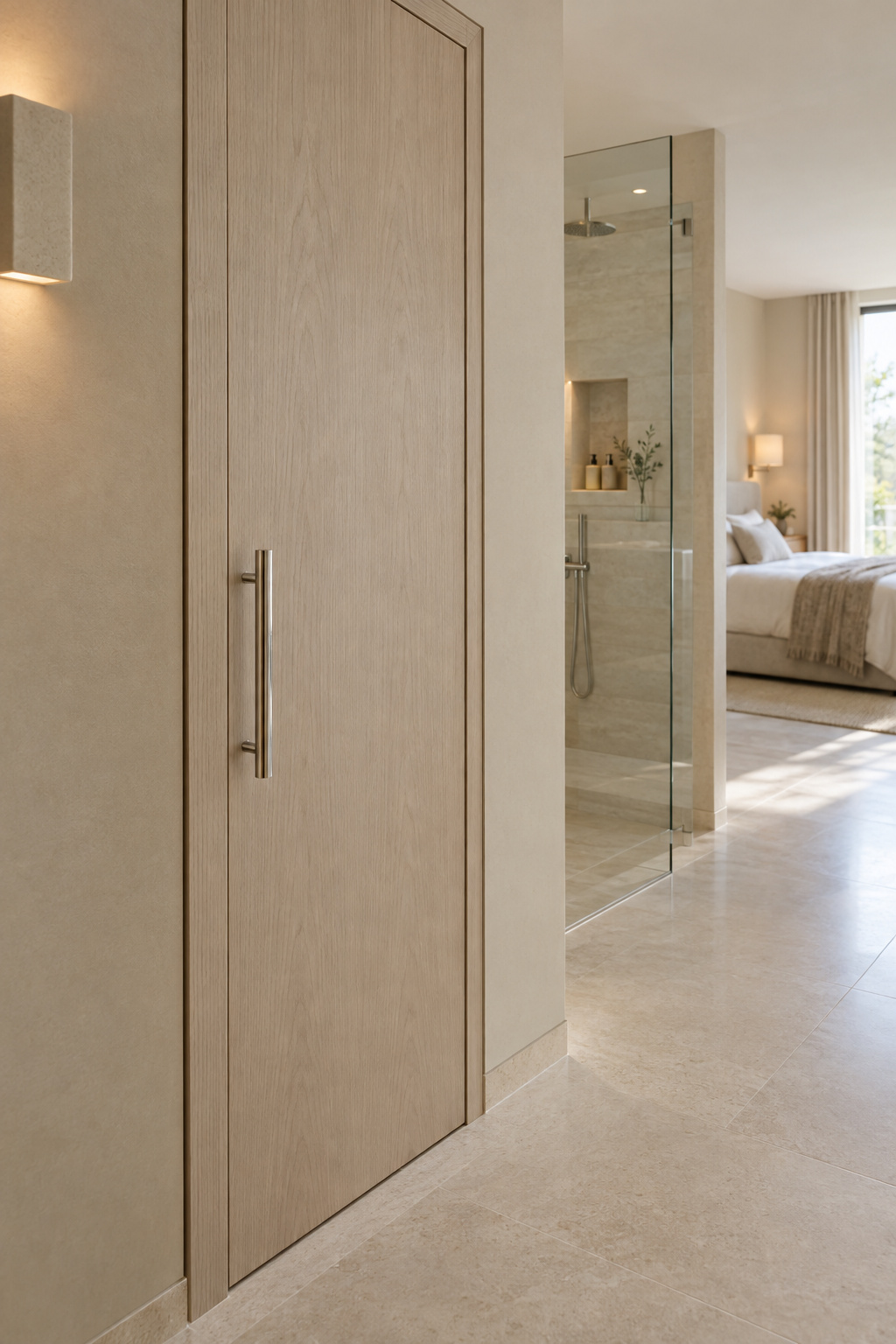
The door is the cheapest climate control you will ever buy. Canadian Heritage’s 2025 collections-care guide says access doors into a climate-controlled space must be well sealed, that unframed glass doors are always hard to seal and are not recommended, and that two sets of doors, a vestibule, may be needed to hold humidity stable. A frameless glass panel looks airy precisely because it is.

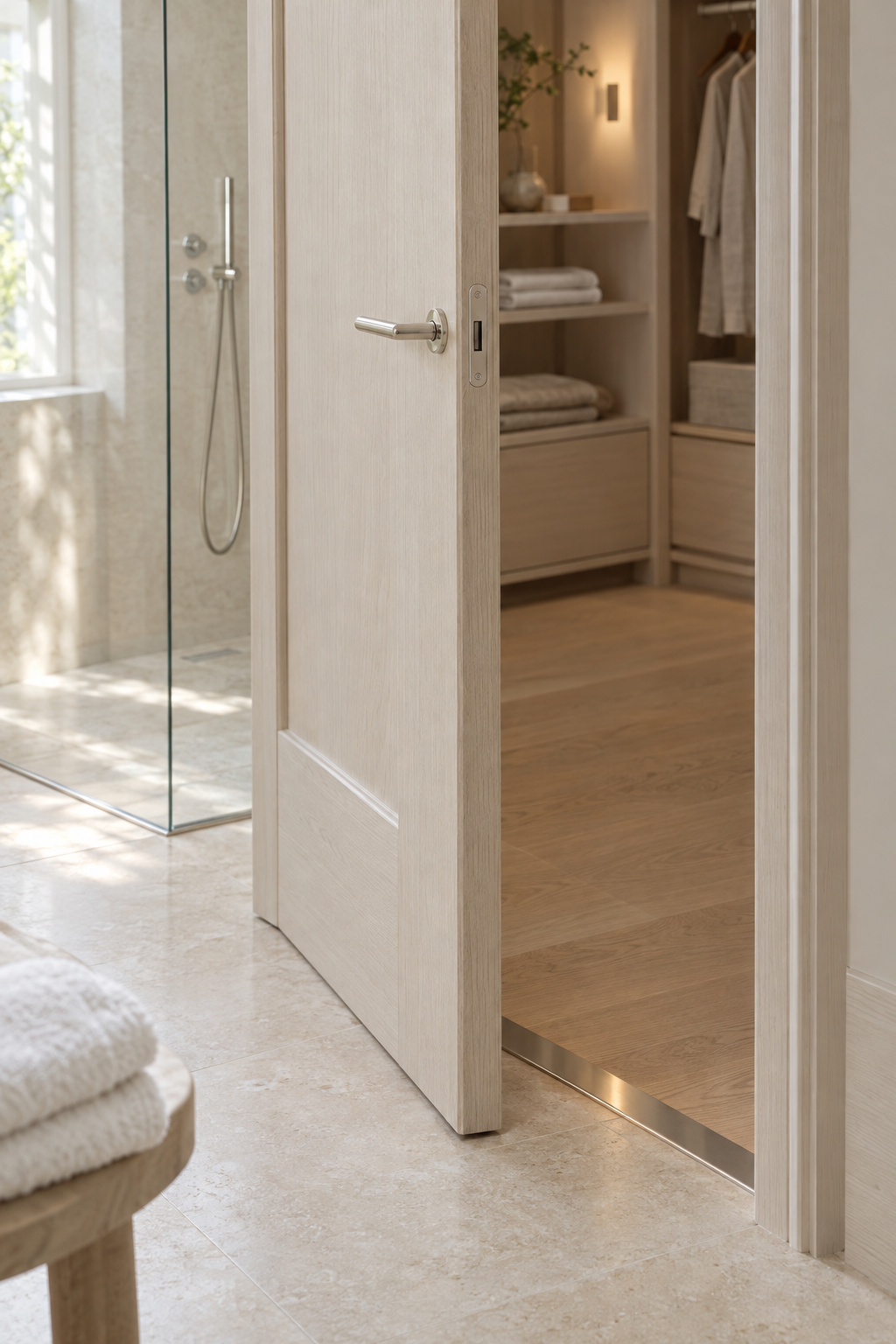
So the bath side gets a solid door, with a continuous sweep or compression seal at the bottom instead of a deliberate undercut. Building Science Corporation’s Info-804 warns that undercutting doors often leaves a bedroom positively pressured, and it prefers through-wall transfer grilles or jump ducts sized to keep the pressure difference across a closed door below 3 Pa. If the closet needs a relief path, put it on the dry bedroom side.
I found no source that settles which way the bath-side door should swing, so choose by clearance. A short dressing zone between closet and bath door becomes your vestibule, the domestic archive airlock.
Keeping the wet zone’s air out: pressure, exhaust hand-off and a hygrometer
Pressure and exhaust
A running fan makes the bathroom the lower-pressure room. The Nagan test shows its replacement air arriving from neighboring rooms, so air flows toward the shower and not away from it. That holds only while the fan runs; at rest I found no measured pressure difference between bath and closet. Size the fan to the suite instead of the shower stall, and never let the closet be the room it pulls its air through.
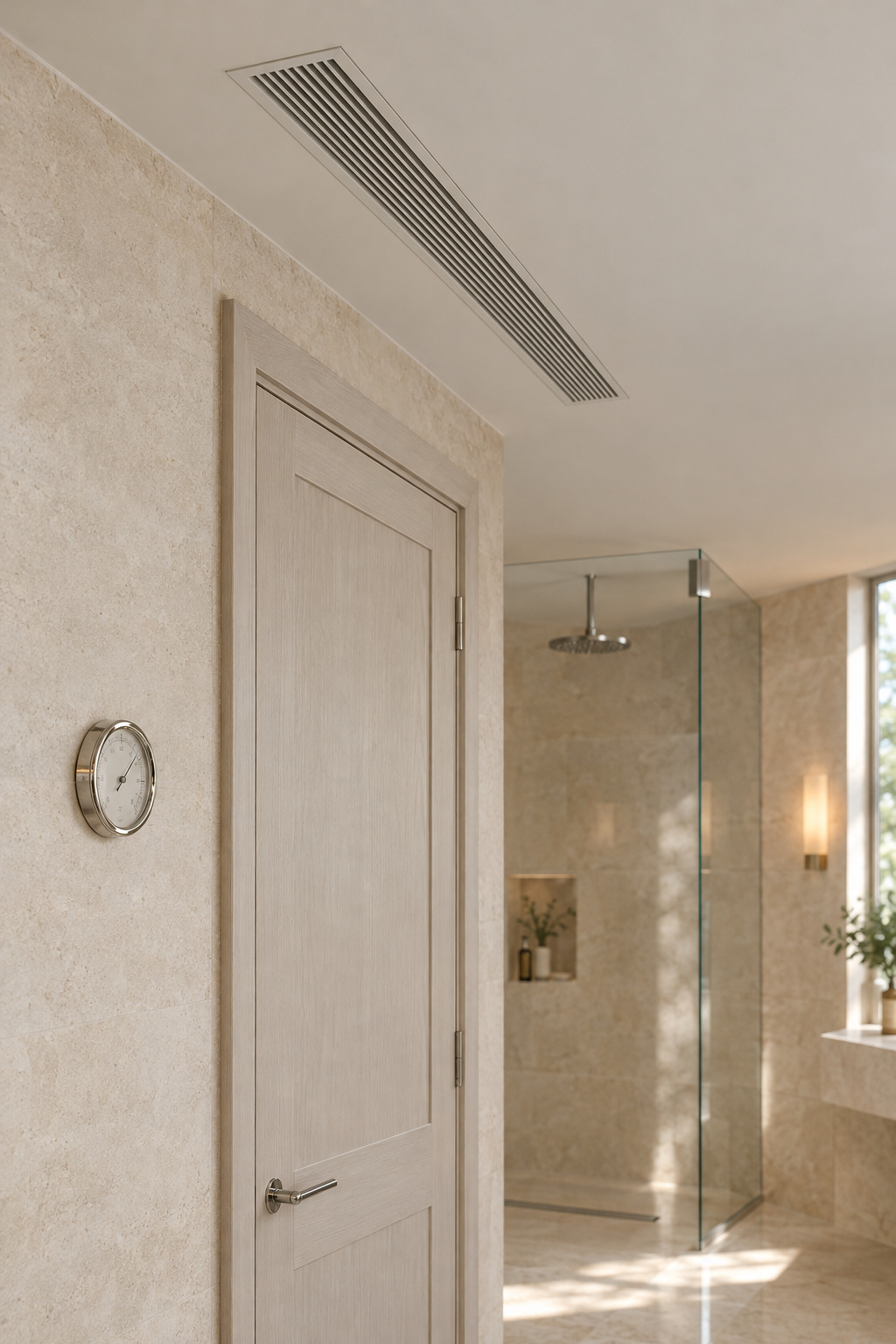
How long should it run? The sources disagree. Badeloft’s ventilation buying guide says at least 15 to 20 minutes after a shower, while a Korean multifamily field study summarized by ROCIS found that 70 minutes were needed after a 10-minute shower, though the installed fans were often underperforming. I would not trust a clock at all. Run the fan until the bathroom’s humidity reading falls back, and let the number end the cycle.
Reading the room with a hygrometer
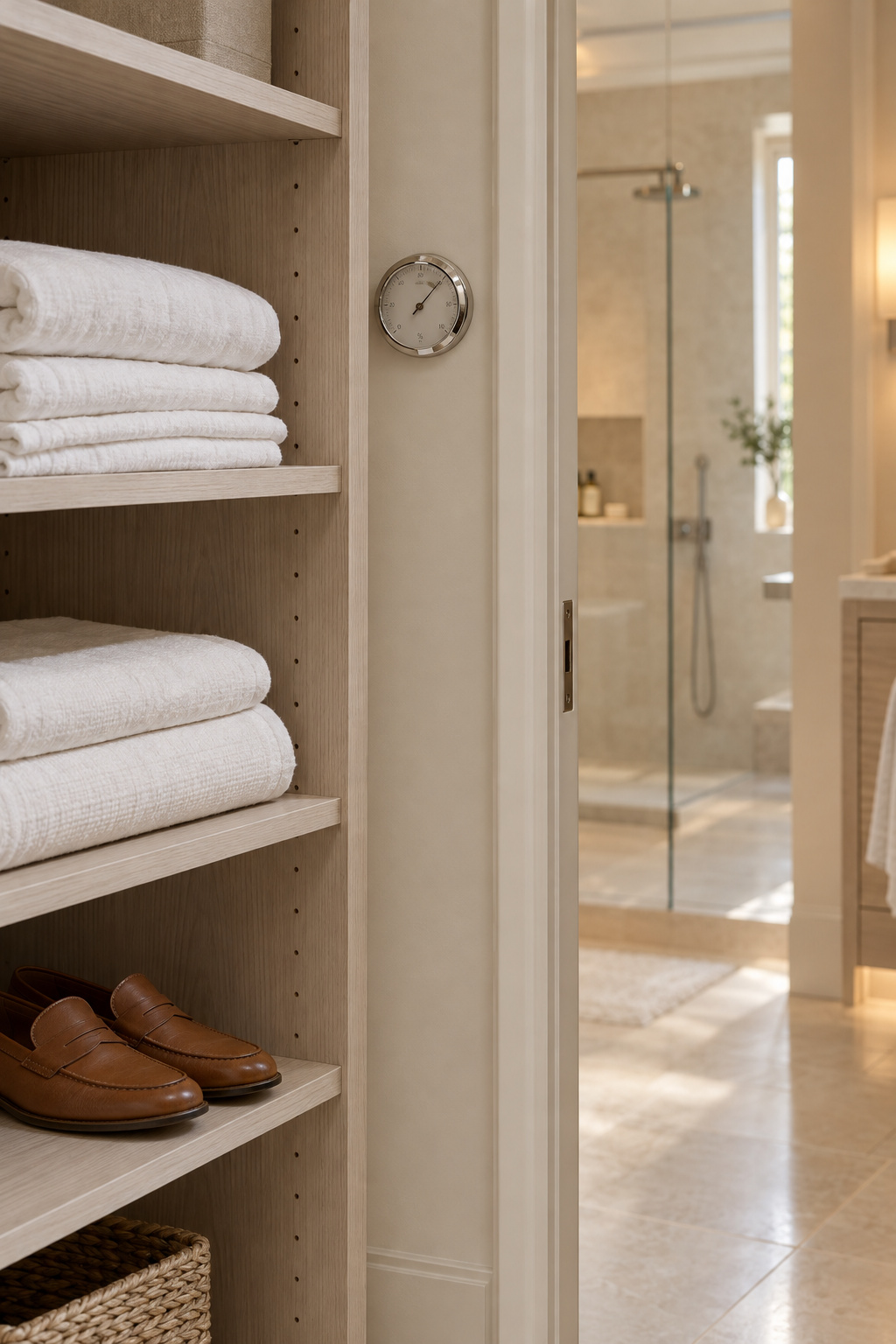
Every archive lives by NEDCC’s advice: measure with an accurate instrument, keep a log, and never trust your impression of the room. A small hygrometer on a closet shelf does what your fingertips on that wool coat cannot. Consumer capacitive sensors are typically accurate to 1 or 2 points, about 3 at the extremes, so leave a margin of 3 to 5 points under the 65% line. A salt test checks the sensor: saturated table salt in a sealed container sits at about 75%, per a calibration vendor’s guide citing the ASTM standard.
The Canadian Conservation Institute tells collections to set an alarm above 65% and keep an action plan ready. Set the closet alert at 60 to 65% and write your plan down: run the fan with the bath door shut, check the seal and sweep, open the bedroom-side vent, and resist the heater, since NEDCC warns that warmth on a damp space speeds mold.
A closet that smells of nothing but cedar and clean cotton
Go back to the coat. The cedar you smell is pleasant and nothing more: no conservation source I read credits it with protecting cloth, and the National Park Service advises against wooden storage furniture for leather. What protects that sleeve is plainer. It is a closet beside the bath instead of inside it, a solid door that seals, a dry stretch of floor between them, and a reading that stays under 60%. Archives work this way, and the same few decisions belong on your list when planning a primary suite bathroom. Do that, and the coat stays as it was, cool and dry and smelling faintly of cedar.

FAQ
Do moisture absorbers or silica gel work in a closet next to a bathroom?
Not as a room fix. The National Park Service says silica gel can only hold a microclimate inside a well-sealed enclosure, and the Canadian Conservation Institute sizes it for display cases with about one air change per day. A closet door leaks far more. Fix the air path first; keep gel for a sealed box holding leather or formal wool.
Can an existing bedroom closet be turned into a walk-through to the bathroom?
Yes, as a design decision, and I found no code that forbids or requires the connection. Give it a solid door that seals on the bath side and a dry buffer toward the bedroom, and put any pressure-relief vent on the bedroom side instead of undercutting the bath door. Ask your builder whether the new opening bears load.
Should a closet off a bathroom have its own heating or vent?
A vent, yes, and no heat. Ventilation from the dry bedroom side keeps air from going stagnant, which NEDCC lists as a mold factor, but never vent the closet from the bathroom. NEDCC also warns that extra heat on a damp space speeds mold growth, so lower the humidity first and keep shelving off cold exterior walls.