“What year is it?” My partner teaches high-school history. It’s the first thing he asks about anything old that comes into the house, and what it cost comes second. I’ve come around to his order of questions, with one change for cloth.
Picture a mudcloth throw over the arm of a sofa, a cream ground with dark brown lines. Before the year, and well before the price, I’d ask who made it. The answer decides almost everything about an Afrohemian living room, because the style rests on a handful of pieces like that throw, and each one either has a maker, a people and a place behind it or it doesn’t.
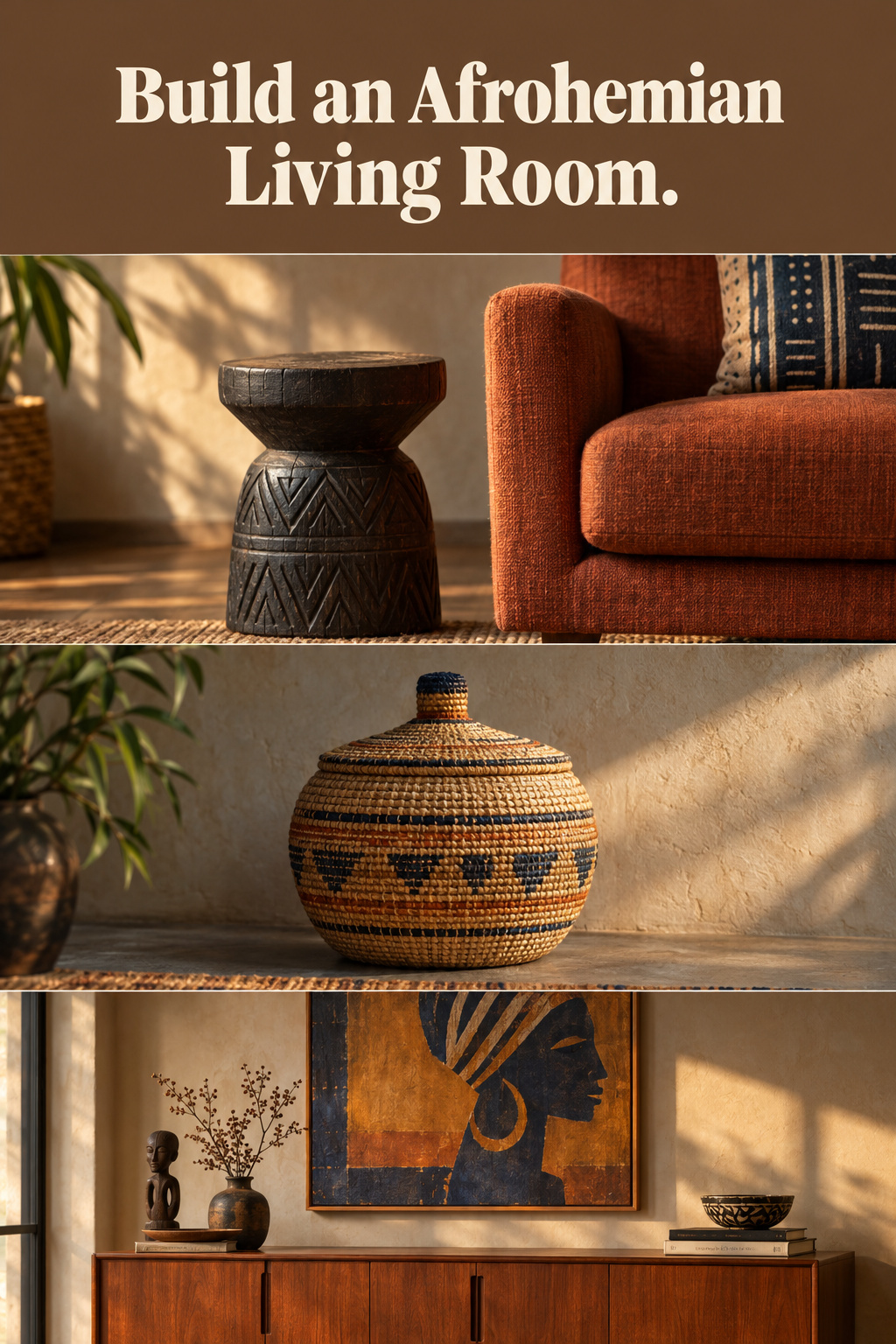
The trend coverage makes it look like a palette. Pinterest put Afrohemian decor on its list of 2026 trends, and the roundups that followed list mudcloth, Kuba cloth, stools, baskets and a mask or two, and rarely name a people. Follow that and you get a theme: a room of interchangeable prints a visitor can’t tell from the last one they saw. The room worth building is calmer. It stands on plain earthy walls, two woods and natural fiber, and it holds three or four pieces you can name, such as Bamana mudcloth from Mali, a Kuba raffia panel from the Democratic Republic of the Congo, a basket woven around Bolgatanga in Ghana, or a stool carved from one block. Prints are welcome too, as long as they say they’re prints.
The earthy base an Afrohemian living room stands on: three walls, two woods, two fibers
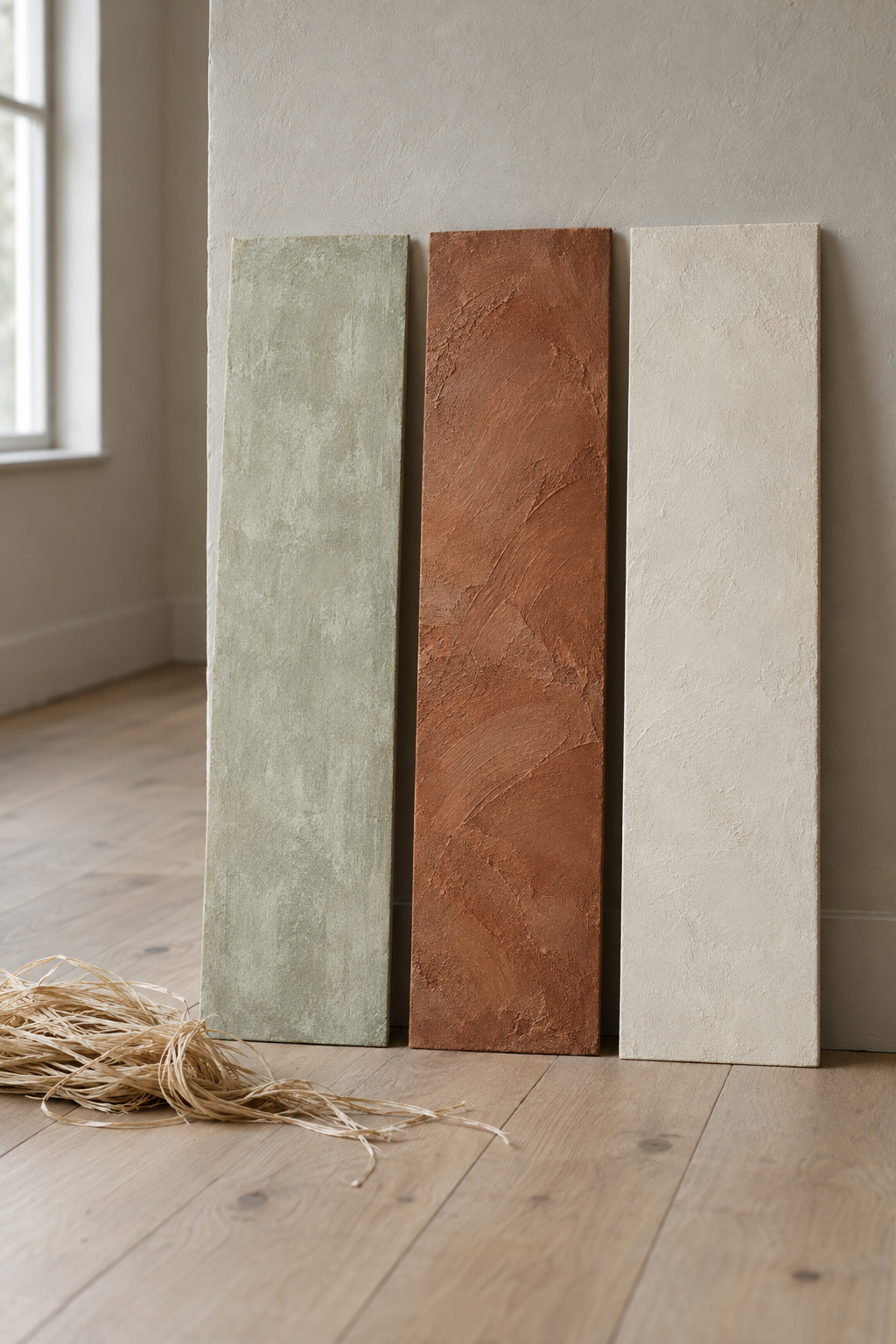
A base is what the room looks like before anything with a history arrives. Its job is to stay quiet, so that one strip-woven throw can carry a whole wall instead of disappearing into a busy one. Choose one wall finish, both woods and both fibers:
| Layer | Option | What it does in the room |
|---|---|---|
| Wall | Limewash in a warm off-white | Always flat, thinner and more translucent than paint, and breathable; it takes on the texture of the wall, so light moves softly across it |
| Wall | Clay-look plaster (Roman clay) | A matte plaster troweled on by hand, lime-based despite the name, with a soft, suede-like and cloudy surface |
| Wall | Terracotta paint | Opaque, covers completely and comes in almost any color; the plainest route to an earth-red wall |
| Wood | A dark carved hardwood | Weight and a deep tone low in the room |
| Wood | A mid-tone wood such as teak or mango | Warmth at hand height, in a shelf, frame or sideboard |
| Fiber | Jute | A coarse, sturdy texture underfoot or in a basket |
| Fiber | Sisal | A tighter, finer texture beside the jute |
The woods and fibers are my own recommendation, not anybody’s rule. Two woods, because one wood everywhere looks like a suite bought on a single afternoon, and a third starts an argument. Pinterest’s own description of the trend mentions “handwoven baskets and natural fiber rugs,” so fiber belongs in the style from the start. Whatever goes on the wall, keep it matte. A glossy finish throws the light back at you and the plaster look is gone.
Rugs belong to the base as well, and their pattern matters more than anything else about them here. A Beni Ourain rug is thick cream wool pile crossed by black lines that form diamonds, woven by Berber women in the northeastern Middle Atlas of Morocco, who used these rugs as beds and bedding. A kilim is flatwoven, the weaver building the whole composition line by line as she goes. A plain jute flatweave is the quietest of the three. Pick one and keep its pattern calmer than the cloth on the sofa, because a busy rug takes the calm out of everything above it.
Each wall finish suits the pieces a little differently, and this is my judgment, not a rule. A warm off-white limewash flatters a dark cloth, since mudcloth browns look deeper against it. Clay-look plaster has its own soft movement, which suits a raffia panel that also changes as you walk past. Terracotta paint is the boldest of the three, and it wants paler pieces in front of it, a cream cloth or a light basket, or everything sinks into one warm blur. Whichever you choose, finish the walls before anything else arrives. It’s much easier to choose a cloth for a wall than a wall for a cloth.
Mudcloth: Bamana bògòlanfini from Mali, and how a printed one gives itself away
Back to the throw on the sofa arm. Against a warm off-white wall its browns look nearly black, and the lines wander a little, as if drawn freehand. They were. Bògòlanfini comes from the Bamana peoples of Mali. Traditionally men weave the cotton in narrow strips and sew them together edge to edge, and women paint the designs in fermented mud on a ground soaked in leaf tea. Painting, washing and painting again can take several weeks. The strips are the detail I’d look at first. A cloth made on a narrow loom has to be joined, and the joins tell you how it was built.
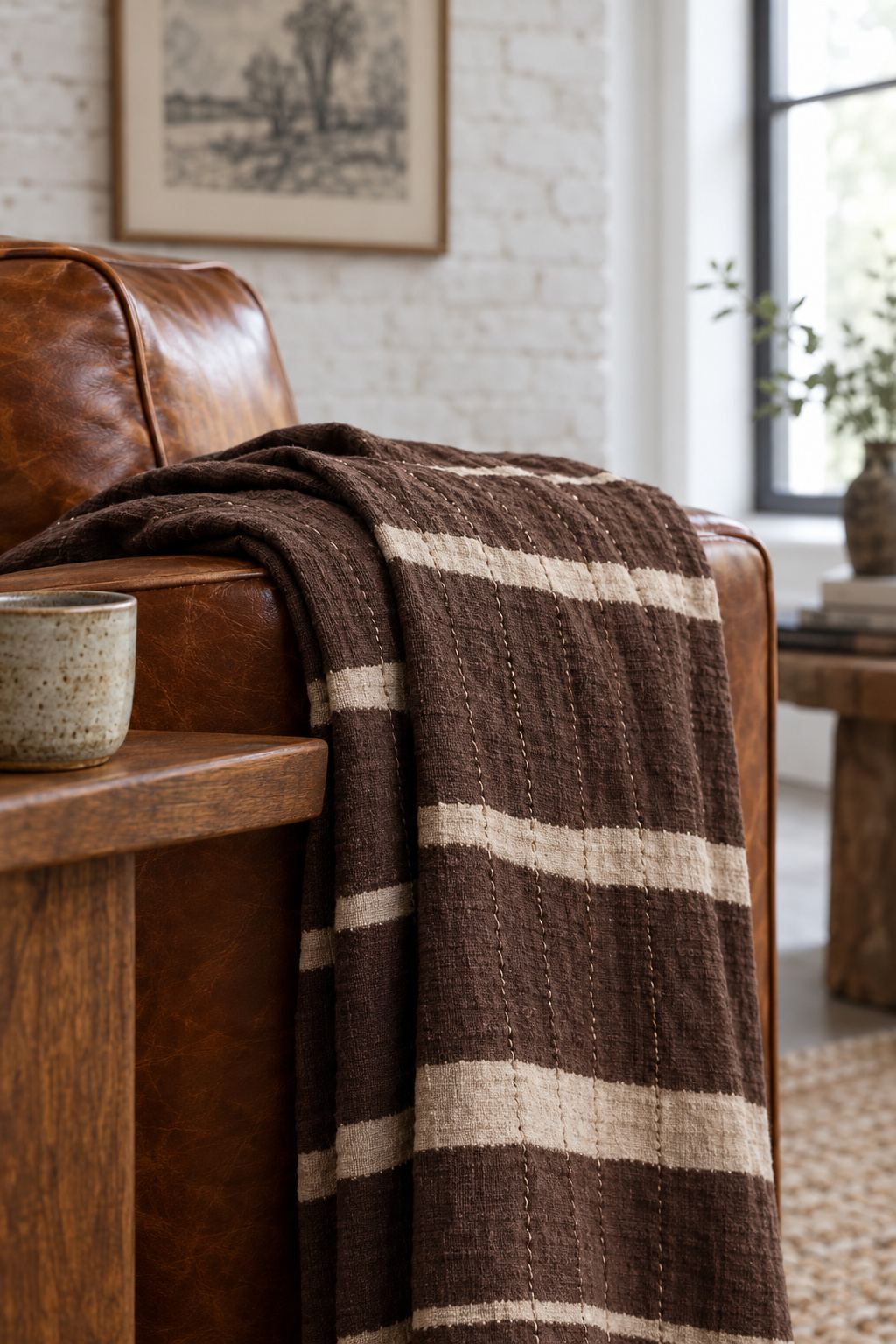
Many products sold under the name are printed or stenciled instead. A printed cloth tends to have a uniform dark and a perfectly repeated motif, while hand painting leaves small irregularities and dark areas that vary in density. Seams alone prove less than you’d hope, since cloth made for tourists is often sewn on a machine. The full method for reading one is in how to tell handmade mudcloth pillows from printed ones, and it’s worth the ten minutes before you pay for anything sold as handmade.
The coffee can of paint chips in my workshop started with a client who insisted a pink was original. The layers underneath said it went on in the 1950s. Since then I check before I call anything original, and cloth deserves the same habit: ask who made it before you call it mudcloth or Kuba. A print sold as a print is a fair thing to own. A print sold as bògòlanfini is a small untruth about somebody else’s work, and the Dallas Museum of Art notes that the designs turn up on Western products “although the source is not always credited.”
Two more West African cloths follow the same rule. Kente is made by the Asante peoples of Ghana and the Ewe peoples of Ghana and Togo, woven by men in narrow strips on portable looms and sewn selvedge to selvedge; its patterns have been printed on everything from Band-Aids to beach balls, and a kente-pattern print is not kente. Adire is indigo cloth made by Yoruba women in south-western Nigeria, patterned with raffia ties, stitching or a starch resist before it goes into the dye. A blue-and-white print that copies it is a print, and should be sold as one.
Kuba raffia: the Congolese cloth that wants a wall to itself
Now a different wall. A raffia panel about the size of a cushion cover hangs by itself above a low wooden chest, against clay plaster, with nothing else competing for that stretch of wall. Up close the surface is a short, dense pile laid out in a maze of lines, and it changes as you walk past.
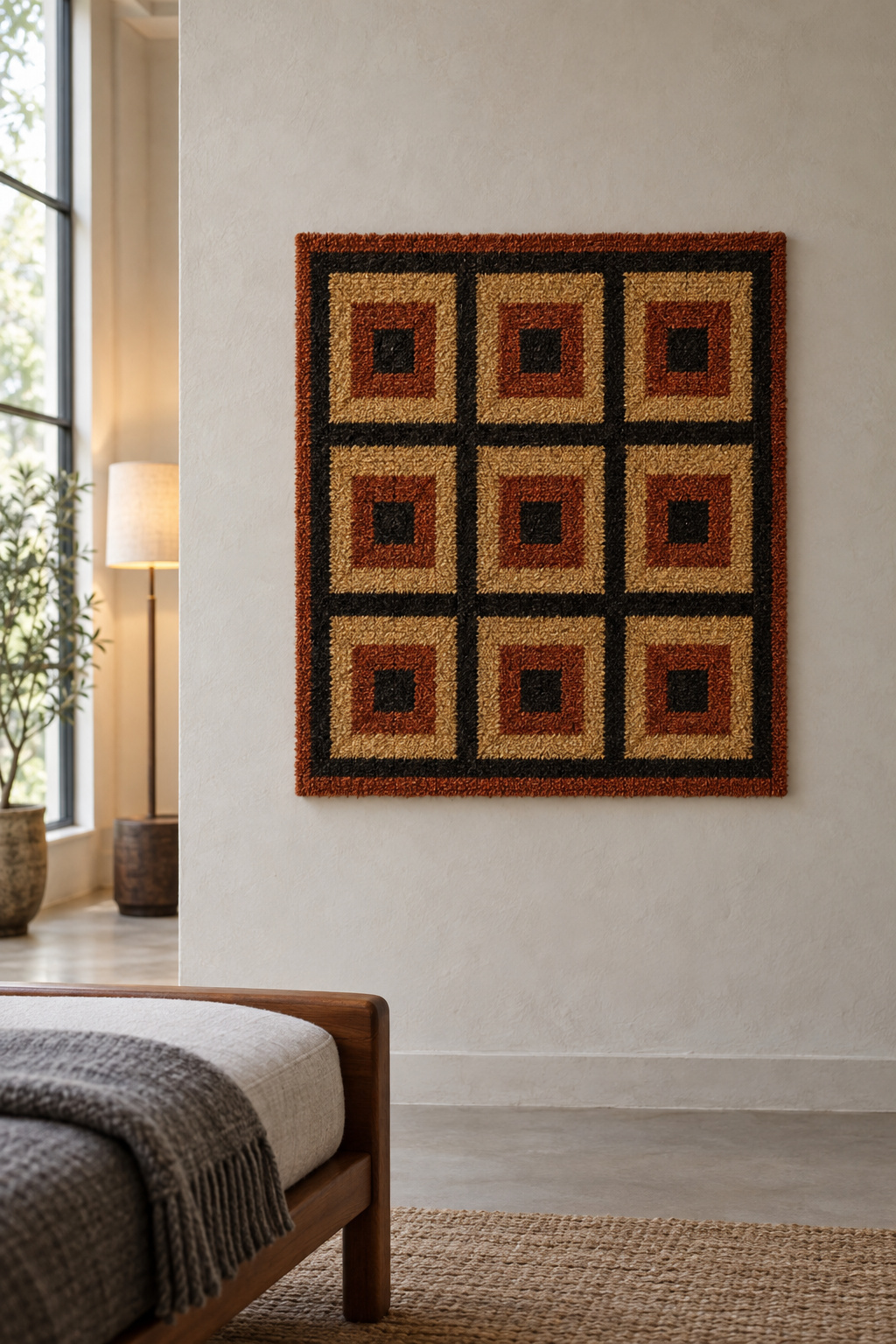
Kuba cloth comes from the Kuba peoples of the Democratic Republic of the Congo, and the related Shoowa made the cut-pile squares most often sold for walls. The ground is woven from raffia fiber. Museum records describe a division of labor: men weave the cloth, and women embroider and paint it. So one small panel usually carries the work of at least two people, and if a seller can tell you nothing about either of them, I’d keep asking.
I’d give a panel like this a wall of its own for two reasons. A pattern that dense fights with anything hung beside it, and a cut-pile surface doesn’t belong anywhere people lean, sit or toss a coat. On a plaster wall, with a plain chest below, it does what a painting does and more quietly.
One popular roundup lists “Kuba cloth” as prints and curtains without naming the Kuba, which tells you how far the name has traveled from the cloth. A Kuba-inspired print is a print, and an honest one is fine on a cushion. A real panel needs more thought. Keep it out of direct sun, choose a mount that comes apart without leaving a mark, and remember that you’re its steward for a few decades at most. The practical side of mounting a Kuba cloth wall hanging is worth reading before any hook goes into the plaster.
Juju hats and wall baskets: Bamileke feathers and Bolga weaving on one wall
A feathered disc hangs over a console table, fully opened, its feathers radiating from a woven center. Beside it hangs a flat fan woven from grass. Both sit against a warm off-white wall, which keeps the feathered edge crisp and lets the weave show.
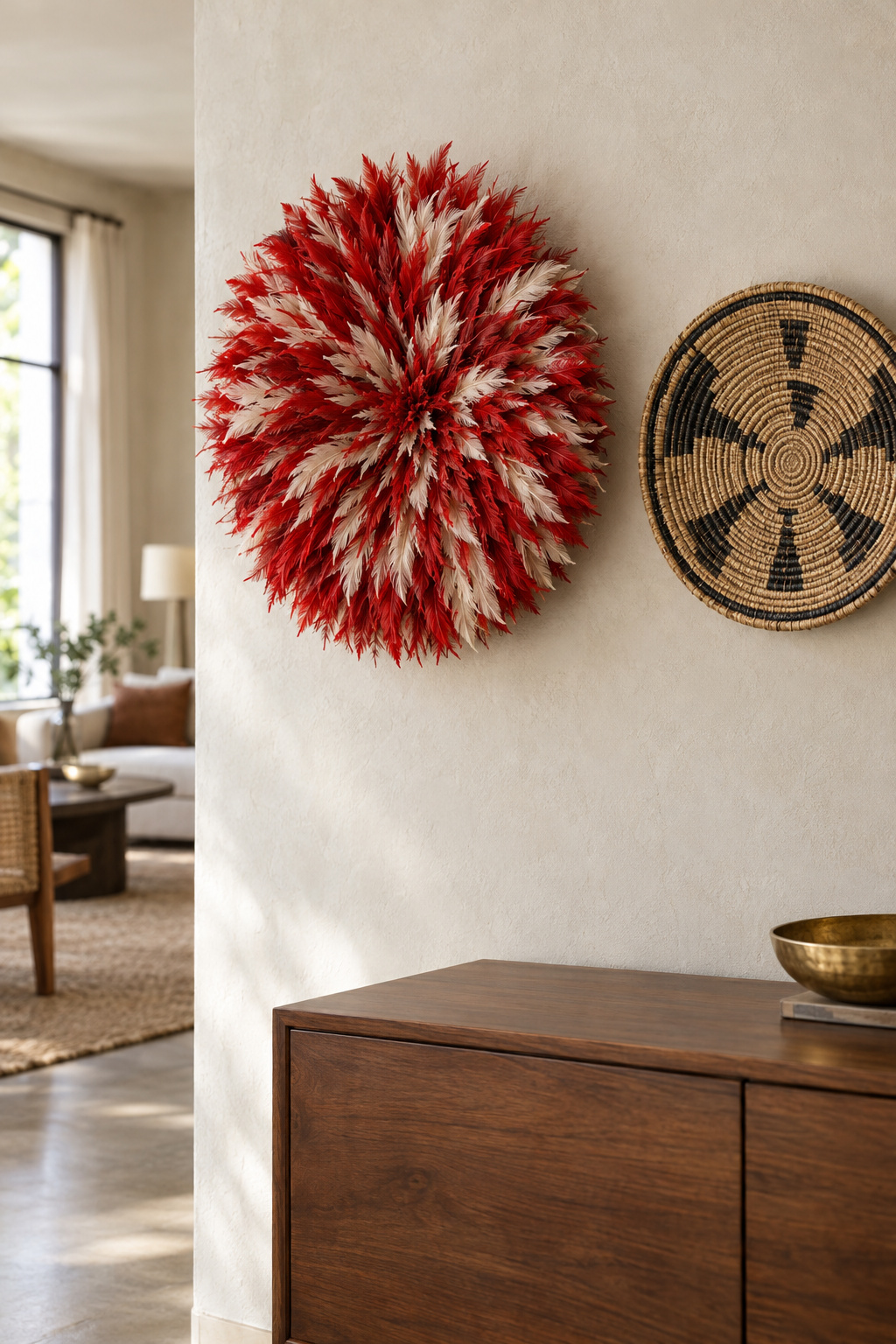
The hat is a Bamileke feather headdress from the Cameroon Grassfields, where hats and caps were signs of status. Lead dancers wore them at festivals and still do. One example at the Cleveland Museum of Art was reserved for the king, some high-ranking people and members of the all-male elephant society, worn at ceremonies and funerals, and it carries hundreds of red tail feathers from the grey parrot. The hats sold for walls now are made for sale, and I’d hang one knowing what the original was. I’d also skip the sales copy that promises it brings luck; no history behind the hat supports that.
The fan comes from weavers around Bolgatanga in Ghana’s Upper East Region, the same weavers whose storage baskets end up beside the sofa. Basket and fan making there has long been dry-season work, done when the fields are quiet. A flat fan has no job on a wall except to be looked at, which is fine, because it pairs well with a hat: one brings soft, radiating texture, the other flat pattern.
Two light things on one wall still need care. A hat that arrives folded has to be opened properly before it can be sized, and two hanging points keep it straighter than one. Read up on hanging juju hats and woven baskets before the first nail goes in, and keep both pieces out of direct sun, where dyed feathers and grass fade.
Baskets that work for a living: Bolga storage beside the sofa
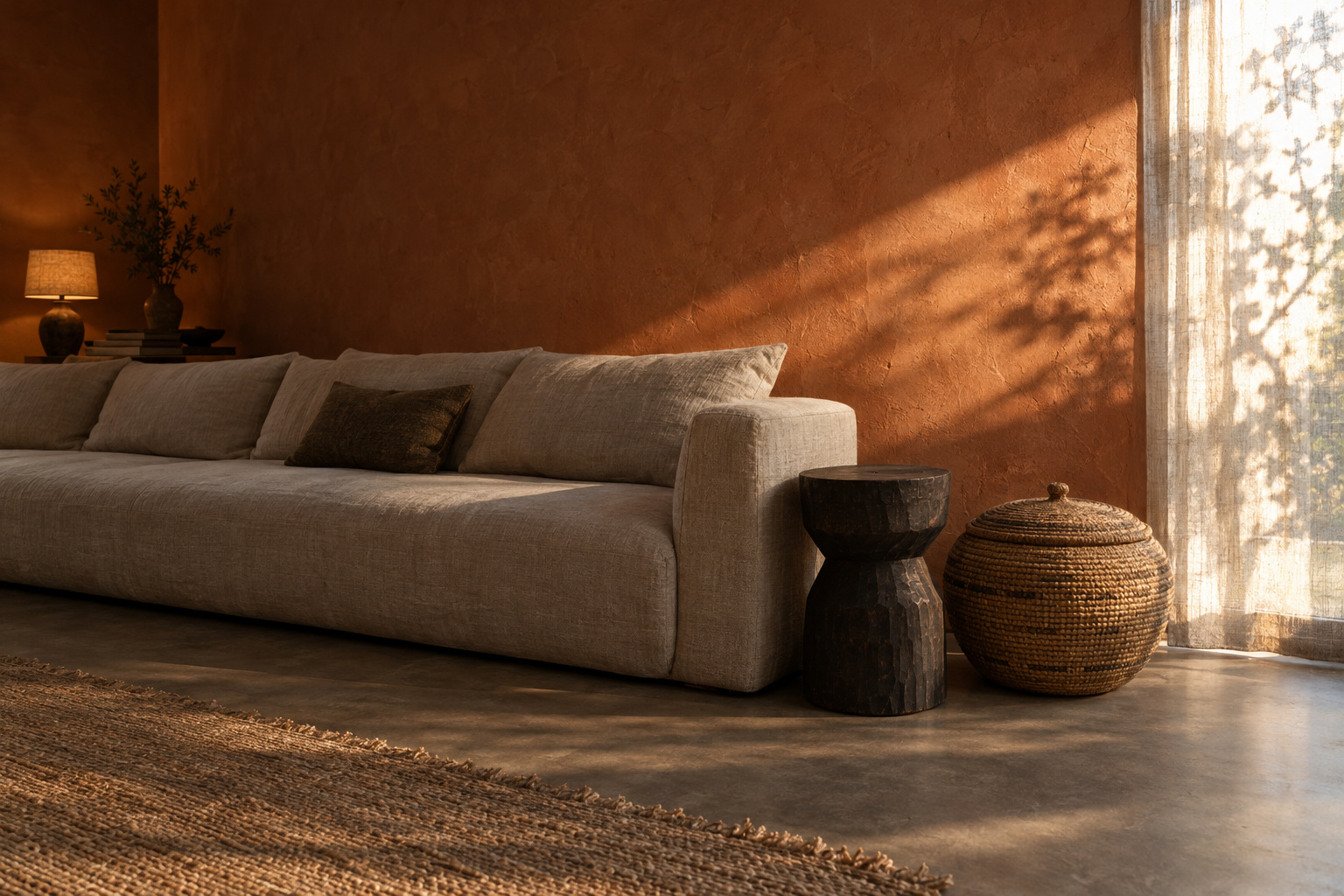
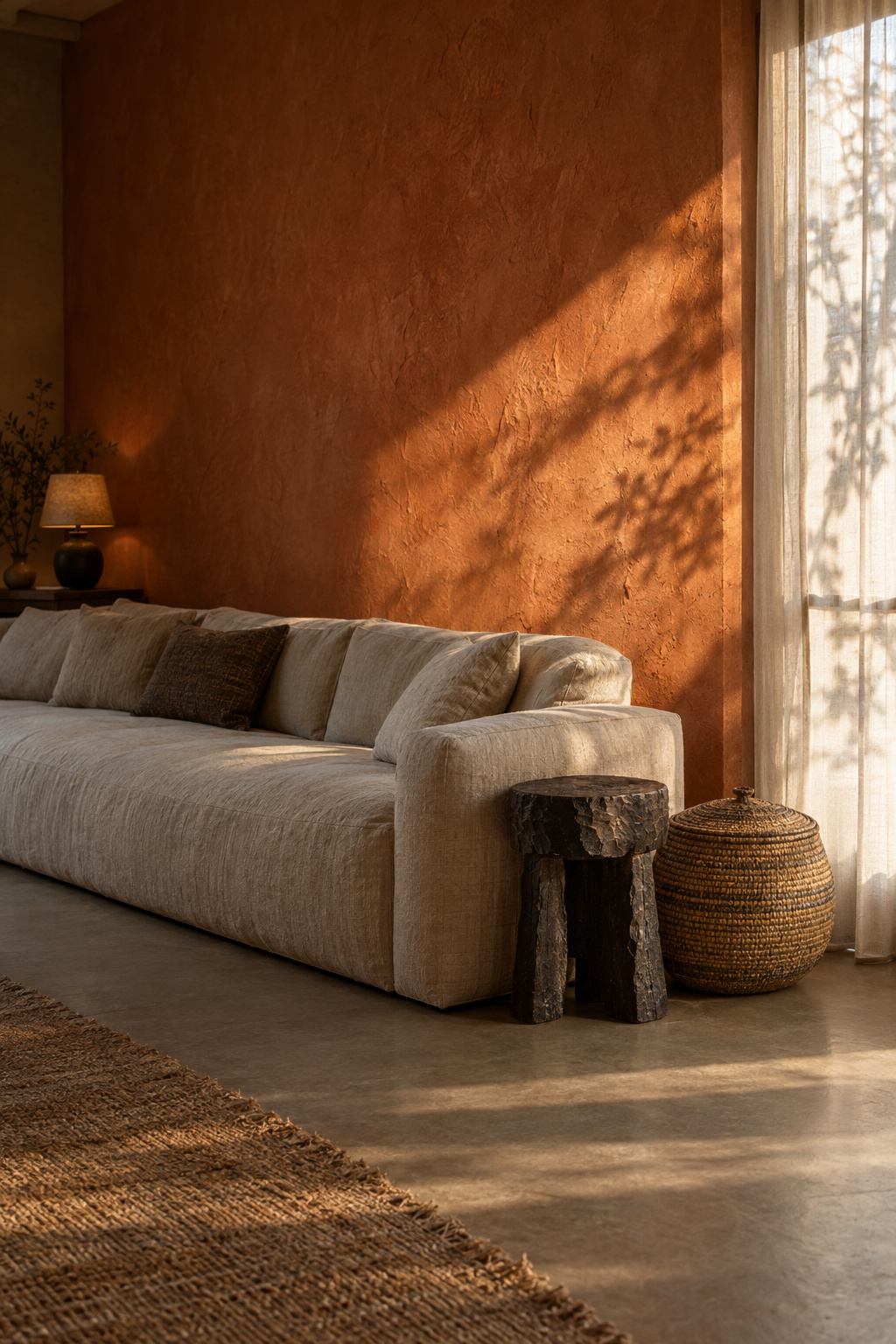
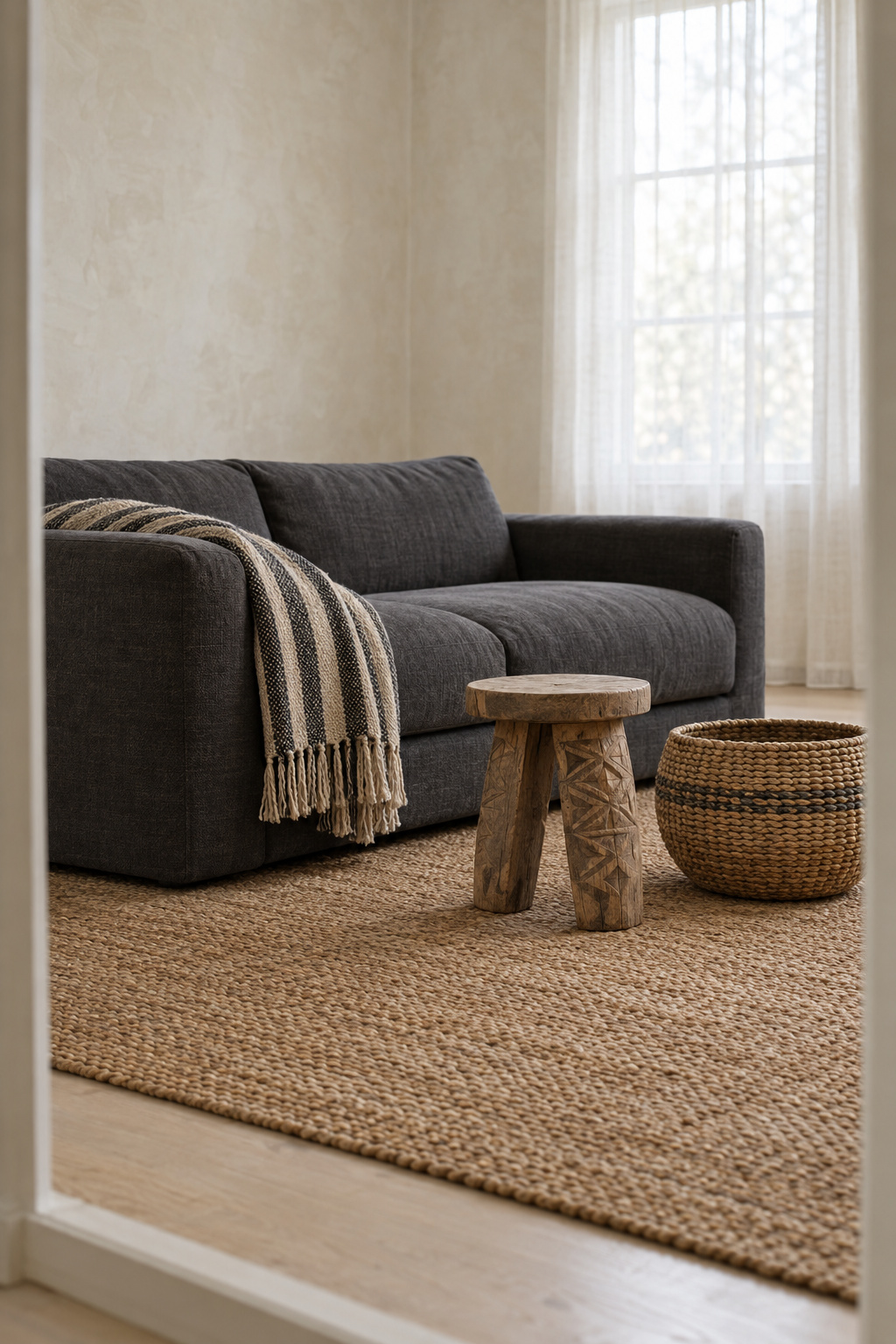
On the floor beside the sofa, an open Bolga basket holds a rolled wool throw. Its grass is close in color to the jute rug under it, so it sits in the room without drawing a line around itself. Across the room a second basket hides a plastic nursery pot holding a snake plant or a ZZ plant, something sculptural that asks for very little.
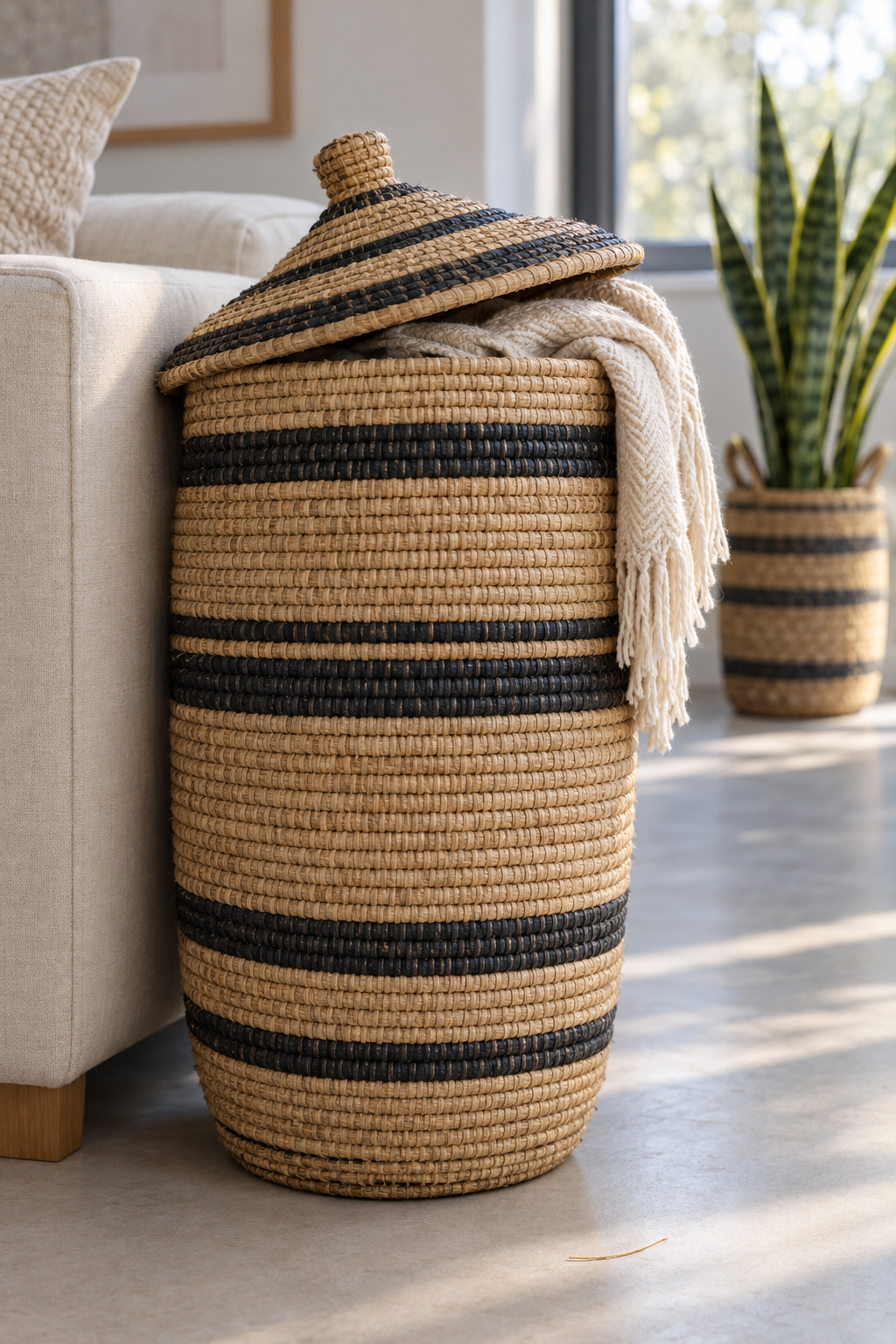
These are the same weavers around Bolgatanga, doing different work. The Upper East Region has one rainy season a year, so farmers can grow crops only once, and many families earn the rest of their living by weaving. TradeAID, a fair-trade organization in Bolgatanga, works with 60 weaver groups across 19 villages: 2,385 women and 57 men, so about 98 percent of its weavers are women. Laundry baskets, fruit baskets and pouffes are all part of what the weavers make. A storage basket beside the sofa is doing the job it was woven for.
I like a basket best when it’s holding something. An empty one set out to look warm is one more surface to dust, and a sofa with three empty baskets around it is a shop display. Give each one a throw, the magazines or the plant, and size it to what goes in. Sizing a basket to a rolled throw, keeping the grass dry and reshaping one that gets crushed are all covered in how to use baskets in a living room. A flat basket with nothing to hold can go up on the wall beside the hats.
A carved stool is furniture first: side table, plant stand, extra seat
A carved hardwood stool stands beside an armchair with a lamp and a cup on its seat. Its dark wood sits in front of a teak bookcase, and its top comes to about sofa-seat height, which tells you what it was built to be.
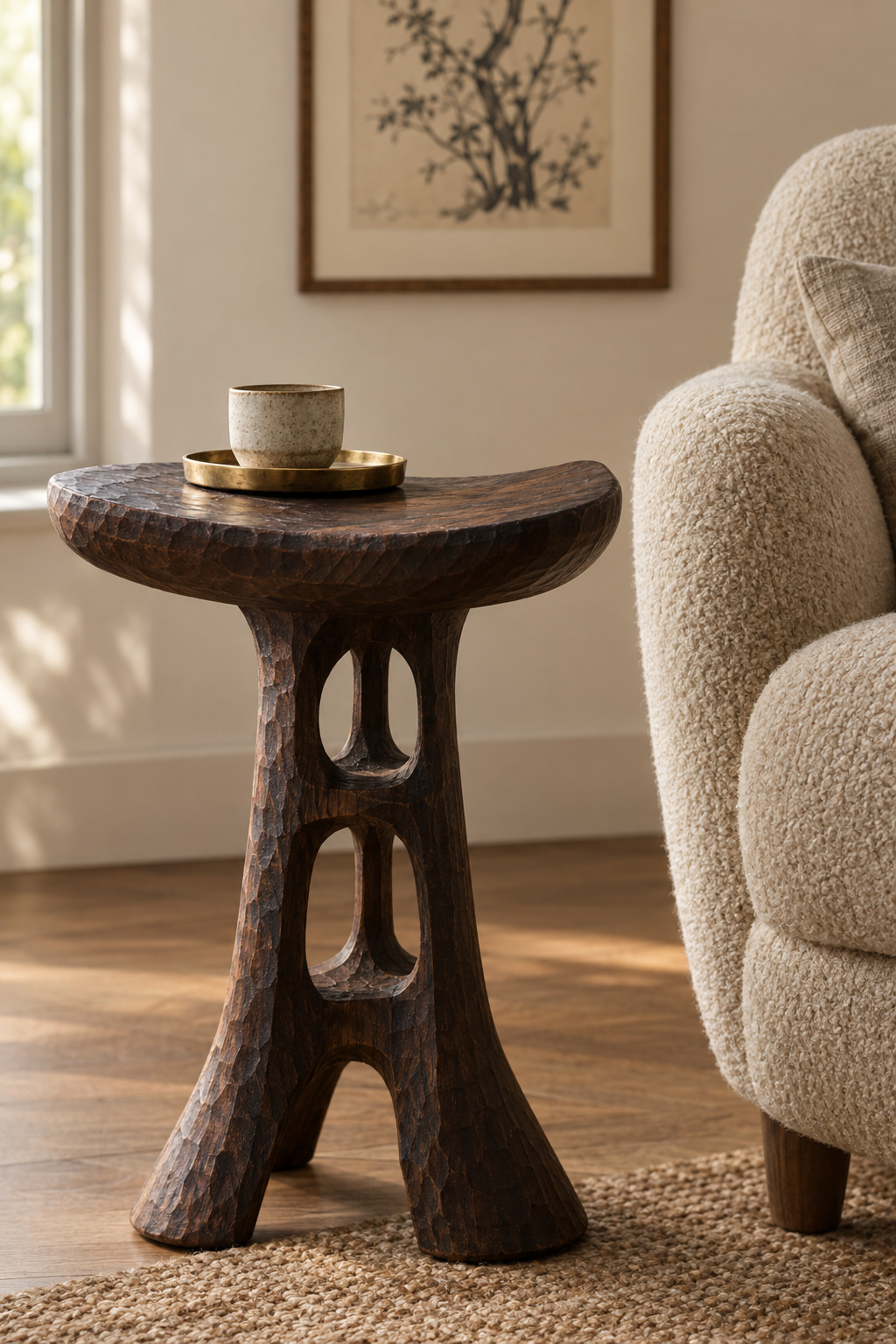
Among the Akan of Ghana, the Asante included, wooden stools have both daily and ceremonial uses, and household stools are found in every home. African carvers most often make a stool from one block of wood, so the legs, seat and base run into each other without a joint. Senufo stools from Côte d’Ivoire are low, cut from a single block and easy to carry; women used them on washday. That single block is the detail I’d grade one by. Nothing is glued, so I’d expect no joint to work loose in a dry winter. Some stools are not furniture at all, since the Asante Golden Stool is never sat upon, and a household stool made for use is the kind to bring home.
The worktable in my half-restored kitchen is a plain pine one I’ve never raised. I sit down at it to roll pastry. Nobody would photograph it, and that suits it. A carved stool deserves that kind of life more than a spot on a plinth: a mug beside a reading chair, a plant lifted off the floor, a seat for the extra guest. Those are the three jobs a carved African stool does, and each one keeps the stool in daily use.
African art for the living room: hang one living artist’s work and leave the ceremonial mask in the shop
A painting hangs above a teak sideboard on a limewashed wall. It’s the only thing on that wall, and the eye goes to it first.
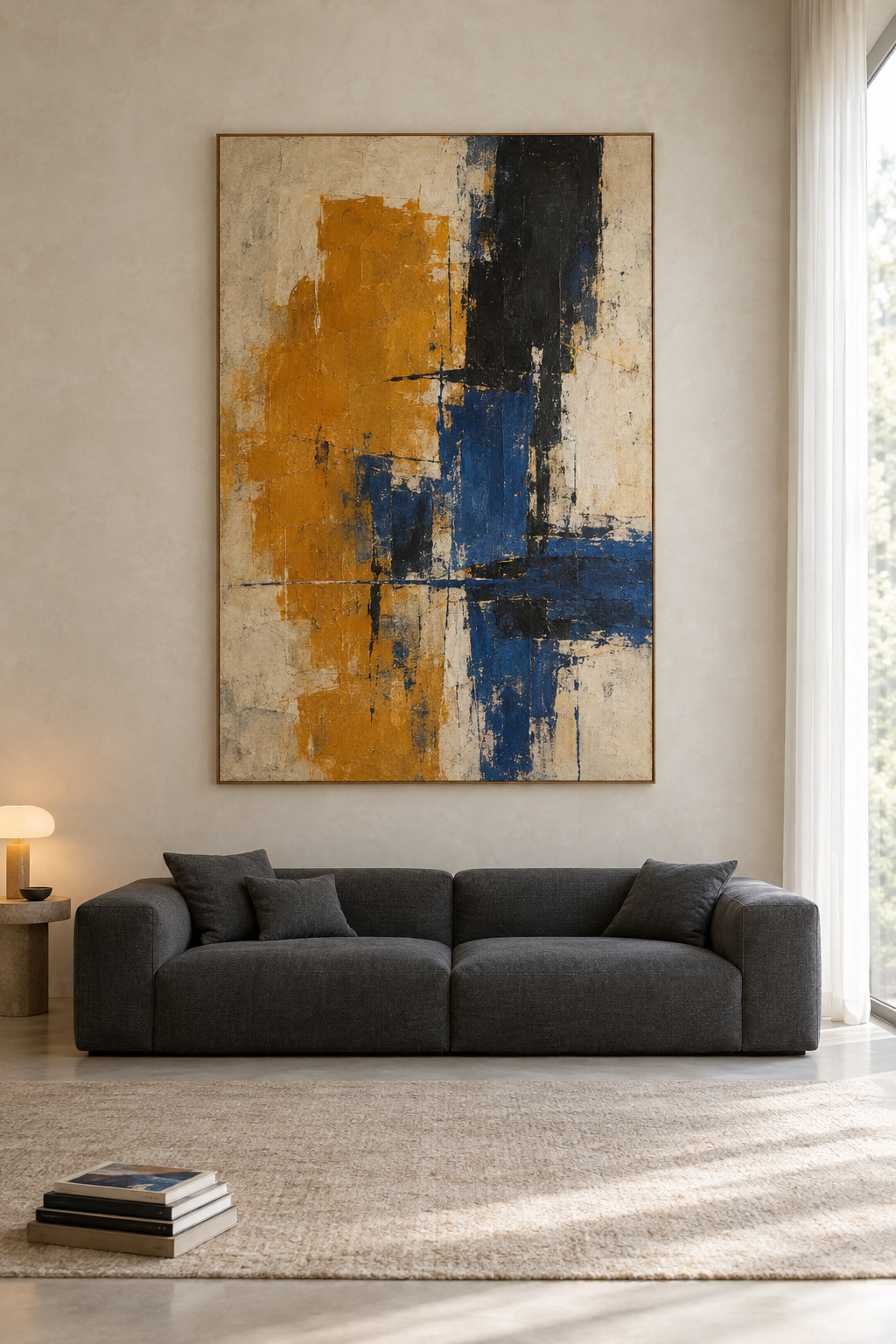
Pinterest’s description of the trend names “Ethiopian wall art,” a country rather than a continent, and that is the right instinct. Hang the work of a living African artist, someone who can be named, written to and paid. Buying from the artist or the gallery that represents them is how the money reaches the person who made the work. A living artist also answers the question the throw raised at the start, with no guesswork: you can ask where they work and when the piece was made.
History first on masks. Many were carved to be seen in performance, with dance and music, and a mask on a wall is, in the Met’s phrase, “a disembodied wood artifact” taken out of that setting; many on sale were made for the market anyway, so the history a dealer offers may not belong to the object. My verdict is to leave the ceremonial mask in the shop.
The base does a lot for a painting. A limewashed or plaster wall gives it a matte, quiet surround, and a teak sideboard below picks up warm tones without matching anything. Resist the urge to surround it with smaller pieces. A single work with a known maker holds the wall the way the Kuba panel holds its own, and the two can share a room as long as they don’t share a wall.
I spend my days with old things, and I’d still rather see a wall carry a living painter’s work than an old object nobody can explain. The names of artists and galleries worth writing to, and what to ask before paying, are in choosing African art for the living room.
Who made it comes before what it costs: the buying principle and the Pinterest figure, checked
I push sideways on every table in a shop before I look at what it costs. Most dealers have stopped being offended. The push tells me how the thing was built, and the price means nothing until I know that. Bring the same order to African craft: the maker and the place before the tag. Textiles of Africa puts the standard well. A seller should be able to name the region and, ideally, the workshop or cooperative, and the question for a buyer “is not whether a method is pure but whether it is described honestly.” A listing that offers only the word “traditional” hasn’t told you anything.
I once bought a painted cupboard for its color and left it wrapped in plastic in the carriage house for a month before I got around to testing the paint. It was the wrong order, and I knew it while I was doing it. Buying on looks and checking later is how a room fills up with things nobody can name.
Prints have a place, labeled as prints. A printed cushion sold honestly fills in around the named pieces for much less than a handmade cloth costs. Buy fewer things, on purpose. What to spend on first, and which sellers hold up, is its own subject: see where to buy authentic African decor. If the look is heading into the dining room as well, the boho dining room rugs and budget articles pick it up there.
The Pinterest figure, checked
The headline number that travels with this trend is usually pinned to the whole style. It comes from Pinterest, but not from the part most people quote. Pinterest’s newsroom announcement of its 2026 trends, published 9 December 2025, says only that searches for “african boho living room” and “afro chic home decor” are trending up, “a sign that decor is going to Dakar and beyond.” That text carries no percentage. The figure sits in the trend report itself, in a list of search phrases printed beside the trend: +220% for the single phrase “afrobohemian home decor.”
What it measures is narrow. Pinterest compared normalized global searches in English from September 2024 to August 2025 with the same months a year earlier. A rise of that size means 3.2 times the earlier level (1 + 2.20), and Pinterest gives no absolute volume, so the figure says nothing about how many people searched. The same list puts “adire fabric” at +130%.
So the figure is real, and it’s the growth of one search phrase. It tells you people went looking. It doesn’t tell you what to buy, and it doesn’t make a room of prints any more Afrohemian. My partner would want the date and the source before he believed it. Here both check out.
The finished room: fewer pieces, each one named
Walk into the room. The walls are a warm off-white limewash, matte, with the light moving softly across them. A jute rug lies under a dark carved stool and a teak sideboard. On one wall a Kuba panel hangs alone. On another, an opened feather hat sits beside a Bolga fan, and above the sideboard hangs a painting by an artist you could write to. A basket by the sofa holds a rolled throw. A printed cushion or two fill in, sold as prints and kept as prints.
Over the arm of the sofa lies the mudcloth throw, its strips joined edge to edge and its brown lines a little uneven. When somebody asks what year it is, you may not know. You will know who made it: Bamana makers in Mali, who wove it in strips and painted it in mud. Every other piece in the room can answer the same question, and that’s what makes it Afrohemian rather than a theme.