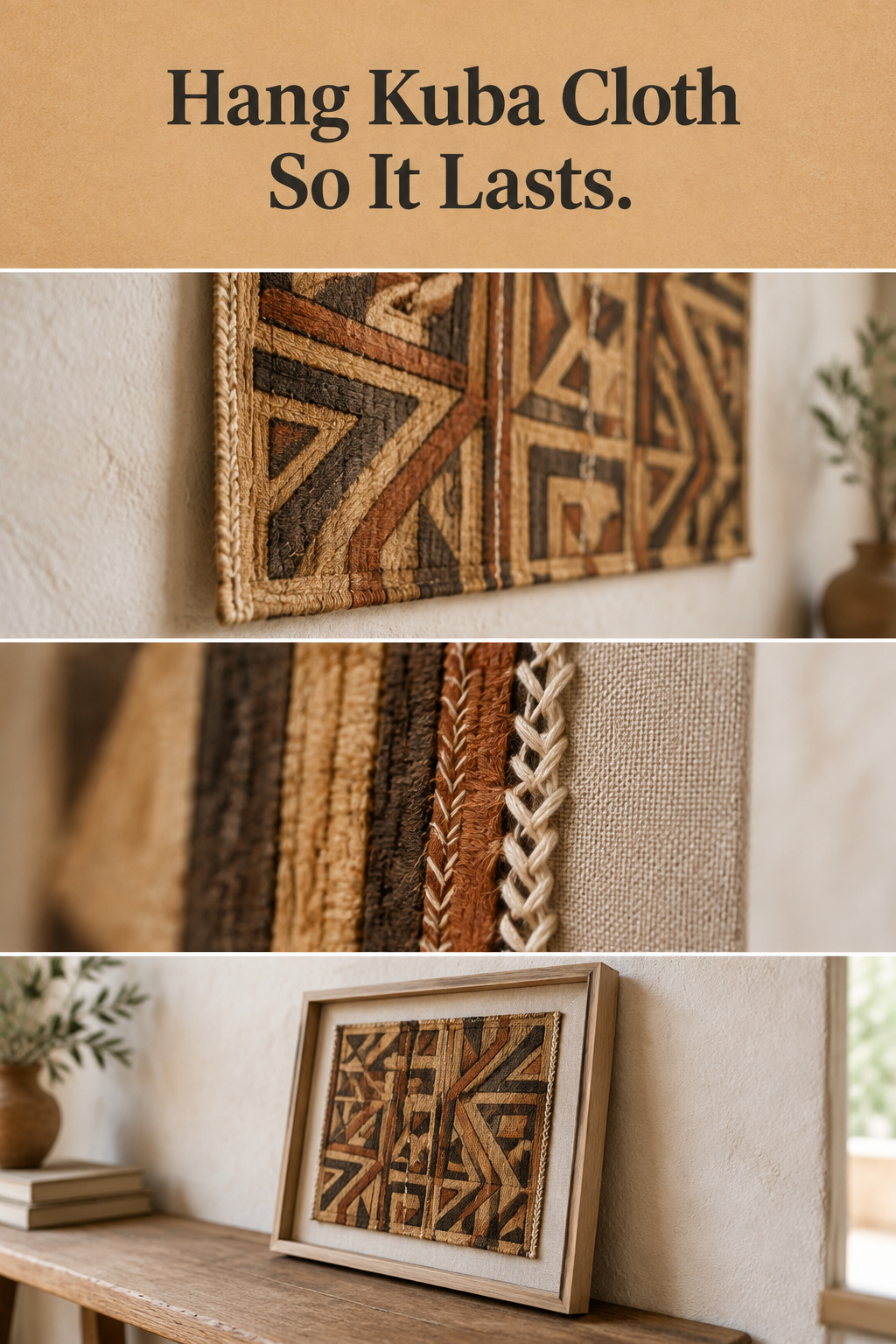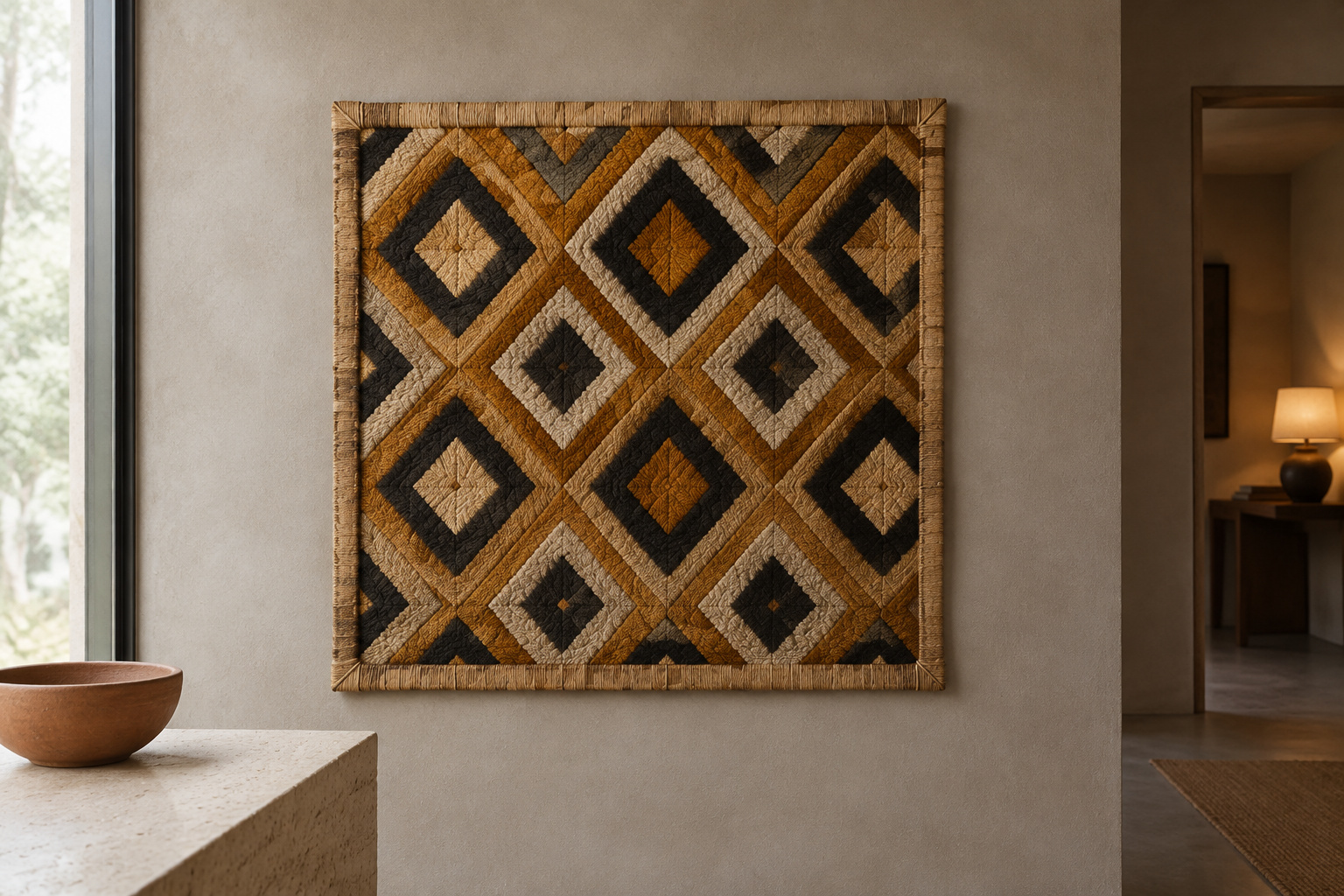
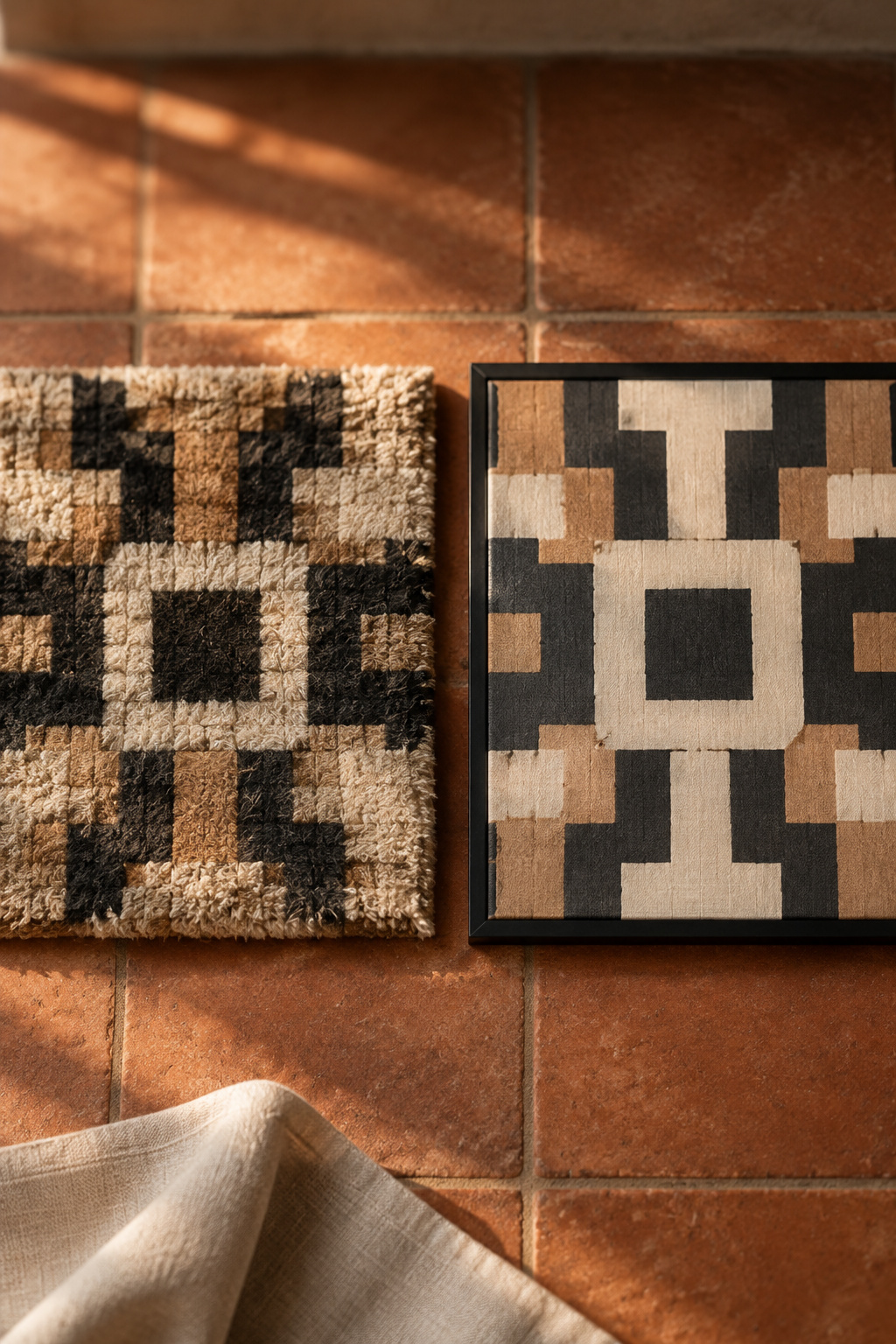
Hold a Kuba square up to a window and tilt it. The surface is a short, dense nap of raffia. Every tuft in it was cut by hand. Behind the nap sits a ground cloth woven from palm fiber, and as the tufts catch the light the pattern seems to shift.
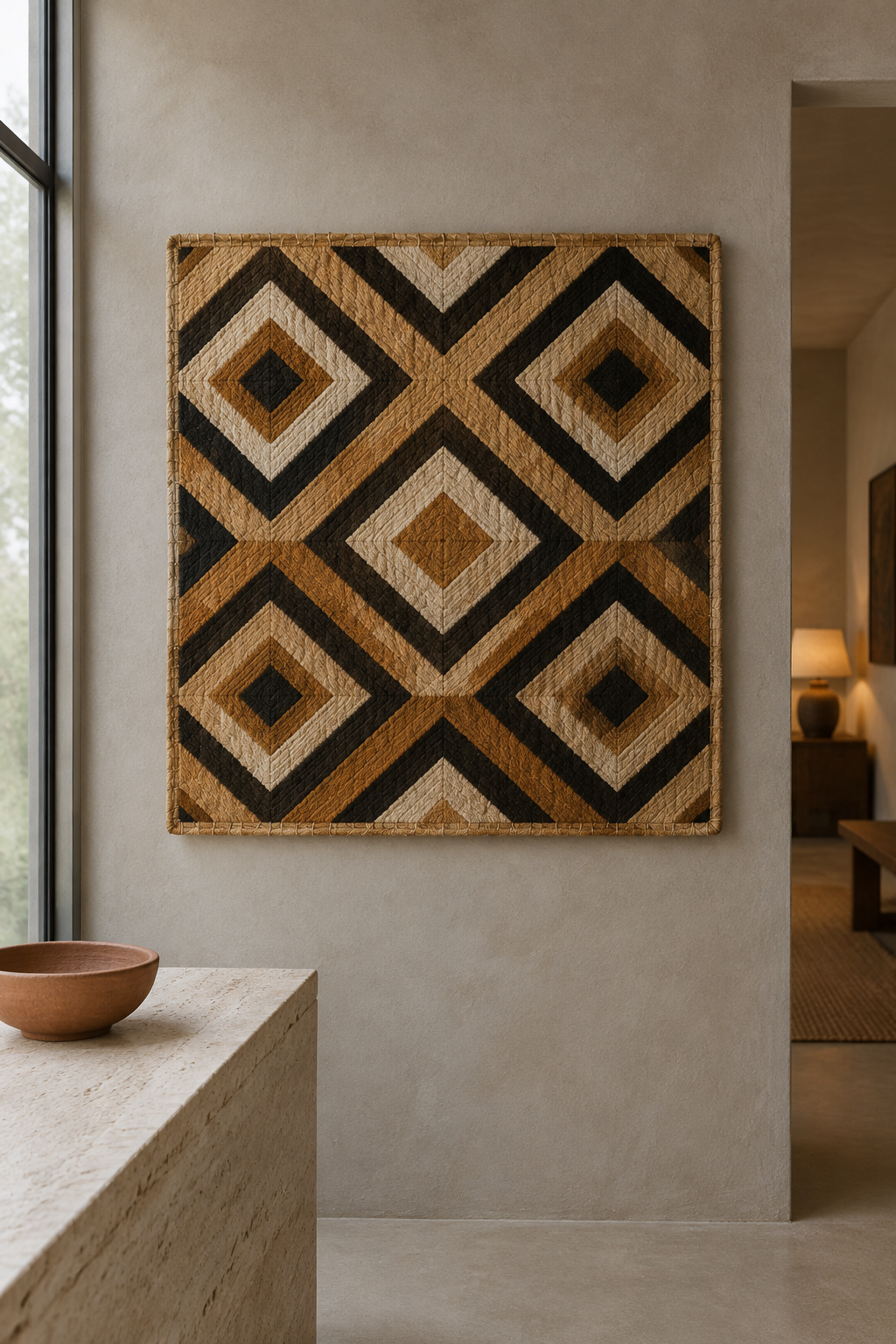
Enjoy the view, because that should be the last time the panel meets the sun. A Kuba cloth wall hanging asks for three things: a mount that holds it without glue or staples in the cloth, a wall out of direct light, and a note on the back for whoever owns it next.
TL;DR
- Stitch a small Kuba square to a fabric-covered acid-free board, or hang a long skirt panel from a hook-and-loop sleeve; nothing adhesive or metal should touch the cloth.
- Keep it out of direct sun at every hour of the day: museums light textiles at about 50 lux, and direct sunlight runs around 30,000 lux.
- If the piece is a print, not hand-cut raffia, an ordinary frame or clips will do, but it still belongs out of the sun.
Read the Panel First: What a Kuba Cloth Is Made Of
Kuba cloth comes from the Kuba Kingdom in the Kasai region of the Democratic Republic of the Congo, and museum records agree on who made what. Men weave the raffia ground; women embroider it and, on the Shoowa squares, cut the pile: a fine raffia thread is drawn under the warps with an iron needle so both ends stand up, then trimmed with a flattened blade to a few millimeters. That plush surface is why the cloth is called Kasai velvet.
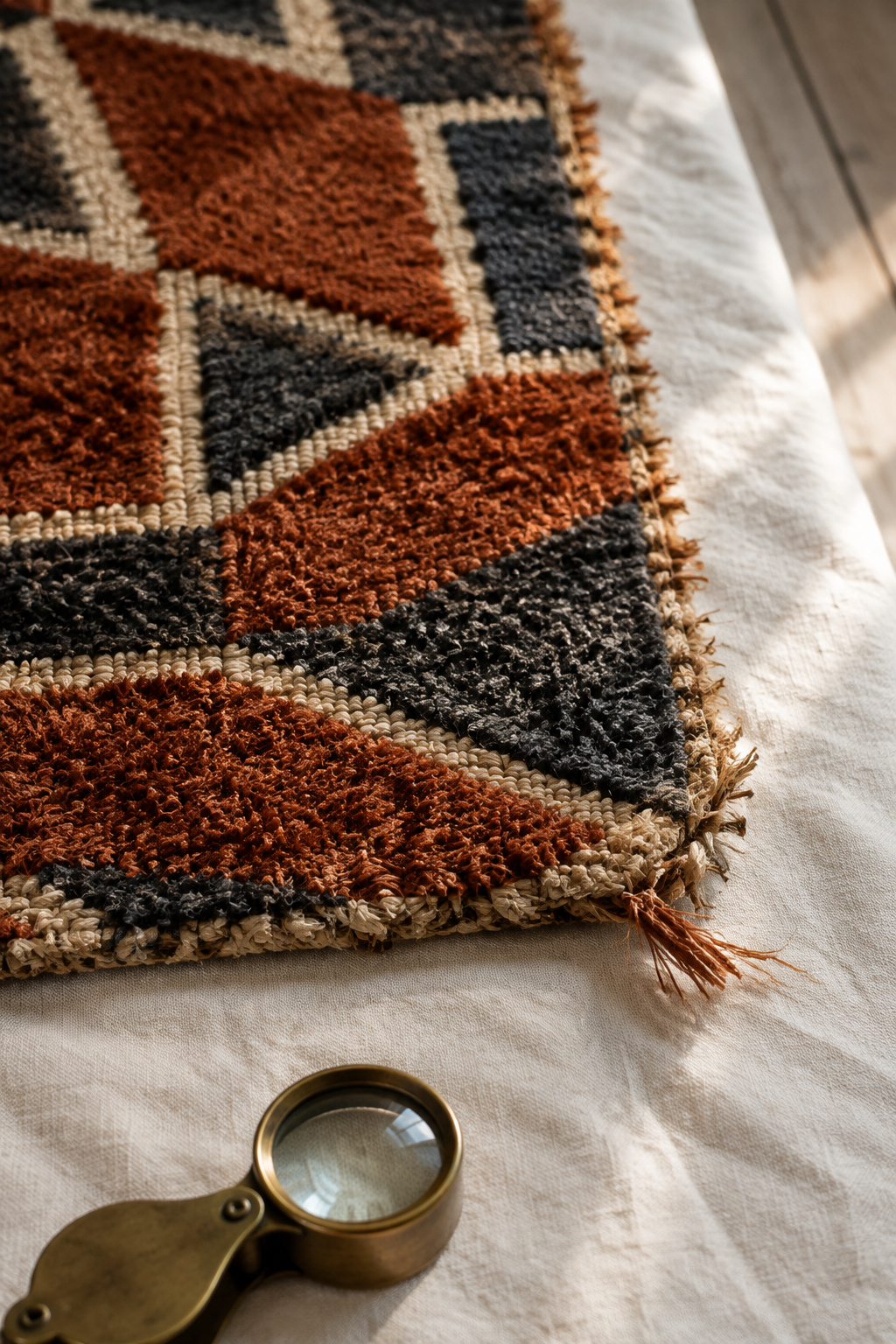
Two shapes reach the decor market: the small Shoowa squares, and long skirt panels once worn at ceremonies, funerals among them. Hanging either flat on a wall is a recent use, adapted particularly for Western buyers. A cloth made to be worn was never designed to hang from plaster for decades.
So go over the panel before you choose a mount, with the same construction-first eye you’d bring to reading a handmade mudcloth. Move it on a flat support, never by a corner. Look for loose tufts, fiber that powders when touched, splits, old repairs and glue residue. White velvety growth with a musty odor is mold. Any of those, or insect damage, and the panel goes to a textile conservator first. I would rather lose a season of looking at a piece than lose a corner of it.
How a Kuba Cloth Wall Hanging Gets Ruined: Glue, Staples, Tape and Sun
My test for any change to an old piece is whether the next owner can undo it. Every common shortcut for hanging cloth fails it.
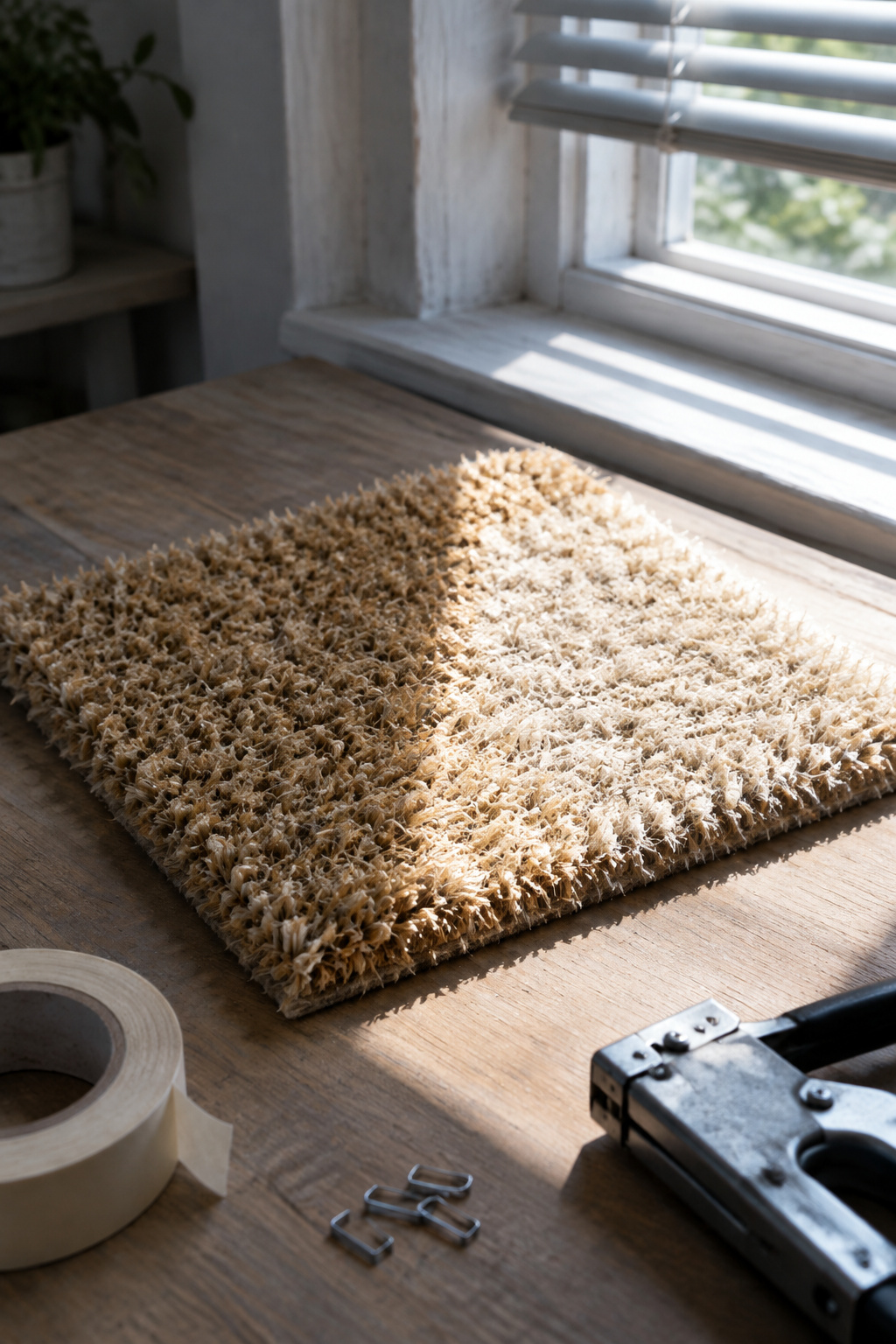
Glue and spray mount leave residue that no framer can lift off; conservators list adhesive residue among the faults that need professional treatment. Tape is glue on a roll. Staples, tacks and nails distort the weave, tear it as the cloth’s weight drags on a few points, and stain it as the metal corrodes; the Canadian Conservation Institute says flatly that they “must not be used.” That guidance is written for textiles in general, not raffia in particular, and I see no reason a plant-fiber cloth would fare better.
I warm hide glue in an old baby-bottle warmer, because it holds the right heat and nobody minds the smell. That glue belongs on wood and nowhere near cloth.
Sun is the slow version of the same mistake. Light fades dyes and leaves fibers brittle, and the damage adds up: brightness multiplied by hours, so halving either halves the harm. None of it comes back.
Conservators do use glue and staples, which surprises people. The glue holds the fabric cover to the back of a mount board, and the staples fix hook tape to a wooden batten. So the rule is narrower than “no glue”: nothing adhesive or metal touches the cloth.
Three Reversible Mounts: Covered Board, Hook-and-Loop Sleeve or Box Frame
Each comes apart without damaging the cloth. Choose by the panel’s size and soundness.
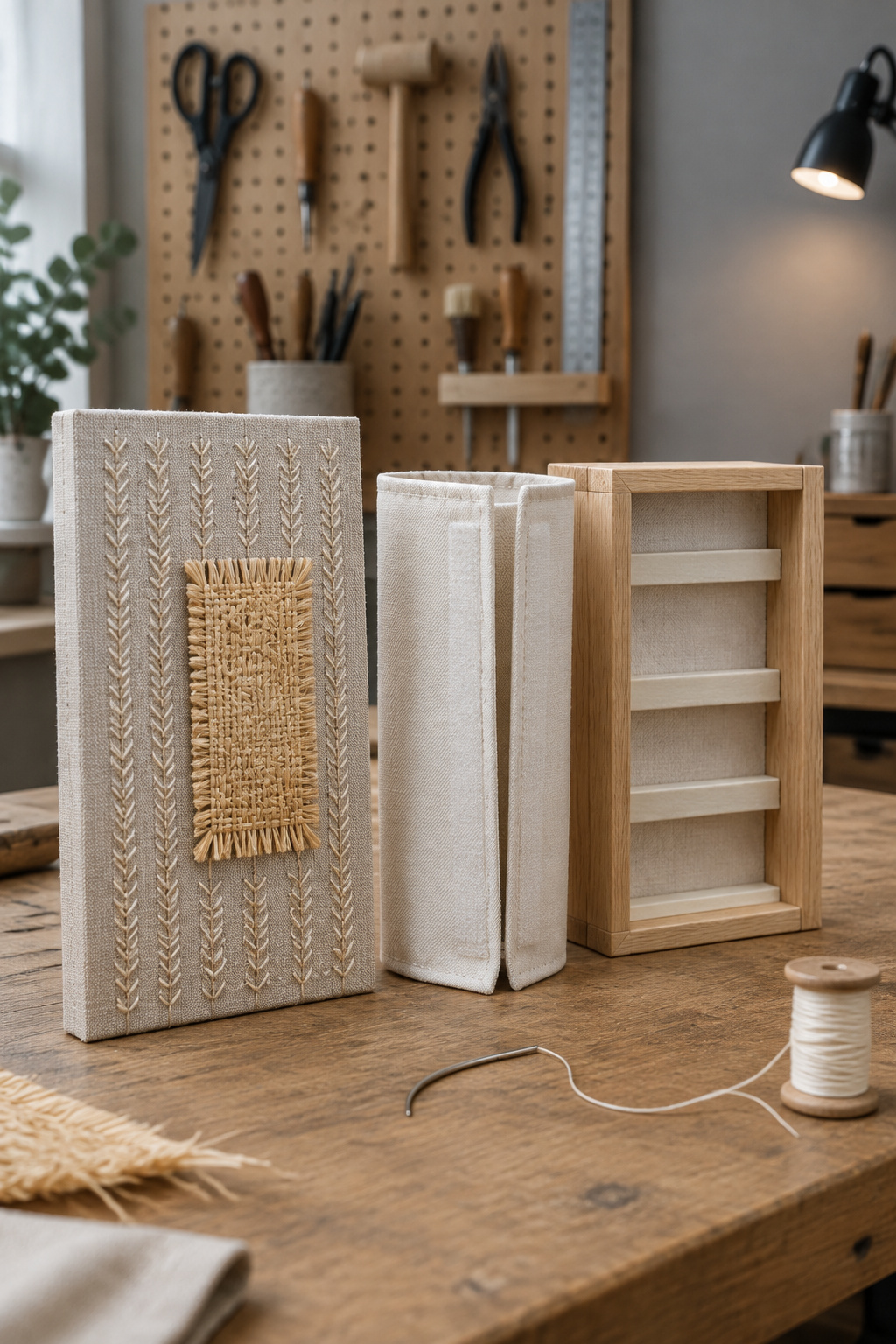
| Method | What holds the cloth | Best for | What it needs or risks |
|---|---|---|---|
| Stitched to a fabric-covered board | Fine cotton stitches through the cloth into the cover fabric | Small Shoowa squares and other light, flat pieces | Acid-free rag board and washed cotton; stitches must stay loose |
| Hook-and-loop sleeve | A cotton strip hand-sewn to the back, its loop tape gripping hook tape on a sealed wood batten | Long skirt panels and large pieces in good condition | A cloth sound enough to bear its own weight; not for fragile pieces |
| Box frame with spacers | The covered board, set behind glazing held off the pile | A square you want behind glass | Conservation framing materials and at least 10 mm between pile and glazing |
For the sleeve, hand-sew the cotton strip 1 to 1.5 cm below the panel’s top edge; hook-and-loop tape is too stiff to stitch straight onto a textile. Never pull on the cloth to take it down.
Stitching It to a Fabric-Covered Board, Step by Step
My workshop is the converted carriage house behind the house, cold in January and smelling of linseed oil all year, and I wouldn’t lay raffia down in either. Work somewhere clean and dry, on a flat table.
- Measure the space, then cut acid-free rag board to sit easily inside the frame or space you plan to use.
- Wash a plain-weave cotton cover fabric with no softener or bleach to strip the starch.
- Sew the fabric into a snug pocket, slip the board in and overcast the open edge at the back, taut without warping the board.
- Lay the panel on smooth acid-free tissue, use the tissue as a sling to lower it onto the board, then slide the tissue out.
- Pin at an angle between the threads, into the cover fabric, not the board.
- With a curved needle and fine cotton thread, sew a row of herringbone stitch along the top edge, then vertical rows about 2.5 to 7.5 cm (1 to 3 in) apart, closer on a fragile piece, and finish with an overcast stitch around the perimeter.
Cross over the raffia instead of piercing it, and never pull the thread tight; polyester thread can slice fiber under tension. Keep face stitches small enough to vanish into the pile. If you glued the cover on instead of sewing a pocket, let the glue dry and air out fully before the cloth goes near it.
When to Pay a Framer
Pay a framer for the box frame, UV-filtering glazing and a finished back, and choose one who works with conservation methods. Talk dimensions before you stitch the panel down, and ask for spacers, acid-free board and no unsealed wood. Anti-static acrylic is usually kinder than glass, which can tear a textile if it breaks. If the panel failed your inspection, skip the framer altogether: mold, insect damage, powdering fiber, splits or old adhesive are a conservator’s work.
Where It Hangs: Light, Sun and the Wall You Give It
Museums light textiles at about 50 lux, and museum bodies put the same advice in plainer words: never in direct sunlight. Direct sun runs around 30,000 lux; evening lamplight at home is roughly the museum level already. You don’t need a light meter. You need a wall the sun never reaches.
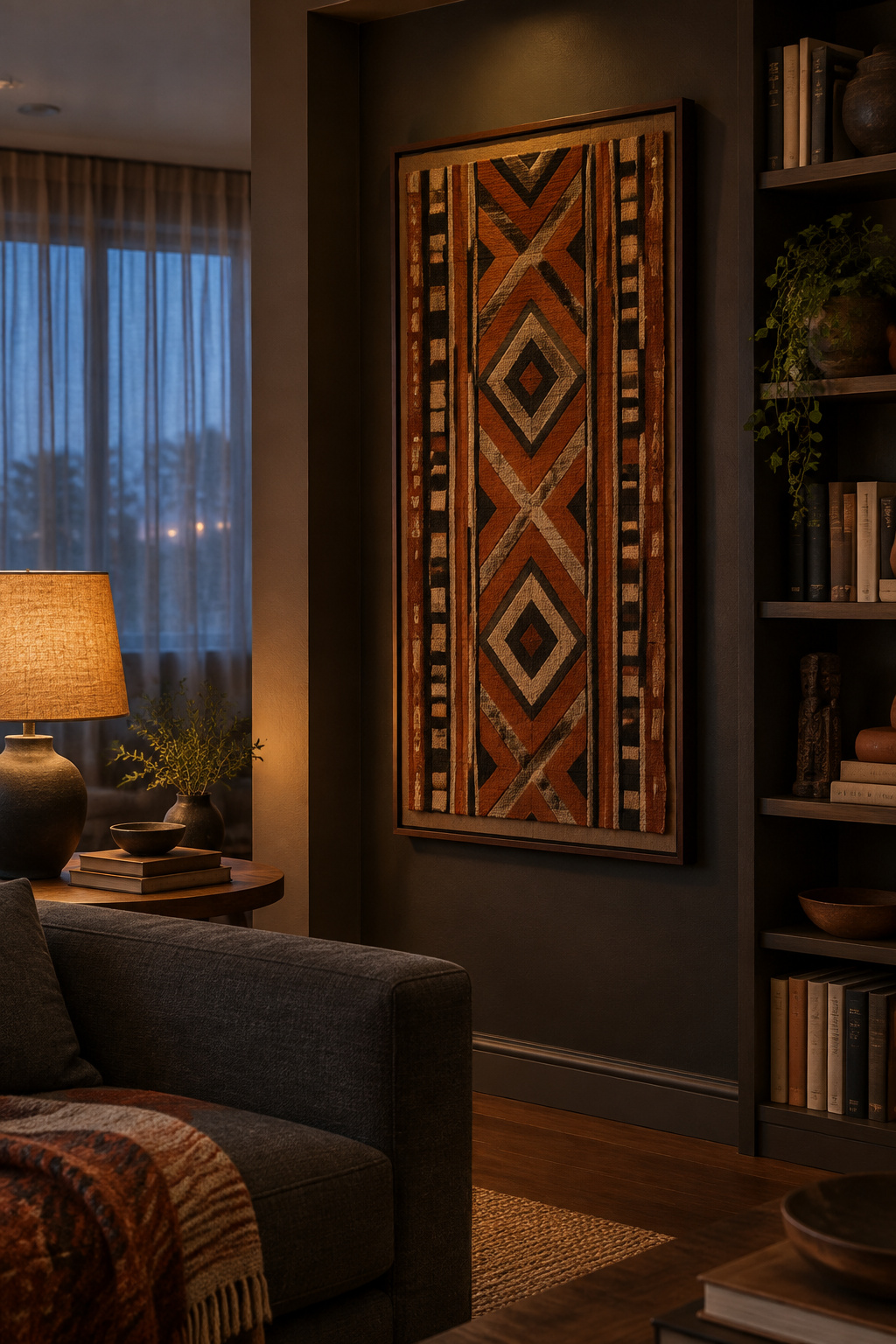
Institutions disagree, widely, on the yearly total a textile can take. I’d leave that number to the museums and keep the sun off the cloth.
- Pass over any wall that catches sun at any hour, including the one facing a south or west window.
- Keep it clear of a radiator, fireplace or heating vent; swings in heat and humidity make cloth expand and contract.
- Where daylight does reach the room, add clear UV film to the window or UV-filtering glazing to the frame.
- Light it with a warm lamp across the room, not a picture light at close range that heats the pile.
- If the only good wall is a bright one, rotate: take the panel down and rest it for a stretch.
A panel this strong competes with anything else on the main wall, so settle that before you put in a hook; choosing art for the same wall decides which piece gets it.
If It Is a Print or Kuba-Inspired: The Lighter Mount
Early on I insisted on stripping every painted door to bare wood. Then I learned that some doors were meant to be painted, and the bare wood was never meant to be seen. Treatment has to fit the thing in front of you, and a printed Kuba-pattern cloth is not a cut-pile panel. It has no nap to crush, and it can be replaced. My call is an ordinary frame, a clip hanger or a hanging rail. Keep it out of direct sun anyway, since light fades printed dyes too, and behind glass use a mat so moisture doesn’t condense on the surface.
Hand-Cut Raffia or Printed Copy: One Check
Look at the surface edge-on and run a hand over it. Cut pile stands up in short, separate tufts, the fiber feels coarse, and the spacing of weave and stitch wanders a little. A print is flat, soft and exactly repeated. Material alone is a weak test, since even genuine pieces are sometimes worked on another base cloth, so trust the tufts.
Label the Back, Then Hang It: Your Next Step
A good restorer leaves notes for the next one. I write what I did and the date in pencil on the underside of anything I repair, and a mounted Kuba panel deserves the same courtesy. The place for that note is the mount.
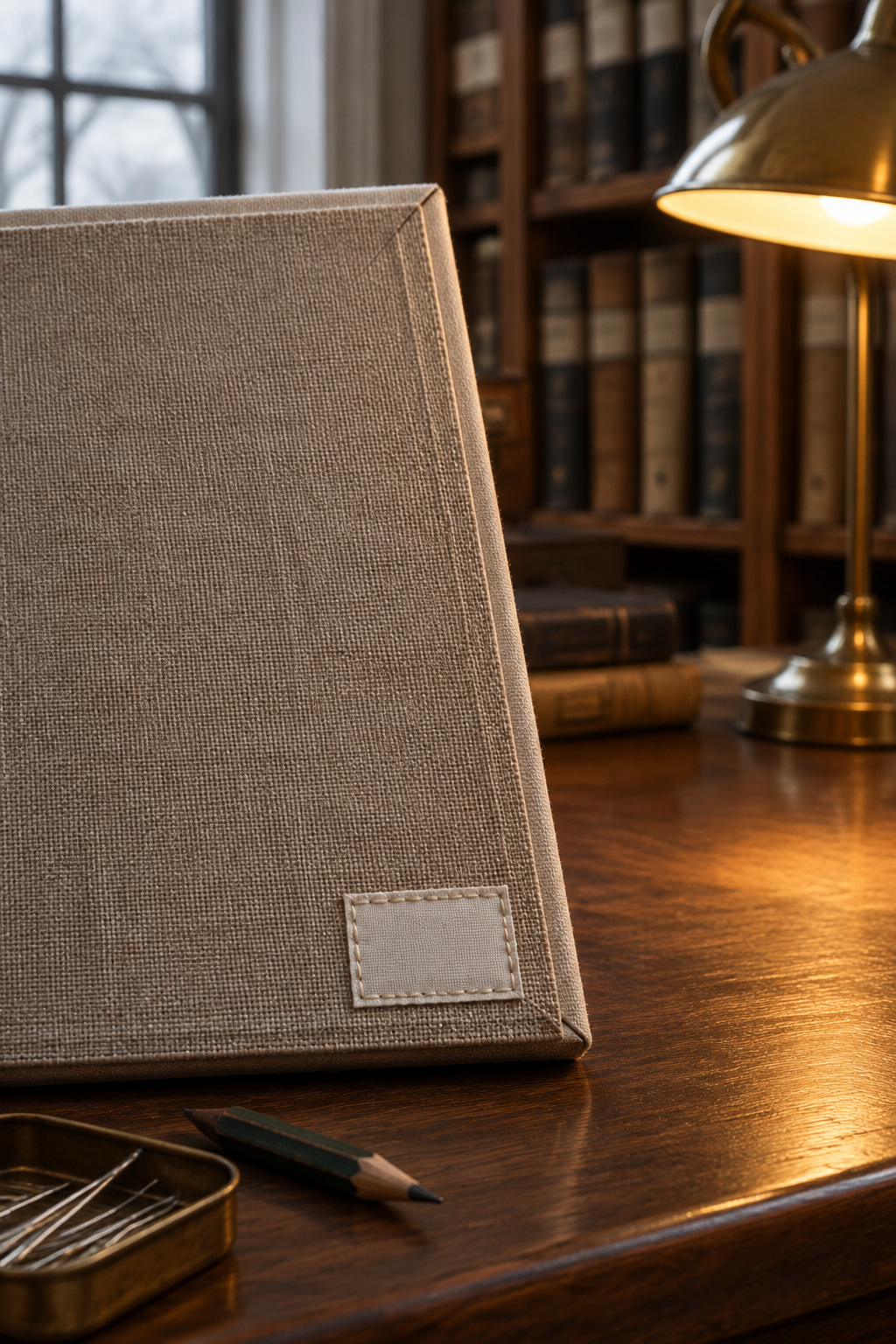
My label for a textile mount carries what the piece is, where it came from if I know, how it is mounted and with what (acid-free board, washed cotton, cotton thread, a sealed batten), the date, and who did the work. That materials list lets someone take the mount apart without guessing. If you sew a label onto a sturdy cloth instead, put it on the reverse with a few cotton stitches and keep the knot against the label, never the textile. On a fragile panel, label the mount only.
If you are building an Afrohemian room around named pieces, a panel like this is one of them. So when you have an hour, take yours down from wherever it’s pinned, lay it flat on a table and check it over: a small square in sound condition goes on a covered board, a long skirt panel in good shape goes on a sleeve, and anything fragile goes to a conservator. Then find the wall the sun never touches, and write the note for whoever takes it down next.
FAQ
Can you hang a Kuba cloth in a bathroom or kitchen?
Better not. Damp air invites mold, and mold moves fast: at 70% relative humidity it takes three months or more to appear, and at 90% only a few days. Swings in heat and humidity also make cloth expand and contract. I wouldn’t volunteer a panel for either room.
How do you clean dust off a Kuba cloth?
Vacuum it gently through a protective screen at the lowest suction, working with the direction of the pile and lifting the nozzle up and down rather than dragging or scrubbing. Suction lifts the dust; pressure only pushes it in. Skip this on a panel with powdering fiber or loose tufts, and leave any washing to a conservator.
How big is a typical Kuba cloth panel?
There is no standard size, but the small cut-pile squares in museum collections run about 46 to 73 cm (18 to 29 in) on a side. Long skirt panels are another matter: one wraparound skirt at the Textile Museum measures 69 by 177 cm (about 27 by 70 in). Check yours with a tape measure before choosing a mount.