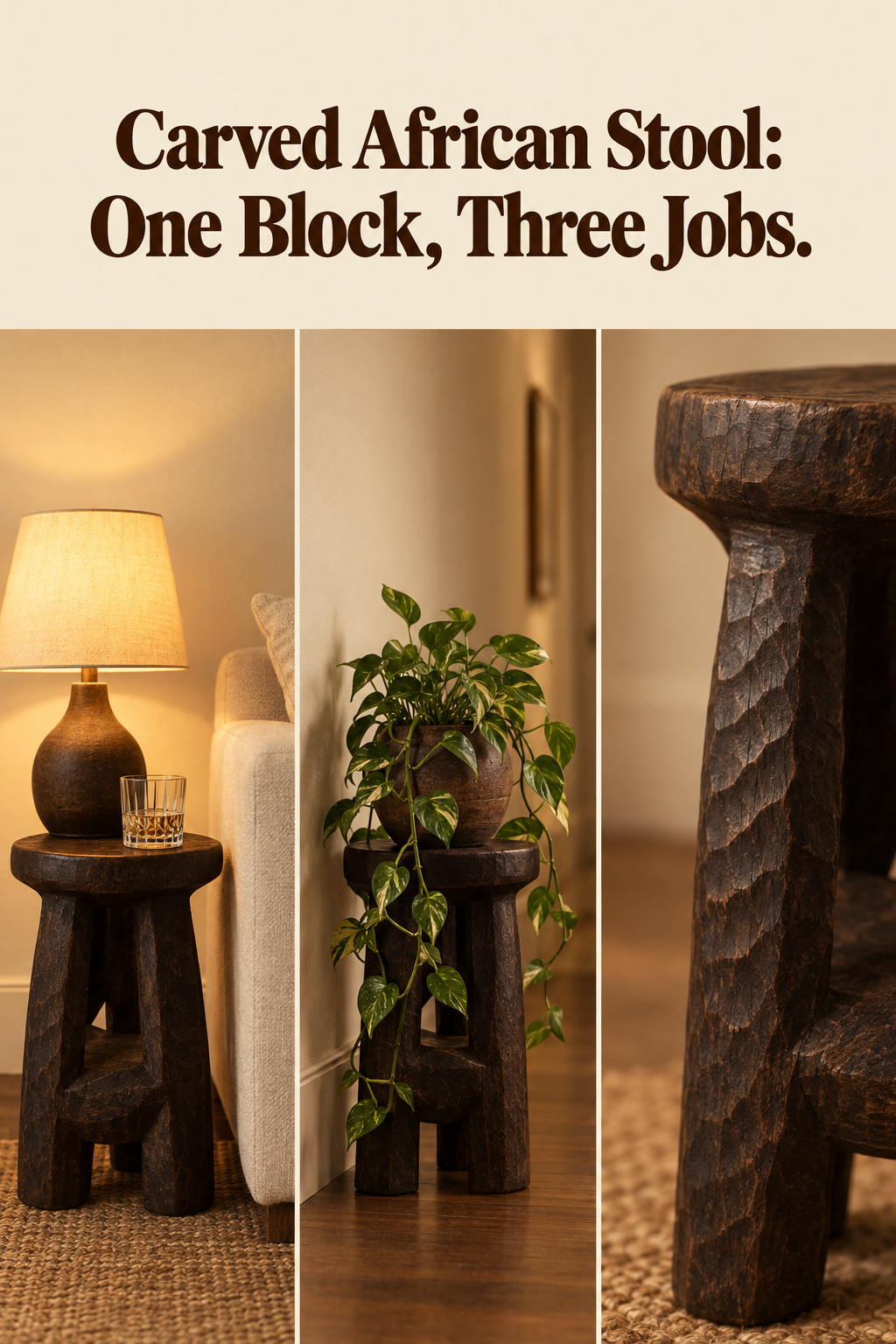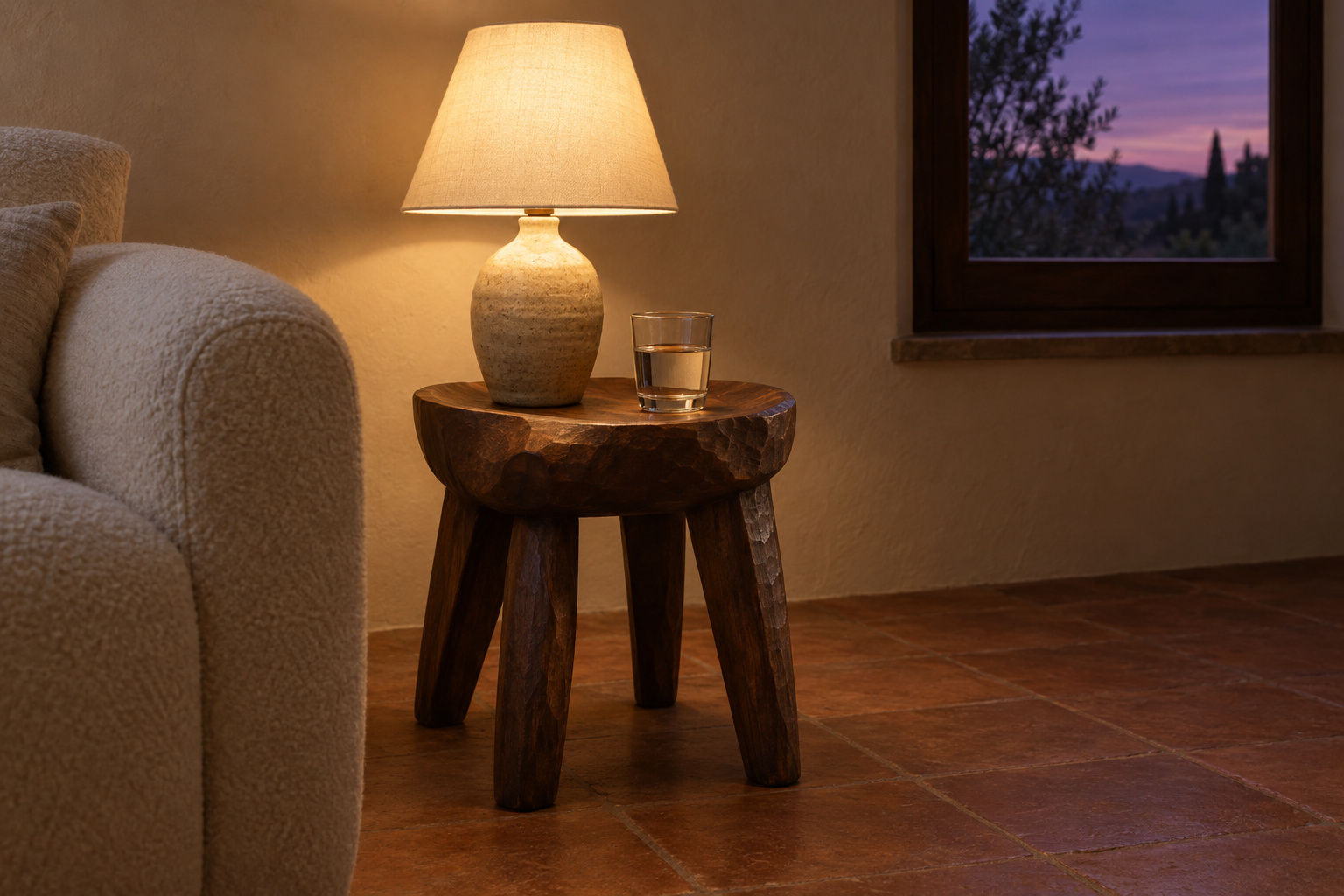

I hold the end of a tape on the floor beside a sofa. I run it up to the top of the arm and read 24 inches. Then I move the tape to a carved stool standing under a lamp. It reads 17.5.
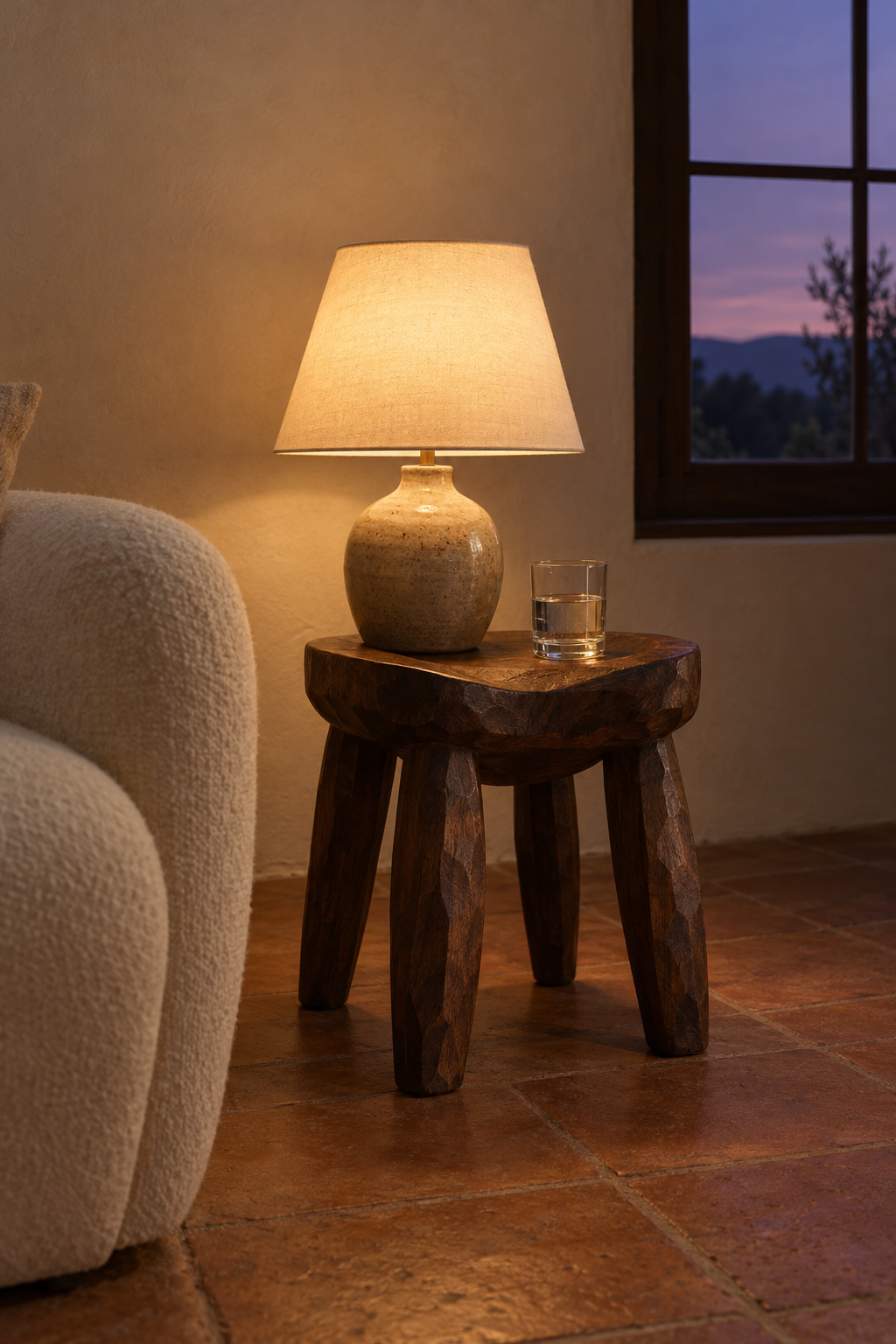
That gap is why I stopped thinking of a stool as a side table and started asking what it is actually for. A carved African stool cut from one block does three jobs in a living room: a low table beside a lounge chair or an armless chair, a plant stand, and an extra seat level with the sofa cushion. It can do all three because there is no joint and no glue in it to fail.
TL;DR
- A carved African stool of 15.75–17.5 in sits level with a 17–19 in sofa seat but 6.5–10.25 in below a 24–26 in arm, so use it as a table beside a lounge chair, an armless chair or a low-arm sofa.
- One block means no joint or glue to fail in dry winter air, but four flat legs that sit level decide steadiness more than the carving does.
- Keep it at least two feet from a radiator or vent, hold indoor humidity somewhere in the 35–55% band sources give, and accept hairline checks but not a crack that keeps widening.
Why a carved African stool is cut from one block, and why that matters
Turn one over and you see it. Legs, seat and base run into each other with no seam, because the carver started with a block of wood and took away everything that wasn’t stool. The Smithsonian’s National Museum of African Art says it plainly on the label for a stool from Guinea: “Typically carved from a single block of wood.” Collection records for Senufo stools and an Asante household stool say the same.
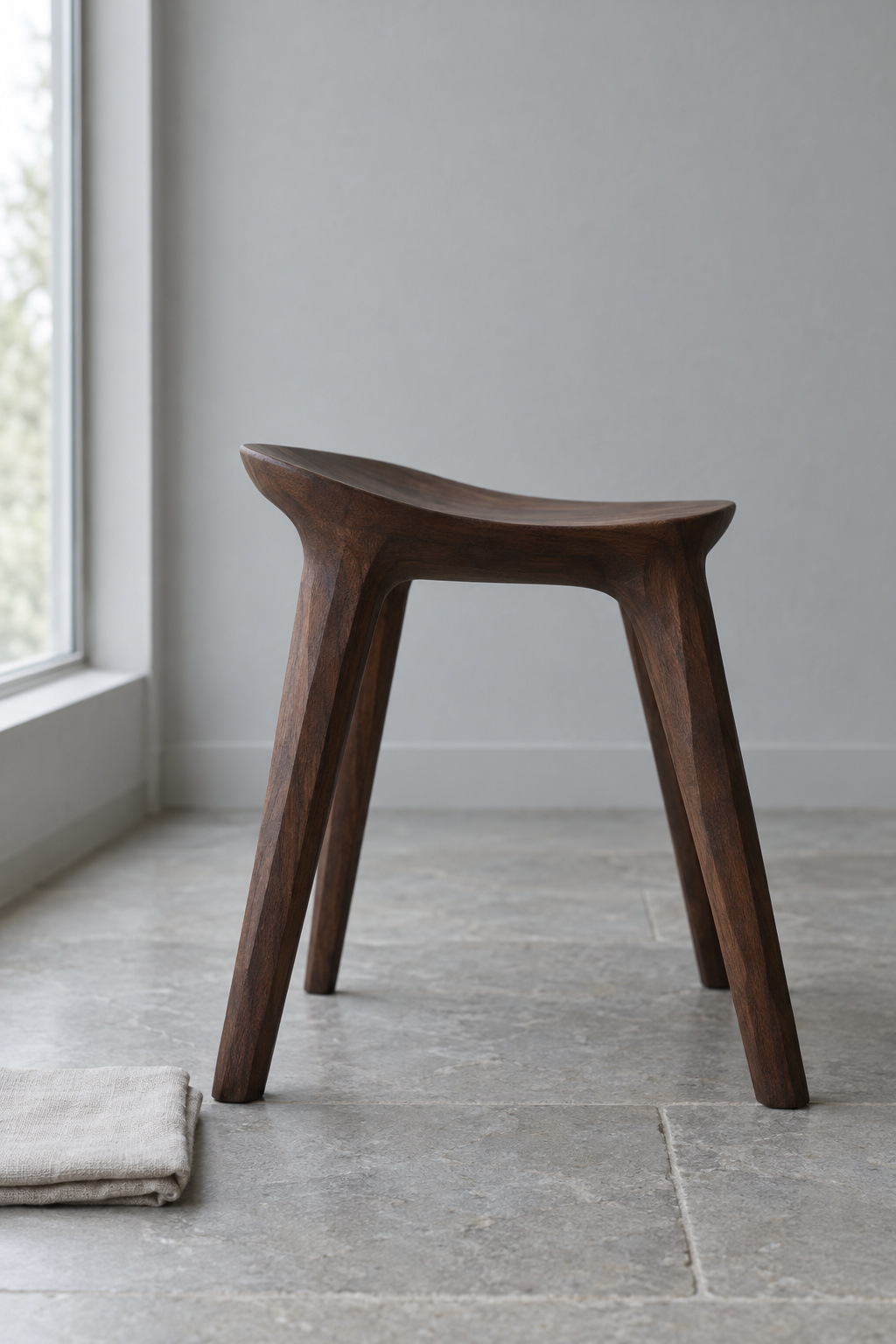
That matters more to me than any carving on the side. In dry indoor air, a conservator at The Henry Ford lists what goes wrong: structural cracks, lifting veneer, gaps in joints and brittle adhesives. A stool from one block has no joints and no glue, so three of those four have nothing to work on. It is also why I say most of what I see sold as Scandinavian furniture is pale veneer pretending to be wood: buy fewer pieces of actual wood.
One stool’s name gets borrowed, so it needs a word. The Golden Stool of the Asante in Ghana dates to about 1700 in court histories, and the Metropolitan Museum calls it “no functional seat but rather a metaphor for the power of the Akan state.” Nobody sits on it; it rests on its own chair. A decor stool is not a Golden Stool, and the name has no place on a listing. The stools worth bringing home are household seats, made to be used, and that is the kind that belongs in an African boho living room.
Job one: a carved African stool as the side table beside your sofa
I read furniture catalogs from the back, where the dimensions and materials are. With stools, the photograph and the numbers disagree.
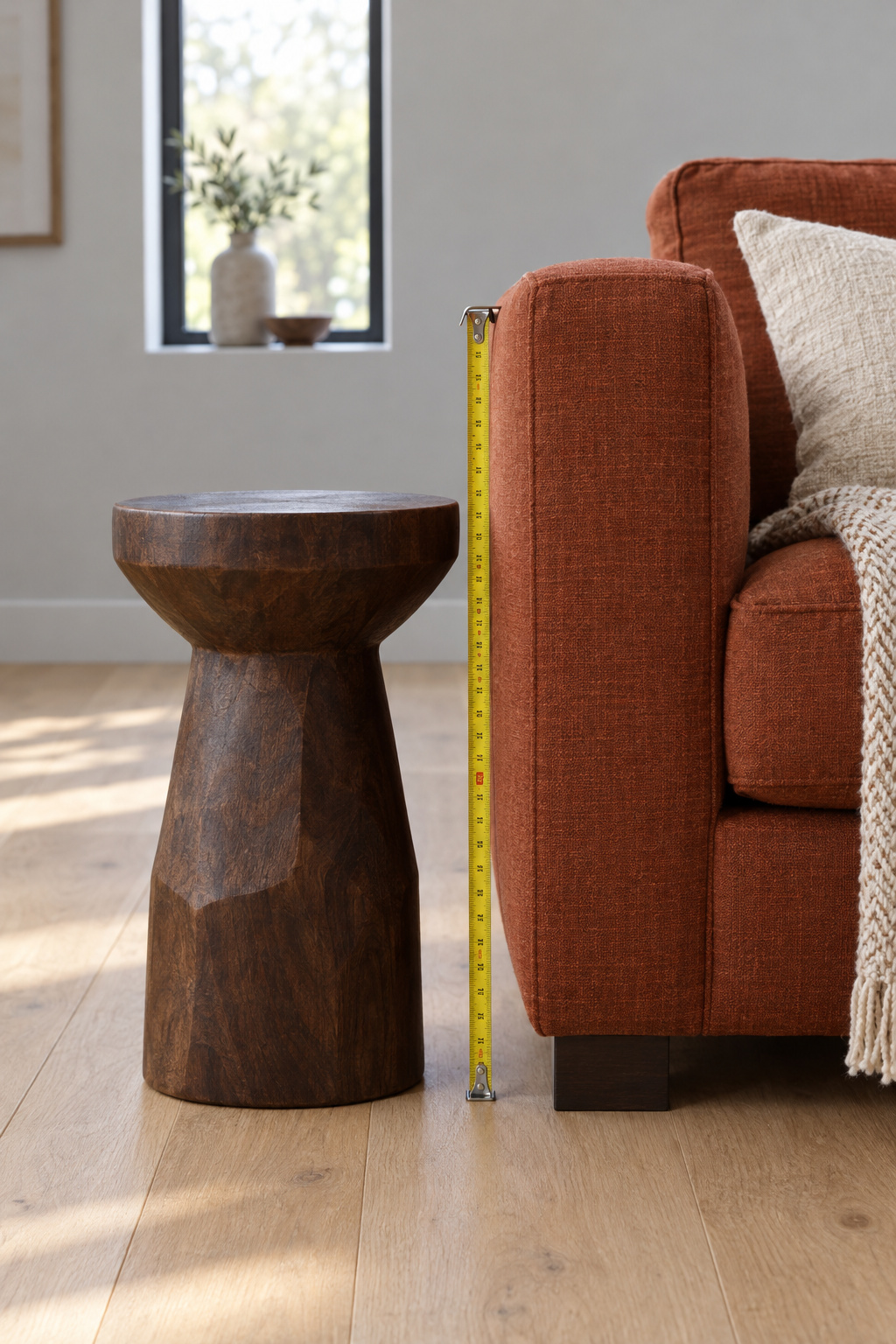
Design guides agree that a side table should sit level with the sofa arm or no more than about 2 in below it. Against that rule:
| Height | Compared with the stool | |
|---|---|---|
| Carved decor stool | 15.75–17.5 in | the reference |
| Sofa seat | 17–19 in | 0.5 in lower to 3.25 in higher |
| Sofa arm | 24–26 in | 6.5–10.25 in higher |
| Side-table rule | level with the arm to 2 in below | the stool misses by at least 4.5 in |
The arm row fails, so read the seat row. A stool this tall was built as a seat, so it matches seat height, and it works as a table beside something with a low arm or none: a lounge chair, an armless chair, a low-arm sofa. Beside a standard sofa it becomes a low companion you reach down to.
For a mug, that is plenty. I use the same mug every day and have stopped apologizing to guests for not owning a set; one mug needs very little table.
For a lamp, measure from where you sit: the bottom of the shade should land at about seated eye level, which on a stool this low means a taller lamp. Leave a few inches between stool and arm, line it up with the front of the arm, and set a Bolga basket beside it for throws. Styling a coffee table nearby is a separate job.
Jobs two and three: a plant stand and an extra seat that holds an adult
Before the product question comes the room question: what do I want this corner to be? If the answer is green, the stool lifts a plant off the floor and closer to the eye. My one rule is a cover-pot or a saucer, never a bare pot on the wood. Standing water raises the grain and stains it.
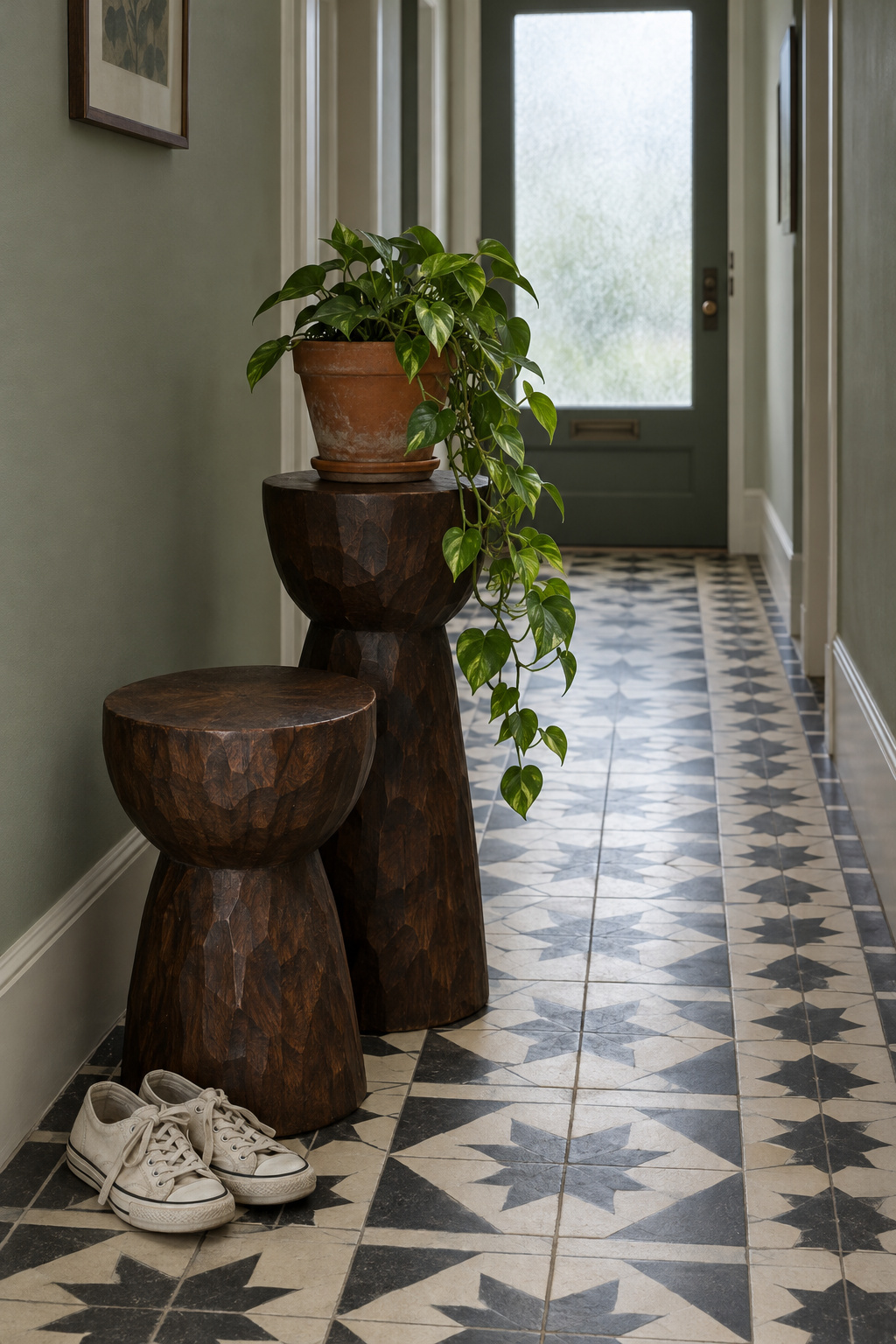
As a seat, a stool is simply doing what it was made for. Senufo stools were everyday household seats, and Asante household stools are ordinary furniture in Ghana. A guest sits a little lower than on the sofa, which nobody minds for an evening. I also think a hallway deserves a chair, and a stool is the most forgiving chair you can put there.
No one publishes a weight rating for a carved stool, or for the plant on it. The legs decide. Four flat legs on a level floor are the safer form. The three-legged Lobi seat that men carried on the shoulder was called assez instable, rather unstable, by Henri Labouret, writing in French. One block takes glue out of the question. The legs are still yours to check.
What to check before you buy a carved African stool
In a showroom I pull a drawer all the way out and turn it over, because the underside is where a maker stops performing. A stool has no drawer. Turn the whole thing over.
Reading tool marks and grain
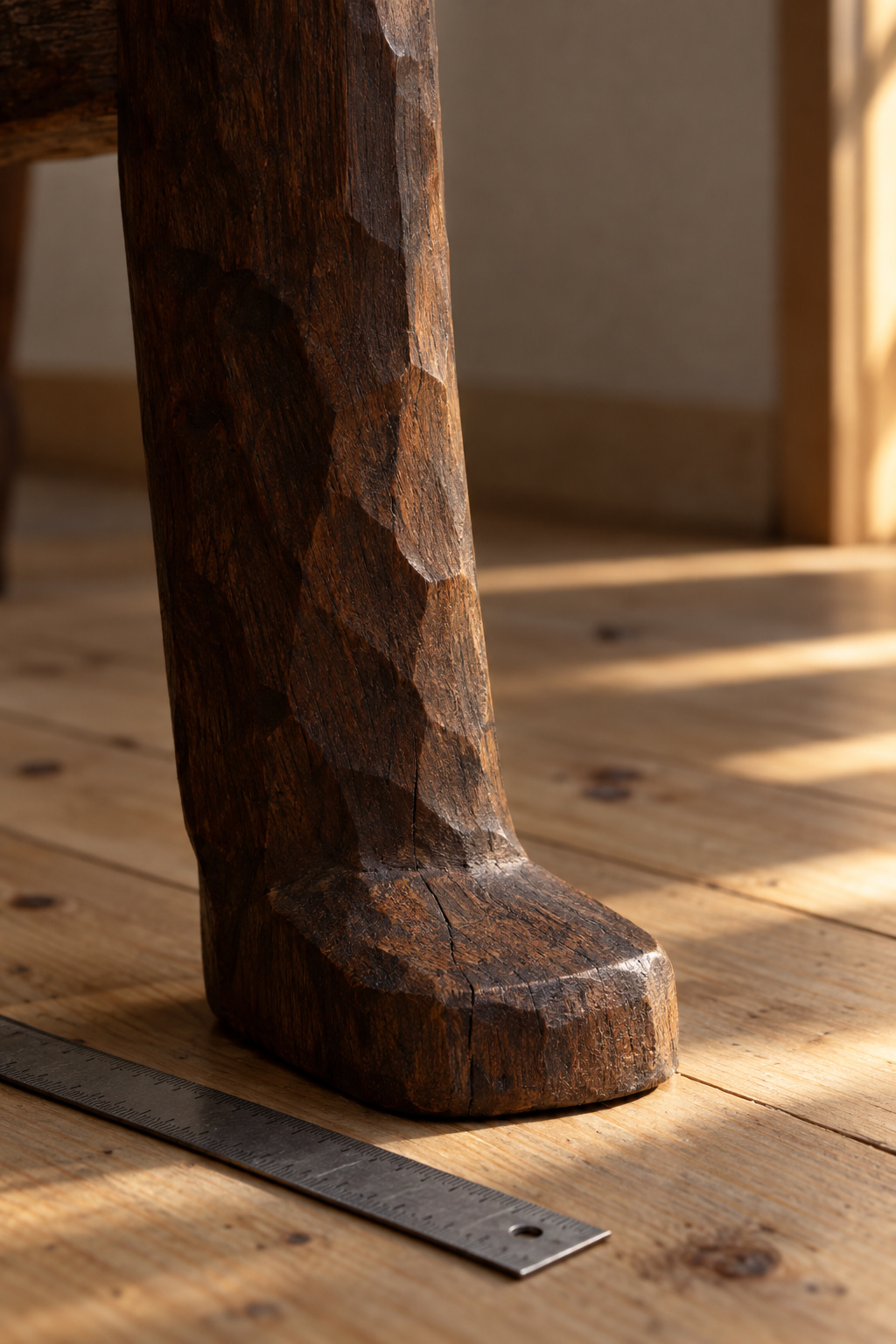
Look across the surface under a low, raking light. Hand cutting leaves facets where the adze bit; machine sanding leaves an even matte surface. Then:
- Run a hand along the underside and the legs. It should feel like one continuous form.
- Set it on a flat floor. It should sit level, without rocking.
- On an older piece, look for honest wear: a seat top polished smoother than the sides, edges softened where hands go. Patina spread evenly into every crevice was put there.
- Accept fine drying cracks. One seller rejects anything wider than 5 mm, about 3/16 in, and that is a fair line to borrow.
- Be wary of a pair that match exactly. Hand carving doesn’t make twins.
Joined, veneer-wrapped or resin copies
On solid wood the grain runs continuously from the face around the edge; veneer shows a thin laminate line at an edge or on an unfinished underside. A glued joint holds only by adhesive and fasteners, which is exactly what dry air attacks. There is no reliable published test for resin, so I would lift it and trust the weight and the feel. A stool that looks carved and weighs like a lampshade is furniture for a photograph.
Plenty of stools sold as Senufo are Lobi or unattributed, so ask the seller what they know, and check what a carved stool costs before you pay.
Keeping a solid-wood stool from cracking in dry winter air
Try it in February. In a heated house, relative humidity can fall to 20 percent or less, and wood gives up moisture and shrinks as the air dries. I ski to the end of the road most winter mornings, and winter is when the air indoors is driest, so this is the section I would read twice.
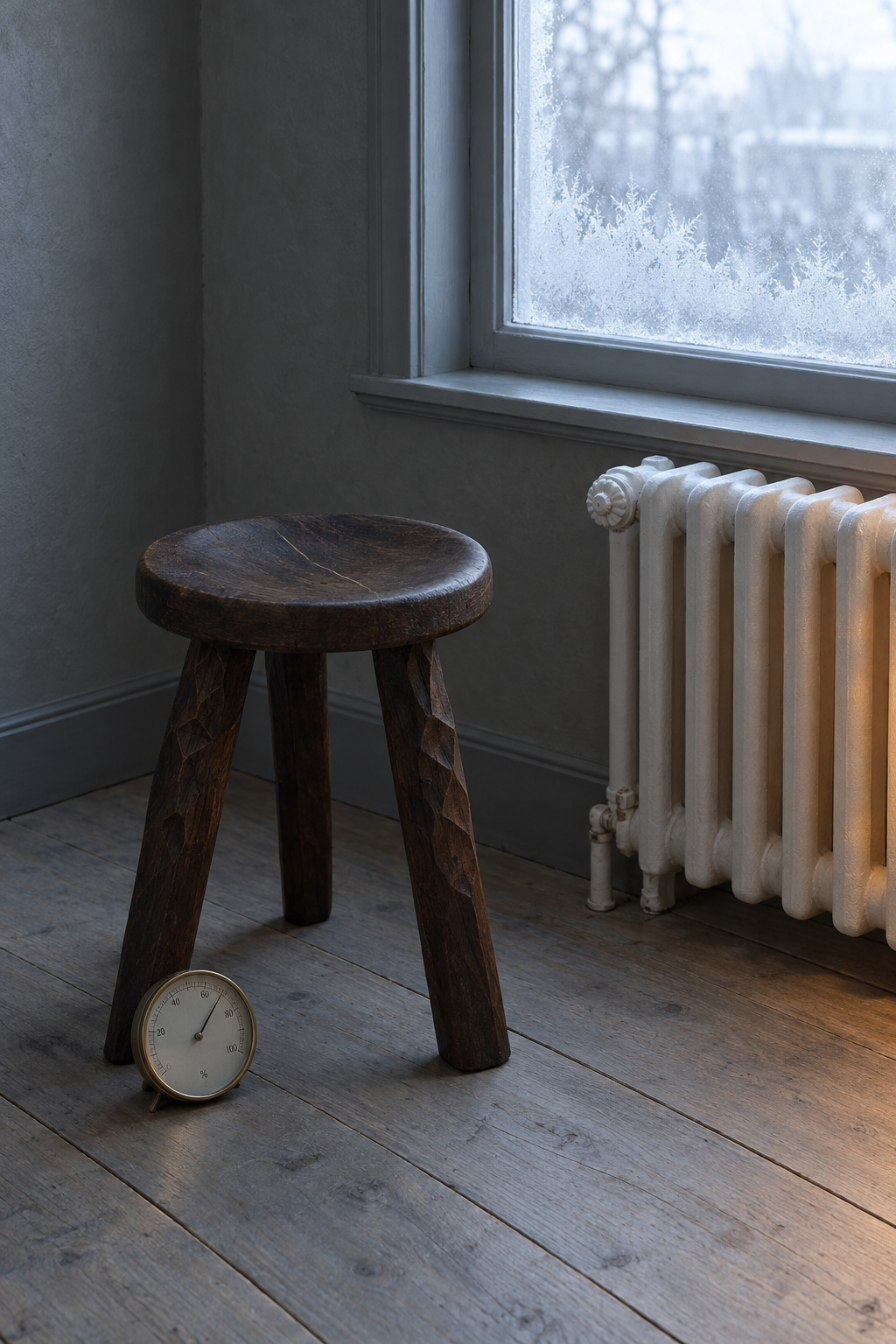
Placement does most of the work. Keep the stool at least two feet from a radiator, a vent or a fireplace, and out of direct sun. Avoid fast swings, too. Sources differ on the target. The Henry Ford’s conservator says winter humidity can safely drop to 35–45 percent if it changes gradually, the British Antique Dealers’ Association asks 50–55 percent for antiques, and furniture-care pages give a wider band that covers both. Put a hygrometer in the room and change things slowly.
A finish helps, within limits. Oil slows the exchange of moisture without stopping it. I oil the breakfast table on the first warm weekend of spring with the windows open, and a bare carved stool can take the same treatment: if a drop of water soaks in and darkens the wood, wipe on a thin coat and take off the excess. Skip silicone spray polish.
A hairline check in the first dry winter is usually cosmetic. Watch for a crack that widens over weeks or reaches an edge; raise the humidity and wait a few weeks before deciding.
Sit, rock, press: the hand test that finishes the job
Sit on the stool under the lamp: the seat should be smooth and gently hollowed, shaped to a body. Rock it side to side on a level floor and feel for a short leg. Press a thumb along the base and down the grain, then turn it over and look at the underside, where the work shows.
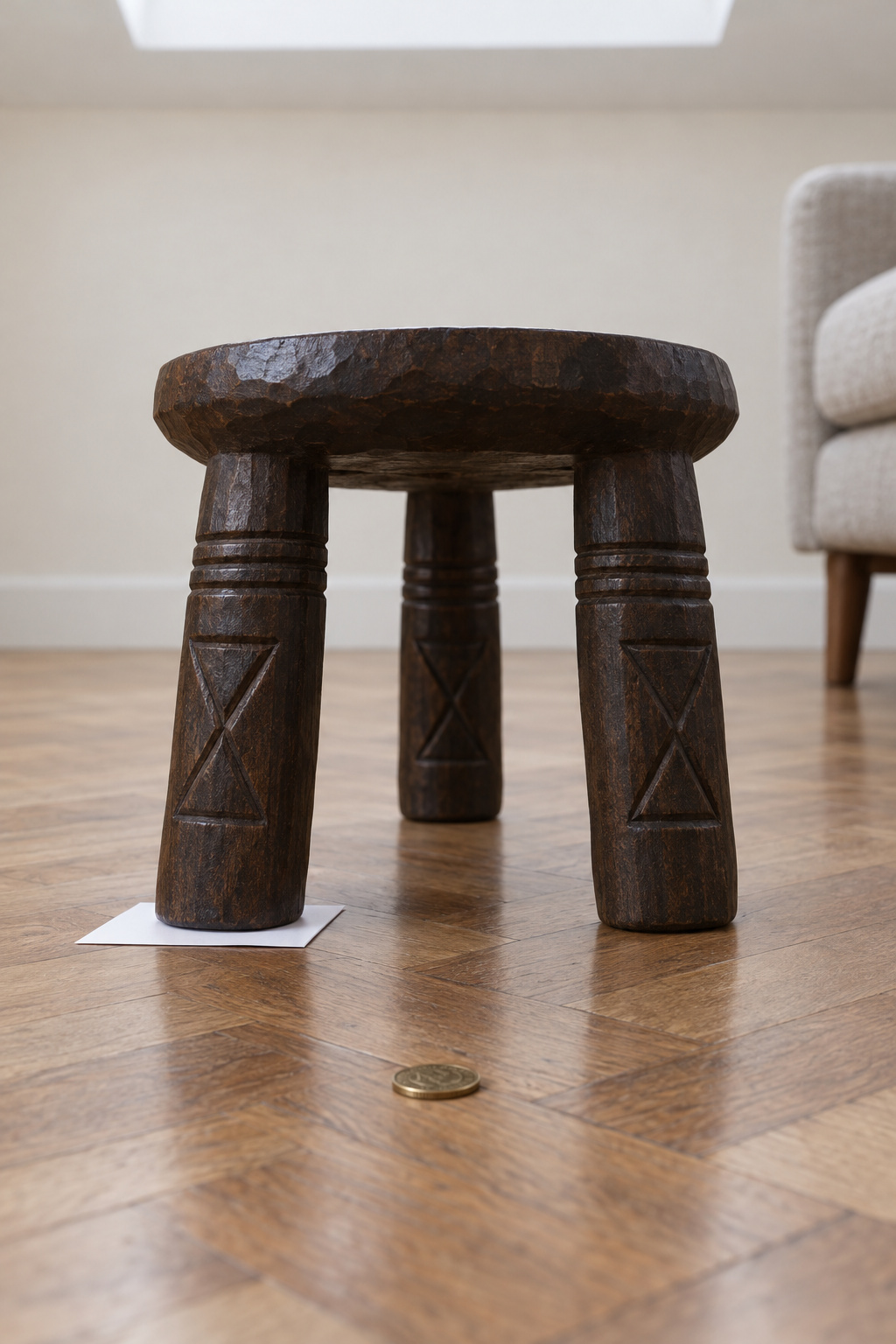
It takes less time than reading a listing. “Sculptural” tells you someone liked the shape. Your hands tell you whether it is one block and whether it stands level, before you ask it to carry a lamp, a plant or a guest. Enough is a good word, and one stool that passes is enough.
What I can judge is the wood: the grain, the joints, the cracks, whether it rocks. What a carving means, and who may sit on which stool, belongs to its carver and the community it came from. I leave that to them.
FAQ
What do the shapes and carved patterns on an African stool mean?
It depends on the people and the stool, and no reliable dictionary maps one motif to one meaning. For the Asante, every stool alludes to the Golden Stool, and a personal stool is tied to its owner’s spirit. Form can also show who sat: Senufo men’s stools have backrests, while women’s washday stools sit low.
Can a carved African stool go on a porch or patio?
Under a roof is the most I would risk; an open patio is a poor home for one. Wood swells and shrinks with outdoor humidity and rain, and a finish only slows that. Direct sun heats and dries it further. Keep yours indoors.
Will a carved wood stool scratch a hardwood floor?
It can, if a foot is rough or the legs are uneven. A stool carved down to flat feet that sits level spreads its weight and is kinder to the floor. Put felt furniture pads under each foot anyway. They are the standard protection for wooden furniture on a wood floor, and they cost you almost nothing.