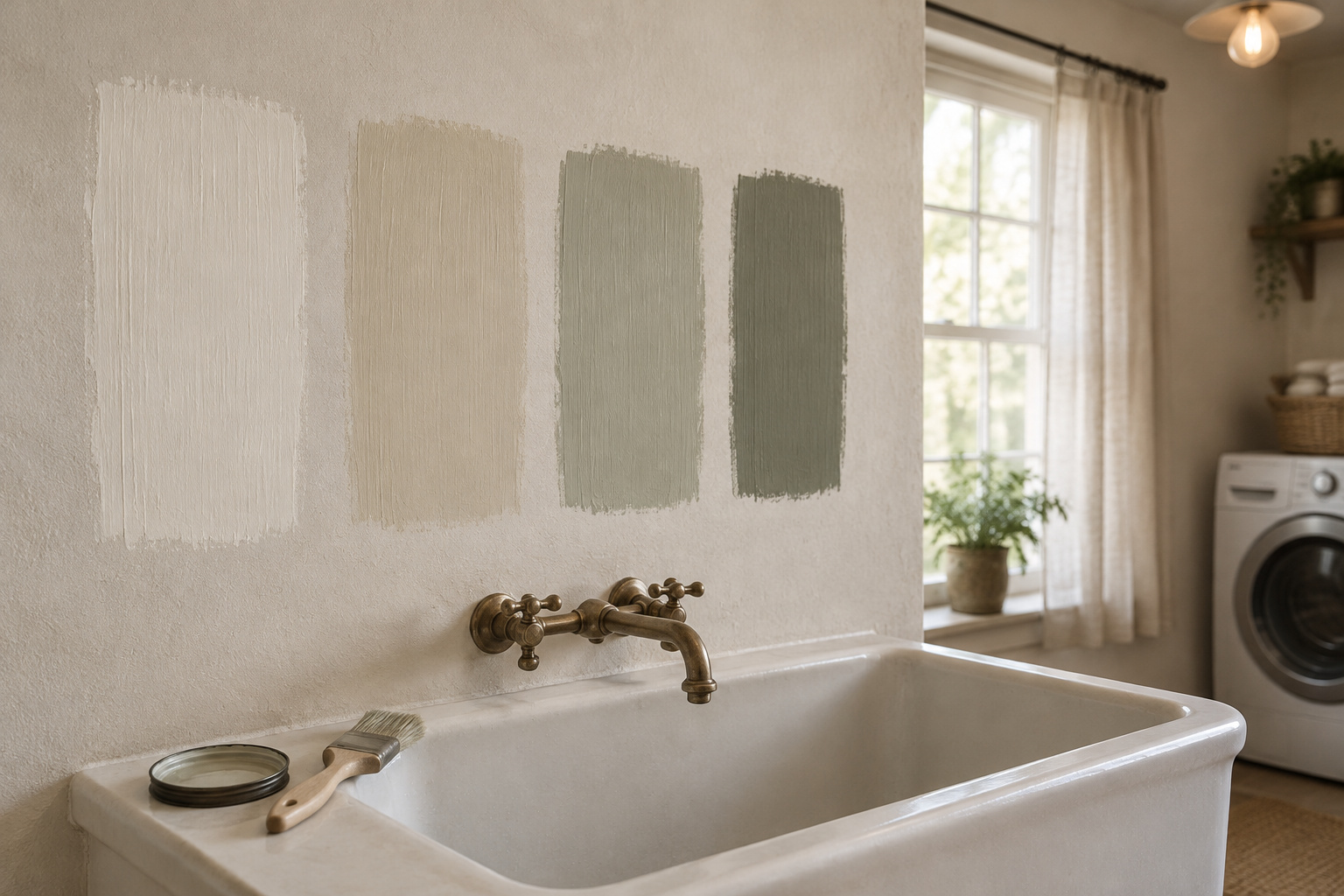

I hold a paint chip flat under a lamp, then tilt it toward the window. The color moves in my hand.
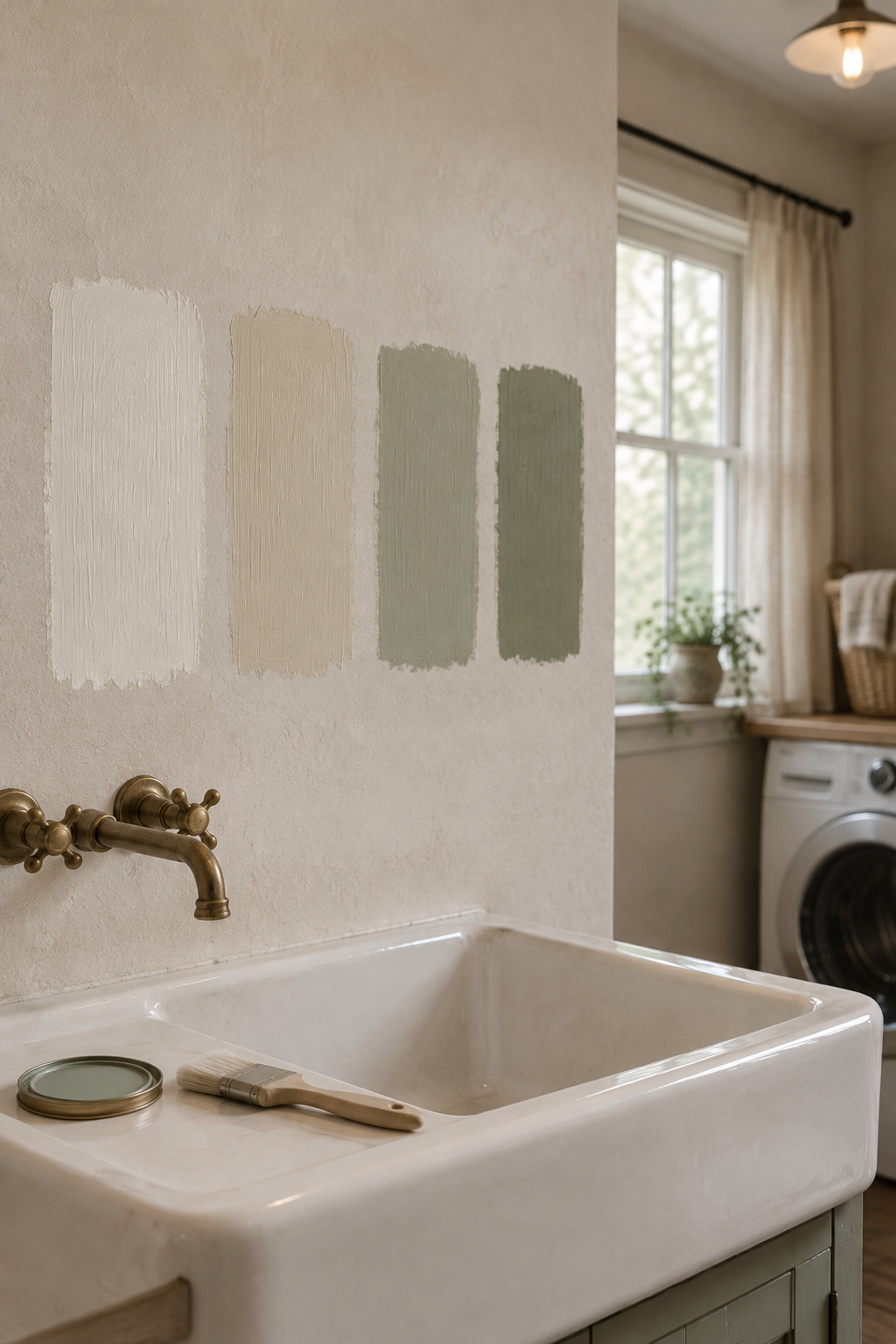
That small shift is the whole problem with choosing laundry room paint colors from a card. The chip is matte, dry and lit by a store. Your wall will be glossier, often damp, and lit by one bulb you have probably not thought about. So I decide in a fixed order. Sheen first, because steam and scrubbing choose it for you. Then the color, judged under the room’s own light, because the finish and the bulb both change how a white looks.
TL;DR
- Use satin at minimum on laundry walls and semi-gloss on trim, doors and painted paneling; wash gently after about a week and scrub only after 2–4 weeks of cure.
- The bulb changes the hue: 2700K pulls a white toward cream or peach, 5000K toward blue and grey. LRV, which Sherwin-Williams prints on the back of its chips, says how much light one returns.
- Test a large two-coat sample board in the real sheen, under the bulb you will keep, for 3 days before you buy gallons.
Why Sheen Comes Before Color on a Wall That Gets Steamed and Scrubbed
I drink my second coffee from a thermos on the back step, in most weather, and the first thing out of the cup is steam. A hot wash and a dryer put the same thing into a laundry room every week. The walls take the steam, then the hands that steady a basket against them, then the cloth that wipes off what the hands left.
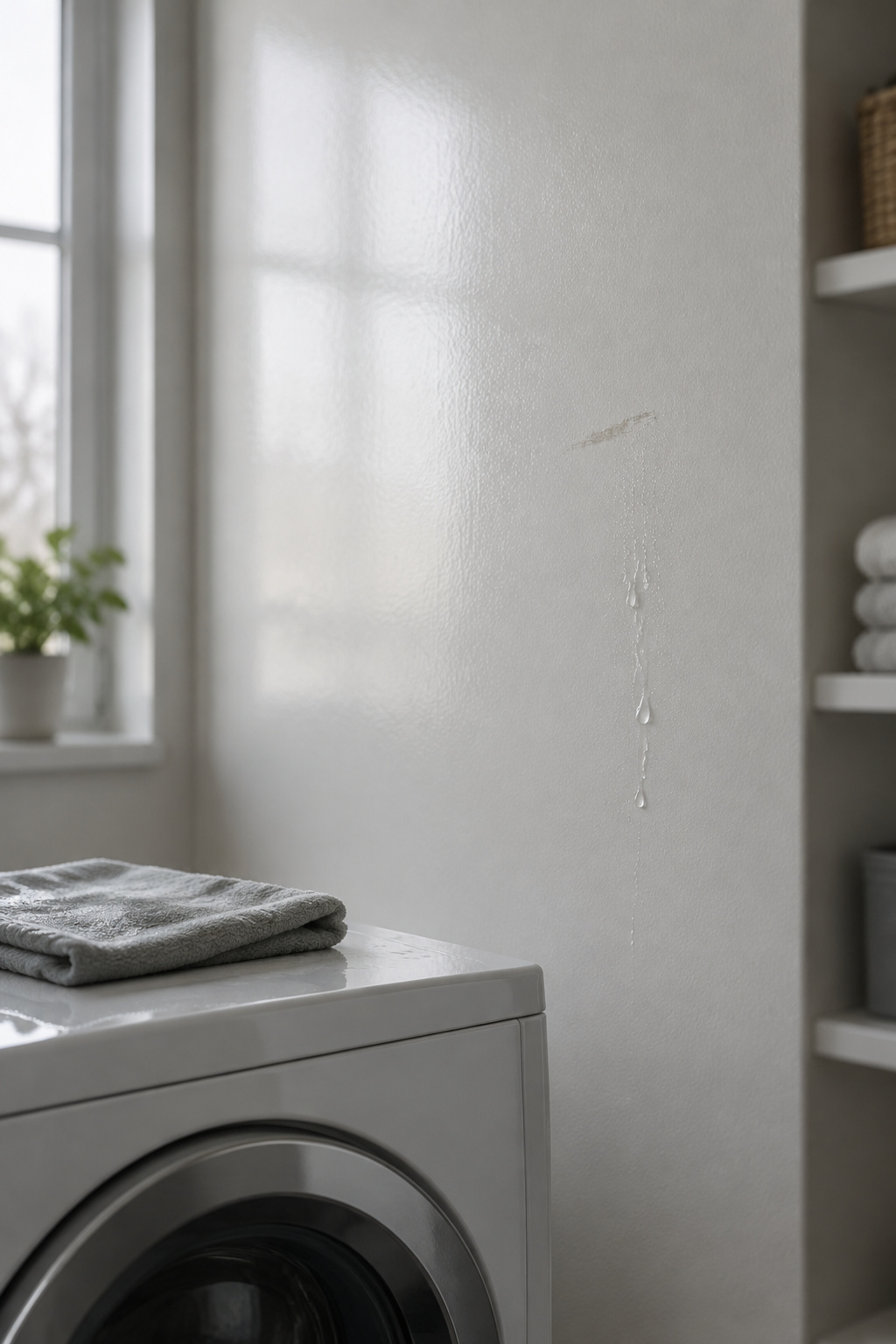
Sheen is how a paint film handles that. Under magnification a flat paint is rough, full of fine pigment peaks. Behr Pro describes a shoulder rubbing that surface as breaking the peaks off, which leaves a scuff and a shiny patch that no longer matches the wall around it. A glossier film has less to break, which is why the makers agree that higher sheen cleans more easily.
Sherwin-Williams lists three ways paint wears away under scrubbing: washing before it has cured, using an abrasive cleaner, and choosing the wrong sheen for the room. The third is the one you decide before you open a can.
Most of this advice is written for bathrooms. A laundry room gets the same steam and wet hands, so I borrow the bathroom rules without apology.
Decide the sheen for each surface before you look at a single chip. Color can be repainted on a Saturday. A wall that burnishes every time you wipe it will annoy you for years.
Match the Sheen to the Surface: Walls, Trim, Ceiling and Paneling
Each surface does a different job, so each gets its own finish.
| Surface | Sheen | Why |
|---|---|---|
| Walls | Satin; semi-gloss where hands and splashes land | Satin is the common floor for humid rooms and washes easily |
| Trim and doors | Semi-gloss | Hands find it first, and semi-gloss wipes clean |
| Painted paneling | Semi-gloss, the trim sheen | It is the lower band, where baskets and hands hit |
| Ceiling | Flat, or low sheen over the dryer | Flat is the US default; low sheen is suggested for wet-area ceilings |
If you only change one row, change the paneling. On a wall with beadboard below the paint line, painted in the wall sheen, the most-handled band becomes the least cleanable.
Makers split on walls. Most put satin as the floor and push toward semi-gloss where moisture is high. Benjamin Moore, on the other side, sells Aura Bath & Spa only in matte, as a mildew-resistant finish for humid rooms. Both positions stand. I still choose satin, because it sits inside most makers’ ranges.
Then leave the wall alone while it cures. Wattyl says to keep steam and condensation off a fresh coat for 48 hours and to wait a week before washing it gently with a soft cloth and mild detergent. Behr puts real scrubbing at 2–4 weeks, when scrub resistance has fully developed.
Laundry Room Paint Colors Start With the Light You Actually Have
From October I leave one lamp on in the kitchen window, so the house looks occupied from the road when I ski back. Coming up the road in the dark, I see that room only as the bulb makes it. Most laundry rooms are seen the same way.
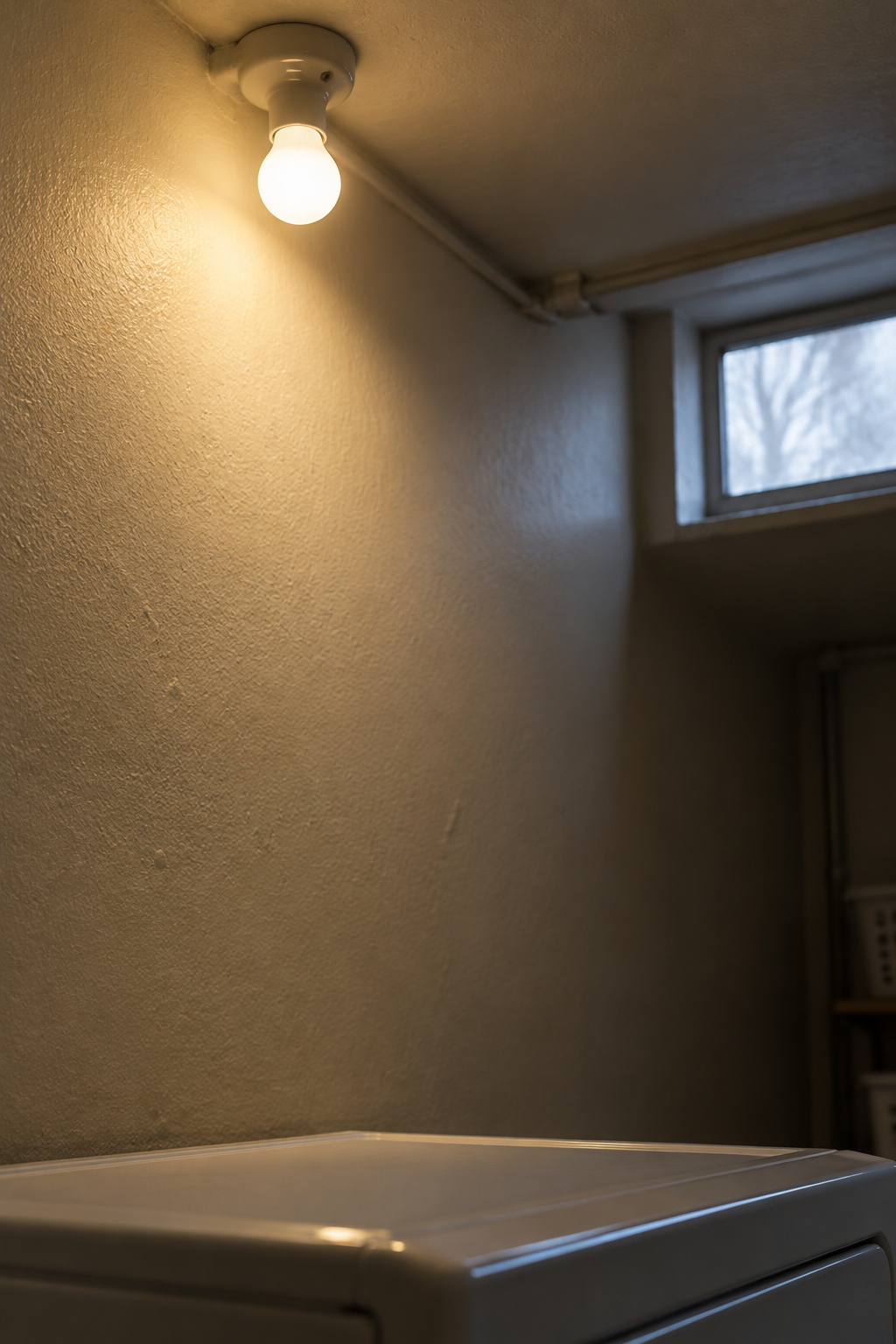
Daylight: a north window, a small window, or none
A window sets the reference for every color in the room, and the safest white is one whose undertone offsets the light it gives. The full north-light case has its own space in our Nordic laundry color palette guide, so I will leave it there.
A small window gives that reference only by day. A basement or windowless laundry gives none, and no bulb temperature fixes a room short of light. Color there depends entirely on the fixture.
The bulb: color temperature and why a white turns grey
Overhead lighting is for cleaning, not for living. A laundry room is the one place I accept it, because cleaning is what happens there. It also means the overhead bulb is the light your paint will be judged by, so choose it before the color.
Color temperature moves the hue. A warm bulb pulls whites toward cream, yellow or peach; a 5000K daylight bulb brings out blue and grey. The advice on what to fit is split. Kitchen lighting advice runs 2700–3000K. A lighting retailer argues that 3500–4000K keeps a plain white closer to the chip. I default to the warm range and let the sample test settle it. Either way, keep every bulb in the room at one temperature, with a CRI of 90 or more, because a low-CRI bulb makes colors look muddy.
LRV, light reflectance value, is printed on the back of the chip and runs from 0, which absorbs everything, to 100, which reflects everything. The bulb does not change a chip’s LRV; it changes the hue you see. In a dim room the undertone takes over. A white with blue in it goes icy grey, and one with too much yellow looks dingy.
Warm White, Cream or Muted Green: Judging the Farmhouse Range by Its Light
The farmhouse range is narrow, which I like. Enough is a good word. Three families, and each behaves differently under the same bulb.
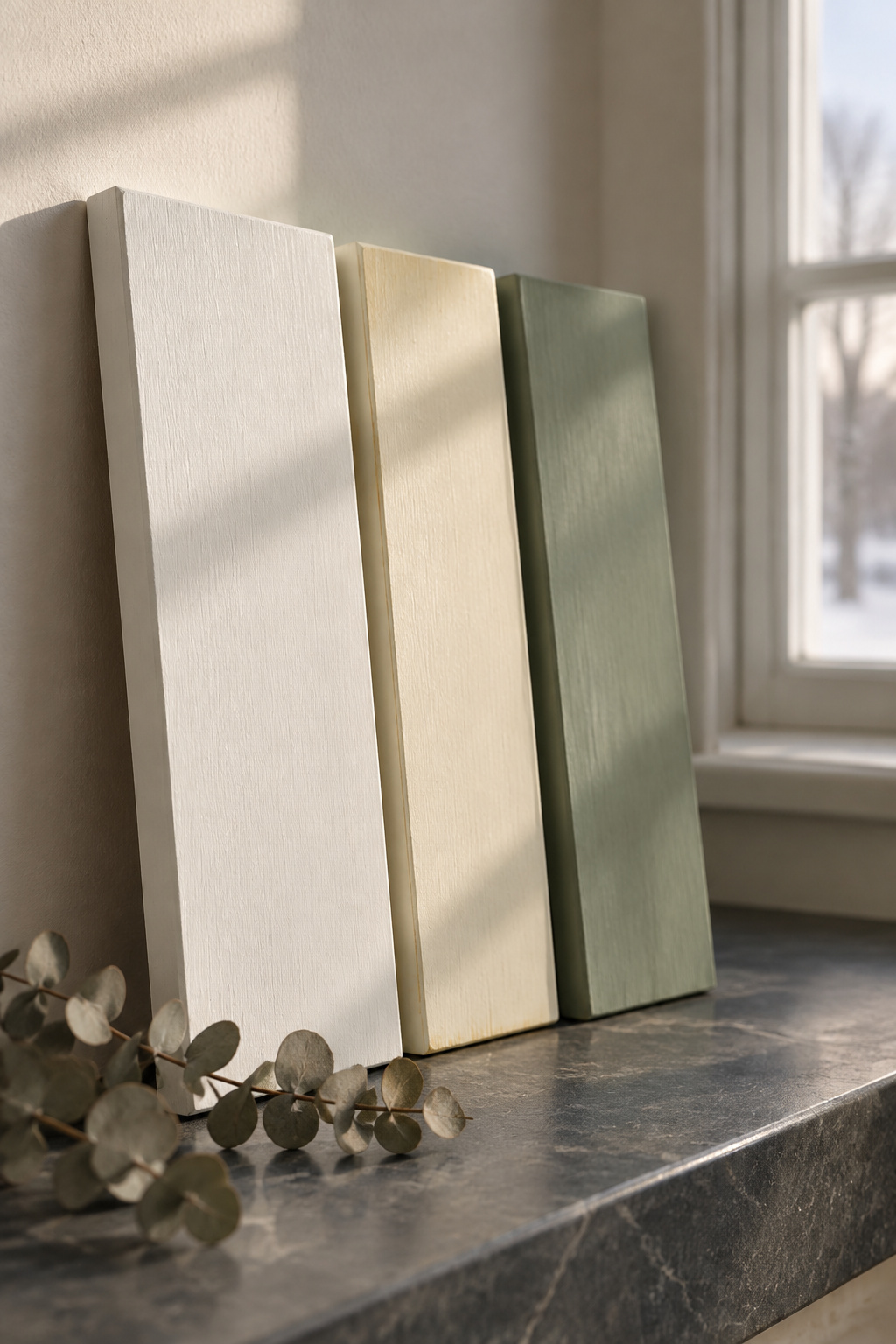
Warm whites carry red, orange or yellow undertones, which is where their soft glow comes from. A warm bulb amplifies that, sometimes past cream into yellow. Under a cooler bulb the yellow offsets the blue in the light, which is the balance you want.
Creams and soft off-whites come next. Cloud White, which Benjamin Moore calls soft and balanced, has an LRV of 85.05. It is where I would start in a laundry with one window and a warm bulb.
Muted greens are a different animal. Benjamin Moore lists October Mist at 46.54 and Saybrook Sage at 45.46; Sherwin-Williams lists Clary Sage at 40.959. Against Cloud White, October Mist returns 85.05 − 46.54 = 38.51 points less of the light that reaches it, so a sage depends on the bulb far more than a cream does. Under a warm bulb a cool green-grey takes a yellow cast, and under a daylight bulb it turns noticeably bluer. Saybrook Sage, cooled with grey, is the one I would test hardest.
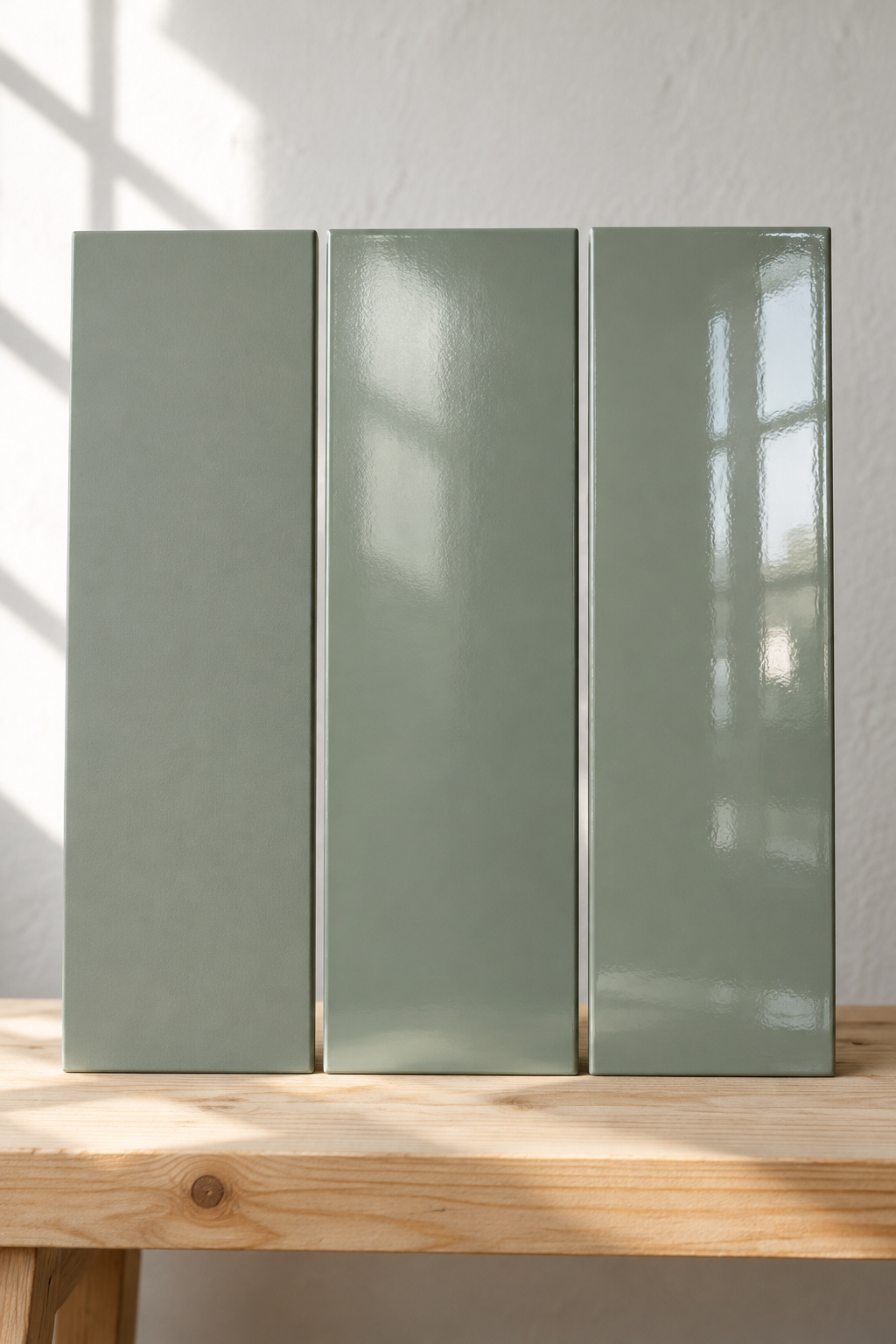
Sheen moves all three. The same chip looks different in satin and semi-gloss and again from an angle, and the makers disagree on which way it shifts. Sample in the sheen you will buy, and if the room has oiled wood and stone, hold the chip against them too.
Test the Sample Under Your Own Bulb, in This Order
A chip is too small to judge and too far from the room. The test takes a few days and one sample pot per color. My neighbor, who waves from his snowblower and still thinks the skiing is a joke, would call this a joke too. He would be wrong twice.
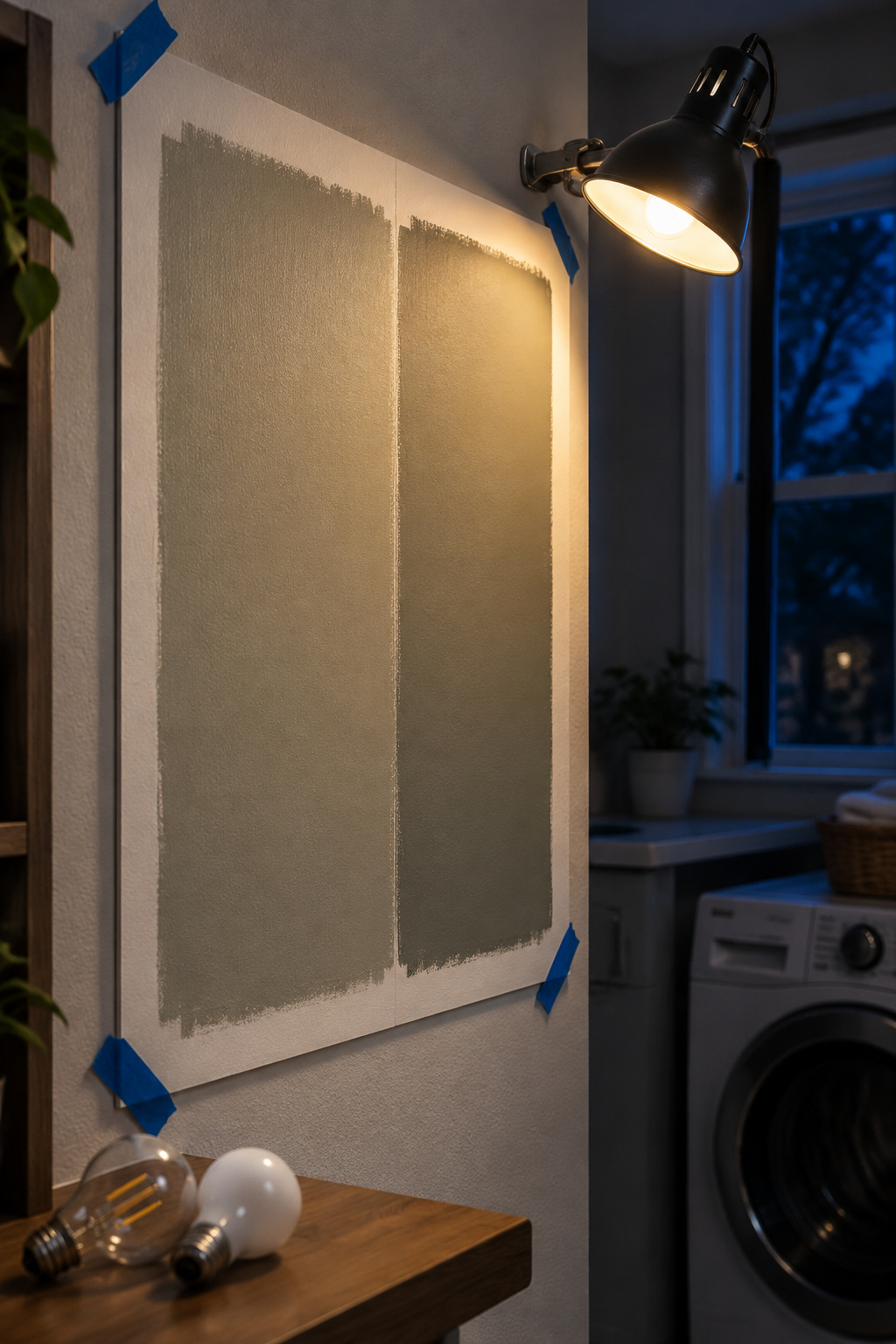
Sample board, not a swatch
Start with the boards, not the wall.
- Paint a board at least A2 in size, white underneath, with two coats, in the sheen you will use on the wall. Let it cure for 24 hours.
- Paint a second board in the trim white from the same maker. Two colors can match under one light and part ways under another; using one maker for both keeps that to a minimum.
Look at it at the hours you actually do laundry
Then move them into the room.
- Fit the bulb you intend to keep, then tape the boards on two walls, one that gets daylight and one that does not.
- Leave them up for 3 days. Look at 8am, at noon, at 4pm and after dark, with the light on and off. Never approve a color under retail lighting.
- Steam it. Once the board has cured, I run a hot wash with the door shut and look again while the room is damp. No paint maker tests this. I do it because that damp hour is when the room works hardest.
If the color still looks like the one you chose after step 5, buy the gallons.
Color the Trim, Keep the Walls Quiet, and Test Before You Buy
My wife has one shelf in our living room that I am not allowed to edit. I have come to think every room needs one place like that, where the color goes, with plain surfaces around it. In a laundry room that place is the trim.
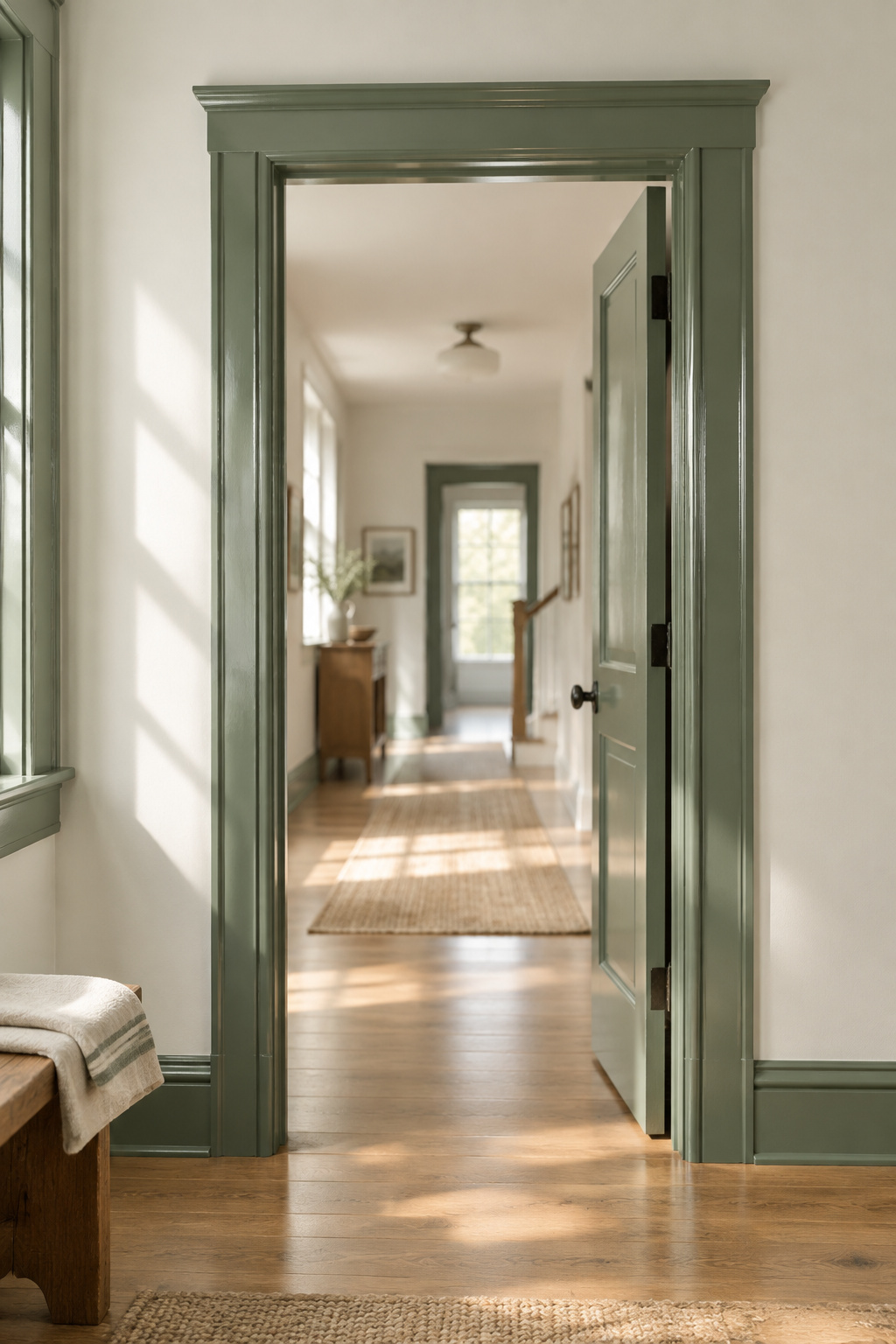
Put the green or the deeper cream on the window and door trim in semi-gloss, and keep the walls a quiet warm white in satin. Glossy trim against lower-sheen walls adds depth and definition. Or use one color for both, satin on the walls and semi-gloss on the trim, which is calmer still in a small room. Either way, keep the undertones leaning the same direction; a cool trim beside a warm wall makes the wall look dingy.
Color on trim is also easier to repaint. If the old trim is glossy, wash it, then sand it or use an adhesion primer.
One sample pot of your favorite color, in satin, under the bulb you plan to keep, will show you what the chip could not. If the color holds still when the light changes and you tilt your head, the sheen and the bulb agree with the chip, and you can plan the rest of a farmhouse-style laundry room around a wall you have actually seen.
FAQ
Should a laundry room match the hallway or kitchen next to it?
No, but the two should share an undertone if you can see one from the other, and one trim color across both ties them together. The laundry will likely be in a harder sheen than the hallway, so expect even a shared color to look slightly different in each.
Do you need to prime before repainting a laundry room?
Not always. Sound, previously painted walls usually need none. Prime bare plaster or drywall, patched areas and glossy trim, which also needs sanding or an adhesion primer. For a water stain, fix the leak first, then use a stain-blocking primer-sealer, ideally an alkyd type that will not re-wet the stain.
Is mildew-resistant paint worth it in a laundry room?
Not by itself. Paint over mold will not stop mold growing in a humid room; fix the moisture source and ventilate the room. Clean existing mildew with one part household bleach to three parts water, rinse, and never mix the bleach with ammonia or detergents.