You know the hour. The light has gone low and gold, the plates are still half full — and then a thin whine at your ear, a hand slapping a forearm, and the whole table stands up. Bug free outdoor dining gets sold as a shopping list: a candle, a plant in a pot, a zapper on the fence. The quieter question underneath it: of everything sold to keep insects off a table, which has anyone measured?

TL;DR
- Moving air is the best-evidenced thing you can put at a table. Klun and colleagues (Journal of Medical Entomology, 2002) found a fan paired with vapor-phase DEET cut mosquito orientation 74%, landing 75% and probing 70%.
- A citronella candle works, weakly. Lindsay and colleagues measured a 42.3% bite reduction in a Guelph woodlot in 1996, which is real and far short of a topical repellent’s 90%-plus.
- A potted “mosquito plant” does nothing while it sits there. Four university extension services and a cage study on Pelargonium x citrosum agree the oil only matters crushed.
What Ends the Evening at the Table
An outdoor table should let you stop paying attention. That is the gift of eating outside: shoulders drop, the talk slows, nobody watches a screen. An insect at your ear takes exactly that away, out of all proportion to its size.

Here is my boundary, stated once and kept. Scent and moving air are materials I work with, as another designer works with color; entomology is not mine. Every efficacy figure below carries the name of whoever measured it, and where nobody has, I say so instead of rounding the gap into a number.
From practice, I can tell you where calm breaks: rarely at the thing anyone budgeted for. Every decision in how the outdoor dining space comes together can be settled (table, canopy, chairs) and one unmanaged input still empties it.
Moving Air: The One Intervention With Real Evidence Behind It
According to the American Mosquito Control Association, mosquitoes fly at one to one and a half miles per hour. It calls them relatively weak fliers and recommends putting a large fan on the deck.
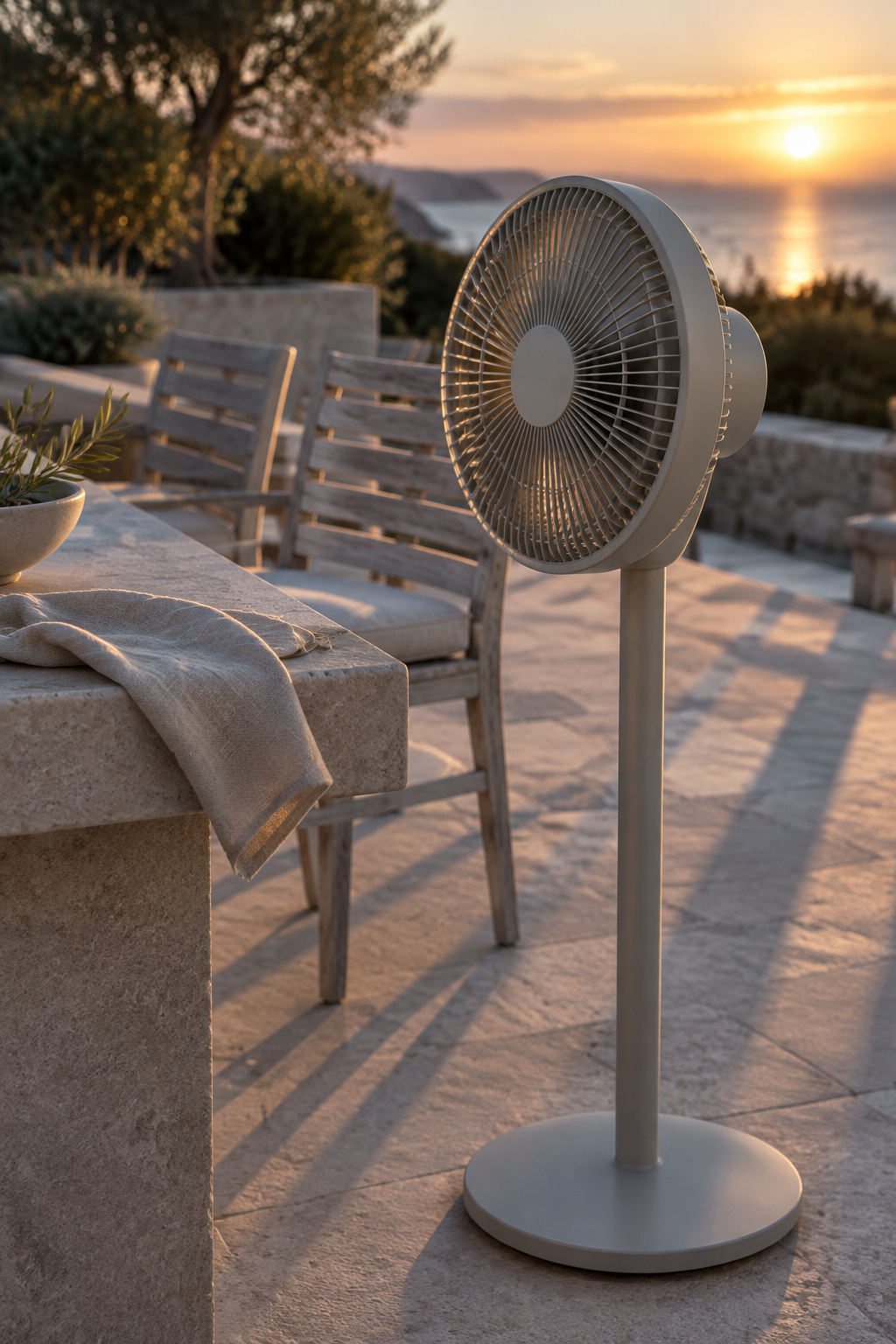
That makes the obvious explanation irresistible, and wrong. A wind-tunnel study by Eaton and McCall tested wind from 0 to 3.7 m/s against mosquitoes tracking a carbon-dioxide source. Catches fell logarithmically as wind rose, matching a dilution model for a plume moving through air, and neither wind speed nor CO2 rate in the tested range stopped catches altogether. Mosquitoes find you by the plume of carbon dioxide you breathe out. A fan does not outrun her; it takes away the thread she was following.
The field figures come from Klun and colleagues in the Journal of Medical Entomology, who measured one subject in a Michigan wetland. A fan moving air at roughly 0.6 m/s, paired with vapor-phase DEET, reduced mosquito orientation by 74%, landing by 75% and probing by 70%. Wind alone reduced all three significantly. DEET beside a fan that was switched off did nothing, because the repellent needed moving air to reach the target.
Aim the fan across the table, not into anyone’s face. The goal is moving air, not force.
Repellents That Hold Up, By the Numbers
Does a higher number on the bottle buy stronger protection? No. It buys longer protection, and that misreading is why people overspend.
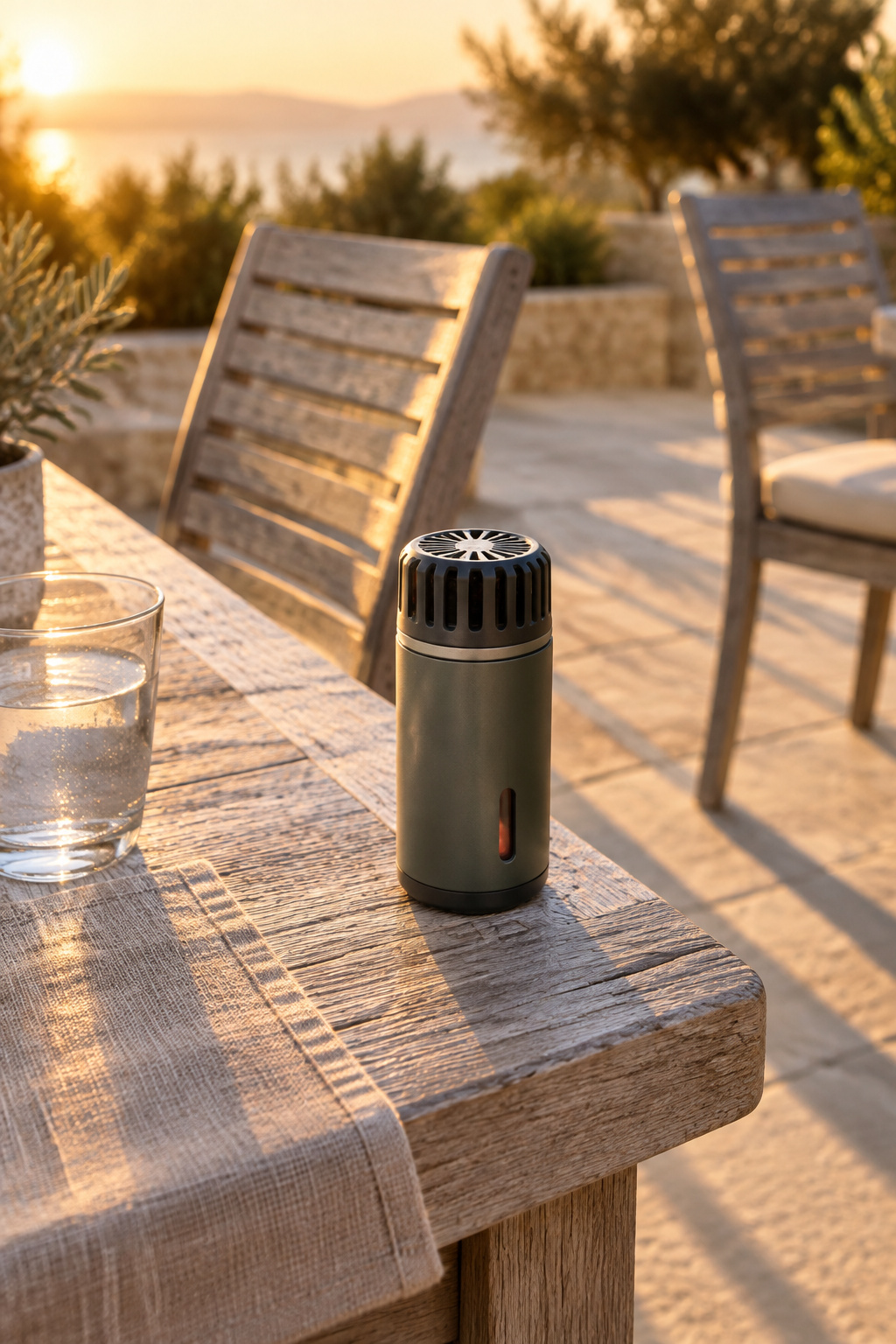
The American Academy of Pediatrics gives the ladder for products applied to skin: 10% DEET protects for about two hours, 30% DEET for about five, and above 50% the duration stops extending. Picaridin behaves the same way: 5% covers three to four hours and 20% stretches to eight to twelve. These are topical, skin-applied conditions in the studies’ own terms, measuring what is on a forearm and not what is in the air around a table.
Which is better? Neither, consistently. A review of eight field studies in the Journal of Travel Medicine found the winner swapping by concentration: 25% picaridin held 95% protection an hour longer than 25% DEET, while 34% DEET stayed above 90% through twelve hours where 20% picaridin fell below it at eight to ten. No consistent superiority at matched doses, the review concluded; at 30% or below either will do.
Area devices, the butane and battery units that vaporize allethrin or metofluthrin, are where the evidence thins, and I would rather name that than fill it. A manufacturer states a 15- to 20-foot radius after a ten- to fifteen-minute warm-up, but no independently sourced bite-reduction percentage for those devices could be found, and the manufacturer’s own comparison cites third-party reviews only qualitatively.
What is safe to apply or burn also changes with small children at the table, and that belongs with eating outside with young children.
Citronella, Candles, and the Comfort of a Flame
A citronella candle does work, only on a much smaller scale than the job we give it.

In a Guelph, Ontario woodlot, Lindsay and colleagues (Journal of the American Mosquito Control Association, 1996) counted Aedes bites on subjects seated beside 3% citronella candles, 5% citronella incense, plain unscented candles, or nothing. The citronella candles cut bites by 42.3%, the incense by 24.2%. The detail I keep returning to is the plain candle, at 8.2 bites per five minutes against the control’s 10.8. Some of what a citronella candle does, any candle does.
Delivery format matters as much as the oil. Muller and colleagues (Journal of Vector Ecology, 2009) tested the same actives as candles and as continuous-release diffusers: indoors, a citronella candle repelled 14% of mosquitoes, a diffuser 68%. Same oil, five times the effect: burning is a poor way to release a volatile oil.
A systematic review of eleven laboratory studies by Kongkaew and colleagues (Tropical Medicine & International Health, 2011) put citronella oil’s protection time 253 minutes shorter than DEET’s (a 95% confidence interval of 169 to 336 minutes) and concluded that citronella products are less effective than DEET products in duration of protection.
None of this is a reason to blow the candle out. A flame gives a table a center. Keep it for the light, and move the protection onto skin and into the air.
Timing and the One Thing Light Actually Explains
Dusk has a sound to it. The birds change over, the air cools on your arms, and if your local mosquito is a Culex or an Anopheles, that is the hour it hunts. Moving dinner earlier is the cheapest intervention here, and the least reliable: Aedes aegypti and Aedes albopictus, the aggressive backyard biters across much of North America, hunt through the middle of the day. It helps only where a dawn-and-dusk species dominates. Shade decides those hours too, which is why the shade hours are the bug hours.

Light enters this article once, and only as biology. Alonso San Alberto and colleagues, tracking more than 1.3 million mosquito flight paths for Nature Communications in 2022, found that carbon-dioxide exposure switches on a strong attraction to the wavelength bands we perceive as cyan, orange and red, the bands dominating the color spectrum of human skin. Here, vision depends on breath. That explains how you are found, and it does not tell you what to hang above the table.
The same distinction governs the plant in the pot. True citronella grass, and the scented geranium sold as a “mosquito plant,” keep their repellent compounds inside intact leaves and release only traces, a point Iowa State, Florida IFAS, Colorado State and Mississippi State extension services each make independently. Matthews and colleagues tested the Pelargonium x citrosum ‘van Leenii’ cultivar and found no difference in landing rates with the plant present or absent; in cage trials mosquitoes rested on its excised leaves as readily as on plain paper. Crushed-oil evidence is not potted-plant evidence.
Crush a leaf between your fingers before you believe a pot of it.
The Bug Free Outdoor Dining Checklist: What to Buy, What to Skip
Years ago a client in tech had me build her a room to sit in, and when it was done she could not use it. It was not the color or the cushion. It was the wall clock. I took it down, and she sat the next morning. One unmanaged element had held a whole room hostage.

A mosquito does that to an evening. This list is short on purpose and ordered by evidence, not by what sits together on a shelf.
| Intervention | What the evidence shows | Verdict |
|---|---|---|
| Moving air from a fan | 74–75% fewer orientations and landings when paired with a vapor repellent (Klun et al., 2002) | Buy first |
| Topical DEET or picaridin | Above 90–95% protection for hours at matched doses (AAP; Journal of Travel Medicine review) | Buy |
| Butane or battery area device | Manufacturer-stated 15–20ft radius; no independent bite-reduction percentage located | Unproven |
| Citronella candle | 42.3% bite reduction in field trial; 253 minutes less protection than DEET (Lindsay 1996; Kongkaew 2011) | Keep for the light |
| Potted “mosquito plant” | No difference in landing rates while intact (four extension services; Pelargonium field study) | Skip |
| Electric bug zapper | 0.22% of 13,789 insects killed were biting flies (University of Delaware) | Skip |
That leaves an honest division of labor. I can move air across a table, choose what it smells like, and notice the one input quietly emptying a room. I cannot out-design a mosquito, and none of the numbers above are mine; they belong to the entomologists, the pediatricians and the extension services who measured them. So: a fan on the table tonight, the repellent on skin, and the candle back to being a candle.
FAQ
Do bug zappers actually reduce mosquitoes at a dining table?
No. By direct measurement, barely. Over ten weeks, a University of Delaware study of six suburban zappers found that only 31 of 13,789 insects killed were biting flies, or 0.22%, and called electric traps worthless for biting-fly reduction. Your exhaled carbon dioxide outcompetes their ultraviolet lure.
What scents do mosquitoes avoid the most?
Geraniol, by measured repellency. In Muller’s controlled testing it beat linalool and citronella in every format tried: a geraniol diffuser reached 97% indoor repellency against citronella’s 68%. DEET and picaridin are not ambient scents; on skin they hold longer protection than any aromatic tested.
Why do some people at the same table get bitten more than others?
Three measured factors. In a study of 102 subjects, mosquitoes fed preferentially on Type O blood and on secretors of the associated H antigen. Exhaled carbon dioxide is a primary long-range attractant, so larger or harder-breathing people get found first. Abundant but low-diversity skin bacteria also raise attractiveness.