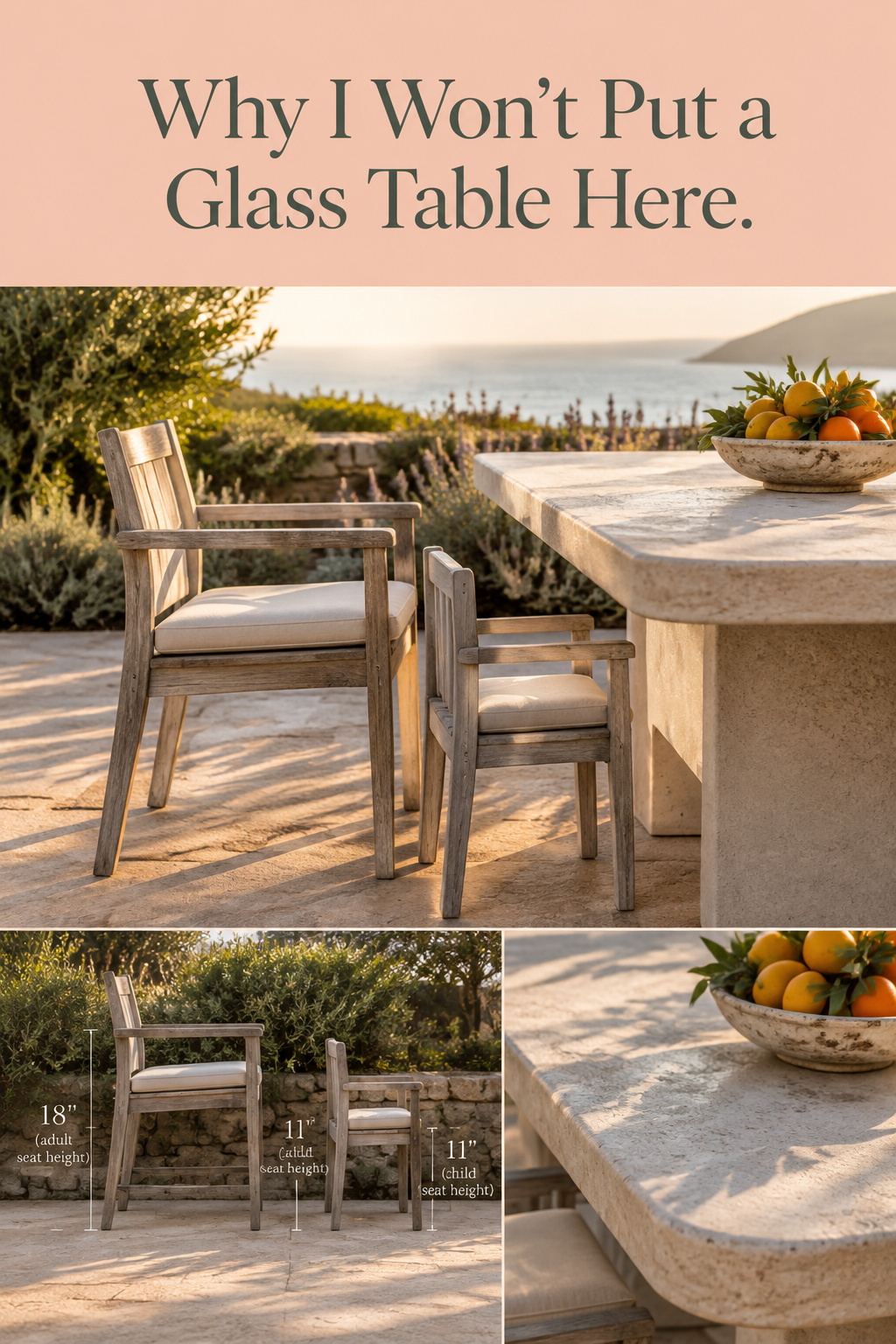
Color decides nothing about kid friendly patio furniture. Not the cushion print, not the rounded corner, not the word “family” on the box. None of them tells you whether your child can climb into the chair, reach their plate, and get out again without your hands. Only that test matters. It takes five minutes in a showroom. I also won’t specify one tabletop material where children eat, and the reason comes with a standard number.
TL;DR
- Buy by your child’s standing height, not their age. BS EN 1729, the European school-furniture standard, sizes by height: a child 93–116cm (36.6–45.7in) tall wants a 10in seat and an 18in table.
- An adult patio table won’t fit a child until the young-teen years. That standard’s tallest band still specifies a 64cm table. Working it out, 64 ÷ 2.54 = 25.2in against a standard 29–30in patio table (a gap of 3.8–4.8in).
- No glass top where children eat, tempered included. ASTM F2813 requires safety glass under 44in, yet compliant tempered glass still fails spontaneously from nickel-sulfide inclusions, most within two to seven years of tempering.
The Real Test for Kid Friendly Patio Furniture
Retailers use “kid friendly” to mean bright, soft and rounded. I mean something plainer: a child can work the furniture without an adult.
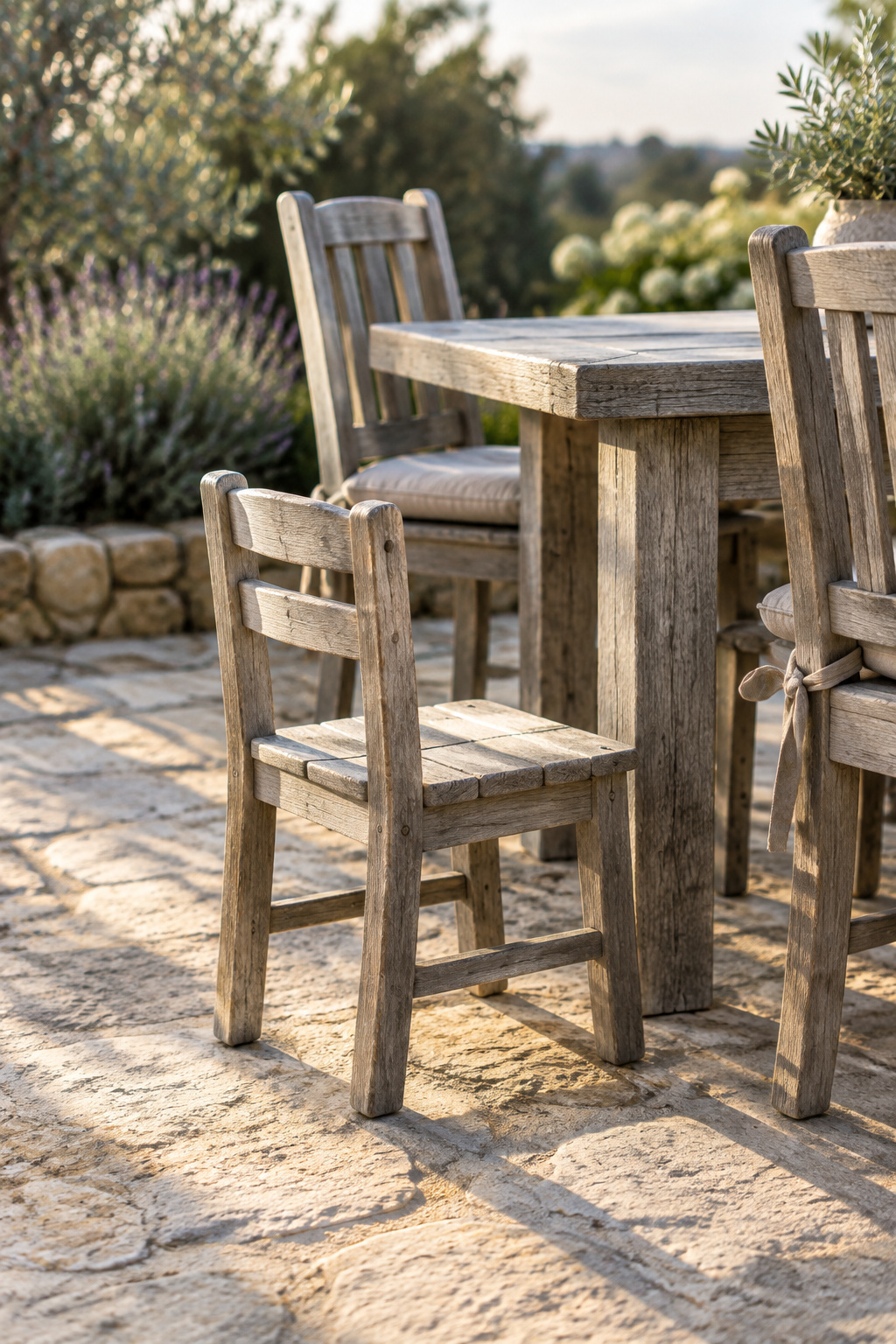
The developmental reason takes one sentence. Getting into and out of a seat unaided is motor planning, and a child who needs adult hands to join dinner learns that dinner is something done to them, not something they arrive at.
So I run one test across the four moments of a real meal. Can the child arrive and get seated, survive spilling on the table, and leave again unaided? A set that passes belongs in the rotation of these outdoor dining area ideas. One that fails twice is decoration, whatever color it is.
Seat and Table Height, By Age
My own two are four years apart, and for one summer that gap lived at a single table. The older could pull a chair out and climb in. The younger needed lifting, a folded towel, then a forearm behind her back so she didn’t slide off. I was the mechanism. After four years of that I treat height as the independence question, tape measure included.
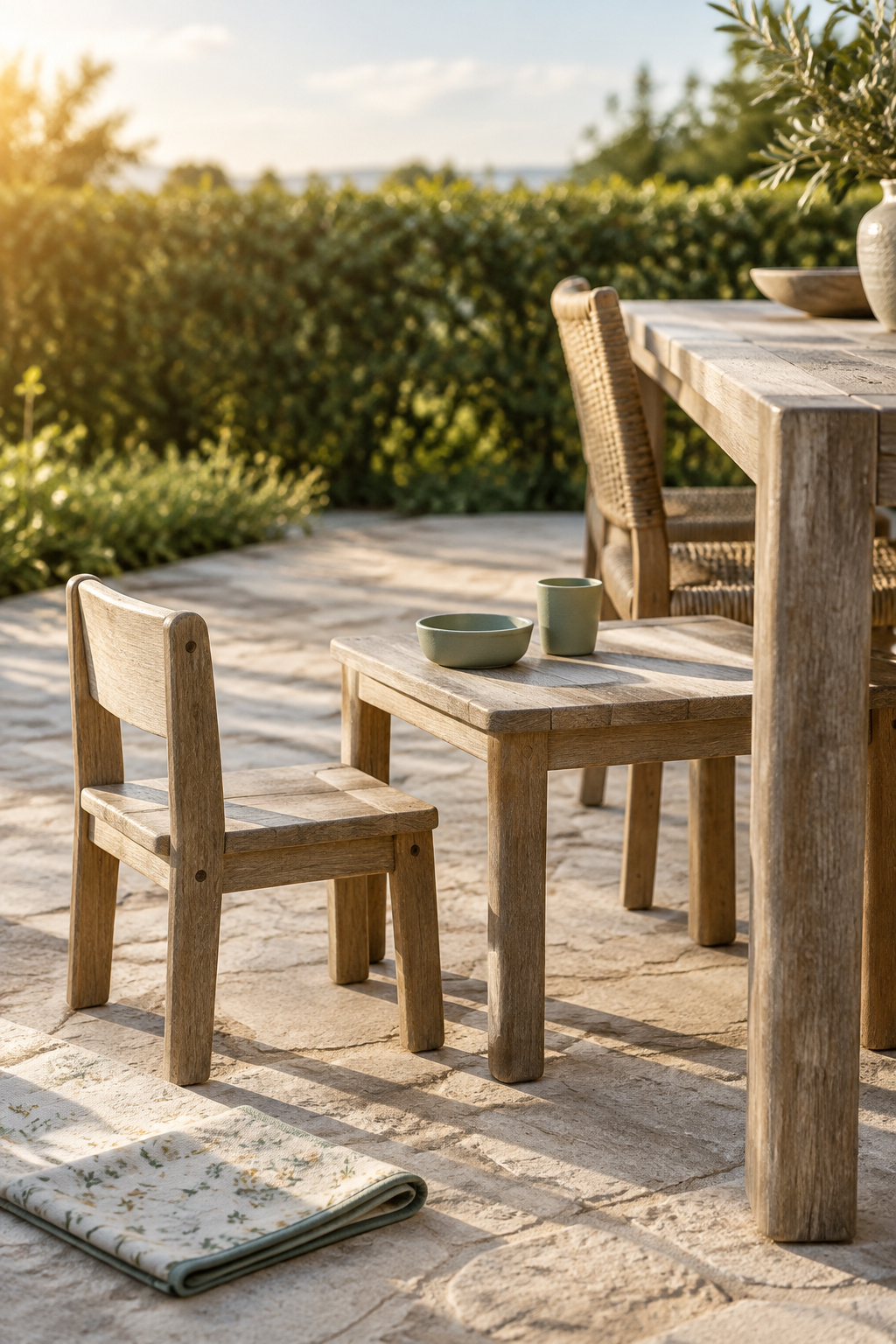
BS EN 1729 is the strongest authority here, and its first useful move is to ignore age. It sizes by standing height, because the link between age and size varies too much to trust. The dimensions below are the standard’s own centimeters; every inch figure is my own conversion, cm ÷ 2.54.
| Child’s standing height | Seat height | Table height | What changes next |
|---|---|---|---|
| 80–95cm (31.5–37.4in) | 21cm (8.3in) | 40cm (15.7in) | Outgrown fast — expect a step within a year or two |
| 93–116cm (36.6–45.7in) | 26cm (10.2in) | 46cm (18.1in) | The longest-serving band for most families |
| 108–121cm (42.5–47.6in) | 31cm (12.2in) | 53cm (20.9in) | Can usually reach a plate on a low adult table |
| 119–142cm (46.9–55.9in) | 35cm (13.8in) | 59cm (23.2in) | A cushion on an adult chair starts working |
| 133–159cm (52.4–62.6in) | 38cm (15.0in) | 64cm (25.2in) | Still 3.8–4.8in below a standard patio table |
One caveat goes with every number in that table: all of it comes from school desks or preschools. Nobody has studied children at dining tables, and reaching a bowl at chest height is a different posture from writing with your forearms flat.
Getting Into the Seat Without a Boost
Popliteal height, floor to the back of the knee with the child seated, decides whether a child can seat themselves. A 2023 peer-reviewed field study by Iliev, Domljan and Vlaović measured 23.5–23.9cm for two- and three-year-olds. It concluded that EN 1729’s smallest sizemark was too short for them and proposed a non-standard seat near 23cm. By my arithmetic, 23 ÷ 2.54 = 9.06in against the published 21cm (8.27in), a 0.79in shortfall against real measured toddlers.
Getting Away From the Table Alone
When did you last think about standing up from a table? You push back, rise and step clear in one motion you stopped noticing decades ago.
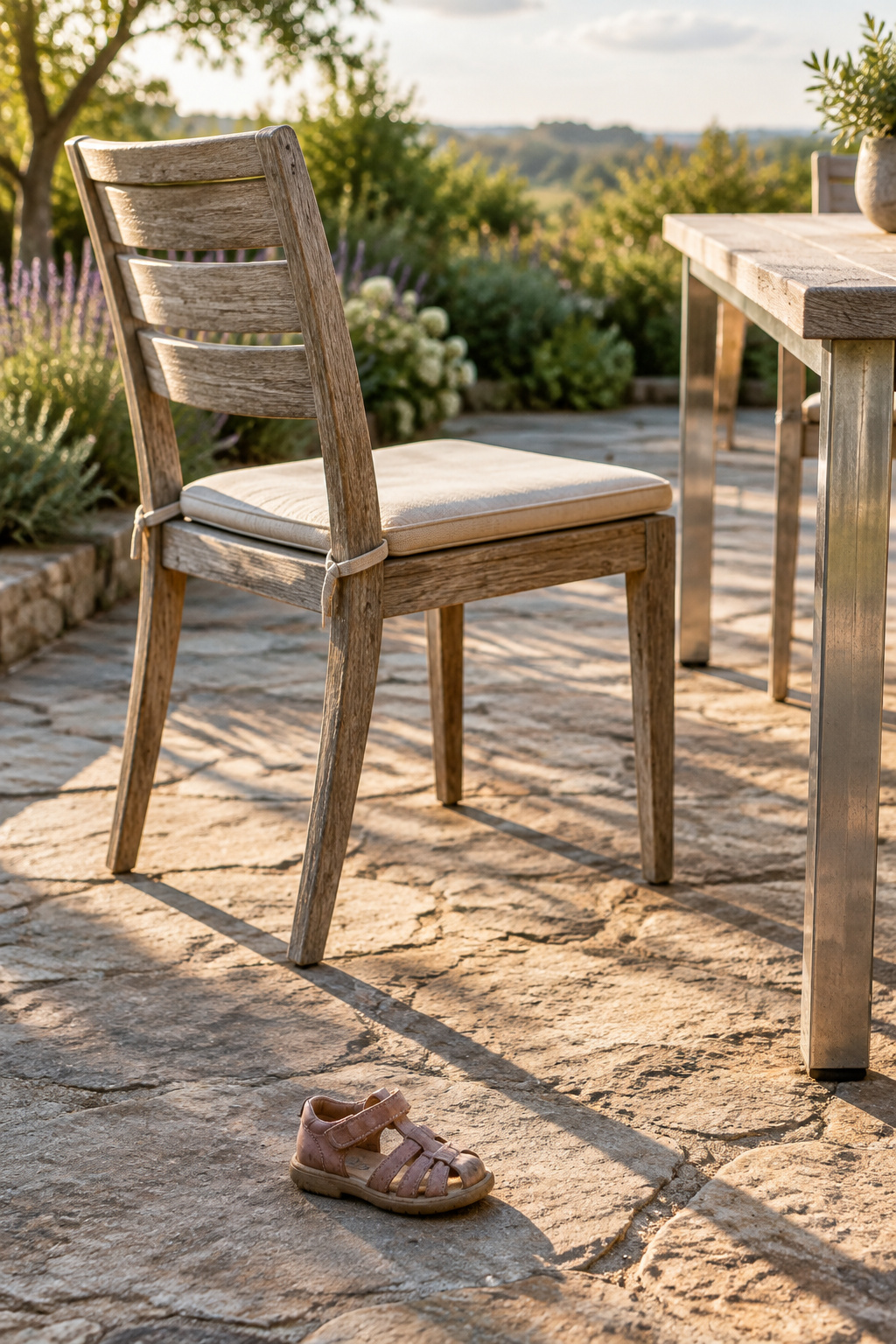
A child’s exit looks nothing like that. They swing a leg wide, twist and go out sideways, often at speed because somebody said “popsicle.” Balance and spatial judgment are still under construction at that age, and backing out of a seat leans on both, so the movement needs more room than an adult’s. Give a child’s chair the generous end of the clearance a family table needs rather than the minimum. That figure belongs to that article; the argument is mine.
The Kneel Test
Before you buy, kneel beside the table at your child’s height. Look for chair-back gaps a foot could catch in and stretchers where a shin lands. Then trace the exit path: does it run into a planter?
Why I Won’t Put a Glass Table Where Children Eat
A live American standard covers this. ASTM F2813, the US specification for glass in desks and tables, applies to any unenclosed horizontal glass surface under 44in in a table. Its scope names dining and outdoor tables, so a 29–30in patio table falls inside it. The standard requires laminated or tempered safety glass meeting ANSI Z97.1-2009 and prohibits ordinary annealed glass.
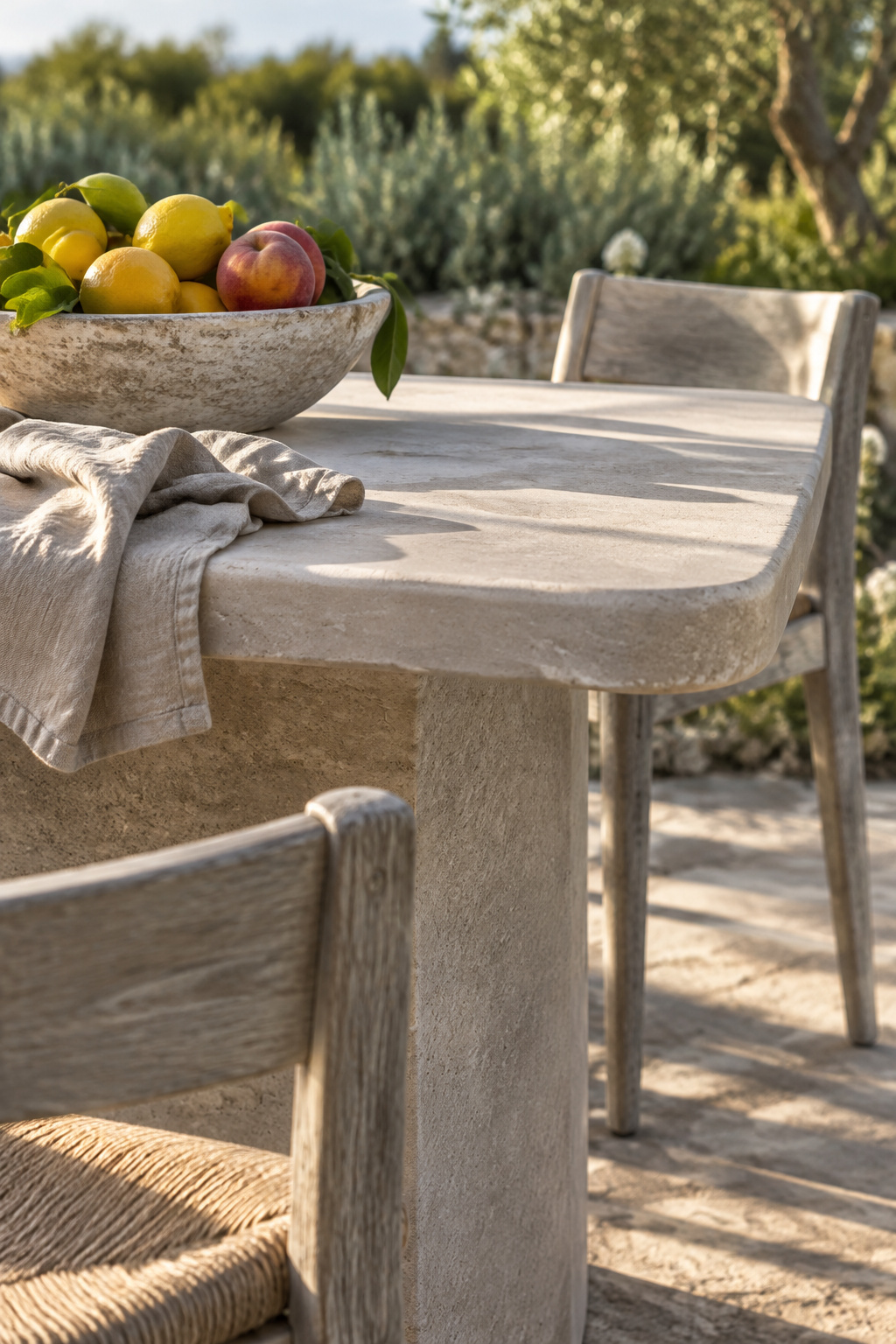
Read honestly, the standard doesn’t back me up. It targets annealed glass, and compliant tempered glass is its answer. Tempering heats the pane to about 1,100°F and cools it fast, so a failure dices into small cube-shaped fragments with no blade edges. The injuries behind the standard came from children climbing onto glass tabletops and adults falling through them. A compliant top will not throw knife-sharp shards over your four-year-old.
My refusal is a judgment, and this is what it rests on. Microscopic nickel-sulfide specks left over from float-glass manufacturing get locked into an unstable crystal phase during tempering. Over the following years they revert and expand, and the stress can fracture a whole pane with nobody touching it. Karlsson’s 2017 review in Ceramics-Silikáty puts most spontaneous fractures two to seven years after tempering. A twelve-year study of 17,760 tempered panels across eight buildings with a confirmed nickel-sulfide problem found 1.73% failed, a rate that review declines to call catastrophic.
I agree it isn’t catastrophic. Glass is the only surface on a patio that can fail while nobody touches it, and two to seven years after tempering is just when a family table is in daily use with children eating off it. A wood or poly top cannot have that event at all. Weigh it differently if you like.
Hot Seats, Sharp Corners, and Surfaces That Survive Real Kids
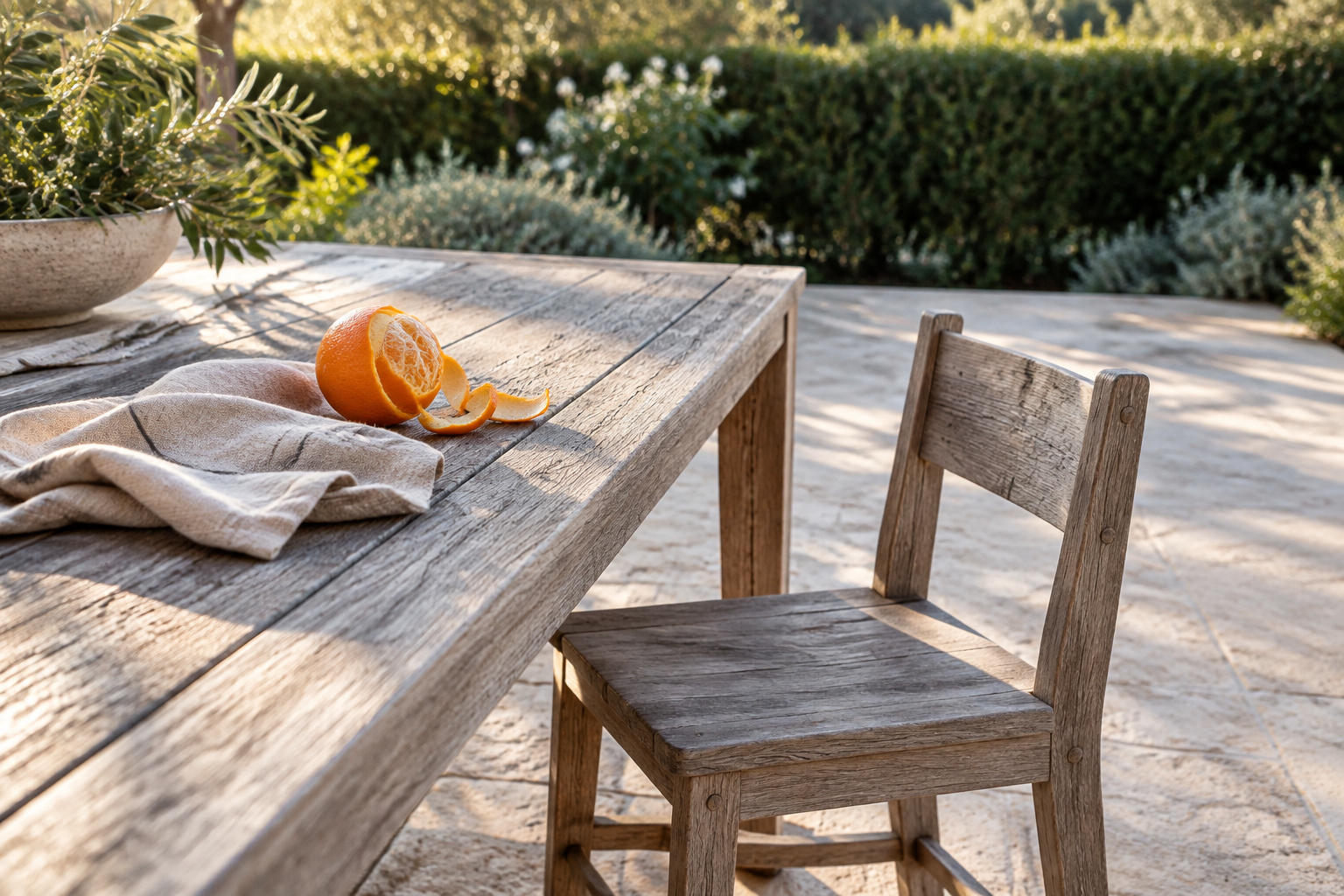
The most common mistake never shows up in a showroom: a dark seat chosen indoors, then installed facing west. A material comparison that ran a thermometer across real surfaces in full sun found that color and coating decide how hot a seat gets, rather than the material. Light powder-coated metal can run cooler than dark wood. A child in shorts meets that surface with the backs of their thighs, at a run.
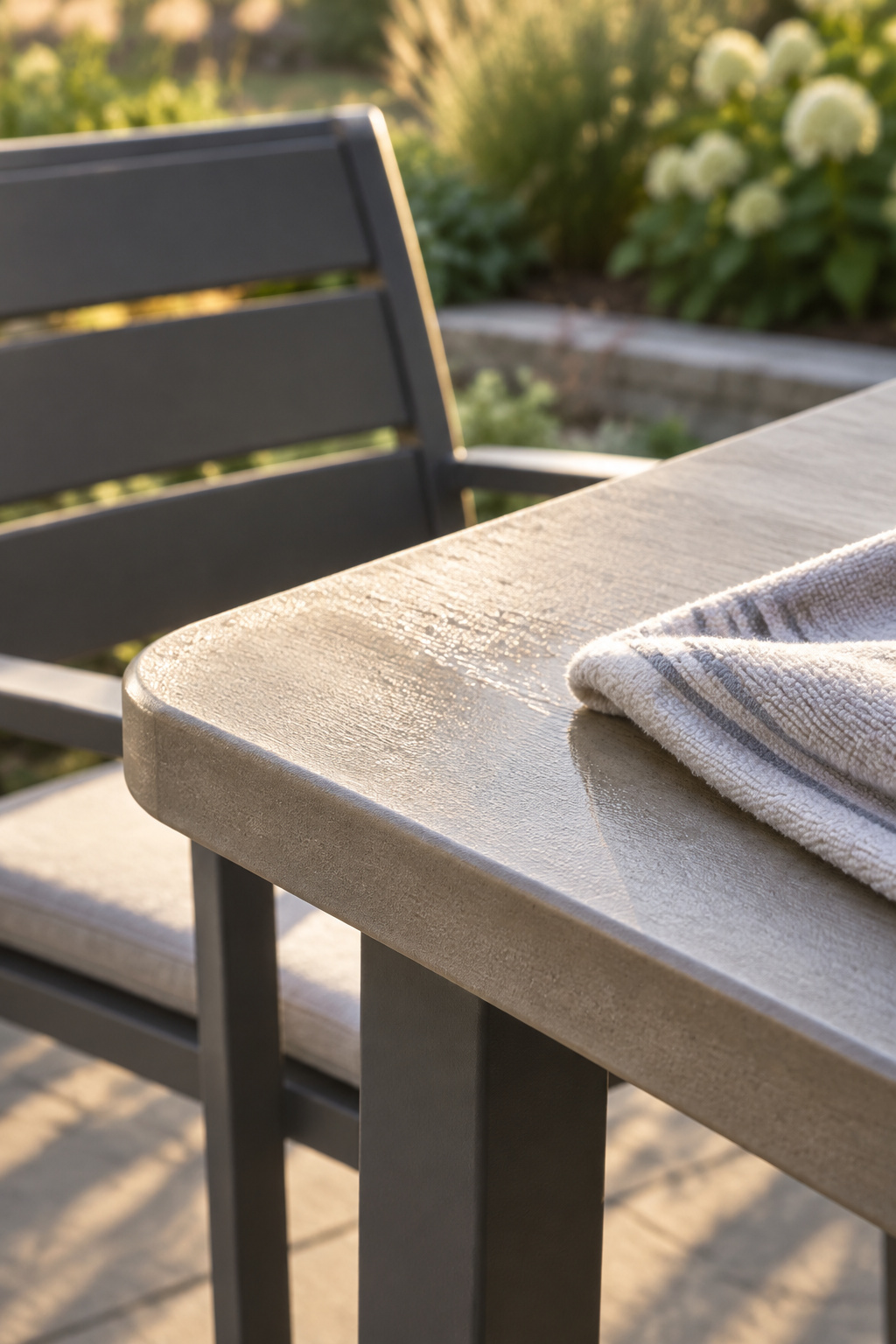
Adults miss corners. A table corner sits at our hip height and at a small child’s forehead, so ease the corners on whatever a child runs past.
Sunscreen, Popsicles, and What a Surface Actually Has to Survive
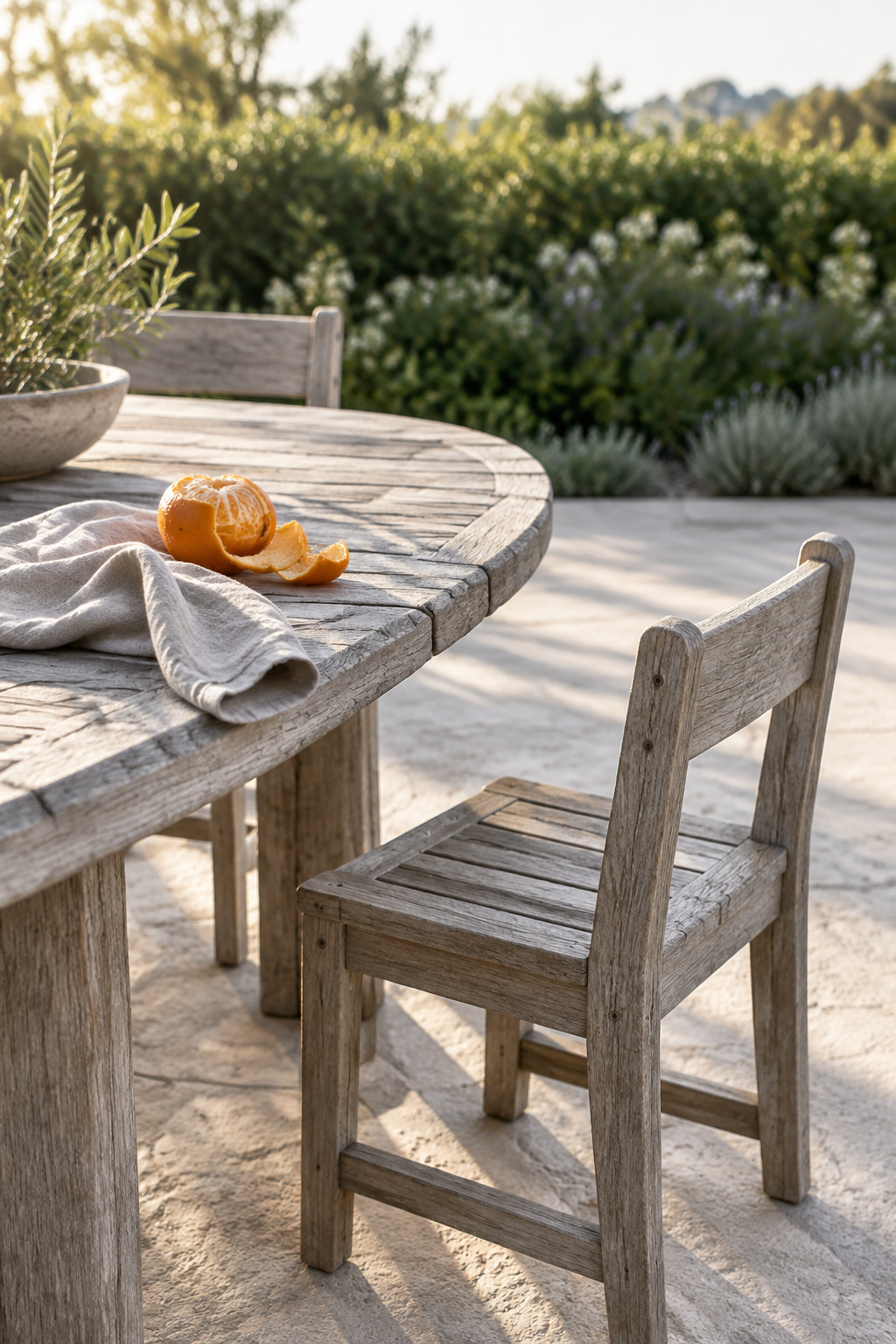
Catalog wipeability is tested with a photogenic drip of water. Real mess is sunscreen, which is oil plus UV filters like avobenzone and mineral zinc, and it marks porous or pale surfaces such as raw teak and light fabric far more readily than sealed ones. Melted popsicle does the same with sugar. My own test is whether a tired six-year-old will wipe at all, so the surface has to forgive a bad, late wipe.
Kid Friendly Patio Furniture: The Five-Minute Showroom Test
Run this in the order a meal happens:
- Arriving: can the child get onto the seat unaided, seat height checked against popliteal measurement, not age?
- Seated: do their feet reach something solid, and can they see over the edge to their plate?
- Leaving: room behind the chair for a wide, twisting, unpracticed exit?
- Skip: any glass top, tempered included, while small children eat there.
- Skip: dark seats in afternoon sun, sharp corners at forehead height.
- Buy: sealed, non-porous surfaces that survive sunscreen and a bad wipe.
This test doesn’t cover keeping bugs off a table full of children. Bite protection at child ages is a real problem, and it belongs to another article.
Buying for the Stage After This One
Buy for the stage after next, because furniture that fits only this year is the most expensive furniture you’ll own. Even the tallest child band still lands several inches under a standard patio table, so expect one more height step before your child fits the family’s own.
The labels are unreliable too. Two independent sources both citing BS EN 1729 give the same dimensions different sizemark numbers, a full band apart. One source’s Sizemark 1 (26cm seat, 46cm table, labeled ages three to four) carries exactly the dimensions the other calls Sizemark 2, with no age attached. I won’t adjudicate that, since it would take the primary standard open in front of me. Still, the number on the box is the least reliable thing in the transaction. So tonight, stand your child against a wall and note their height. Then sit them on a kitchen chair and measure floor to the back of the knee. Take those two numbers shopping instead of an age.
FAQ
What age can a child safely sit at a regular-height patio table without a booster?
No standards body publishes an age. BS EN 1729 sizes by height, and its tallest band, covering children up to 159cm, still specifies a 25.2in table, below a standard 29–30in patio table. By its own numbers, most children fit unassisted in the young-teen years.
Are plastic or resin patio chairs sturdy enough for a toddler to climb into alone?
Seat height relative to leg length decides this, more than sturdiness does. A lightweight resin chair at toddler seat height (roughly 8–10in for a two- to three-year-old, from measured popliteal height) is easier to self-seat in than a heavier chair at adult scale.
Do tempered-glass patio tables actually shatter, or just crack?
Compliant tempered glass fractures into small, roughly cube-shaped pieces without long sharp edges, which is the safety behavior the standard requires it for. It can still fail suddenly and without impact because of nickel-sulfide inclusions left in manufacturing, most within two to seven years of tempering.