

Twenty to thirty pounds per linear foot is what a run of ordinary books weighs, and it decides whether a shelf holds its line or bows in the middle. Almost nobody checks it. Nearly every dark academia bookshelf you have saved to a board was photographed the week it went in, and a photograph cannot show you deflection. Those rooms are still doing what this aesthetic asks: holding books somebody reads. This piece is how to build a shelf that can.
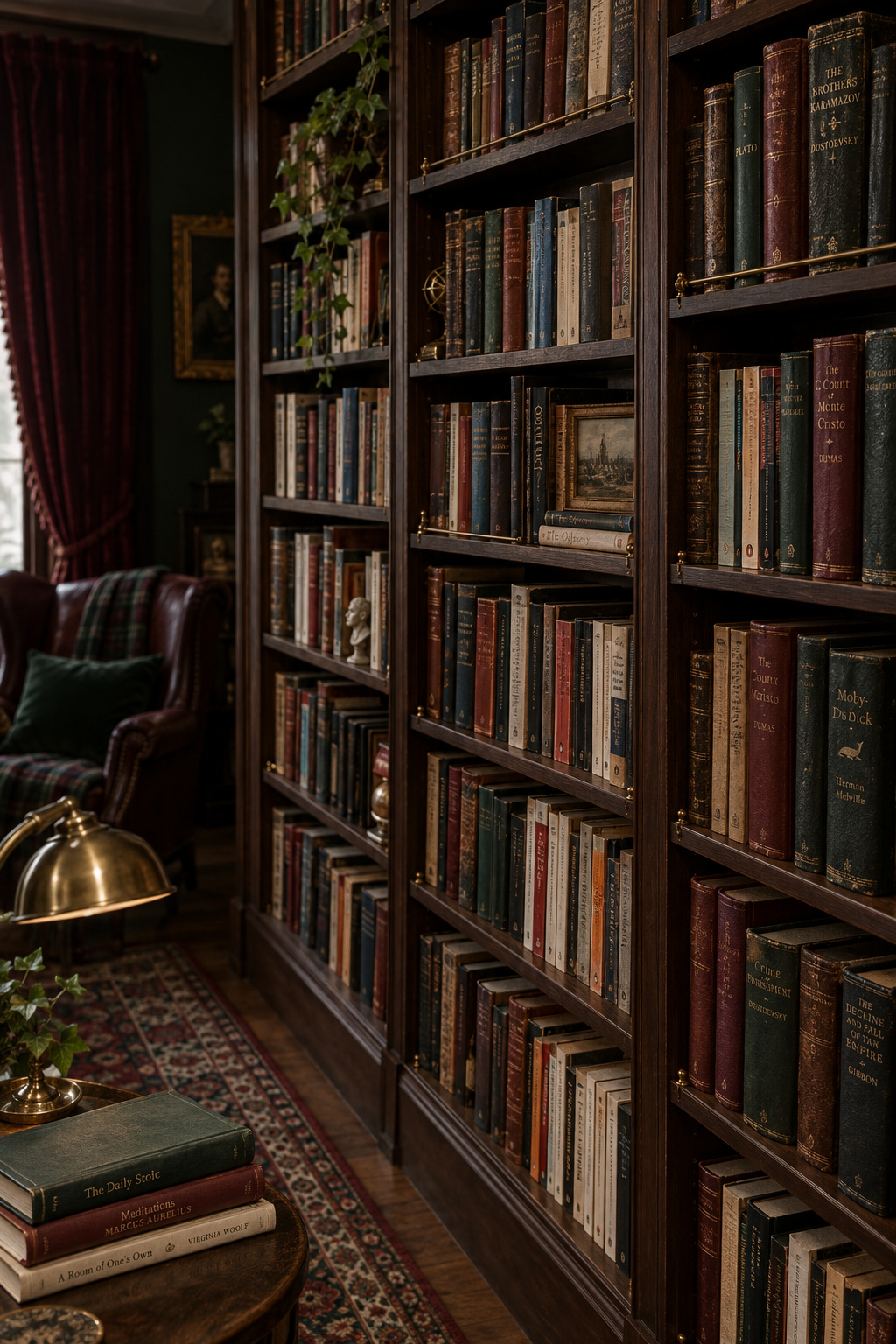
TL;DR
- Depth first: 8 inches for paperbacks, 10 to 12 inches for most mixed collections, 12 to 14 only for oversized art volumes.
- At 20 to 30 pounds per linear foot, 3/4-inch plywood spans 32 to 36 inches before sag shows, and a 6-foot run carries 120 to 180 pounds: tie it into at least two studs.
- Arrange by author, series and genre for retrieval, and skip the tricks: backward spines and color-sorting both cost you the ability to find a book.
The depth and load a dark academia bookshelf needs
Depth and load are the two decisions you cannot revisit once a run is loaded and screwed to a wall, so they come before styling, and before how a dark academia bedroom comes together.

Depth: what a mixed collection of paperbacks and hardcovers needs
The best run I ever specified was ten inches deep, and I settled that number before the wall, ten inches being what the collection measured, trade paperbacks mostly with a shelf and a half of hardbacks. The wall turned out to be a client’s hallway, which everyone thought a compromise until the shelves went in and the corridor stopped being one. We called it the library corridor, at first as a joke. A library is wherever the books and the light agree.
Size depth to the deepest volume that will live there, never the average one. A library-shelving manufacturer’s planning guide sorts real stacks the same way: 80 to 85 percent of an average library’s shelving at 8 inches, 10 to 15 percent at 10, only 2 to 5 percent at 12.
| Shelf depth | Typical load per linear foot | Best suited to |
|---|---|---|
| 8 in | ~6 lb/ft (paperbacks only) | Mass-market and trade paperbacks, general fiction — 80–85% of a library’s stock |
| 10–12 in | 20–30 lb/ft (moderate mixed load) | Most mixed paperback and hardcover collections; the working depth for a home book wall |
| 12–14 in | 35 lb/ft (library planning convention) up to ~40 lb/ft (magazine stacks) | Oversized art volumes, quartos and folios, bound periodicals |
Vertical clearance I hand you as an absence. No published figure governs shelf-to-shelf clearance for a full book wall, and the 8-to-12-inch clearance this site publishes elsewhere belongs to a reading nook’s working rotation, a different fixture. Build a floor from the ladder instead. A shelf sits about an inch deeper than its widest book, so the widest volume on a 10-to-12-inch shelf runs 9 to 11 inches across; assume a bound book stands taller than it is wide (true of upright books, cheerfully false of landscape art books) and the tallest is at least 9 to 11 inches. Add an inch to get a hand over the top: a minimum near 12 inches, 14 for oversized. That is an assumption, not a standard.
Load: why sagging starts before it’s visible
At a moderate book load of 20 to 30 pounds per linear foot, three-quarter-inch plywood carries a maximum unsupported span of about 32 to 36 inches before sag becomes visible; the deflection limit behind that span is roughly 1/32 inch per foot. An unrelated technical source reaches the same math from measured households (6 pounds per linear foot for paperbacks, 40 for magazine stacks, 35 as the library-shelving convention) and sets a stricter no-sag target near 1/50 inch per foot.
That gap is the whole problem: sag accumulates in fractions of an inch long before anything looks bent, so a shelf that still looks fine at six months is no evidence it sits inside its limit.
One unit check, because this error travels furthest. Twenty to thirty pounds is per linear foot of shelf, the weight one board spans. It is not the 150 pounds per square foot the building code sets as a library stack room’s minimum floor design load, which is what the floor beneath a whole stack must bear. Different quantities; there is no conversion between them.
Arranging a mixed collection for retrieval, not just for photos
How do you actually reach for a book: by author, by subject, by whatever you read last? A shelf sorted against your own habit will fight you daily.

Emma Carbone, senior YA librarian at Brooklyn Public Library, calls her method vibrational shelving: series and author kept together inside a genre grouping, deliberately loose. The reason is mechanical: a growing collection gains a title or two at a time, and a grouped shelf absorbs them where an alphabetical run has to be shoved along to the end of the wall. Her fallbacks when a section fills: stack same-author titles flat, park overflow on a cart, double-stack behind the front row, and only then buy furniture.
Then the handling, where the discipline I trained under still applies at domestic scale. Keep a shelf full enough that nothing leans, since a leaning book distorts and eventually breaks at the spine joints, but never so tight that pulling one title abrades its neighbors. Shelve by size within a grouping. And take a book down by the middle of its spine rather than hooking a finger over the headcap, the most fragile point on a binding and the first place wear shows. The Northeast Document Conservation Center publishes the first rule; a public library’s preservation blog publishes the second independently, in nearly identical words: standard practice, shared across institutions.
The honest verdict on backward spines, color-sorting, and filler decor
Books face backward on renovation television for a reason that has nothing to do with design. HGTV host Jasmine Roth has said on the record that spines go in because showing a cover or title on camera means clearing copyright for every title in shot. A legal department invented the look, and it escaped into people’s homes as a styling trend.
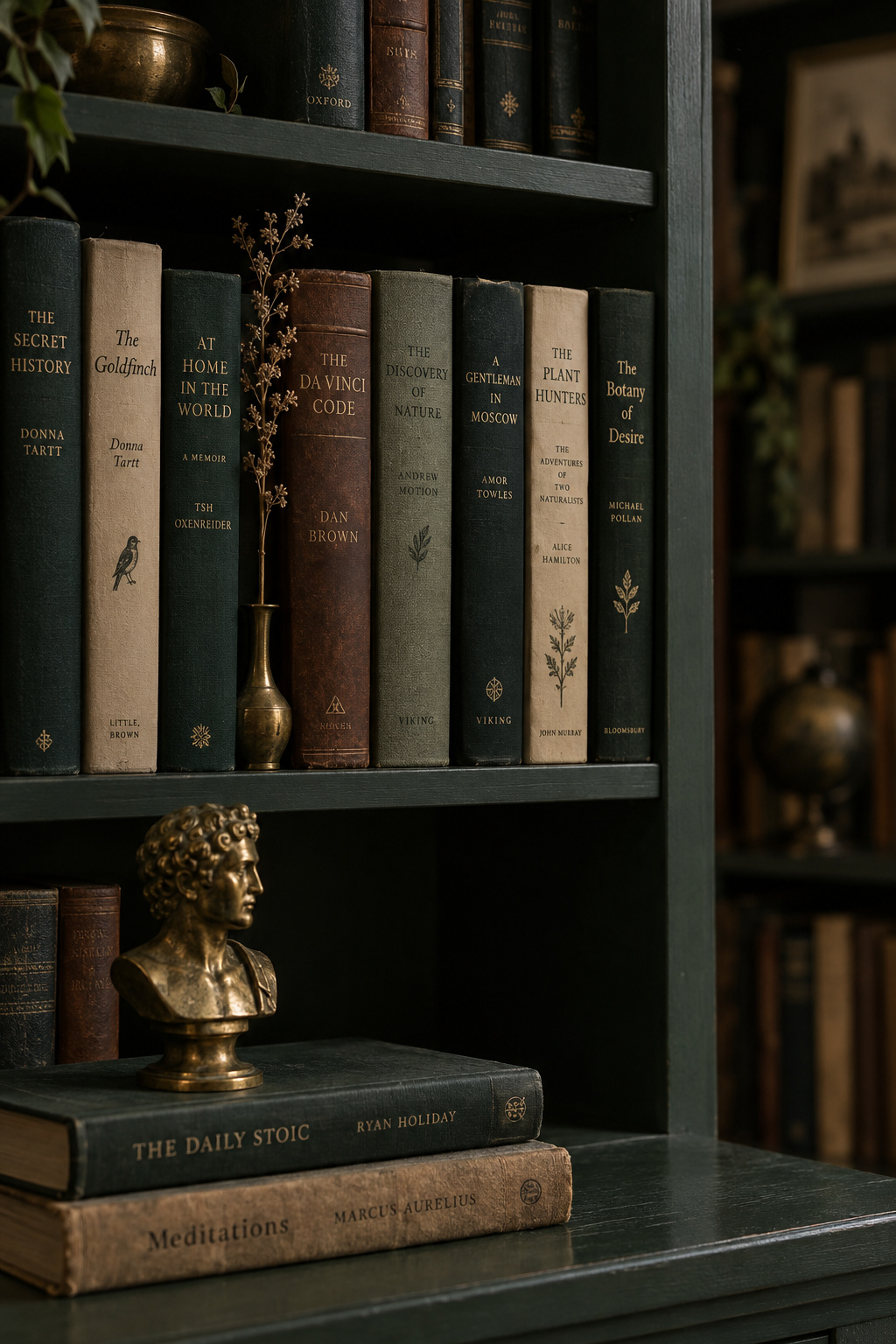
Spine-in was also the original convention. Mark Purcell, formerly libraries curator at the National Trust and now at Cambridge University Library, notes that English, Welsh and Scottish libraries mostly shelved spine-in until gilt lettering made a spine worth showing off in the seventeenth and eighteenth centuries. So the trend offends no tradition; it only costs your ability to find anything, which I care about more. That verdict rests on journalism and one named historian: no conservation or library-science body has weighed in at all.
- Backward spines: one small, deliberately non-functional display shelf at most, never a working run.
- Color-sorting: three professional organizers independently call it a retrieval failure dressed as a design win. Lisa Zaslow of Gotham Organizers puts it plainly: “No one retrieves books based on their color… the point of organizing is to make things easy to find.”
- Filler decor: every object displaces books and adds a thing to move before you can reach one. A brass piece or two is fine; a shelf given mostly to objects is a display case that happens to own books.
Face-out covers fill a gap without apology: the title still shows, and a thin collection stops looking unfinished.
Anchoring the run so it’s safe on a real wall
The classic mistake is tying the middle of a long run into one stud and calling it anchored. Find the studs (16-inch centers is the US framing standard) and fasten the run’s ledger strip or top rail into them with screws penetrating an inch to an inch and a half. Use L-brackets or a ledger rather than the unit’s own back panel, which is usually hardboard doing an impression of structure, and tie anything wider than a single bay into at least two studs. Where a stud genuinely is not there, drywall anchors carry 50 to 350 pounds depending on the anchor and product, so you are trusting the specific hardware, not the category.
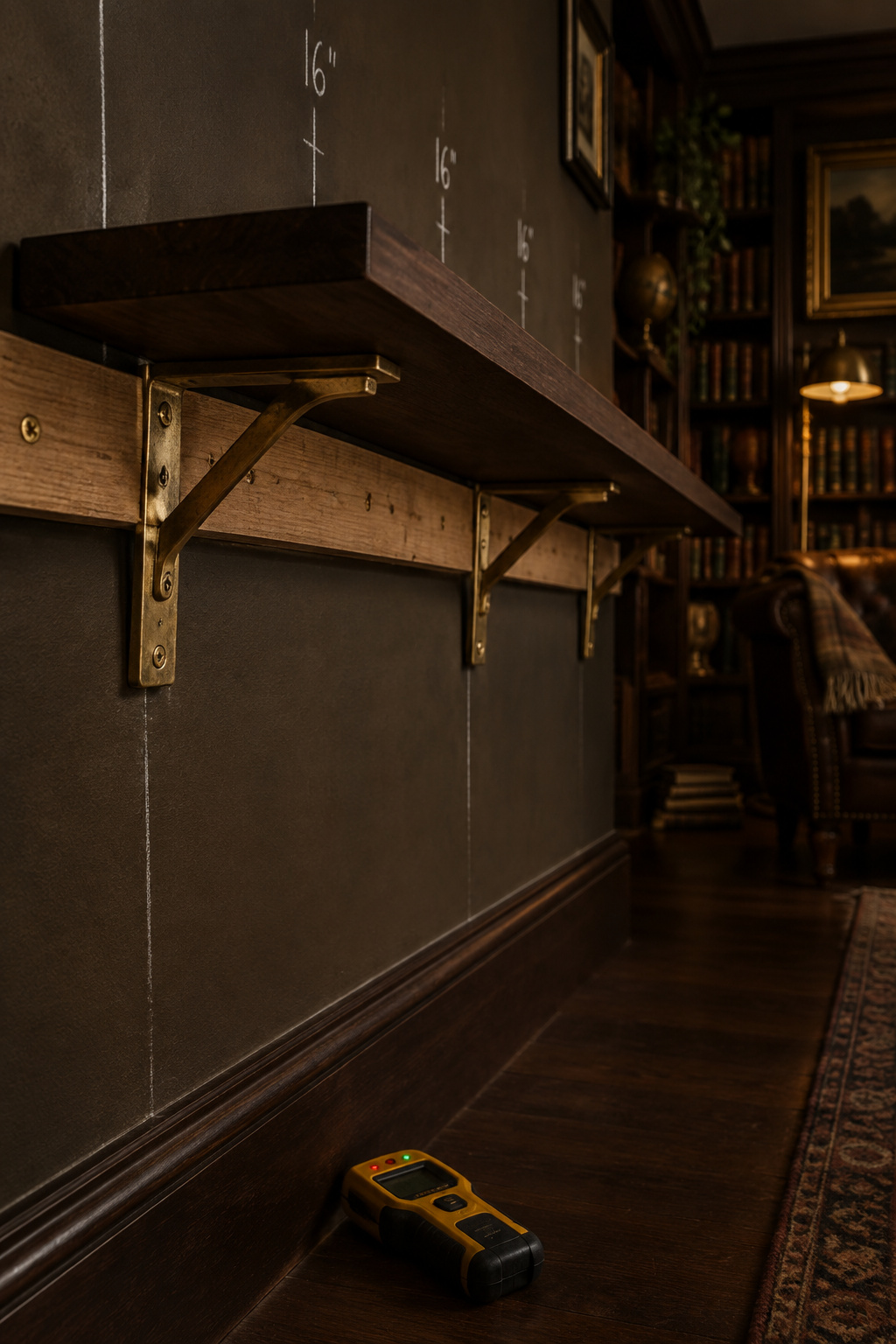
Put the load figure to work. At 20 to 30 pounds of books per linear foot, a 6-foot run carries roughly 120 to 180 pounds (20 × 6 = 120, and 30 × 6 = 180). Spread that across several stud ties rather than one bracket that happened to find timber, and keep the heaviest volumes low, where they exert less leverage on the anchors.
Where the shelf wall ends and the art wall begins
A shelf run and a framed-art wall are two systems sharing a room. One is sized to books and structure (depth, span, anchoring, the clearance to get a hand in). The other is sized to sightlines. Planned as one continuous surface they compete, and the shelving loses, because a framed piece can move an inch and a loaded run cannot.
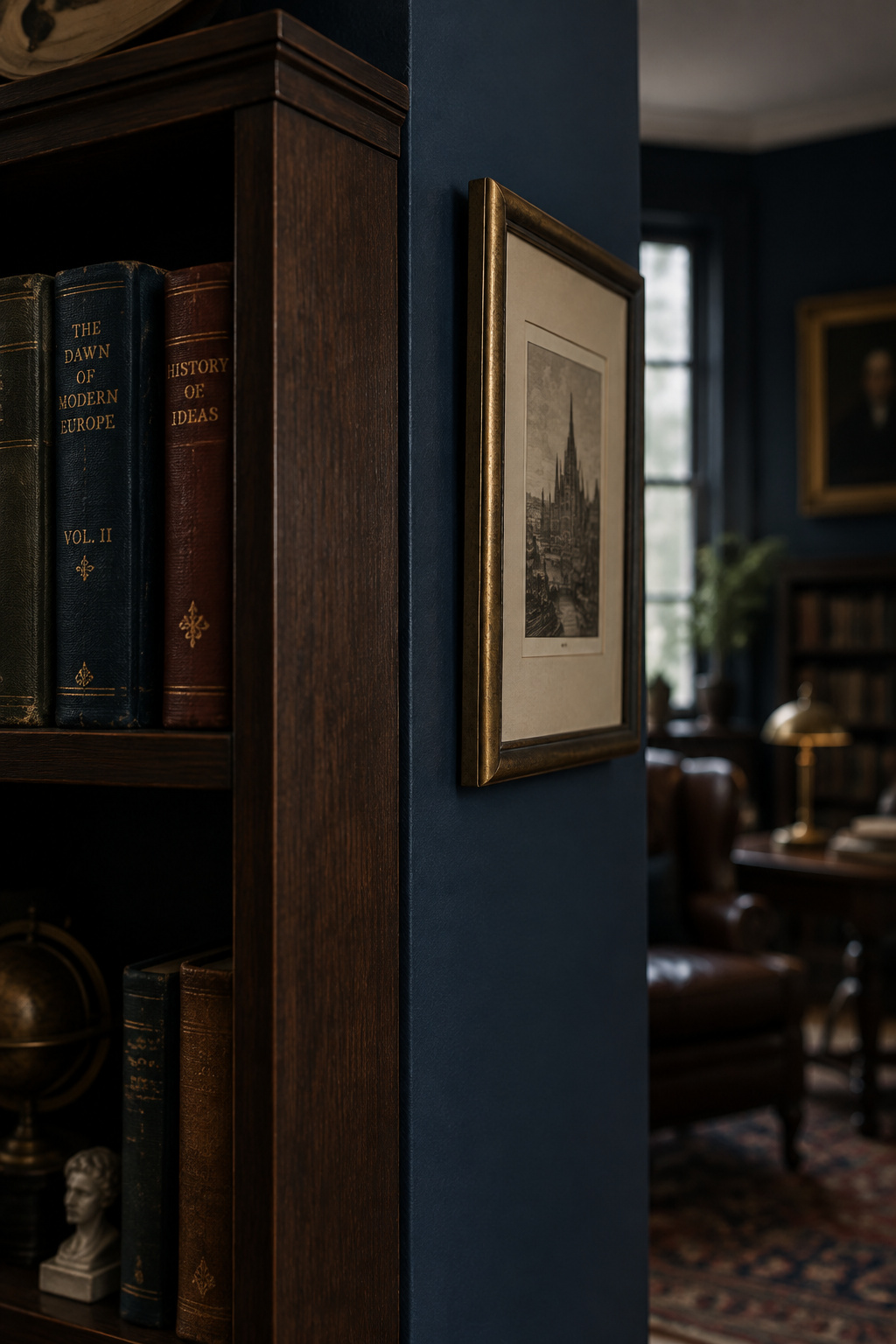
Give each its own plane. A fitted run ends at a corner or a clear change in wall plane, and the art begins on the next segment; the architecture does the separating. On the shelves, framed things stay small and few. Anything that wants a hanging height belongs on the wall, where hanging framed art beside a bookshelf wall is worked out properly, heights included.
Building the run vs buying one: the case for DIY
Labor is 70 to 80 percent of what a professional built-in costs. That share is the whole financial argument for building your own, and why a shelf run is the best-paying weekend of work in the room. The cost guides agree on direction and not on range: one puts custom built-ins at $400 to $1,000-plus per linear foot, another at $150 to $1,200-plus, and two honest ranges beat one confident average no source supports.
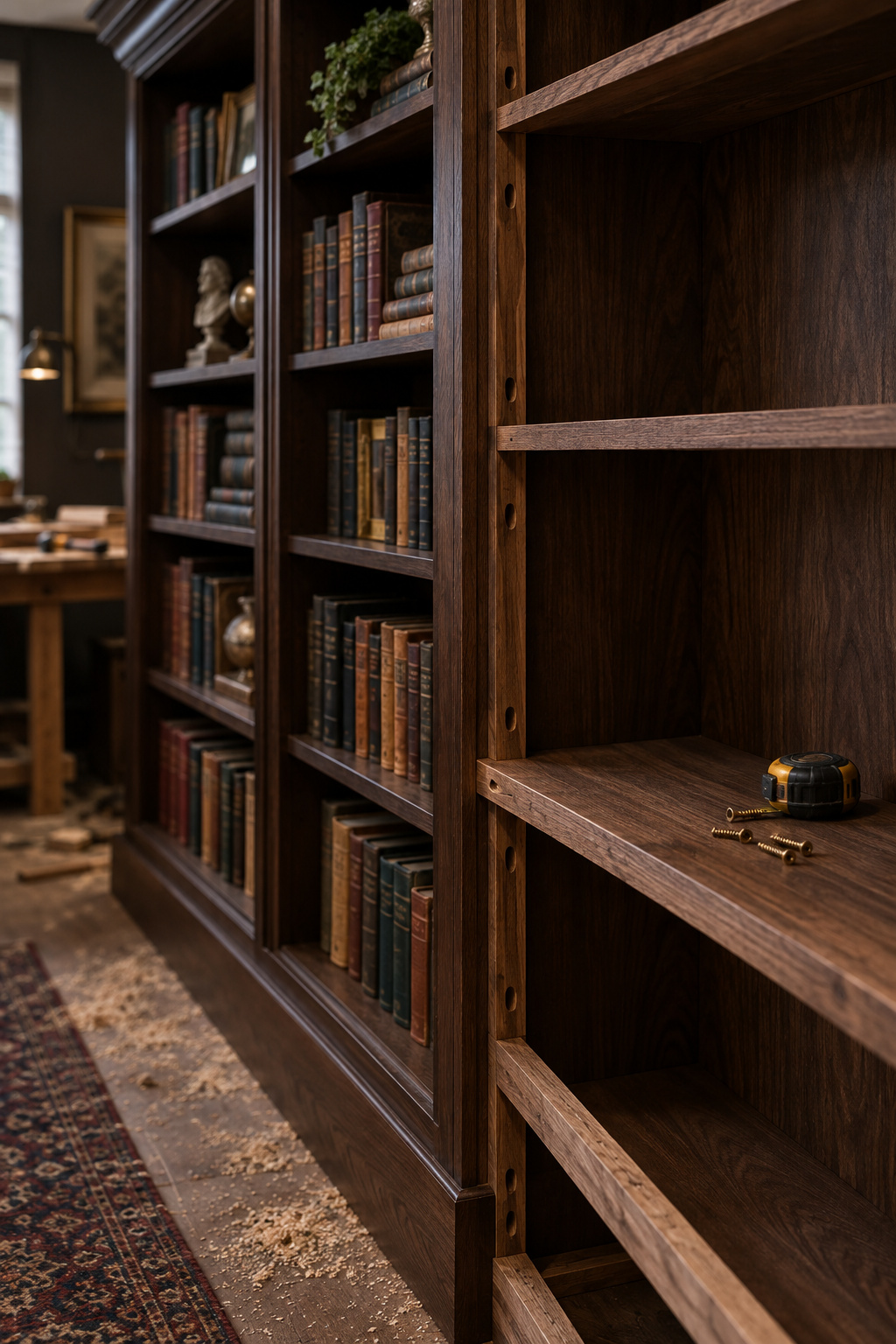
Where this lands in the room’s money: the shelf run and its books are the largest single line inside the cost ladder’s top rung, the cumulative $265 to $894 tier, and the most thriftable, since secondhand books do most of the filling. The full ladder is in budgeting a thrifted shelf and book collection.
Measure the deepest book, keep the unsupported span inside 32 to 36 inches, group the collection the way you reach for it, spines out. Then anchor for the weight you will really have: 120 to 180 pounds on a 6-foot run, on the assumption your shelves carry books at 20 to 30 pounds a linear foot, which is what a mixed collection weighs. Build for that weight and the photograph follows.
FAQ
Do floating shelves work for a dark academia book wall, or do they need bracket support?
They work only when the brackets land on studs. A stud-mounted floating-shelf bracket holds roughly 45 to 50 pounds, so a 3-foot shelf into two studs carries about 90 to 100 pounds. A drywall-only toggle mount drops to 20 to 25 pounds, which books at 20 to 30 pounds per foot pass within two feet.
Is it bad for the books if they’re shelved with no gaps at all?
No. Conservation guidance recommends keeping shelves full enough that nothing leans, since a leaning book distorts and can break at the spine joints over time. The risk sits at the opposite end: packed so tight that pulling one title abrades its neighbors. Full enough to stand unsupported, loose enough to lift one out cleanly.
How many books do I need to start a dark academia shelf if my collection is still small?
There is no such number. No code, standard or trade figure exists for a minimum book count or a books-to-decor ratio, and any source quoting one invented it. Shelve what you own upright with bookends so nothing leans, and use a row of face-out covers to fill the gaps honestly.