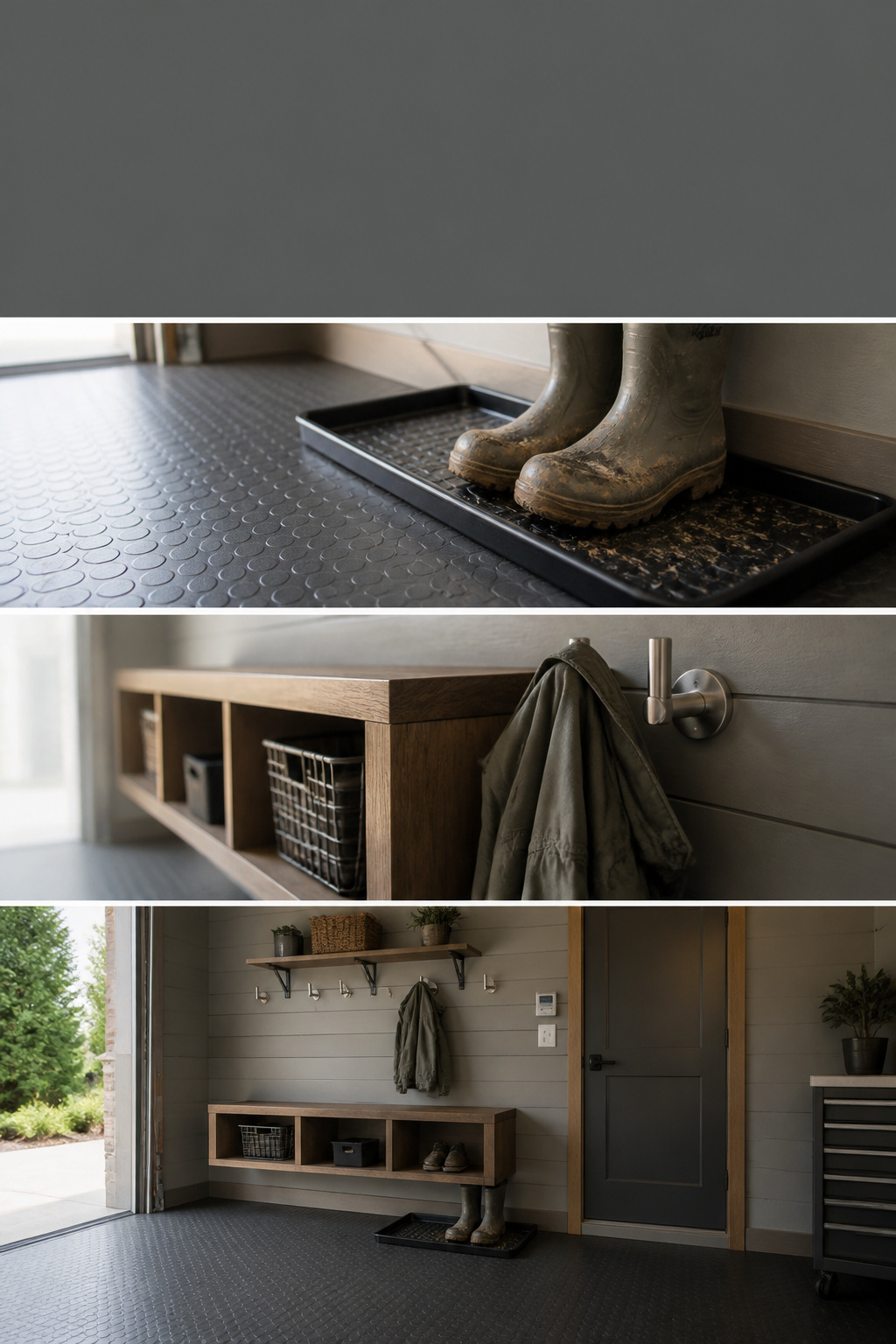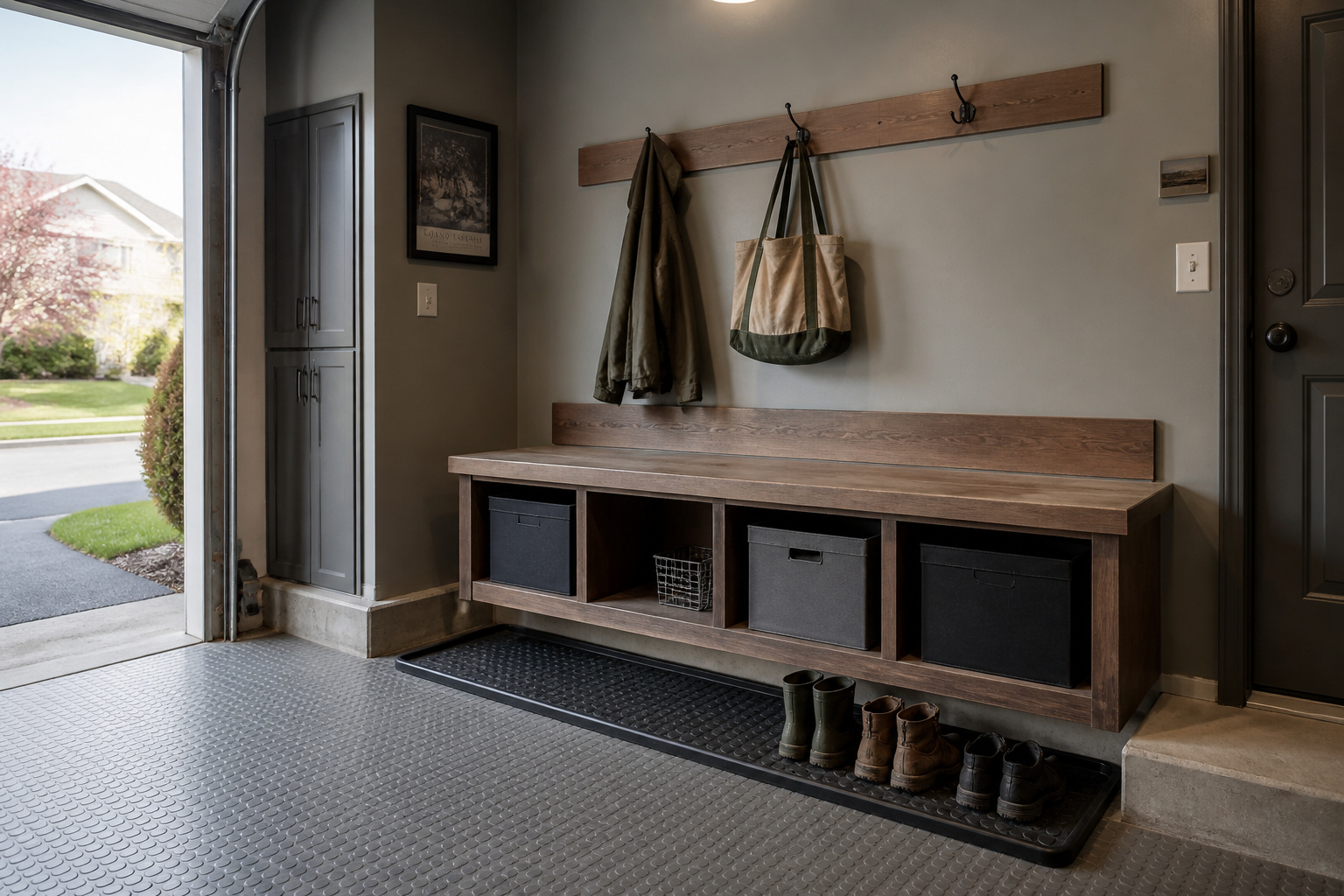
Most people treat the garage door like any other doorway: same painted hooks, same fabric bench, same rug they’d put in a front foyer — and a season of wet boots and road grime chews through all three. I built a garage entryway drop zone for my sister right after the $212 kitchen-island build in stock lumber — same cheap materials, picked for moisture instead of looks, and two winters on it still wipes clean. A garage entry isn’t a decorating problem; it’s the wettest, dirtiest door in the house, and it has to be built like one.
TL;DR
- A garage entry takes mud, road salt and standing water straight off tires and boots, so it needs three things a foyer doesn’t: moisture-tolerant flooring, corrosion-resistant hooks, and storage lifted off the slab.
- Coin-pattern vinyl runs roughly $2.75 per square foot as a no-adhesive DIY install, comparable to interlocking tile and far cheaper than a $2,400–$4,200 epoxy job.
- Build in order — floor first, then wall-mounted bench and hooks, then gear — because mounting the bench before the floor means tearing it back out to lay the mat underneath.
Why Garage Entries Wreck Regular Drop Zone Furniture
The myth is that a garage entry is just another entryway with a rougher paint job. It isn’t — it’s the one door that gets tire runoff, boot mud, and de-icer tracked straight across it with no mat zone to catch it first, and foyer-styled furniture fails here in predictable ways.
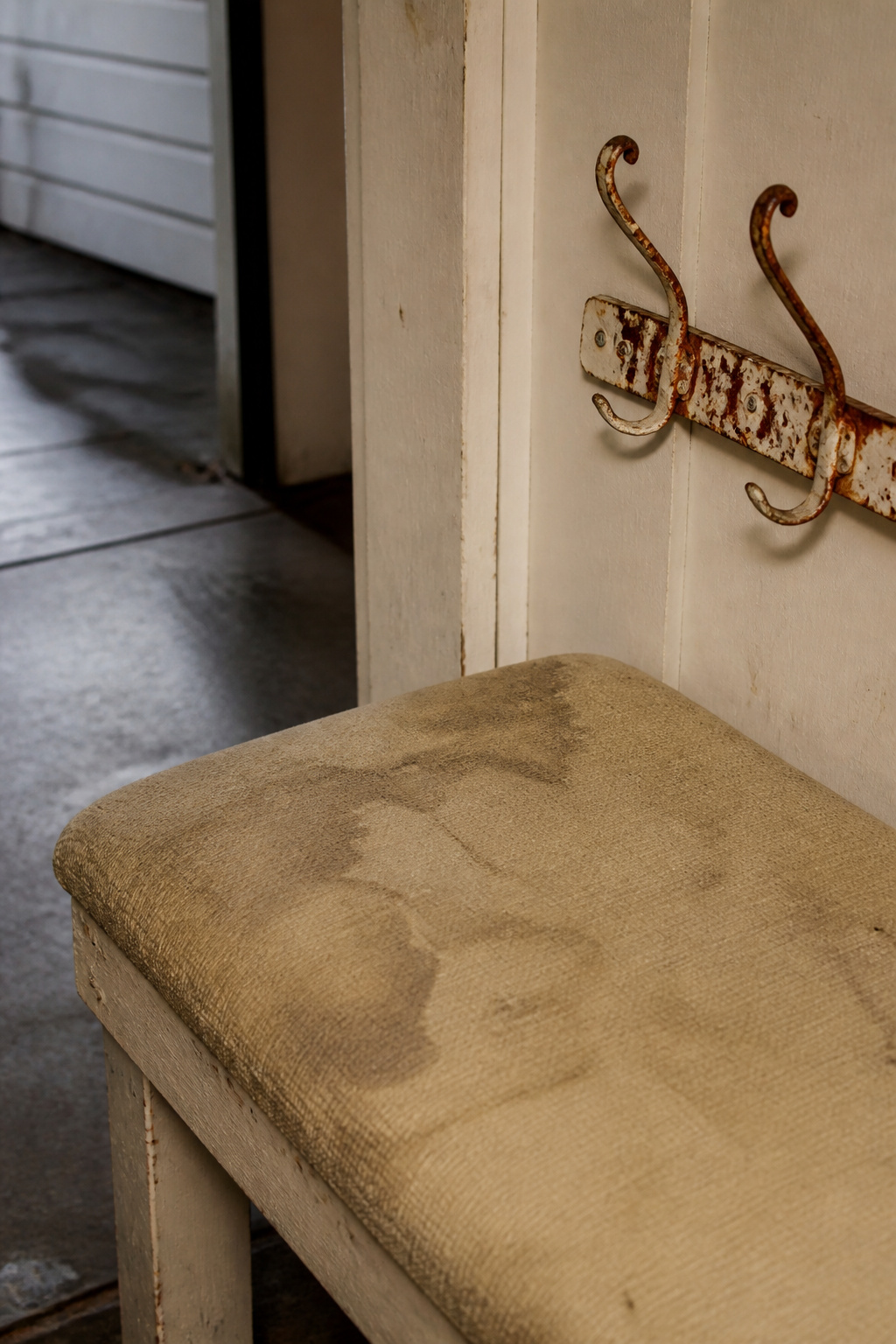
What mud, road salt and moisture do to fabric and painted wood
Two mechanisms do the damage. Moisture first: a painted surface that gets wet repeatedly swells and cracks until the film flakes off — why painted hooks and MDF trim peel here faster than anything inside. Then salt, corrosive and abrasive, speeding rust wherever it meets moisture and bare metal. The hard data on salt is automotive, not fabric, so I’ll say this cautiously: by the same logic, a fabric bench or cloth bin holds grime instead of shedding.
The common mistake: buying interior-entryway furniture for an exterior-adjacent door
The failure in one sentence: people buy furniture built for a dry foyer — upholstered seat, painted hooks, a jute rug — and set it at the door that takes direct tire and boot runoff. Mudroom designers name the mistake outright: trendy design chosen over the durability the traffic calls for.
What actually needs to be different here
Only three things change from a standard entryway:
- Flooring — moisture-tolerant, not carpet or bare painted wood
- Hardware — corrosion resistance built in, not painted on
- Storage — up off the slab, the way garage cabinets get hung off the floor
Get those three right and the rest is styling.
Flooring That Survives Wet Boots
This is where the real fight is — standing water and grit at floor level.
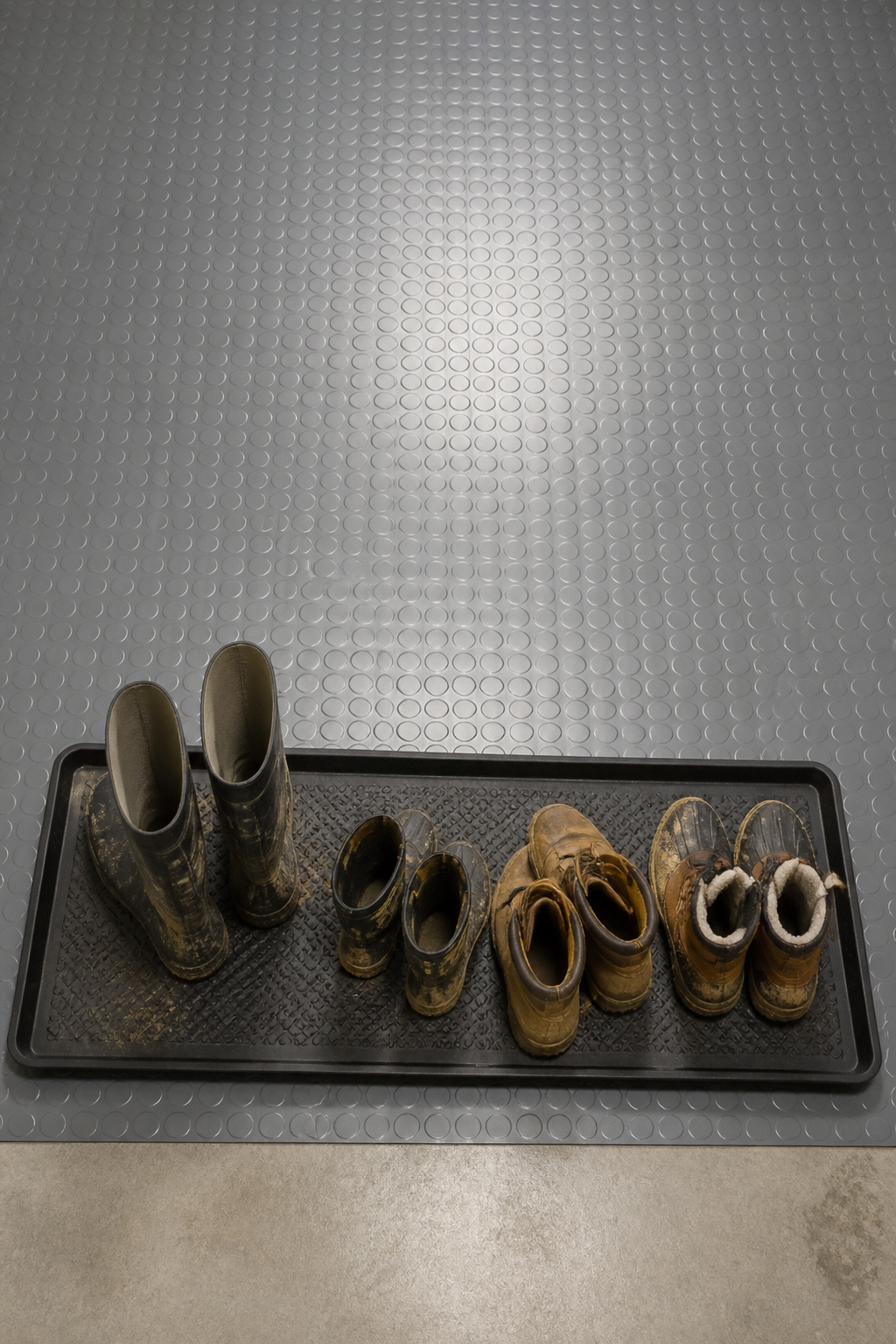
Rubber matting vs. coin-pattern vinyl vs. sealed concrete
| Surface | Best for | Trade-off |
|---|---|---|
| Coin-pattern vinyl | My default: no-adhesive DIY, wipes clean | Loses traction to rubber when wet |
| Rubber matting | Wet traction | Absorbs automotive fluids and swells |
| Sealed concrete (epoxy/polyaspartic) | Permanent, true vapor barrier | Bigger cost and labor commitment |
All three beat the surface to avoid: carpet or bare painted wood.
Sizing a boot tray to your household’s shoe traffic
Size the tray to footwear traffic, not door width — the mistake I see most. Mark where feet land stepping in, then add 6 inches front-to-back and 4 inches side-to-side for splash margin. A 16 x 36-inch tray holds four pairs; a 28 x 15-inch one holds three. Count everyone who uses the door, and keep the tray 2 inches shallower than any bench above it.
What it costs to redo this floor properly
| Floor option | Cost | Verdict |
|---|---|---|
| Coin-pattern/interlocking vinyl | ~$2.75/sq ft, DIY, no adhesive | Best value for an entry-sized job |
| Epoxy (full 2-car garage) | $3–$12/sq ft installed, $2,400–$4,200 total | The permanent step-up |
| Concrete floor paint | ~$0.15/sq ft | Skip it — peels under traffic within months |
You’re only covering the entry, not the whole garage, so the vinyl bill stays small — paint is a false economy here.
Storage That Handles Wet and Muddy Gear
Gear that comes in wet has to dry; gear that’s moisture-sensitive has to stay dry. Pros split the difference.
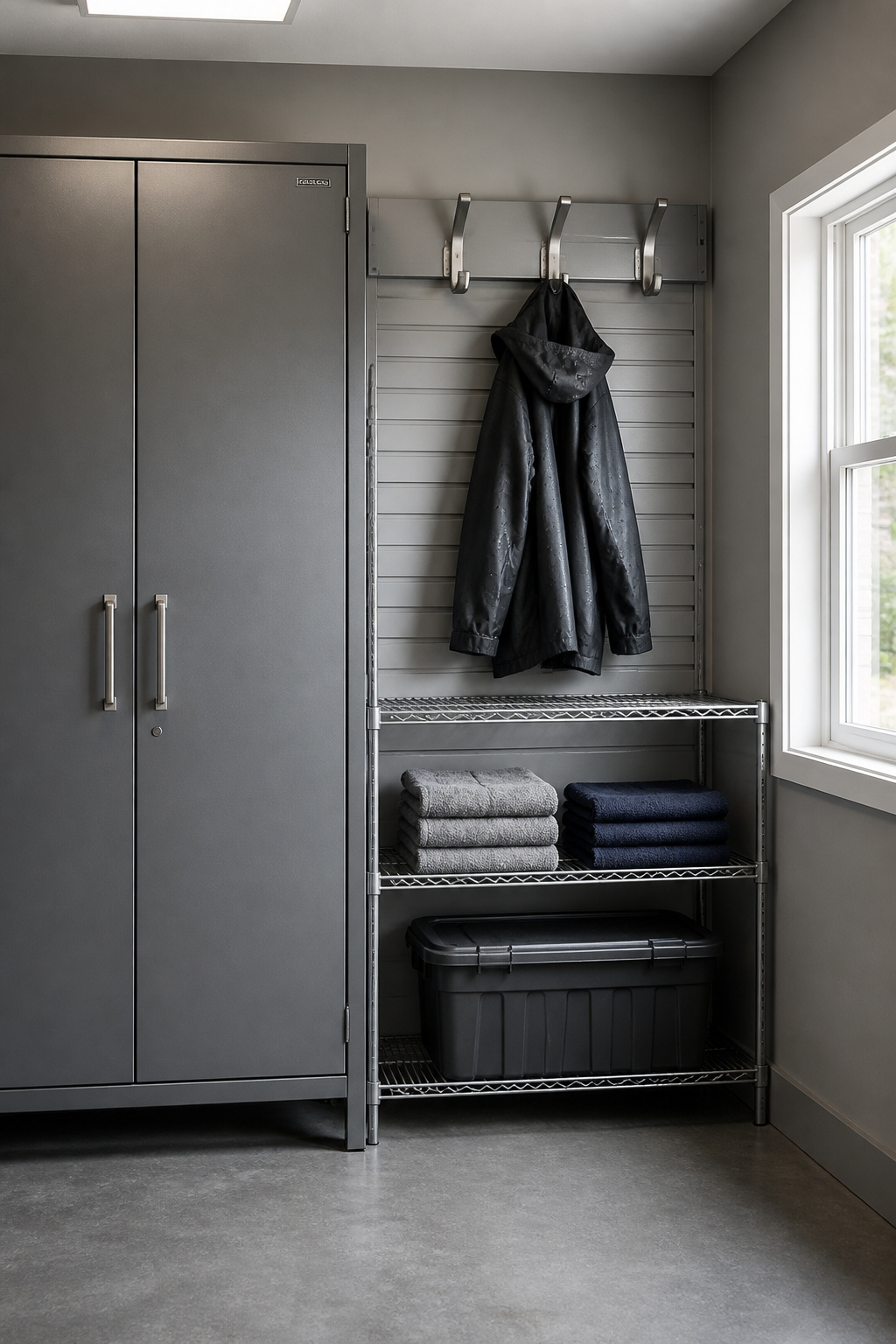
Open metal or plastic shelving vs. closed cabinets for wet gear
Run a hybrid. Open shelving wins for airflow — wet coats, muddy cleats, and camp gear need to breathe, and a closed cabinet just traps damp and grows mildew. Closed cabinets win for what must stay clean and dry, but keep them metal with a rust-resistant coating: particleboard is ruined by water. That split is the professional call.
Hook materials that won’t rust or peel
Hook material matters as much as placement.
- Stainless steel (SUS 304) — resists rust because its chromium forms a passive layer that blocks moisture; corrosion resistance that’s inherent, not a coating that can chip
- Rubber-coated heavy-duty hooks — the other good call, many rated to 50 lbs
- Painted steel — the failure case: paint chips under friction, and rust starts at the chip
It’s the same logic behind choosing the right entryway hooks generally — buy the corrosion resistance in, don’t paint it on.
Where to put a drying spot for wet coats before they hit the hook
Give wet coats somewhere to drip before storage. A separate drying hook lets a soaked jacket air out first — a wet coat shut in a cabinet is a leading cause of mildew smell. The garage trick: crack the door part-way in mild weather, or run a fan. Dry first, store second.
Weatherproofing Standards That Matter Here
The durability claims on flooring aren’t all marketing — real ratings sit behind them, and knowing two or three keeps you from buying underbuilt.
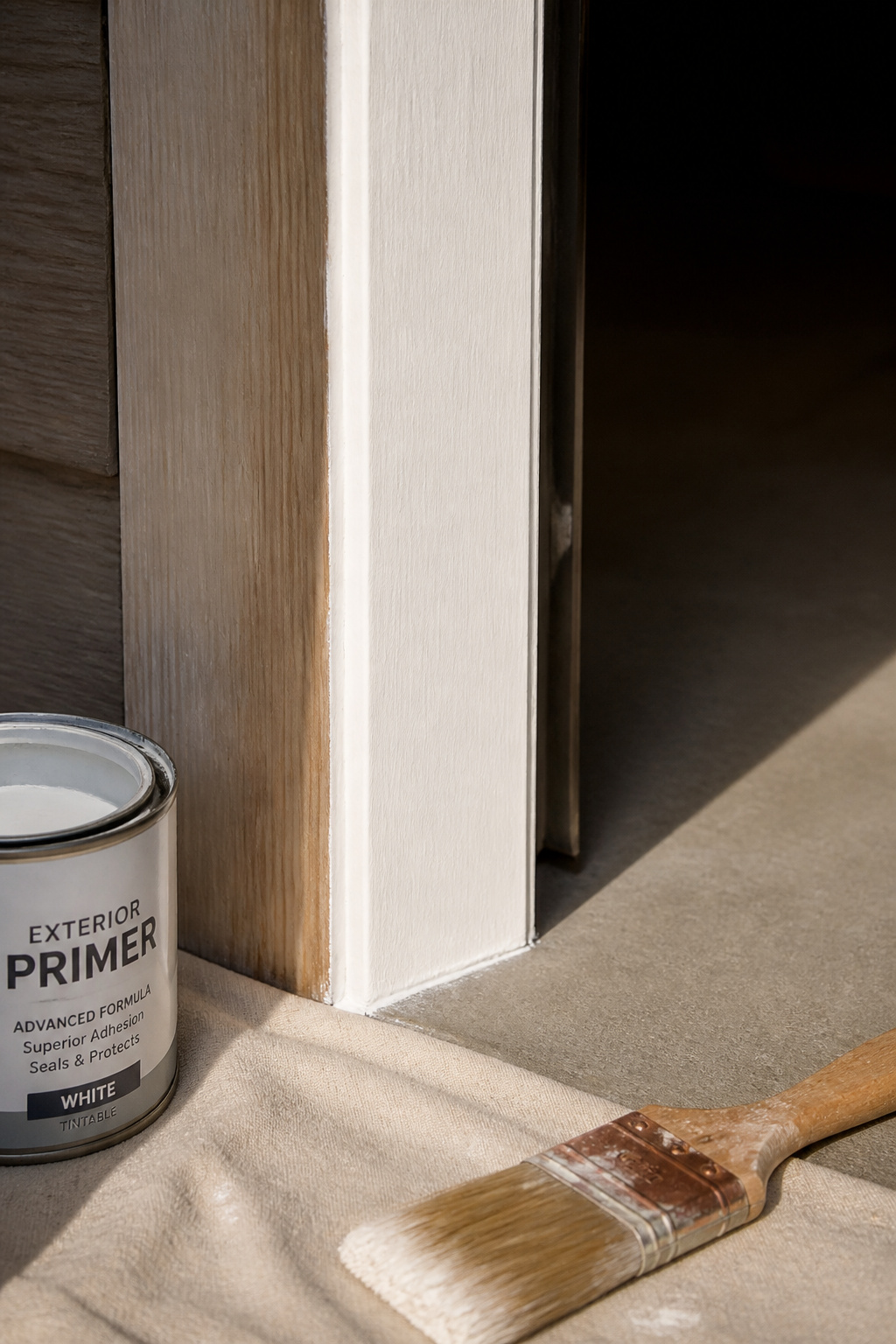
What moisture and abrasion ratings on flooring actually mean
The AC rating (Abrasion Class, EN 13329) runs AC1 to AC5 for resistance to wear, impact, and staining — higher is tougher, and boot-and-grit traffic wants the upper end. ASTM F925 checks that de-icer or oil won’t stain. Coating bare concrete: ASTM F2170 tests slab moisture first, since coating a too-wet slab is a classic failure cause. Just check the spec sheet.
Why interior paint fails on garage-entry trim
Interior paint fails at a garage door for a specific reason, rarely the paint’s fault. Trim boards can wick moisture 4–5 inches up from the slab even without direct rain, which is why peeling almost always starts at the base. Brush a coat onto bare wood, and the film swells, cracks, and lets go — the same mechanism as the hooks, running up from the floor.
One expert habit: sealing before decorating
The habit separating trim that lasts from trim that bubbles is sealing the wood first. Most paint failure at an exterior-adjacent door traces to moisture moving through the wood, so the fix is sealing the substrate, not fancier paint. Prime bare wood before painting, and prime the cut edges too — moisture enters through unsealed end grain.
Building the Full Garage Drop Zone
Pull the pieces into one layout.
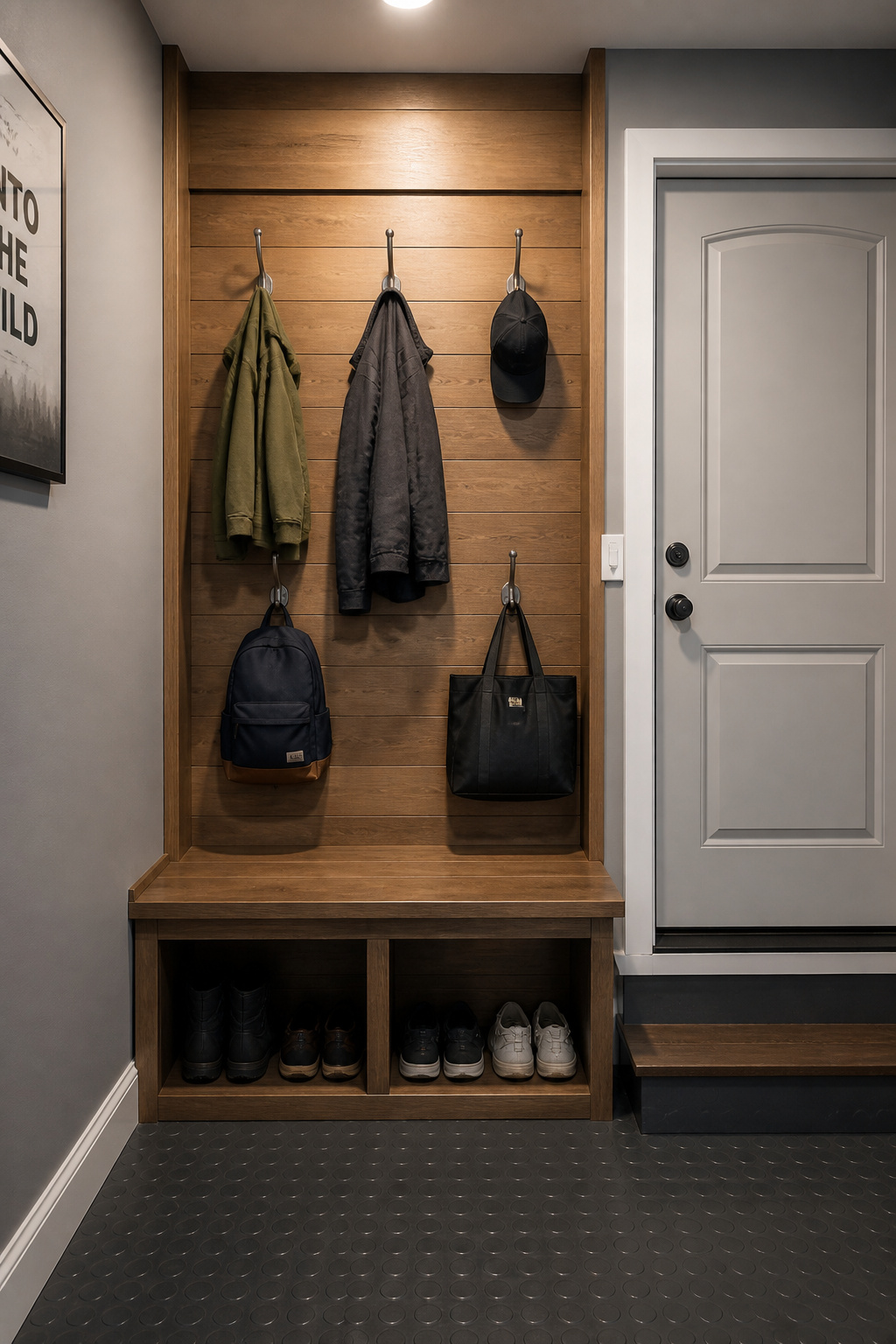
Layout: bench, hooks, and floor zone in a tight footprint
Work to real numbers. A bench 17–19 inches high, 14–16 deep, about 36 wide suits a roughly 5 x 5-foot entry. Mount adult hooks 60–66 inches off the floor, spaced 6–10 inches apart, with a lower row at 42–54 inches for kids or bags. Cubbies want 12–16 inches of depth — 12 for shoes, 14–16 for winter boots. Leave a clear 36-inch walkway so two people can pass.
A weekend build order that avoids re-doing steps
The sequence is my own method, learned the hard way:
- Lay the floor covering
- Mount the wall bench and hooks
- Move gear in
Skip the order and you’ll tear the bench back out to get the mat underneath. The build is friendly — about $130 in pine and plywood, together in an afternoon, and a $20 pocket-hole jig makes assembly about as easy as flat-pack (or glue-and-screw if you’d rather skip the jig). I’ll rate this one first build — a circular or miter saw is the only real power tool. Budget for the trip back to the store; there’s always one.
Pairing it with a family command center for the paper side
A garage drop zone handles the physical stuff — shoes, coats, bags — not mail, keys, or the calendar. That’s a separate build on the same wall, usually done the same weekend: pairing it with a family command center covers that half.
Another Dead-Space Build Worth Trying
If your garage entry is too small for a full bench, hooks, and cubbies, don’t force it — a close cousin solves the same problem.
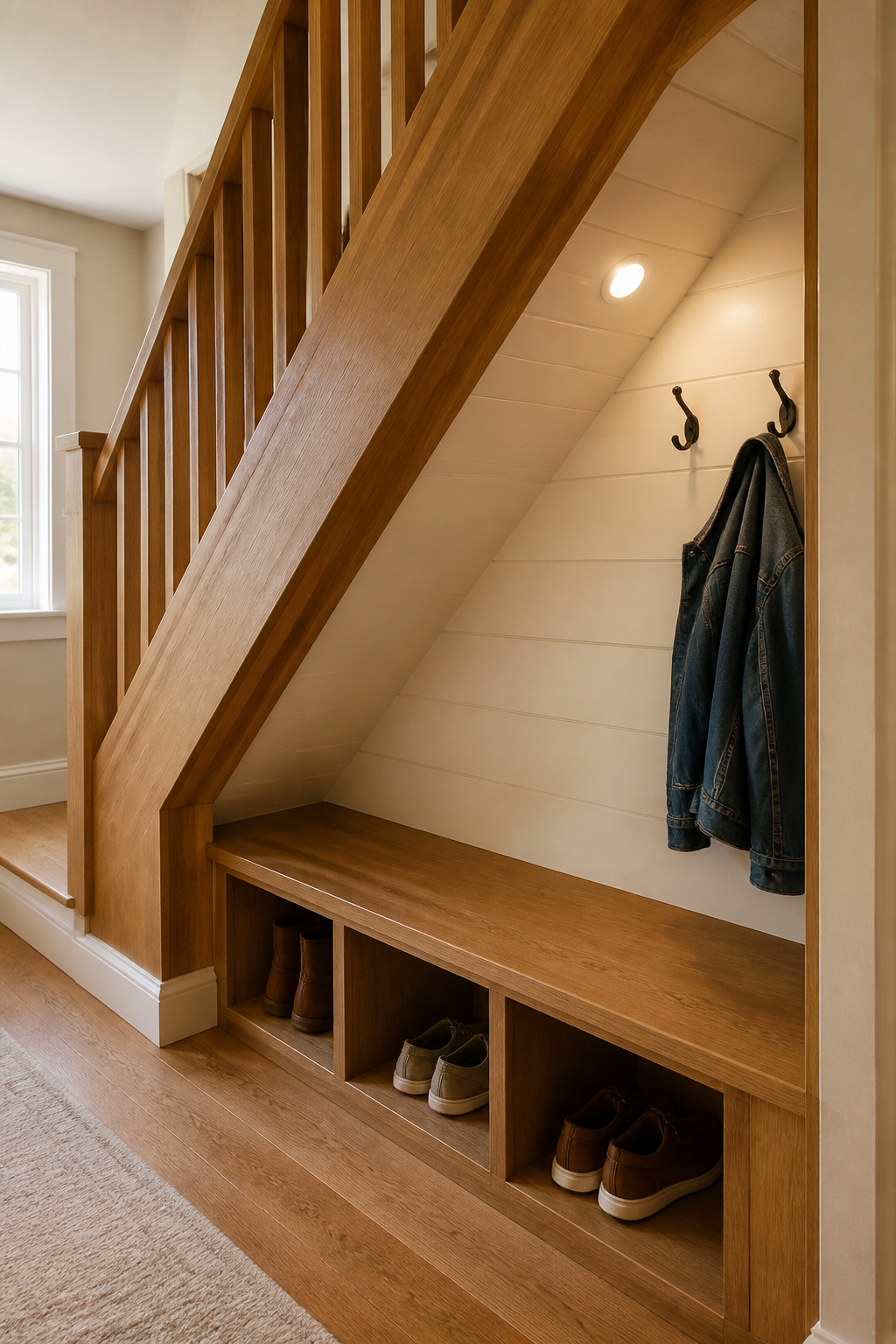
How under-stairs builds solve a similar no-closet problem
The triangle under a staircase takes the same core components as a garage entry — bench with cubbies below, hooks above — fitted to a sloped ceiling instead. Same 2×4-and-plywood approach, same budget range. It can even become a closed coat closet, an option a garage entry rarely fits.
When a garage entry alone isn’t enough storage
Think of it as a second zone, not a replacement. When the garage entry can’t fit a bench, cubbies, and hooks together, split the load — daily gear at the garage door, overflow into pull-out drawers under the stairs, another dead-space build worth trying. For how every entry setup fits together, start with the full drop zone ideas guide.
You now have what you need to build a garage entryway drop zone that survives winter: three floor surfaces to choose between, hooks that won’t rust, and a build order that keeps you from redoing your work. Your first move costs nothing — stand at the door, count the boots that come through it, and mark the boot-tray footprint in painter’s tape. Size the floor to real traffic, and everything above it follows.
FAQ
Do I need a drain in a garage entryway drop zone?
Usually not. If the slab already slopes toward the main garage door, water flows back out instead of pooling. Many municipalities also restrict garage floor drains over oil and runoff concerns, so check local code first. Most homeowners use a roll-out mat or tile with drainage channels instead.
What’s the best flooring for a garage mudroom on a budget?
Interlocking garage floor tiles run about $2.75 per square foot with no adhesive, one of the cheapest durable DIY options. Roll-out coin-pattern vinyl is a comparable budget pick — waterproof, installed by unrolling and trimming to fit. Avoid concrete floor paint; at $0.15 per square foot it’s cheaper upfront but peels within months.
Can I add a garage entry drop zone without cutting into the garage wall?
Yes. A freestanding bench placed at the entry gives you seating and under-bench storage with no wall modification. Floating shelves mount on almost any vertical surface without structural cutting. A coat tree or a repurposed cube shelf used as a bench are both no-modification options — good for renters or anyone avoiding wall work.