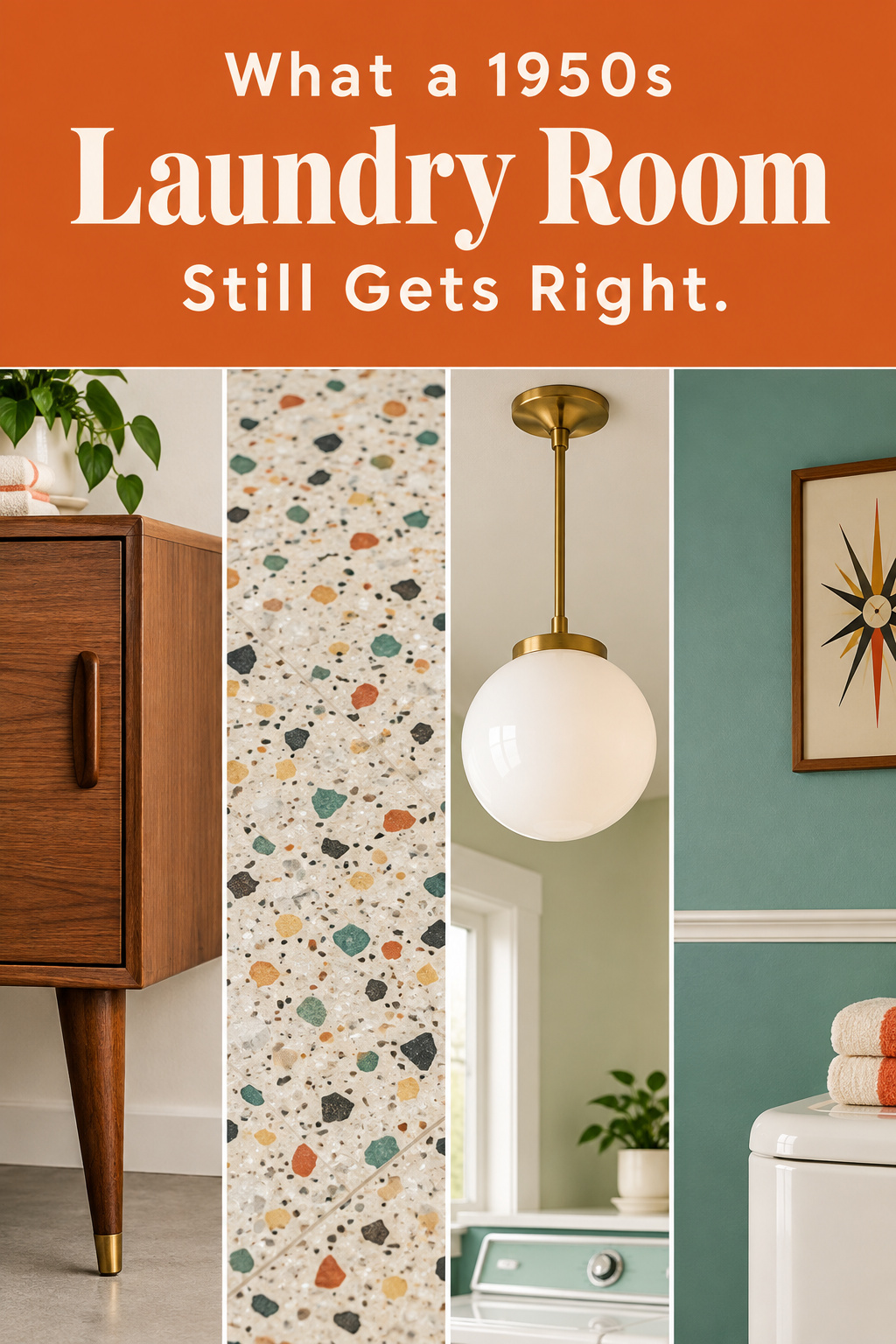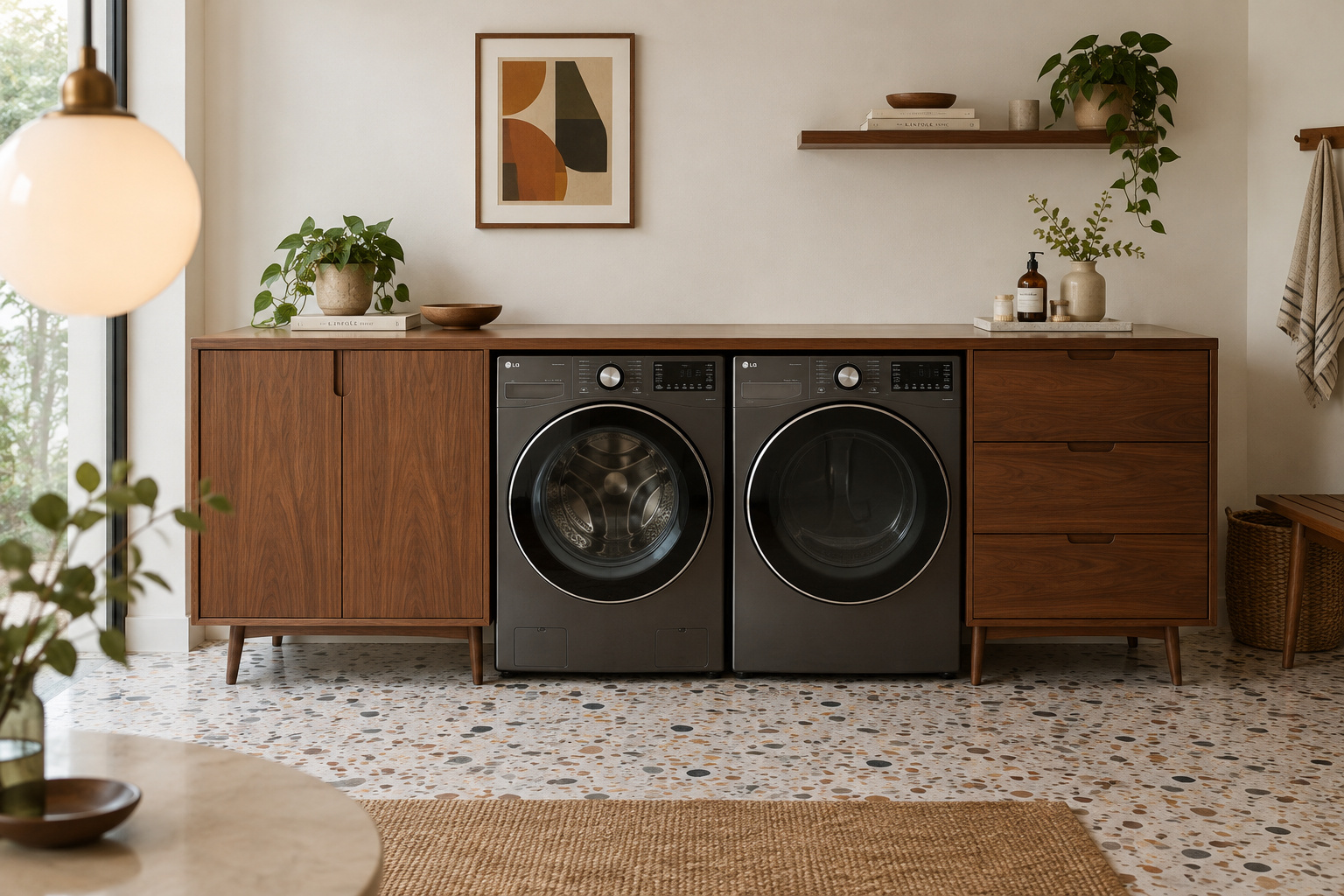

That is the year avocado arrived in General Electric’s appliance lineup, according to GE’s own color-history material, and harvest gold followed in 1968. Both came in alongside the Danish modern look of the late sixties. The green washer most people picture in a mid century modern laundry room is therefore a late arrival to the period, not its founding color. A 1959 laundry room was more likely to be pink. The real room was practical, plastic and pastel. The walnut version you want is something new wearing a period accent, and knowing the difference is how you build it well.
TL;DR
- The period room wasn’t walnut. Records from 1959 and 1964 show pastel color, laminated-plastic cabinet fronts and vinyl floors; wood tone became common in the 1960s, and GE’s avocado only arrived in 1966.
- The idiom is five pieces, not a period set. Slab walnut or teak-tone fronts, tapered legs, period color, terrazzo or VCT-style floors and a globe or saucer light, each traceable to a real 1950s source such as Paul McCobb’s 1955 Planner Group catalog.
- Period depths don’t fit modern machines. A 24-inch base cabinet sits well short of a 30-to-34-inch-deep front-loader, so a working version needs a deeper counter, offset hinges and a check of your model’s door swing.
What a 1950s Laundry Room Actually Looked Like
Any period cabinet front that crosses my bench announces itself at the edge before the face. Laminate shows a hard, thin line where the plastic meets its core, and no styling hides it.
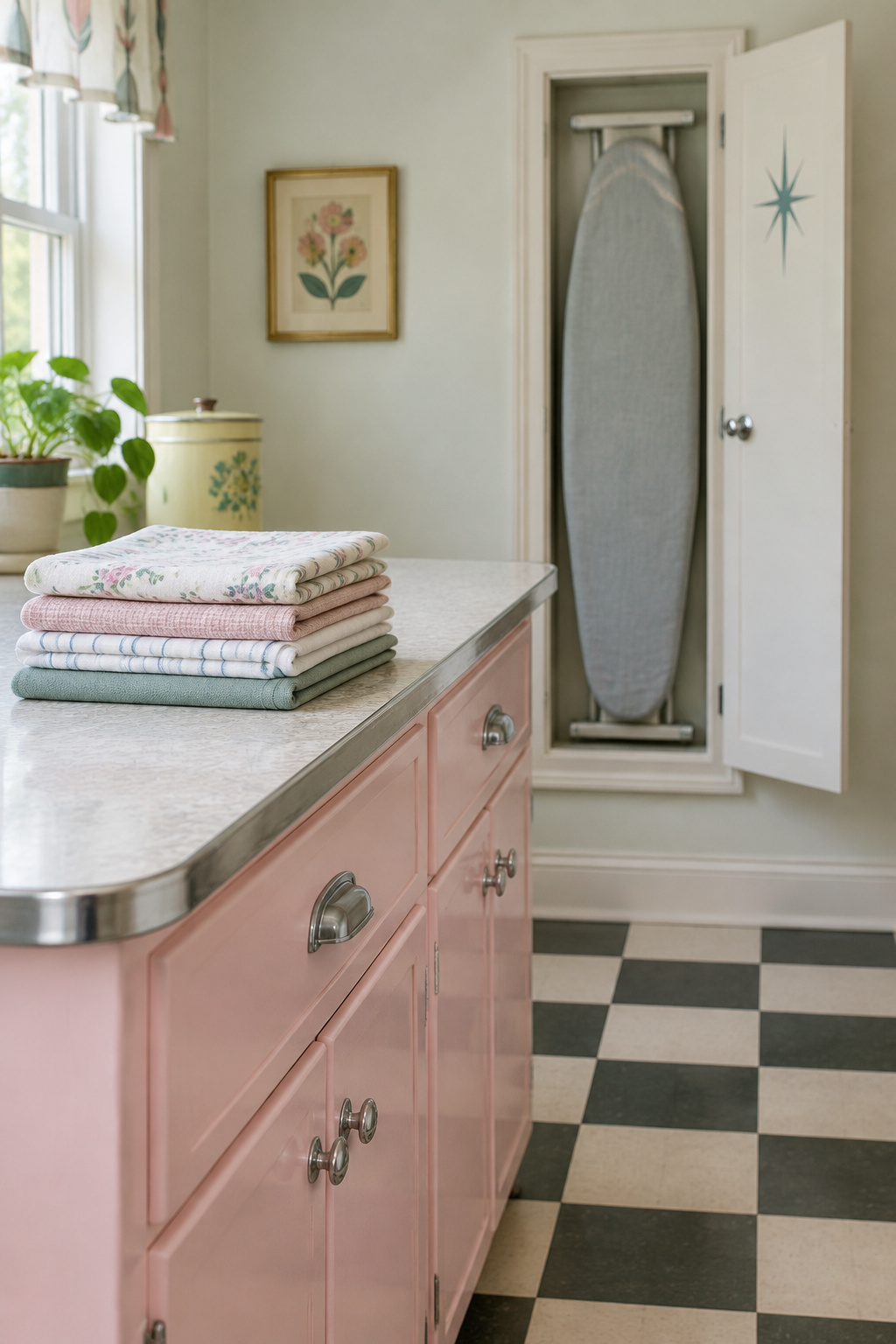
Click Americana reproduces period ads and captions from 1948 through 1977. Its archive documents a 1959 laundry room with pink as the dominant color, fitted with a sink, counter space and an ironing board. A 1964 laundry plan there specified “easy-care surfaces”: laminated-plastic work tops and cabinet fronts, vinyl-coated wallpaper and a textured vinyl floor. None of it was wood veneer. CabinetDoors.com’s decade-by-decade cabinet history adds that 1950s kitchens and utility spaces most often had vinyl checkerboard floors under metal cabinets in candy pastels, light blue, pink and yellow, and that wood-tone cabinetry only became affordable and common in the 1960s.
What the era invented was consolidation. The archive shows washers and dryers leaving separate basement corners to stand as side-by-side pairs in a dedicated closet or room. A tilt-out clothing basket appeared in 1956, and roll-around sorting carts in the early sixties were designed around that pairing.
The mood-board laundry room, all walnut and avocado, never existed in the fifties. The walnut room is a modern room in a mid-century idiom. You can still build it, with your eyes open.
The Mid-Century Modern Laundry Room Idiom, Piece by Piece
What reads as “mid-century” today is a distillation of rooms that held a great deal more, and treating every 1950s object as fair game is how a laundry room tips into reenactment. The working idiom is five pieces, each with a traceable source:
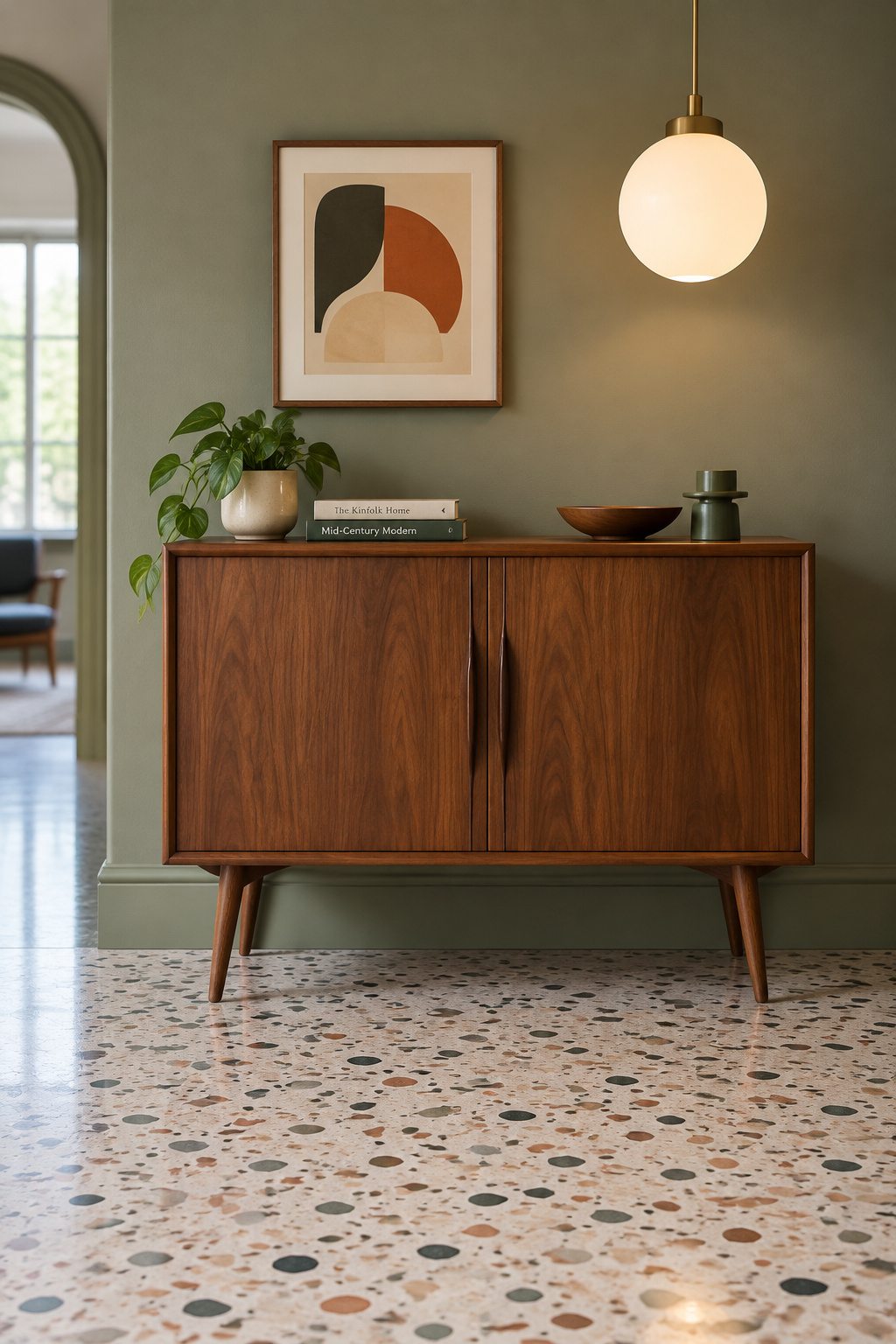
- Slab walnut or teak-tone fronts. Paul McCobb’s Planner Group went to retailers in 1949 and to consumers in 1950, with solid-maple case pieces in natural, tobacco, walnut and black. It became the decade’s best-selling modern furniture line.
- Tapered legs. McCobb’s 1955 Planner Group catalog lists chests and cabinets “available with attached leg bases or tapered legs and braces.” The leg was a line item you ordered.
- Period color. Pastels ran through the mid-fifties, then came GE’s avocado in 1966 and harvest gold in 1968. Pick the decade you mean before you pick the paint.
- Terrazzo or VCT-style floors. Richard Neutra was putting terrazzo into Southern California houses in the 1940s, and vinyl tile went mainstream once the war’s vinyl shortages ended.
- A globe or saucer light. William Krisel, who designed thousands of Palm Springs tract homes between 1955 and 1965, told the Eichler Network: “The globe light is what was available at the time.”
I would pin Krisel’s line above any mid-century project: the era’s most recognizable fixture was simply the one on the shelf. Thomas Erik Nielsen of Translite Sonoma explains why one globe so often lit a whole room. It needs “a large housing and diffuser and a central location, and consequently is rather inflexible.”
Walnut and Teak-Tone Fronts: The Heart of the Look
Why does a walnut slab front feel approachable rather than grand? It was sold that way. McCobb’s Planner Group was open stock, bought one piece at a time instead of as a matched suite, and aimed at “young moderns” and new homeowners at entry-level prices. Two hundred and fifty stores bought it in its first year, so the walnut finish was a mainstream choice made by ordinary households.
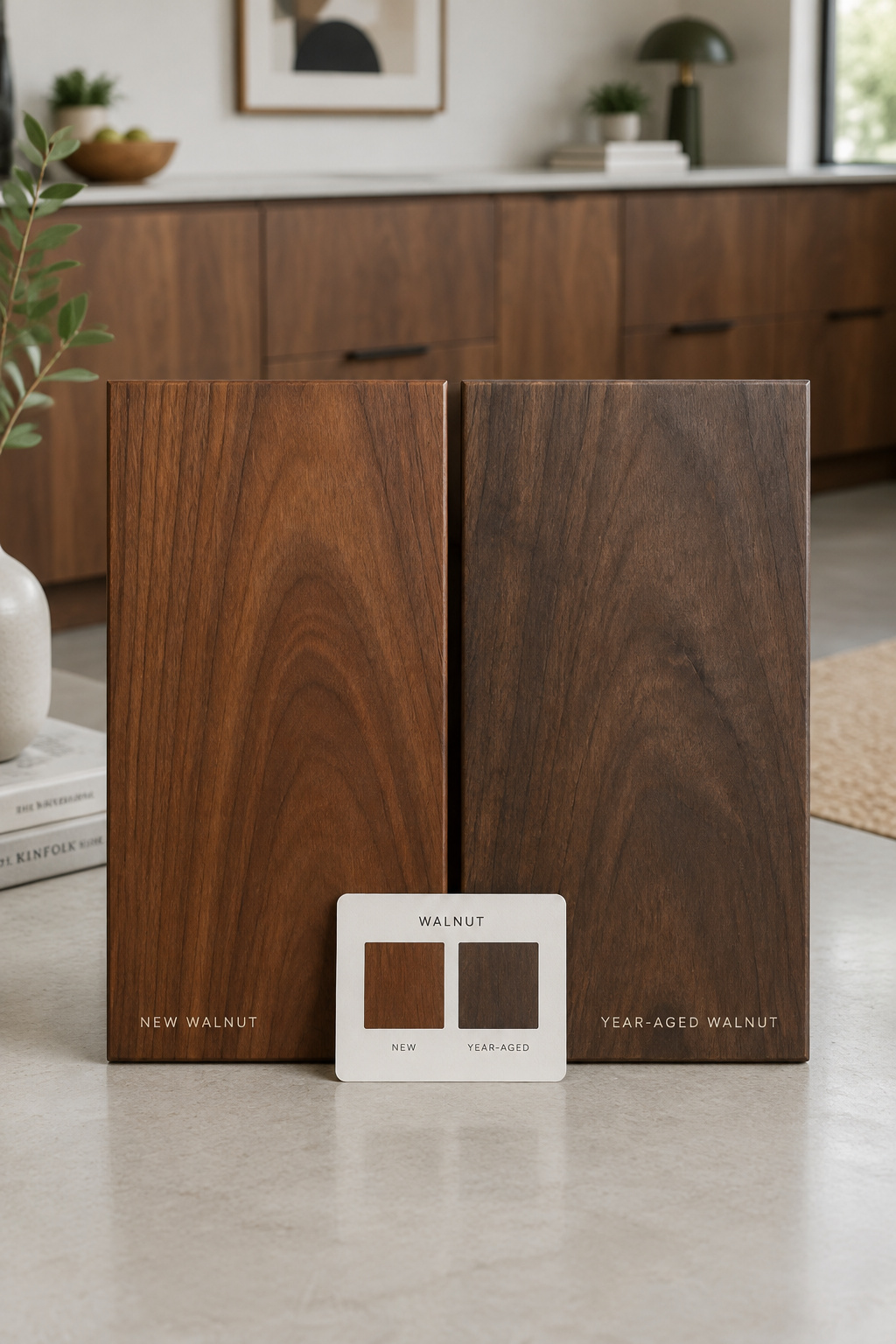
That history suits a laundry room, where a frameless slab front continues the flat face of the machines beside it.
Now the part the showroom won’t tell you. New walnut starts as a consistent dark brown. As it ages it lightens and a honey tone comes through the grain, and Room & Board notes that the change is most dramatic within the first year, even within the first few months. A front matched to a swatch on delivery day will look different a year on. The wood is behaving normally, so choose walnut for where it is headed, not where it starts. My working habit is finish first: I test the finish on an offcut or a hidden corner, in the room’s own light, before a door is hung.
Whether walnut and teak-tone fronts survive a room full of steam is a separate question, about species, veneer versus solid wood and finish. Our guide to whether walnut and teak-tone fronts survive the steam answers it. This article settles the look; that one settles the durability.
Terrazzo and VCT-Style Floors: The Period Floor
Frank Lloyd Wright settled on terrazzo for the Guggenheim’s ramps after seeing it in a Rome airport. “This is it, the ideal floor for our ramp,” he wrote in a 1957 letter, adding that “it is not unduly expensive or they would not have been using it for acres of floor in an Italian airport.”
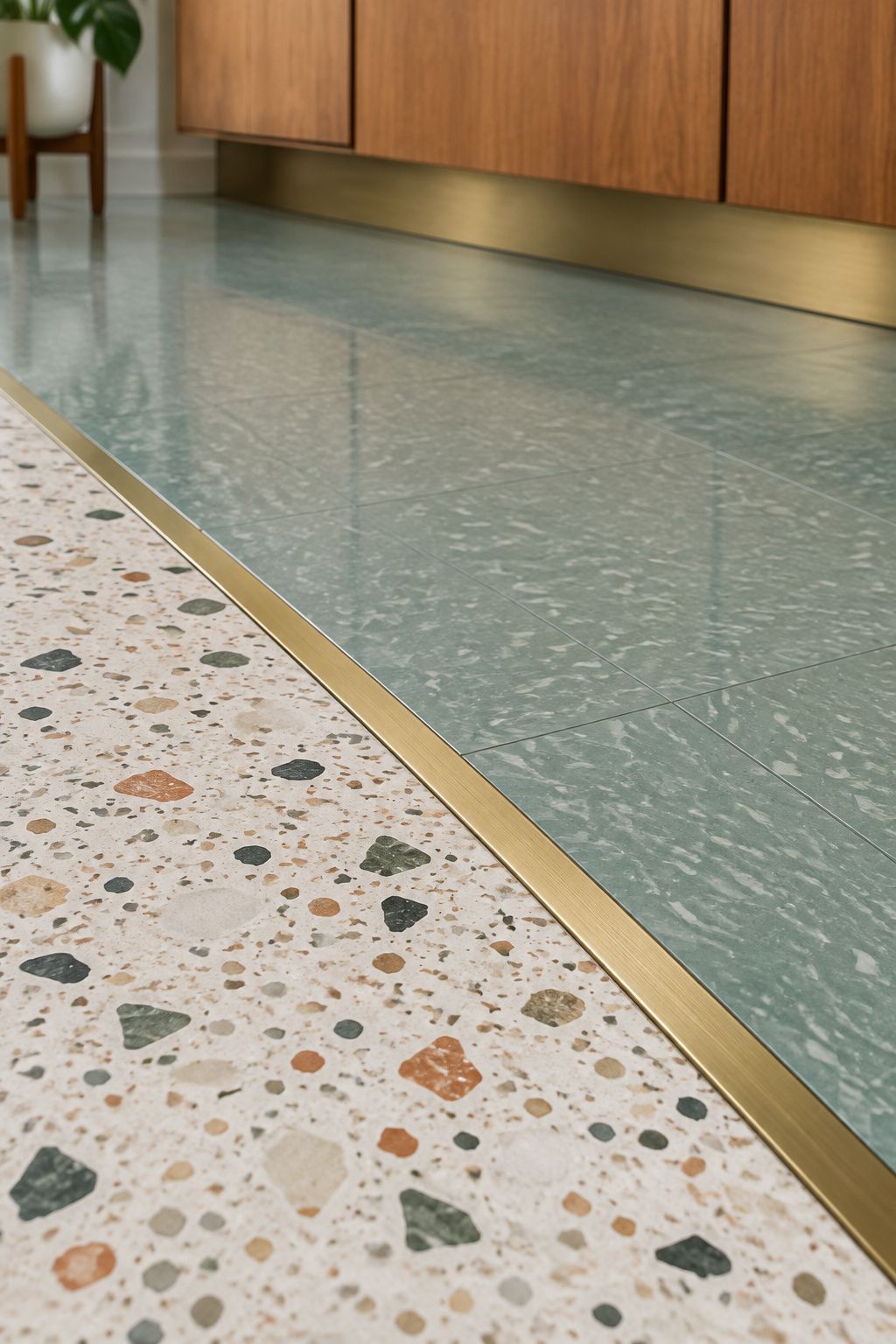
Terrazzo’s residential moment rested on older engineering. The Association for Preservation Technology’s bulletin on the material credits two innovations: brass divider strips in 1919 to control cracking, and the electric grinding machine in the 1920s. Together they kept terrazzo “a common flooring material since the mid-twentieth century.” By the 1960s, after Neutra’s houses, it was the indoor-outdoor floor of choice in California and Florida homes.
Vinyl composition tile is the humbler period floor, and just as honest. It became a widely marketed residential floor only after the late 1940s, once wartime vinyl shortages ended, so VCT and the mid-century laundry room grew up together. Retro Renovation reported in 2012 that the streaky 1950s look of Azrock’s Cortina pattern had been made by the same process for at least 34 years. You can still buy a period-process floor new.
A terrazzo-look porcelain or vinyl shares a picture with real terrazzo but not a manufacturing history, so choose it knowingly. The flooring guide has the ratings and the prices for how terrazzo and VCT-style floors hold up to water and cost; I’ve kept both out of this article on purpose.
Where the Idiom Stops Working With Modern Machines
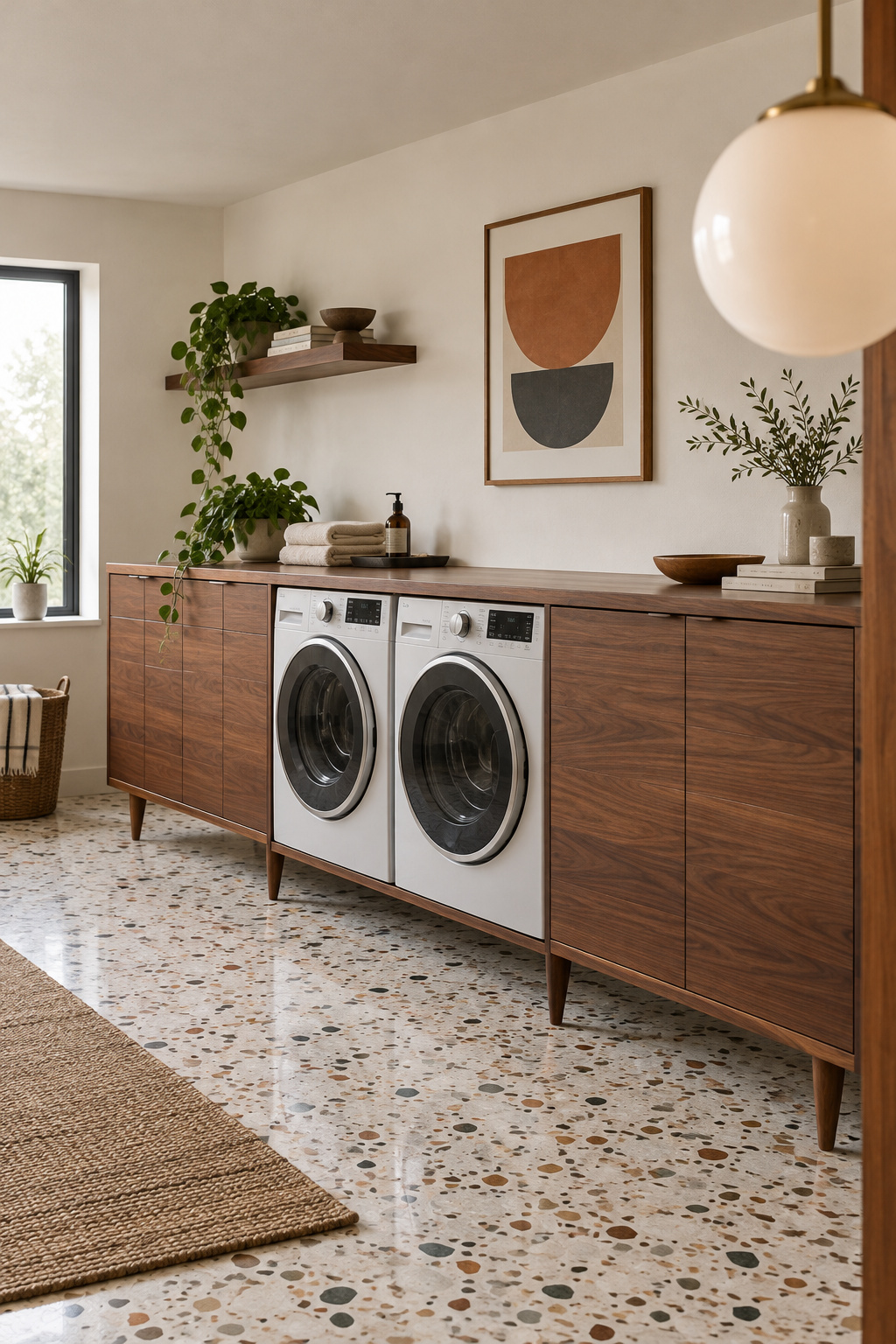
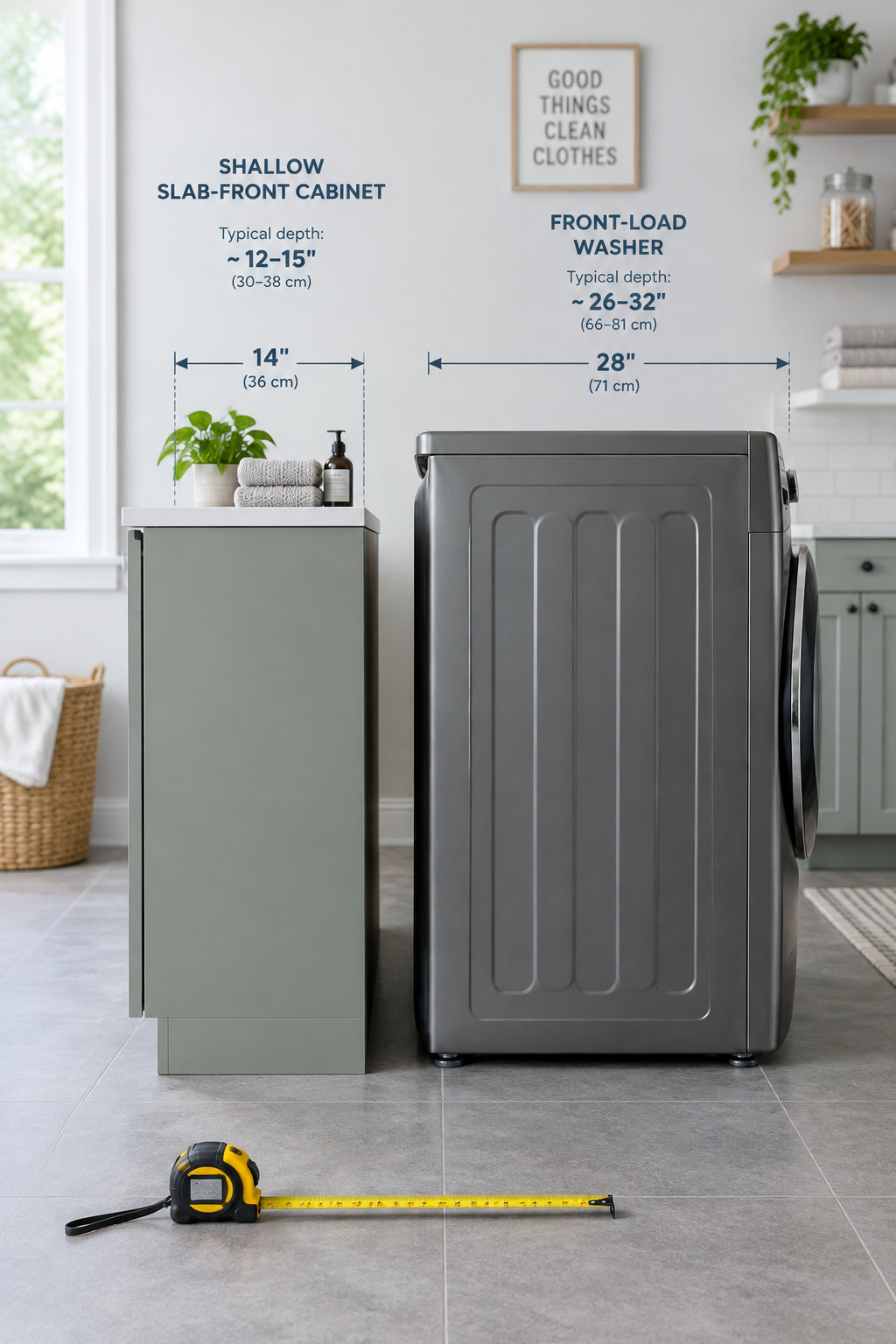
Here the idiom turns on a matter of inches. Period slab-front runs were drawn around a standard 24-inch-deep base cabinet. Maytag puts a standard front-load washer at 30 to 34 inches deep, so a run built to period depth falls 6 to 10 inches short of the machine’s face. The idiom collides with the machine in several places, and each has a fix:
| Period move | Where it meets the modern machine | The fix |
|---|---|---|
| 24-inch slab-front base run | Front-loader stands 6 to 10 inches proud of it | Deepen the counter and pull the run forward so the fronts align with the machine |
| Slab door hung beside the washer | Door collides with the deeper appliance run | Offset (swing-clear) hinges move the pivot away from the cabinet |
| Tapered-leg base piece | Open base and forward legs crowd the working zone | A recessed toe-kick where you stand; keep the legs to pieces away from the machines |
| One central globe light | Inflexible by design, as Nielsen notes | Keep the globe for character and add task light at the counter |
A slab door or a tapered-leg console can’t be allowed to crowd the zone a front-load door and a standing person need. Check your model’s door swing in its installation instructions and plan the floor around it. The site’s laundry room layout guidance holds the clear-floor figures. The period piece yields to the machine, never the other way round.
Making the Look Work Today: A Working Mid-Century Modern Laundry Room
McCobb designed the Planner Group to be bought “piece by piece, or room-by-room, as families or budgets grew.” A mid-century laundry room could take no better instruction. Start with the floor and the light, the lowest-friction pieces, since both are still made the old way. The walnut fronts and period color ask the most of a modern room.
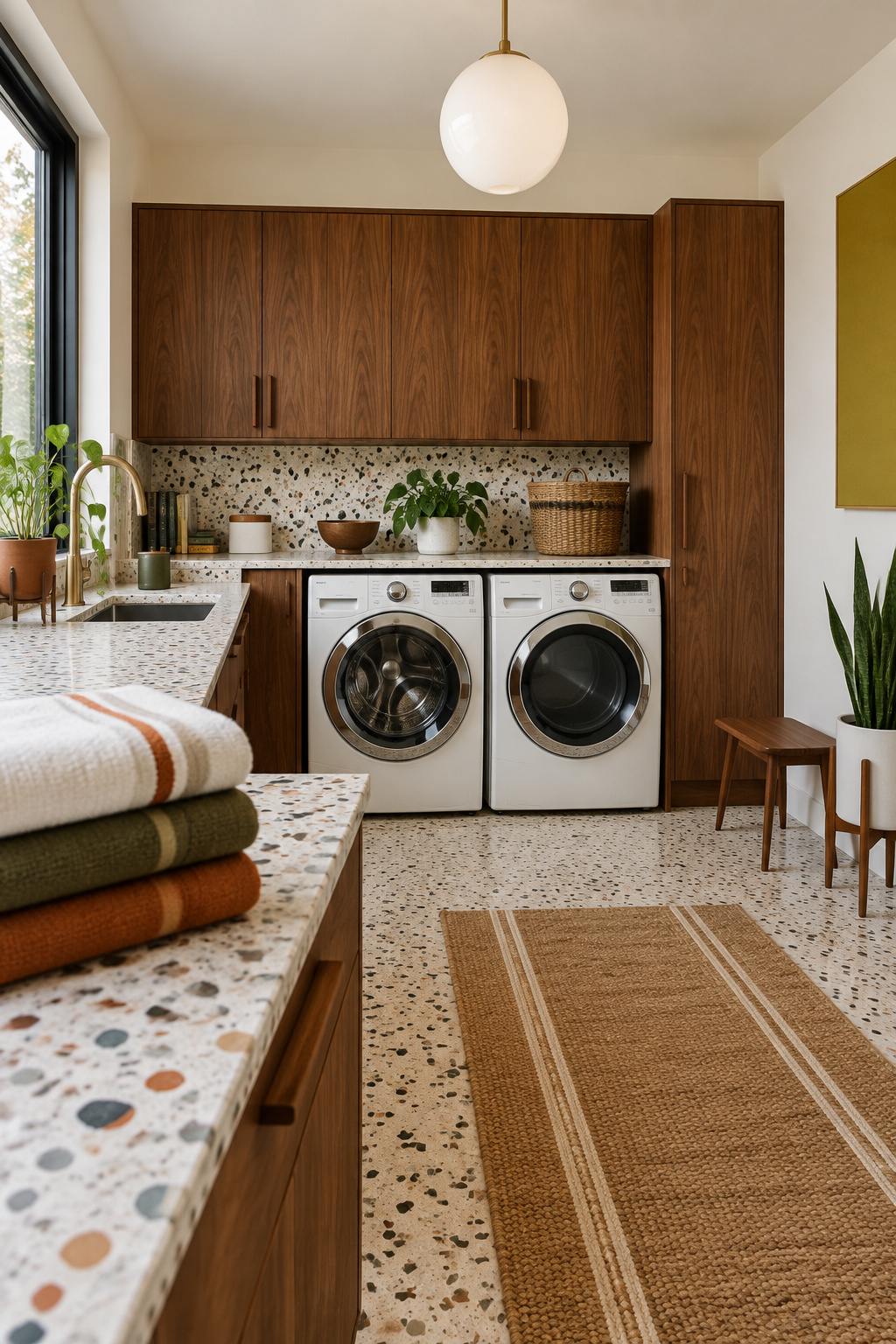
Hold the line on restraint: one wood tone, one accent color, one fixture type, with the machine-era fixes folded in where nobody sees them. The idiom is only one layer. For the machines, lighting and flow that sit under it, start from the principles of modern laundry room design and let the period pieces ride on top.
Go back to that avocado washer from 1966. It was a late color for a room that had already been pink, set in a space of laminate and vinyl, and it was made to be used every week. That is what the 1950s laundry room still gets right: honest surfaces, a pair of machines at the center, and color chosen with intent. Build your walnut room in that spirit, and call it what it is: a modern room speaking a period language.
FAQ
Is mid-century modern too retro for a modern laundry room?
Not if you use the idiom instead of reproducing the room. Five pieces keep it restrained: walnut or teak-tone fronts, tapered legs, period color, terrazzo or VCT floors and a globe light. Paul McCobb’s Planner Group was sold in the fifties as contemporary design for “young moderns,” not nostalgia, and the same restraint keeps it current now.
What colors are authentic to a 1950s laundry room?
Pastels. Pink, light blue and yellow ran through the early and mid-1950s, and a documented 1959 laundry room was pink. Avocado arrived at General Electric only in 1966, with harvest gold in 1968, so those are late-sixties colors. Aim for pastel if you mean the fifties, and for avocado or harvest gold if you mean the late sixties.
Can I use real walnut cabinets in a laundry room without ruining them?
Moisture is the main question, and the answer depends on species stability, veneer versus solid construction and finish, all of which the site’s wood guide covers in depth. Color is a separate matter: new walnut is dark brown and lightens toward honey, most dramatically within the first year. That is normal aging, not damage, so choose accordingly.