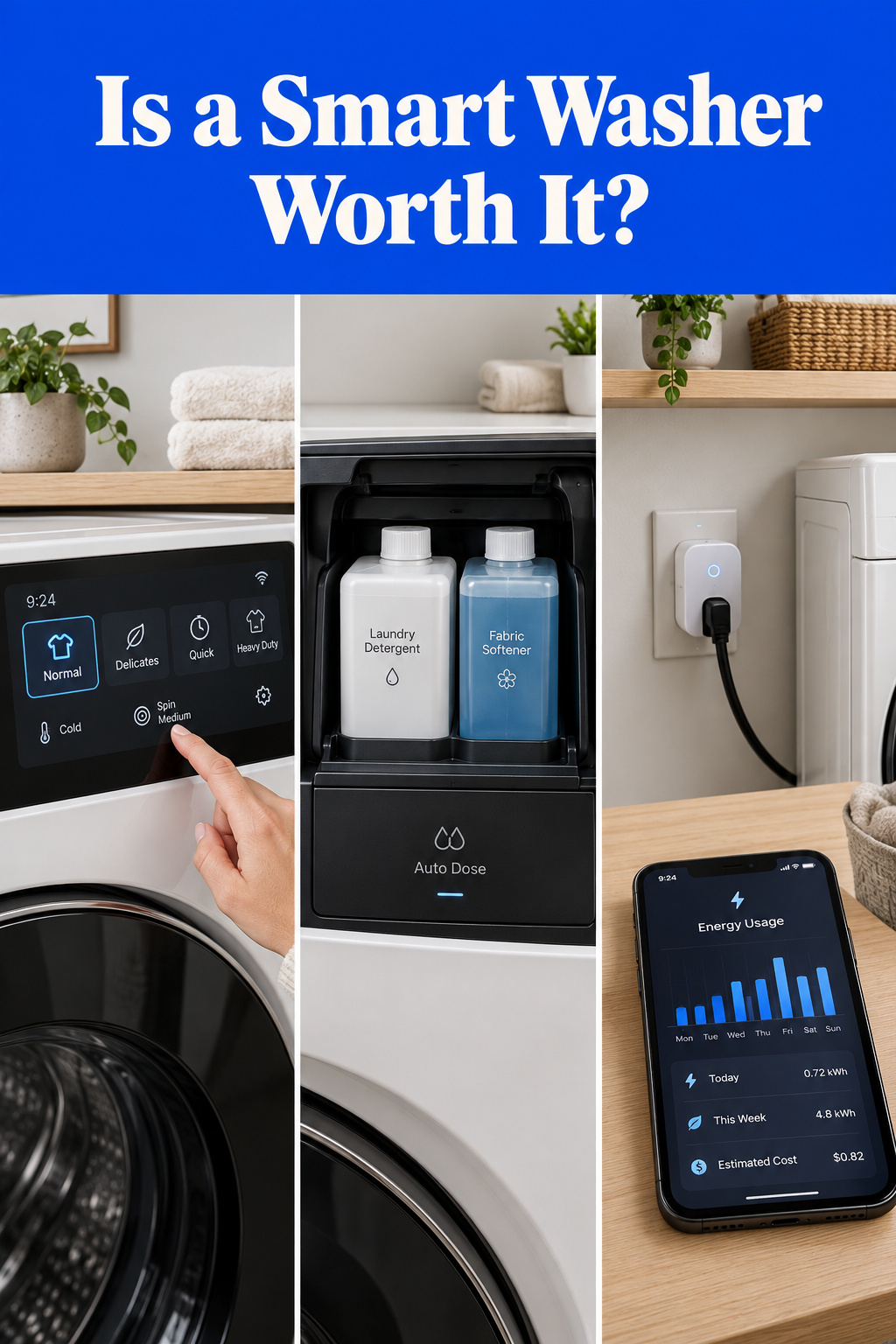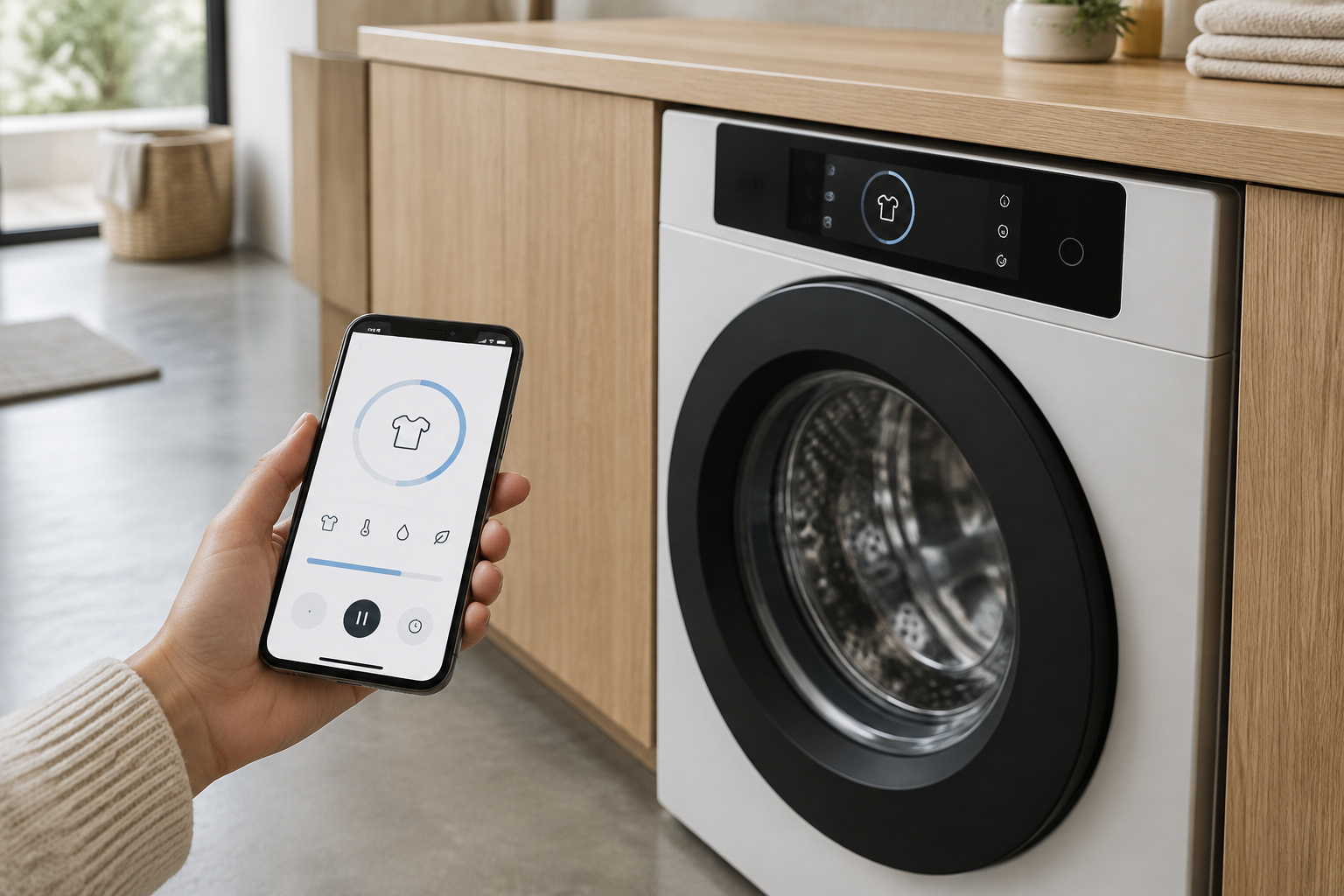

What does a smart washer do on an ordinary Tuesday night that a plain one doesn’t? The appliance aisle gives you a list: remote start, cycle alerts, auto-dosing, load sensing, diagnostics, voice control, all on one spec sheet with no hint of which ones matter. The premium is real money, and the list never says what changes when you’re standing there with a basket. A three-load test sorts smart laundry room ideas out of that list. You run three loads yourself, give each connected feature a verdict, and hold a table against the retailer’s number before paying for something that dazzled in the showroom and does nothing at home.
TL;DR
- Going smart added $206.99, about 19%, to the price of a front-load washer on one like-for-like Whirlpool pair. That is one data point from two retailers, not a market rate.
- Cycle-end alerts and load sensing pass because they change wash day without asking for a new habit. Auto-dosing passes only if you already buy liquid detergent, and remote start only if you already load the washer before you leave.
- A $15–$30 smart plug can connect a washer on a standard outlet, but it won’t fit an electric dryer’s 240-volt outlet.
Smart Laundry Room Ideas Worth Testing: My Three-Load Method
Before I call a room finished, I run the same three scenes in it: a quiet dialogue scene, a bass-heavy action sequence and a dark night scene. None of them is special. They never change, which leaves the room as the only variable. I tell readers to build their own three-scene test, and a washer deserves the same treatment. The spec sheet is the showroom demo. These three loads are the screening:
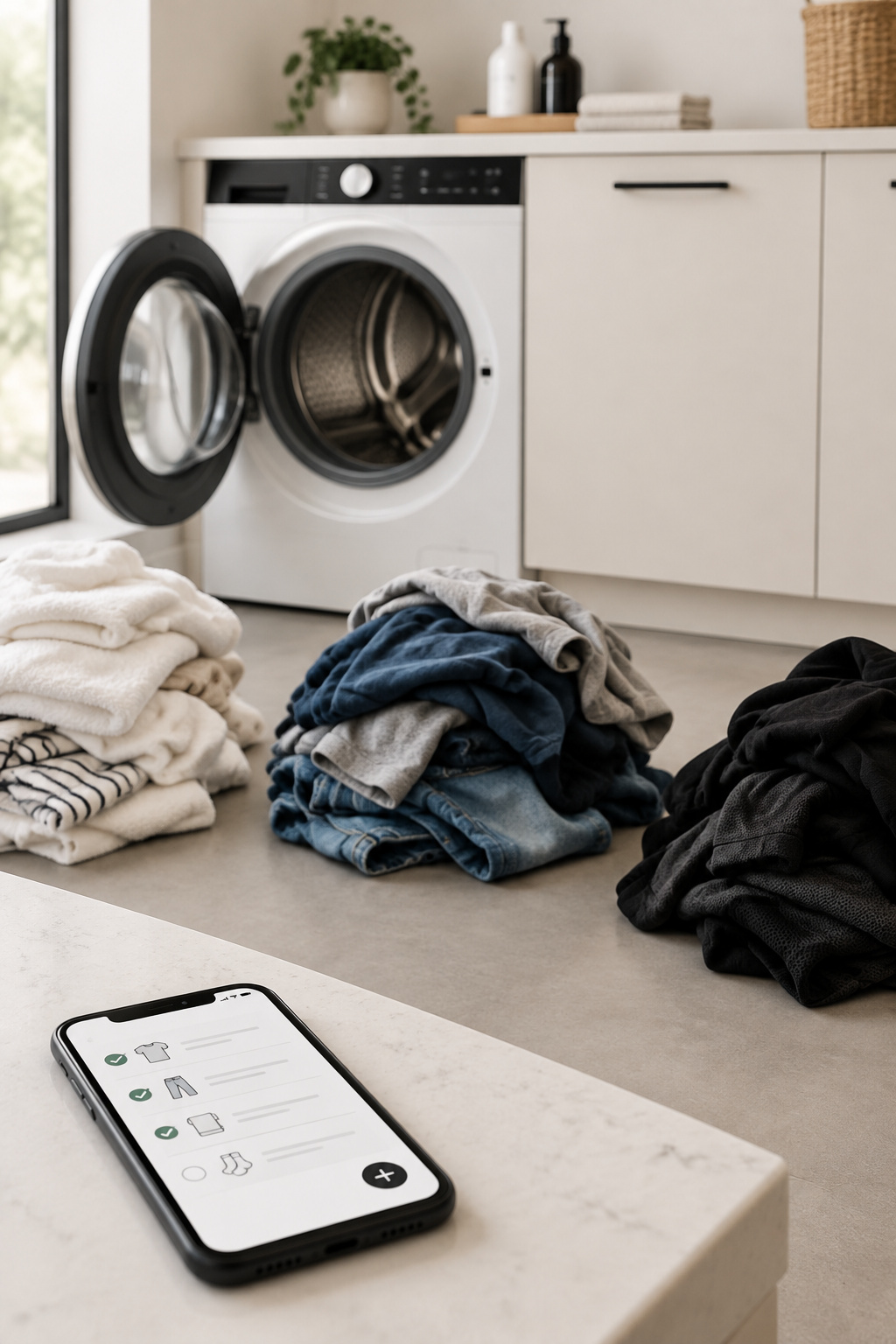
- A delicates load you start and walk away from. It tests cycle-end alerts, and the question is whether the ping changes when you come back.
- A heavy towel load. Bulky and absorbent, with an obvious “right” amount of detergent and water, this one tests auto-dosing and load sensing.
- A load started while you’re out. It tests remote start and shows its limit: someone still has to put the wash in the drum.
Every verdict below applies the same rule. A feature is worth paying for only if it changes what you do or spend on wash day, whatever the machine can do in a demo.
Why test before you buy? A Dutch field study of connected white goods by TNO found that 93% of participants knew their washing machine had smart features, and 66% of those aware owners used them. Over nine months that usage didn’t significantly rise. The study measures smart features as a category, not any single one, but the lesson holds. A feature that hasn’t found a place in your routine early shouldn’t be expected to creep in later.
If the room itself isn’t settled yet, start with modern laundry room ideas and come back. Automation goes in last.
Cycle-End Alerts and Remote Start: What Actually Changes on Wash Day
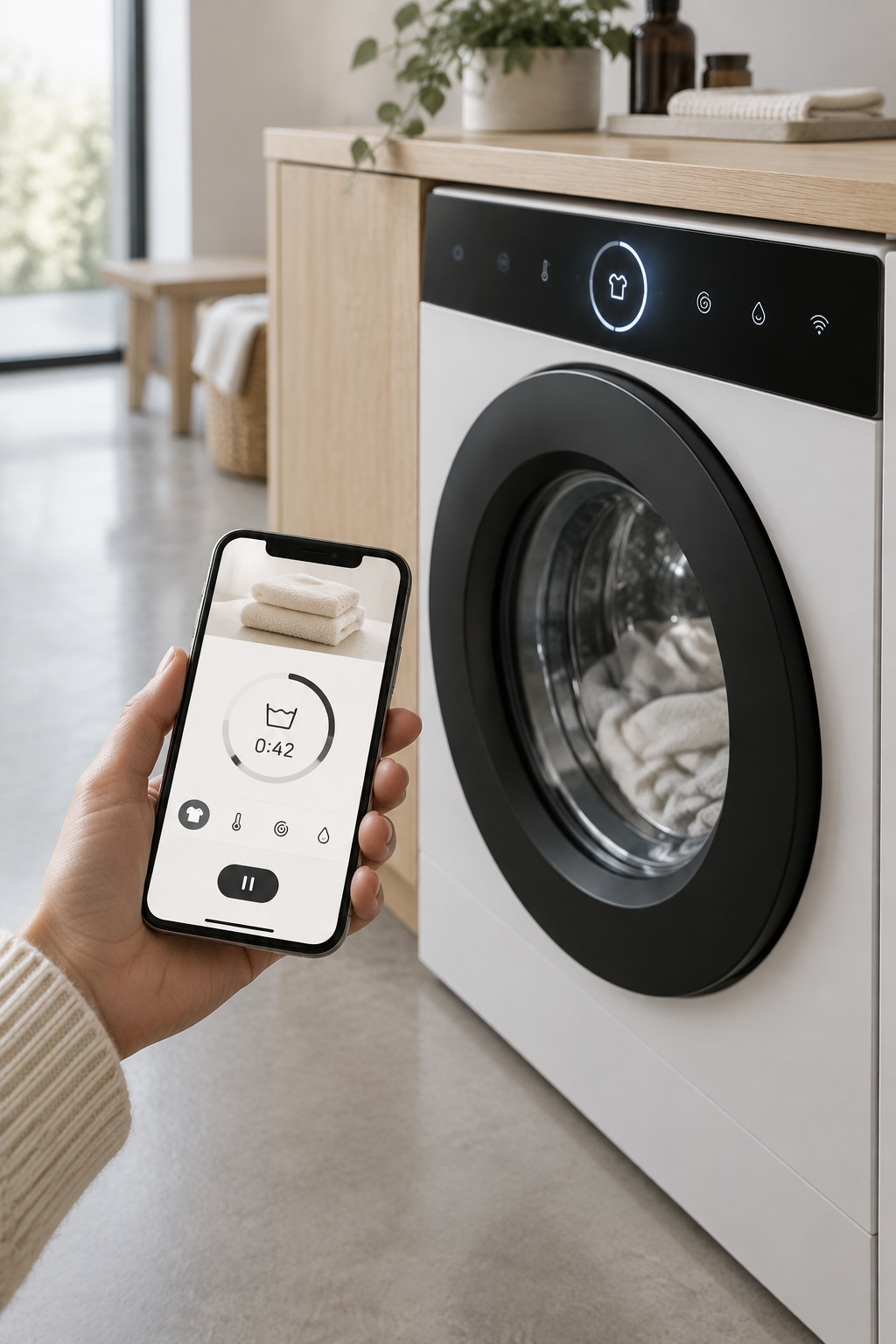
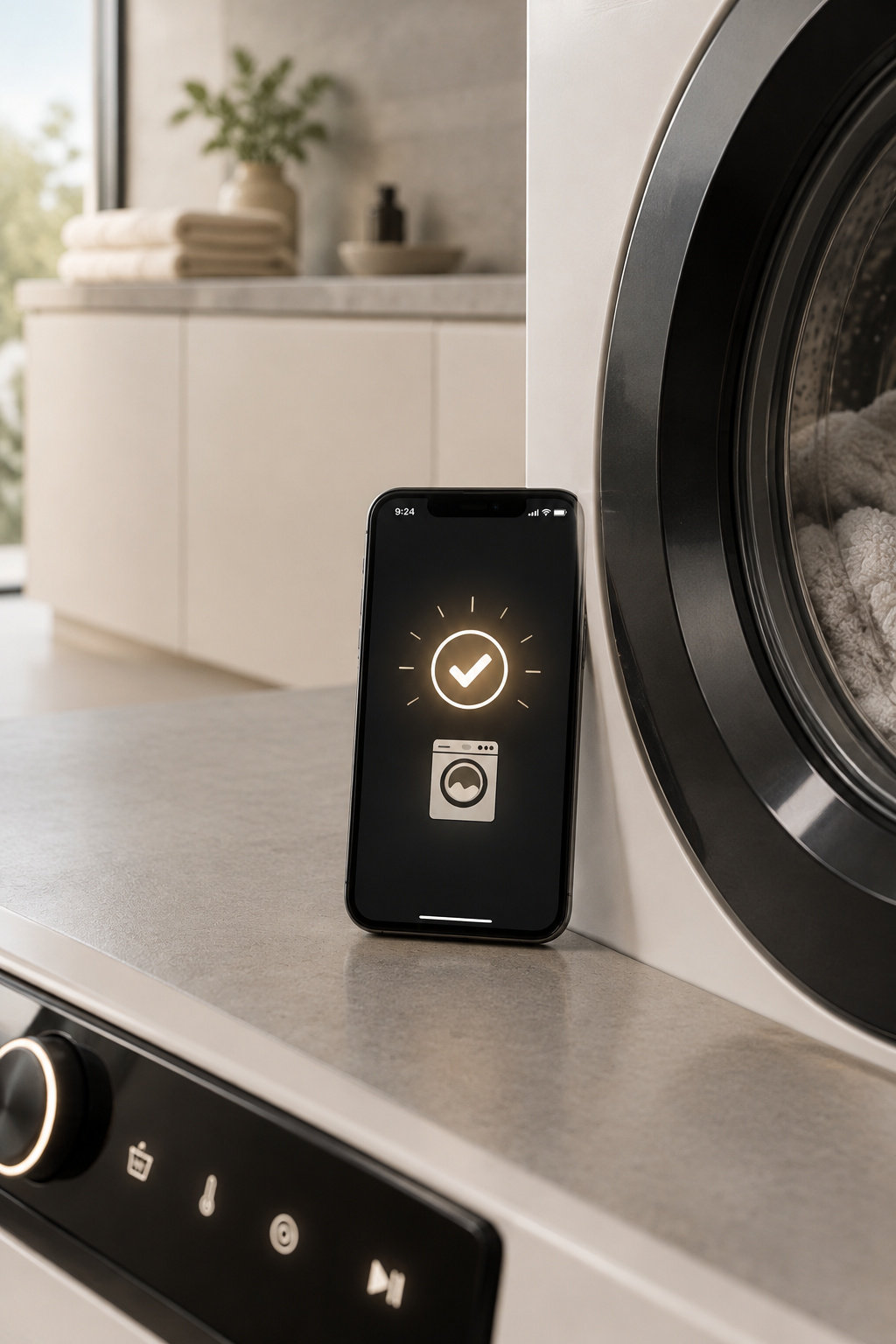
Cycle-end alerts pass the first load outright. Whirlpool’s app pushes a notification when a cycle finishes and lets you follow its progress from your phone. On the delicates test, that ping replaces guessing when to go back, and guessing is how a load ends up sitting damp until it smells musty. You were going to check on the wash anyway, so the alert asks nothing new of you. In a theater, it’s the house lights coming up on cue, with no audience wondering whether the credits are over.
Remote Start’s Real Limits
LG’s own support documentation shows how it works. With “Keep Remote Start ON” enabled, the door stays locked and the washer stays powered after a cycle, which lets you queue a second load and start it from the phone. Switch the setting off and the machine powers down and unlocks at cycle end, and remote control goes with it.
That’s LG’s design and other brands may differ, but it shows what the feature is: remote start runs a load you’ve already put in the drum and dosed. It can’t load the machine, add detergent or decide what the load needs. The third test therefore passes only if you already load a wash before leaving the house, and most households don’t. A hands-on review of Whirlpool’s smart washer found confusing setup steps and unclear app guidance. Verdict: conditional.
Auto-Dosing and Load Sensing: Features That Change What You Buy, Not Just What You Do
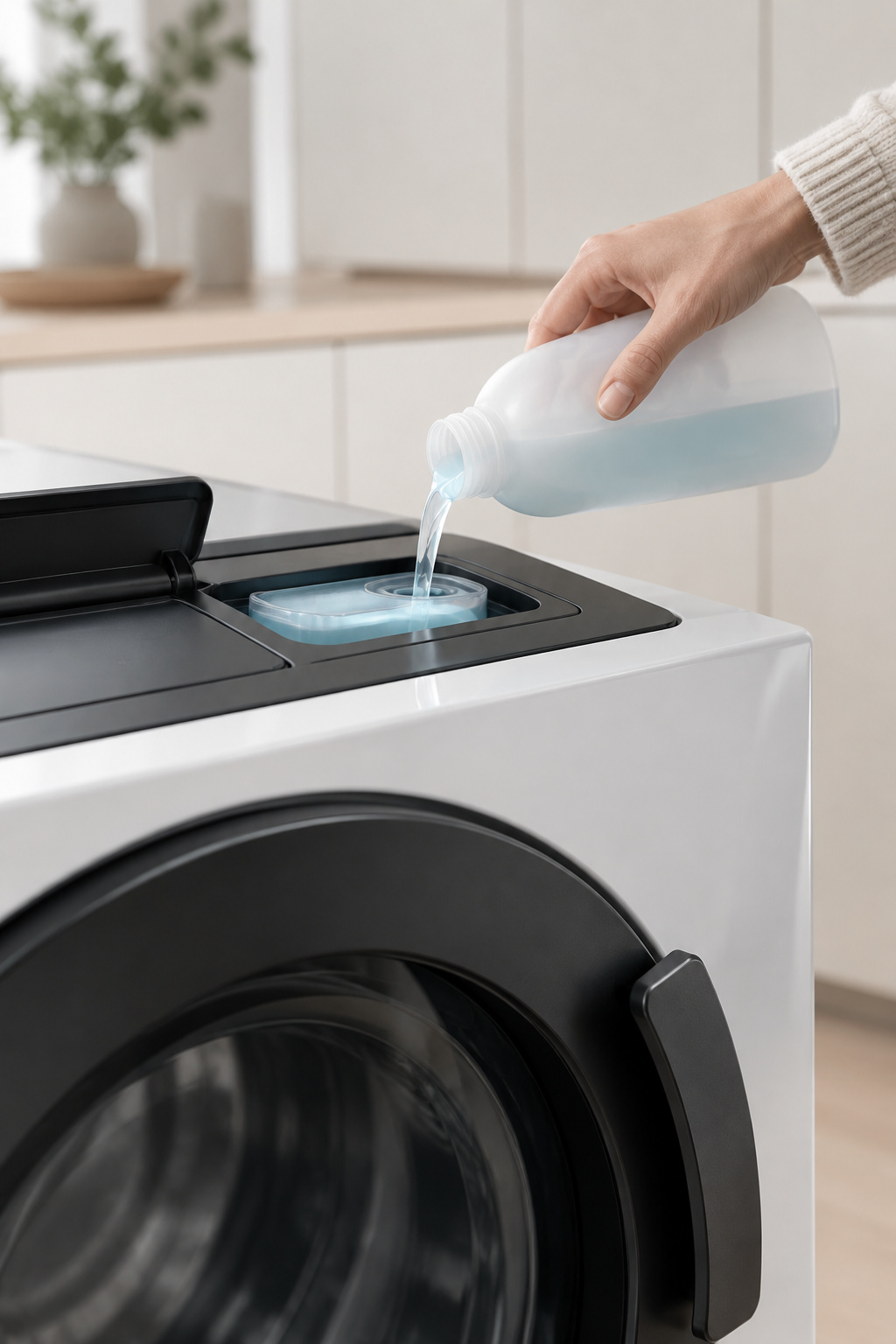
A Bosch i-DOS reservoir holds 1.3 liters, enough liquid detergent for at least 26 washes. That’s the clearest picture of what these features change: how often you pour and how much you buy, with no new step on wash day.
Auto-Dosing: Less Guessing, Less Waste
Samsung’s AutoDose uses a weight sensor to check how many kilos are in the drum, plus a water-level sensor. On AI Wash models a turbidity sensor also reads how dirty the water is and adjusts cycle length. The dispenser then releases the calculated amount. That takes the guess out of the towel load, which most of us get wrong because a bulky load invites a heavy pour.
Miele markets its TwinDos system as saving “up to 30%” on detergent. That is Miele’s claim, made with Miele’s own detergent. Consumer NZ, an independent tester, reports the claim and confirms the dispensing mechanism, without independently verifying the percentage. The limit that decides the verdict is simpler, though: auto-dosing is liquid-only. Pods and powder go straight into the drum, so anyone who buys pods gets none of the benefit.
Load Sensing: Right-Sizing Every Cycle
Load sensing doesn’t weigh the laundry. Maytag explains that early in the cycle the washer notes the resistance the laundry creates as the drum turns and estimates load size from how many rotations that takes. A water-level sensor then fills only enough for that load, and cycle time adjusts. A light, bulky comforter and a dense pile of towels can therefore register differently from their actual weights. On the towel test it passes anyway, since the machine takes over a job you used to do by guessing at a dial.
Smart Plugs and Energy Monitoring: Making Any Machine Connected
I’d most readily talk someone out of buying a smart plug for an electric dryer. A standard smart plug is built for a 120-volt, 15-amp outlet, and electricians and smart-home installers comparing notes confirm there’s no common off-the-shelf plug for a dryer’s 240-volt NEMA 14-30 or 14-50 outlet. The options on that side are a clamp-style whole-circuit monitor at the breaker or a dryer with wifi monitoring built in.
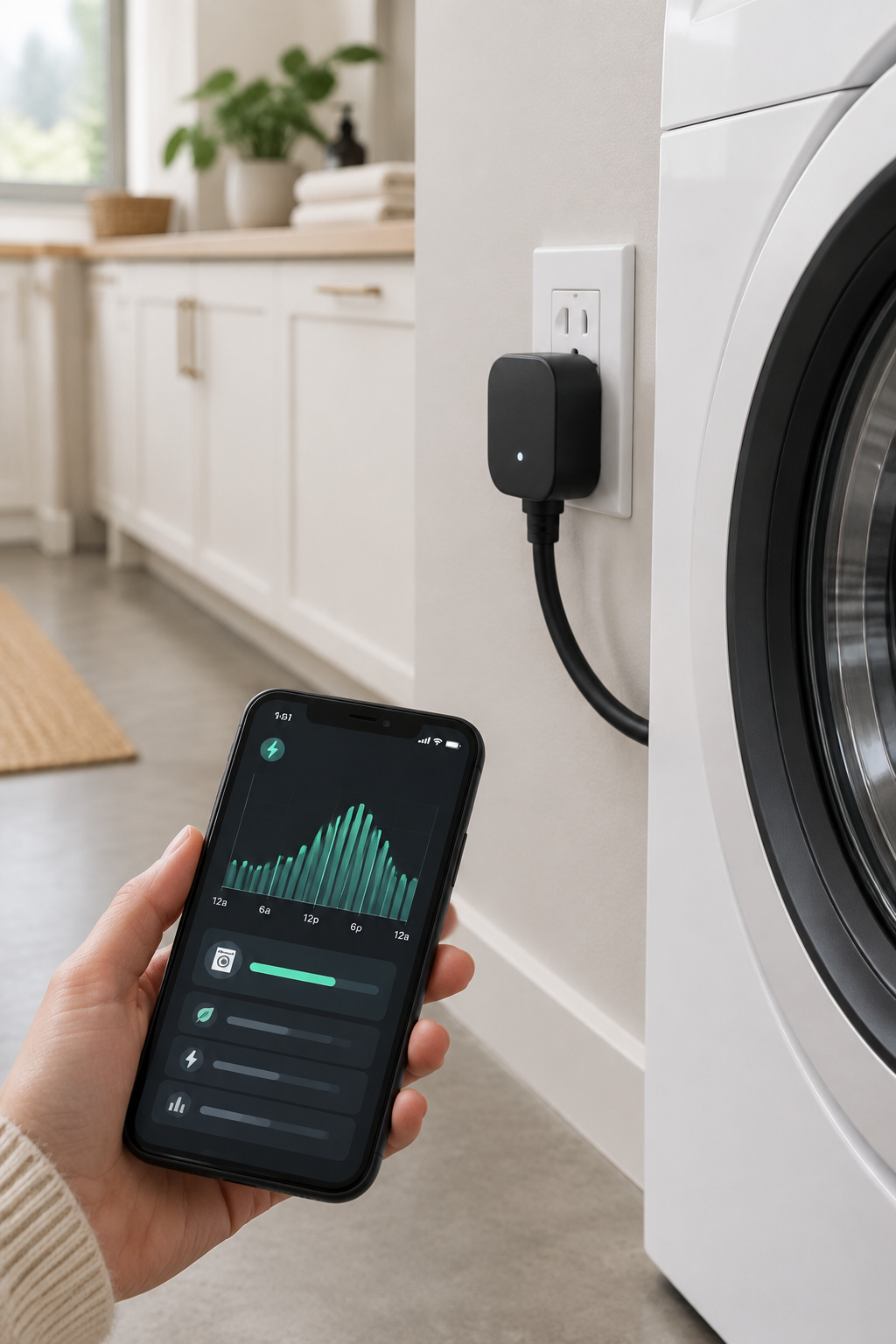
On the washer side, the budget path is real: a $15–$30 plug adds scheduling, remote power and basic energy monitoring to a washer or a gas dryer’s controls. The payoff comes from the trend across loads. A dryer drawing power for longer per load than it used to, for example, could point to a failing heating element or a clogged vent worth a service call, and the same graph can flag an iron left on standby. Plugs and hubs also need a better home than an outlet jammed behind the machine, which is why planning outlets and hubs into the layout belongs at the drawing stage.
Motion Lighting: The One Automation Worth Adding to a Good Fixture
You come through the door with a full basket on your hip and no hand free for the switch. That repeated moment is the whole case for motion sensing here. Still, I plan laundry rooms the way I plan theaters, with the room first and the controls last. A sensor and an idle-off schedule can’t fix a badly placed or underpowered fixture. They only switch it on for you. So getting the lighting itself right first comes before any sensor.

The Price-Premium Table: What Smart Actually Costs You
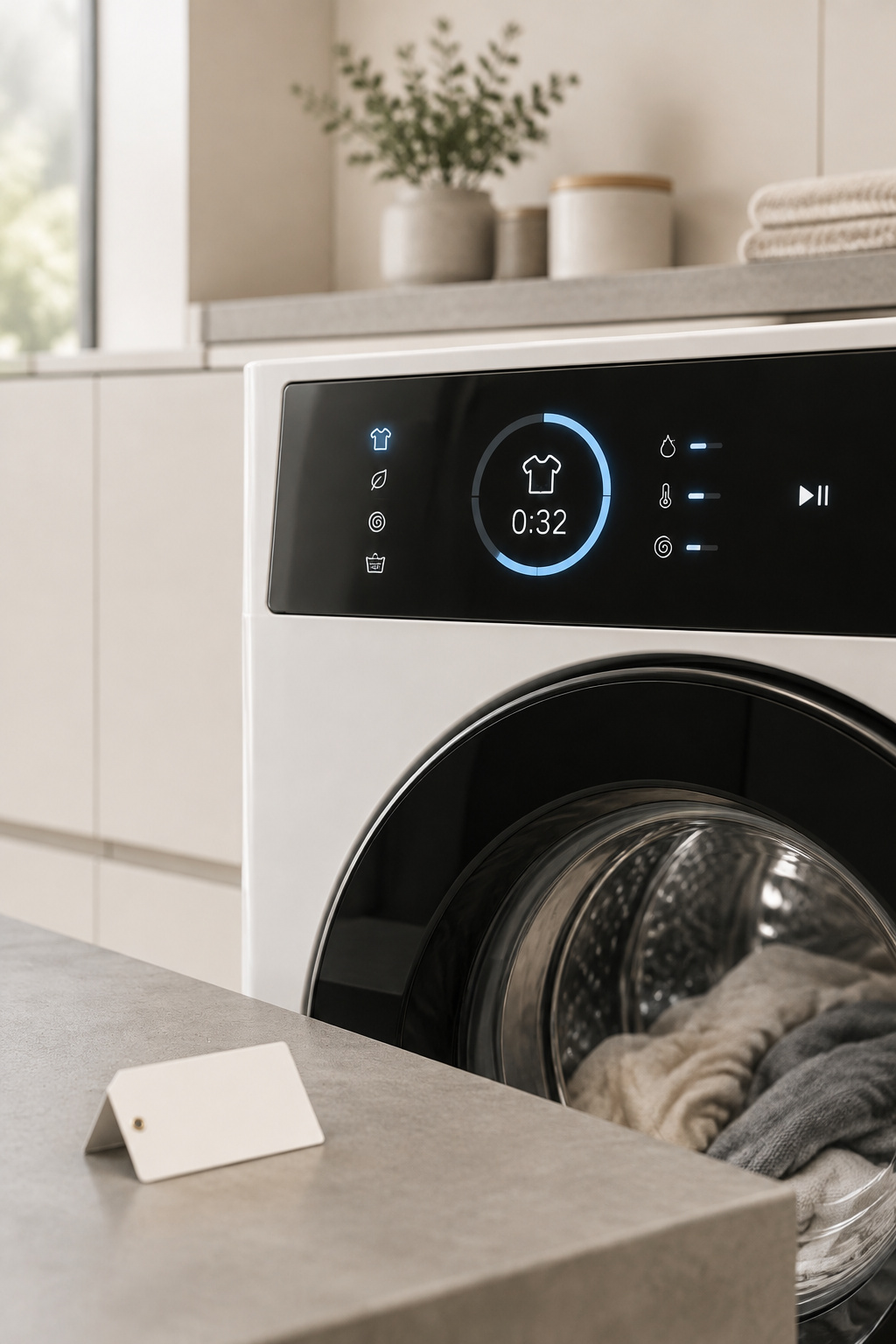
Two Whirlpool front-loaders with the same 5.0 cu. ft. drum give the cleanest like-for-like comparison I could find:
| Model | What you get | Price | Retailer |
|---|---|---|---|
| Whirlpool WFW8620HW | Load & Go XL dispenser, no wifi | $1,098.00 | Abt |
| Whirlpool WFW9620HW | Load & Go XL Plus dispenser, wifi, app control, touchscreen | $1,304.99 | Best Buy |
Here is my own sum: $1,304.99 − $1,098.00 = $206.99; $206.99 ÷ $1,098.00 = 18.9%, about 19%. This is one pair at two retailers, so read it as a premium in the low hundreds for a mid-range washer, not a rate for every brand. The extra money also buys a bigger dispenser tier and a touchscreen, so not all of it pays for connectivity.
Here’s how each feature did:
| Feature | Load that tests it | What it changes | Verdict |
|---|---|---|---|
| Cycle-end alerts | Delicates | When you go back for the load | Worth it |
| Remote start | Started away from home | Nothing, unless you already pre-load | Conditional |
| Auto-dosing | Heavy towels | How much detergent goes in, how often you pour | Worth it on liquid; skip on pods or powder |
| Load sensing | Heavy towels | Water and cycle time matched to the load | Worth it |
| Smart plug, energy monitoring | Any | Remote power, a usage trend | Worth it on a washer or gas dryer; skip for an electric dryer |
| Motion lighting | Any, arms full | Light without a free hand | Worth it once the fixture is right |
Before any washer feature, I’d fit a leak sensor that closes the valve, a smart device that isn’t on the washer at all. This site’s second-floor laundry flood-prevention guide covers leak prevention end to end, and its stackable washer and dryer guides cover ventless, heat-pump and combo-machine questions.
That gives you what the spec sheet never did: three loads, one rule and a verdict per feature. The cheapest reversible version starts tonight on the machine you own. Run the three loads with a phone timer standing in for the alert and see which gap actually bothers you. To try connected before paying any premium, put a $15–$30 smart plug on the washer’s outlet. If it changes nothing, it comes out of the wall in a second.
FAQ
Do smart washers and dryers need wifi to work at all?
No. A smart washer or dryer runs its normal cycles from its own control panel with no internet, and wifi only adds the app features. Many never stay connected. LG has reported that fewer than half of its smart appliances stay online long-term, while Whirlpool says more than half of its connected appliances remain online.
Are smart dryers worth the extra cost if I already have a smart washer?
Only if the dryer passes the test on its own. A cycle-end alert clears the bar just as it does on the washer. Moisture-sensing auto-dry works differently from a washer’s water-fill sensing, so judge it on towels and delicates. An electric dryer also can’t be retrofitted with a smart plug later.
Can I make a regular washer or dryer smart without buying a new machine?
Partly. For a washer on a standard outlet, a smart plug and hub add scheduling, remote power and basic energy monitoring, but not remote cycle-start, cycle alerts, auto-dosing or load sensing. Most electric dryers use 240-volt outlets, so the options there are a clamp-style circuit monitor or a vibration sensor that detects a finished cycle.