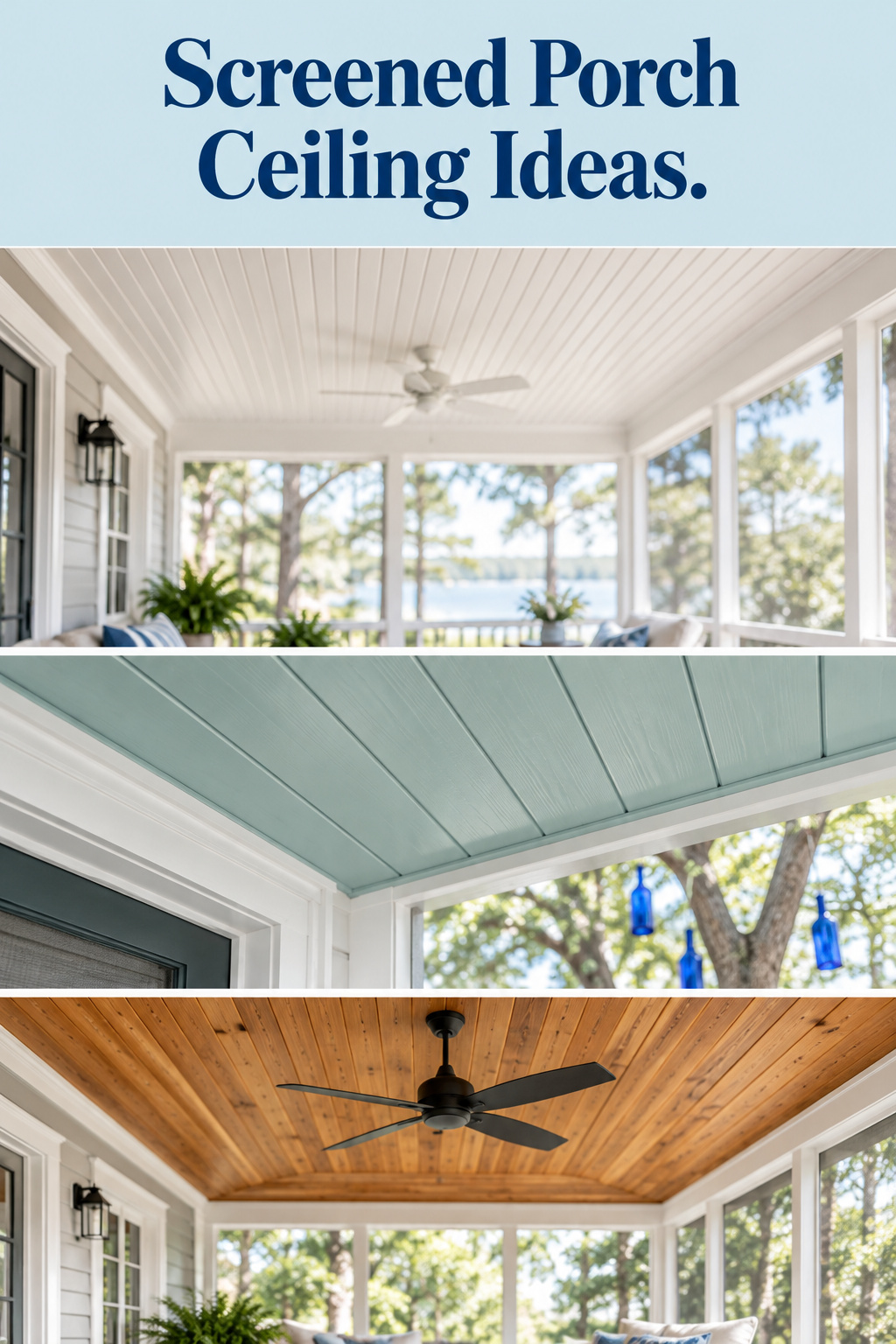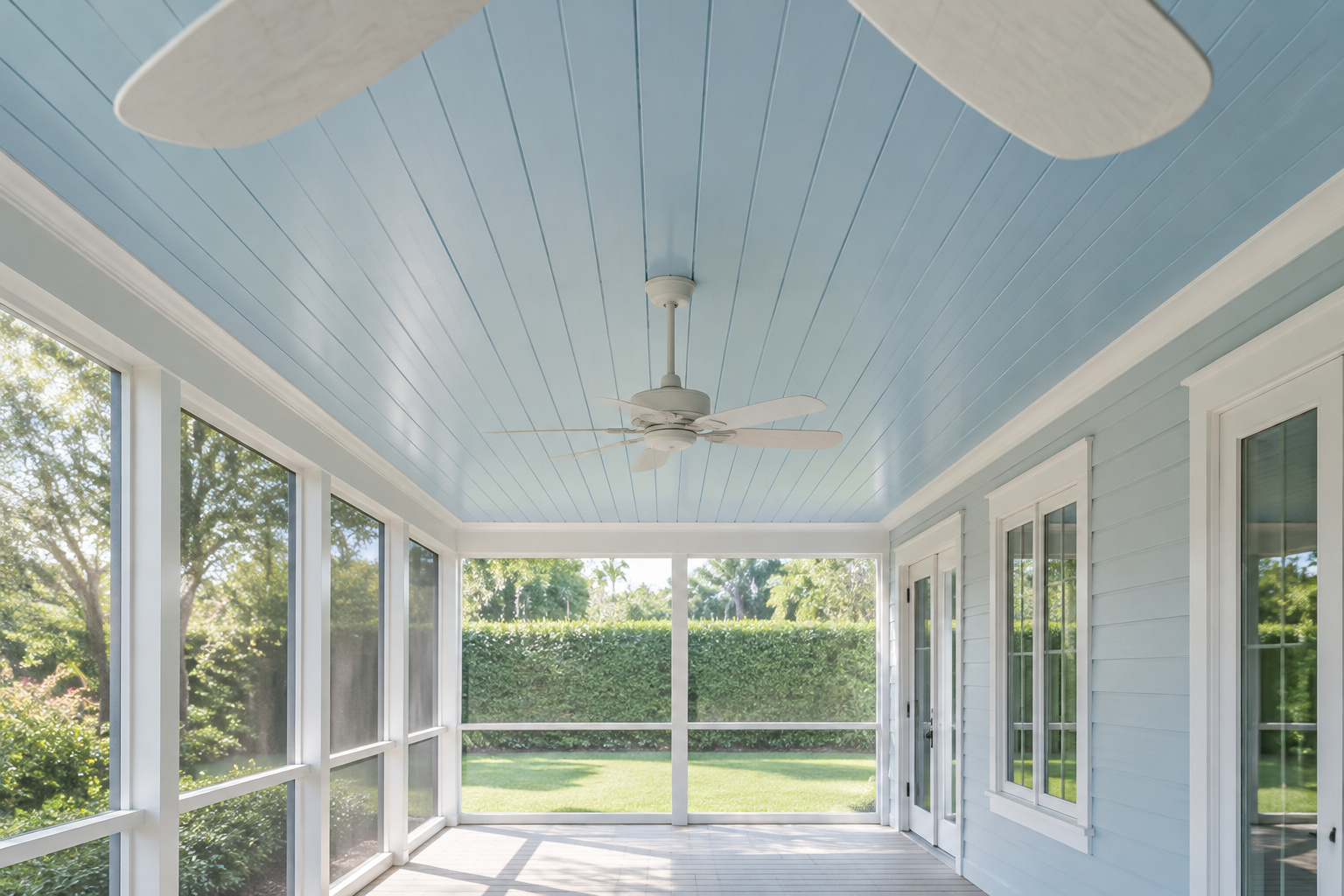
In Savannah, the old quarters at the Owens-Thomas House have a ceiling washed blue. It has been put on again and again, layer on layer, and the museum that keeps it describes it as a synthetic ultramarine limewash with small traces of indigo in its earliest coats. The claim people repeat about that blue is that wasps stay off a ceiling painted this color. Of all the screened porch ceiling ideas going around, that one has the least behind it. The color has a real history, and the ceiling has two plainer jobs first, because a roof leaves the back half of a screened porch dim and damp.
TL;DR
- A roofed porch is a damp location under the electrical code, and porch ceilings are a known place for mildew, so choose cellular PVC or wood sealed on every face before you choose a color.
- A lighter ceiling sends more daylight toward the back wall, which matters most on a deep porch; use a mildew-resistant acrylic latex, which lasts four to five years in one top coat and up to ten in two.
- Haint blue is a Gullah Geechee tradition against spirits, and there is no scientific evidence it keeps wasps or spiders off; a fan should be damp-rated, about 44 to 54 in across for a porch up to 400 sq ft, with 7 ft under the blades.
Why the back half of a roofed screened porch goes dim and damp
Stand on a screened porch at midday and look at the floor. The sun comes through the mesh and stops somewhere. Everything behind that line lives on reflected light.
My first winter in Minnesota, I put the reading chair in the corner I was sure was the best one, and from November on it was the darkest. I moved it three times before February. A roofed porch has that trap built in: the back half, against the house, is the dim half.
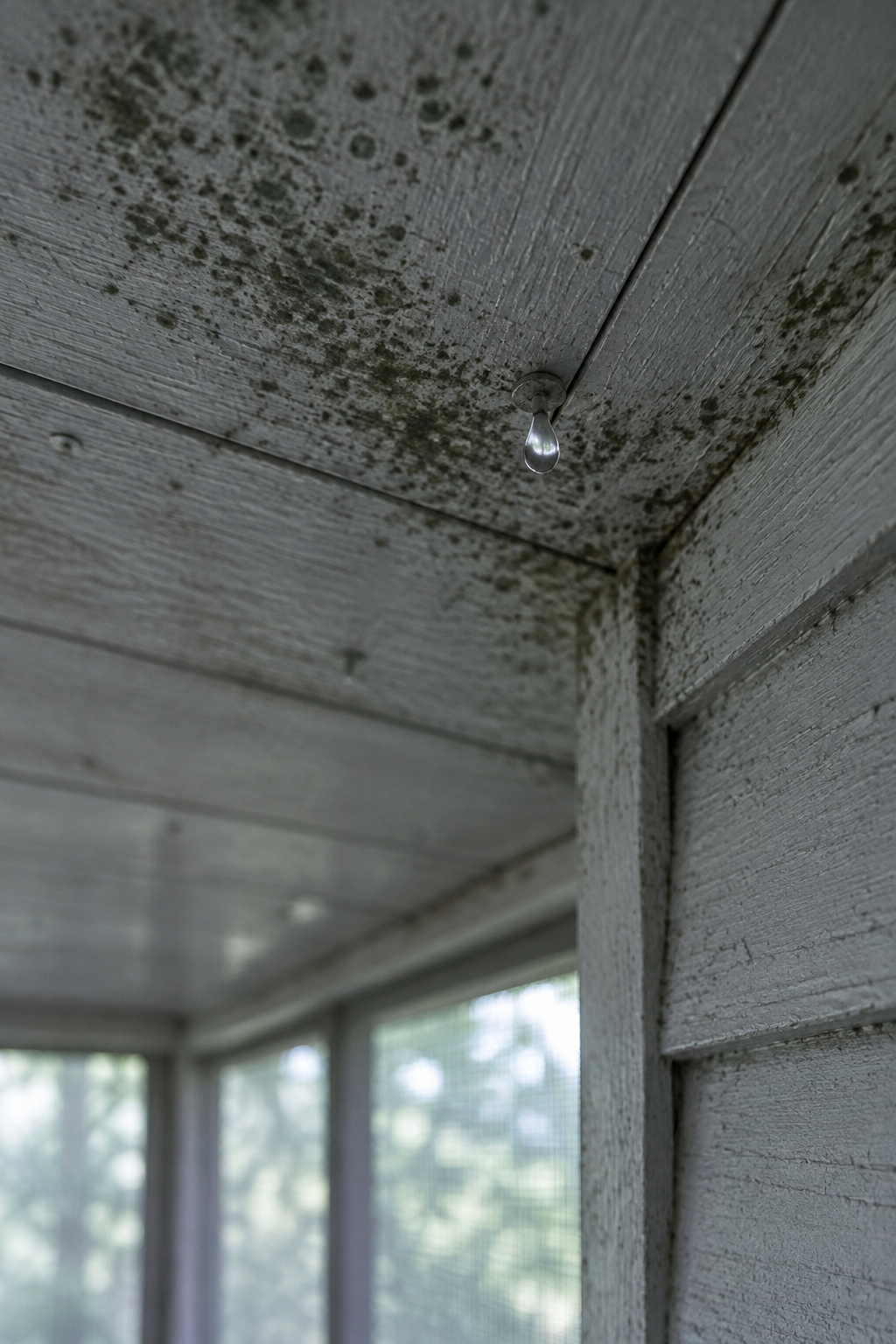
Dim and damp is how mildew likes it. The National Electrical Code defines a damp location as one protected from weather but subject to moderate moisture, and it names roofed open porches as an example. Mildew is a symptom of a place that is too moist or gets little direct sun, and Purdue Extension names porch and carport ceilings as a place it forms often. The back of a roofed porch is both.
Picking a ceiling from a photograph, by color, skips the question that decides whether it still looks good in five years: how far does the sun line reach? The range of porch shapes and roofs is in the wider guide to screened-in porch ideas; here the roof is a given.
Screened porch ceiling ideas, ranked by how they handle damp
Moisture sorts these surfaces first, and light second.
| Ceiling | How it handles damp | What it does for daylight |
|---|---|---|
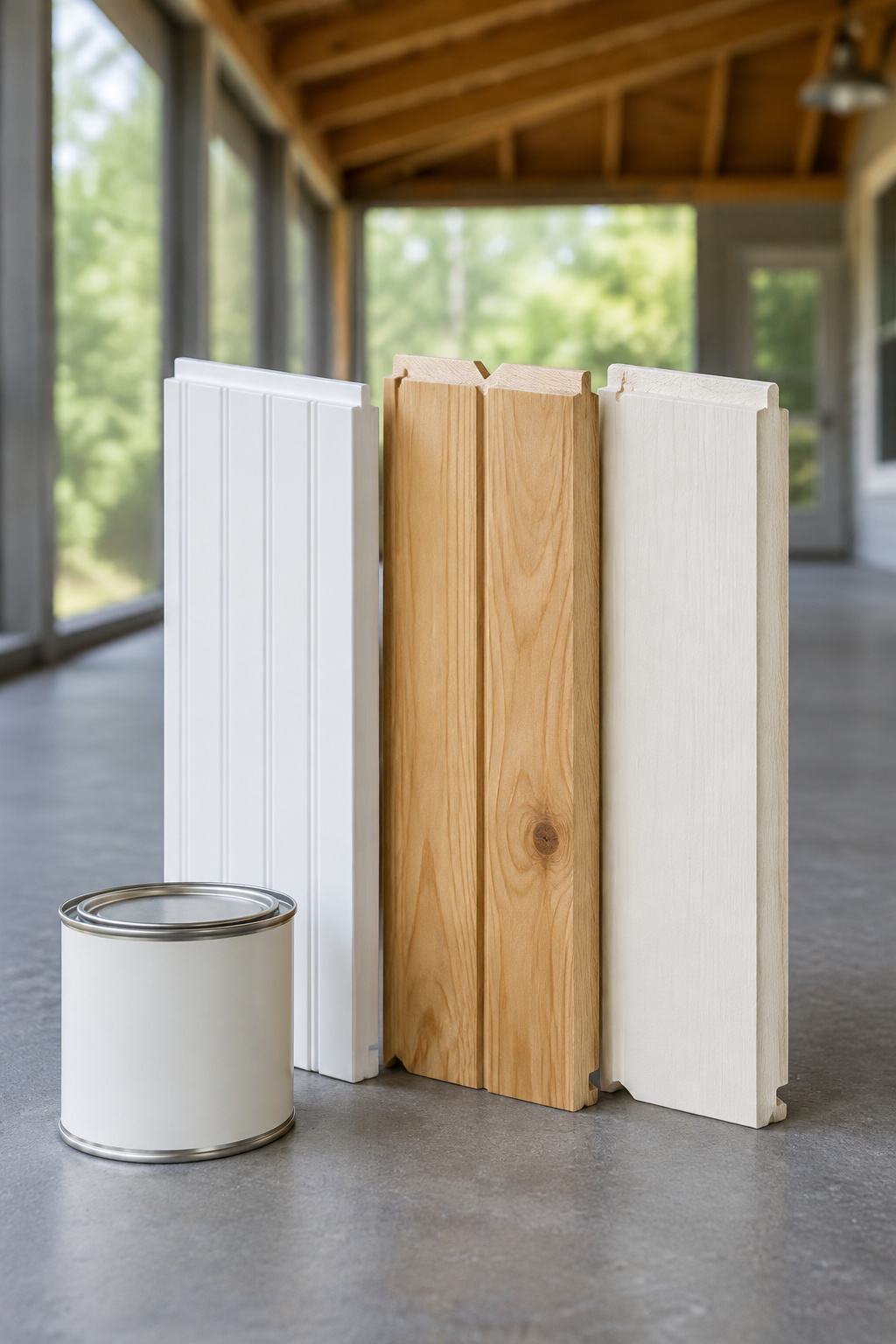
| Cellular PVC beadboard | Maker says it won’t rot or attract termites and absorbs virtually no water | Takes acrylic latex; light colors are simplest |
| PVC v-groove or nickel gap planks | Sold as moisture and insect proof; also comes pre-colored in stained-wood tones | Color is set by the maker’s wood tones |
| Cypress tongue-and-groove, sealed all faces | Naturally rot and insect resistant; the supplier pick for blown rain or high humidity | Paint or stain; paint can go light |
| Southern yellow pine tongue-and-groove, sealed all faces | Durable enough under a full roof; untreated boards decay where moisture sits in the joint | Paint or stain; paint can go light |
| Exposed rafters with decking above | No flat surface to hold damp | Little surface to bounce light back down |
My pick for a damp, roofed porch is cypress, primed or stained on both faces and every cut end before it goes up. It is real wood, the species the supplier singles out for wet exposure. The trade-off is labor: the boards should acclimate on site for a couple of weeks, and you need about half an inch of space at each side wall because wood moves across its width.
If you would rather not worry about rot, PVC is the alternative, on the maker’s word. Fasten it with stainless or hot-dipped galvanized nails, never staples or brads, and leave an expansion joint on runs over 18 ft; the maker says it moves about 1/8 in per 18 ft with temperature. Exposed rafters look fine, but on a porch I want a surface overhead that sends light back down.
Finish the ceiling for light: how paint carries daylight to the back wall
Once the surface can live with damp, its color starts doing a second job. A pale ceiling catches the light that comes in low through the screen and throws it further into the room. A dark one swallows it near the edge. On a shallow porch you hardly notice. On a deep one it decides whether the back wall is a place to sit or a place to store the cushions.
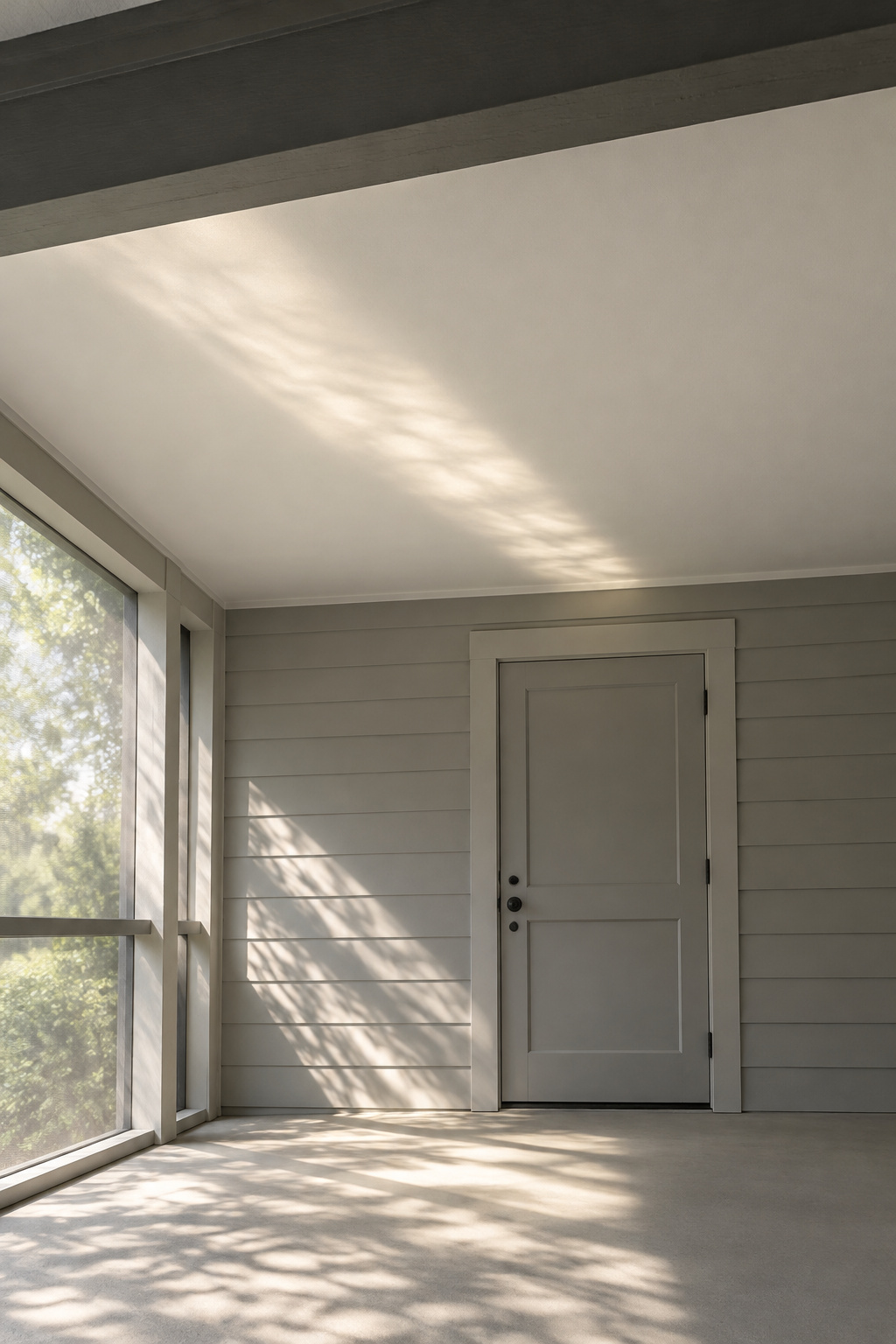
The finish still has to answer to moisture first. Purdue Extension’s advice for protected porch ceilings is a high-quality acrylic latex over a primer, mildew-resistant, with the surface scrubbed with detergent before any repaint so the new coat sticks. One top coat should last four to five years and two up to ten. On PVC the maker asks for a vinyl-safe paint if you go dark, which is one more reason the light colors are the easy ones.
A brighter ceiling also changes what the room beneath it can hold, which is where decor that suits a brighter porch picks up.
Haint blue: keep the tradition, drop the wasp claim
Where the blue comes from
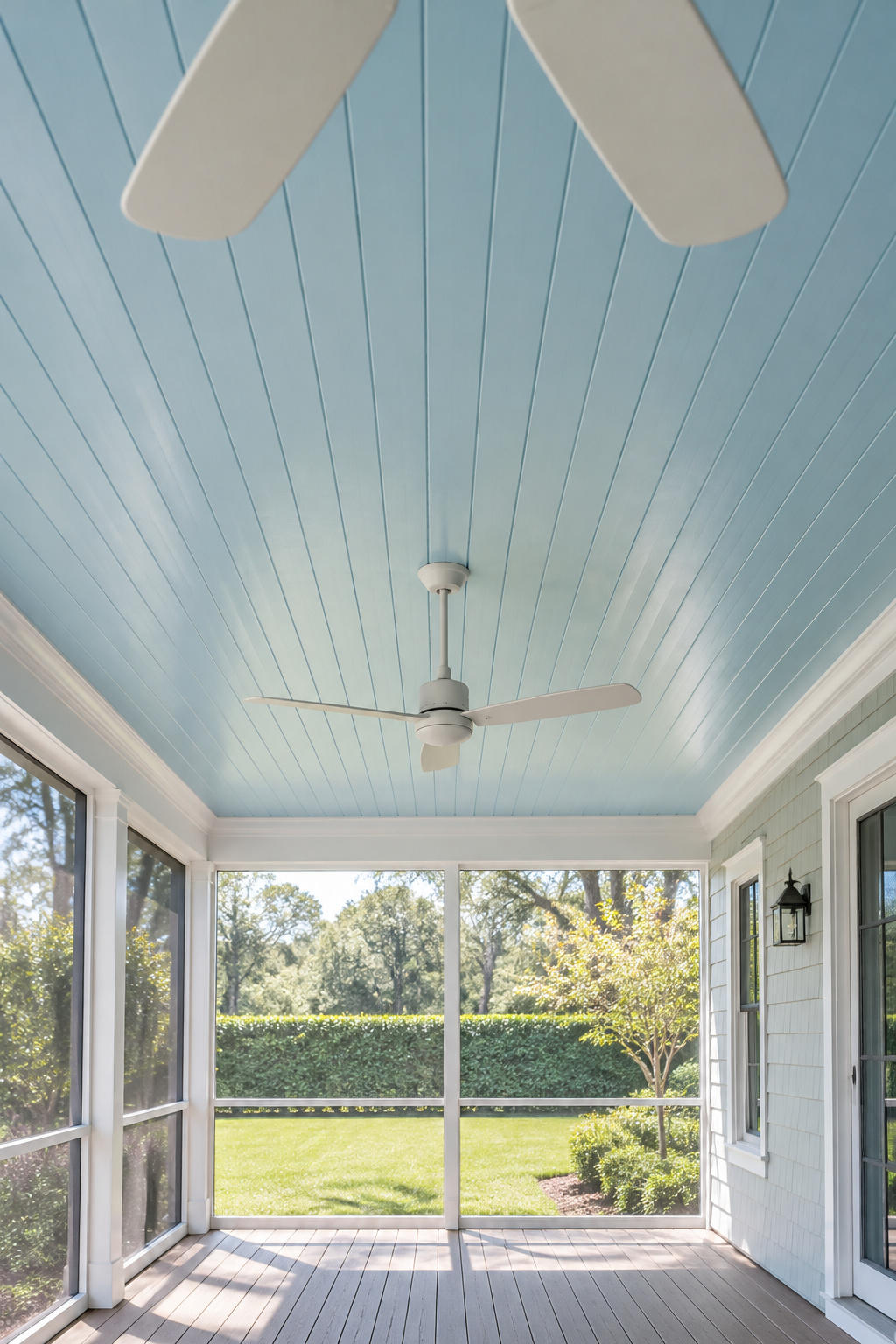
Haint blue belongs to the Gullah Geechee people of the Lowcountry coast. A haint is a spirit, and the blue on porch ceilings, doors and trim stood for water, which harmful spirits were believed unable to cross. Telfair Museums ties the Owens-Thomas ceiling to that West African belief about warding off negative spirits. Tour accounts give the paint a recipe of indigo, buttermilk and crushed oyster shell, but the museum’s own paint analysis describes ultramarine limewash with only traces of indigo. Connect Savannah, quoting Telfair staff, calls it the largest swath of haint blue paint in North America.
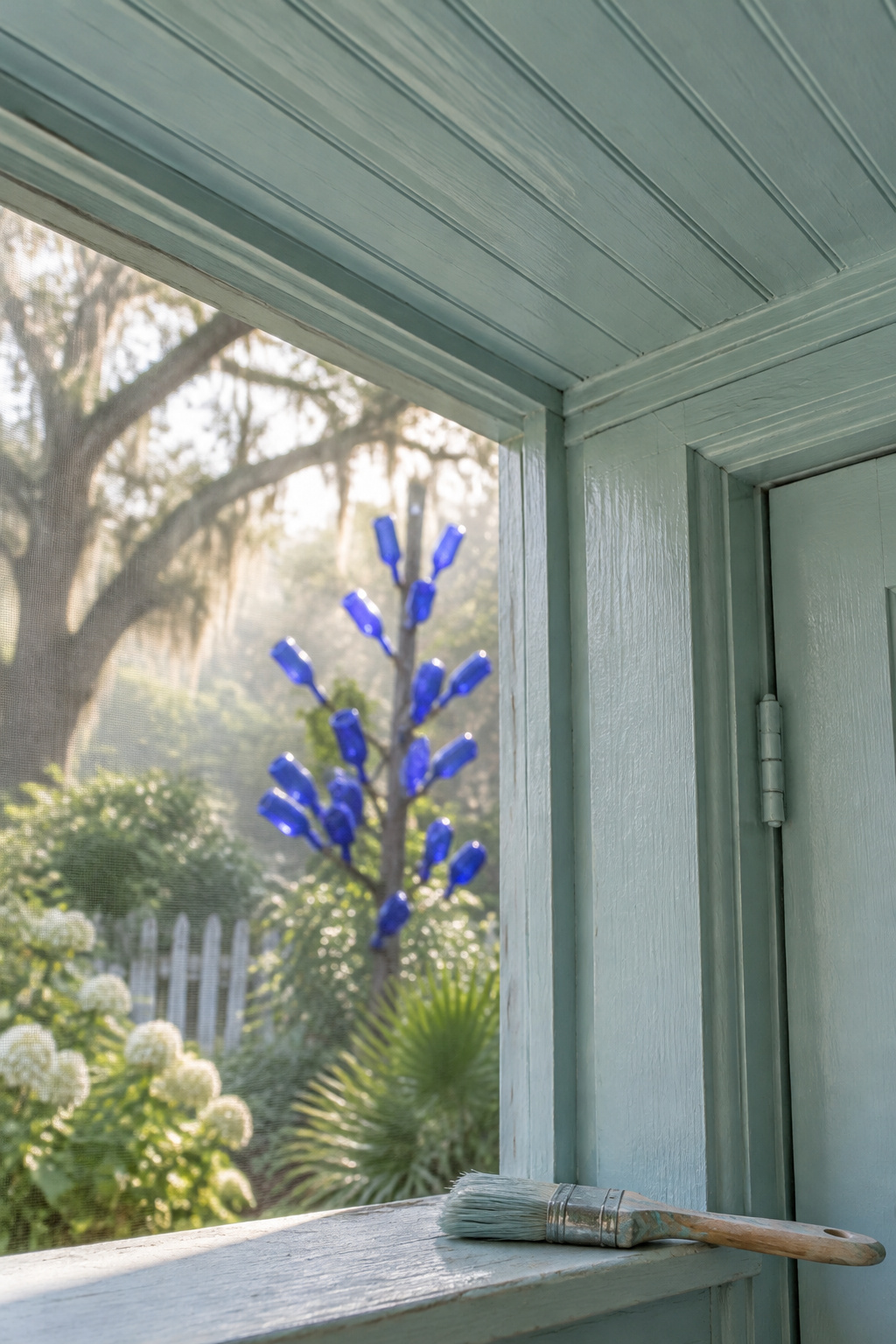
That history is reason enough to paint a ceiling blue. It is a sky color, and its story belongs to one coast and the people who live on it.
Does a blue ceiling keep wasps away?
No one has shown that it does. Arty Schronce, the public affairs director of the Georgia Department of Agriculture, put it plainly: it is a common belief, but there is no scientific evidence for it, including the idea that wasps and spiders read the ceiling as open sky. A museum insect-zoo director found no research behind it, and a university entomologist says most of the studies people cite as proof of color repellency only show that insects prefer some colors to others.
The other explanation is that the old lime or lye in the paint kept insects off. A museum and a paint maker have both said so, and nobody has published a test of it. If you believed the wasp story, you were in good company. Insects on a porch are a job for the screen, not the paint.
Pick the screened porch ceiling fan like a ceiling finish: damp rating first
The fan hangs in the same damp air. Check three things before you look at blade finishes:
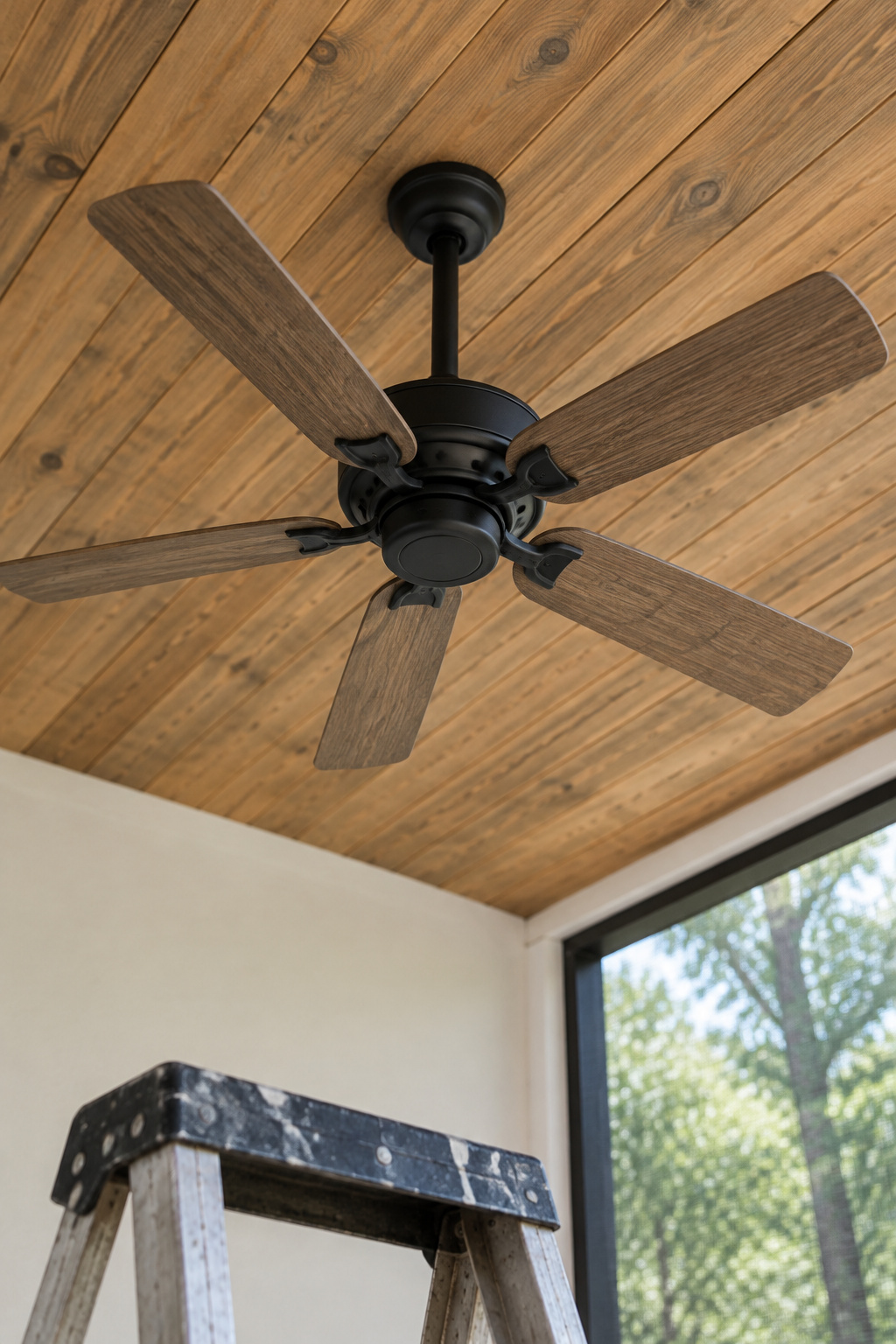
- Rating. A roofed screened porch is a damp location, so a damp-rated fan fits. Hunter’s rule: if rain can reach the fan, buy wet-rated. A dry-rated indoor fan does not belong out there.
- Blade span. Hunter puts spaces up to 100 sq ft at 36 to 44 in and spaces up to 400 sq ft at 44 to 54 in. A 15 by 15 ft porch is 225 sq ft, so it sits in that second band.
- Clearance. Manuals ask for 7 ft from the floor to the blades. From blade tip to wall, most manuals ask for 18 in, while Hunter’s installation sheet asks for 30 in. Use the manual that comes in your box, and mount to a box marked as acceptable for fan support.
For a typical porch I would buy a damp-rated fan in the 44 to 54 in range. Take a light kit if you like, but overhead lighting is for cleaning, not for living: the fan light is for sweeping up the leaves, and lamps are for the evening. Whether a fan does anything about mosquitoes is a separate question, answered in the bug-free outdoor dining guide.
The fan matters most where people sleep, so a sleeping porch under that ceiling asks the most of it.
Choosing your ceiling in order: roof depth, moisture, then daylight
Go back to the sun line on the floor. It sorts the rest.
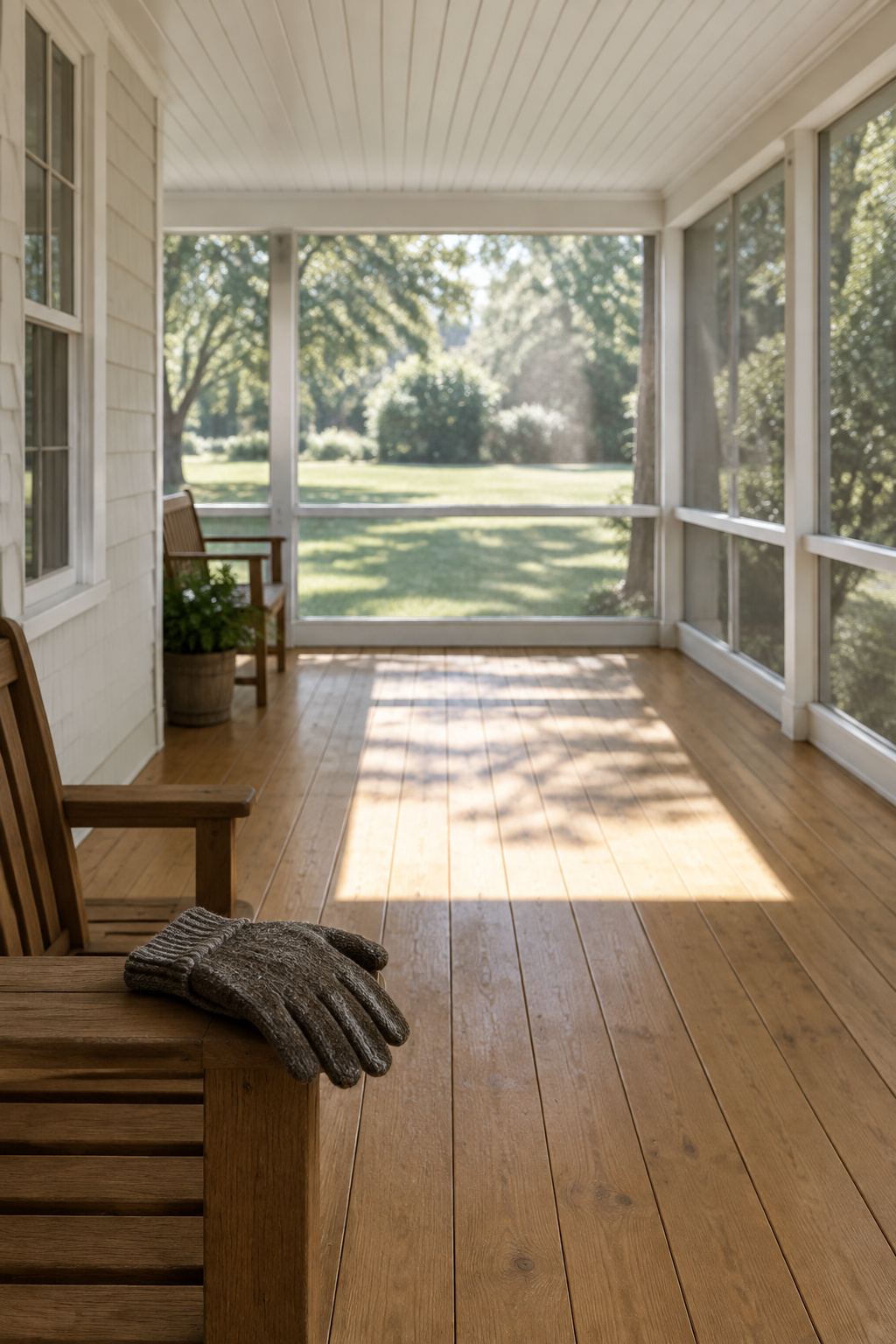
On a shallow porch, where the sun reaches most of the boards, any mildew-resistant painted wood or PVC in a light color will do. On a deep porch, the ceiling is carrying the back half of the room. There I would choose sealed cypress or PVC, keep the color light, and give it two top coats. Then add a damp-rated fan sized to the floor area, with 7 ft under the blades.
Enough is a good word for a ceiling: one sound surface, one light color, one fan.
Think of that limewashed ceiling in Savannah, layer over layer of blue. Paint yours blue if that is the story you want overhead. Choose the boards for the damp and the shade for the light before you choose the blue.
FAQ
How do you clean mildew off a porch ceiling?
Wash it with one part liquid bleach to three parts water, scrub, leave it ten minutes, then rinse well and let it dry. Test first with a few drops of bleach: if the spot lifts, it is mildew. On wood or recently painted surfaces, use vinegar instead. Wear eye protection, never mix bleach with ammonia, and never paint over mildew.
Can you stain a porch ceiling instead of painting it?
Yes, on wood. A semitransparent penetrating stain does not form a film, so it cannot crack and peel the way paint can, and the grain stays visible. One coat on new wood lasts roughly two to four years, and later coats last longer. PVC planks come pre-colored in wood tones and need no stain.
How often does a painted porch ceiling need repainting?
Less often than the exposed parts of the house. One top coat of acrylic latex over primer should last four to five years and two coats up to ten, and protected ceilings can usually wait for every other house repaint. Scrub the surface with detergent first, remove any mildew, and use a mildew-resistant paint.