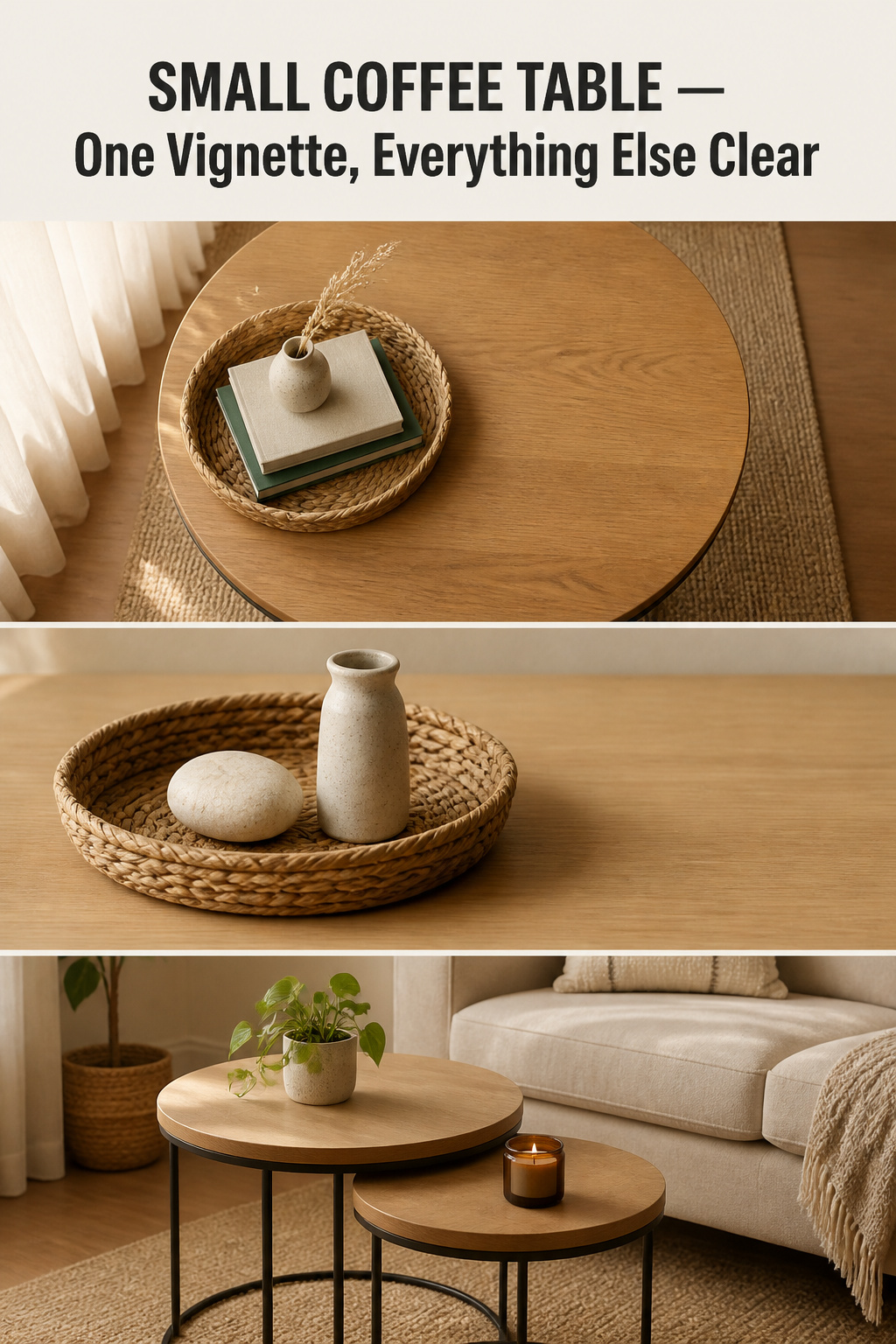
Here is the honest before-state for most small living room coffee table decor: a 28-inch table holding a candle, a stack of magazines, a trinket dish, a remote, and a half-finished mug. It does not read as styled. It reads as full — and every time you set down a coffee, you have to move something. A correctly styled small table flips that: one tight group in one corner, the rest bare and ready for daily life.
TL;DR
- Size first: keep the table to two-thirds your sofa’s length (a 60-inch sofa wants a ~40-inch table) and hold 14–18 inches of clearance to the sofa front; under 200 square feet, stay under 48 inches and lean round or oval.
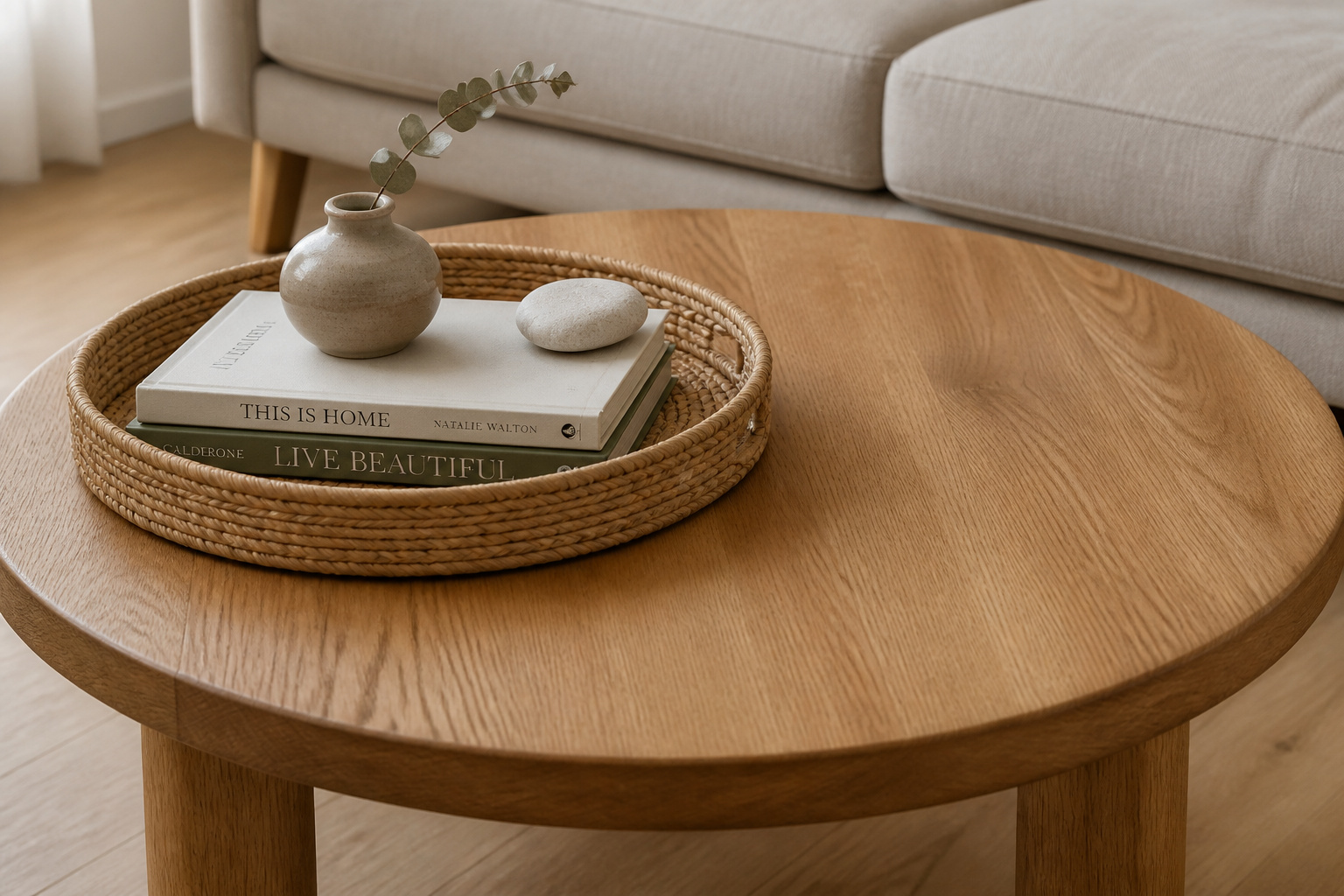
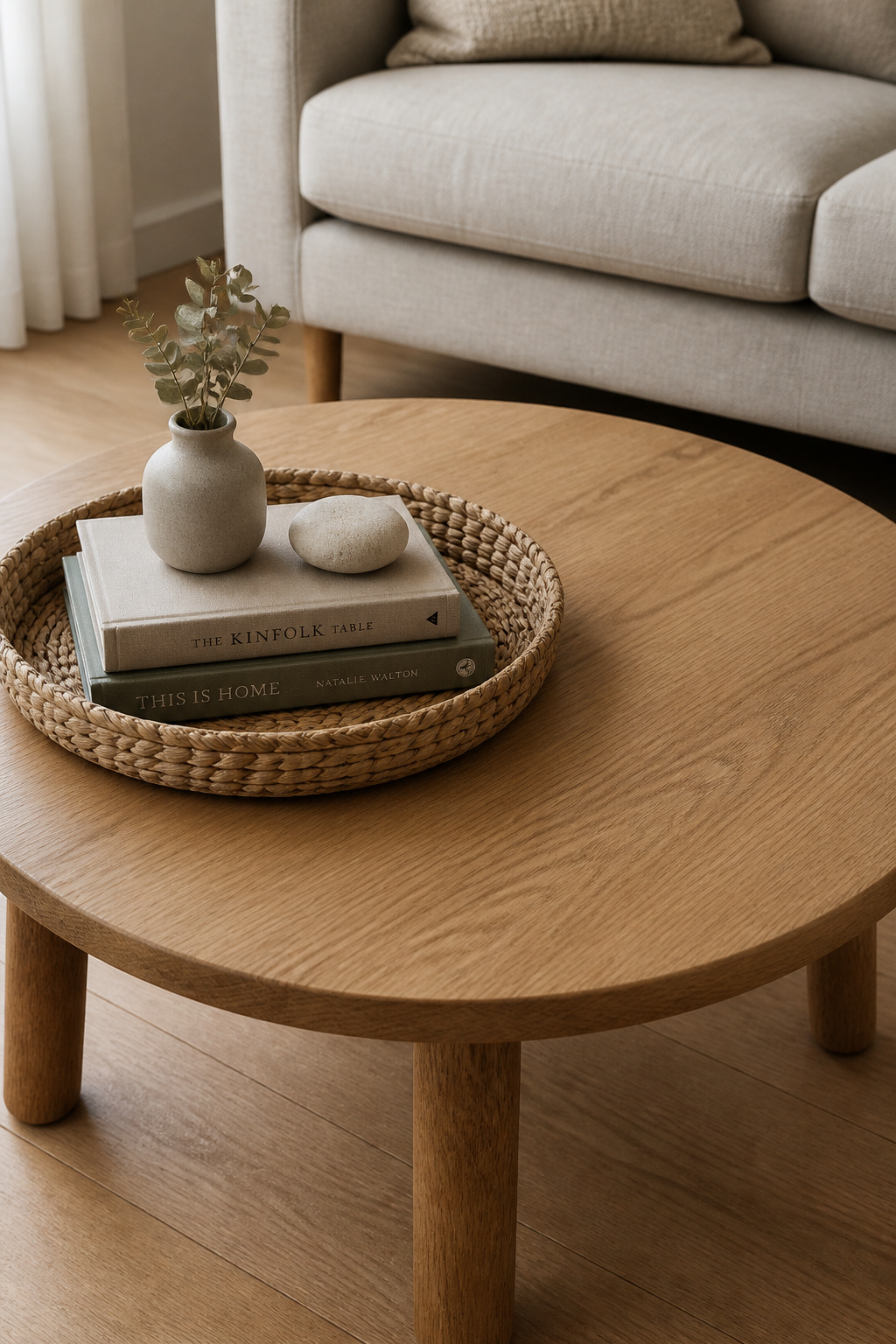
- Style one tight vignette only — a 12–14 inch tray with two or three objects, covering about a third of the surface — and leave the opposite end clear for a mug, a remote, the book you’re reading.
- Choose pieces that earn their footprint twice: a lidded tray that hides the remote, a book stack that doubles as a riser, and lightweight, knock-proof, moveable picks if you rent.
The Small-Table Before and After That Changes Everything
The instinct on a small table is to fill it — and that instinct is the whole problem. Empty space looks unfinished, so people keep adding, and what works on a 48-inch table sinks a 28-inch one.
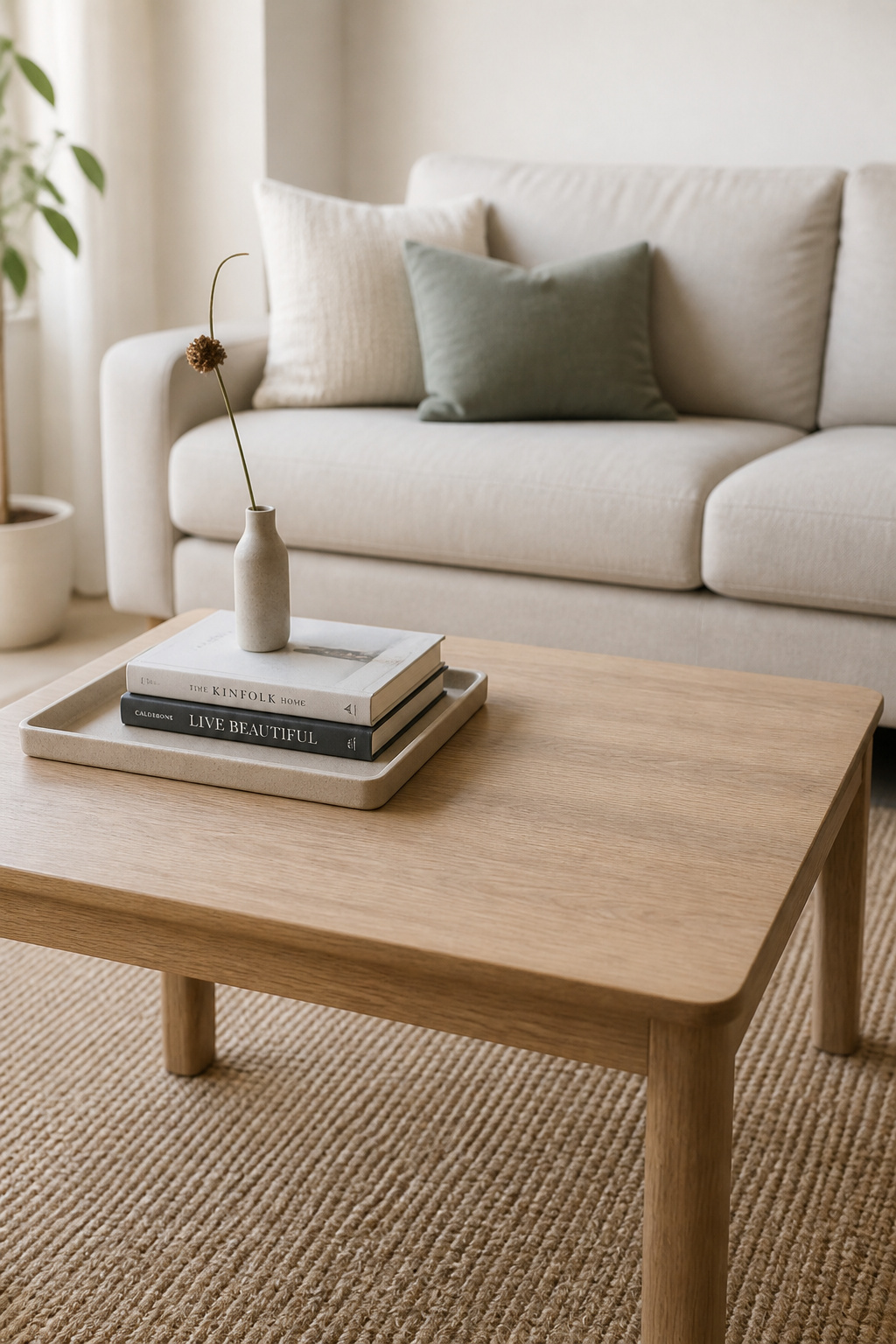
Why small tables get over-decorated
A small surface punishes extra objects harder than a big one. Spread four things across it and the eye reads disorder, which makes the whole room feel more cramped than it is.
What a correctly styled small table looks like
A styled small table has one vignette in one zone and the rest deliberately clear. Julia Demer, style editor at Homes & Gardens, puts it plainly: “the trick isn’t adding more, it’s choosing smarter.”
The one rule I use on every compact table
One tight vignette, everything else clear. General guidance says leave 30–40% of a table empty; on a small one, skew closer to 50%. The full system lives in the how to style a coffee table guide.
Small Living Room Coffee Table Decor Starts With the Right Table Size
Get the size right before you style anything. A wrong-size table is a daily frustration no styling fixes.
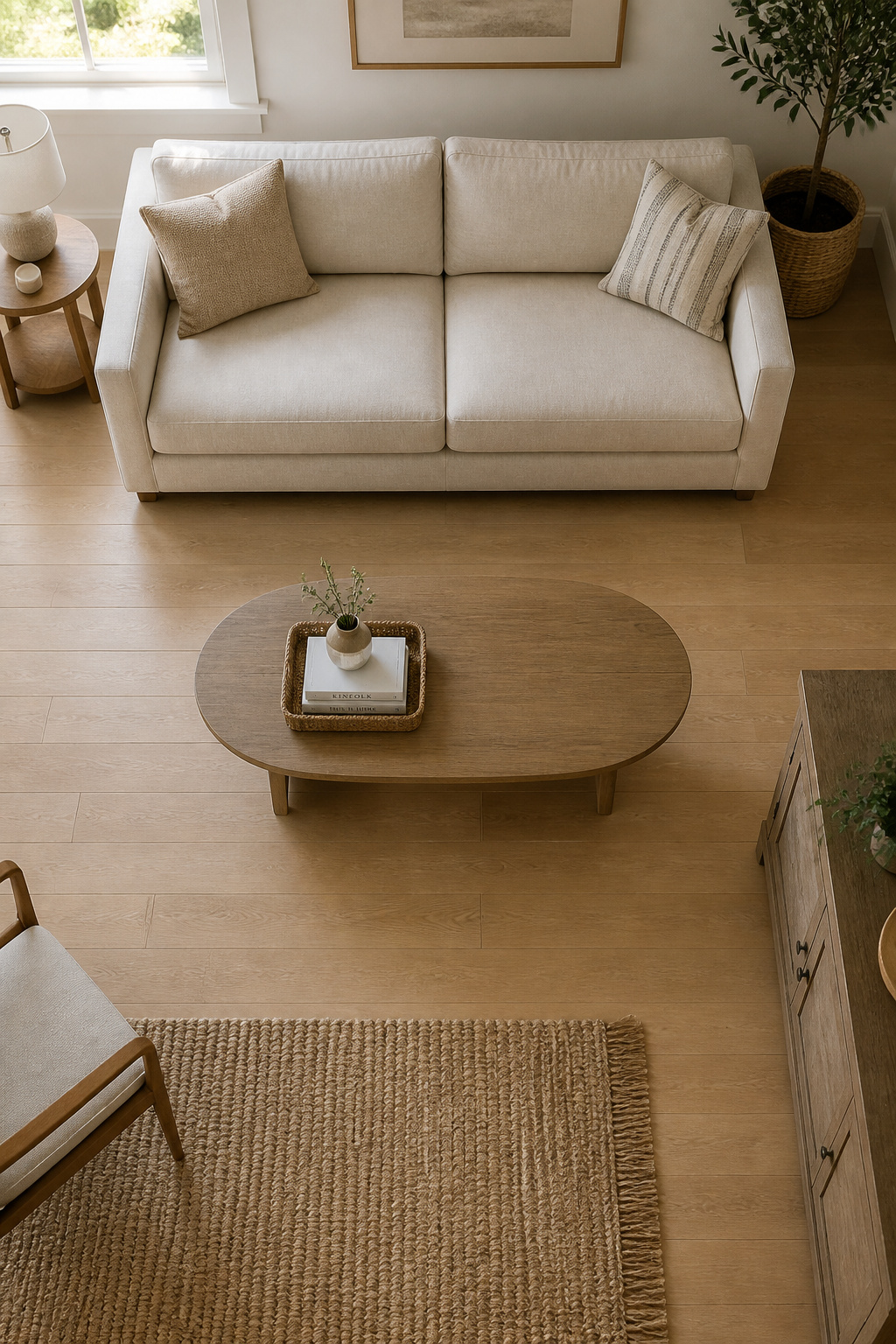
| Table type | Best room size | Styling approach |
|---|---|---|
| Round, 24–32 in | Under 150 sq ft | One small tray vignette |
| Oval, ~36 in long | 150–200 sq ft | Vignette one end, clear the other |
| Nesting set (2–4) | Under 200 sq ft | Style the top table only |
| Rectangular, under 48 in | 200 sq ft and up | Thirds: one styled, two clear |
The table-to-sofa ratio
Keep the table to about two-thirds your sofa’s length, as a maximum. A 60-inch sofa pairs with a 40-inch table; a 72-inch sofa with a 48-inch one. Under 200 square feet, stay under 48 inches regardless.
Clearance you can’t skip
Leave 14–18 inches between the sofa front and the table edge — below 14 it feels crammed, above 18 you’re leaning to reach a drink. Designer Catherine McColly of Perigold Design Services targets 17 inches in tight rooms. Keep at least 24 inches of aisle elsewhere.
Shape and nesting options
Round and oval tables flow better in tight rooms — curved edges eliminate corner-collision points. Oval is the small-room answer to a rectangle; there’s more in the coffee table decor by shape guide. If floor space is tight, nesting tables beat a fixed surface: they pull apart for guests and tuck back to one footprint.
The Single-Vignette Rule: One Group, Everything Else Clear
On a big table, designers spread three groupings across the surface. On a small one, do the opposite: one zone, the rest bare.
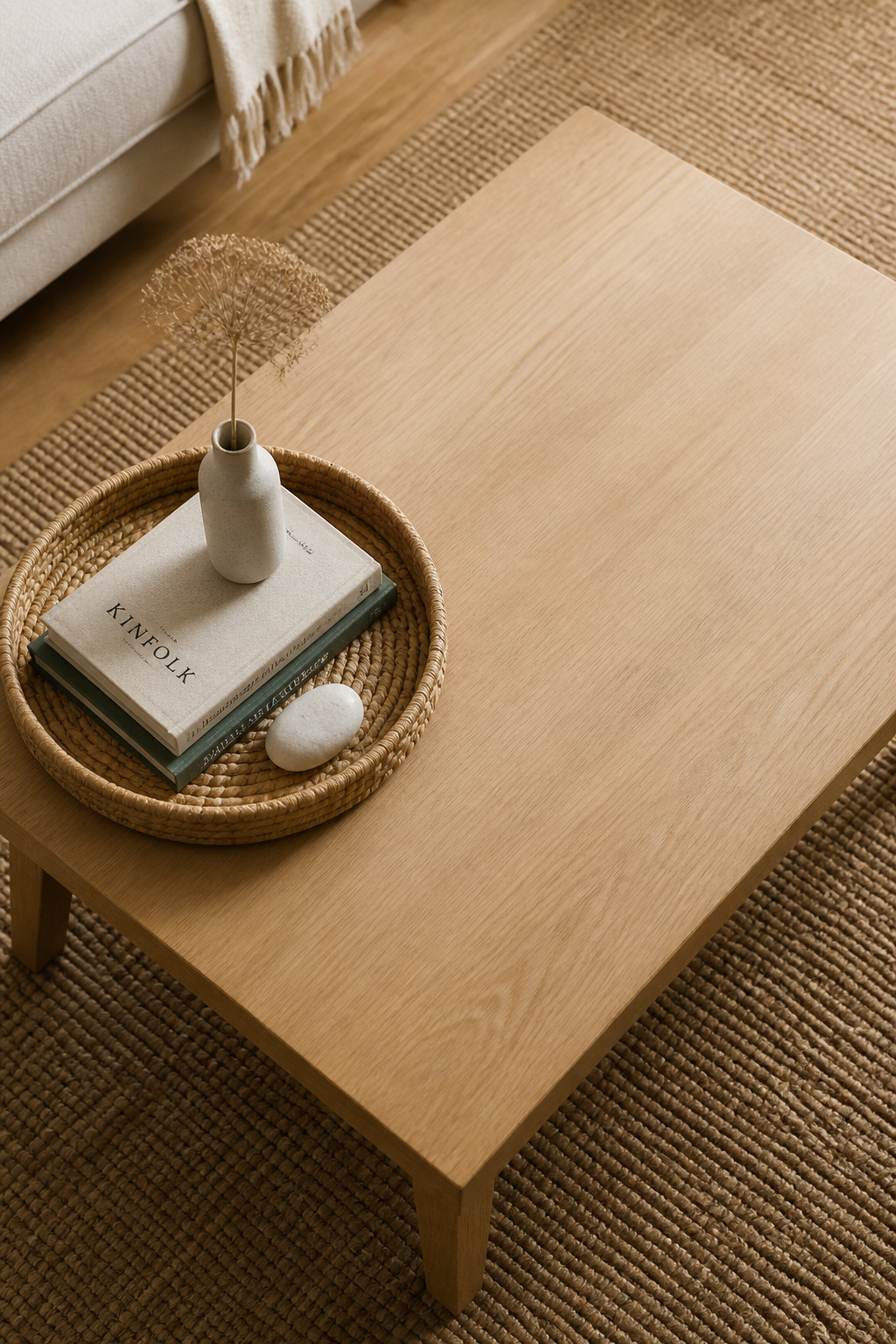
What one tight vignette means
One tray, two or three objects at varied heights, in a single zone left- or right-of-centre. Build height inside the group: one low (book stack or tray base), one medium (a box or candle), one tall (a bud vase). The rule of three applies inside the vignette, not across the whole surface.
Why spreading objects makes the table look smaller
Distribute objects and the eye reads several islands of clutter rather than one group. The tray fixes this: its border corrals loose objects into one unit. Demer’s line is blunt — clutter versus curation, “nine times out of ten, it’s a tray.”
The footprint rule, and keeping the far end clear
Cap the vignette at about a third of the surface; aim for 50% or more left clear. A coffee table exists first for daily use — if the group eats more than a third, every coffee disturbs it and it slides back to messy. A quick checklist:
- Put the vignette in one third of the table, not the dead centre.
- Keep it to three objects; four is usually one too many.
- Decide in advance where the mug and remote land, and protect that zone.
Dual-Purpose Objects That Earn Their Place
On a small table, every object has to justify its footprint — does it do two jobs at once? Anything that only decorates is a harder sell when surface is this scarce.
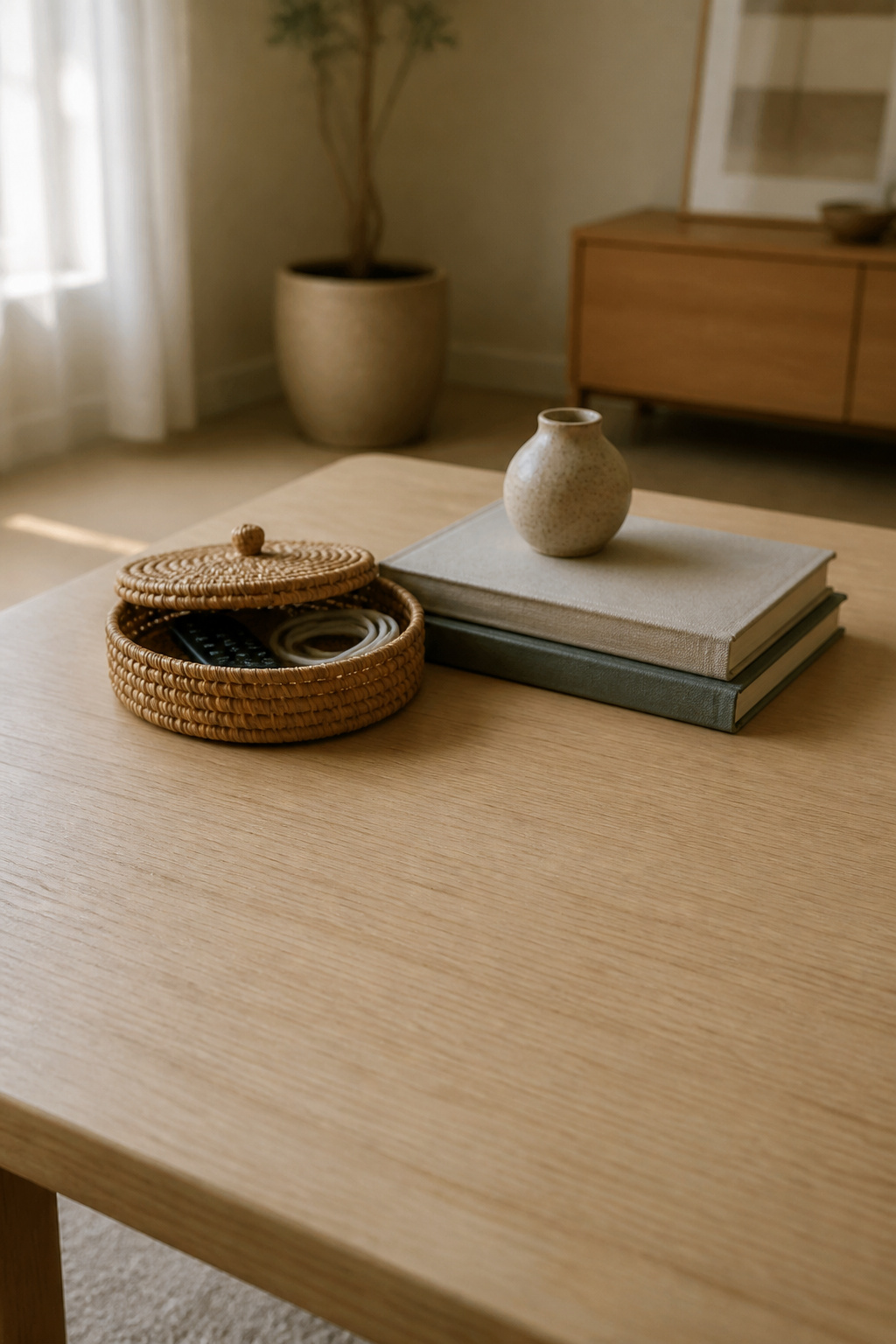
A lidded tray or box that hides the clutter
A lidded tray (12–14 inches for a compact table) handles what clutters a small living room most reliably — the remote, the charger, the coasters that creep across the clear zone. From across the room it reads as a decorative anchor; up close it’s storage. Woven seagrass or rattan is lightweight and rental-friendly, and turns up at Target, IKEA, and thrift stores for very little. A separate lidded box around 6–8 inches tucks beside the tray if you need more hidden storage.
A book stack that doubles as a riser
A stack of two or three hardcovers lifts a short vase or candle that would otherwise vanish, and the books are decorative on their own. Stack largest on the bottom; more than three reads as a pile. Keep them in the 9–11 inch range — a 12-inch art book can eat a third of a 28-inch table by itself.
What to leave off
A lit candle needs a clearance zone around the flame — wasted real estate on a compact surface, so use a side table instead. And skip anything fragile: pick objects you can knock without a heartbreak.
Scale and Proportion: Objects That Fit, Objects That Fight
Most small-table vignettes look wrong because of scale, not object count.
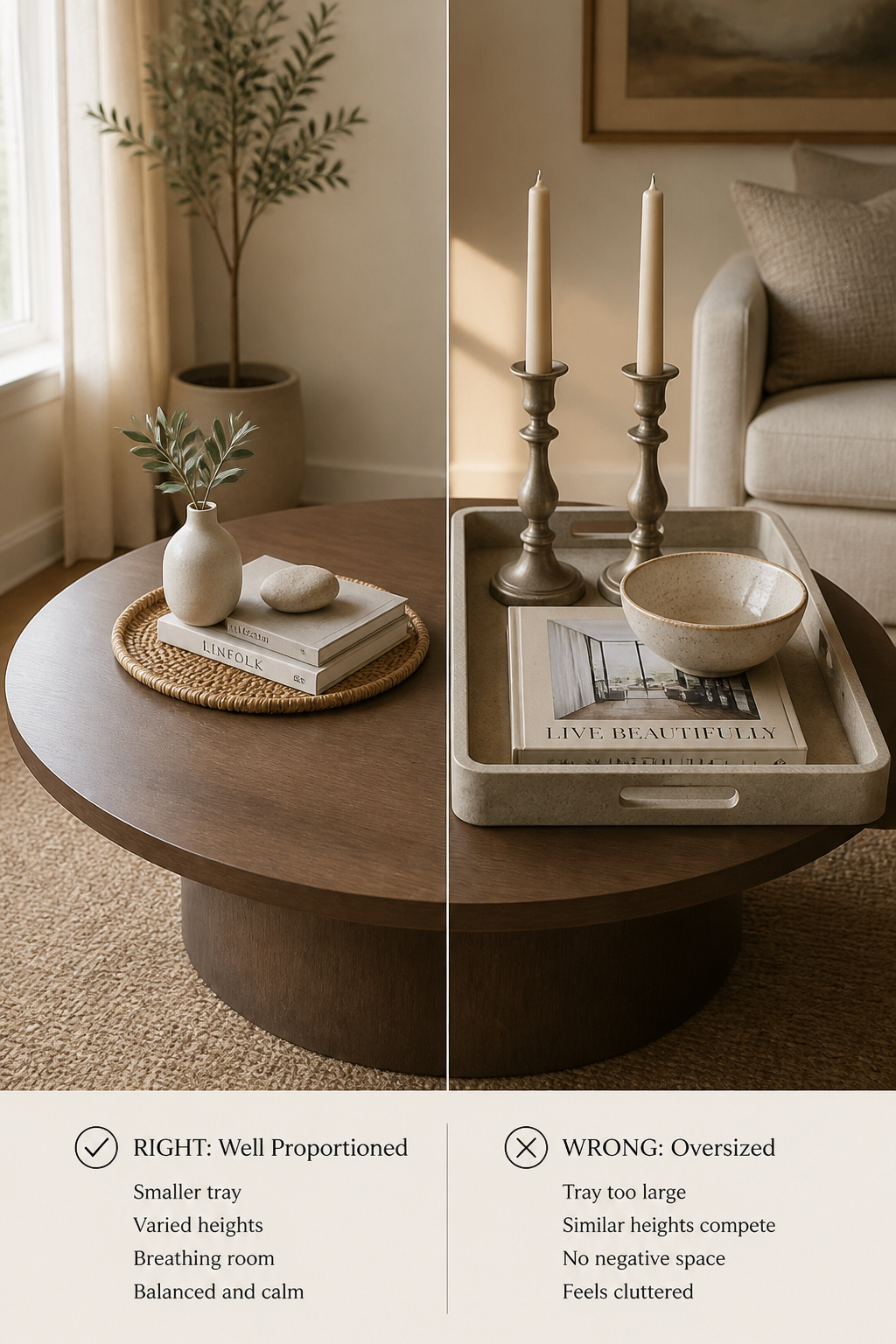
| Object | Max scale for a compact table | If oversized |
|---|---|---|
| Tray | 12–14 in longest dimension | Fills the zone, no room for objects inside |
| Tall element | 7–8 in tall, slim footprint | Breaks sightlines, crowds the table |
| Book stack | 9–11 in, two to three books | One book dominates a third of the surface |
| Tall objects | One only | Two compete and neither wins |
The 12–14 inch tray range is a proportional rule of thumb, not a sourced standard — the usual 18-inch-plus guidance is built for full-size tables, and this is that scaled down.
Keep objects below sofa-arm height
A standard sofa arm sits around 24–26 inches off the floor; a coffee table is 16–18 inches — leaving roughly a 6–10 inch budget for object height. That ceiling is derived from those two dimensions, not a published rule, but it holds up. A 7–8 inch bud vase works; a 12-inch vase fights the room.
One tall object only
Two tall objects — two candlesticks, or a vase plus a plant — compete in a space too small to hold the tension. Experience, not a cited rule, but it plays out every time. Pick one; if torn between two, take the narrower footprint.
The three-foot test
Step back about three feet — the group should read as one composed unit, not separate objects. Then sit on the sofa and check again: if it only looks right standing, it’ll feel wrong every evening you use it.
Renter-Friendly Choices for Small-Space Coffee Tables
Rent, and you stack a second constraint on the first: small footprint plus impermanence. The brief: lightweight, moveable, no damage, adaptable to the next floor plan.
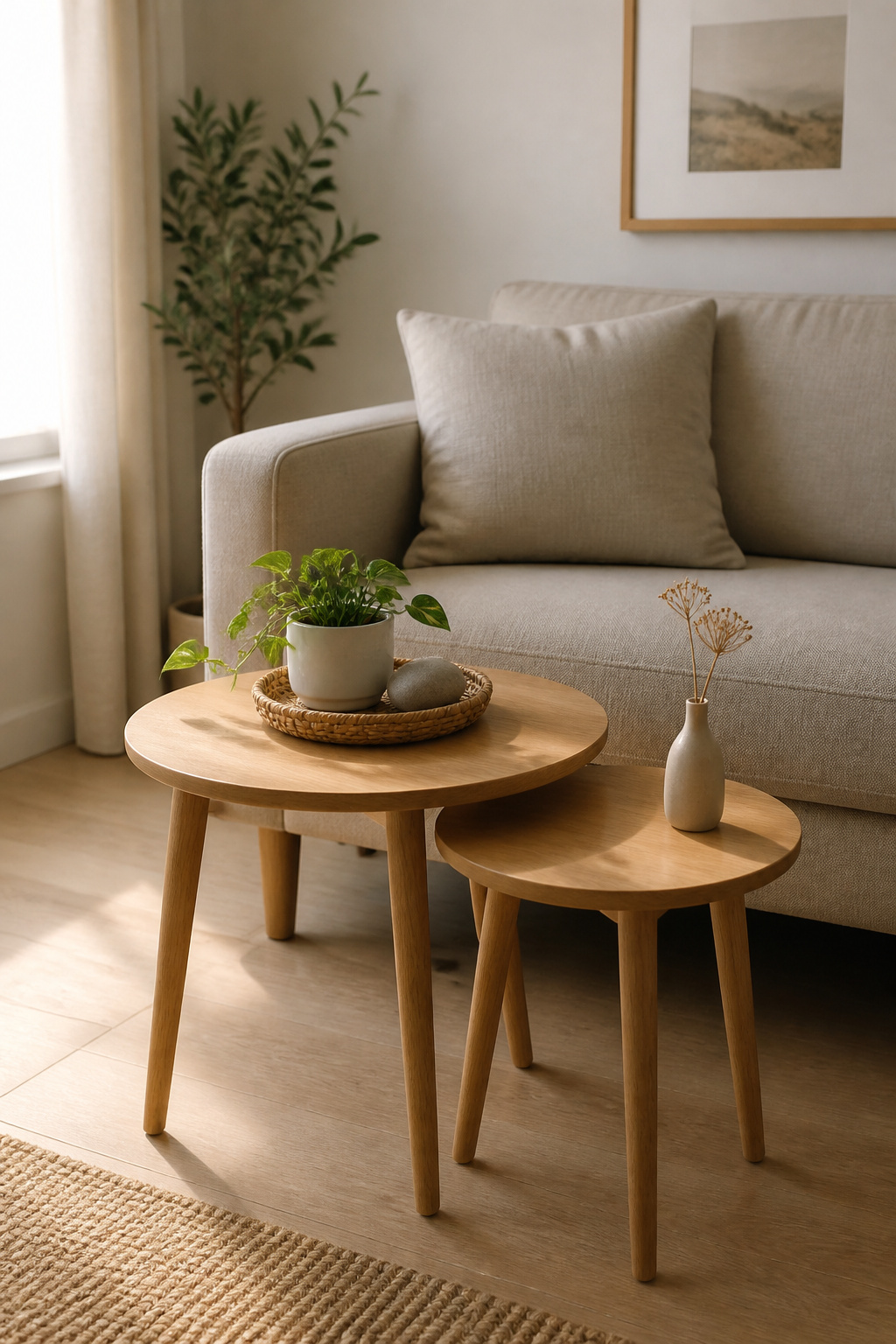
Lightweight and moveable is the whole brief
For anyone moving every year or two, a table under 30 pounds is the line for hauling it solo without wrecking carpet or floors — rattan, slim metal frames, and compact solid-wood designs usually land in the 15–28 pound range. If space is truly tight, a pouf or ottoman with a tray on top moves anywhere and doubles as seating.
Skip the heavy and the fixed
Stone sculptures, marble trays, big ceramic vases — a pain to pack, high-risk on moving day, and often wrong for the next rental. The renter rule: objects under about 3 pounds each, nothing that shatters if knocked, everything that fits in a standard box. A mirrored tray is a bonus — it bounces light around a small room and travels well.
Where to thrift, what to buy new
Thrift stores are the best source for trays — ceramic, rattan, lacquered wood, usually $3–15. Thrift the vessels, vases, boxes, and candle holders too; at vignette scale, the gap between a $2 find and a $40 retail piece is basically zero. Buy new only where fit matters most: the table itself, plus maybe IKEA’s Gladom tray table (around $25, under four pounds). The styling discipline this forces — spare, one vignette, nothing extra — is exactly what the minimalist coffee table decor guide covers for renters who want to go further.
First move, four dollars: tape the table footprint on the floor before you buy or rearrange, and live with it a day. Once the size is right, the styling is one tray, three objects, one zone — the rest left clear for the coffee you’re about to set down.
FAQ
How do you style a small coffee table without it looking cluttered?
Consolidate into one vignette: a 12–14 inch tray holding two or three objects at varied heights, grouped in one zone, with the rest of the surface left clear. The tray’s border turns scattered objects into a composed group. Step back three feet — if you see one visual group plus clear space, it’s right.
What size coffee table works best in a small living room?
Use the two-thirds rule: table length about two-thirds your sofa’s (a 60-inch sofa wants a 40-inch table). In rooms under 200 square feet, stay under 48 inches; under 150, choose a round or oval table 24–32 inches across. Keep 14–18 inches of clearance to the sofa and at least 24 inches of aisle elsewhere.
Can you have a coffee table in a very small living room?
Yes, if the proportions and clearances hold. A round table 24–32 inches across, or a set of nesting tables, works in rooms down to roughly 100–120 square feet. If you can’t keep 14 inches to the sofa and 24 inches of aisle, use an ottoman or pouf with a tray on top — a surface that moves when you need the floor.