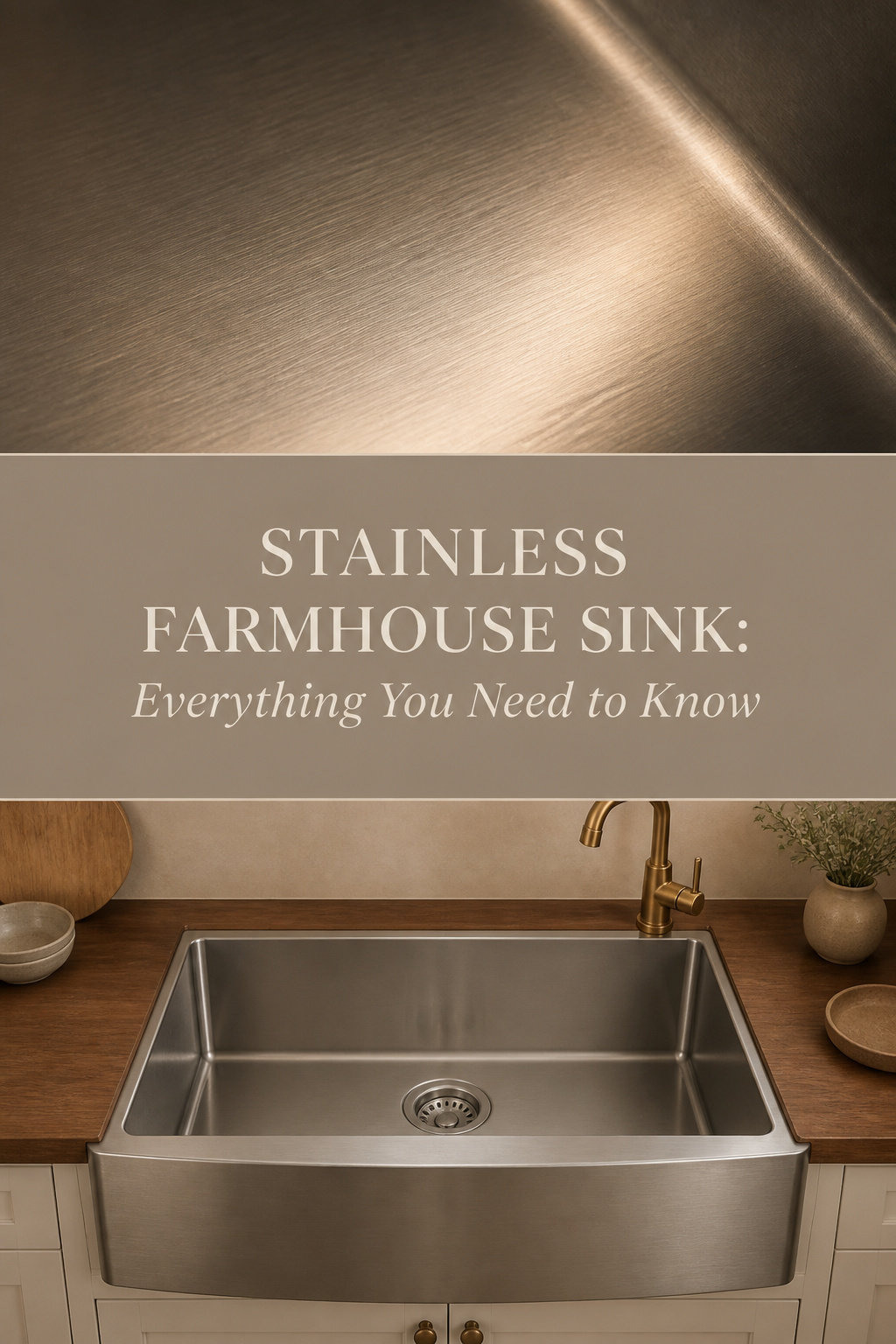
A sink is the most-used object in a kitchen, and almost nobody chooses one for that reason. The photographs sell the surface that gets seen; the real question is the surface that gets worked. So ask what this basin has to survive every evening: the dropped cast-iron pan, the soaking stockpot, the hot water over it for the ten-thousandth time. Answer that honestly and a stainless steel farmhouse sink stops being the plain option and becomes the considered one. It is built for the kitchen you live in, not the one you photograph.
TL;DR
- Buy 16-gauge (1.59 mm) steel and walk away from anything thinner: 18-gauge is 20% lighter, dents more easily, and rings louder. Confirm T-304 grade too — if a magnet sticks, it is lower-grade steel that rusts.
- Expect a premium 16-gauge apron sink to cost roughly $400–$800, less than comparable fireclay, and expect it to scratch — but on a brushed finish those scratches blend into a patina within about a year.
- Stainless reads cold only when everything around it is cold. Pair it with butcher block, warm paint, and a brass faucet, and it carries the rest.
Why a Stainless Steel Farmhouse Sink Works for How You Actually Cook
The apron front is usually sold as a style. It began as a solution: extending the basin past the counter edge lets you stand close without leaning over the lip — and that matters across a long evening at the sink more than in any photograph.
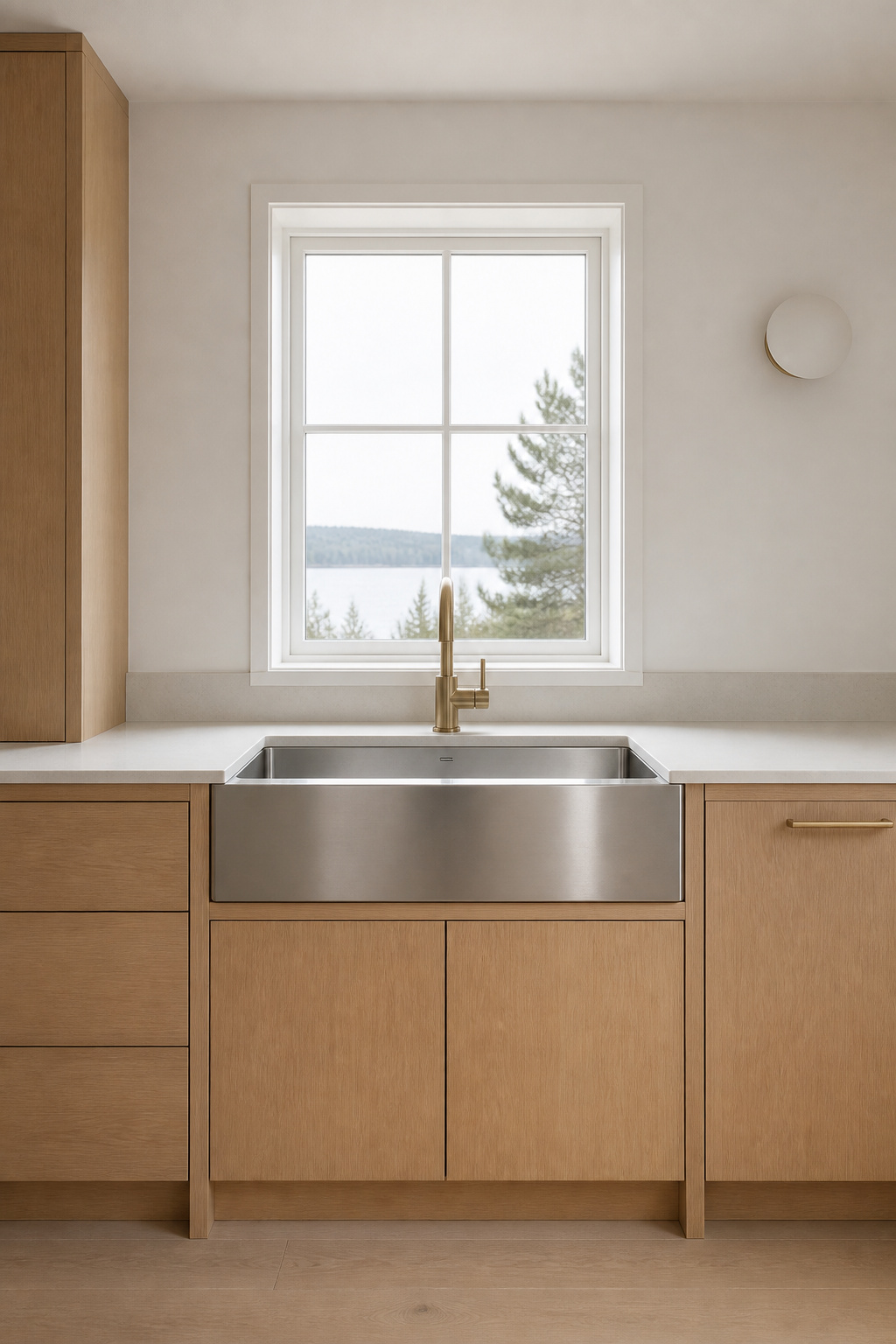
Why the daily-use case is stronger than its styling reputation suggests
Stainless earns its place through what it tolerates. The surface is non-porous, so it does not harbour bacteria — the reason it dominates commercial kitchens worldwide. It takes a hot pan straight off the burner without marking, and asks for nothing special: warm water and mild soap, no sealers.
What Scandinavian kitchen design has known about stainless for decades
I come at this from a Nordic habit of mind, so take it as my reading. In the kitchens I learned from, stainless was never the budget fallback — it was the right material. The working kitchen is a place of use, not display. A pan landing in the basin is not damage to apologise for; it is the basin doing its job.
The question to ask before any other: what does this sink need to survive?
Not which finish, or which brand — how the sink will be used. Daily pot-washing, soaking cast iron, high-volume dishwashing — these are where stainless outperforms the alternatives, because it does not chip or crack when a heavy pan drops in, the way fireclay or enamelled cast iron can. For the wider choice, start with the farmhouse kitchen sink buyer’s guide.
Gauge: The Number That Tells You Whether to Buy It
If you remember one specification, make it gauge — the most reliable quality marker, and the one most buyers skip.
What gauge actually means and why the number runs backward
Gauge measures thickness and runs backward: the lower the number, the thicker the steel. In practice, 16-gauge steel is 1.59 mm thick and 18-gauge is 1.27 mm — a 0.32 mm gap that amounts to roughly 20% less material. Residential sinks run from 16-gauge at the premium end to 22-gauge at the budget end. Anything above 18 is entry-level, not built for daily household use.
16-gauge vs 18-gauge: what Henrik recommends and why
Buy 16-gauge. I will commit to that rather than present a balanced choice, because the physics are not balanced. The extra 0.32 mm resists denting when a cast-iron dutch oven drops in, and it runs quieter before any sound treatment. Ruvati builds its entire range in 16-gauge T-304 and is blunt about it: “where you save on money, you also compromise durability.”
| Gauge | Thickness | Dent resistance | Noise profile | Typical price tier |
|---|---|---|---|---|
| 16 | 1.59 mm | High — resists heavy-pan impact | Quietest before treatment | Premium ($400–$800) |
| 18 | 1.27 mm | Moderate — dents under impact | Louder, more drum | Mid-range |
| 20–22 | thinner than 1.27 mm | Low — not for daily use | Loudest, thin ring | Budget |
What to do when you can’t find the gauge listed
Treat a missing gauge as a warning — reputable makers always print it. Confirm the grade too: T-304, the 18/10 stainless with 18% chromium for corrosion resistance and 10% nickel for rust resistance. Field test: quality 300-series stainless is non-magnetic — if a magnet sticks, it is not the grade you want.
Finish Choices: Satin, Brushed, and Why It Matters Long-Term
Finish is where most people start. I’d argue you should arrive here third — after gauge and grade. It is a real decision, but about how the sink ages, not how it photographs.
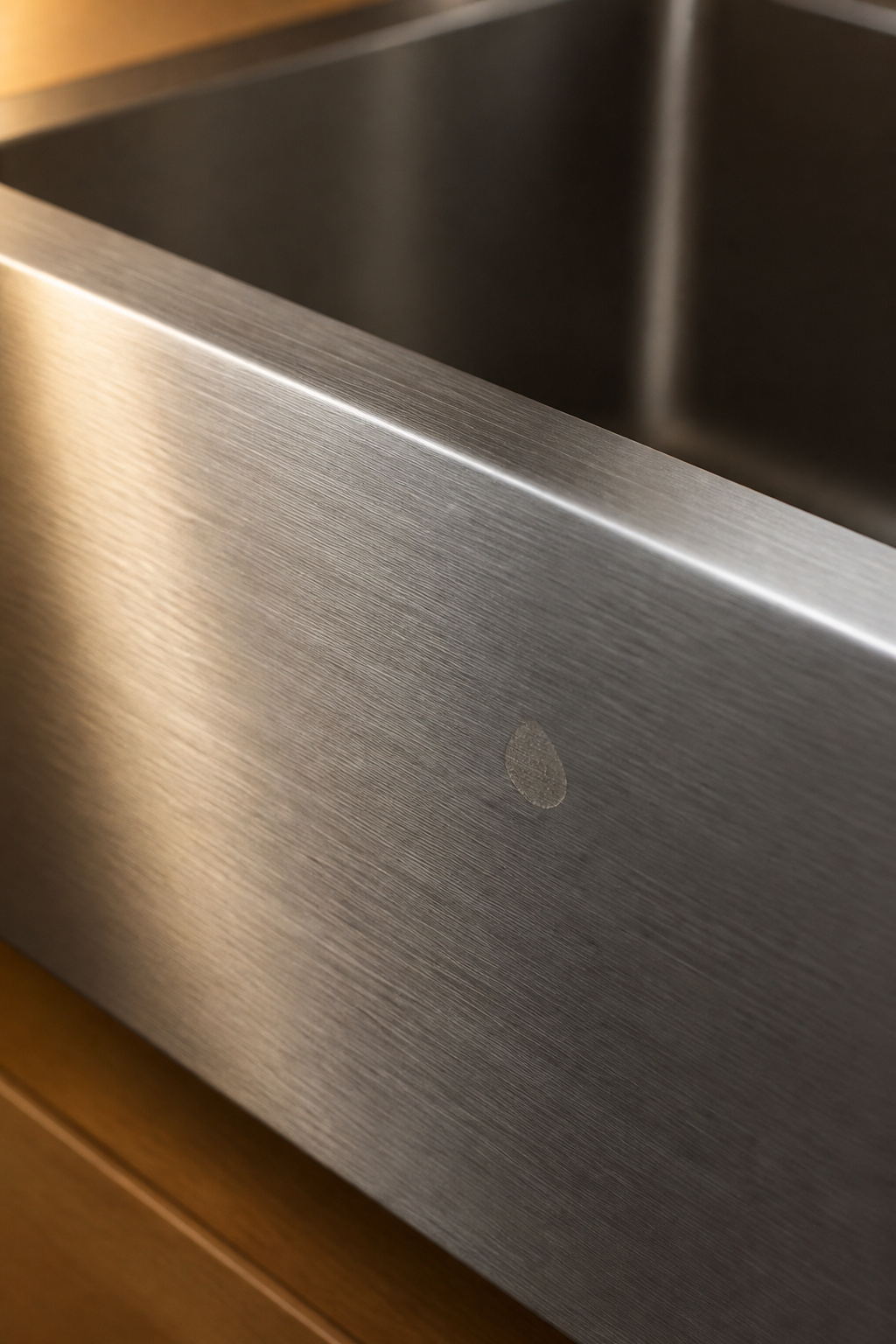
Satin vs brushed finishes: the visual and practical difference
A brushed finish lays down fine parallel lines in one direction — matte-to-low-sheen, slightly coarser. Satin is smoother: thinner lines, a dull glow rather than a reflection. Brushed steel hides fingerprints better because the textured lines scatter light; satin shows them a little more under direct light.
How each finish ages with daily use and water marks
Neither finish needs refinishing — stainless does not tarnish under normal use. The difference is in how wear reads. A brushed surface forgives: hairline scratches work together within about a year into a unified character, so each new mark stands out less than the last. If you want a sink that looks better the less you fuss over it, brushed is the honest choice.
Which finish to choose for wood or painted farmhouse cabinets
For a farmhouse kitchen with warm wood — oak, walnut, shaker doors in off-whites and greens — choose brushed. Its lower reflectivity sidesteps the cold sheen a mirror polish throws against warm cabinetry. Satin suits lighter, more minimal kitchens: matte whites and soft greys, where its even glow reads as deliberate. In practice the distinction blurs — most premium farmhouse sinks are sold as “brushed satin,” which Randy Mauldin of Create Good Sinks notes “minimises the appearance of scratches and water spots for a consistently clean look.”
Noise and Scratch Reality: What the Product Pages Don’t Say
Two objections come up: it rings, and it scratches. Both are true. Neither is a reason to walk away.
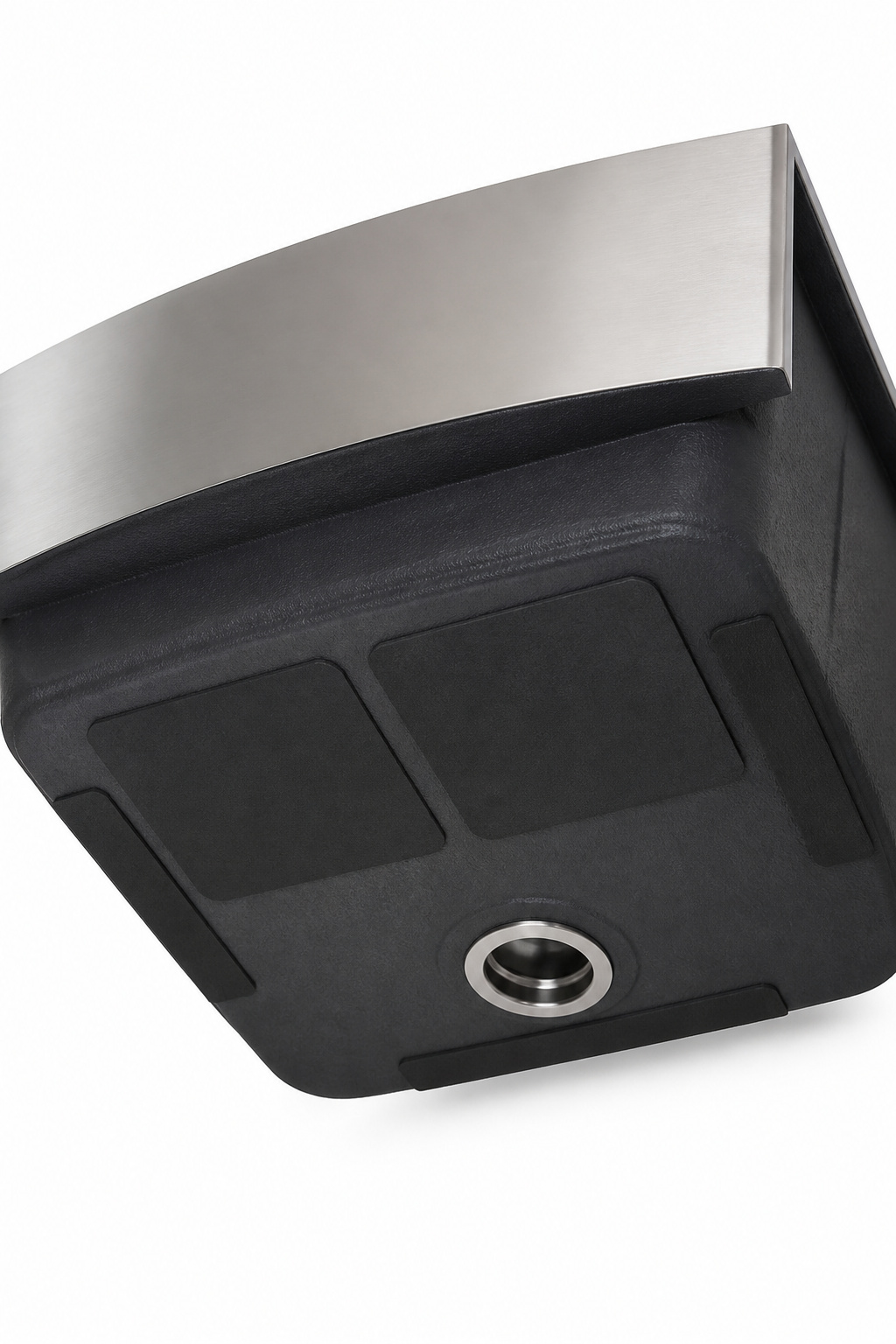
Why stainless rings — and what sound-dampening actually does
Stainless is resonant: sound travels through the metal rather than being absorbed. It is a mass problem — more mass solves it, which is why 16-gauge is quieter than 18-gauge before any treatment. Quality sinks add two further layers: a sprayed undercoating and rubber pads on the base panels. Kraus claims up to 80% noise reduction with its NoiseDefend system; Ruvati runs a comparable setup on its 16-gauge range.
Scratch formation: how fast, how visible, and whether it matters
Stainless will scratch — every sink does. On a brushed finish, scratches align with the grain over time: within about a year the hairlines work together into a soft patina, and the surface reads as uniform. One rule applies: always work along the grain, never across it. Cross-grain abrasion is what makes a scratch stand out.
The coating on the underside: what to look for and what to ignore
Look at how far the dampening reaches. A coating on only the flat bottom leaves the apron and side walls free to ring. The benchmark: sprayed sound-deadening compound across the underside, plus rubber pads on the basin floor. The cheap substitute is a thin acrylic spray that cuts almost no noise. Coverage area is what matters, not the word “dampened” on the label.
Keeping Stainless Looking Like Stainless: The Right Maintenance Routine
Stainless is genuinely low-maintenance. Two prohibitions and one daily habit cover almost all of it.
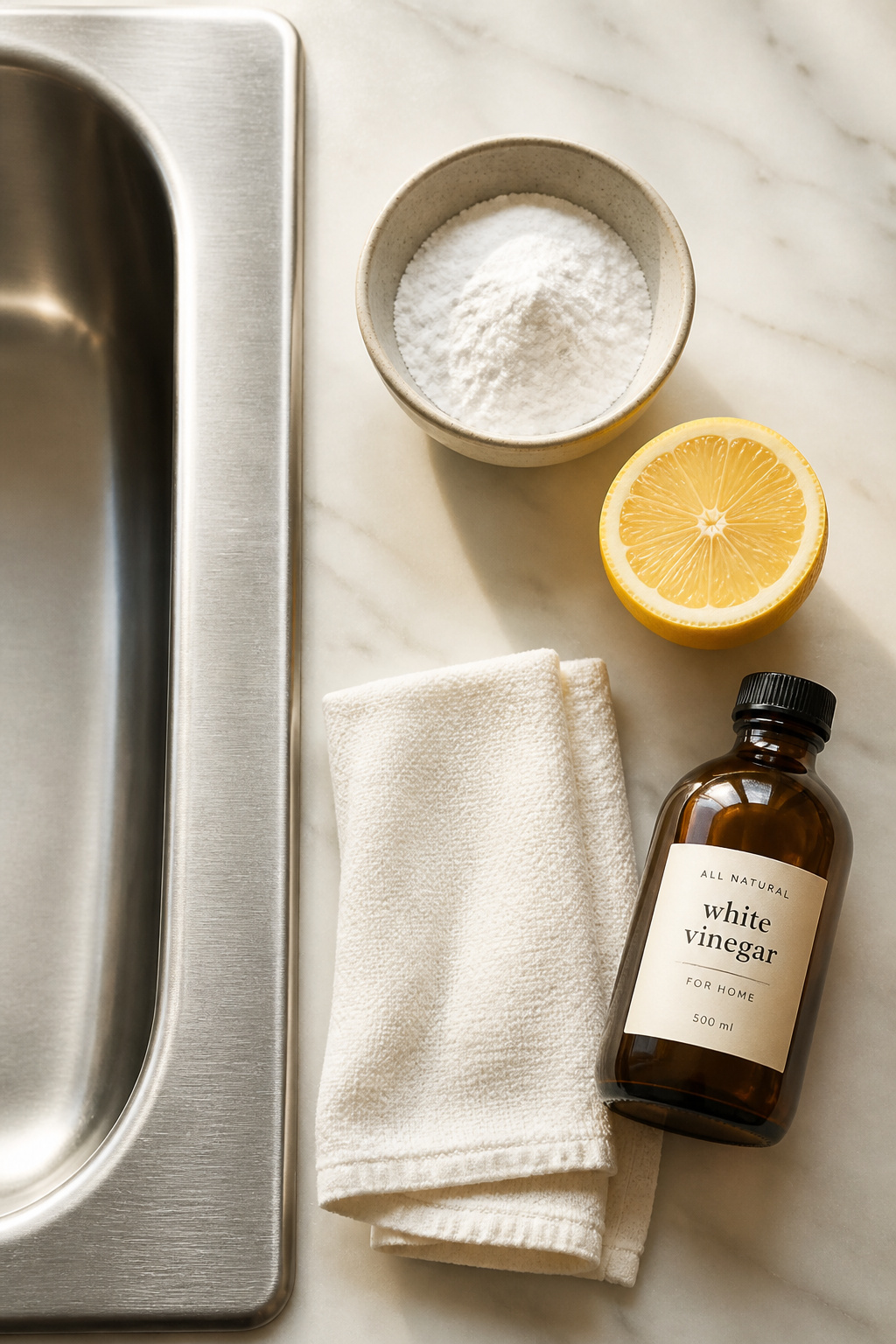
Daily wipe-down: what to use and what never to use
Rinse with warm water after use and dry with a soft cloth — that one step prevents most hard-water spotting. Safe options: mild dish soap, baking soda worked with the grain, white vinegar diluted 50/50. Two firm prohibitions: never use chlorine bleach or steel wool. Both attack the chromium oxide passive layer — as Hunker’s editorial team notes, chlorine staining “is a type of corrosion and is permanent.”
Safe on stainless / Never on stainless:
- Mild dish soap and warm water — Chlorine bleach or any sodium hypochlorite cleaner
- Baking soda, worked with the grain — Steel wool or scouring pads
- White vinegar, diluted 50/50 — Abrasive powder cleansers (Comet-style)
Removing water spots and light surface marks
For dried water spots, white vinegar on a soft cloth rubbed with the grain lifts them without risk. For a stubborn mark, Bar Keepers Friend (oxalic acid, not chlorine) worked strictly with the grain will clear it; keep it for spot treatment. An occasional buff with mineral oil leaves a thin film so water beads rather than dries flat.
How the care compares to a white fireclay sink
A white fireclay basin needs daily watching for metal-transfer marks and periodic treatment; stainless needs a rinse and a dry. It does not stain from coffee, wine, or food pigment — the defining vulnerability of a white basin. To weigh the trade properly, see how white sinks compare on cleaning.
Styling Stainless in a Farmhouse Kitchen Without It Reading Cold
Stainless can look industrial. But the coldness almost never comes from the sink — it comes from what surrounds it.
The warmth problem: why stainless can feel industrial and how to avoid it
Stainless reads cold when it is the only reflective thing in a hard, pale kitchen — white walls, white cabinets, chrome taps. The material is not cold in itself; the context is. The Nordic answer is to surround it with deliberate warmth — natural wood, linen, muted earth tones. The apron front helps: its exposed horizontal face relates to woodwork, not to a commercial scullery.
Cabinet and countertop pairings that pull stainless into the farmhouse register
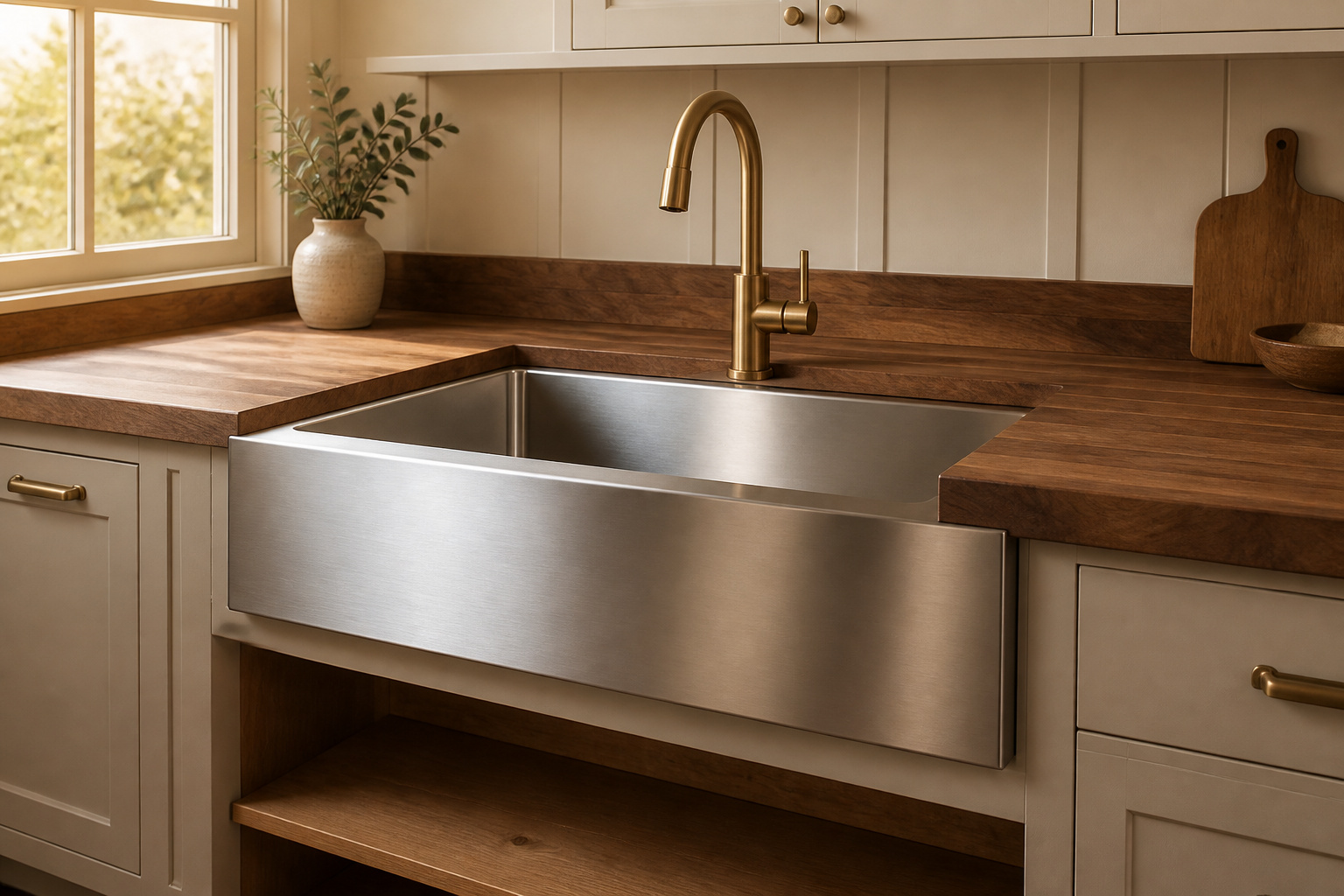
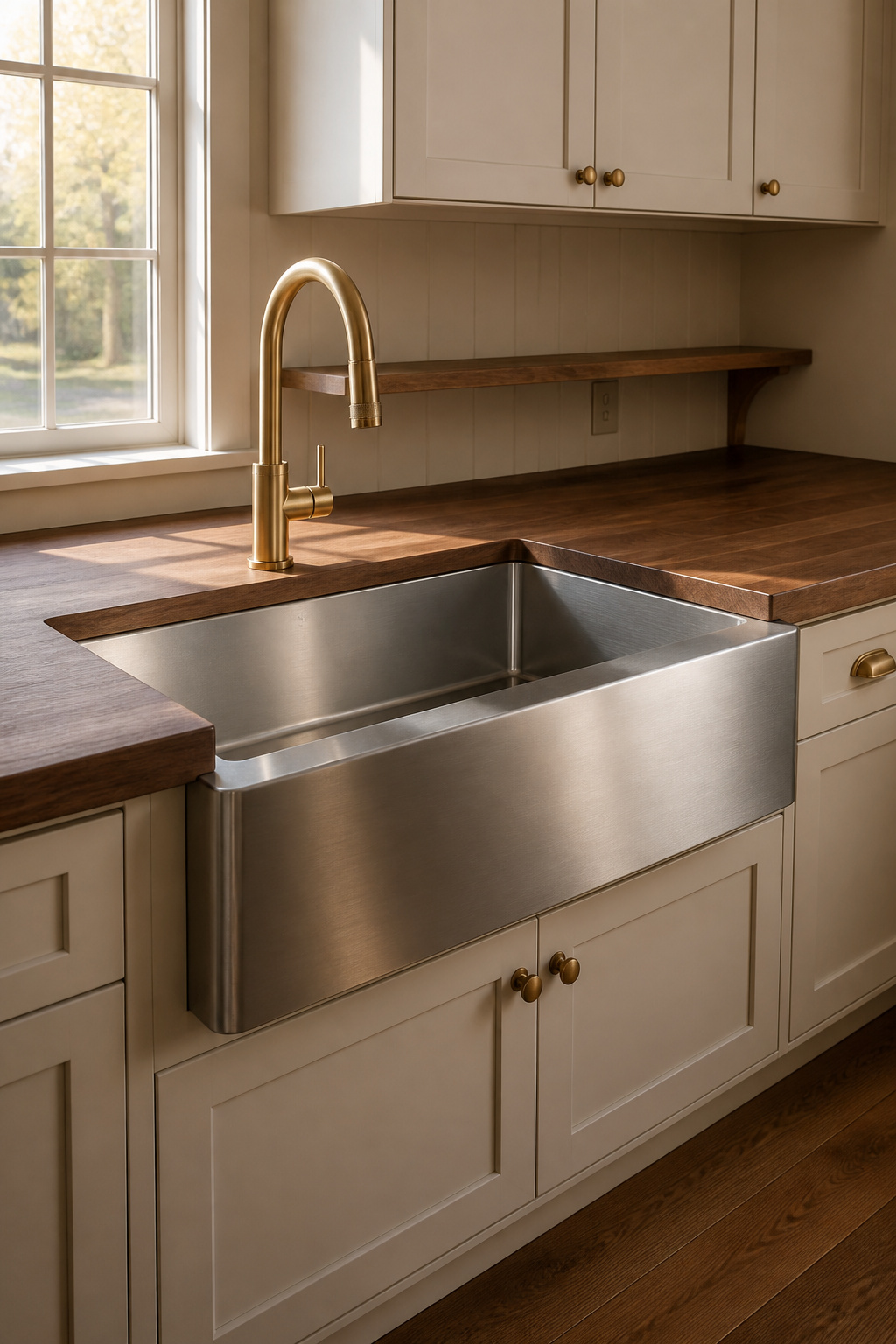
The most effective pairing is butcher block. Walnut or maple brings the warm grain stainless lacks, and together they read as professional-kitchen-meets-home. After that, paint: sage green cabinetry carries an earthy warmth that counters the cool metal and stays timeless. For a lighter look, warm cream over pure white — the ivory undertone harmonises with wood nearby, where stark white amplifies the chill.
Hardware and faucet finishes that work with brushed stainless
Faucet finish is where warmth gets its sharpest lever. Unlacquered brass against brushed stainless reads artisan rather than accidental, and it develops a patina that ages well beside the steel. Champagne bronze gives the same tone in a steadier finish. Avoid chrome — cooler and more reflective than brushed steel, the contrast reads as a mistake. If you would rather lead with warmth in the metal itself, consider a copper sink instead. Either way, the full decision lives in the farmhouse kitchen sink buyer’s guide.
FAQ
What gauge stainless steel is best for a farmhouse sink?
16-gauge (1.59 mm) is the best choice for a farmhouse sink. It is 20% thicker than 18-gauge and meaningfully more resistant to denting from heavy pots, bowing, and drumming noise. Avoid anything above 18-gauge for a primary sink. Also confirm T-304 grade — if a magnet sticks, the steel is lower-grade and prone to rust.
Does a stainless farmhouse sink scratch easily?
Yes, stainless will always scratch under daily use. On a brushed finish, though, those scratches blend into the grain direction and form a natural patina within roughly a year, becoming less noticeable over time. The key rule is to clean and rub along the grain, never across it — a brushed finish hides daily wear far better than satin-smooth steel.
How do you keep a stainless steel farmhouse sink from looking cold in a warm kitchen?
Surround it with warmth. Pair the sink with a butcher-block counter in walnut or maple, which immediately counters the cool metal tone. Choose a brass or champagne bronze faucet rather than chrome for a mixed-metal moment that reads designed. Paint cabinetry in sage green or warm cream rather than pure white, whose cool undertone only amplifies the steel.