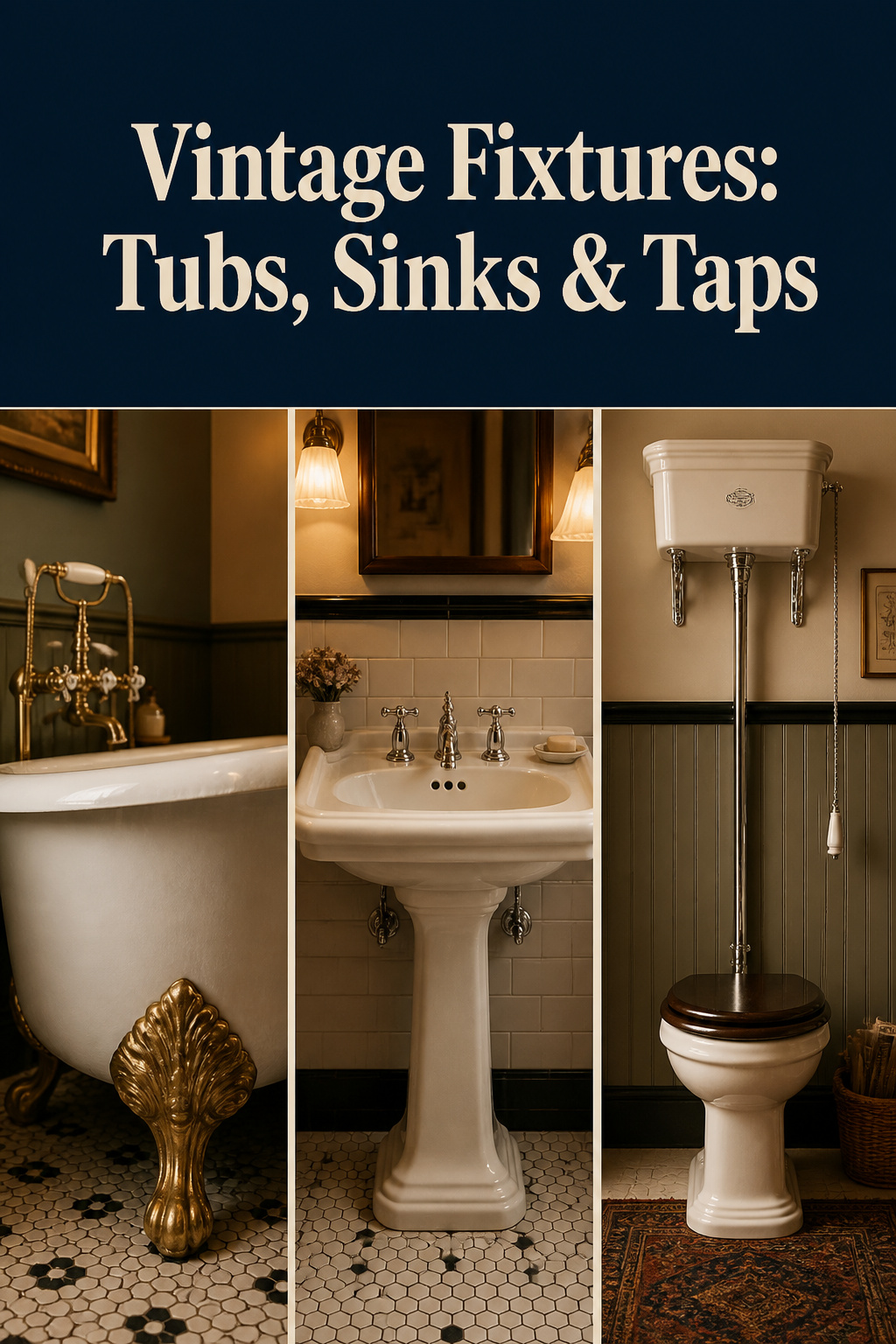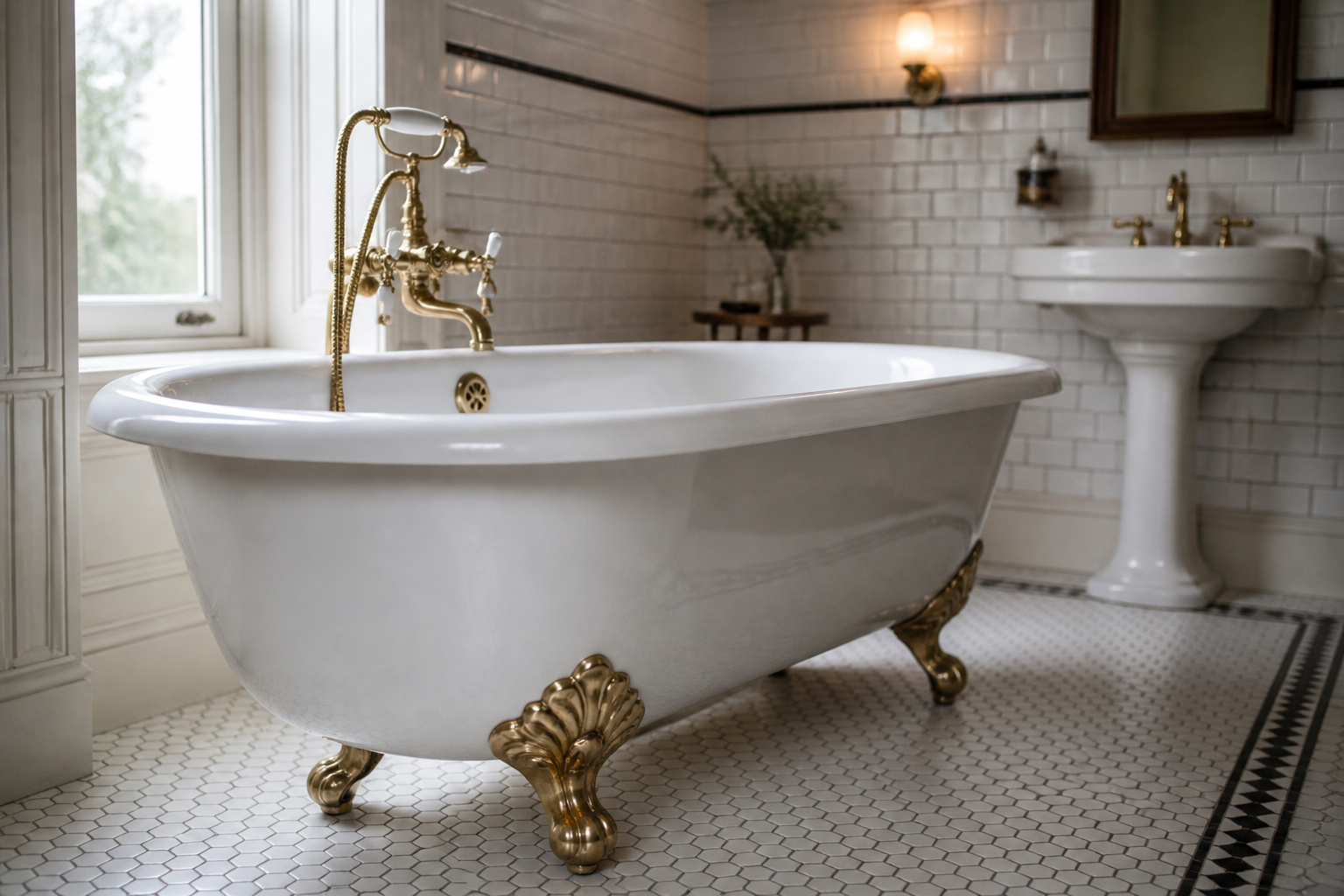

The Victorian bathroom was a manifesto before it was a room. The sanitary reform movement of the 1890s and 1910s rejected the wood-encased washstand as a bacterial hiding place and celebrated vitreous china, exposed legs and visible plumbing as proof that nothing was concealed. The clawfoot tub stood at the room’s centre as a display of status; the pedestal sink showed its supply lines on purpose. Choose your fixtures with that history in mind, and the rest of the room has something true to answer to.
TL;DR
- A genuine cast-iron clawfoot weighs 350–450 lbs empty (originals up to 500 lbs); acrylic reproductions weigh 75–120 lbs, which removes the floor-loading question for most homes.
- Finish and foot style date the room: claw-and-ball feet with polished brass or nickel read Victorian/Edwardian, while chrome reads 1920s–1940s — so chrome on a claw-and-ball tub mismatches the decades by 30–40 years.
- Refinishing an original costs $300–$650 (spray) or $800–$1,400 (factory re-enamel); salvage tubs run $500–$2,000, and roughly a third need $200–$400 in valve work first.
Why the Right Fixture Is the Most Important Period Decision You Will Make
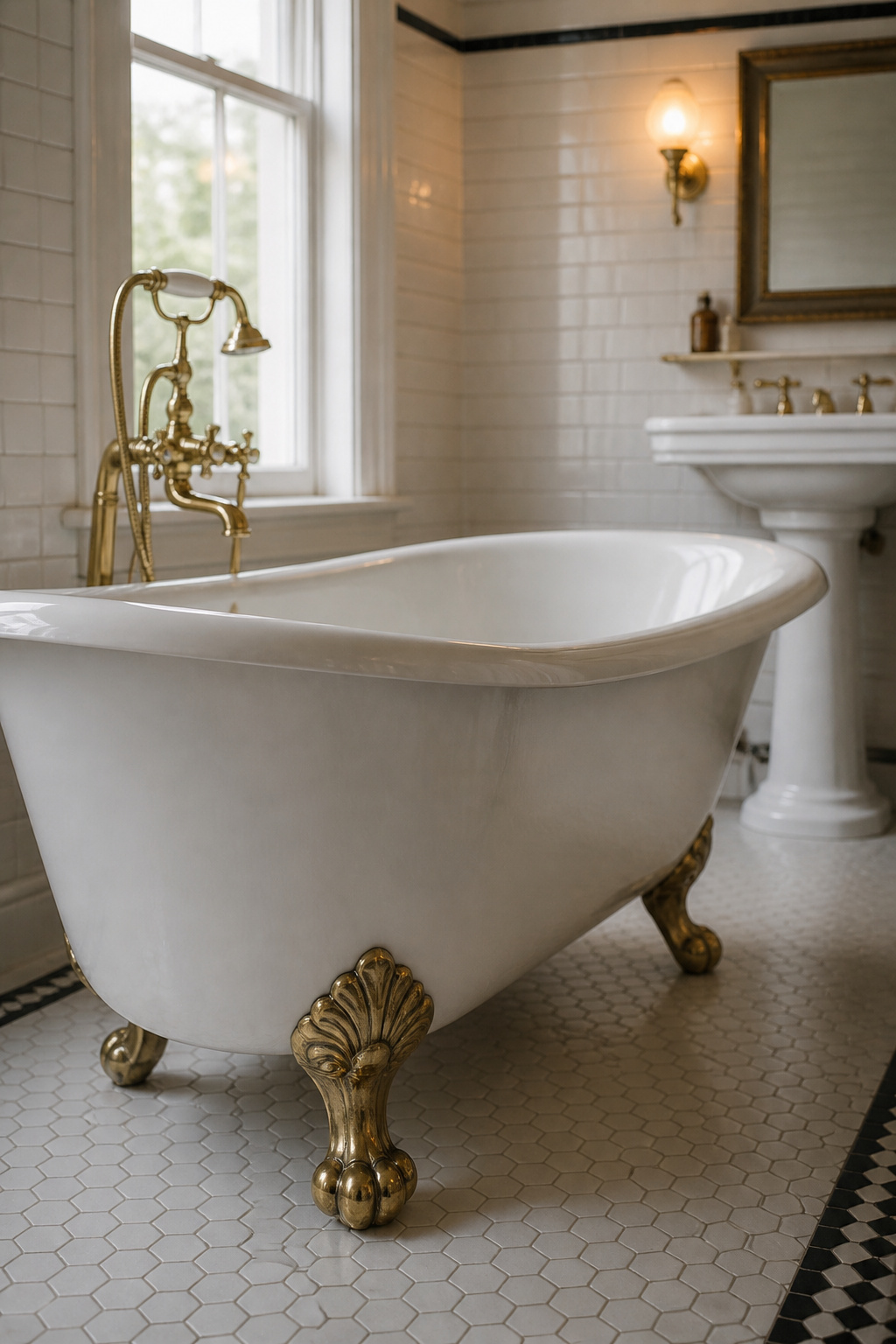
Fixtures carry more history than any other surface in the room. The tile, paint and accessories all fall into place once they are right.
The clawfoot tub’s origins: 18th-century furniture legs on a Victorian cast-iron basin
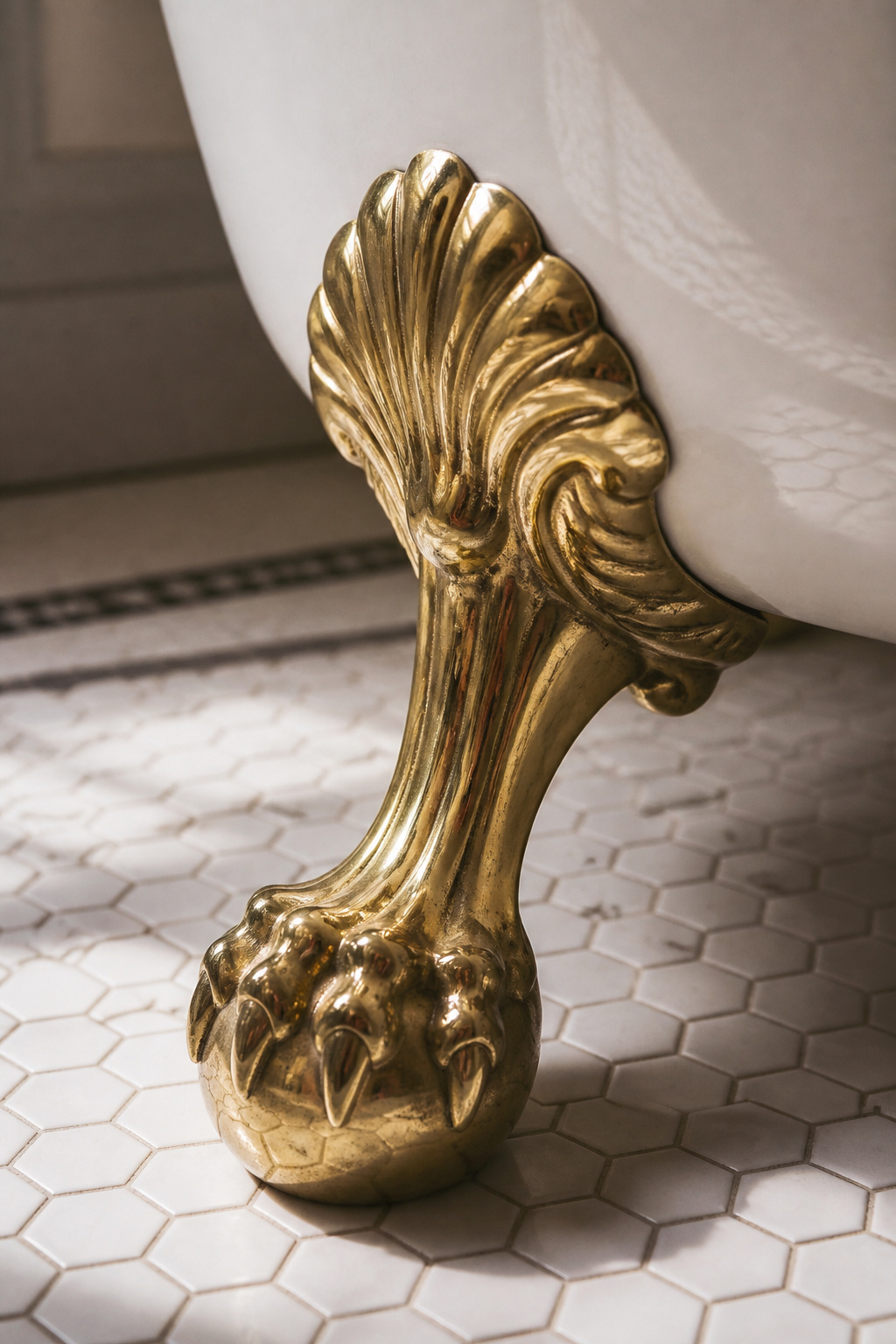
The claw-and-ball foot is older than the bathtub it props up. The motif — a dragon’s talon grasping a sacred pearl — entered English furniture design around 1710, peaked under George I (1714–1727), and was revived in cast brass for mass-produced cast-iron tubs whose heyday ran from roughly 1885 to 1930. As Fine Woodworking notes, the foot is “often mistakenly considered an invention of Thomas Chippendale” — on a Victorian tub, it is a deliberate period revival.
How plumbing reform in the 1890s–1910s created the pedestal sink and high-tank toilet
Mains water reached most UK towns in the 1860s and 1870s, and fixed sanitaryware followed. The pedestal sink was a deliberate move away from washstands hidden inside furniture. Vitreous china became the preferred material by the 1890s because its glassy surface wiped clean, unlike the wood-encased fixtures that had harboured bacteria.
The fixture as period anchor — everything else reads against it
The clawfoot tub and pedestal sink are the two most recognisable period signals; everything else reads against them. A modern undermount sink inside a 1920s-tiled bathroom looks half-finished, not eclectic. For the wider picture — tile, colour and walls — the vintage bathroom decor overview is the right starting point.
Clawfoot Tubs: Cast Iron Versus Acrylic and What It Costs to Live With Each
The cast-iron-versus-acrylic question decides authenticity, weight, heat and budget at once, as the table shows.
| Attribute | Cast iron | Acrylic |
|---|---|---|
| Weight empty | 350–450 lbs (originals up to 500 lbs) | 75–120 lbs |
| Refinishing | Spray $300–$650; re-enamel $800–$1,400 | Cannot re-enamel; colour runs through |
| Cost | Salvage $500–$2,000; new repro $1,500–$3,000+ | $750–$1,100 new |
| Lifespan | Century-plus; enamel chips, iron never fatigues | Long, but can warp without shower bracing |
| Authenticity | Genuine — solid feet, hand-finished enamel | Gap at close range — hollow resin feet |
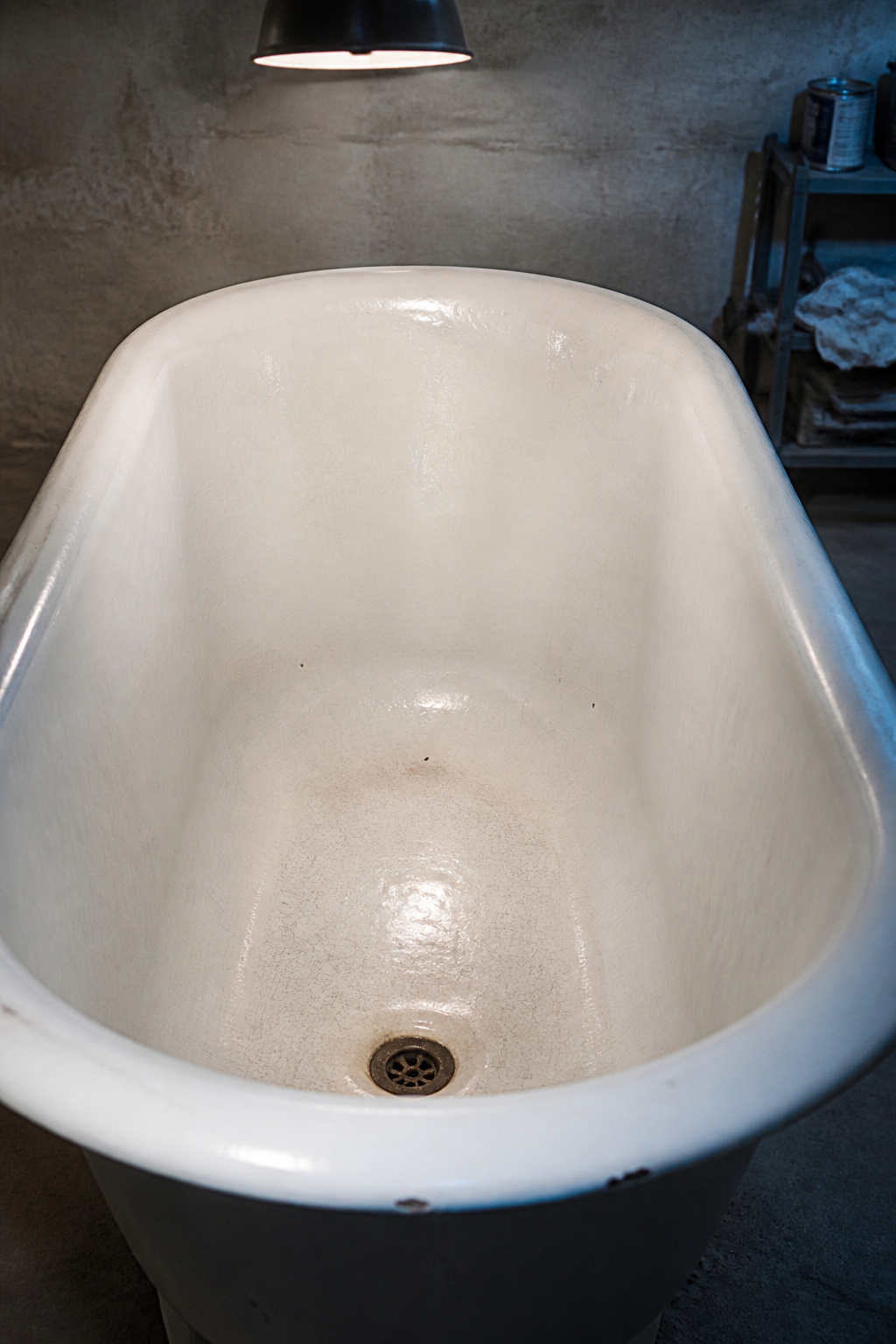
Original cast-iron clawfoot tubs: weight, refinishing, and where to source them
A standard 60-inch cast-iron clawfoot weighs 350–450 lbs empty; originals using 6–8mm iron can reach 500 lbs. Filled with water and a bather, the load tops 1,100 lbs on four small feet — for pre-1960 homes or second-floor installs, have a structural engineer assess the joists first. As Miracle Method’s refinishers note, the enamel “chips but never delaminates from the iron beneath it,” so a sound original can serve another century.
Acrylic reproductions: what they get right and where they fall short
Acrylic clawfoot tubs weigh 75–120 lbs — roughly a quarter of cast iron — erasing the floor-loading concern for most modern construction. Colour runs through the material, so chips never expose bare metal. The trade-off is heat: as reference guidance from trade sources suggests, cast iron holds warmth significantly longer, though a vacuum-formed tub with an insulation layer narrows the gap.
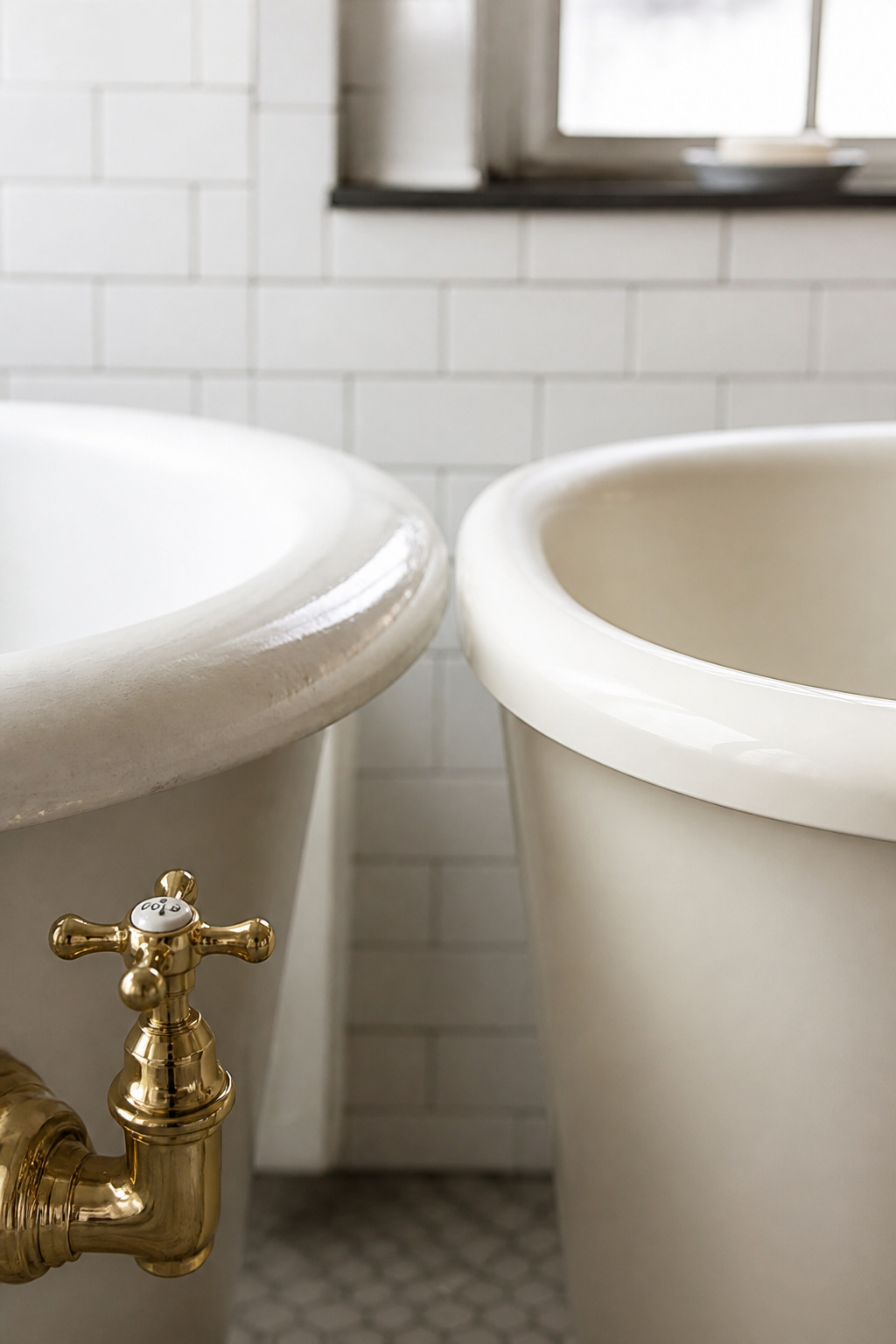
Claw-and-ball versus simple bun feet: the detail that dates the tub to the right decade
The foot dates the room. Claw-and-ball in brass reads Victorian–Edwardian (1880s–1910s); bun feet — a rounded ball with no talon — read inter-war (1920s–1930s). The common error: chrome feet on a claw-and-ball tub. Chrome is a late-1920s–1940s finish; polished brass or nickel is the period-correct choice.
Pedestal and Console Sinks: The Case for Each
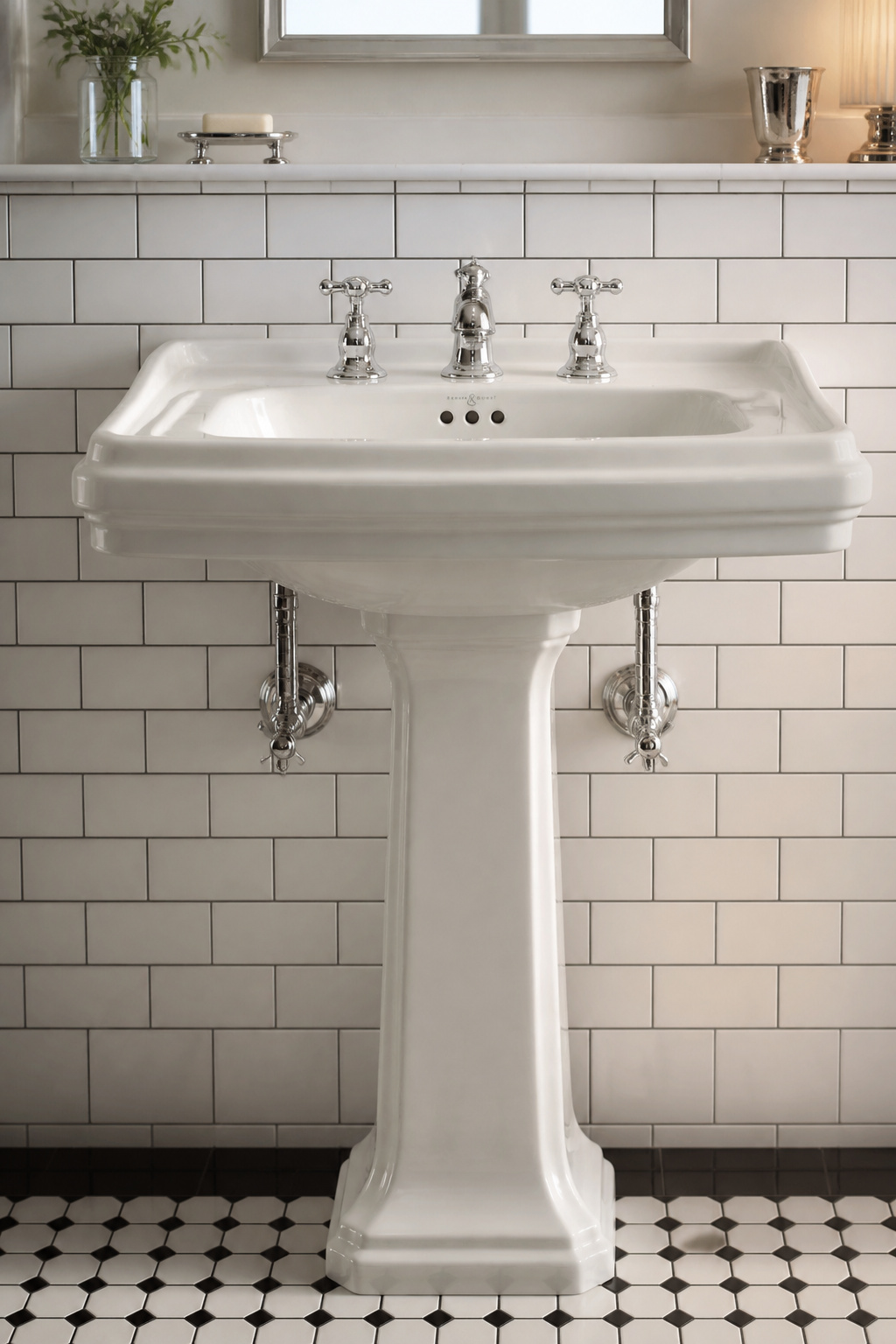
Both sinks eliminate under-sink cabinetry and put the plumbing on show. The difference between them is era and storage.
The wall-mounted pedestal: why its exposed plumbing is a period feature, not a flaw
Concealed pipes were considered unhygienic — leaks could not be spotted — so the pedestal’s exposed legs and supply lines were a deliberate display of cleanliness. As Brownstoner notes, the porcelain pedestal “would have been deemed very modern at the time.” To keep that read, the exposed P-trap must be polished brass or chrome; a plastic trap breaks it instantly.
Console sinks: four-legged, more storage-friendly, a slightly later period feel
A console sink rests on four legs — often spindle-turned china or metal — like a small table, and reads Edwardian to inter-war (1900s–1930s) rather than pure Victorian. Its basin runs wider than a pedestal’s, around 33–36 inches, giving a small shelf at each end without a vanity cabinet.
What period basin sizes actually were — and the UPC-compliant versions that match
Period basins ran roughly 18–22 inches across in the 1890s–1910s — treat these as period reference, since firm catalogue dimensions are scarce. Modern reproductions from makers like Thomas Crapper copy Victorian originals from company archives. Once the sink is set, see the period tile to match the basin.
Period-Style Toilets: High Tank, Low Tank and the Choices That Matter
The toilet dates a bathroom most precisely — choose the wrong tank height and the room slips a generation.
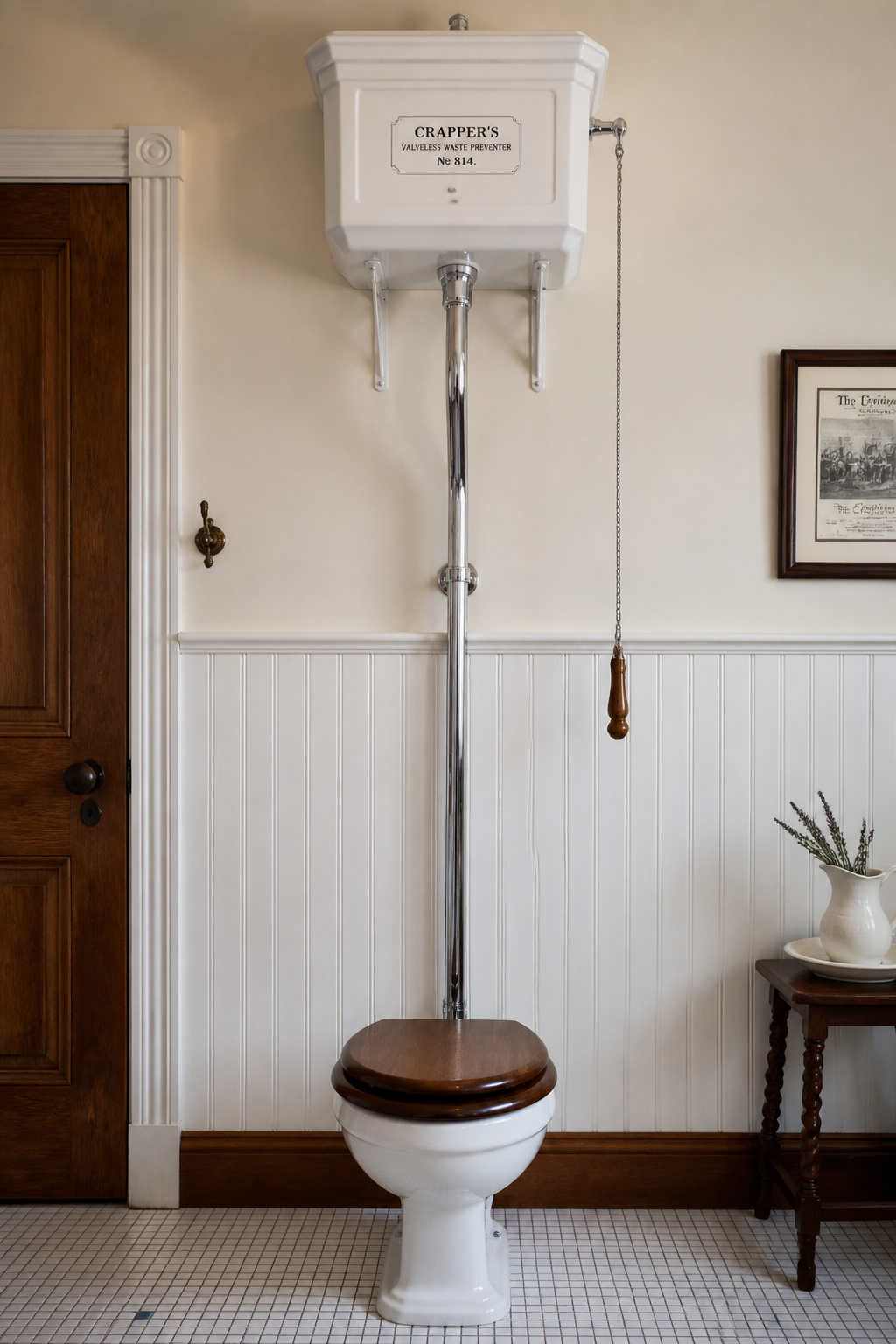
High-tank (pull-chain) toilets: the Victorian original and modern reproductions
Early high-tank toilets mounted the cistern 6–7 feet above the bowl so gravity supplied flush pressure. The authenticity tell: a genuine antique has its flush arm on top of the tank; reproductions put the lever on the front. As DEA Bathroom Machineries advises, “a flush lever on the front of the tank is the immediate sign of a reproduction.”
Low-tank close-coupled toilets: the Edwardian and inter-war compromise
Once the siphonic-jet flush arrived in the 1890s, the gravity tank was no longer needed; the close-coupled low tank took over. Treat the high-to-low transition as period reference, not a hard rule — sources point to the 1890s without a single authoritative year. A round-bowl, wooden-seat, chrome-lever close-coupled reads Edwardian to 1930s; a square bowl with a push-button reads 1950s–60s.
Water efficiency in reproduction period toilets: what the specs actually are
Modern reproductions meet the 1.6 GPF federal maximum; WaterSense-certified models reach 1.28 GPF. The tall pull-chain tank is no exception: its long pipe run builds velocity that flushes strongly at the lower figure.
Cross-Handle Taps and Shower Fittings: What Authentic Hardware Looks Like
After the tub and sink, nothing signals the decade faster than the taps: handle shape names the era, and finish narrows it down.
Cross-handle versus lever: why the handle shape is a period signal
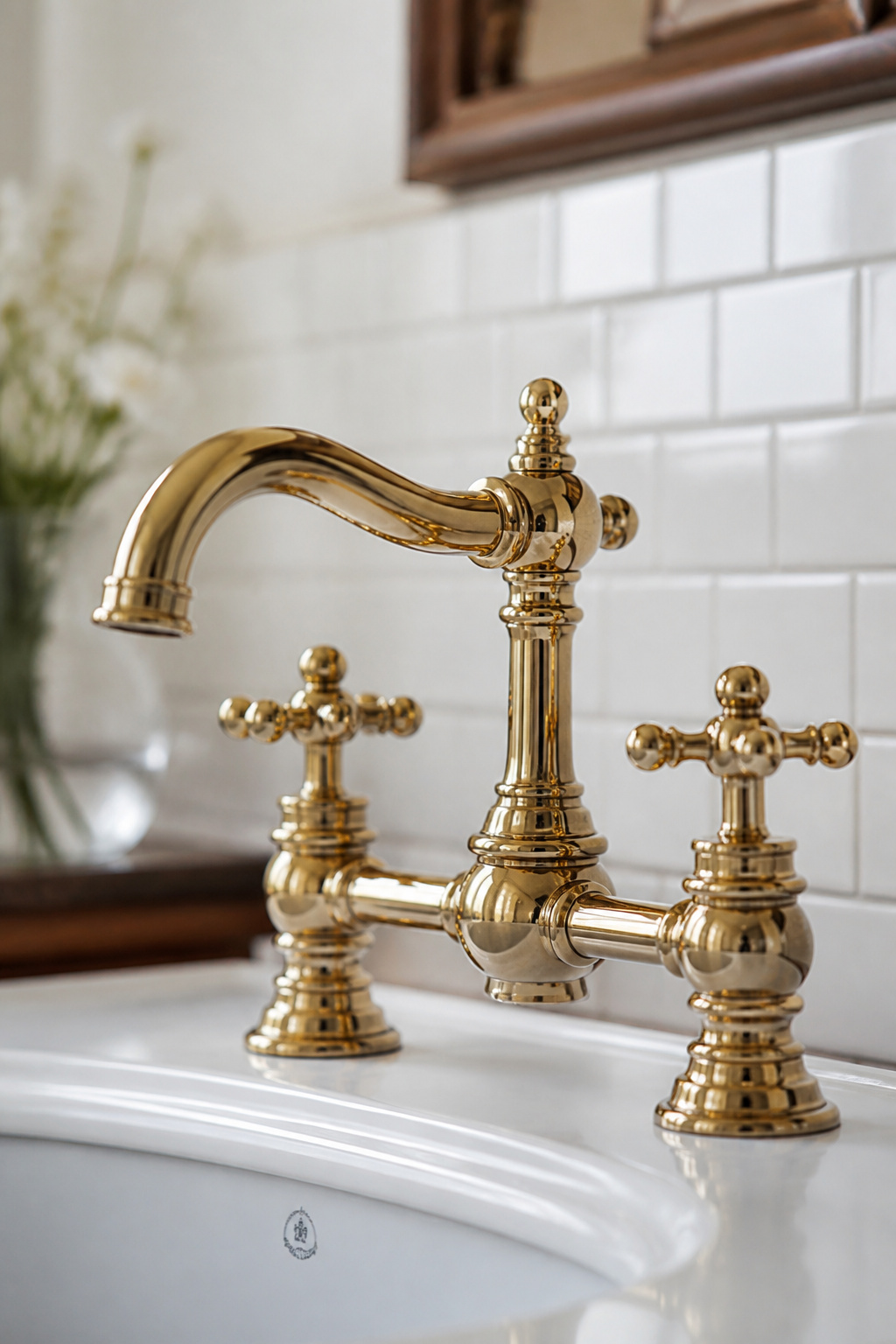
Cross handles — four-spoke, turned from brass — were universal through the Victorian and Edwardian eras; the single-lever mixer is post-1950s. For a pedestal or console, the period-authentic choice is a bridge faucet, where an exposed pipe connects the two supply stems above the basin. Choose heavy turned cross arms over thin die-cast ones: the spoke depth is the visual signal of quality, whatever the finish.
Finish choices — chrome, polished brass, unlacquered brass — and the decade each reads as
Finish is the decade lock — the table matches the three primary options to era and upkeep.
| Finish | Era | Upkeep |
|---|---|---|
| Polished brass | Victorian–Edwardian (1880s–1910s) | Lacquered stays bright; wipe dry |
| Polished nickel | Victorian to Art Deco (1900s–1930s) | Duller sheen than chrome; shows water spots |
| Polished chrome | Inter-war (late 1920s–1940s) | Low-fuss; too modern for Victorian |
Unlacquered brass is the fourth option: raw brass that warms to honey in the first year and deepens to golden-brown by year three. Because finish ties to the room’s wider scheme, coordinate taps with the period colours for fixtures you plan to run.
Shower risers and telephone handshowers: the period alternatives to the modern rain head
The period shower for a clawfoot is a telephone handshower on an exposed riser pipe, used from the Edwardian era onward. Complete kits from Barclay (making these since 1933), Randolph Morris and Cheviot bundle the faucet, riser, showerhead, handheld and curtain ring. The firm rule: every visible piece must match the tub faucet finish — a brass faucet with a chrome riser is one of the most common errors.
Sourcing Vintage Bathroom Fixtures: Salvage, Reproduction and the Line Between
Sourcing is a three-way choice: genuine salvage, specialist reproduction, or mass-market reproduction — each a different balance of authenticity, cost and risk.
Salvage yards and estate clearances: what to inspect before buying a second-hand tub
Before buying a salvage clawfoot, run the checklist:
- Enamel condition — chips are refinishable; cracks reaching the iron are not.
- Foot integrity — check for hairline cracks at the foot mounting points.
- Drain thread — rusted or stripped threads need replacement fittings.
- Overflow condition — original brass overflow assemblies usually clean up.
- Rust bleed — surface rust below chipped enamel is normal; deep pitting is not.
A salvage clawfoot in good condition runs $500–$2,000, plus $400–$800 for replumbing — and budget honestly, since roughly a third need $200–$400 in valve work first.
Specialist reproduction suppliers: casting quality and finish durability
When a reproduction makes more sense, specialists such as Thomas Crapper, DEA Bathroom Machineries and Vintage Tub & Bath offer correct proportions that big-box suppliers cannot match. On a cast-iron reproduction, ask about wall thickness (4–5mm minimum; thinner casts vibrate), foot attachment (bolted beats threaded post) and enamel grade.
Refinishing original cast iron versus replacement
Spray-on refinishing costs $300–$650 and lasts 10–15 years; factory re-enamelling — sandblasted and kiln-baked at 1,475°F — costs $800–$1,400 and lasts 20–30 years. Replace when chips cover more than 30 percent of the interior or the iron shows deep pitting. Otherwise, a refinished original offers the one thing reproduction cannot — genuine material continuity.
Three rules hold this together: choose the fixture first; match finish to decade; and when you find a sound original, refinish it rather than buy new. The three errors to avoid: a plastic P-trap, chrome hardware on a Victorian tub, and a salvage buy made without the inspection.
FAQ
How heavy is a cast iron clawfoot tub and can a standard bathroom floor support it?
A standard 60-inch cast-iron clawfoot weighs 350–450 lbs empty, and Victorian originals reach 500 lbs. Filled, with a bather, the load tops 1,100 lbs on four small feet, so for pre-1960 homes or second-floor installs, get a structural assessment first. Acrylic tubs at 75–120 lbs avoid the concern entirely.
Can you put a shower over a clawfoot tub without ruining the period look?
Yes. The period-authentic solution is a telephone handshower on an exposed riser with a circular curtain ring, all matching the tub faucet finish — polished brass for Victorian, chrome for inter-war. Complete kits from Barclay, Randolph Morris and Cheviot run $300–$700. A ceiling rain head, by contrast, reads as a modern choice rather than a restoration one.
How do I know if a second-hand clawfoot tub can be refinished or should be replaced?
Refinishing works when chips affect under 30 percent of the enamel interior and the iron shows only surface rust, not deep pitting. Check the drain thread and overflow first, since stripped threads add $200–$400. Replace instead when the enamel is cracked in several places, the iron is deeply pitted, or the foot mounts show hairline cracks.