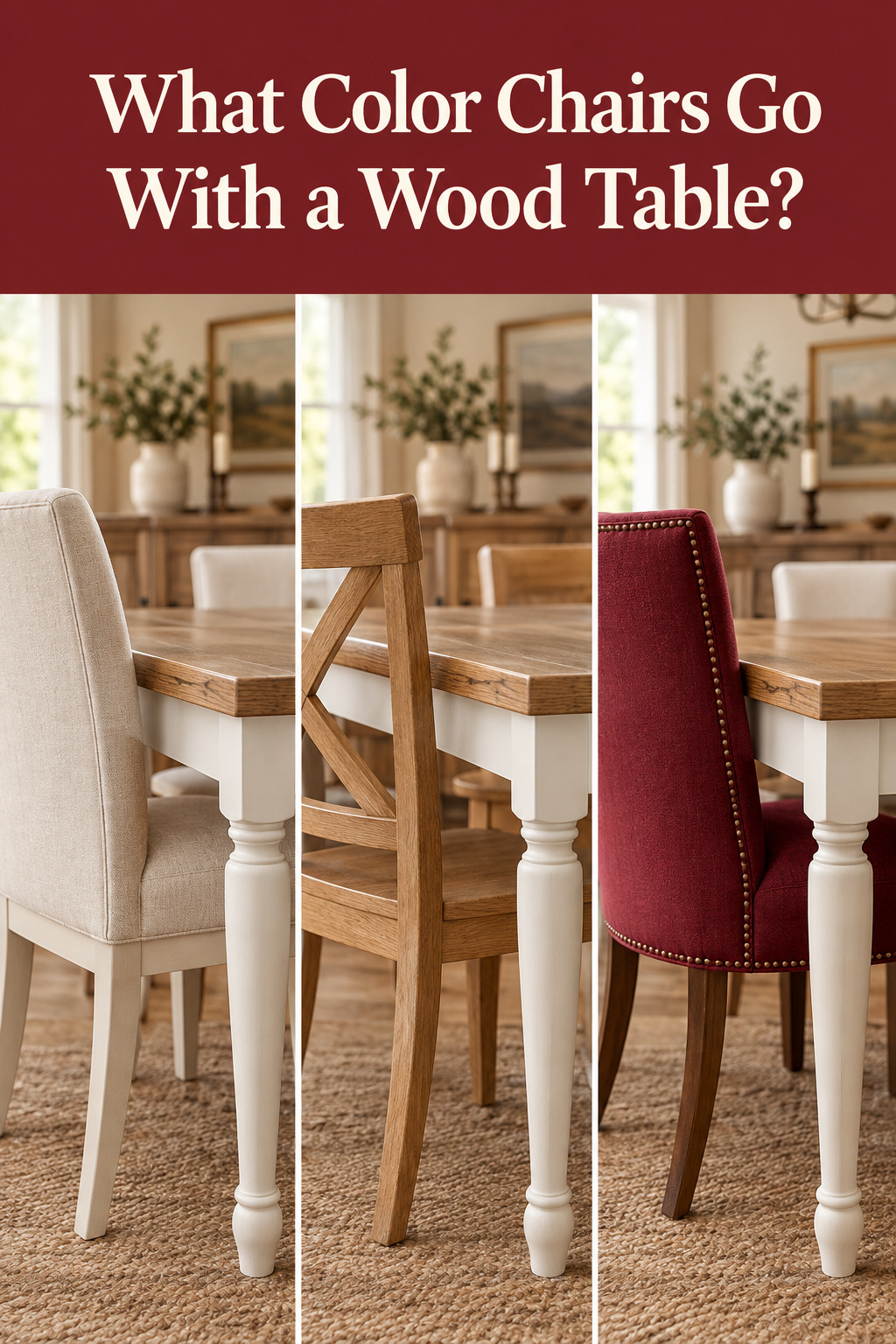

There is no rule for this. No standard, no code, no manufacturer’s sheet says what color chairs go with a wood table, and none says it for a table that already wears two colors. What exists are conventions from working designers, and that absence is good news. The question is not “what is correct” but “what does this room need to settle,” and a two-tone table has already answered half of it. The chairs are completing a relationship between two colors that is already there.
TL;DR
- Echoing the base is the calmest choice. Painted or upholstered chairs that clearly repeat the base color borrow a color the room has already accepted. The risk is a near-miss shade, which looks like an accident.
- Wood chairs should agree with the top’s undertone, not its species. Warm with warm, cool with cool, and count the chairs as one of no more than three wood tones in the room.
- A third color works as an accent, not a set. Two chairs at the head and foot, in a color genuinely new to the table, look decided; a color halfway between the two table tones looks like a compromise.
What Color Chairs Go With a Wood Table? Why Two Tones Change the Question
A room with the wrong chairs feels unfinished before you can say why. Table and chairs are each fine alone, and together something hums.
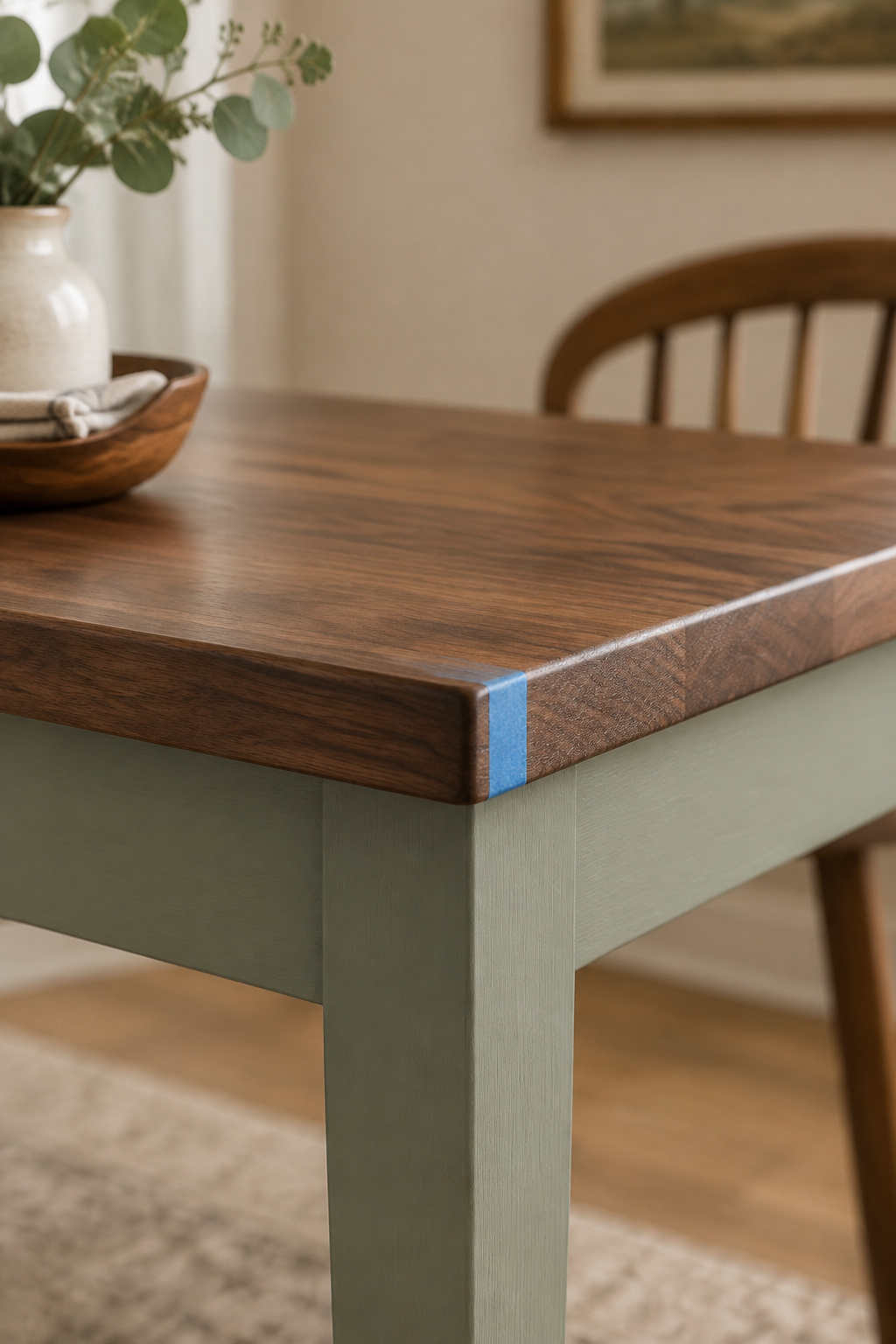
A two-tone table has already made a contrast of its own, a wood top over a painted base, and it quietly asks the chairs to take a side. Pick a chair that relates to neither half and three unrelated tones pull at the eye. Pick one that relates to one half on purpose and the whole thing settles.
The designers who write about this lean away from matching altogether. Birdie Fortescue, writing for Homes & Gardens, advises against matching table and chairs at all, arguing that contrasting finishes tie the scheme together. Zin Home calls matching “one option, not a rule,” and notes that a chair’s repeated shape creates order even when its finish differs. They are conventions, not laws, and they agree on what matters. The chairs are the third tone in the room, not a copy of the first.
I have a habit I call the doorway test. When a room is finished, I stand at the threshold and notice where my eye lands first. If it lands on something that asks something of me, the room is not done. Around a two-tone table, the eye should land on the table, on the top or on the line where top meets base. When it goes to the chairs first, they are asking a question the room has not answered.
Tonight, stand in your dining room doorway and notice, before you think, where your eye goes.
Echoing the Base: The Safest Two Tone Chair Pairing
Why is the base the safest place to start? The room has already accepted that color, and repeating it asks nothing new of anyone.
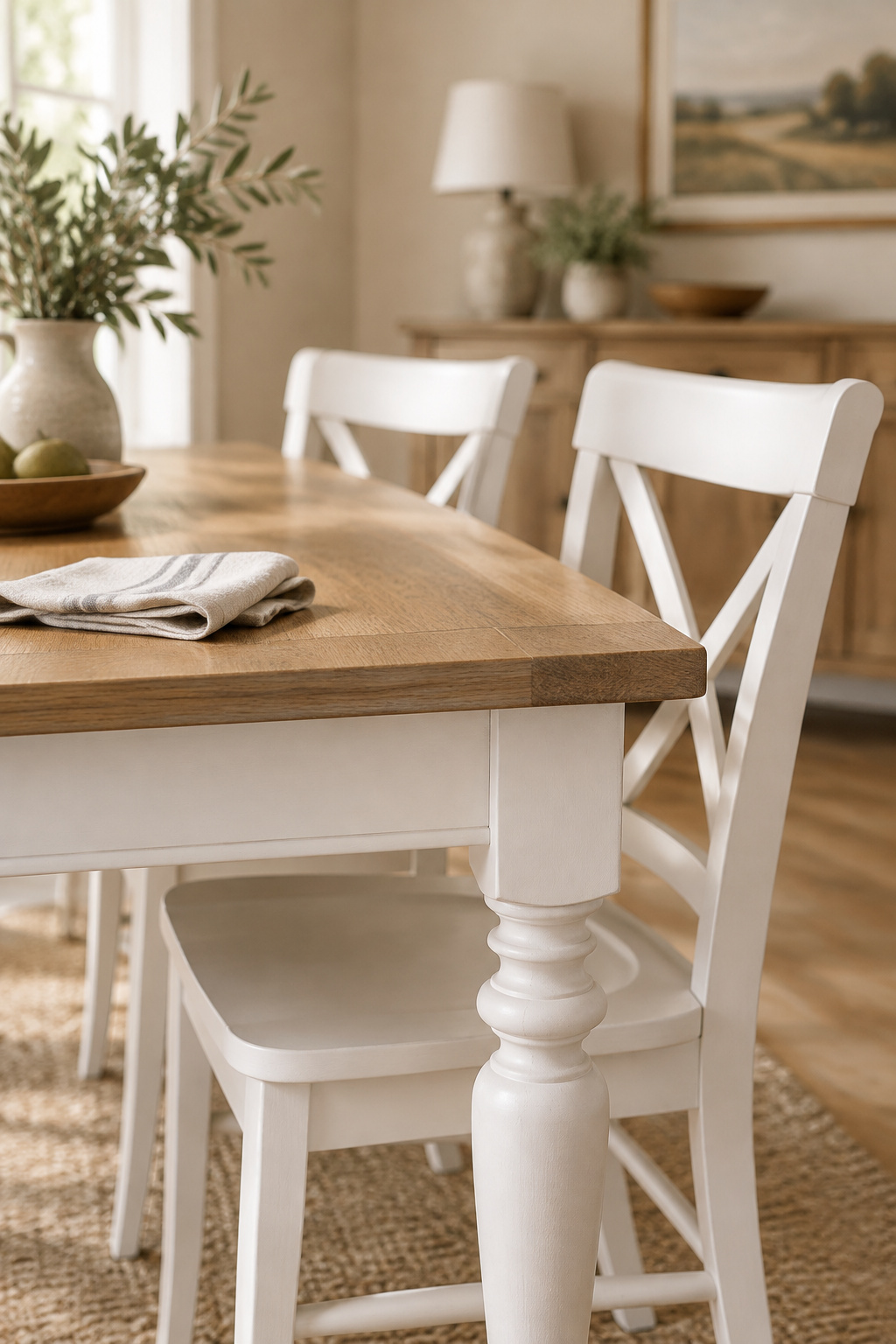
Designer Valentina Cirasola’s approach to painted furniture is to take one or two colors from the piece and use them as the room’s scheme. Here, that means pulling the base color straight into the chairs, either the same paint or upholstery in the same color family. If you have not settled the table itself yet, that decision belongs to the article on the base color you land on, and the chairs follow it.
The trap is approximation. Zin Home warns that finishes “almost identical but not quite the same” look like a mistake rather than a match. An echo has to be a clear repeat, never a guess from memory.
Fabric carries one extra caution. Two materials that match under one light can drift apart under another, an effect called metamerism, and paint against dyed textile is exactly where it shows.
This pairing can also go flat. A pale base repeated perfectly in pale chairs lets the lower half of the room blur into one soft mass. That may be the stillness you want, or it may feel like nothing is happening.
Before you buy, hold the fabric or paint chip against the base in your own room, once in daylight and once after dark.
Echoing the Top: Letting Wood Chairs Carry the Room
Late morning light across an oiled top, a wood chair pulled in beside it, the same warmth in both grains. When this works, the room feels grounded.
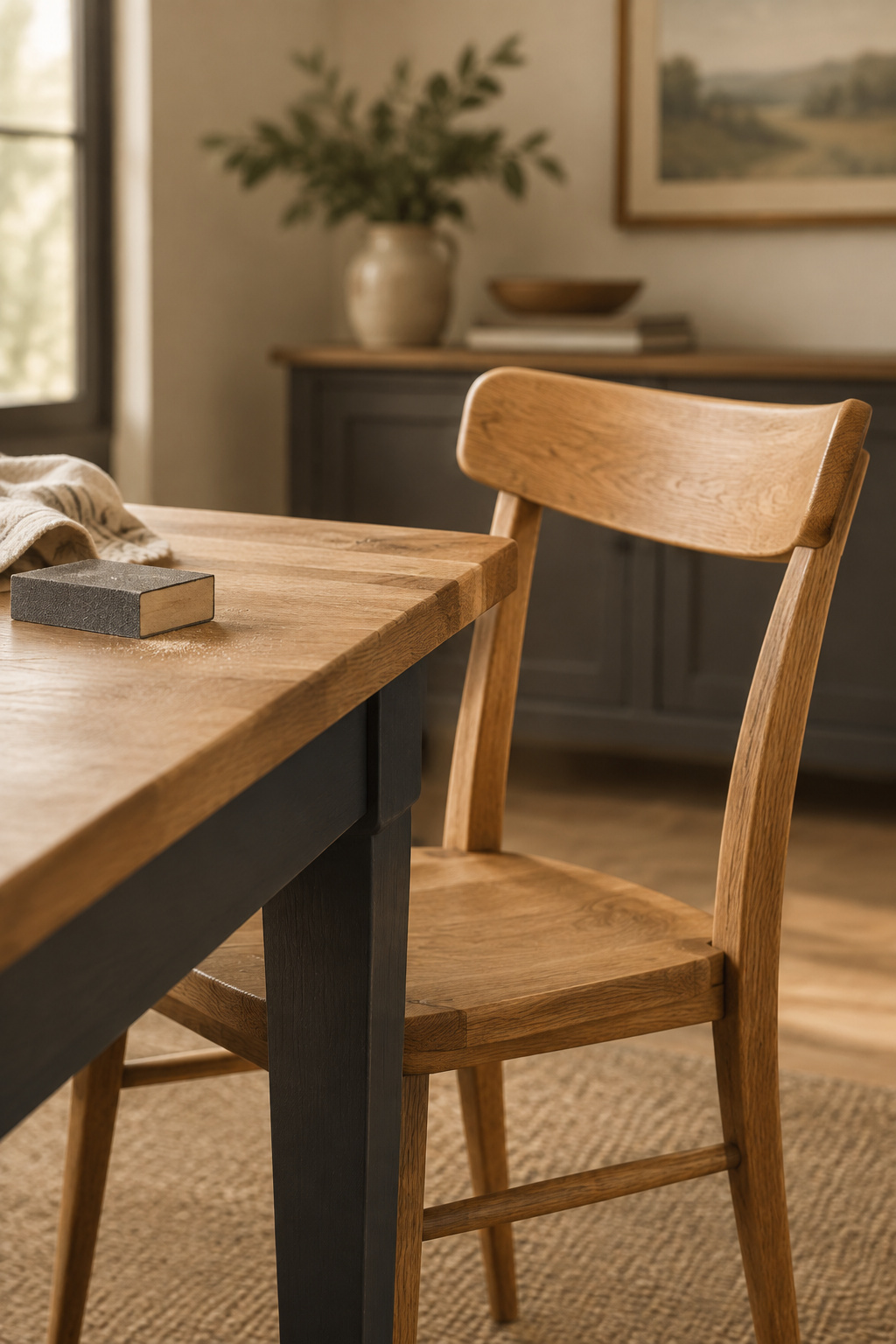
The deciding factor is undertone, not species. Edward Martin’s framework pairs warm woods such as cherry and walnut with earthy, inviting shades, and cool woods such as maple and birch with charcoal, navy or steel. A chair can be any species as long as it shares your top’s temperature. The quiet failure is a chair close in depth but opposite in undertone — a gray-toned chair against a honey top — which looks like a near-miss.
Then count. Designer Susann Goerg’s personal rule is two, maximum three, wood tones in a space, and Houzz and other outlets have repeated the rule of three for over a decade: a base, a contrast and an accent, in one undertone family. On a two-tone table the top is one tone and wood chairs are a second, which leaves one tone of headroom for the floor, the sideboard and everything else. If your floor is already a different wood, the chairs may be the tone the room cannot afford.
Count the distinct wood tones visible from your doorway before a wood chair comes home.
When a Third Color Earns Its Place
The usual mistake with a third color is a timid chair, not a bold one.
What a Third Color Needs to Succeed
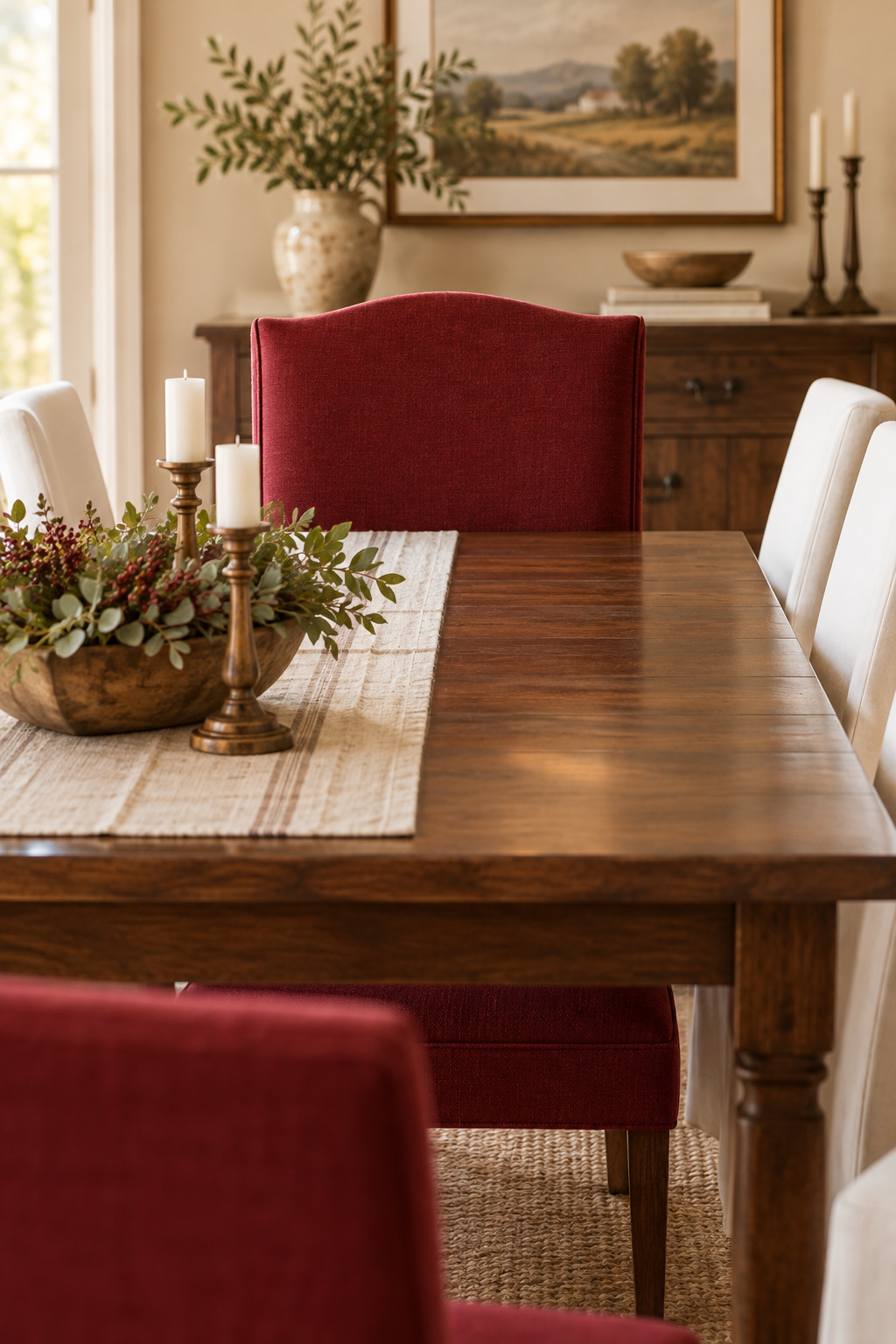
A third color succeeds when it is clearly new. Cirasola’s method is to choose one color that does not exist in the painted piece at all, such as a cranberry, a deep navy or an emerald, and let it be the accent. Edward Martin suggests neutral chairs with a pair of bold ones at the head and foot: two chairs, not six. An accent is punctuation, and a sentence made only of punctuation says nothing.
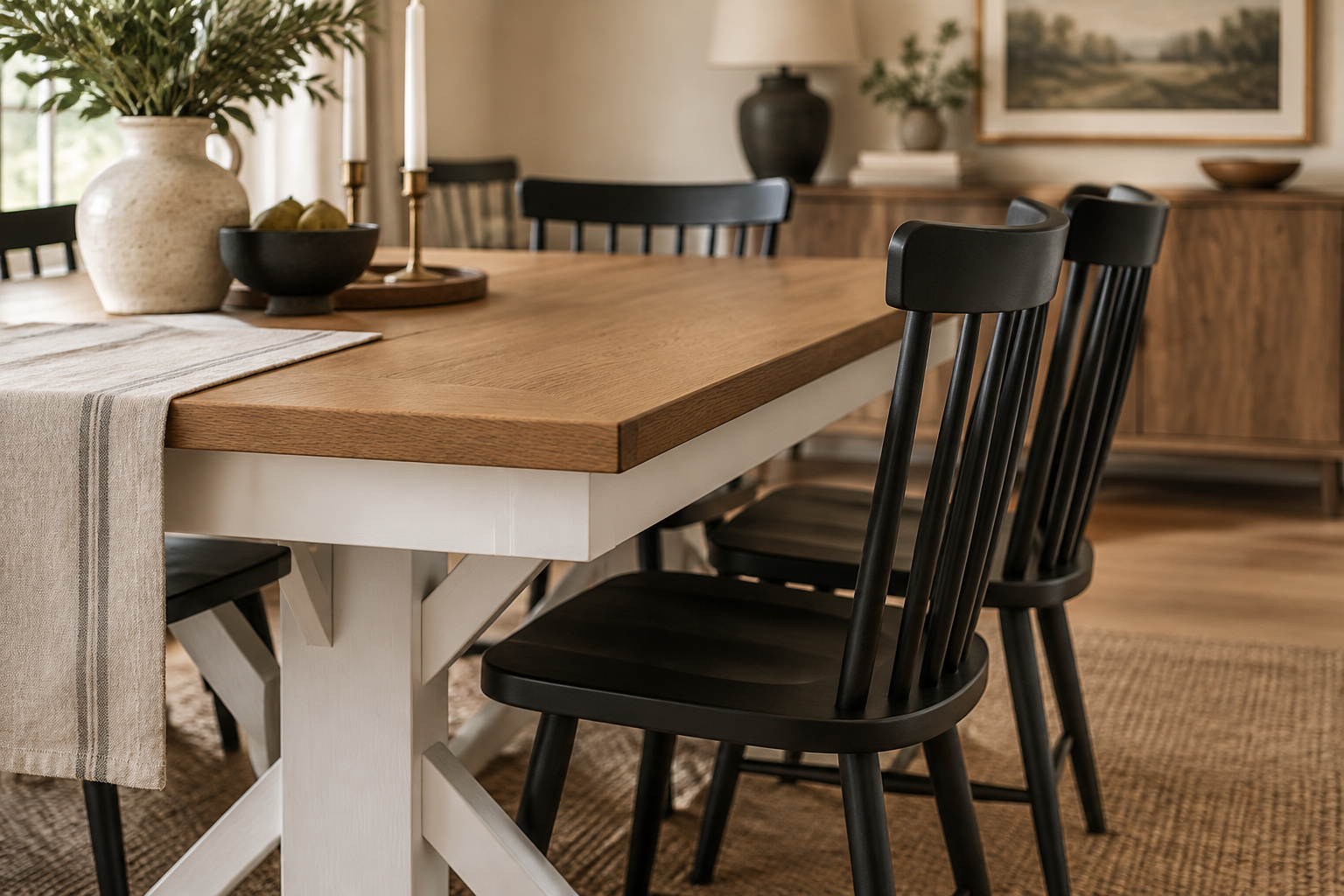
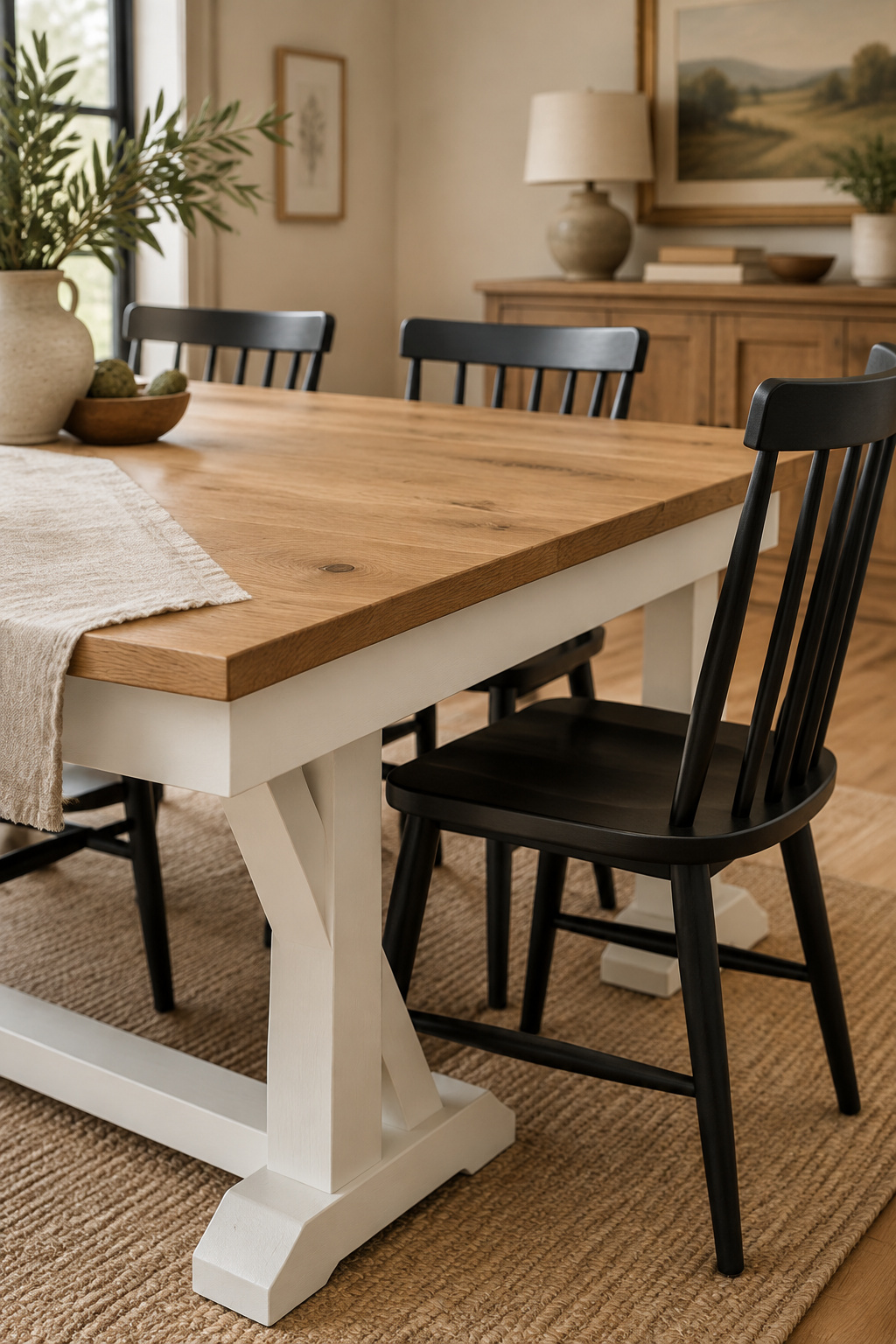
Black is the third color most people reach for, and it can be right. In a light room, around a lighter table, black chairs add contrast without taking the air out of the space. In a room already dim, the same chairs pull everything downward.
Where This Goes Wrong
A third color fails when it sits between the two tones it should stand apart from, like a muddy tan between an oak top and a cream base. The eye takes it as indecision, and indecision is restless to sit beside. Emily Henderson names a related failure: an odd chair that is neither a clear head-chair accent nor part of the matched set. Before adding a third color, remove:
- the near-match chair that is almost the base color
- the one accent chair with no partner at the other end
- any chair whose color competes with both table tones at once
No one has published a ratio for how many accent chairs a coordinated set can hold. Designers tend toward two accents against four to six matched chairs, which is a pattern and not a rule.
If you are drawn to a third color, choose one you can name in a single word.
Upholstered or Wood: How the Chair Material Shifts the Balance
Fabric softens; wood holds its edge. Henderson notes that a whole table of upholstered chairs, especially around a hefty trestle, can feel heavy or stuffy, and that lighter side chairs restore the balance. A solid painted trestle or pedestal base is already doing a lot of visual work.
| Upholstered seats | Wood seats | |
|---|---|---|
| How it sits beside the table | Softens the base; can crowd a heavy trestle | Repeats the top’s grain; can pile onto a wood-heavy room |
| Color flexibility | Wide: any echo or third color in fabric | Limited to wood tones or paint |
| Care | Harder to clean after spills | Mild soap and water |
| Wear | Wears with heavy use, pets and children | More durable, heavier to move |
Reversibility matters most for a colored scheme, and an upholstered seat can change color later. According to Angi, professional reupholstery runs $100–$550 per standard dining chair, or $210–$620 for curved or armed chairs, while materials for a do-it-yourself slip seat run $20–$100 per chair. It is a real sum across a set, and also a way back.
Two End Chairs in a Different Finish
The gentlest way to add contrast is to change only the two end chairs. Shea McGee of Studio McGee wants table and chairs to “speak together without being a set,” and treats an end-chair swap as a low-cost change. She cautions that if the end chairs have chunkier legs or arms, the side chairs should stay slim so the finishes do not compete. This is a finish change within one set, upholstered ends and wood sides. Mixing chair styles is a separate question.
Buying table and chairs together raises a question beneath the color, whether the table and chairs are solid wood or veneer, because that decides what recoloring the wood can take later. For the table’s own decisions, see the full two-tone table walkthrough.
You began by matching chairs to a table as if it were one color. Now you can say which half your chairs should echo, when a third color is a decision and not a compromise, and how many wood tones a room holds before it stops feeling calm. That part — where the eye lands, how much contrast a room can hold — is mine. The facts about fabrics, finishes and reupholstery costs come from the people who work with them, and on those I would trust them over me.
FAQ
Should dining chairs match the table base or the tabletop?
Either can work if the choice is deliberate. Echoing the base with painted or upholstered chairs is the calmest, lowest-risk pairing, and echoing the top with wood chairs lets the grain carry the room, provided the chairs share the top’s undertone. Designers treat it as a choice and not a fixed rule.
Can you mix wood tones between chairs and a two tone table?
Yes, within limits. The long-standing designer convention caps a room at three wood tones sharing one undertone family: a base, a contrast and an accent. Wood chairs against a two-tone table’s wood top count as one of those, which leaves one more for the floor and other furniture. Undertone matters more than species.
Do all the chairs around a two tone table need to match each other?
No. A common, low-risk approach keeps the side chairs matched and changes only the two end chairs, in a different finish, material or accent color. A single odd chair that belongs to neither the set nor a clear head-and-foot pair is what looks unplanned. Fully mixed sets are a separate styling question.