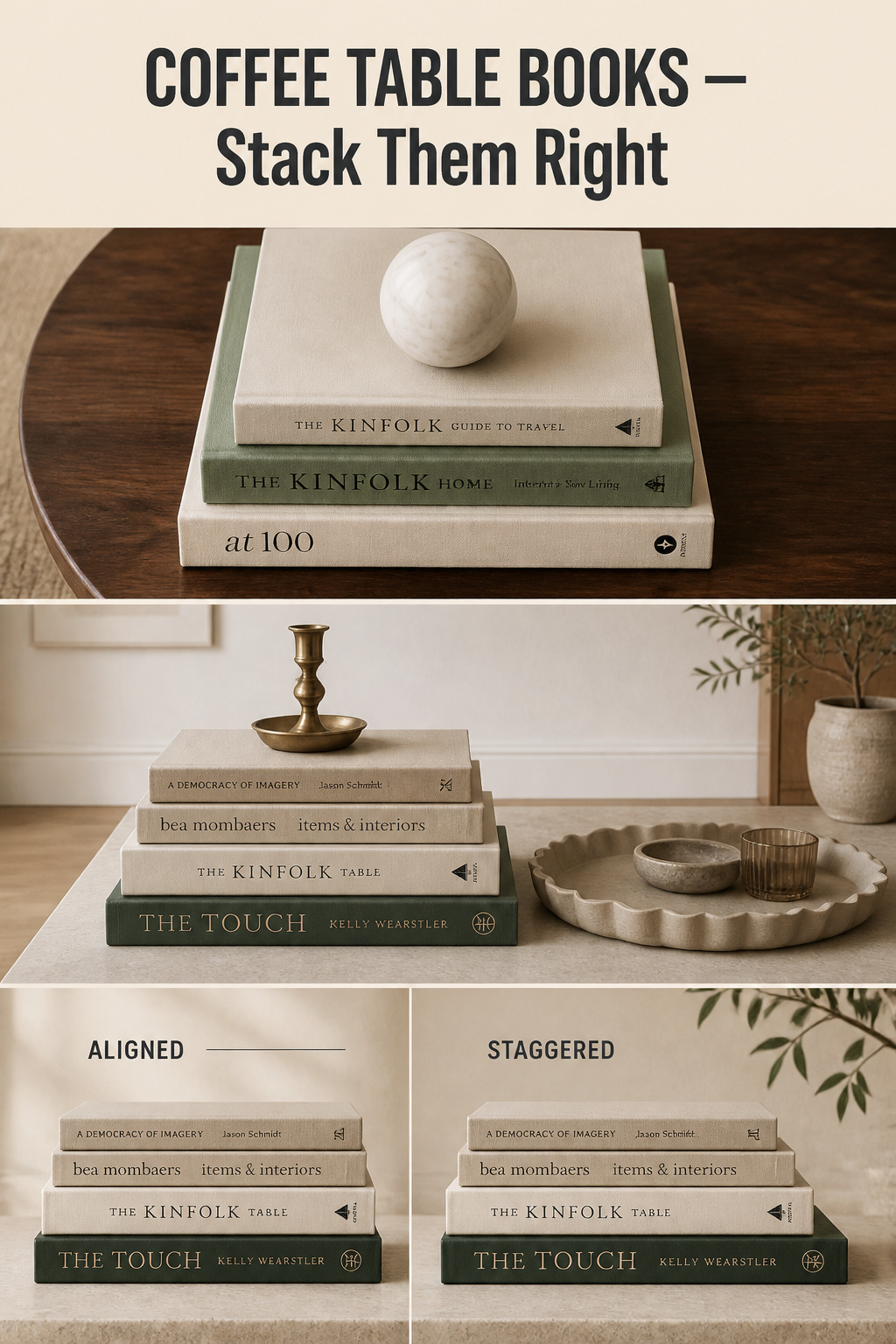
The stack of books on a coffee table is the oldest piece of interior styling we still practise without realising we inherited it. Long before the coffee table existed, English country houses arranged their principal rooms around circular central tables built to hold folio volumes where guests could see them. Coffee table books decor is that Georgian habit at smaller scale — and once you know the lineage, you choose and stack the books differently.
TL;DR
- Stack largest to smallest, heaviest book on the bottom, total height under 8 inches; a three-book stack (around 4 inches) suits most tables.
- Limit the stack to three dominant spine tones drawn from the room, and choose books across subjects you actually read — guests notice props.
- Use the stack as a riser for a candle or small object, leave 30 to 40 percent of the table clear, and face spines out so titles stay legible.
The Display Book Has Been a Styling Tool Since the Georgian Drawing Room
How folio volumes became social objects in eighteenth-century interiors
From the 1730s, the book room migrated out of private studies into the principal living rooms of English country houses; at Syon and Heveningham, libraries opened straight off the main drawing rooms. The architectural historian John Martin Robinson, writing in Country Life, describes these Regency rooms as furnished with “circular central tables on which to display folio books and albums of prints and engravings” — purpose-built social furniture, two centuries before Instagram. When landowners gathered libraries “just for the distinction of possession,” the visible book signalled status before anything read.
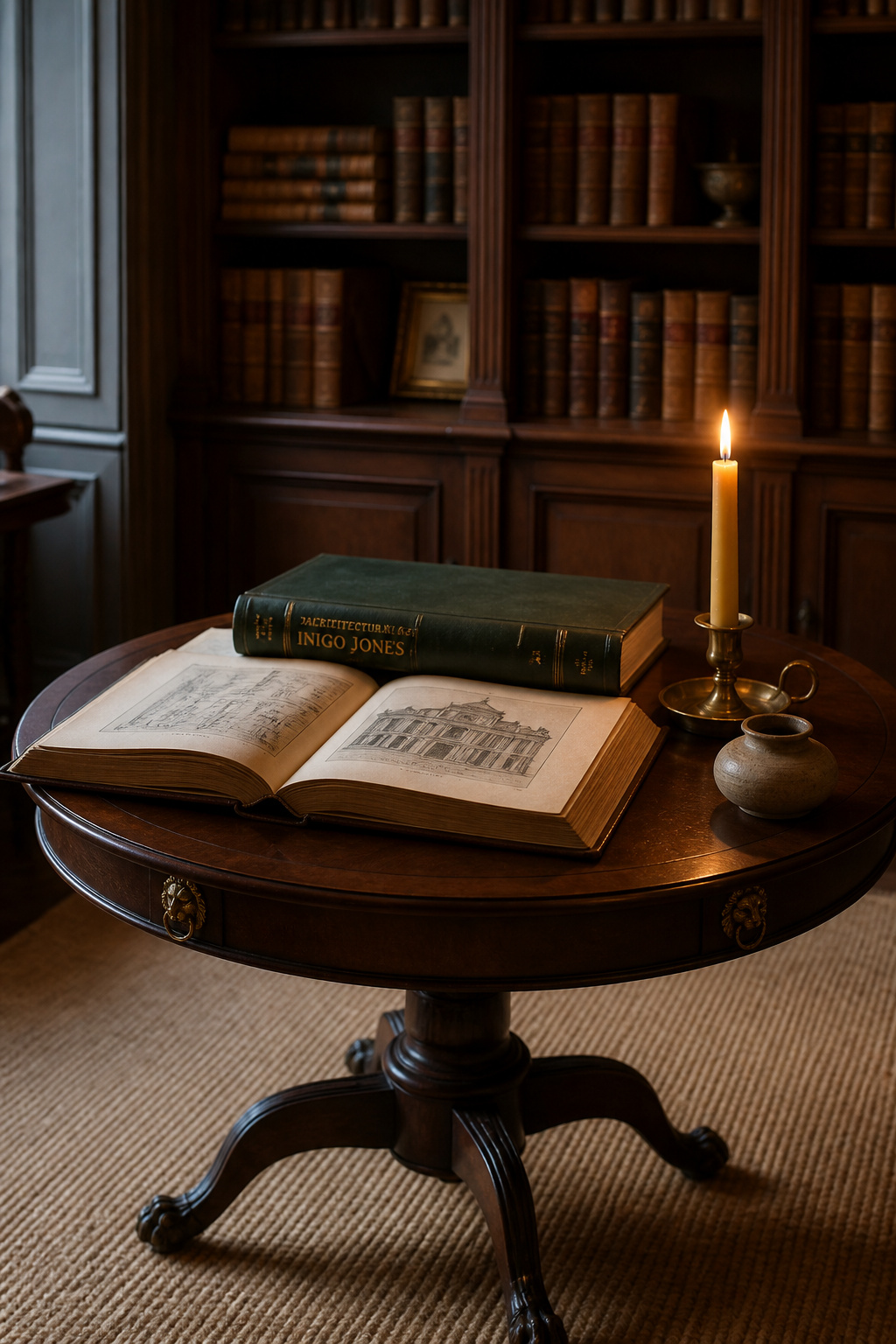
What that tradition means for how we choose and position books today
The function has barely moved. Lucy Searle, Editor in Chief of Homes & Gardens, calls the modern coffee table book “the post-pandemic equivalent of the curated video call background.” The Georgians also set the specification: displayed books were large, well-bound objects, and the modern book holds the same brief. That is why books are a fixture of coffee table styling, not an afterthought.
Why I draw a hard line between display books and books-as-props
Here I state a position rather than cite a study, because the trade is divided. Some stylists treat these books as pure colour and mass, “judged purely by cover, spine, size and colour.” I do not. A book bought sight-unseen from a designer bundle, on a subject no one in the house cares about, announces itself within a sentence of conversation — and conversation is exactly what the display book was invented to start. A genuine stack gets read; props never do.
Choosing the Right Coffee Table Books
Selection is the stage most guides skip, yet it decides everything else.
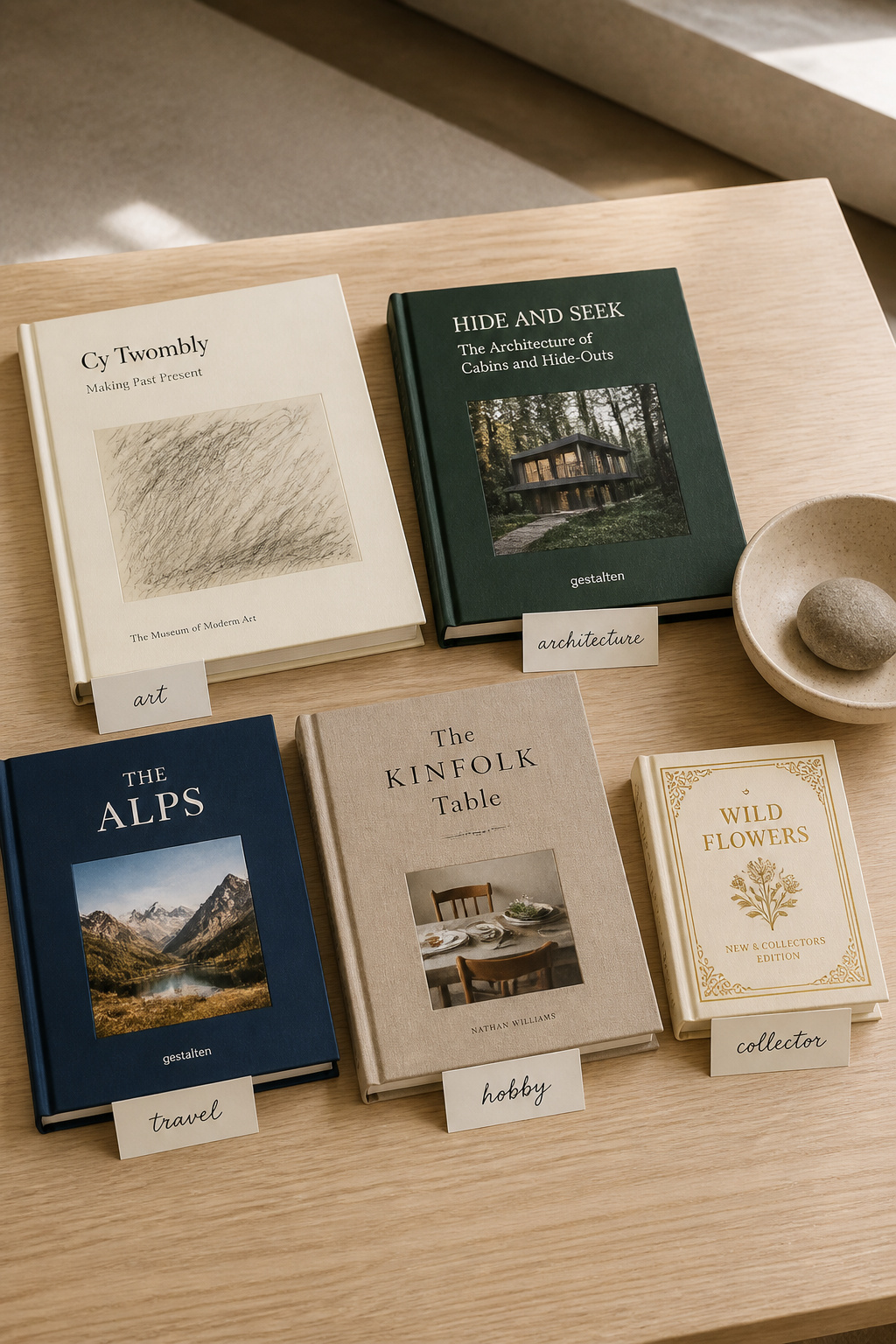
Size: why the largest book sets the footprint for the whole vignette
The bottom book sets the footprint and visual mass of the whole stack. On a coffee table you read books from above, as covers — so anything under 9×12 inches disappears on a surface of 48 inches or more. The display sweet spot is around 10×13 inches at 250 pages; reserve small 5×7 volumes for the top as accents.
Subject and colour: choosing books that tell something true about the household
A diagnostic question before you buy: what do the people in this house actually read? Mixed-subject stacks — travel, art, a genuine hobby — draw the most questions; single-category stacks read as performance. The working selection checklist:
- Size: base book 10×13 inches or larger; nothing under 9×12 on a big table.
- Subject: mix at least two categories you genuinely read.
- Colour: three dominant tones maximum, drawn from the room’s palette.
- Quantity: two to five books, odd numbers preferred.
How many books: two to five is the working range
Three is the most versatile count — stable, balanced, the one that turns up most in styled rooms. Two reads as accidental; beyond five the stack dominates. Searle’s rule: “Always work with odd numbers of books.” A rough guide is the table’s diameter divided by twelve — a 36-inch table takes three, a 48-inch four. If an object goes on top, drop to one to three.
Where to source: bookshops, charity shops, estate sales, and online
New tiers run from MoMA editions at $40–$150 and Phaidon at $50–$200 up to Taschen and Assouline in the hundreds. The better hunting is secondhand: estate sales and thrift stores turn up vintage volumes at $5–$15, with ThriftBooks and Etsy online, and bookshops like the Strand and Powell’s for out-of-print oddities. Avoid the sight-unseen subscription bundles.
The Stacking Technique: Largest to Smallest and Why It Works
The stacking rule is structural before it is aesthetic — which is why it never changes:
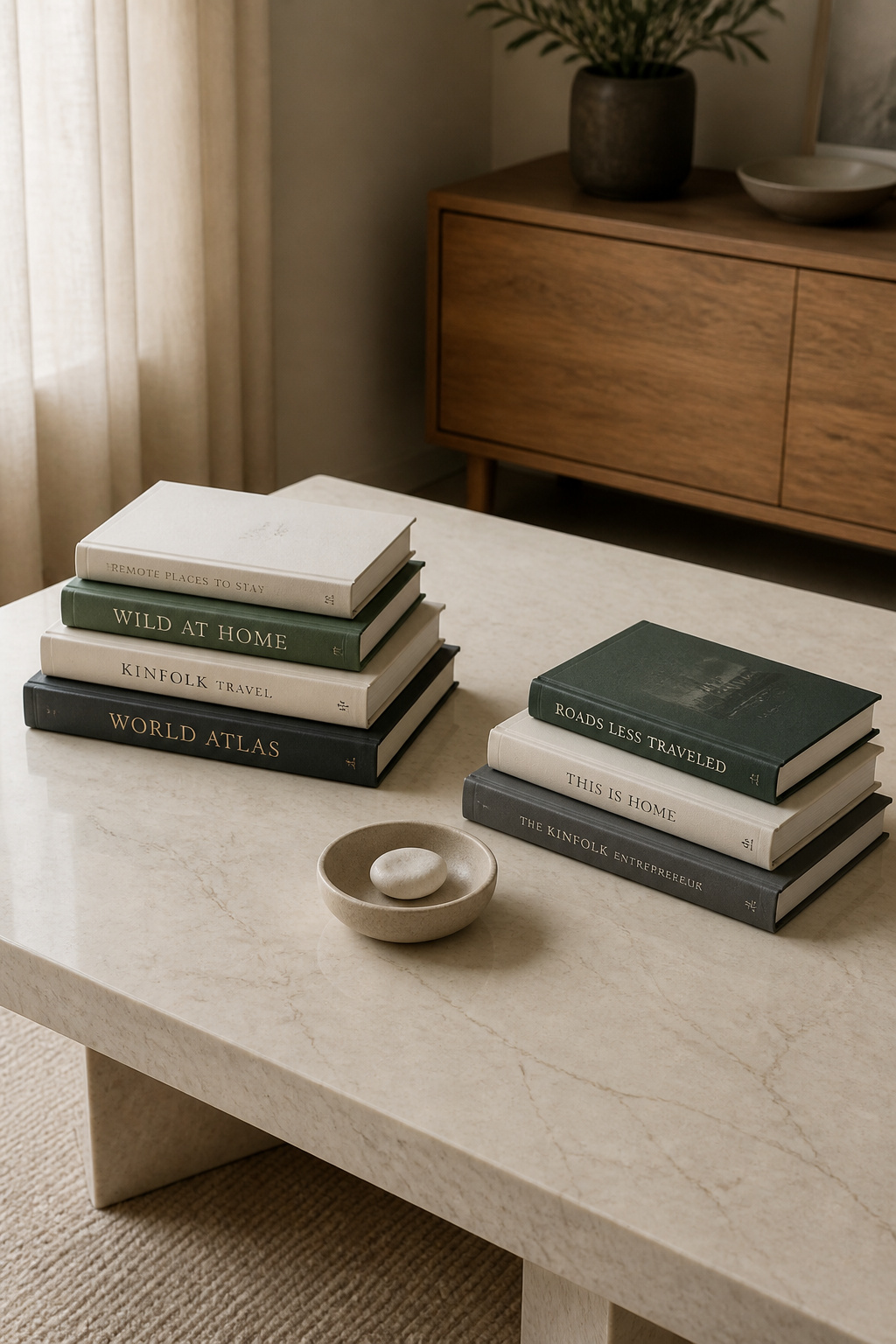
- Lay the largest, heaviest book on the bottom. Weight settles downward, and the eye reads a bottom-heavy shape as stable rather than precarious.
- Graduate smaller toward the top, varying the size so the stack reads as composition, not inventory — three identical volumes look like stock.
- Keep the whole stack under 8 inches. Three books make about 4 inches, four make 5.5, five make 7; above that, the Ashdeco team found stacks “block sight lines across the sofa.”
Spine alignment vs deliberate stagger
Both are legitimate. Align every spine to the sofa-facing edge for a formal, legible column, or stagger each book a consistent inch in the same direction for a layered, casual look. The distinction that matters: an even stagger reads as intent, a random half-inch as carelessness.
Portrait stacking: when to stand a book upright
Horizontal is right for perhaps nine arrangements in ten — it presents the cover and gives you a platform. Stand a book upright only when its spine earns it, or lean one vertical book against two horizontal ones for height on a rectangular table. An art book left open to a full-bleed spread becomes a small rotating artwork — provided you turn the page weekly.
Stack height as a riser
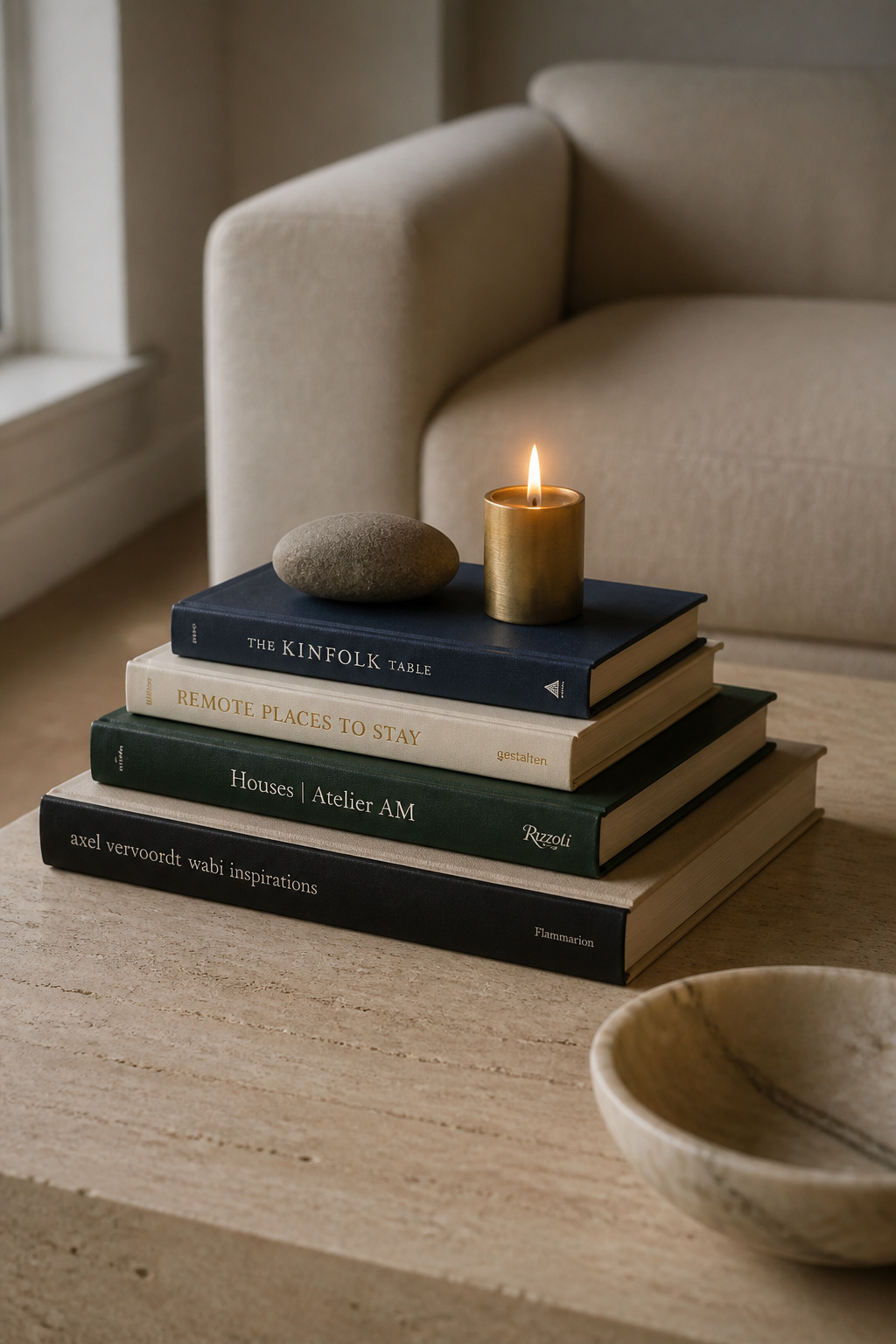
Because total height is predictable, it becomes a variable you set on purpose. A candle that would vanish at table level reads well lifted 4 inches on a three-book base; a sculpture may want the 5.5 inches of four. Choose the book count for the height you need.
Using the Book Stack as a Base for Other Objects
This is the technique that separates styling from shelving — the reason the stack belongs on the table at all.
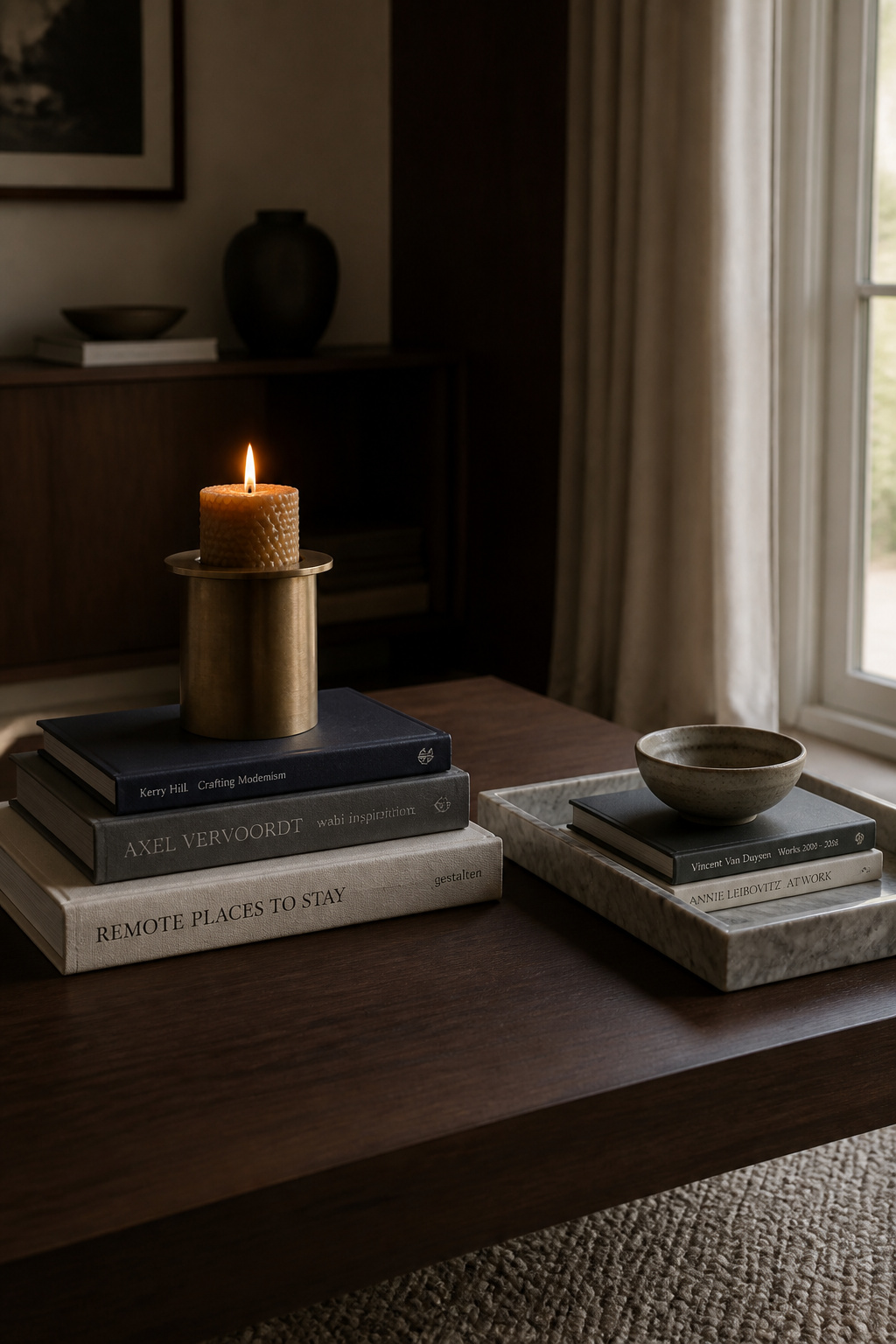
Placing a candle, sculpture, or plant on top
A large hardcover is an ideal platform for anything “lacking height on its own” — a designer candle, a small ceramic bowl, a compact succulent — on a one-to-three book base. Use the books’ colour to solve problems: against a dark object on a dark table, a light-toned top book stops it disappearing into shadow. The same trick lifts a jewellery box on a dresser.
Weight limit and stability
No hard load rating exists here — this is judgement, not a spec. Keep the object light, low, and no wider than the top book’s cover; a smooth sphere or a candle in a small holder sits safely, a top-heavy sculpture does not. Build tall stacks from books of near-identical size only.
How the stack integrates with a tray
The classic pairing places the stack beside a tray rather than inside it — the tray gathers the small movable things, the stack stands as its own mass, which suits rectangular and oval tables. On a round or square table, set three books inside a tray as a “tray cluster” topped with one anchor object; it lifts away in one motion for dinner. Stack and tray are partners — the full case for coffee table tray decor is in its own guide.
Colour, Spine Direction, and Knowing When to Stop
Colour and spine direction are the most argued-over questions here, so a clear position helps most.
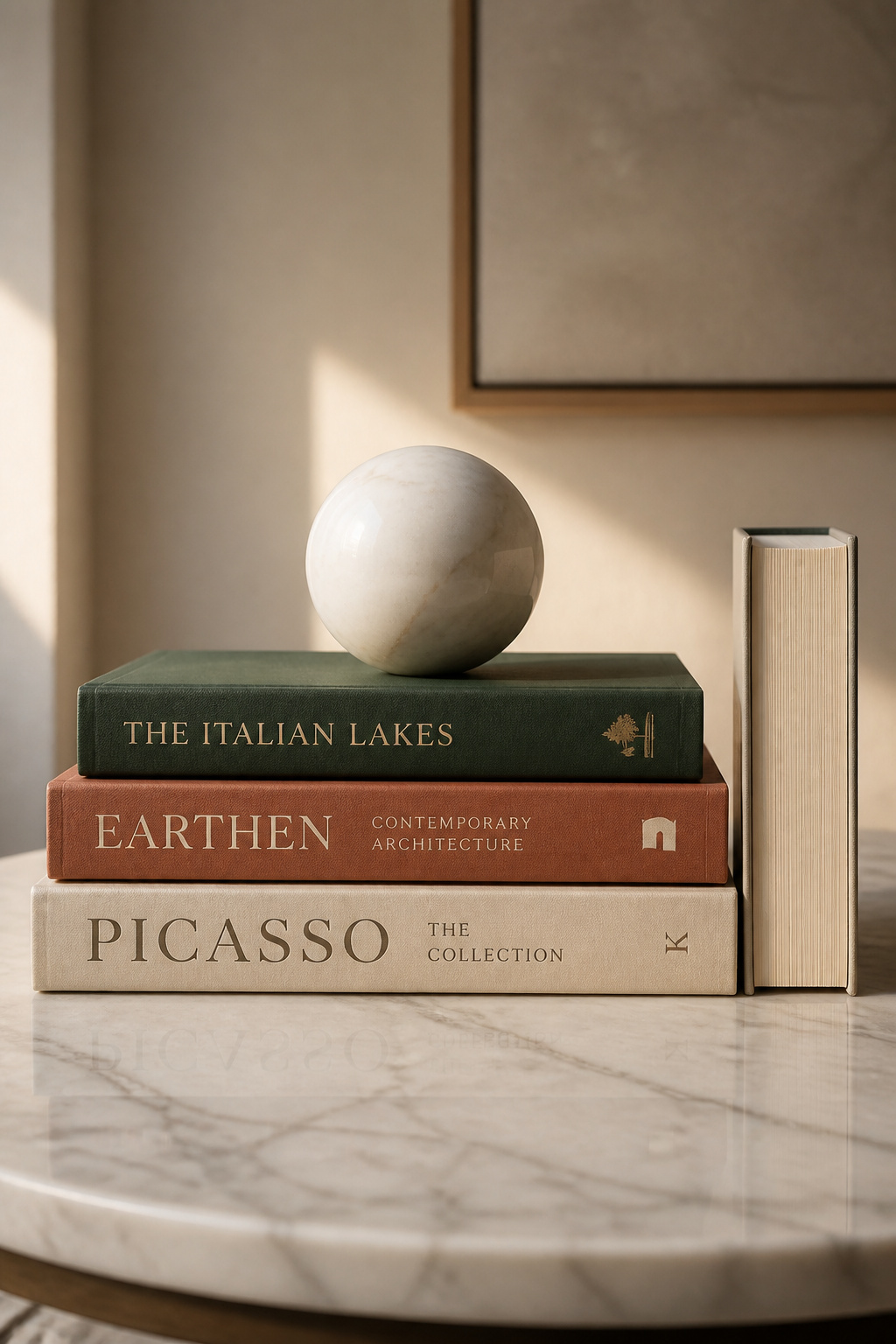
Coordinating spine colours
Lead with subject; let colour follow. The professional cap holds at three dominant tones drawn from the room. On dark walnut, cream, rust, forest green and deep navy read well; on pale marble or oak, charcoal and navy carry while cream vanishes. The most cohesive approach is ombré within one family — cream through tan through warm brown. One convention I keep, rather than a cited prescription: rotate a book or two each season.
Spines backward: where I draw the line
Turning one offending book backward to hide a clashing spine is a fair, targeted fix. Turning the whole stack backward is not. The trend erases every title, and with the titles goes the social legibility the display book has carried since the Georgian drawing room — guests cannot see what is there, so the conversation never happens.
The remove-one-book finishing rule
A collection is edited by what you leave out, and so is a stack. When an arrangement feels finished, take one item off — usually the last thing added — and look again; it almost always improves. Keep 30 to 40 percent of the table clear, because past 60 to 70 percent coverage the surface stops being a table. This is the discipline minimalist rooms live by, covered under minimalist coffee table decor.
Coffee Table Books in Different Room Contexts
The method holds across rooms; only the scale and restraint change.
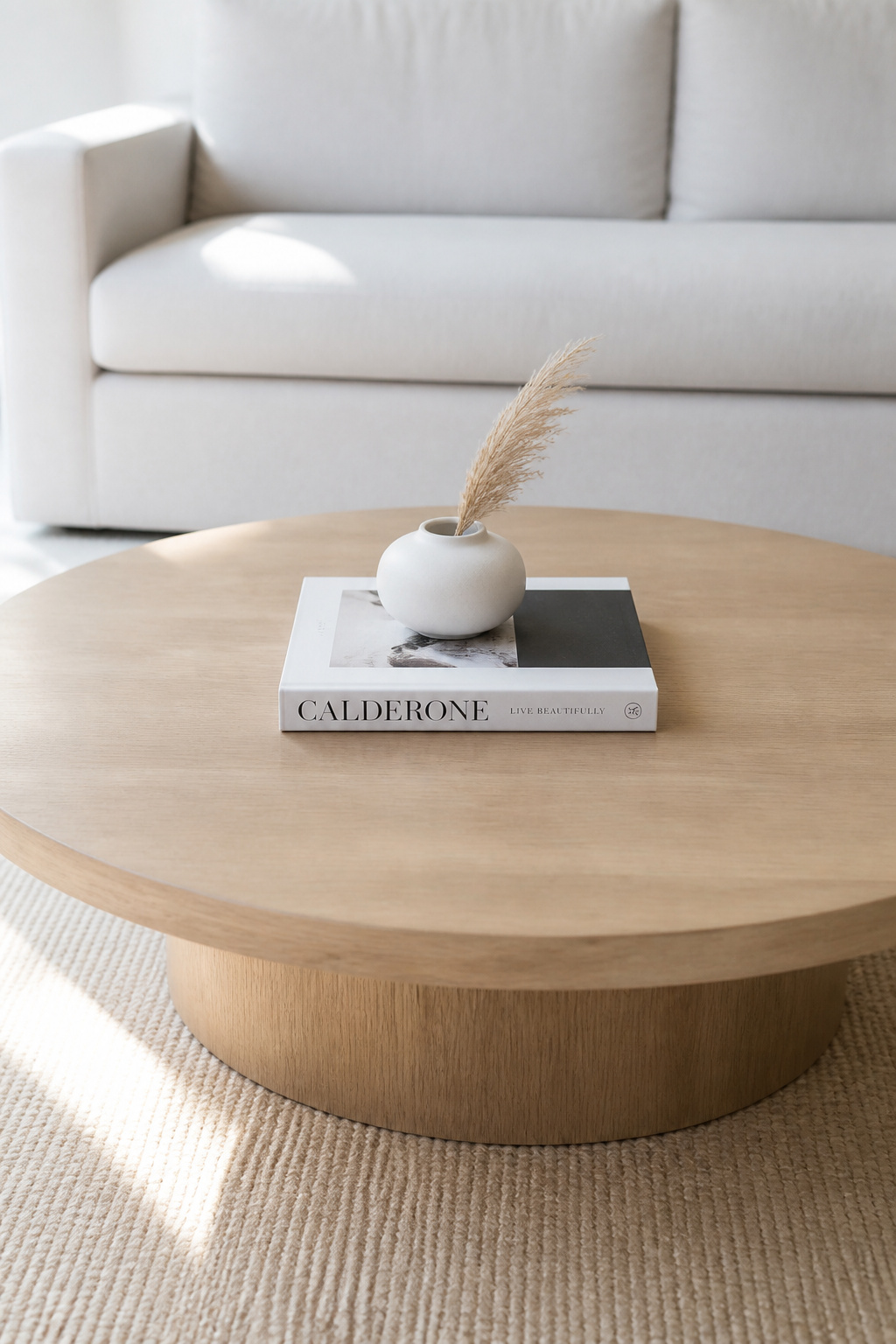
Minimalist rooms
In a spare interior, a single oversized book set dead centre says more than any stack — the empty surface does the rest. Two stacked books with one quiet object is the ceiling. Subjects with calm covers — architecture, Japanese design, black-and-white photography — reinforce the palette.
Smaller tables
A small or narrow table rewards a single book over a stack, especially one with a bold typographic cover that works as decor on its own. Round and oval tables suit a central focal point, so a single book in the middle is the natural placement.
Seasonal swaps
The stack is the easiest element on the table to refresh. Swap one or two books a season, leave the base constant: travel and landscape in summer, earth tones in autumn, design in winter. Changing only the top book’s colour is often enough.
Stack largest to smallest under 8 inches, hold to three tones and odd numbers, face the spines out, and choose books you would actually open. Do that and the stack becomes what it was in the Georgian drawing room — a portrait of the people who live there.
FAQ
How do you stack books on a coffee table?
Place the largest, heaviest book on the bottom, then stack progressively smaller ones to the smallest — a stable pyramid that will not tip and tapers pleasingly. Keep it to five books and under 8 inches; a three-book stack near 4 inches suits most tables. Align the spines, or stagger each book evenly.
How many coffee table books should you display at once?
Two to five per stack, always in odd numbers, with three the most versatile. As Lucy Searle of Homes & Gardens advises, start with three and work up to five or seven. If books and decor cover more than 60 to 70 percent of the table, you have too many; drop to one to three with an object on top.
Should coffee table books face spine out or spine in?
Spines should face out toward the sofa so titles stay legible — the display book’s social function depends on guests seeing what is there. Turn a single book’s spine backward only to hide one clashing colour, never the whole stack. To keep a loud spine forward while neutralising it, wrap it in a plain paper or linen sleeve.