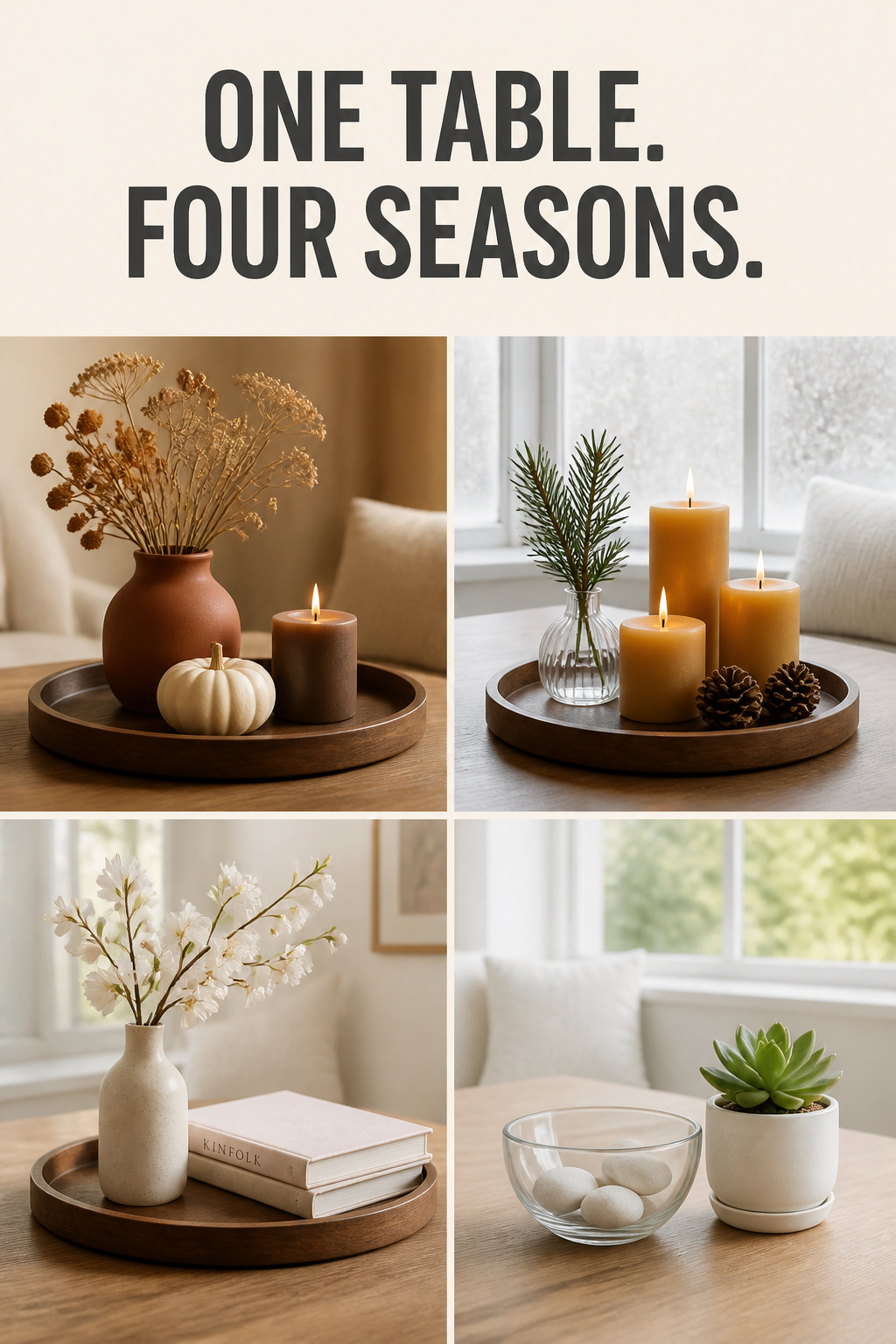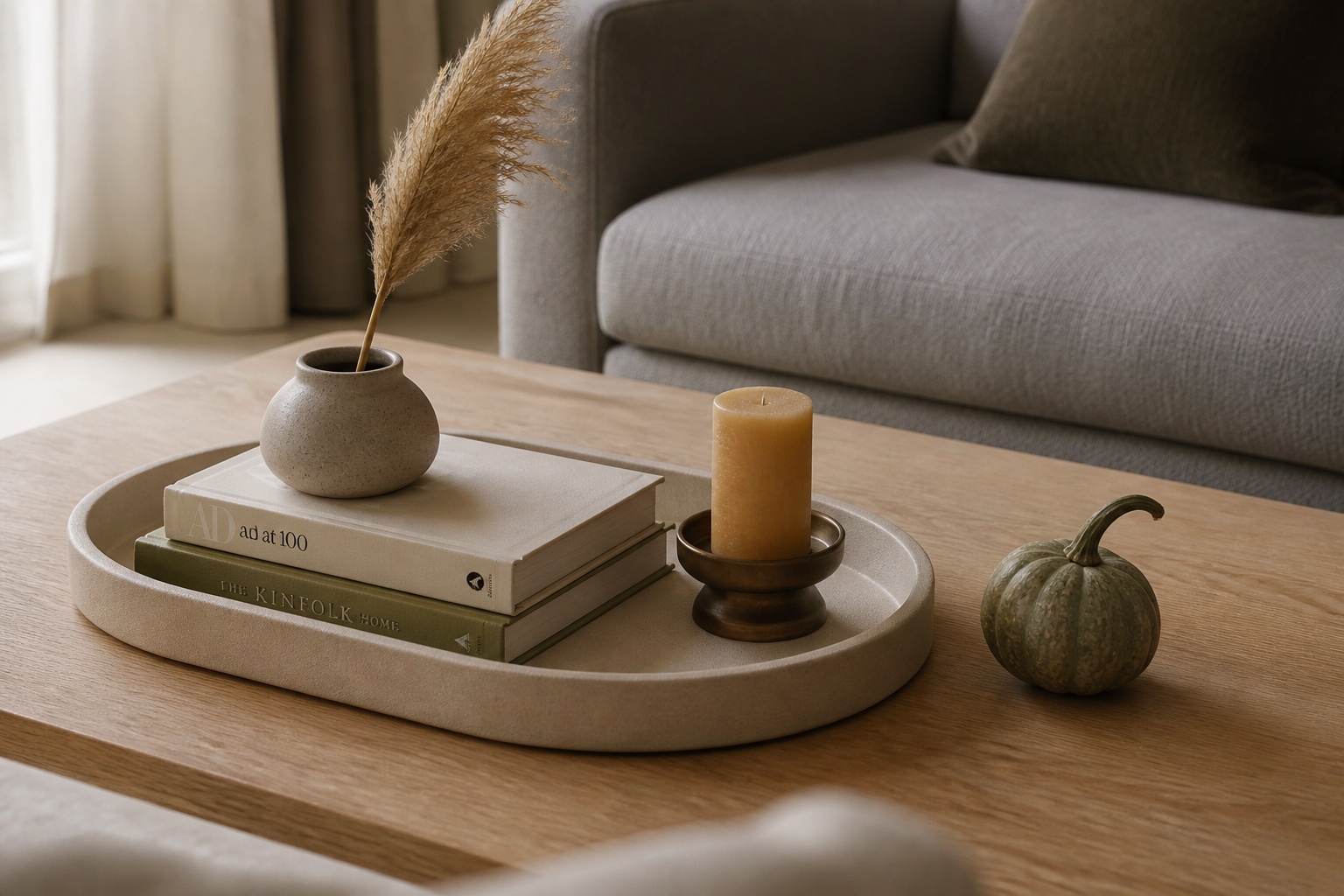
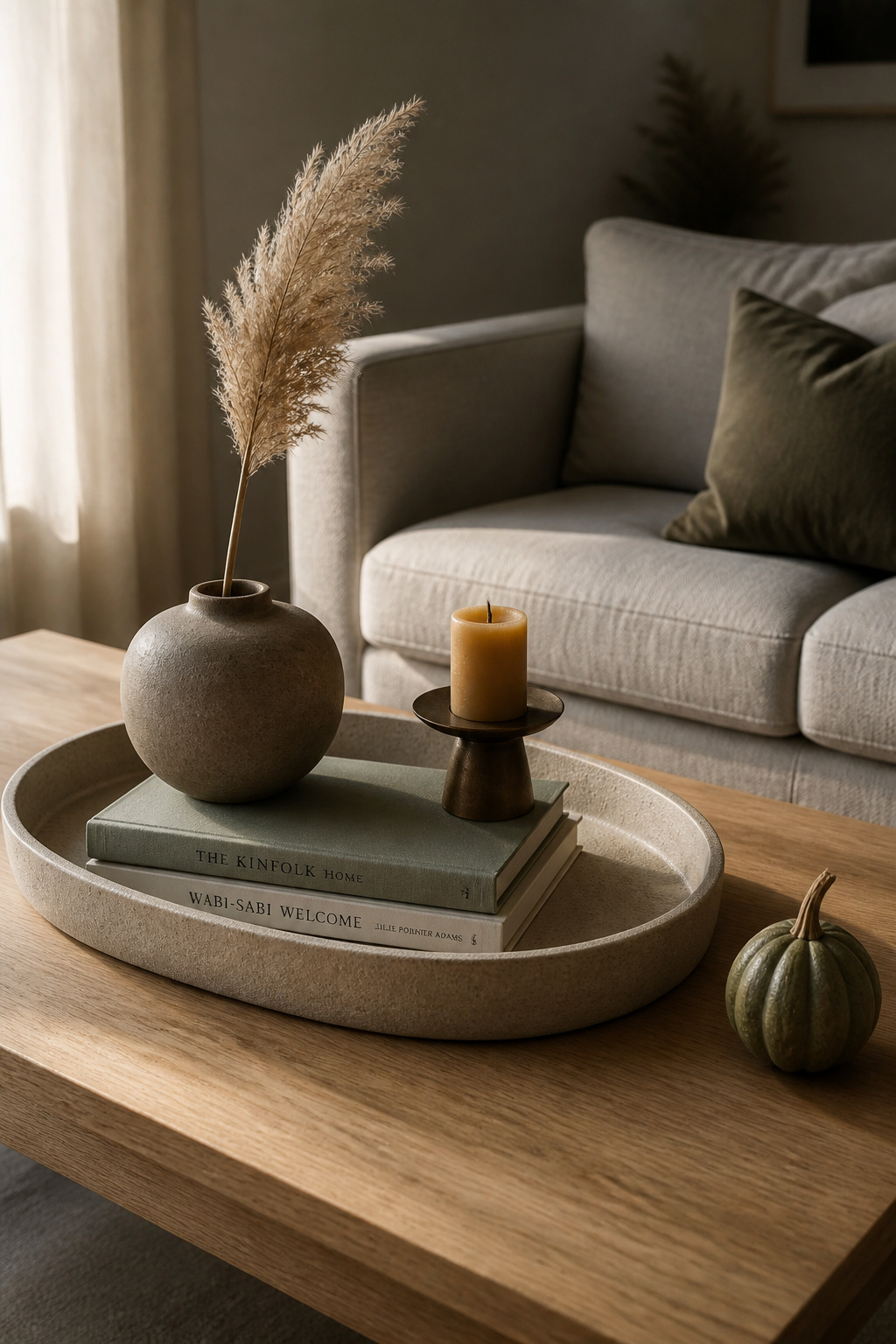
It is a Tuesday in October. The light has gone amber by four, and the table still carries the bowl of summer shells. You lift three small things out, set three small things down — dried stems, one sage-green gourd, a candle that smells faintly of woodsmoke — and the room turns a season. Nothing was bought. That ten-minute change is what good seasonal coffee table decor actually is: not four fresh tables a year, but one quiet base that lets the season do the talking.
TL;DR
- Keep a permanent base year-round — tray, a low stack of books, one vessel, one candle — and swap only three slots: one organic element, one accent object, one candle or textile.
- The base costs once. The seasonal swaps can be foraged, thrifted, or pulled from a single labelled box, so a refresh takes about ten minutes, not a shopping trip.
- Read each season as a mood, not a checklist: autumn warms and rises, winter spreads low and bright, spring strips back, summer almost empties the table.
The Stable Base That Makes Every Season Easy
Before any season, decide what never leaves the table. Get it right once and each refresh becomes a small pleasure rather than a project.
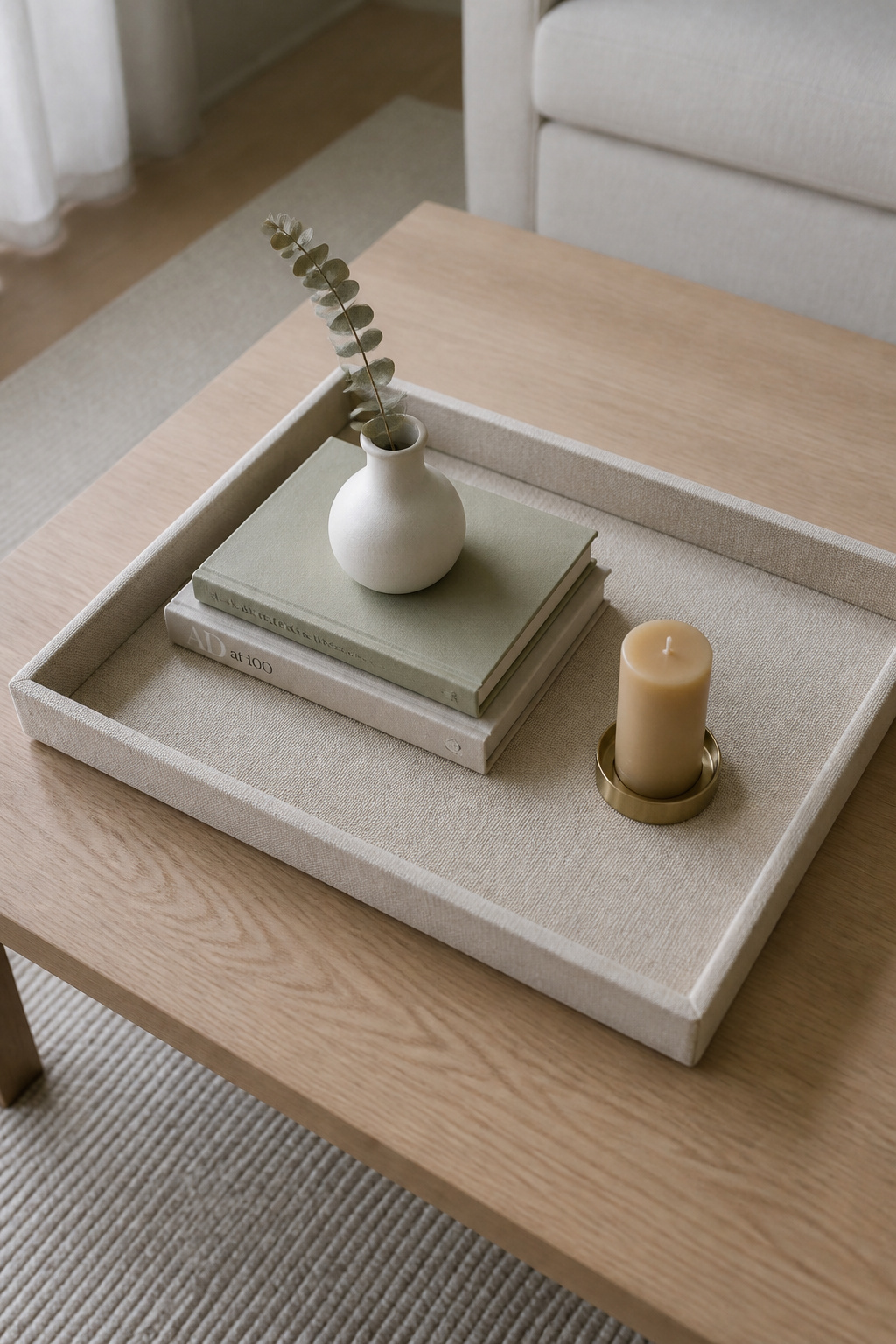
What the year-round base looks like: tray, books, one permanent vessel
Four objects stay through every season: a neutral tray, a low stack of two hardcover books, one ceramic vessel, one candle. These earn the spend — buy the better ones once. For the wider system these objects sit inside, the coffee table styling guide covers the rules they follow.
Books are the quiet anchor. They add height, bring order to the grouping, and let you signal a season without buying anything — pale linen spines in spring, deeper art monographs in autumn.
Why a neutral base costs less to refresh than a fully seasonal reset
Choose the base in tones that do not argue with anything you add later: whitewashed wood, soft beige, natural rattan. A neutral tray holds spring blossom, autumn stems, and winter evergreen with equal grace. A terracotta or forest-green tray fights three seasons out of four.
Concentrate the money where it stays visible all year — tray, books, vessel — and the seasonal pieces can cost almost nothing. Each swap reads as a refresh, not a restart.
The three swap slots: one organic element, one accent object, one candle or textile
Here is the framework I use — my own way of organising what designers broadly agree on, rather than a rule with a name. Change three things and the whole table changes season:
- One organic element — stems, florals, evergreen cuttings, dried grasses.
- One accent object — a small gourd, a stone, a shell, a pine cone.
- One candle or textile — a votive cluster, a small runner, a woven coaster.
The slots stay the same all year; only their contents move. The table below shows what holds and what rotates.
| Base object | Stays all year | Swapped seasonally |
|---|---|---|
| Tray | Yes | No |
| Book stack | Yes — covers rotated for colour | No |
| Ceramic vessel | Yes | No |
| Organic element | No | Yes — slot one |
| Accent object | No | Yes — slot two |
| Candle or textile | No | Yes — slot three |
Autumn Coffee Table Decor: Warmth Without the Clichés
Autumn is the season people most often overdo. The fix is to add less than feels natural.
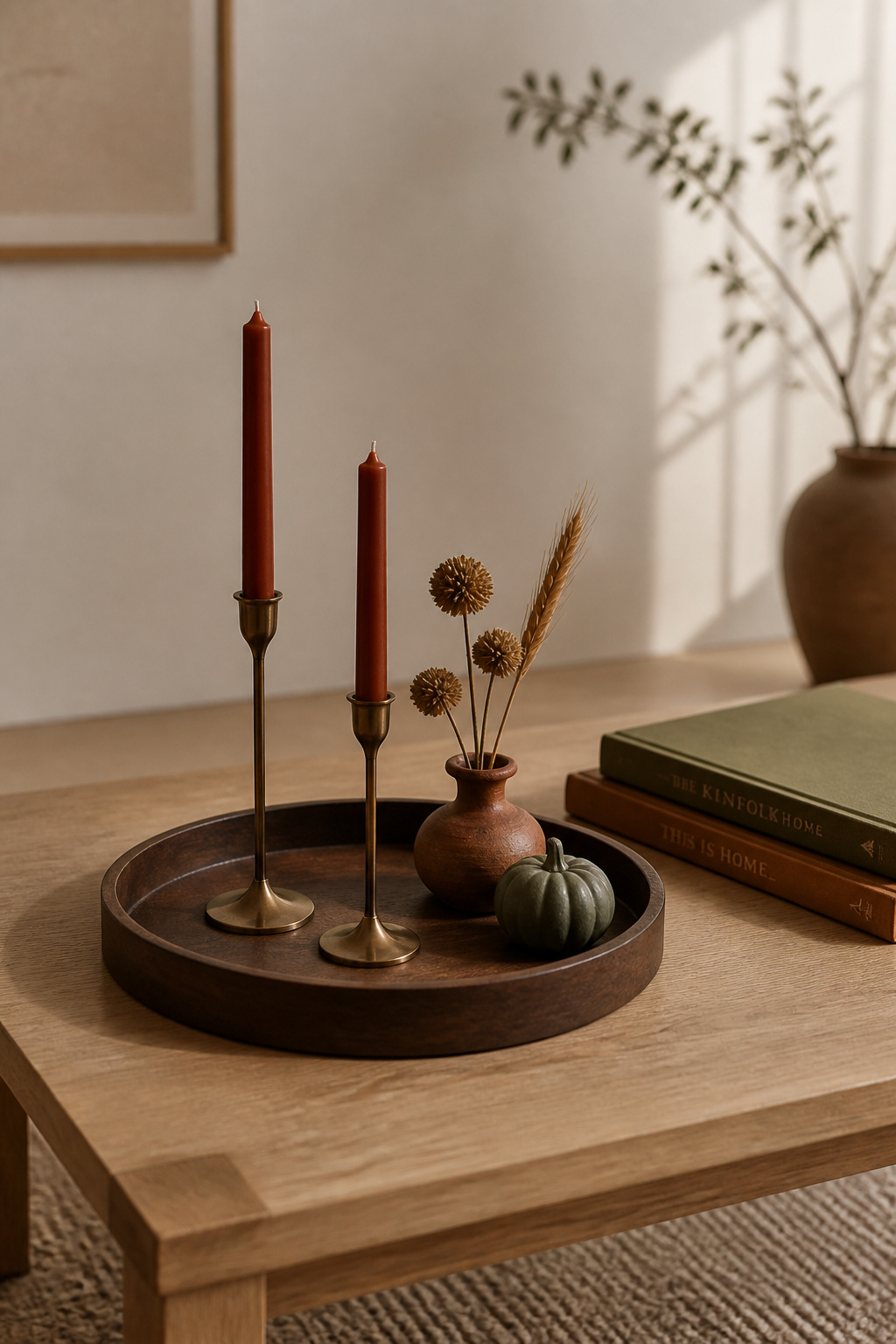
Warm-toned stems, dried seed heads, and small gourds
Fill the organic slot with one type of natural material. Dried pampas, eucalyptus, or wheat stalks in a ceramic vase bring texture without the upkeep of fresh stems. For the accent slot, three small gourds in sage, cream, or dusty white — never a row of bright orange. Restraint reads as intention; a pile reads as a patch.
Candlesticks in bronze or dark wood
Swapping summer’s clear glass for bronze, dark wood, or aged brass shifts the table into autumn without a new object beyond the holder. Pick taper candlesticks in rust, ochre, or deep red. On a low table near seating, flameless tapers give the same vertical drama with no flame to mind. A scented candle — apple, woodsmoke — signals the season before anyone has looked at the table.
The autumnal book stack
Rotate to two or three hardcovers with deep spines — rust, olive, warm brown — stacked largest to smallest. The spines carry colour without adding an object, and the stack doubles as a riser for a gourd or small vase placed on top.
What to avoid: the full-pumpkin farm
Choose three to five well-placed pieces in varied materials and leave the tray’s edge visible. The direction worth following is quiet luxury — warm light and good texture over sheer quantity.
Winter Coffee Table Decor: Hygge on a Horizontal Surface
Hygge, the Danish word for warmth and contentment, is not a style you buy — it is a low, glowing table you sit beside. The autumn instinct was to rise; winter’s is to spread low and keep warm.
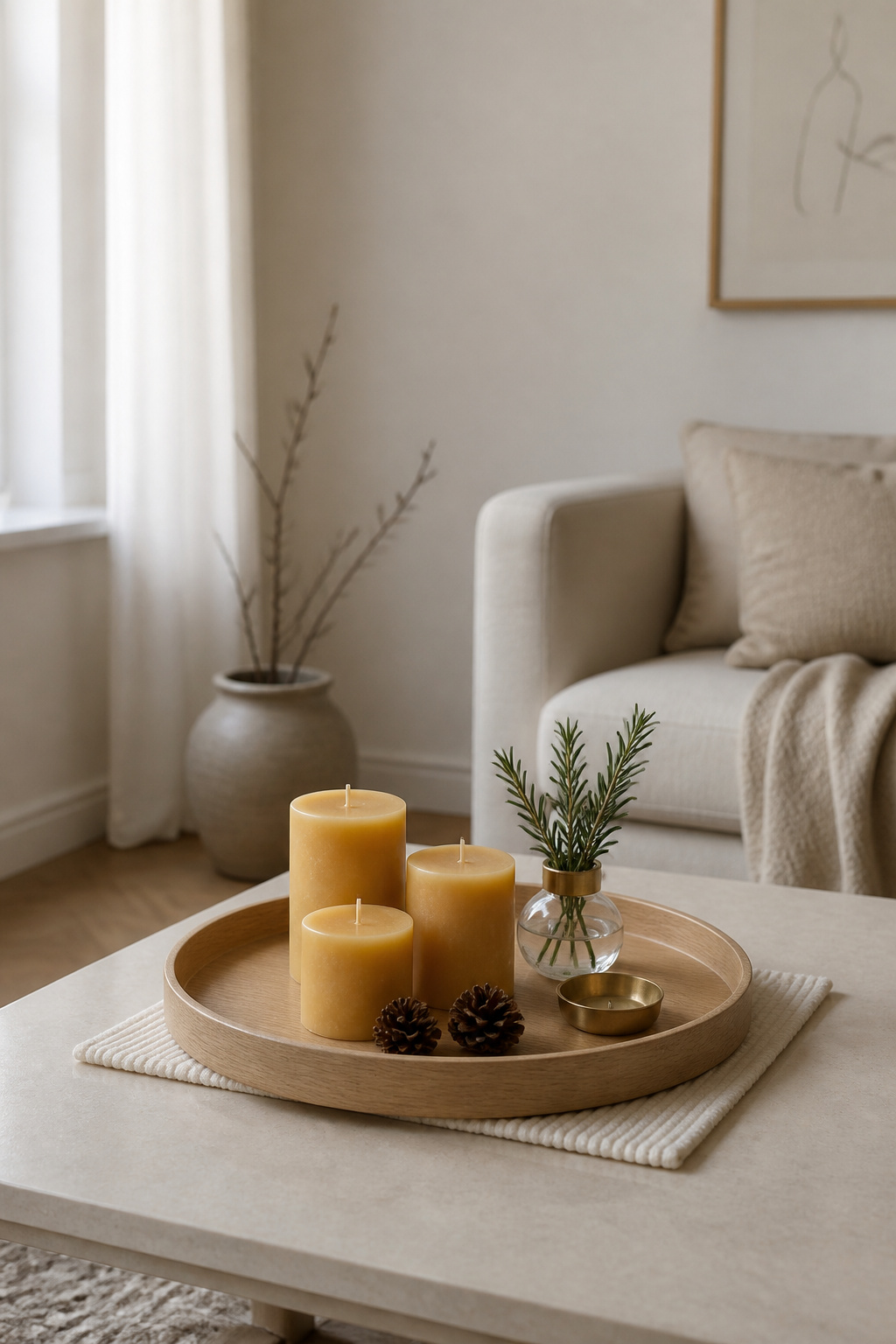
The textile slot earns its keep now. A folded square of faux fur or wool under the tray adds warmth you can see at the edges — no snowflakes or Santas required, which means the table works the full three months, not three weeks of December.
For the organic slot: rosemary, pine, or cedar in a slim glass bud vase, the winter answer to spring’s florals. A bowl of foraged pine cones adds scent and costs nothing. Then one metallic — a single brass holder or bud vase — as the light-catcher that multiplies the glow. One is the rule; a second only competes.
The candle slot is the centre of it all. A low cluster of three to five pillars and votives at slightly different heights spreads glow across the surface instead of rising above it. Warm candlelight around 2700K reads like firelight, and on dark evenings this cluster becomes the room’s main light. Height is autumn’s language; in winter, warmth replaces it.
Spring Coffee Table Decor: Light, Fresh, and Easy
Spring arrives on the table as subtraction. The first thing you do is take something away.
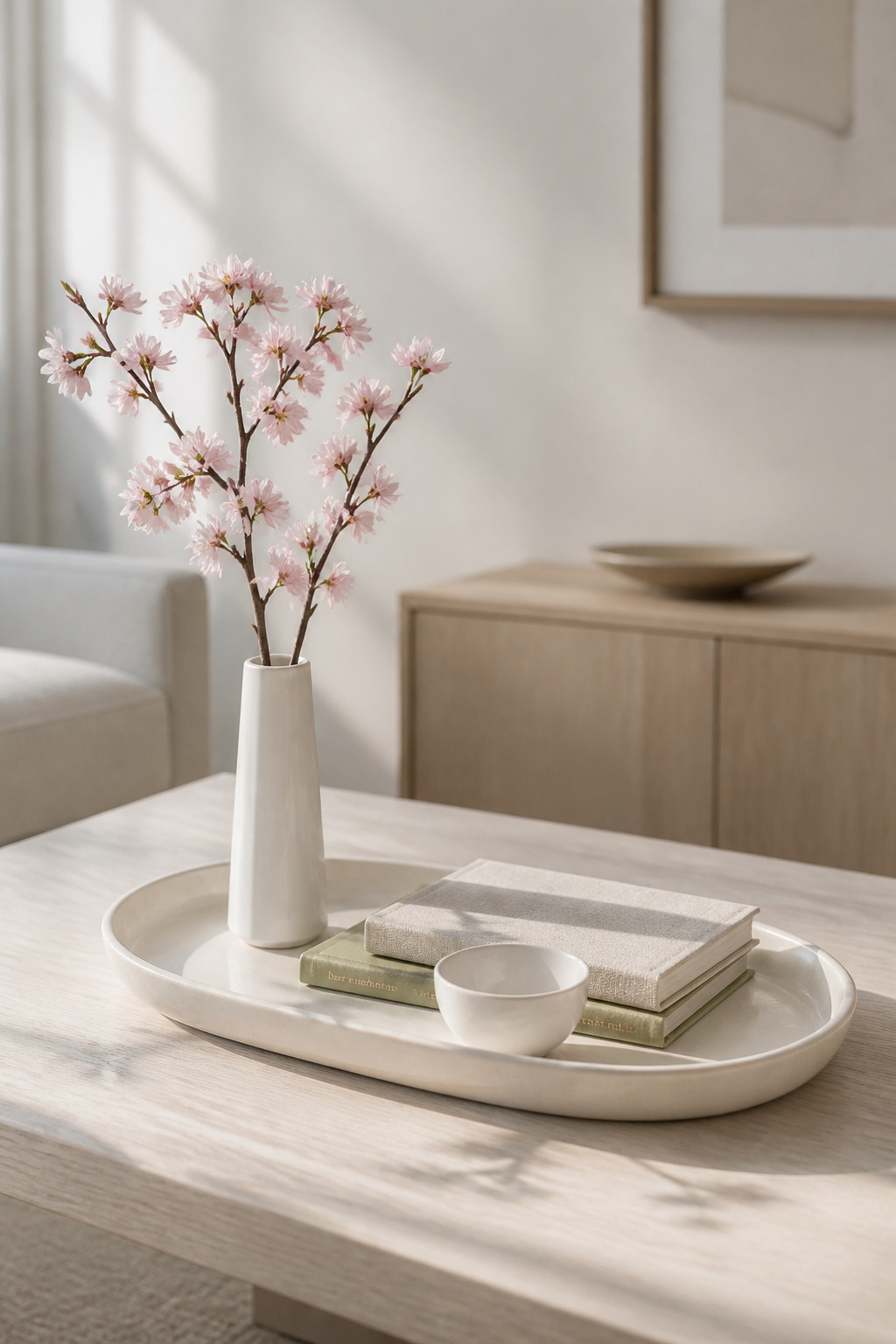
Removing the winter textile and resetting to a bare edge
Pull the fur or wool out from under the tray. That removal lightens the whole table before you add anything. Reduce the candle cluster to one at most, and let a single floral or branch carry the height alone.
Florals and blossom branches: scale and vessel
For a cut branch — cherry, forsythia, magnolia — the vessel must be at least 20cm to counterbalance the weight. I aim for roughly 20–25cm of arrangement above the surface, as a working sightline rule rather than a fixed standard — sit on your own sofa and check, because every room differs. Tulips are the most practical spring stem; they hold five to seven days and replace cheaply.
Lighter covers and pastels that don’t read as Easter
Rotate the book spines to pale linen, white, or soft sage, and swap heavy winter ceramics for white or pale pieces. Keep pastels muted — dusty blush, sage, chalky blue. Saturated egg-yellow or hot pink tips the table into Easter decor; the muted end reads as palette, not novelty.
Summer Coffee Table Decor: Airy and Low-Effort
Summer is the season where the room’s own light is the feature, and the table’s job is to stay out of its way. This is where the Nordic instinct for restraint comes most naturally — and I will say plainly that this is design judgement drawn from how the tradition handles light and space, more than a set of summer-specific rules. The table almost empties, and that is the point.
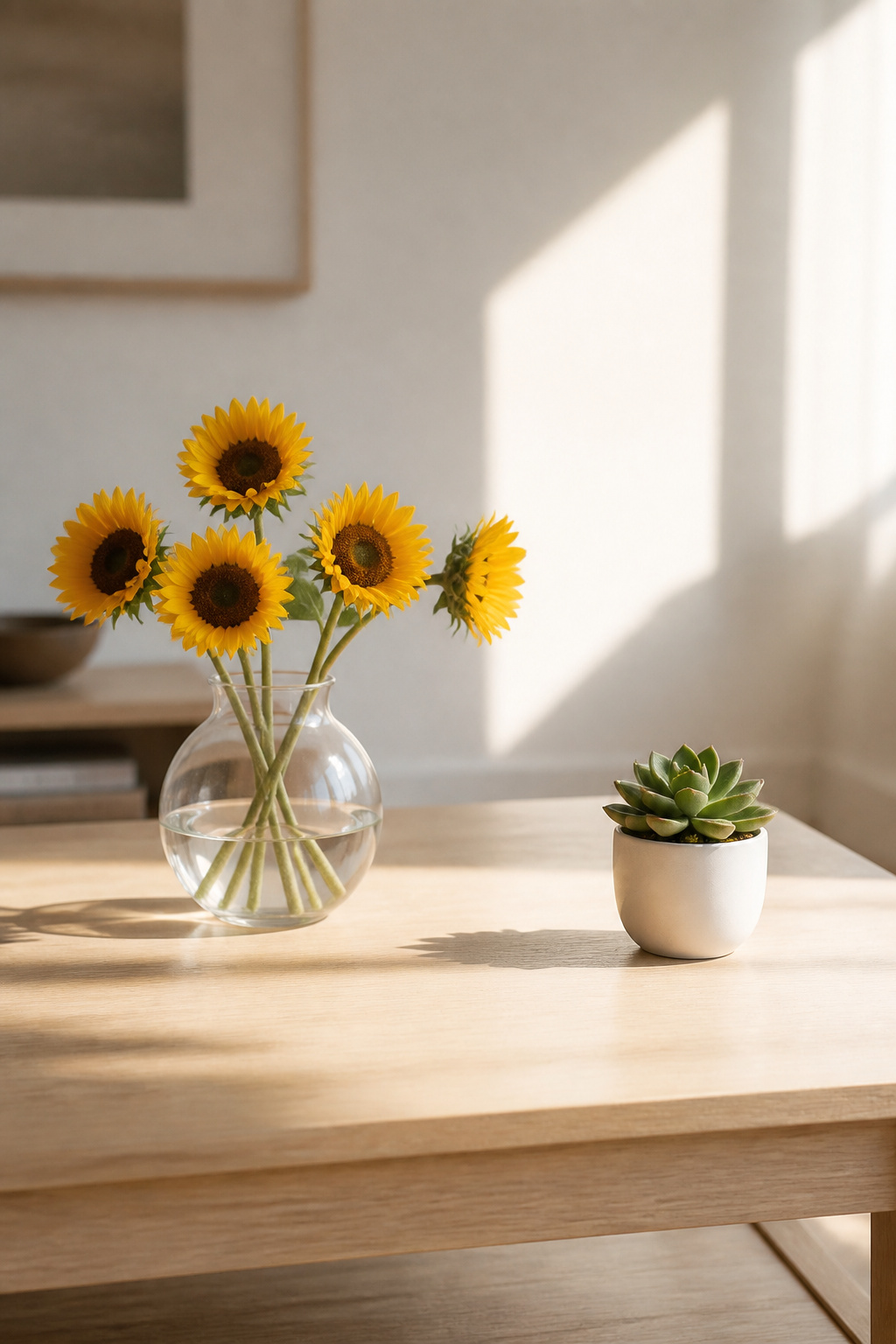
Reach for glass and light ceramics. A clear glass vase disappears into the daylight rather than adding mass. The palette runs to whites, creams, sandy beige, with a single cool-blue piece if you want one accent. Put the heavy winter ceramics and dark trays away for the season.
Keep the living element simple: loose sunflowers, peonies, or lavender in glass. A bowl of lemons is graphic, costs little, and lasts a fortnight. A small succulent in white ceramic asks nothing of you for weeks.
Then stop. Choose one focal object and let the rest of the table breathe. The visible wood grain is part of the composition. The difference between empty and edited is one considered object.
Making Seasonal Refreshes Budget-Friendly
The base was the only real spend. The three slots fill themselves from a walk, a box, and the occasional thrift find.
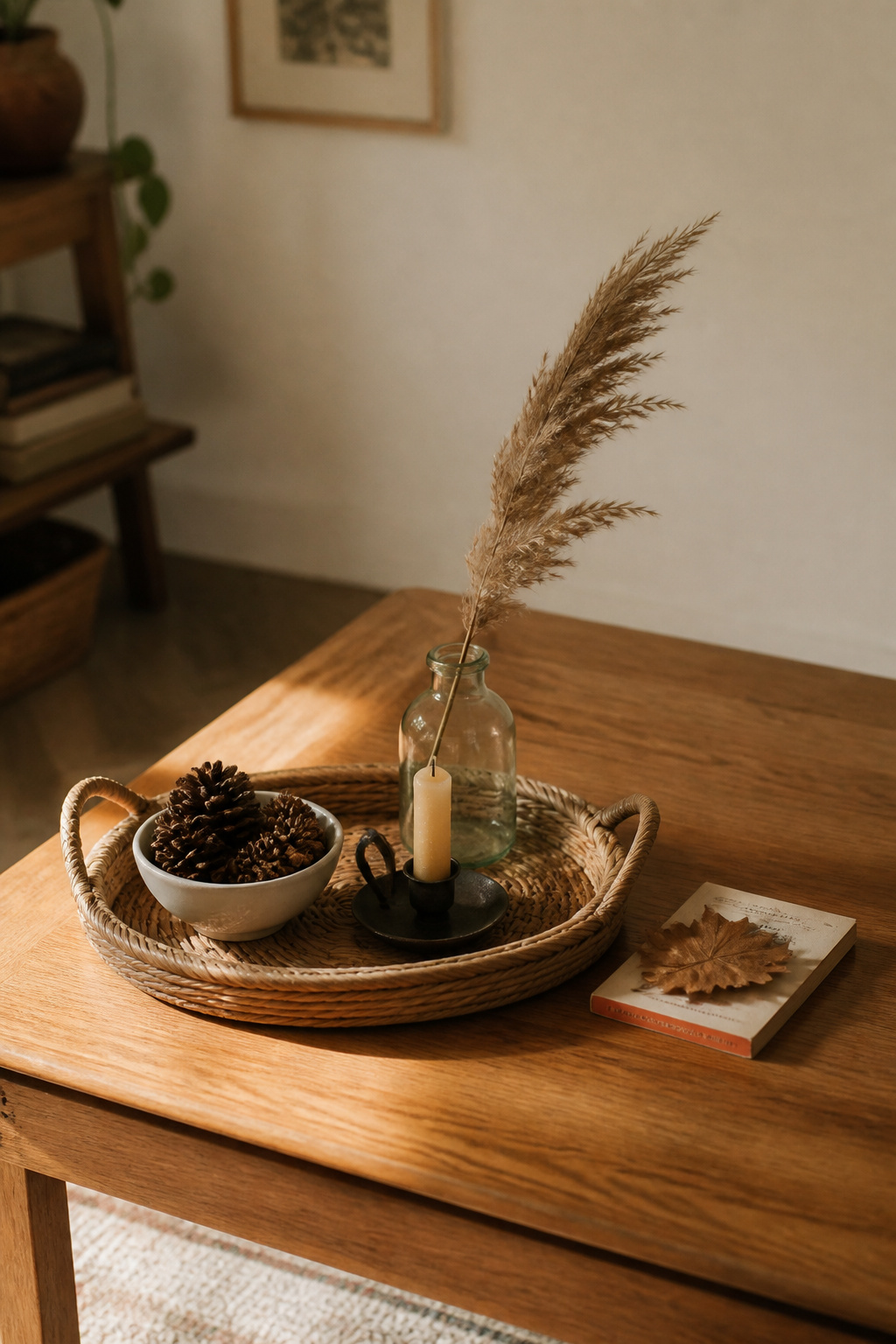
Forage the organic slot. Fallen leaves, seed heads, budding twigs, and pine cones cost nothing. Pine cones are the most reliable find in temperate places — a walk from October to February yields a season’s supply, good across both autumn and winter. At season’s end the organic content goes to compost; only the tray and vessel are kept.
Then rotate from storage. One small labelled box per season — holding just the three swap-slot objects — turns the change into minutes. A brass holder bought for autumn returns as winter’s metallic; a spring bud vase comes back as a summer glass. When the box is full, the buying stops. For the pieces you do buy, thrift stores and seasonal clearance carry ceramic vessels, glass vases, and bowls at a fraction of retail. If you would rather make than buy the accents, DIY coffee table decor goes deeper on building and thrifting them — and since every slot sits on the tray, choosing that tray well in coffee table tray decor is what makes the whole rotation effortless.
The table is never finished, and that is the quiet luxury of it. Four times a year you lift three small things off and set three small things down, and the room keeps pace with the light outside the window. The base holds; the season moves on top.
FAQ
How do you decorate a coffee table for fall?
Start with a tray, then add three objects in a height hierarchy: a tall element such as dried stems or a bronze candlestick, a medium one such as two dark-spined books, and a low accent of small gourds in muted sage, cream, or dusty white rather than bright orange. Keep to odd numbers and leave the tray edge visible.
What do you put on a coffee table for winter decor?
Use five components: a low candle cluster at varying heights, one organic piece (evergreen cutting, pine cones, or dried citrus), one textural element such as faux fur under the tray, one metallic accent like a brass holder, and a stack of neutral-spined books. The candle cluster is the centrepiece — warm 2700K light spread low, not one tall candle.
How often should you change your coffee table decor?
Seasonally is the recommended rhythm — four refreshes a year keep the table current without making it a chore. Change only the three swap slots (organic element, accent object, candle or textile) and the permanent base stays put. The swap takes about ten minutes, with optional micro-refreshes like replacing a dead stem between seasons.